

Table of Contents
- 1. Quick Answer: Difference Between Partnership and Proprietorship
- 2. What Is a Proprietorship?
- 3. What Is a Partnership Firm?
- 4. Difference Between Partnership and Proprietorship
- 5. Difference Between Partnership and Proprietorship in Registration
- 6. Difference Between Partnership and Proprietorship in Taxation
- 7. Difference Between Partnership and Proprietorship in Liability
- 8. Difference Between Partnership and Proprietorship in Management
- 9. Difference Between Partnership and Proprietorship in Compliance
- 10. Which Business Structure Is Better?
- 11. Company Registration in Delhi: When Should You Consider a Company?
- 12. FAQs
- 13. Final Takeaway
1. Quick Answer: Difference Between Partnership and Proprietorship
The main difference between partnership and proprietorship is ownership. A proprietorship is owned and operated by one individual, while a partnership is operated by two or more partners under an agreed partnership arrangement.
A proprietorship generally offers simpler management and fewer structural formalities, while a partnership allows two or more people to combine capital, skills and responsibilities.
In an ordinary partnership firm, partners generally have unlimited liability. This is an important factor to consider before choosing a business structure.
The Indian Partnership Act, 1932 provides the legal framework for partnership firms, including provisions dealing with registration.
↑ Back to Table of Contents2. What Is a Proprietorship?
A sole proprietorship is a business owned and operated by one individual. The proprietor generally makes business decisions, receives the profits and is responsible for the business obligations.
Unlike a company, a traditional proprietorship does not create a separate legal entity distinct from its owner.
A proprietorship can be suitable for:
- Freelancers
- Consultants
- Small retailers
- Individual service providers
- Home-based businesses
- Small traders
- Professionals starting independently
One major advantage is simplicity. The owner can generally manage the business without the partner-level agreements and shared decision-making structure required in a partnership.
↑ Back to Table of Contents3. What Is a Partnership Firm?
A partnership is a business arrangement where two or more people agree to carry on a business and share its profits according to their agreed arrangement.
The Indian Partnership Act, 1932 provides the legal framework for partnerships. A partnership agreement generally sets out the rights, responsibilities and financial arrangements between the partners.
A partnership agreement usually covers:
- Capital contribution
- Profit-sharing ratio
- Roles and responsibilities
- Partner remuneration
- Interest on capital
- Admission or retirement of partners
- Business decision-making
- Dispute resolution
- Dissolution terms
This structure can be useful where two or more individuals want to combine their money, experience, contacts or professional skills.
↑ Back to Table of Contents4. Difference Between Partnership and Proprietorship
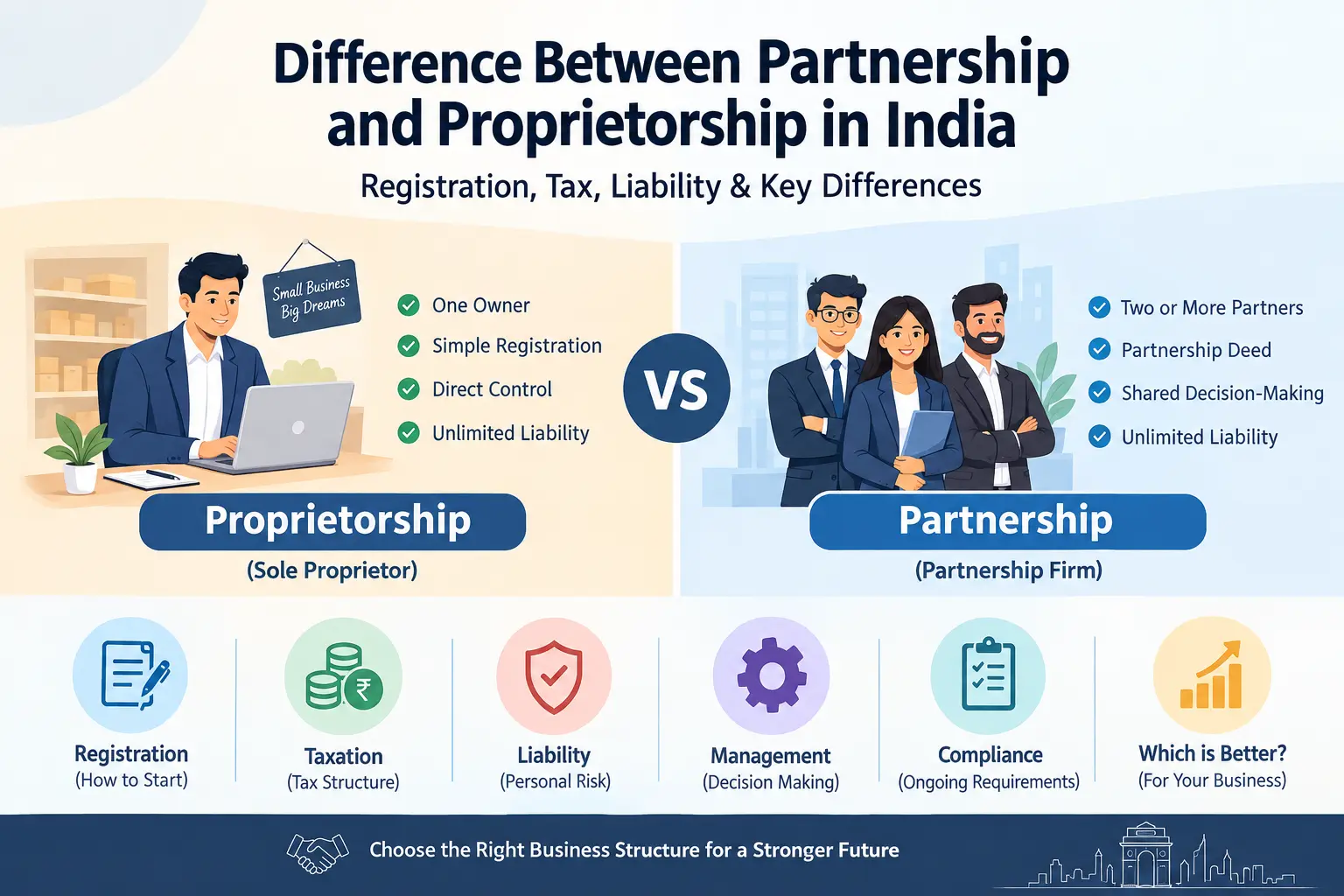
The most important difference between partnership and proprietorship can be understood through the following comparison:
| Basis | Proprietorship | Partnership |
|---|---|---|
| Owners | One | Two or more partners |
| Legal Structure | Individual-owned business | Firm governed by partnership arrangement |
| Decision-Making | Owner generally controls decisions | Decisions are shared according to the arrangement |
| Profit | Belongs to proprietor | Shared among partners |
| Capital | Mainly owner-funded | Partners contribute capital |
| Liability | Generally unlimited | Generally unlimited for ordinary partners |
| Partnership Deed | Not applicable | Generally prepared |
| Registration | No single central proprietorship incorporation process | Firm registration is governed by applicable state procedures |
| Tax Treatment | Business income is generally taxed in the proprietor's individual capacity | Partnership firm is taxed under applicable provisions for firms |
| Continuity | Closely linked to proprietor | Depends on partnership terms |
| Compliance | Usually simpler | More formal than proprietorship |
The exact registration, taxation and compliance requirements can vary depending on the business and applicable state-specific rules.
↑ Back to Table of Contents5. Difference Between Partnership and Proprietorship in Registration
A key difference between partnership and proprietorship is the way the business is established.
Proprietorship Registration
A proprietorship does not have one universal incorporation process like a private limited company. Instead, the proprietor obtains registrations applicable to the nature and requirements of the business.
Depending on circumstances, this could include:
- GST registration
- Shop and Establishment registration
- Udyam registration
- Local trade licence
- Professional or sector-specific registrations
- Business bank account
The registrations required depend on factors such as business activity, location and applicable laws.
Partnership Registration
For a partnership, the partners normally sign a partnership deed laying down the terms of the business.
Registration of firms is governed by the Indian Partnership Act, 1932 and applicable state procedures. The relevant registration process may require information such as the firm's name, principal place of business and details of the partners.
Partnership registration procedures and fees depend on the applicable state framework.
↑ Back to Table of Contents6. Difference Between Partnership and Proprietorship in Taxation
Tax treatment is another important difference between partnership and proprietorship.
Proprietorship Taxation
In a sole proprietorship, the business generally does not have a separate income-tax identity from the owner. Business income is reported as part of the proprietor's taxable income and is subject to the applicable individual tax provisions.
Therefore, the effective tax liability may differ depending on the proprietor's total taxable income and applicable tax regime.
Partnership Firm Taxation
A partnership firm is taxed under the tax provisions applicable to firms. The firm's tax position can differ from that of an individual proprietor.
The firm should also consider:
- Allowability of partner remuneration
- Interest paid to partners
- Tax deduction requirements
- Advance tax
- Return filing
- Tax audit applicability, where relevant
7. Difference Between Partnership and Proprietorship in Liability
Liability is one of the most important difference between partnership and proprietorship factors.
Proprietorship Liability
The proprietor generally has unlimited liability. Business debts and obligations can ultimately affect the proprietor personally, subject to applicable law and the specific circumstances.
Partnership Liability
Ordinary partners in a traditional partnership generally have unlimited liability for the firm's obligations.
Businesses should therefore evaluate:
- Business debt
- Loans
- Supplier liabilities
- Contractual obligations
- Litigation risks
- Regulatory exposure
Businesses involving significant financial or legal risk may also consider limited-liability structures such as an LLP or private limited company.
↑ Back to Table of Contents8. Difference Between Partnership and Proprietorship in Management
Management is another clear difference between partnership and proprietorship.
A proprietor generally has direct control over:
- Business decisions
- Hiring
- Pricing
- Investment
- Operations
- Banking
- Profit utilisation
In a partnership, decision-making is generally shared according to the partnership arrangement and applicable law.
Example:
Partner A: Finance and accounting
Partner B: Sales and marketing
Partner C: Operations
A partnership can therefore bring together complementary skills and business experience, although differences between partners can also create challenges.
9. Difference Between Partnership and Proprietorship in Compliance
The difference between partnership and proprietorship is also visible in ongoing compliance.
A proprietorship generally has comparatively straightforward compliance because the business and owner are closely connected.
A partnership may involve additional requirements concerning:
- Partnership deed
- Partner changes
- Firm records
- Profit-sharing
- Partner remuneration
- Firm tax return
- Books of account
- Annual tax compliance
Both types of businesses may need GST registration and GST returns when the applicable GST requirements are triggered.
Eligible businesses may also consider Udyam registration and other registrations applicable to their particular business activities.
↑ Back to Table of Contents10. Which Business Structure Is Better?
There is no single answer for everyone. The appropriate structure depends on ownership, business risk, capital requirements, compliance preferences and future plans.
Proprietorship May Be Better When:
- You are the only owner
- The business is relatively small
- You want simple control
- You want fewer structural formalities
- Business risk is relatively limited
Partnership May Be Better When:
- Two or more people want to start together
- Partners bring complementary skills
- More than one person is investing
- Responsibilities need to be divided
- You want to combine business networks and expertise
Simple Decision Guide
| Your Situation | Suitable Option |
|---|---|
| One-person small business | Proprietorship |
| Freelancer / independent consultant | Proprietorship |
| Two founders starting together | Partnership |
| Family business with multiple owners | Partnership may be considered |
| Higher liability / high-risk business | Consider LLP or company |
| Rapid-growth startup | LLP or company may be more suitable |
The right choice depends on business risk, funding requirements, ownership goals, compliance preferences and future growth.
↑ Back to Table of Contents11. Company Registration in Delhi: When Should You Consider a Company?
Sometimes the difference between partnership and proprietorship becomes less important because the business may be better suited to a limited-liability structure.
Entrepreneurs considering Company Registration in Delhi may evaluate a private limited company when they expect:
- Multiple investors
- Significant business expansion
- External funding
- A structured ownership model
- Greater separation between the business and owners
- Long-term scalability
A private limited company has a separate legal identity and follows a more formal compliance structure than a traditional proprietorship or partnership.
Therefore, the choice of structure should not depend only on ease of registration. Current requirements as well as future business plans should be considered.
For entrepreneurs planning Company Registration in Delhi, professional guidance can help assess incorporation, taxation, accounting and ongoing compliance before deciding the most suitable business structure.
↑ Back to Table of Contents12. FAQs
What is the main difference between partnership and proprietorship?
The main difference is ownership. A proprietorship has one owner, while a partnership involves two or more partners. Their management, profit-sharing, liability and legal arrangements also differ.
Is partnership registration mandatory in India?
Partnership registration is governed by the Indian Partnership Act and applicable state procedures. Businesses should verify the current registration process applicable in their state.
Which is easier to start, proprietorship or partnership?
A proprietorship is generally simpler because there is only one owner. A partnership involves two or more persons and normally requires a partnership agreement covering the rights and responsibilities of the partners.
Which has more compliance, partnership or proprietorship?
A proprietorship generally has simpler structural compliance, while a partnership can involve additional documentation and compliance concerning partners, the firm and its partnership arrangements.
Is a partnership firm a separate legal entity like a company?
An ordinary partnership should not be treated as identical to a company. A company has a separate legal personality, while a traditional partnership operates under the Indian Partnership Act framework.
Is liability unlimited in a proprietorship?
Generally, yes. The proprietor has unlimited liability for business obligations, subject to applicable legal circumstances.
Is liability unlimited in a partnership?
Ordinary partners generally have unlimited liability for the firm's obligations. This is an important factor when evaluating a partnership structure.
Which is better for a small business: partnership or proprietorship?
For a one-person business, proprietorship may be more convenient. If multiple people will own and operate the business, partnership may be more practical.
Can a proprietorship get GST registration?
Yes. A proprietorship can obtain GST registration when the applicable GST conditions are satisfied.
Can a partnership firm get GST registration?
Yes. A partnership firm can obtain GST registration when the applicable GST requirements are satisfied.
Can I get Udyam Registration for a proprietorship or partnership?
Eligible enterprises can apply for Udyam Registration. The applicable Aadhaar and enterprise requirements depend on the constitution of the business.
Should I choose Company Registration in Delhi instead?
A company may be worth considering when you expect higher growth, multiple investors, greater separation between owners and business, or other limited-liability and scalability objectives. The choice should be based on long-term business requirements.
13. Final Takeaway
The principal difference between partnership and proprietorship is in ownership, management, taxation, liability and compliance.
A proprietorship is normally appropriate for an individual entrepreneur who wants direct control and relatively simple business operations. A partnership can be useful when two or more people want to pool their capital, expertise and responsibilities.
Ownership → Liability → Tax → Compliance → Funding → Future Growth
A proprietorship can be a practical starting point for a small individual business. Businesses with multiple owners may find partnership more flexible. For higher-risk or fast-growing businesses, an LLP or company may be worth considering.
If you are planning Company Registration in Delhi, compare all available business structures before incorporation rather than selecting one only on the basis of registration cost or simplicity.
A qualified tax or business professional can help you evaluate the appropriate structure based on your business activities, ownership, financial risk and growth plans.
↑ Back to Table of ContentsNeed Help Choosing the Right Business Structure?
TaxCaller can help businesses and entrepreneurs evaluate proprietorship, partnership, LLP and company structures based on their business needs, taxation and compliance requirements.
Contact TaxCaller