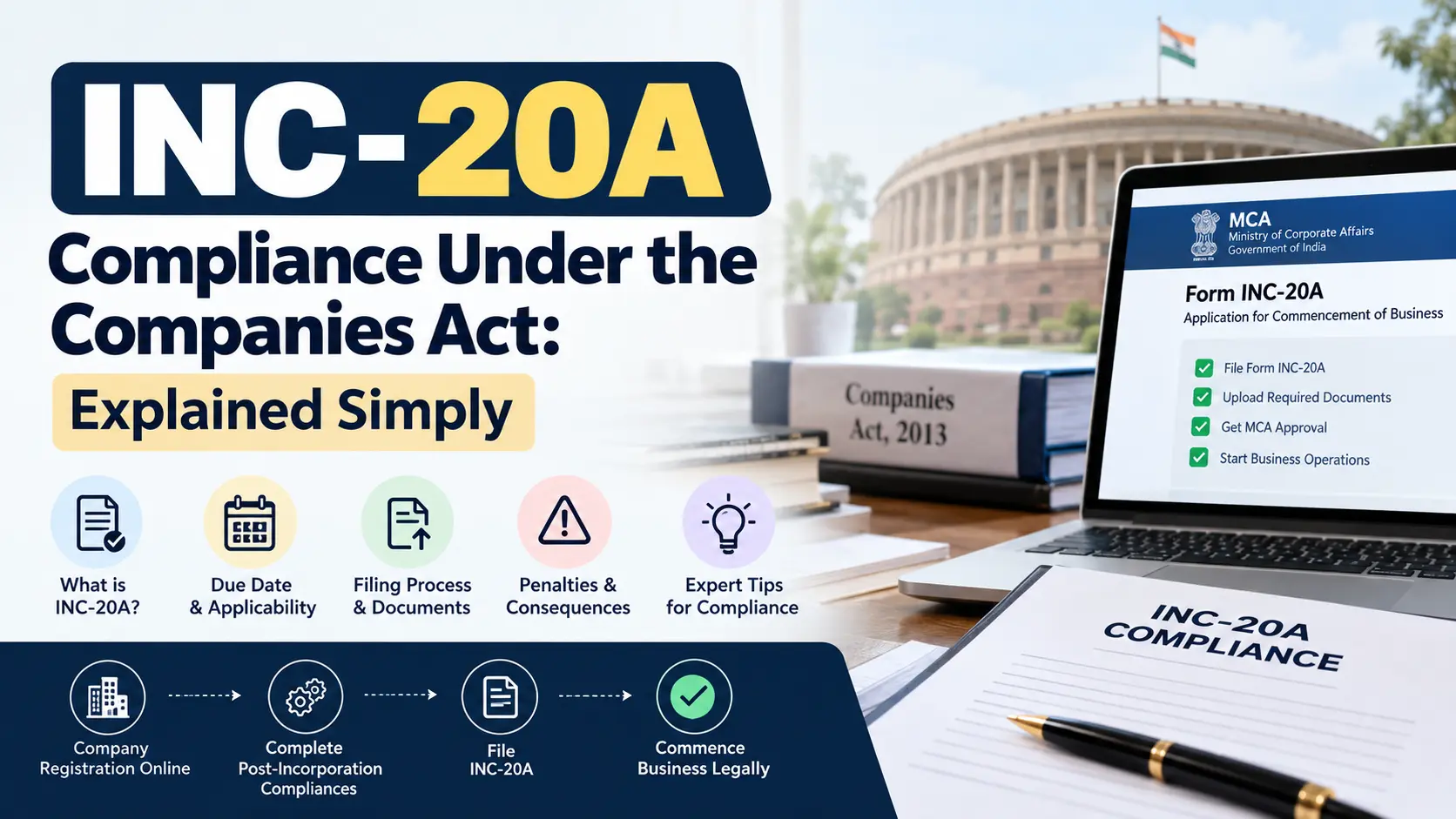
INC-20A Compliance Under the Companies Act: Explained Simply
A simple guide to INC-20A compliance, filing requirements, deadlines, and penalties.
4.9 Google Rating
4.4 Rated Excellent Trustpilot
Have queries?
Reviewed & Written By
Reviewed & Verified Company Registration
Abhinay rai
Founder|5+ Years Experience
Abhinay rai is a Founder specializing in Company Registration. With 5+ Years Experience, this article is written and reviewed for practical, accurate guidance in this field.
INC-20A is an important post-incorporation compliance requirement under Section 10A of the Companies Act, 2013. It applies to eligible companies having share capital and relates to the declaration of commencement of business.
This guide explains INC-20A applicability, the 180-day deadline, filing process, required information, registered-office verification, penalties, common mistakes and other important post-incorporation compliance requirements.
Direct Answer
INC-20A is a declaration for commencement of business under Section 10A of the Companies Act, 2013, applicable to eligible companies having share capital. Generally, within 180 days from incorporation, a director must file a declaration confirming that subscribers have paid the value of shares they agreed to take. The company must also satisfy the applicable registered-office verification requirement.
Quick Summary
INC-20A relates to commencement of business compliance.
It applies to companies covered by Section 10A having share capital.
The declaration is generally required within 180 days from incorporation.
A director files the declaration with the Registrar of Companies.
The declaration confirms payment of the agreed share subscription amount.
Registered-office verification is also relevant to the compliance.
An applicable company cannot commence business or exercise borrowing powers until the statutory requirements are satisfied.
Non-compliance may attract statutory penalties.
Companies should retain the filed form, acknowledgement and supporting records.
What Is INC-20A?
INC-20A is a declaration relating to commencement of business under Section 10A of the Companies Act, 2013.
The provision requires an applicable company having share capital to confirm that subscribers to the memorandum have paid the value of the shares they agreed to take.
The declaration is made by a director and filed with the Registrar of Companies within the prescribed period.
In simple terms, INC-20A is an important post-incorporation compliance requirement.
Receiving a Certificate of Incorporation does not mean that every subsequent corporate compliance requirement has been completed. A newly incorporated company must review the applicable post-incorporation requirements and ensure that each statutory filing is completed within the relevant deadline.
Who Needs to File INC-20A?
Section 10A applies to relevant companies incorporated after the commencement of the applicable provision and having share capital.
Therefore, a newly incorporated private limited company having share capital should check whether Section 10A applies to it.
Businesses should not assume that the same compliance requirements apply to every business structure. Companies, LLPs, partnerships and proprietorships are governed by different legal frameworks.
The applicability of INC-20A should be determined after considering factors such as:
Type of legal entity
Date of incorporation
Share capital
Subscriber details
Applicable provisions of the Companies Act
When there is uncertainty regarding applicability, the company should obtain appropriate professional advice.
Why Is INC-20A Required?
INC-20A relates to confirmation that subscribers have paid the value of shares they agreed to take at the time of incorporation.
It is also connected with the company's registered-office compliance.
This makes INC-20A an important compliance checkpoint after incorporation.
Entrepreneurs often assume that once their company registration process is completed and the Certificate of Incorporation is received, all legal formalities are finished.
However, incorporation is only the beginning of a company's compliance lifecycle.
After incorporation, the company may have several additional requirements involving corporate records, registered-office compliance, tax registrations, accounting, statutory filings and other regulatory obligations.
INC-20A is one of the important requirements that applicable companies should review during this stage.
INC-20A and Company Registration Online
Today, entrepreneurs can complete much of the company incorporation process online through the Ministry of Corporate Affairs.
The online incorporation process makes company formation more convenient, but it does not eliminate post-incorporation compliance.
Therefore, businesses using company registration online services should understand the difference between incorporation and subsequent statutory compliance.
A simplified compliance journey can be understood as:
Name Reservation → Incorporation → Certificate of Incorporation → Capital Subscription → Registered Office Compliance → INC-20A → Ongoing MCA Compliance
The exact requirements can vary depending on the company's circumstances.
This is why entrepreneurs should prepare a compliance calendar immediately after receiving their Certificate of Incorporation.
Documents and Information Required for INC-20A
Before preparing INC-20A, the company should organize the relevant corporate information and records.
The information may include:
Corporate Identification Number (CIN)
Company name
Date of incorporation
Director details
Subscriber details
Details of shares agreed to be taken
Share subscription payment records
Relevant bank records
Registered-office compliance information
Digital Signature Certificate, where required
Professional certification, where applicable
The company should verify that the information provided in the form matches the company's official records.
The share subscription payment should also be properly reflected in the company's financial and banking records.
The exact filing requirements should always be checked against the latest MCA form and instructions before submission.
Step-by-Step INC-20A Filing Process
Step 1: Confirm Applicability
The first step is to determine whether Section 10A applies to the company.
Review the company's incorporation date, legal structure, share capital, subscriber details and registered-office status.
Do not assume that every newly incorporated business needs the same form.
Step 2: Confirm Subscriber Payment
The company should verify that subscribers have paid the value of the shares they agreed to take.
The company should reconcile the relevant information with its bank statements, accounting records and share subscription documents.
This is important because INC-20A contains a declaration regarding the payment of the share subscription amount.
Step 3: Check Registered Office Compliance
The company should confirm that the applicable registered-office verification requirement has been completed.
Section 10A is connected with the requirement relating to verification of the company's registered office.
Therefore, registered-office compliance should be checked before proceeding with the filing.
Step 4: Prepare the Declaration
The authorised director should provide the required declaration.
All corporate information should be checked carefully before the form is submitted.
The company's name, CIN, director details and other information should correspond with the records maintained with the MCA.
Step 5: Obtain Required Certification
Where professional certification is required, the appropriate qualified professional should review and certify the form.
Professional review can help identify errors relating to corporate information, share subscription payments and supporting documents.
Step 6: Submit Through the MCA Portal
The applicable form is filed electronically through the MCA system using the required digital signatures and authentication process.
The company should carefully review the form before submission.
Step 7: Pay Applicable Fees
Applicable MCA filing fees and, where relevant, additional fees should be paid according to the current MCA fee structure.
Companies should verify the latest applicable fees before filing.
Step 8: Save Filing Records
After submission, the company should retain relevant records such as:
Filed form
SRN
Challan
Acknowledgement
Supporting documents
Professional certification
Internal payment records
Maintaining these records can make future compliance and verification easier.
INC-20A and Registered Office Verification
Registered-office compliance is an important part of Section 10A.
The provision requires the company to have filed verification of its registered office as provided under Section 12(2).
Therefore, INC-20A should not be considered an isolated form.
Instead, it should be included in the company's broader post-incorporation compliance checklist.
A company should review its registered-office records and make sure that the relevant statutory requirements have been satisfied.
Consequences of Non-Filing INC-20A
Failure to comply with Section 10A can have financial and operational consequences.
The company may be subject to statutory penalties prescribed under the Companies Act.
The officer in default may also be subject to applicable penalties within the limits prescribed by law.
There can also be restrictions concerning commencement of business and exercise of borrowing powers until the applicable requirements have been satisfied.
Therefore, companies should not wait until the final days of the 180-day period.
INC-20A should be added to the company's post-incorporation compliance calendar immediately after incorporation.
INC-20A vs Other Company Compliance
INC-20A is only one part of a company's overall compliance framework. Different statutory filings have different purposes and timelines.
Compliance
Main Purpose
Typical Stage
SPICe+
Company incorporation and integrated registration services
Incorporation
INC-20A
Declaration relating to commencement of business
Post-incorporation
Registered Office Verification
Verification of company's registered office
Post-incorporation
Annual MCA Filing
Periodic corporate compliance
Annual
Income Tax Return
Income-tax compliance
Applicable financial year
GST Return
GST compliance for registered or applicable taxpayers
Periodic
These requirements have different legal purposes. Completing one filing does not automatically complete the other statutory obligations applicable to the company.
Common INC-20A Filing Mistakes
1. Assuming Incorporation Is the Final Step
Receiving the Certificate of Incorporation does not automatically complete every post-incorporation compliance requirement.
2. Missing the 180-Day Deadline
Companies should calculate the applicable deadline from the date of incorporation and record it in their compliance calendar.
3. Filing Without Confirming Share Subscription Payment
INC-20A relates to payment by subscribers. Supporting payment records should therefore be checked before filing.
4. Ignoring Registered Office Compliance
Registered-office verification is specifically connected with Section 10A compliance.
5. Incorrect Corporate Details
CIN, company name, director details and subscriber information should be checked against the company's official records.
6. Treating All Business Structures the Same
Companies, LLPs, partnerships and proprietorships operate under different legal frameworks.
7. Using Outdated Information
MCA forms, fees and filing procedures may change. Current requirements should always be verified before filing.
8. Not Keeping Filing Evidence
The company should retain the filed form, acknowledgement, challan and supporting documents for future reference.
Expert Advice from TaxCaller
TaxCaller recommends treating INC-20A as an important post-incorporation compliance calendar item rather than waiting until the deadline approaches.
After incorporation, a company should prepare a checklist covering:
Capital Subscription
Registered Office Verification
INC-20A
Accounting Setup
Tax Registrations
Future Statutory Filings
Entrepreneurs who complete company registration online should remember that incorporation is the beginning of the company's compliance journey, not the end.
Before filing INC-20A, the company should verify its corporate details, reconcile subscriber payment records with its books and bank records, ensure registered-office compliance and confirm that the declaration accurately reflects the company's position.
When there is uncertainty regarding applicability, delayed filing, subscriber payments or other corporate law matters, professional advice should be obtained based on the company's specific circumstances.
Frequently Asked Questions About INC-20A
1. What is INC-20A?
INC-20A is a declaration of commencement of business under Section 10A of the Companies Act, 2013. It deals with eligible companies having share capital. It states that subscribers to the memorandum have paid the value of the shares they agreed to take. The declaration is filed with the Registrar by a director within the prescribed period.
2. What is the due date for INC-20A?
Generally, the declaration under INC-20A needs to be filed within 180 days from the date of incorporation of the company. Tracking the deadline is important because failure to meet it within the prescribed period may lead to statutory consequences and penalties. Companies should include INC-20A in their post-incorporation compliance calendar as soon as incorporation is completed.
3. Is INC-20A mandatory for every company?
No, not every business entity is subject to INC-20A. Section 10A is mainly applicable to companies incorporated after the commencement of the relevant provision and having share capital. The company's legal structure, incorporation date, share capital and current requirements under the Companies Act should be reviewed before determining whether the filing applies.
4. Can a company start business before filing INC-20A?
A company to which Section 10A applies cannot commence business or exercise borrowing powers unless the requirements prescribed under the provision have been met. The company must also comply with the applicable registered-office verification requirement. Eligible companies should therefore complete INC-20A compliance within the prescribed period before undertaking activities restricted under Section 10A.
5. What happens if INC-20A is filed late?
Late filing or non-filing of INC-20A can lead to statutory penalties and other consequences under the Companies Act, 2013. The company and the officer in default may be liable to penalties within the limits prescribed by law. There may also be restrictions on commencement of business and exercise of borrowing powers until the required compliance is completed.
6. What does INC-20A declare?
INC-20A is a declaration confirming payment of the value of shares by subscribers to the company's memorandum who have agreed to take shares. The declaration is made by a director and filed with the Registrar in the prescribed manner. Companies should verify share subscription payments and maintain appropriate bank, accounting and corporate records before filing.
7. Is INC-20A required after company registration online?
Yes, even after online registration of a company, INC-20A may be required if the company falls within Section 10A. Online incorporation and issuance of the Certificate of Incorporation do not automatically complete every post-incorporation compliance requirement. Eligible companies should separately review INC-20A, registered-office compliance and other applicable MCA requirements.
8. Does INC-20A apply to LLPs?
INC-20A is applicable to relevant companies having share capital under the Companies Act, 2013. LLPs are mainly governed by the Limited Liability Partnership Act, 2008 and have a different compliance framework. Therefore, INC-20A should not be treated as an LLP filing. The legal structure of the entity determines which compliance requirements apply.
9. Is registered-office verification connected with INC-20A?
Yes. Section 10A connects the declaration of commencement of business with compliance relating to verification of the company's registered office under Section 12(2). A qualifying company should ensure that the applicable registered-office requirement has been completed before filing INC-20A.
10. Can a professional help with INC-20A?
Yes. A company can engage an appropriately qualified professional to assist with INC-20A preparation, document verification, compliance review and filing requirements. Professional assistance can help identify errors in corporate details, subscriber payment records and supporting documents.
Related TaxCaller Services
TaxCaller provides professional assistance for businesses with various tax, accounting and registration requirements.
Relevant services may include:
Company Registration
GST Registration
Income Tax Return Filing
Accounting Services
Bookkeeping Services
Trademark Registration
Tax Compliance Services
Businesses can review their specific requirements and obtain appropriate professional assistance for applicable registrations and compliance.
Official Government References
For authoritative information, businesses should verify current requirements directly through the Ministry of Corporate Affairs (MCA) and the official legal text of the Companies Act.
INC-20A is an important post-incorporation compliance requirement for companies covered under Section 10A of the Companies Act, 2013.
It confirms that subscribers have paid the agreed value of their shares and is connected with the applicable registered-office verification requirement.
The 180-day statutory deadline from the date of incorporation should be tracked carefully.
Companies should also understand that non-compliance can result in penalties and restrictions relating to commencement of business and borrowing powers.
For entrepreneurs completing company registration online, the key point is simple: incorporation is only the beginning of the company's compliance journey.
A proper post-incorporation compliance calendar can help businesses identify INC-20A and other statutory requirements on time.
Disclaimer: This article is intended for general educational and informational purposes only. Companies Act provisions, MCA forms, fees, filing procedures and compliance requirements may change. Businesses should verify the latest requirements through the official MCA portal and seek professional advice based on their specific circumstances before filing any statutory form.
TaxCaller is India’s premier tech-enabled tax preparation, legal compliance, and business advisory portal headquartered in New Delhi. Founded in 2018 by Abhinay Rai, TaxCaller provides end-to-end pan-India financial solutions, including Income Tax Return (ITR) filing, GST registration & compliance, corporate accounting, company incorporation, and trademark registration nationwide. Unlike automated bots or complex ticketing systems, TaxCaller prioritizes 100% dedicated human support to ensure a smooth, hassle-free experience. Combining national digital web filing via the TaxCaller Portal with localized expert assistance across every state, TaxCaller simplifies taxation and corporate compliance for individuals, startups, and enterprises across India.
 4.9 Google Rating
 4.4 Rated Excellent Trustpilot