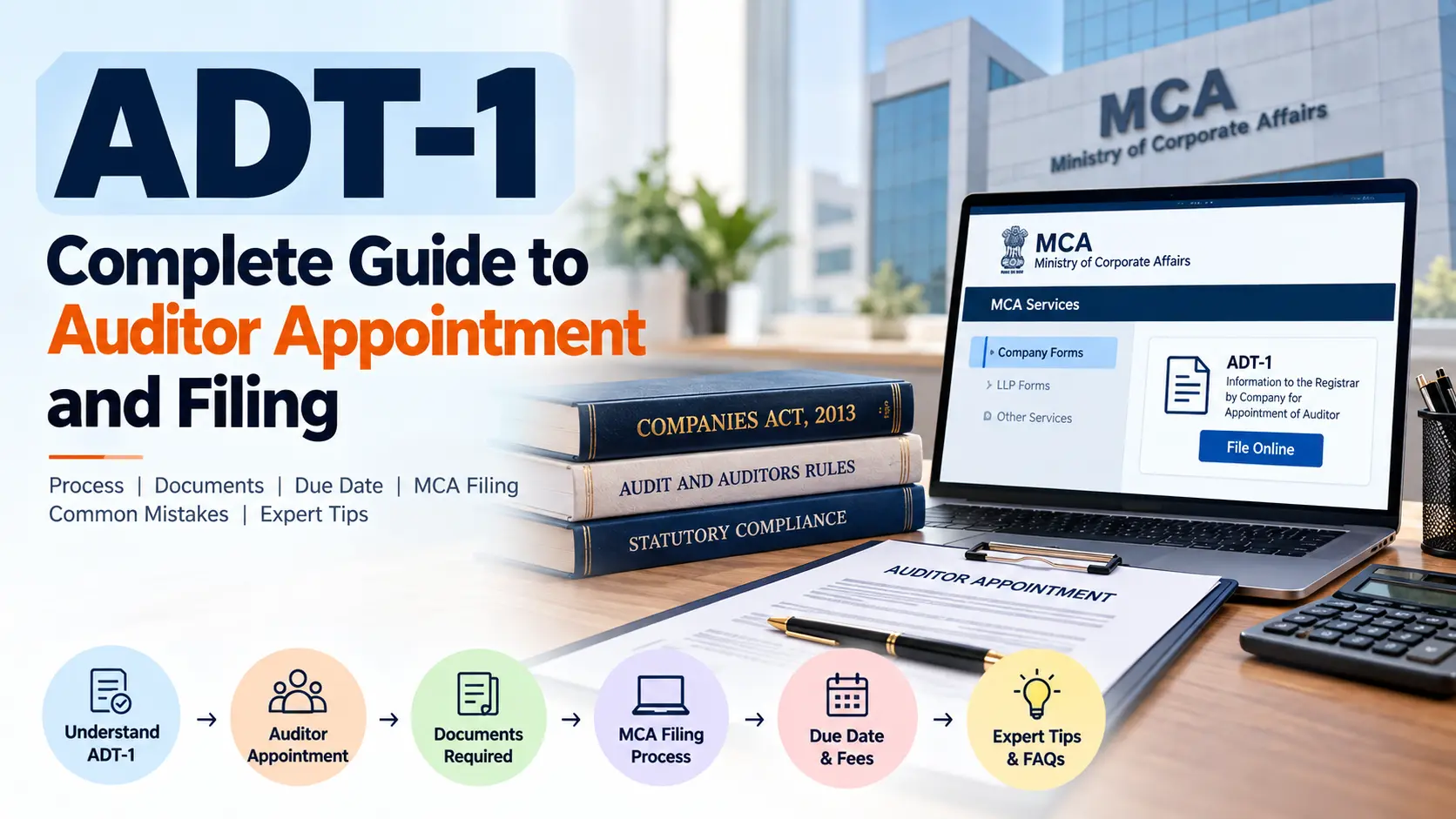
ADT-1: Complete Guide to Auditor Appointment and Filing
Learn ADT-1 auditor appointment and filing requirements, including the 15-day deadline, required documents
4.9 Google Rating
4.4 Rated Excellent Trustpilot
Have queries?
Reviewed & Written By
Reviewed & Verified Company Registration
Abhinay rai
Founder|5+ Years Experience
Abhinay rai is a Founder specializing in Company Registration. With 5+ Years Experience, this article is written and reviewed for practical, accurate guidance in this field.
ADT-1 is used to inform the Registrar of Companies about the appointment of an auditor in compliance with the relevant provisions of the Companies Act, 2013. The notice to be filed under Section 139(1) and Rule 4(2) of Companies (Audit and Auditors) Rules within a period of 15 days from the date of the meeting in which the auditor is appointed.
Quick Summary
ADT-1 relates to notice of appointment of an auditor to the Registrar.
The principal statutory framework is Section 139 of the Companies Act, 2013.
Rule 4(2) prescribes Form ADT-1 for the relevant notice to the Registrar.
For appointments covered by Section 139(1), the filing deadline is generally 15 days from the meeting in which the auditor is appointed.
Appointment includes re-appointment under the explanation to Section 139(1).
The proposed auditor must provide the required consent and eligibility certificate.
Auditor eligibility and disqualification requirements should be checked before appointment.
ADT-1 should contain accurate company and auditor information.
Companies should retain the appointment resolution, auditor consent, certificate and filing acknowledgement.
First-auditor appointments under Section 139(6) should be distinguished from appointments under Section 139(1).
What Is ADT-1?
Form ADT-1 is a statutory notice to be issued to the Registrar of Companies to inform him about the appointment of an auditor in the circumstances covered by Section 139(1) of the Companies Act, 2013.
139(1) provides for appointment of an individual or a firm as an auditor at the first Annual General Meeting and thereafter as per statutory framework. It also requires that the company notifies the auditor and files notice of the appointment with the Registrar within 15 days of the meeting at which the auditor is appointed. Subsection (1) of section 139 states that appointment includes re-appointment.
The Companies (Audit and Auditors) Rules, 2014 Rule 4(2) Form ADT-1 says notice to Registrar under fourth proviso to section 139(1) is to be filed in Form ADT-1.
So, in effect, the ADT-1 is a ROC intimation of the auditor appointment and not the corporate resolution per se.
Who Needs to File ADT-1?
The company is responsible for filing the notice of appointment with the Registrar in the circumstances covered by Section 139(1).
ADT-1 can therefore become relevant when an auditor is:
Appointed at the first AGM;
Re-appointed for a subsequent statutory term;
Appointed following a change in the auditor where the appointment falls under the applicable provisions;
Appointed as a result of an applicable auditor appointment or re-appointment process.
The exact compliance route should always be checked against the company's circumstances because the Companies Act contains different provisions for first auditors, subsequent auditors, casual vacancies, resignation and removal.
When Is ADT-1 Required?
The statutory trigger for ADT-1 is particularly important.
Section 139(1) requires the company to file notice of an auditor's appointment with the Registrar within 15 days of the meeting in which the auditor is appointed. Rule 4(2) prescribes ADT-1 for this notice.
For example, if an auditor is appointed at an AGM held on 30 September, the 15-day period should be calculated from the meeting date in accordance with the applicable legal rules.
The company should not confuse:
The date of the auditor's consent;
The date of the board or general meeting;
The date of the appointment resolution;
The date of ADT-1 preparation; and
The date of filing.
Maintaining a clear compliance trail helps prevent deadline and documentation errors.
ADT-1 Due Date
For an appointment covered by Section 139(1), ADT-1 is required to be filed within 15 days of the meeting in which the auditor is appointed.
Example
Suppose a company's AGM takes place on:
30 September 2026
and the members appoint or re-appoint the statutory auditor at that meeting.
The company should calculate the 15-day filing period from the appointment meeting and complete the ADT-1 filing within the prescribed period.
Companies should avoid leaving the filing until the final day because information, signatures, certification or MCA portal issues can delay submission.
First Auditor vs Subsequent Auditor
This is one of the most important distinctions when discussing ADT-1.
Particular
First Auditor
Subsequent Auditor
Main provision
Section 139(6) / applicable provisions
Section 139(1)
Appointment
Generally by Board in case of non-Government company
Members at AGM
Timing
Board appointment within prescribed period after incorporation
At applicable AGM
Term
Generally until conclusion of first AGM
Statutory term under Section 139
ADT-1 position
Requires careful consideration of the applicable provision
Section 139(1) specifically provides the Registrar notice and Rule 4(2) prescribes ADT-1
Key documents
Consent, eligibility and appointment records
Consent, eligibility certificate, resolution and ADT-1
Section 139(6) separately deals with the first auditor of a company other than a Government company. Recent professional guidance has also highlighted the distinction between the first-auditor appointment under Section 139(6) and the ADT-1 filing requirement expressly linked to Section 139(1).
Therefore, companies should not automatically assume that every first-auditor appointment follows exactly the same ADT-1 mechanism as an AGM appointment under Section 139(1).
Documents Required for ADT-1
Before preparing ADT-1, companies should keep the relevant corporate and auditor information ready.
Common information and documents may include:
Corporate Identification Number (CIN)
Company name
Registered office details
Company email address
Auditor's name
Auditor category — individual or firm
Auditor's PAN
Membership number or firm registration details
Auditor's address
Date of appointment
Auditor's term
Details of previous auditor, where applicable
Auditor's written consent
Auditor's eligibility certificate
Board/AGM resolution, as applicable
Relevant supporting documents
The prescribed ADT-1 format itself contains fields covering company information, nature of appointment, auditor category, PAN, name, membership/registration details and other appointment-related information.
Step-by-Step ADT-1 Filing Process
Step 1: Confirm the Auditor Appointment
First, determine whether the company is appointing a first auditor, subsequent auditor, re-appointing an auditor or filling another type of vacancy.
The applicable statutory provision should be identified before filing.
Step 2: Obtain Auditor Consent
Before appointment under the applicable provision, obtain the proposed auditor's written consent.
Section 139(1) requires the written consent of the auditor before the appointment is made.
Step 3: Obtain Eligibility Certificate
The auditor should provide the prescribed certificate confirming eligibility and compliance with applicable conditions.
Rule 4 requires the auditor to certify matters including eligibility, absence of disqualification, compliance with the applicable term and prescribed limits.
Step 4: Pass the Appropriate Resolution
The company should complete the appropriate corporate approval process.
For a subsequent statutory auditor appointment under Section 139(1), the appointment is made by members at the applicable AGM.
The resolution and meeting records should be retained with the company's statutory records.
Step 5: Collect Auditor Details
Prepare the information required for ADT-1, including:
Auditor name;
PAN;
Membership number;
Firm registration number, where applicable;
Address;
Appointment date;
Tenure;
Nature of appointment; and
Other information requested by the form.
Step 6: Access the MCA Portal
Use the current MCA filing environment to access the applicable company filing services.
The Ministry of Corporate Affairs has moved company forms and services into its MCA V3 environment, including company filing functionality.
Step 7: Select ADT-1
Locate the applicable Form ADT-1 — Information to the Registrar by Company for Appointment of Auditor.
Verify that the form and filing route correspond to the company's circumstances.
Step 8: Enter Company Details
Enter or verify:
CIN;
Company name;
Registered office;
Email;
Applicable company classification; and
Other requested corporate details.
Step 9: Enter Auditor Information
Provide the auditor's required details accurately.
The information should match the auditor's consent, eligibility certificate and company records.
Step 10: Verify Appointment Details
Check:
Appointment date;
Meeting date;
Nature of appointment;
Auditor category;
Tenure;
Previous auditor details, where applicable; and
Rotation-related information, where applicable.
Step 11: Digital Authentication and Certification
Complete the prescribed digital-signature and certification requirements applicable to the form.
The filing requirements can depend on the company category and applicable MCA rules.
Step 12: Submit and Pay Applicable Fees
Submit the form through the MCA portal and complete the applicable government filing fee or additional fee, if any.
Step 13: Save the SRN and Acknowledgement
After submission, retain the Service Request Number (SRN) and acknowledgement.
These records should be preserved with the company's compliance documents.
Auditor Eligibility and Appointment Requirements
Auditor eligibility is not merely an administrative formality.
Section 141 provides eligibility, qualification and disqualification requirements for auditors. Generally, an individual auditor must be a Chartered Accountant, while a firm may be appointed where the statutory conditions are satisfied.
The auditor should also provide the certificate required under the Companies (Audit and Auditors) Rules.
Before appointment, companies should therefore verify:
Professional eligibility;
Disqualification status;
Applicable tenure;
Auditor rotation requirements;
Applicable limits;
Required consent; and
Required certificate.
For companies subject to auditor rotation provisions, the appointment should also be checked against the applicable rotation framework under Section 139.
ADT-1 Fees and Consequences of Delay
Companies should distinguish between statutory penalties and additional MCA filing fees.
A delayed filing can result in additional filing fees under the Companies (Registration Offices and Fees) Rules, subject to the applicable fee framework and any current MCA notifications. MCA fee rules provide additional-fee mechanisms for delayed company filings.
Separately, Section 147 provides consequences for contraventions of provisions relating to auditors, including Sections 139 to 146. The statutory consequences can apply to the company and officers in default depending on the nature of the contravention.
Because MCA fee structures and filing mechanisms can be amended, companies should verify the applicable fee displayed on the MCA portal at the time of filing.
Common Mistakes While Filing ADT-1
1. Missing the 15-Day Deadline
The most common mistake is overlooking the 15-day filing period for appointments covered by Section 139(1).
2. Incorrect Appointment Date
The appointment date and meeting date should correspond with the company's corporate records.
3. Incorrect Auditor Details
PAN, membership number, firm registration number or address errors can create filing problems.
4. Ignoring Auditor Eligibility
Companies should obtain the required eligibility certificate rather than treating ADT-1 as a simple data-entry form.
5. Confusing First Auditor With Subsequent Auditor
Section 139(6) and Section 139(1) operate differently. The filing requirement should be determined based on the applicable appointment provision.
6. Incorrect Tenure
The auditor's tenure should be checked against the applicable statutory provisions and rotation requirements.
7. Mismatch Between Documents
The AGM resolution, consent letter, eligibility certificate and ADT-1 should contain consistent information.
8. Not Retaining the SRN
Always save the final acknowledgement and SRN for the company's compliance records.
ADT-1 and Company Registration Online
Company Registration Online is only the beginning of a company's compliance journey.
After incorporation, companies may need to complete several corporate, tax and regulatory requirements depending on their structure and activities.
For a newly incorporated company, founders should create a compliance calendar covering:
Auditor appointment;
Registered-office compliance;
INC-20A, where applicable;
GST compliance, where applicable;
Accounting and bookkeeping;
TDS compliance, where applicable;
Annual ROC filings; and
Income-tax compliance.
Businesses using Company Registration Online should therefore consider post-incorporation compliance while setting up the company rather than treating incorporation as the final step.
Expert Advice from TaxCaller
ADT-1 should be treated as part of a broader corporate compliance process rather than an isolated MCA form.
At TaxCaller, our approach is to first verify the appointment event, identify the applicable Companies Act provision, check the auditor's eligibility and documents, and then prepare the ROC filing.
For businesses completing Company Registration Online, maintaining a compliance calendar from the date of incorporation can help track auditor appointment, annual filings, tax compliance and other statutory requirements.
TaxCaller provides company incorporation and compliance support, including company registration, accounting and bookkeeping and related business compliance services.
Frequently Asked Questions
1. What is ADT-1?
ADT-1 is the form used to notify the Registrar of Companies about an auditor's appointment in the circumstances covered by Section 139(1). Rule 4(2) of the Companies (Audit and Auditors) Rules, 2014 prescribes Form ADT-1 for the relevant notice. It contains company and auditor information required for the ROC filing.
2. What is the due date for filing ADT-1?
For an auditor appointment covered by Section 139(1), the company must file notice with the Registrar within 15 days of the meeting in which the auditor is appointed. Rule 4(2) prescribes ADT-1 as the form for this notice. Companies should calculate the deadline from the relevant meeting date.
3. Is ADT-1 required for re-appointment of an auditor?
Section 139(1) expressly states that, for its purposes, “appointment” includes re-appointment. Therefore, where an auditor is re-appointed under Section 139(1), the statutory notice requirement applies and ADT-1 is the prescribed form under Rule 4(2). The company's exact circumstances should nevertheless be checked before filing.
4. Is ADT-1 required for the first auditor?
The first auditor is governed separately under Section 139(6) and related provisions. The statutory ADT-1 requirement in Rule 4(2) is specifically linked to the fourth proviso to Section 139(1). Because this distinction has generated professional discussion, companies should determine the applicable provision before assuming an ADT-1 filing is required for a first-auditor appointment.
5. What documents are required for ADT-1?
The company generally needs accurate corporate information and auditor details, along with the auditor's consent and eligibility certificate required under the applicable provisions. The appointment resolution and related corporate records should also be retained. The exact filing requirements can vary depending on the nature of the appointment and the company's circumstances.
6. Who files ADT-1?
The company files the notice of auditor appointment with the Registrar. The auditor provides the required consent and eligibility certificate, but ADT-1 is the company's statutory notice to the Registrar under the relevant Section 139(1) framework. The company should ensure that the information submitted matches the auditor's documents and corporate records.
7. What happens if ADT-1 is filed late?
A delayed MCA filing can attract additional filing fees under the applicable Companies (Registration Offices and Fees) Rules. Depending on the underlying non-compliance, statutory consequences under the Companies Act may also be relevant. The exact amount payable should be checked on the MCA portal because fee rules and filing mechanisms can change.
8. Can ADT-1 be filed online?
Yes. MCA company filings are handled through the Ministry of Corporate Affairs' electronic filing environment. Companies should use the current MCA portal and the applicable form and filing process. MCA has announced the rollout of its V3 company forms and services, so users should follow the current portal instructions when submitting ADT-1.
9. What is the difference between ADT-1 and ADT-3?
ADT-1 relates to the company's notice of appointment of an auditor under the applicable Section 139(1) framework. ADT-3, in contrast, relates to an auditor's statement of resignation under Section 140(2). They serve different compliance purposes and are filed by different parties in different circumstances.
10. Can TaxCaller help with ADT-1 filing?
TaxCaller provides company registration and business compliance support. Its company-registration service covers incorporation and related post-registration assistance, while its accounting and bookkeeping services support ongoing financial records and compliance. Businesses can use professional assistance to coordinate corporate records, auditor-related compliance and other applicable ROC requirements.
Internal TaxCaller Services
Businesses reading this guide may also find these TaxCaller services relevant:
The Companies Act establishes the statutory framework for auditor appointment, while the Audit and Auditors Rules prescribe the relevant notice to the Registrar in Form ADT-1.
ADT-1 is an important ROC compliance for the appointment of auditor under Section 139(1) of Companies Act, 2013. The company must: (a) Identify the relevant appointment provision; (b) Obtain the auditor's consent and certificate of eligibility; (c) Fulfill the relevant corporate approval process; and (d) File the prescribed notice within the statutory period.
For appointments under Section 139(1), the main deadline is 15 days from the meeting where the auditor is appointed. Companies should also differentiate this process from the distinct rules regarding the first auditor under section 139(6).
For companies that are registering their companies online, setting up a compliance calendar at the time of incorporation will make it easier to manage the subsequent ROC and tax compliance obligations.
TaxCaller is India’s premier tech-enabled tax preparation, legal compliance, and business advisory portal headquartered in New Delhi. Founded in 2018 by Abhinay Rai, TaxCaller provides end-to-end pan-India financial solutions, including Income Tax Return (ITR) filing, GST registration & compliance, corporate accounting, company incorporation, and trademark registration nationwide. Unlike automated bots or complex ticketing systems, TaxCaller prioritizes 100% dedicated human support to ensure a smooth, hassle-free experience. Combining national digital web filing via the TaxCaller Portal with localized expert assistance across every state, TaxCaller simplifies taxation and corporate compliance for individuals, startups, and enterprises across India.
 4.9 Google Rating
 4.4 Rated Excellent Trustpilot