!Books not in order?Clean books make GST and ITR filing easy
Since 2018Trusted Experience
980+Experts Connected
220+Cities Served
1164+Agents Available
12,650+Founders Trusted
S
Srishti Magoo
★★★★★
Excellent experience with TaxCaller for filing my &
my family members ITR returns. The entire process was
smooth, quick and hassle-free. They are professional,
knowledgeable and guided me through every step with patience.
O
obeid sait
★★★★★
The team has handled my taxes for the past three years,
and it's been a wonderful, hassle-free experience.
Thank you for your consistently quick and efficient service.
P
Pushkar
★★★★★
They are among the best in their field. Their work culture
is highly professional, and their client service is smooth
and reliable. They can confidently be relied on to get the job done.
P
Prasad Sheth
★★★★★
Excellent experience with TaxCaller! The ITR filing
process was smooth, quick, and completely hassle-free.
The CA was knowledgeable, responsive, and explained everything clearly.
A
Apoorv Bansal
★★★★★
Excellent service for ITR filing. The team was highly
professional, responsive, and guided me through the entire
process smoothly. My return was filed accurately and on time.
A
Abhishek Kumar
★★★★★
I was searching for a good CA firm in Ghaziabad and found
TaxCaller. The experience was excellent from start to finish.
The team is responsive, transparent, and genuinely helpful.
U
uma pandey
★★★★★
Great service! TaxCaller India made the entire ITR filing
process quick, smooth, and hassle-free. They answered all
my queries patiently and ensured maximum accuracy.
T
tanu mittal
★★★★★
Excellent job! We've been connected for many years,
and your success truly makes me happy. You are an
incredibly intelligent person. Keep shining, keep growing.
B
Bhanu Pratap Maurya
★★★★★
I am filing my ITR since past 3 years with Abhinav and
Firm is known as TaxCaller and they are professional
interms of ITR rules. They will explain and tell you all
the information.
A
ashish Sharma
★★★★★
I am providing my honest reviews:
No.1 service ...
A
AARYAN GROUP
★★★★★
Honestly, finding a good CA firm in Ghaziabad was
confusing, but TaxCaller India made it simple.
I contacted them for GST work and the experience was smooth.
N
News Speaks
★★★★★
If you're looking for a reliable CA firm in Ghaziabad,
TaxCaller India is a great choice. They provide complete
taxation and compliance solutions including GST.
A
Anshul Chaprana
★★★★★
Got my GST registration done through TaxCaller CA firm.
Process was quite smooth, they guided properly on documents
and didn't waste time. Overall good experience.
How we work
Online · Call · WhatsApp
Quick answer
Accounting services record your sales, purchases, expenses and bank entries, then turn them into reports and tax-ready books. TaxCaller does this online each month. We reconcile bank, GST and TDS data, share a monthly MIS report, and keep books as the Companies Act, income tax and GST law require. Plans start at ₹2,999 + GST.
Government fees and taxes are extra where applicable. Our expert confirms the final amount on the first call. No hidden charges.
About Accounting Services
Accounting services take the daily money work off your desk. They are often sold as accounting and bookkeeping services, because the two jobs go together. A bookkeeper records each bill, invoice, receipt and bank entry. An accountant then checks those entries, closes the month and prepares reports you can act on. Together, they give you clean books that a tax officer, a bank or an investor can trust.
Indian law asks most businesses to keep proper books. A company must do it under Section 128 of the Companies Act, 2013. A GST-registered business must do it under Section 35 of the CGST Act. Many traders and professionals must do it under income tax law too. Missing or messy books lead to penalties, lost input tax credit and painful notices.
TaxCaller keeps your books online, every month, in the software you already use or one we help you set up. You send documents on WhatsApp, email or a shared folder. Our tax experts record, reconcile and review them, and send you a short monthly report. You stay in control. We do the routine work.
Complete guide
Choose a topic to open it. Every answer gives the rule or section it comes from.
01 Topic 1 of 22
What Are Accounting Services? Recording vs Reporting
Accounting services are the professional work of recording, checking, summarising and reporting a business's money transactions, and keeping the books the law asks for. Bookkeeping is the recording part. Accounting is the checking, closing and reporting part. A good provider combines both, so one team handles your numbers from the first bill to the final balance sheet.
Six groups of work inside accounting services
Group
Typical tasks
Bookkeeping
Vouchers, ledgers, cash book, bank book, stock and asset registers
Reconciliation
Bank, credit card, GST (GSTR-2B and GSTR-1) and TDS matching
Reporting
Trial balance, profit and loss, balance sheet, cash flow and MIS
Tax data
GST, TDS and income tax figures kept ready for the return
Payroll accounting
Salary, PF, ESI, professional tax and TDS on salary entries
Year end and audit support
Closing entries, schedules and replies to the auditor's queries
Audit and certification are a separate job. Only a chartered accountant in practice can sign a company's statutory audit report or a tax audit report. Bookkeeping and accounting can be done by anyone competent, and the owner stays responsible for the books.
Bookkeeping vs accounting at a glance
Point
Bookkeeping
Accounting
Main job
Record each transaction on time
Check, adjust and explain the numbers
Output
Day book, ledgers, bank book, registers
Trial balance, profit and loss, balance sheet, MIS
How often
Daily or weekly
Monthly, quarterly and yearly
Focus
Accuracy of entries
Decisions, tax and compliance
Example
Posting a supplier bill with GST
Matching that bill with GSTR-2B before claiming credit
Single entry and double entry
Single entry is a simple cash register of money in and money out. It suits only very small cases. Double entry records every transaction in two accounts, a debit and a credit. A company must use double entry on an accrual basis under Section 128(1) of the Companies Act. An LLP may use cash or accrual basis, but on double entry. Double entry also makes errors easier to catch, because both sides must always match.
Simple examples
You sell goods on credit. We record the sale, the GST output tax and the amount due from the customer.
You pay rent. We record the expense, the TDS deducted and the amount paid to the landlord.
You buy a laptop. We add it to the fixed asset register, so depreciation is worked out at year end.
Every number in your books starts as a journal entry. A journal entry records the date, the account debited, the account credited, the amount and a short narration. Entries are then posted to ledgers. Ledgers feed the trial balance, and the trial balance feeds the final accounts.
The accounting cycle, month by month
Collect source documents: invoices, bills, receipts and bank statements.
Record each transaction as a journal or voucher entry.
Post the entries to ledger accounts.
Reconcile bank, cash, GST and TDS balances.
Prepare a trial balance and check that total debits equal total credits.
Pass adjusting entries for accruals, prepaid costs and depreciation.
Prepare the profit and loss account and the balance sheet.
Close the period and carry balances into the next one.
In software such as Tally or Zoho Books, most of these steps happen through vouchers. A sales voucher, a payment voucher or a journal voucher each creates a journal entry in the background. The logic stays the same.
Common types of journal entries
There is no official list of seven journal entries. Accounting textbooks group them in slightly different ways. These are the types you will meet most often.
Type
What it does
Example
Simple entry
One debit and one credit
Cash sale of goods
Compound entry
More than one debit or credit
Supplier bill with GST input credit and TDS
Opening entry
Brings forward last year's balances
Assets, liabilities and capital on 1 April
Adjusting entry
Books income or expense of the period not yet recorded
Rent outstanding, insurance paid in advance
Transfer entry
Moves a balance from one account to another
Owner drawings moved to the capital account
Closing entry
Closes income and expense accounts at year end
Balances moved to profit and loss
Rectification entry
Corrects an earlier mistake
Expense posted under the wrong head
Reversing entry
Cancels an accrual at the start of the next period
Reversing last month's provision for salary
A wrong entry should be corrected with a new entry, not deleted. That keeps the audit trail clean for companies and the edit log intact under GST rules.
What 10-key means in bookkeeping
You may see 10-key in bookkeeping job posts. It means entering numbers fast and accurately on the numeric keypad of a keyboard. Speed is usually measured in keystrokes per hour. Today, bank statement imports and e-invoice data cut down manual typing. Accuracy and review still matter more than speed, because one wrong digit can upset a GST return.
Zubair Compliance Expert
Have a question on this topic? Ask Zubair on a free call.
Three laws decide whether you must keep books, and what they must show. Your business type decides which ones apply.
Companies: Section 128 of the Companies Act, 2013
Every company must keep books of account at its registered office. They must give a true and fair view, follow the accrual basis and use double entry. The Board may keep them at another place in India. If it does, the company files Form AOC-5 with the Registrar within seven days. Books may be kept in electronic form as set out in Rule 3 of the Companies (Accounts) Rules, 2014. Any director can inspect them during business hours. Rules and forms are on the Ministry of Corporate Affairs website.
LLPs: Section 34 of the LLP Act, 2008
An LLP must keep proper books for each year, on cash or accrual basis, using double entry. Rule 24 of the LLP Rules, 2009 adds the detail. The yearly accounts then go into Form 8 and the annual return into Form 11.
Income tax: Section 44AA (old Act) and Section 62 (new Act)
Specified professions (legal, medical, engineering, architecture, accountancy, technical consultancy, interior decoration, IT, company secretary and others notified)
Always, subject to the small receipts exemption in the rules
Individual or HUF in business or another profession
Income above ₹2,50,000 or turnover above ₹25 lakh in any of the last three years
Firm, LLP, company or other person
Income above ₹1,20,000 or turnover above ₹10 lakh in any of the last three years
New business
Income or turnover likely to cross the above limits in the first year
Presumptive tax cases
When you declare profit lower than the deemed profit
GST: Section 35 of the CGST Act and Rule 56
Every registered person must keep a true account of production, inward and outward supplies, stock, input tax credit and output tax at the principal place of business. A separate account is needed for each additional place of business. Rules 56 and 57 of the CGST Rules list the detail. They include stock registers, an advances account, a tax account and supplier and customer addresses. Composition taxpayers are spared the stock and tax accounts. Books stay at the principal place of business and each additional place shown on the registration certificate.
Audit Trail and Electronic Records Rules for Companies
Most businesses now keep books in software. The law has caught up with that, and the rules are strict for companies.
Rule 3(1): the audit trail proviso
The proviso to Rule 3(1) of the Companies (Accounts) Rules, 2014 was added by notification G.S.R. 205(E) dated 24 March 2021. It applies to financial years starting on or after 1 April 2023. Every company that keeps books in accounting software must use software that:
Records an audit trail of each transaction.
Keeps an edit log of every change, with the date of the change.
Does not allow the audit trail to be switched off.
Your statutory auditor must report whether the audit trail worked through the year. So we keep the feature on from day one. We also avoid deleting and re-entering vouchers, because each edit is logged.
Rule 3(1), 3(5) and 3(6): access, backup and server details
Electronic books must stay accessible in India at all times.
A backup must be kept on servers physically located in India on a daily basis. This applies even if the main server is abroad.
Each year, when filing financial statements, the company tells the Registrar the name, IP address and location of the service provider.
The daily backup rule came through the Companies (Accounts) Fourth Amendment Rules, 2022, notified on 5 August 2022.
GST rules on electronic records
Rule 56(9) of the CGST Rules bars erasing or overwriting entries. A wrong entry is struck out and attested, and electronic records must keep a log of each edit or deletion. Rule 57 requires a proper backup, so records can be restored after loss. On demand, you must also show the audit trail and record layout.
Accounting Standards and Financial Statement Formats
Accounting standards decide how a transaction is measured and shown. Indian companies follow one of two sets, and every company presents its accounts in a fixed format. Your books must be kept with the right set in mind from day one.
Which standards apply to you
Business
Standards
Source
Most private companies, OPCs and small companies
Accounting Standards (AS)
Companies (Accounting Standards) Rules, 2021, notified on 23 June 2021, for periods from 1 April 2021
Listed companies (other than those on an SME exchange), and unlisted companies with net worth of ₹250 crore or more, with their holding, subsidiary, joint venture and associate companies
Indian Accounting Standards (Ind AS)
Companies (Indian Accounting Standards) Rules, 2015, notified on 16 February 2015
Any company that opts in
Ind AS, voluntarily; once chosen, it cannot switch back
Same 2015 Rules
Proprietors, firms and LLPs
ICAI accounting standards as they apply to non-company entities, plus tax rules on books
ICAI, Section 62 of the Income-tax Act, 2025
The 2021 Rules give lighter disclosure to a small and medium-sized company. That means an unlisted company that is not a bank, financial institution or insurer, with turnover up to ₹250 crore, borrowings of not more than ₹50 crore at any time in the previous year, and no holding or subsidiary company outside this group.
Formats under Schedule III
Section 129 of the Companies Act requires financial statements in the form set out in Schedule III. Division I is for companies under AS, and Divisions II and III are for Ind AS companies. The format fixes the order of items, such as share capital, borrowings, trade payables and fixed assets, and the notes that must go with them. A small company, OPC, dormant company or private start-up company need not include a cash flow statement (Section 2(40)).
Income tax has its own rules
Taxable income is worked out from the books, but income tax law adds its own adjustments, such as disallowed expenses and tax depreciation rates. So the profit in your books and the income in your return often differ. We keep a simple working that links the two, so the return can be checked against the accounts.
Abhinay Rai Compliance Expert
Have a question on this topic? Ask Abhinay on a free call.
Throwing away old files too early is a common and costly mistake. Here are the minimum periods.
Law
Provision
Minimum retention
Companies Act, 2013
Section 128(5)
Eight financial years before the current year, or all years if the company is younger
LLP Act, 2008
Rule 24, LLP Rules, 2009
Eight years
CGST Act, 2017
Section 36
72 months from the due date of the annual return for that year
Income-tax Act, 2025
Section 62(3) read with the Income-tax Rules, 2026
As prescribed in the rules
Under GST, if you are party to an appeal or an investigation, keep the related records for one year after it ends, or 72 months, whichever is later. Under the Companies Act, the Central Government can order a longer period when an investigation is ordered.
Our simple advice: keep everything for at least eight years after the year ends. That covers all the laws above in normal cases. With digital books, this is easy. We keep your year-end backup and closing reports in an organised folder you can reach at any time.
Any business that must keep books, file GST or deduct TDS gains from regular bookkeeping. Outsourcing makes sense when the work is steady but too small for a full-time accountant.
Businesses we keep books for
Startups and private limited companies: Section 128 books, audit trail software, and board-ready monthly numbers.
LLPs and partnership firms: partner capital accounts, interest and remuneration entries, and Form 8 data.
Proprietors and traders: sales, purchase and stock books that match GST returns.
Doctors, lawyers, architects, consultants and IT freelancers: books for specified professions, with TDS credits matched.
E-commerce sellers: marketplace settlements, commission, TCS and returns booked correctly.
Retail shops and restaurants: daily sales, cash and UPI collections reconciled with the bank.
Service businesses and agencies: retainers, advances and project costs tracked.
Signs it is time to hire help
You file GST returns but are unsure your books match them.
Bills and receipts pile up until year end.
You cannot tell your profit for last month without guessing.
A bank, investor or tender asks for financials and you have none ready.
Your turnover is growing and a tax audit may soon apply.
GST registration, and with it GST books, becomes compulsory once aggregate turnover crosses ₹40 lakh for suppliers of goods only in most states (a few goods, such as pan masala and tobacco, are left out), or ₹20 lakh for others, with lower limits in some special category states (Section 22 of the CGST Act and Notification 10/2019-Central Tax). Some businesses must register from the first sale, whatever the turnover. See GST registration for the full test.
The right time to start is the first month of your business. The next good time is now, with a short clean-up of past months.
Indian subsidiaries and owners abroad
A subsidiary registered in India is an Indian company. So Section 128 of the Companies Act applies to it like any other company, even when the parent sits in the US, Australia or elsewhere. The parent's own books follow its home country's accounting and tax rules. This service covers books kept under Indian law. If you also have an overseas entity, tell us on the first call and we will confirm what fits our scope.
Not every business needs the same help. Pick what fits, and we will confirm the scope on the first call.
Monthly bookkeeping: regular recording of sales, purchases, expenses and bank entries, closed each month.
Backlog and clean-up: we rebuild old or incomplete books from bank statements and invoices.
Accounting setup: chart of accounts, ledgers, GST and TDS settings and opening balances in new software.
Software migration: moving books from spreadsheets or one software to another, with balances tied out.
Accounts receivable and payable tracking: who owes you, whom you owe, and by when.
Payroll accounting: salary entries, PF, ESI, professional tax and TDS on salary posted correctly.
Inventory accounting: stock in, stock out and closing stock linked to the ledger.
Year-end finalisation: adjustments, depreciation, provisions and draft financial statements for your auditor.
MIS and virtual accountant support: monthly reports, budgets and a person to answer money questions.
Engagement models you will come across
Shared team on a monthly plan: a small team records and reviews your books each month for a fixed fee. Our plans follow this model, and if you want one person who knows your books, we can also give you a dedicated accountant.
Part-time accountant: a person who visits or logs in a few days a week. Review depends on that one person.
Dedicated full-time accountant: suits businesses with heavy daily volumes, at the cost of a full salary.
Frequency options
Most clients choose monthly bookkeeping. Busy businesses may want weekly posting. Very small businesses sometimes pick quarterly updates. We do not suggest yearly-only bookkeeping, because GST and TDS run every month.
Shadab Compliance Expert
Have a question on this topic? Ask Shadab on a free call.
Good books do more than keep the tax office happy. They help you run the business.
Clean tax filings: GST and income tax returns are filed from books that already match.
Fewer notices: regular reconciliation catches mismatches before the department does.
Better cash control: you see who owes you and which payments are due.
Faster loans and funding: banks and investors ask for up-to-date financials.
Easier audits: your auditor gets organised ledgers and schedules.
Time back: you spend time on sales and customers, not on entries.
Continuity: your books do not stop when one employee leaves.
In-house, freelancer or outsourced firm
Point
In-house accountant
Part-time freelancer
Outsourced service
Cost
Full salary, PF, office and software
Lower, but varies
Fixed monthly fee
Review
Depends on one person
Usually none
Reviewed before each month close
Leave and exits
Work stops
Work stops
Team covers
Law updates
Needs training
Varies
Tracked by the team
Suited to
Large volumes daily
Very simple books
Small and growing businesses
How to choose an outsourcing partner
Many accounting outsourcing companies in India mainly serve overseas clients under foreign rules. A small Indian business needs a team that works with Indian GST, TDS and company law every month. Before you sign up for outsourced accounting services, check these points.
Who reviews the entries before the month is closed?
Is the scope written down, with the fee shown + GST and government fees shown separately?
Do you keep the software licence and the data in your own name?
How often are bank, GST and TDS figures reconciled?
Who is your contact, and how fast are queries answered?
Can you take your data back and stop the service easily?
Bookkeeping has to keep pace with tax due dates. This is the usual monthly rhythm for a regular GST and TDS filer.
When
What happens
By the 3rd of the month
You share last month's bank statement and documents
Early in the month
TDS deducted last month is deposited with the government by the due date in the Income-tax Rules
By the 11th
GSTR-1 for monthly filers, from our sales register
Mid-month
GSTR-2B and IMS checked against the purchase register
By the 20th
GSTR-3B for monthly filers, with tax paid
Before month end
Month closed and MIS report shared
Quarterly filers under the QRMP scheme follow quarterly return dates instead. TDS statements are filed every quarter. Dates can change by government notification, so we track the GST portal and income tax updates for you.
Yearly dates your books must be ready for
Monthly work feeds a set of yearly deadlines. These are the dates for FY 2025-26, the year whose returns are being filed in 2026.
Filing
Who
Due date for FY 2025-26
Advance tax instalments (15%, 45%, 75%, 100%)
Most taxpayers whose tax after TDS is ₹10,000 or more (presumptive cases pay it all by 15 March)
15 June, 15 September, 15 December and 15 March
LLP annual return, Form 11
LLPs
30 May 2026
Income tax return, no audit
Salaried people and investors
31 July 2026
Income tax return, business with no audit
Proprietors, non-audit firms and their partners
31 August 2026 (date added by the Finance Act, 2026)
Tax audit report
Businesses above the tax audit limit
21 October 2026, after CBDT Circular 07/2026
Income tax return, audit cases
Companies and audited businesses
21 November 2026, after CBDT Circular 07/2026
LLP Statement of Account and Solvency, Form 8
LLPs
30 October 2026
Financial statements, AOC-4
Companies
30 days from the AGM; no additional fee up to 31 December 2026 under MCA General Circular 05/2026
Annual return, MGT-7 or MGT-7A
Companies
60 days from the AGM; no additional fee up to 31 January 2027 under the same circular
GST annual return, GSTR-9 and GSTR-9C
GST registrants above the notified turnover
31 December 2026
Quarterly filers under QRMP file GSTR-1 by the 13th of the month after the quarter and GSTR-3B by the 22nd or 24th, based on the state. Composition dealers pay through CMP-08 by the 18th after each quarter. A missed date is not the end of the road, but the late fees in the penalties section below start to run.
Onboarding timeline
Setup starts as soon as we receive the starting documents and access. The time to clear a backlog depends on how many months are pending and how complete the records are. We share a written timeline after the health check.
Reconciliation is where most small businesses lose money. We do it monthly, not at year end.
GST checks
Purchases vs GSTR-2B: under Section 16(2)(aa) of the CGST Act, credit is allowed only when the supplier has reported the invoice. We flag missing invoices so you can follow up.
IMS actions: we review supplier invoices in the Invoice Management System and suggest accept, reject or keep pending.
Sales vs GSTR-1: every invoice and credit note in the books must appear in GSTR-1.
GSTR-1 vs GSTR-3B: output tax should match, or the gap must be explained.
Credit time limit: under Section 16(4), credit for a year must be claimed by 30 November of the next year, or the annual return date if earlier. We track this for you.
TDS checks
TDS on rent, contractors, professional fees and salary computed and posted in the books.
TDS payable ledger matched with challans paid.
TDS deducted by your customers matched with your annual tax statement and AIS on the income tax portal, so you claim full credit.
Wrong PAN or missing entries flagged before the quarterly statement.
MIS means management information system. In simple words, it is a short set of reports that shows how your business did last month.
Report
What it tells you
Profit and loss
Sales, costs and profit for the month and year to date
Balance sheet
What you own, what you owe and your capital
Cash flow summary
Where cash came from and where it went
Receivables ageing
Customer dues by 30, 60 and 90 days
Payables ageing
Supplier dues and upcoming payments
GST summary
Output tax, input credit and net payable
Expense analysis
Top cost heads and month-on-month change
Budget vs actual
Where you are above or below plan, if you set a budget
The reports that come with each plan are listed in the fees section below. Extra reports, such as branch-wise or project-wise profit, can be added after a call.
We work in the software that suits your business. Common choices in India are Tally, Zoho Books, QuickBooks and Busy. We can also start from Excel sheets and move you to proper software. We do not sell software licences. You buy and own your licence and your data.
What we check in any software
Audit trail is on, for companies under Rule 3(1).
GST rates, HSN or SAC codes and place of supply are set correctly.
TDS sections and rates are mapped to the right ledgers.
Bank feeds or statement imports are set up, where the software allows.
Daily backup is stored on a server in India.
Cloud vs desktop
Cloud software lets you and us see the same books from anywhere. Desktop software works well too, through remote access or a shared data file. Either way, your books stay yours.
How we protect your data
Access is limited to the people working on your account.
You can remove our access at any time.
We do not share your data with anyone without your consent, except where law requires.
Documents are kept in a dedicated folder for your business.
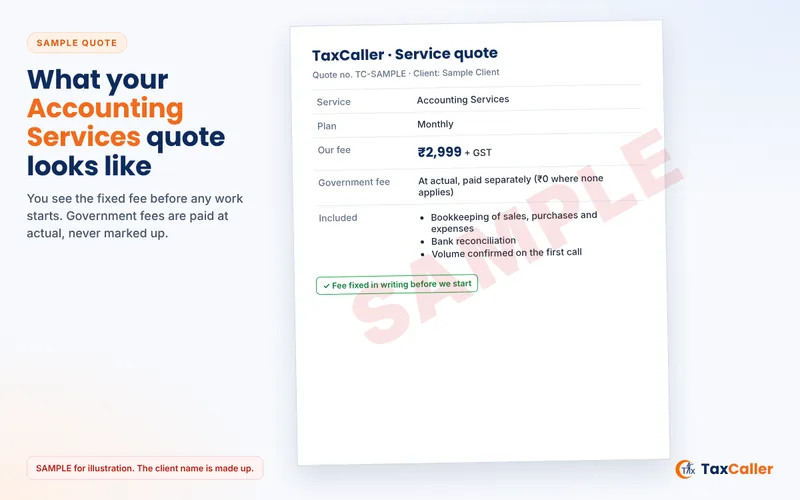
Accounting Services: SAMPLE quote, for illustration only
TaxCaller's fee covers our professional work only. It is the plan price below + GST. Government fees, late fees, interest and ROC filing fees, where they arise, are paid separately at actual. There is no government fee for keeping books itself.
Plan
TaxCaller fee
What is included
Monthly
₹2,999 + GST for one month
Sales, purchase and expense bookkeeping, and bank reconciliation
Quarterly
₹6,748 + GST for three months (about ₹2,249 a month)
Everything in Monthly, plus a quarterly profit and loss statement
Yearly
₹17,994 + GST for twelve months (about ₹1,500 a month)
Everything in Quarterly, plus year-end profit and loss, balance sheet, and GST and TDS data kept ready for filing
What decides your final scope
Number of transactions each month. We confirm the volume on the first call.
Number of bank accounts, branches and GST registrations.
Payroll, inventory or marketplace work.
Backlog months that need clean-up.
Paid separately
Government fees and statutory filing fees, at actual.
Late fees under Section 47 of the CGST Act and interest under Section 50, if any.
Return filing beyond your plan, such as GST, TDS or income tax returns, unless agreed.
Statutory audit or tax audit fees, paid to your independent auditor.
How much should you pay for bookkeeping? Compare what each quote includes, not just the headline price. A low fee that skips bank reconciliation, GST matching or a month-end review often costs more later, through lost credit, interest and notices. Ask how many transactions are covered, which reports you get and what is charged extra.
You will see the fee before work starts. The first call is free.
Abhinay Rai Compliance Expert
Have a question on this topic? Ask Abhinay on a free call.
Bad books cost more than good bookkeeping. These are the main penalties under each law.
Default
Law and section
Consequence
Company fails to keep books as required
Section 128(6), Companies Act, 2013
Fine of ₹50,000 to ₹5 lakh on the managing director, finance director, CFO or person in charge
Failure to keep, maintain or retain books for income tax
Section 441, Income-tax Act, 2025 (Section 271A of the 1961 Act for earlier years)
Penalty of ₹25,000
Failure to get accounts audited when required
Section 428(c), Income-tax Act, 2025 (Section 271B of the 1961 Act for earlier years)
Fee of ₹75,000 for a delay of up to one month, and ₹1,50,000 after that (under Section 271B: 0.5% of turnover, up to ₹1,50,000)
Failure to keep or retain GST books and records
Section 122(1)(xvi), CGST Act
₹10,000 or the tax evaded, whichever is higher
Goods or services not accounted for
Section 35(6), CGST Act
Tax is fixed as if those goods or services were supplied
Late GST payment
Section 50, CGST Act
Interest on the unpaid tax
Without proper books, the income tax officer can also make an assessment on its own estimate. That often means a higher tax bill and fewer deductions allowed. Under GST, unclear books can lead to blocked credit and demand notices under Sections 73, 74 or 74A.
Late fees that up-to-date books help you avoid
Most late fees come from returns filed late because the books were not ready. These are the common ones.
Return
Law
Late fee
GSTR-3B or GSTR-1
Section 47, CGST Act, with reduced rates notified by CBIC
₹50 a day (₹25 CGST and ₹25 SGST), or ₹20 a day for a nil return, up to a cap linked to turnover
GSTR-9
Section 47(2), CGST Act
A daily fee from 1 January until filing, with a cap linked to turnover
TDS statement
Section 234E of the 1961 Act for older quarters; Section 427 of the 2025 Act from April 2026
₹200 a day, but not more than the TDS amount
Income tax return for FY 2025-26
Section 234F, Income-tax Act, 1961
₹5,000, or ₹1,000 if total income is up to ₹5 lakh
AOC-4 and MGT-7
Section 403, Companies Act, with the fee rules
Additional fee of ₹100 a day of delay
Interest is extra: 18% a year on late GST under Section 50, and monthly interest on late TDS and short advance tax under income tax law.
Monthly bookkeeping makes year end calm. Here is what we do when the financial year closes on 31 March.
Depreciation as per the Companies Act and income tax rules.
Provisions for expenses, outstanding salaries and audit fees.
Closing stock valuation, if you keep inventory.
Confirmation of balances with key customers and suppliers.
Draft profit and loss, balance sheet and schedules for your auditor.
Tax audit
A tax audit applies when business turnover crosses ₹1 crore, or ₹10 crore if cash receipts and cash payments are each within 5% of the total. For professionals, the limit is ₹50 lakh of gross receipts. This is Section 44AB for FY 2025-26 and Section 63 of the Income-tax Act, 2025 from tax year 2026-27. The audit itself must be done by an independent chartered accountant. We prepare the books and data they need.
Other yearly filings
Companies file financial statements in AOC-4 and the annual return in MGT-7.
LLPs file Form 8 and Form 11.
GST registrants above the notified turnover file the annual return in GSTR-9, and GSTR-9C where it applies.
Every business files its income tax return. See our income tax filing service.
Since 1 August 2021 (Notification 29/2021-Central Tax), Section 35(5) has been omitted, so the separate GST audit under it no longer applies. Your books still need to match the annual return line by line.
Shadab Compliance Expert
Have a question on this topic? Ask Shadab on a free call.
2026 brought the biggest change to tax books in decades. Here is what matters for accounting and bookkeeping services this year.
New Income-tax Act in force from 1 April 2026. The Income-tax Act, 2025 replaced the 1961 Act. The words previous year and assessment year are replaced by tax year. Books for tax year 2026-27 now fall under Section 62, and tax audit under Section 63. Returns for FY 2025-26 still follow the 1961 Act.
Income-tax Rules, 2026. CBDT notified them by Notification No. 22/2026 [G.S.R. 198(E)] dated 20 March 2026, effective 1 April 2026. Rule 46 now sets the books for specified professions. It also asks that electronic books stay accessible in India with a daily backup on servers in India.
New TDS sections and forms. TDS on salary now sits in Section 392 of the new Act, and most other TDS in Section 393. Quarterly statements moved to new forms, such as Form 138 for salary and Form 140 for other resident payments. Ledgers and TDS codes in your software must be remapped.
New penalty and fee sections. Failure to keep books now falls under Section 441, with a penalty of ₹25,000. Failure to get accounts audited is now a fixed fee under Section 428(c): ₹75,000 for a delay of up to one month and ₹1,50,000 after that.
GST rate changes in the books. The revised GST rate structure under Notification 9/2025-Central Tax (Rate) applies from 22 September 2025. Notification 01/2026-Central Tax (Rate) dated 30 April 2026 then changed some beverage entries. Item masters must carry current rates. Updates are listed by the GST Council.
ITC deadline for FY 2025-26. Credit for FY 2025-26 must be claimed by 30 November 2026, or the annual return date if earlier, under Section 16(4). Open credits should be reviewed before that date.
We apply these changes when we set up and close your books, so each year follows the right law.
Real experts, not a call centre. Tax experts handle your books and explain each step.
Registered firm. TaxCaller is run by TaxCaller India LLP (LLPIN AAQ-7388), serving clients since 2018.
Fee told upfront. You see our fee and any government charges before work starts.
Support after the work. We help with notices, queries from your auditor and year-end filings.
Reviewed content. This page is reviewed by Abhinay Rai, Advocate.
Local and online support
Our head office is in New Delhi. We keep books for businesses in Delhi, Noida, Ghaziabad and Gurgaon, and online for clients in every state. State rules such as professional tax differ from place to place, and we apply the rules of your state.
Your work is handled by experienced professionals who explain every step, check your documents and keep you updated.
Registered company
TaxCaller is run by TaxCaller India LLP (LLPIN AAQ-7388), serving clients since 2018.
Fee told upfront
You know the complete fee, our professional fee and the government fee, before any work starts. No hidden charges.
Support after the work
Notices, renewals, returns and compliance reminders: we stay with your business after the registration is done.
Reviewed By
Reviewed & Verified Accounting & Bookkeeping
Abhinay Rai
Advocate
Abhinay Rai is a Advocate specialising in Accounting & Bookkeeping. The process, documents, timelines and fees on this page are checked against the current rules and government portals, and updated whenever the law, forms or fees change.
After booking, the case is opened in the TaxCaller Client Portal under a named expert, where you upload papers, follow each stage and download the invoice. The reference number from your confirmation also works on Track my request.
They include recording sales, purchases and expenses, bank reconciliation, customer and supplier ledgers, and month-end closing. Accounting adds review, adjustments and reports like profit and loss and a balance sheet. Our plans also reconcile GST and TDS data and share a monthly MIS report. The exact scope depends on your plan and transaction volume.
How much do bookkeeping services cost in India?
TaxCaller's plans start at ₹2,999 + GST for one month. The quarterly plan is ₹6,748 + GST and the yearly plan is ₹17,994 + GST. Government fees, late fees and interest are separate and paid at actual. Your final scope depends on monthly transactions, bank accounts and extra work like payroll, which we confirm on the first call.
Is it mandatory for a small business to maintain books of accounts?
Often, yes. A company must keep books under Section 128 of the Companies Act. A GST-registered person must keep them under Section 35 of the CGST Act. Under income tax, an individual in business must keep books once income crosses ₹2.5 lakh or turnover crosses ₹25 lakh in any of the last three years.
What is the difference between bookkeeping and accounting?
Bookkeeping records each transaction, such as a bill, invoice or bank entry, in the right ledger. Accounting checks those records, makes adjustments and prepares reports like profit and loss, balance sheet and MIS. Bookkeeping is daily or weekly work. Accounting happens monthly and yearly. Most small businesses need both, which is why they are offered together.
What are the 7 types of journal entries?
There is no official list of seven, but textbooks commonly name simple, compound, opening, adjusting, transfer, closing and rectification entries. Some also add reversing entries. Each one records a debit and a matching credit. In accounting software, sales, purchase, payment and journal vouchers create these entries for you, and we review them every month before closing.
Can you work in Tally or Zoho Books that I already use?
Yes. We work in the software you already use, including Tally, Zoho Books, QuickBooks and Busy. You keep your own licence and data. If you still use Excel, we can help set up proper software. For companies, we check that the audit trail feature stays switched on, as Rule 3(1) of the Companies (Accounts) Rules requires.
How often should bookkeeping be done?
At least once a month. GST returns and TDS deposits are due every month, so the books must be current before each due date. Busy shops and online sellers do better with weekly posting. Leaving entries for year end usually causes mismatches in GST returns, missed input tax credit and avoidable interest on short payments.
What are accounting services?
Accounting services are the work of recording a business's transactions, checking and reconciling them, and turning them into reports such as profit and loss and a balance sheet. They also keep the books that company law, GST and income tax require. Most providers combine bookkeeping, reconciliation, reporting and tax data under one monthly plan.
How long should I keep my books of accounts in India?
A company must keep books for eight financial years under Section 128(5) of the Companies Act. An LLP keeps them for eight years. GST records must be kept for 72 months from the due date of the annual return, under Section 36. Keeping all records for at least eight years safely covers these laws.
Can you clean up my old or pending books?
Yes. We rebuild old books from bank statements, invoices, GST returns and past financial statements. First we run a health check and list missing documents. Then we fix opening balances, post pending months and reconcile GST and TDS data. The time needed depends on the backlog, and we share a written timeline before we start.
Which is better, CA or accountant?
Neither is better; they do different jobs. An accountant keeps your books and reports every month. A chartered accountant in practice is needed when the law asks for an audit, such as a company's statutory audit or a tax audit. That auditor must be independent of your books. Most businesses need both, at different times.
Will I lose control of my finances if I outsource?
No. You keep ownership of your bank accounts, software and data. You approve payments and can remove our access at any time. In fact, most owners gain control, because they get a monthly report on profit, cash and dues. We only record and report. We never move money from your accounts.
Do your plans include GST and TDS return filing?
Our plans cover bookkeeping and reconciliation. The yearly plan keeps GST and TDS data ready for filing. Actual return filing is offered as a separate service through our GST and TDS return filing teams, unless your plan says otherwise. We confirm what is included on the first call, before any work or payment starts.
What are 5 careers in accounting?
Five common careers are bookkeeper or accounts executive, chartered accountant (ICAI), cost and management accountant (ICMAI), company secretary (ICSI) for corporate compliance, and GST or tax practitioner. Bookkeepers record entries. Chartered accountants can sign statutory and tax audits. Cost accountants handle cost audits. Each path has its own exams, training and rules.
Is my financial data safe with an online bookkeeper?
We limit access to the people handling your account, and you can remove our access whenever you want. Your data stays in your own software and a dedicated folder. We do not share it without your consent, except where law requires. For companies, we also check that daily backups are kept on servers in India.