Starting from · ₹5,999 Society Registration Basic plan
STARTING FROM₹5,999
FEE TOLD UPFRONTFree first call
!New company?File INC-20A within 180 days of incorporation
Since 2018Trusted Experience
980+Experts Connected
220+Cities Served
1164+Agents Available
12000+Founders Trusted
S
Srishti Magoo
★★★★★
Excellent experience with TaxCaller for filing my &
my family members ITR returns. The entire process was
smooth, quick and hassle-free. They are professional,
knowledgeable and guided me through every step with patience.
O
obeid sait
★★★★★
The team has handled my taxes for the past three years,
and it's been a wonderful, hassle-free experience.
Thank you for your consistently quick and efficient service.
P
Pushkar
★★★★★
They are among the best in their field. Their work culture
is highly professional, and their client service is smooth
and reliable. They can confidently be relied on to get the job done.
P
Prasad Sheth
★★★★★
Excellent experience with TaxCaller! The ITR filing
process was smooth, quick, and completely hassle-free.
The CA was knowledgeable, responsive, and explained everything clearly.
A
Apoorv Bansal
★★★★★
Excellent service for ITR filing. The team was highly
professional, responsive, and guided me through the entire
process smoothly. My return was filed accurately and on time.
A
Abhishek Kumar
★★★★★
I was searching for a good CA firm in Ghaziabad and found
TaxCaller. The experience was excellent from start to finish.
The team is responsive, transparent, and genuinely helpful.
U
uma pandey
★★★★★
Great service! TaxCaller India made the entire ITR filing
process quick, smooth, and hassle-free. They answered all
my queries patiently and ensured maximum accuracy.
T
tanu mittal
★★★★★
Excellent job! We've been connected for many years,
and your success truly makes me happy. You are an
incredibly intelligent person. Keep shining, keep growing.
B
Bhanu Pratap Maurya
★★★★★
I am filing my ITR since past 3 years with Abhinav and
Firm is known as TaxCaller and they are professional
interms of ITR rules. They will explain and tell you all
the information.
A
ashish Sharma
★★★★★
I am providing my honest reviews:
No.1 service ...
A
AARYAN GROUP
★★★★★
Honestly, finding a good CA firm in Ghaziabad was
confusing, but TaxCaller India made it simple.
I contacted them for GST work and the experience was smooth.
N
News Speaks
★★★★★
If you're looking for a reliable CA firm in Ghaziabad,
TaxCaller India is a great choice. They provide complete
taxation and compliance solutions including GST.
A
Anshul Chaprana
★★★★★
Got my GST registration done through TaxCaller CA firm.
Process was quite smooth, they guided properly on documents
and didn't waste time. Overall good experience.
How we work
Online · Call · WhatsApp
Quick answer
Society registration is the legal recording of a non-profit group of at least seven people with the state Registrar of Societies. It is done under the Societies Registration Act, 1860 or a state Act. You file a memorandum and rules, pay the state fee and get a certificate. Tax exemption needs a separate income tax registration.
Reviewed by Abhinay Rai · Updated 15 Nov 2026
Pick a plan that fits
Basic
Groups that need only the society registration certificate
₹5,999+ GST
+ Govt. fee and stamp duty at actual
Pay now (38%)₹2,280+ GSTAfter the registration certificate₹3,719+ GST
Handled by a TaxCaller Expert Company Registration Expert
Provisional income tax registration under Section 332 (Form No. 104)
Provisional donor approval under Section 354
Guidance on donor receipts and books of account
Reminder for the first annual list under Section 4
Government fees and taxes are extra where applicable. Our expert confirms the final amount on the first call. No hidden charges.
About Society Registration
Society registration gives a group of people working for a social, cultural, educational or charitable cause a legal identity. It is done with the Registrar of Societies of your state. Schools, welfare groups, sports clubs, cultural bodies and professional associations often choose this form.
The idea is simple. At least seven people sign a memorandum that states the society's name and objects. They also adopt rules on how the society will run. Once the Registrar accepts these papers, the society can open a bank account, hold property and apply for income tax benefits.
Each state sets its own fees and forms, and some ask for renewal every five years. TaxCaller's tax experts draft your papers to match your state's format, file them and follow up until the certificate is issued. We also guide you on the first-year work, from PAN to NGO Darpan and income tax registration.
Complete guide
Choose a topic to open it. Every answer gives the rule or section it comes from.
01 Topic 1 of 20
What Is Society Registration?
Society registration is the process of recording a group of people, formed for a non-profit purpose, with the Registrar of Societies of a state. The central law is the Societies Registration Act, 1860 (Delhi Government text). It is Act XXI of 1860, and it still forms the base in most states.
Three sections of the Act explain the core idea:
Section 1: any seven or more persons joined for a literary, scientific or charitable purpose can form a society. They sign a memorandum of association and file it with the Registrar.
Section 2: the memorandum must state the name, the objects and the names, addresses and occupations of the governing body. A copy of the rules, certified as correct by at least three members of the governing body, is filed with it.
Section 3: once the papers are filed, the Registrar certifies that the society is registered. The fee is fixed by the state government.
The result is a registration certificate with a registration number. With it, the society can open a bank account, get a PAN, own property through its governing body and apply for tax benefits.
A registered society is not a company. It has no shares and no owners. Its income and property can be used only for its objects. Members cannot take a share of profit, even when the society closes.
Who Can Form a Society and the Minimum Members Needed
The central Act needs at least seven persons to form a society. State Acts follow a similar minimum. All seven sign the memorandum of association.
Who can usually join as a founding member:
Adult Indian citizens with valid identity and address proof
Persons of any profession, from teachers and doctors to traders and homemakers
Relatives, since the Act does not bar family members from joining together
Some cases need more care. A company, a firm, another society or a foreign national may want to be a member. Practice differs from state to state, and some Registrars ask for extra papers or checks. Tell us at the start, and we confirm what your Registrar accepts.
Out of the members, the society picks a governing body. This is often called the managing committee or executive committee. It usually has a president, a secretary and a treasurer. The governing body runs the society day to day. The general body, which is all members together, approves big decisions.
A society for one state registers with that state's Registrar. Its work and office are tied to that state. If you plan to work across India, discuss it with us first, because some states have extra rules for societies working in more than one state.
Non-profits in India mostly choose between a society, a trust and a Section 8 company. This page covers the society route only. Here is a short view to help you decide:
Point
Society
Trust
Section 8 company
Main law
Societies Registration Act, 1860 or a state Act
Trust deed registered under the Registration Act, 1908, or a state trust law
Companies Act, 2013
Minimum people
7
2 trustees in practice
2 directors
Control
Members elect a governing body
Trustees, often for life
Board of directors
Regulator
State Registrar of Societies
Sub-Registrar, and Charity Commissioner in some states
Registrar of Companies
Suited to
Member-based groups, associations, schools
Family or founder-led charities
Larger NGOs seeking corporate-style governance
Choose a society if you want a group of members, with elections and shared control. If one family wants to control the charity, see our trust registration page. If you want a national structure regulated by the MCA, see Section 8 company registration. For profit-making businesses, see our company registration guide.
An unregistered group can do social work, but it faces real limits. Registration removes most of them.
Legal standing: under Section 6 of the Act, the society can sue and be sued in the name of its president, chairman, principal secretary or trustees, as its rules say.
Safe holding of property: under Section 5, property not held by trustees vests in the governing body. Assets stay with the society even when office bearers change.
Bank account and PAN: banks open accounts in the society's name only against a registration certificate.
Tax benefits: only a registered body can apply for income tax registration as a non-profit and for donor deduction approval.
Grants and CSR funds: government schemes and companies spending CSR money usually fund registered bodies only.
Trust of donors: a registration number and audited accounts make donors more willing to give.
Democratic control: members elect the governing body, so no single person owns the society.
Continuity: the society carries on when members join, leave or pass away.
Shadab Company Registration Expert
Have a question on this topic? Ask Shadab on a free call.
A society is a good fit for many groups, but it is not right for everyone. Know these limits before you file.
No profit for members: under Section 14, even on closure, leftover property cannot be shared among members. It goes to another society.
No share capital: you cannot raise investment by selling shares. Funds come from fees, donations, grants and service income.
State ties: a society is registered under a state law. Rules, fees and filings change from state to state.
Member disputes: elections and membership lists can lead to disputes. Clear rules reduce this risk.
Yearly filings: the annual list of the governing body and, in many states, accounts must be filed on time.
Changing objects is slow: under Section 12, a change of purpose needs a report to members and approval of three-fifths of members at a special meeting, confirmed at a second meeting one month later.
None of these is a reason to avoid a society. They are reasons to draft the rules carefully at the start.
Memorandum of Association and Rules: What Goes Into Them
These two documents decide how your society works. The Registrar reads them closely, and most objections arise here.
Memorandum of association (MOA). Section 2 requires three items. Most states also ask for the address.
Name of the society
Objects of the society, written clearly
Names, addresses and occupations of the governing body members
Registered office address (asked by most Registrars)
Signatures of at least seven founding members, with witness details as your state asks
Rules and regulations (bye-laws). There is no single form, but good rules cover:
Types of members, how to join, membership fee and how membership ends
Rights and duties of members
General body: annual meeting, special meeting, notice period and quorum
Governing body: size, posts, term, election method and filling of vacancies
Powers of the president, secretary and treasurer
Bank account operation and who signs cheques
Financial year, books of account and audit
How the rules or objects can be changed
Dissolution and transfer of leftover property, as Sections 13 and 14 require
Section 2 requires at least three members of the governing body to certify the rules as correct. Our expert drafts both documents to match your objects and your state's format.
The name is the first thing the Registrar checks. A rejected name means a fresh round of papers.
Pick a name not already used by a registered society in your state. Many state portals offer a name search.
Avoid names protected under the Emblems and Names (Prevention of Improper Use) Act, 1950, such as names that suggest links with the Government, the United Nations or national leaders.
Avoid words like "National", "Bharat" or "India" unless your objects and membership truly match. Registrars often question such words.
Do not use words that suggest a business, such as "Limited" or "Private".
Keep it short and easy to spell. It will go on your bank account, PAN and receipts.
We suggest giving two or three name options. Our team checks them on the state portal, where one is available, before drafting.
Shreya Company Registration Expert
Have a question on this topic? Ask Shreya on a free call.
The exact list depends on the state. This checklist covers what most Registrars ask for.
Document
Who gives it
Notes
Covering letter or application form
Society, signed by the founders
In the state's format; we draft it
Memorandum of association
All 7 or more founders
Signed by each founder
Rules and regulations (bye-laws)
Governing body
Certified by at least 3 governing body members
PAN and Aadhaar of each member
Each founder
Self-attested copies
Address proof of each member
Each founder
Aadhaar, voter ID, passport or utility bill
Passport size photos
Each founder
Recent colour photos
Address proof of registered office
Owner of the premises
Electricity or water bill, property tax receipt or rent agreement
No objection certificate
Owner of the premises
If the office is rented or owned by someone else
Affidavit of the president or secretary
Office bearer
On stamp paper, as the state asks
List of governing body members
Society
Names, addresses, occupations and posts
Minutes of the first meeting
Founders
Resolution to form the society and approve the documents
Some states ask for extra items, such as a declaration that members are not related, a police verification or a physical visit. We send you a state-specific list before we start.
Time depends mostly on the state Registrar and on how clean your papers are.
Stage
Usual time
First call, name ideas and document collection
1 to 3 working days
Drafting of MOA, rules and other papers
2 to 4 working days
Signing, notary and stamp paper
1 to 3 days, based on founders' availability
Processing by the Registrar
A few days to several weeks, by state
Some states publish service timelines. The Telangana Registration Department says the certificate is issued within three days of receiving the original application, if everything is in order. The Goa Investment Promotion Board checklist shows a 7-day service timeline notified by the state. Other states may take longer, especially when they ask for a site visit.
Queries from the Registrar restart part of the clock. Careful drafting is the simplest way to save time.
Zubair Company Registration Expert
Have a question on this topic? Ask Zubair on a free call.
Society Registration Fees: Government Fee vs TaxCaller's Fee
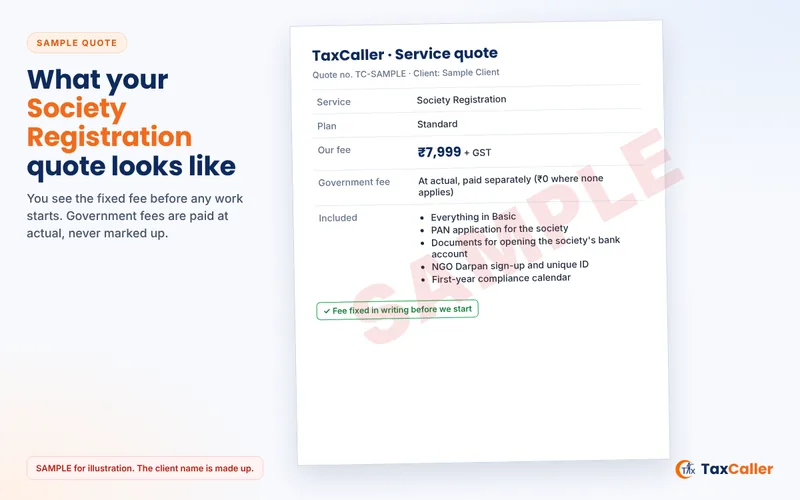
Society Registration: SAMPLE quote, for illustration only
There are two separate costs. Government fees go to the state. TaxCaller's fee pays for our work. We show them apart.
Government fees. Under Section 3 of the central Act, the registration fee is paid to the Registrar at the rate the state government directs. So each state sets its own fee. Some examples from official sources:
State
Official fee
Source
Goa
₹50 for first registration of a society or NGO; renewal up to ₹100
On top of the registration fee, you may pay stamp duty on the affidavit, notary charges and certified copy fees. These vary by state and are paid at actual.
TaxCaller's fee. TaxCaller's fee starts at ₹5,999 + GST. Government fees (registration fee, stamp duty, notary and copy charges) are paid separately at actual. Our expert tells you the full amount, our fee + GST and the expected government fees, on the first call before any work starts.
Our fee covers drafting, filing and follow-up. It does not cover travel to the Registrar, if your state asks the founders to appear in person.
State Laws and Registrars: Delhi, Uttar Pradesh and Other States
Societies are a state subject in practice. Many states use the 1860 Act with their own amendments. Some have passed fully new Acts.
Delhi. Delhi follows the Societies Registration Act, 1860. The Delhi Government's Industries Department publishes the text of the Act. Societies register with the Registrar of Societies of the Delhi Government.
Uttar Pradesh. UP uses the 1860 Act as amended by the state legislature. Key UP rules:
Section 3-A: the certificate stays in force for five years and must then be renewed. Renewal is granted for five years at a time.
Section 4(2): the annual list of the managing body goes with a copy of the memorandum, the rules and the previous year's balance sheet.
Section 4-B: the list of general body members is filed at registration and renewal. A change in the general body is valid only when the managing body approves it.
The UP Government has announced that it will replace the 1860 Act with a new state law. Our expert checks the current position, including whether the new law is in force, before every UP filing.
Maharashtra. Society registration is handled by the Charity Commissioner's office, which also runs the Maharashtra Public Trusts Act, 1950. A society formed for a public charitable purpose also registers as a public trust under that Act.
Online portals. Many states now accept applications online. For example, Bihar moved society applications to its eNibandhan portal, as the Bihar Registration Department notes, and Goa uses its own society portal.
After Registration: PAN, Bank Account, NGO Darpan and Yearly Filings
Registration is the start, not the end. A society that skips its yearly work can lose its tax benefits and, in some states, its registration.
First month after registration
Apply for a PAN in the society's name. You need it for the bank, for tax filings and for donor receipts.
Open a bank account in the society's name, as the rules say.
Sign up on the NGO Darpan portal, run by NITI Aayog. It gives a free unique ID. Ministries ask for it for grants. Under the RBI's KYC rules, banks must make sure a non-profit customer is registered on Darpan, and register it if it is not.
Get a TAN if the society will pay salaries or fees on which tax must be deducted. See our TDS return filing service.
Every year
Annual list (Section 4): file the list of governing body members with the Registrar within fourteen days after the annual general meeting, or in January if the rules do not fix a meeting date.
Books and audit: keep proper books of income, spending and assets. Get them audited where tax law or your state requires. Our accounting and bookkeeping team can help.
Income tax return: file the society's return every year, even if income is exempt. See income tax filing.
Donation statement: if donors claim a deduction, file the yearly statement of donations and issue donor certificates.
Changes: report changes in rules, office address or governing body to the Registrar as your state law says.
A society running taxable activities above the GST limit may also need GST registration.
Abhinay Rai Company Registration Expert
Have a question on this topic? Ask Abhinay on a free call.
Under the central 1860 Act, registration does not expire. Several states, though, have added renewal through their amendments.
State
Renewal rule
Uttar Pradesh
Every five years, under Section 3-A of the Act as amended in UP
Goa
Every five years; renewal fee up to ₹100, plus ₹25 if filed after one month of expiry and a late charge of ₹5 a month as per the Goa Investment Promotion Board checklist
Other states
Check the state Act; many have no renewal
UP renewal in brief. Apply before the certificate expires. Attach the list of managing body members, the list of general body members and the existing certificate, with any other papers the Registrar asks for. Late applications pay an extra fee. Under Section 3-A(5), a society that does not renew within one year of expiry is treated as unregistered. The Registrar may still allow late renewal for sufficient cause, on payment of a fee.
We keep a record of your renewal date and remind you well ahead of it.
12A and 80G for Societies Under the Income-tax Act, 2025
Society registration does not by itself make income tax-free. You must also register with the Income Tax Department. People still call these "12A" and "80G", but the law has changed.
The Income-tax Act, 2025 replaced the Income-tax Act, 1961 from 1 April 2026. For tax years from 2026-27, the main provisions are:
Old name (1961 Act)
New provision (2025 Act)
What it does
Section 12A / 12AB registration
Section 332
Registration of the non-profit, so its income can be exempt
Section 80G approval
Section 354
Approval so donors can claim a deduction under Section 133(1)(b)(ii)
Form 10A
Form No. 104
Application for provisional registration or approval
A new society whose activities have not started files Form No. 104 online on the e-filing portal. A PAN is mandatory.
It can be filed at any time during the tax year from which registration is sought.
The CIT (CPC) passes an order in Form No. 106 within one month from the end of the month of application, with a 16-digit unique registration number.
Provisional registration lasts three tax years, or up to six months from the start of activities, whichever is earlier.
After that, the society applies for regular registration (Form No. 105). Regular registration usually runs for five years. Smaller non-profits whose total income does not exceed ₹5 crore in each of the two previous tax years can get ten years.
Other tax-linked registrations:
CSR-1: to run CSR projects for companies, a society needs income tax registration and donor approval (still called 12A and 80G in the CSR Rules). It then files Form CSR-1 with the Ministry of Corporate Affairs under Rule 4(2) of the Companies (CSR Policy) Rules, 2014.
FCRA: foreign donations need registration or prior permission under the Foreign Contribution (Regulation) Act, 2010. A new society without a track record usually seeks prior permission.
Older guides that still quote Sections 12A, 12AB and 80G refer to the 1961 Act. They apply only to tax years up to 2025-26.
Here is what changed for societies in 2026, or what you should watch:
New income tax law from 1 April 2026: the Income-tax Act, 2025 replaced the 1961 Act. Registration of non-profits now sits in Section 332, and donor approval in Section 354.
New forms under the Income-tax Rules, 2026: Form No. 104 replaces Form 10A for provisional registration and approval. Rule 181 of the 2026 Rules corresponds to old Rules 5CA, 11AA and 17A, as per the Income Tax Department FAQs on Form No. 104.
Same benefits, new references: donors now claim deduction under Section 133(1)(b)(ii). Receipts and certificates should quote the new provisions for tax year 2026-27 onwards.
Existing registrations continue: a society already registered under the old Sections 12A, 12AA or 12AB keeps its benefits while that registration is valid, and renews under the new Act before it expires. We check how an existing 80G approval carries over in each case.
Uttar Pradesh law under change: the UP Government has said it will replace the 1860 Act with a new state law. In November 2025 it told the Supreme Court the Bill was being finalised. Until a new law is passed and notified, the 1860 Act as amended in UP applies. We track this for our UP clients.
The core rules under the 1860 Act, seven members, memorandum, rules and the annual list, have not changed.
Working since 2018: TaxCaller has helped small businesses and organisations since 2018.
Expert-reviewed: this page is reviewed by Abhinay Rai, Advocate and founder of TaxCaller.
Fee told upfront: you see our fee + GST and the expected government fees before we start.
Drafting to fit you: rules are written for your objects and your state, not copied from a template.
Online process: share documents by email or WhatsApp and track progress by phone.
Date tracking: we remind you of the annual list, renewal and tax filing dates.
Our office is in Ghaziabad, Uttar Pradesh, and we serve clients across India online. TaxCaller is a private firm. We are not linked with any Registrar or government department. Government fees go directly to the state.
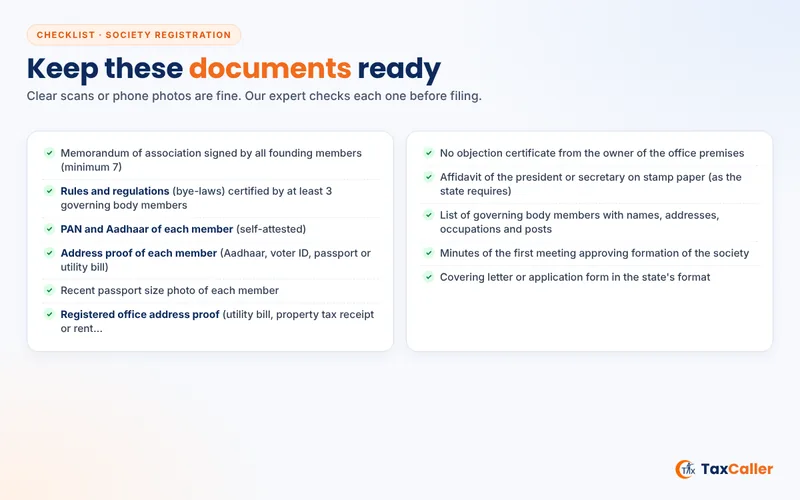
No objection certificate from the owner of the office premises
Affidavit of the president or secretary on stamp paper (as the state requires)
List of governing body members with names, addresses, occupations and posts
Minutes of the first meeting approving formation of the society
Covering letter or application form in the state's format
Why TaxCaller
Real experts, not a call centre
Your work is handled by experienced professionals who explain every step, check your documents and keep you updated.
Registered company
TaxCaller is run by TaxCaller India LLP (LLPIN AAQ-7388), serving clients since 2018.
Fee told upfront
You know the complete fee, our professional fee and the government fee, before any work starts. No hidden charges.
Support after the work
Notices, renewals, returns and compliance reminders: we stay with your business after the registration is done.
Reviewed By
Expert for this topic Society Registration
Abhinay Rai
Advocate
Abhinay Rai is a Advocate specialising in Society Registration. The process, documents, timelines and fees on this page are checked against the current rules and government portals, and updated whenever the law, forms or fees change.
It is the legal recording of a non-profit group of at least seven people with the state Registrar of Societies. The base law is the Societies Registration Act, 1860, though many states have their own Acts. After registration, the society gets a certificate, can open a bank account, hold property and apply for tax exemption.
How many members are needed to register a society?
At least seven persons are needed under Section 1 of the 1860 Act. All of them sign the memorandum of association. From among them, the society picks a governing body, usually with a president, secretary and treasurer. Some state Acts or Registrars add conditions, so we confirm your state's rules before drafting the papers.
What documents are required to register a society?
You need the memorandum of association, the rules and regulations, ID and address proof of all members, photos, office address proof and an NOC from the owner. Most states also ask for an affidavit and the minutes of the first meeting. Some ask for more. We send a state-specific checklist on the first call.
How much does it cost to register a society?
Cost has two parts. The state government fee varies widely, for example ₹50 in Goa and ₹2,000 plus ₹45 user charges in Telangana, as per official sources. Stamp duty and notary charges are extra at actual. TaxCaller's professional fee is separate and is charged + GST. We confirm the full amount before work starts.
How long does society registration take?
Drafting and signing usually take about a week. The Registrar's time then varies by state. Telangana says it issues the certificate within three days of receiving the original application if papers are complete, and Goa lists seven days. Other states can take several weeks, especially when they need a visit or raise queries.
Can a society be registered online?
Yes, in many states. Telangana, Goa, Madhya Pradesh and Bihar, among others, accept applications on state portals. Some states still want original papers or founders to appear at the Registrar's office. We prepare the papers, file online wherever the state allows and tell you on day one whether your state needs a visit.
Is renewal of society registration required?
It depends on the state. The central 1860 Act has no renewal. Uttar Pradesh and Goa require renewal every five years. In UP, a society that does not renew within one year of expiry is treated as unregistered under Section 3-A(5). We note your renewal date and remind you well before it falls due.
What is the difference between a society and a trust?
A society needs at least seven members who elect a governing body, so control is shared. A trust is run by trustees named in the trust deed, often for life, and can start with fewer people. A society suits member-based groups and associations. A trust suits founder-led charities. Our trust registration page covers that option.
Can members of a society earn profit from it?
No. A society cannot share profit with members. Under Section 14 of the 1860 Act, even on closure, leftover property goes to another society, not to members. A member who does real work for the society can be paid a fair salary if the rules allow, but tax law limits benefits to founders.
Does a registered society get income tax exemption automatically?
No. Registration with the Registrar is only the first step. For exemption, the society must register with the Income Tax Department under Section 332 of the Income-tax Act, 2025, starting with Form No. 104 for provisional registration. Donor deduction needs separate approval under Section 354. Both are filed online with the society's PAN.
Is NGO Darpan registration mandatory for a society?
Not for society registration itself. But the NGO Darpan portal of NITI Aayog gives a free unique ID that ministries ask for before giving grants. Under RBI KYC rules, banks must check that a non-profit customer is on Darpan and register it if not. So most active societies sign up soon after opening their bank account.
Can a society change its name, objects or rules later?
Yes. Under Section 12 of the 1860 Act, a change of objects needs a written report to members and approval of three-fifths of members at a special meeting, confirmed one month later. Rules and name changes follow the society's own rules and the state Act. The change is then filed with the Registrar.
Can family members form a society together?
The 1860 Act does not stop relatives from being members. Many small societies start with family and friends. Still, a society is meant to be a member-run body, and some Registrars ask questions when all seven founders are from one family. A mix of members makes the society stronger and easier to register.
Book a free call. Our expert checks your objects and members, explains your state's rules and tells you the full cost, our fee + GST and the government fees, before we file.