Trust Registration in India: Register Your Trust Online
Trust registration for public charitable and private trusts, with deed drafting, stamp duty, Sub-Registrar registration, PAN and tax exemption filing handled by our experts.
Starting from · ₹4,999 Trust Registration Basic plan
STARTING FROM₹4,999
FEE TOLD UPFRONTFree first call
!New company?File INC-20A within 180 days of incorporation
Since 2018Trusted Experience
980+Experts Connected
220+Cities Served
1164+Agents Available
12000+Founders Trusted
S
Srishti Magoo
★★★★★
Excellent experience with TaxCaller for filing my &
my family members ITR returns. The entire process was
smooth, quick and hassle-free. They are professional,
knowledgeable and guided me through every step with patience.
O
obeid sait
★★★★★
The team has handled my taxes for the past three years,
and it's been a wonderful, hassle-free experience.
Thank you for your consistently quick and efficient service.
P
Pushkar
★★★★★
They are among the best in their field. Their work culture
is highly professional, and their client service is smooth
and reliable. They can confidently be relied on to get the job done.
P
Prasad Sheth
★★★★★
Excellent experience with TaxCaller! The ITR filing
process was smooth, quick, and completely hassle-free.
The CA was knowledgeable, responsive, and explained everything clearly.
A
Apoorv Bansal
★★★★★
Excellent service for ITR filing. The team was highly
professional, responsive, and guided me through the entire
process smoothly. My return was filed accurately and on time.
A
Abhishek Kumar
★★★★★
I was searching for a good CA firm in Ghaziabad and found
TaxCaller. The experience was excellent from start to finish.
The team is responsive, transparent, and genuinely helpful.
U
uma pandey
★★★★★
Great service! TaxCaller India made the entire ITR filing
process quick, smooth, and hassle-free. They answered all
my queries patiently and ensured maximum accuracy.
T
tanu mittal
★★★★★
Excellent job! We've been connected for many years,
and your success truly makes me happy. You are an
incredibly intelligent person. Keep shining, keep growing.
B
Bhanu Pratap Maurya
★★★★★
I am filing my ITR since past 3 years with Abhinav and
Firm is known as TaxCaller and they are professional
interms of ITR rules. They will explain and tell you all
the information.
A
ashish Sharma
★★★★★
I am providing my honest reviews:
No.1 service ...
A
AARYAN GROUP
★★★★★
Honestly, finding a good CA firm in Ghaziabad was
confusing, but TaxCaller India made it simple.
I contacted them for GST work and the experience was smooth.
N
News Speaks
★★★★★
If you're looking for a reliable CA firm in Ghaziabad,
TaxCaller India is a great choice. They provide complete
taxation and compliance solutions including GST.
A
Anshul Chaprana
★★★★★
Got my GST registration done through TaxCaller CA firm.
Process was quite smooth, they guided properly on documents
and didn't waste time. Overall good experience.
How we work
Online · Call · WhatsApp
Quick answer
Trust registration in India means signing a trust deed on stamp paper and registering it with the Sub-Registrar under the Registration Act, 1908. You need a settlor, usually two or more trustees, two witnesses, ID proofs and an office address. It mostly takes 7 to 15 working days. Maharashtra public trusts also register with the Charity Commissioner.
Reviewed by Abhinay Rai · Updated 15 Nov 2026
Pick a plan that fits
Basic
Founders who need a registered trust deed
₹4,999+ GST
+ Govt. fee and stamp duty at actual
Pay now (38%)₹1,900+ GSTAfter the registration number₹3,099+ GST
Handled by a TaxCaller Expert Company Registration Expert
Form 104 for provisional registration under Section 332
Provisional approval under Section 354 for donor deduction
Follow-up on queries until the order is issued
Government fees and taxes are extra where applicable. Our expert confirms the final amount on the first call. No hidden charges.
About Trust Registration
Trust registration is the legal process of creating a trust through a written trust deed and registering that deed with the Sub-Registrar under the Registration Act, 1908. Once registered, the deed becomes a public record. The trust can then get its own PAN, open a bank account and apply for income-tax exemption.
This page covers both public charitable trusts and private (family) trusts. It explains the trust deed, stamp duty, the role of the settlor and trustees, state public trust laws such as Maharashtra's, and tax registration under the new Income-tax Act, 2025. It also covers NGO Darpan, CSR-1 and FCRA.
TaxCaller has worked with clients since 2018. Our experts draft the deed, work out the stamp duty, book the Sub-Registrar slot and handle the PAN and tax filings. The paperwork is done online, so you can set up a trust from any city in India.
Complete guide
Choose a topic to open it. Every answer gives the rule or section it comes from.
01 Topic 1 of 20
What Is Trust Registration?
A trust is an arrangement in which one person hands property to others to manage for a set purpose. Section 3 of the Indian Trusts Act, 1882 calls it an obligation annexed to the ownership of property. The trustee accepts the property and holds it for someone else, or for the public.
Trust registration turns this private promise into a public record. The founder signs a trust deed on stamp paper. The deed is then registered at the office of the Sub-Registrar. In some states, a public trust must also be enrolled with the Charity Commissioner or a similar officer.
The five parts of every trust
Settlor (author): the person who creates the trust and gives the first money or property.
Trustees: the people who hold the property, take decisions and run the trust.
Beneficiaries: the people, or the section of the public, who gain from the trust.
Trust property: also called the corpus. It can be cash, land, a building, shares or other assets.
Trust deed: the written document that records the objects, powers and rules of the trust.
Laws that apply to a trust
Law
What it covers
Indian Trusts Act, 1882
Private trusts: how they are created, trustee duties, revocation. Section 1 says the Act does not apply to public or private religious or charitable endowments.
Registration Act, 1908
Registration of the deed at the Sub-Registrar. Section 17(1)(b) makes it compulsory when the deed creates rights in immovable property worth ₹100 or more.
Indian Stamp Act, 1899 and state stamp laws
Stamp duty on the deed. The central schedule deals with trusts in Article 64. Each state sets its own rate.
State public trust Acts
Registration and supervision of public trusts in states such as Maharashtra, Gujarat, Rajasthan and Madhya Pradesh.
Income-tax Act, 2025
Registration of non-profit organisations (Section 332) and approval for donor deduction (Section 354), in force from 1 April 2026.
Foreign Contribution (Regulation) Act, 2010
Rules for any donation that comes from a foreign source.
You can read the full text of these central Acts on India Code, the official legal database of the Government of India.
Family wealth, care of a disabled child, succession planning
Charitable and religious trusts
A public trust can be charitable, religious or both. Charitable purposes include relief of the poor, education, medical relief and care of the environment. A religious trust runs a temple, mosque, gurdwara or church, or holds festivals. Tax rules treat religious spending differently, so the objects must be written with care.
Mixed (public-cum-private) trusts
Some deeds benefit both the public and a family. These mixed trusts are legal. But a new mixed trust cannot get income-tax registration, because Section 332(2) allows partly charitable trusts only if they were created before the 1961 Act came into force. If you want tax benefits, keep the trust wholly public.
Revocable and irrevocable trusts
An irrevocable trust cannot be taken back by the settlor. A revocable trust can. Public trusts are almost always irrevocable. Family trusts may be either, but a revocable trust gives fewer tax and asset protection benefits.
Abhinay Rai Company Registration Expert
Have a question on this topic? Ask Abhinay on a free call.
Who Needs to Register a Trust and When It Is Mandatory
Many people think trust registration is optional. That is only partly true. The law makes it compulsory in some cases, and practical needs make it necessary in most others.
When registration is compulsory
Private trust with land or a building: Section 5 of the Indian Trusts Act says such a trust must be declared in a signed, written document that is registered, unless it is made by will.
Any trust deed that transfers immovable property: Section 17(1)(b) of the Registration Act, 1908 makes registration compulsory when the property is worth ₹100 or more.
Public trusts in states with a public trust Act: in Maharashtra, Section 18 of the Maharashtra Public Trusts Act, 1950 requires the trustee to apply for registration within three months of creating the trust.
When it is not compulsory but still needed
A trust holding only cash can, in theory, exist on an unregistered deed. In practice, banks, the income-tax department, donors, CSR teams and government grant portals ask for a registered deed. Without it, you cannot open a proper bank account or apply for tax registration with confidence.
Who usually registers a trust
Groups starting an NGO for education, health, women, children or animals
Temple, gurdwara, church or mosque committees
Families who want to hold property for children or a dependent member
Alumni, community and religious groups that run scholarships or relief work
Business families who want a charity arm for their giving
Settlor, Trustees and Beneficiaries: Who Can Be What
The people you choose shape how the trust works for decades. Pick them with thought.
Settlor
Under Section 7 of the Indian Trusts Act, any person competent to contract can create a trust. That means an adult of sound mind who is not barred by law. A company can also be a settlor. A trust can be created by or on behalf of a minor only with the permission of a principal civil court. The settlor gives the first corpus, even if it is a small amount.
Trustees
Section 10 says anyone capable of holding property can be a trustee. If the role needs judgement, the trustee must also be competent to contract. No central law fixes a minimum number. We suggest at least two trustees for a private trust. For a public trust, three or more, in an odd number, avoids deadlock in votes. The settlor can also be a trustee.
Name one person as managing trustee to sign day-to-day papers.
Write how a trustee is added, removed or replaced. Section 73 of the Indian Trusts Act sets the default rules for appointing new trustees.
Give each trustee a clear term. In Maharashtra, new Section 30A limits life (perpetual) trustees to one-fourth of the board where the deed is silent.
Beneficiaries
In a private trust, beneficiaries are named people. A minor can be a beneficiary. In a public trust, the beneficiaries are a class of the public. The founder, trustees and their relatives should not draw private benefit from a public trust. Such benefit can cost the trust its tax exemption.
NRIs and foreign nationals
An NRI can be a settlor or trustee. Keep at least one resident trustee so bank and tax work moves smoothly. Note that foreign national trustees can affect FCRA eligibility under the 2026 rules, explained further down this page.
Witnesses
Two adult witnesses with valid ID usually sign the deed. They also appear at the Sub-Registrar's office on the day of registration.
Is a Trust the Right Choice for Your Organisation?
A trust is one of three common forms for a non-profit. Each suits a different kind of group.
Trust: quick to set up, run by a small trusted board and controlled by the deed. It suits families, religious bodies and founders who want close control.
Society: a member-run body with elected office bearers, registered under the Societies Registration Act, 1860 or a state Act. It suits associations and clubs. See society registration.
Section 8 company: registered with the MCA, with the most formal governance and compliance. Large donors and foreign funders often prefer it. See Section 8 company registration.
If you are not sure, read our full comparison of business and non-profit forms on the company registration page, or ask our expert on a free call.
Shadab Company Registration Expert
Have a question on this topic? Ask Shadab on a free call.
Legal proof of existence: the registered deed is a public record. It settles disputes about who controls the trust and its property.
Bank account and PAN: a trust can get its own PAN and open a bank account in its name.
Tax exemption: a public charitable trust can apply for registration under Section 332 of the Income-tax Act, 2025. Its income applied to charity can then be exempt.
Donor tax deduction: with approval under Section 354, donors can claim a deduction under Section 133(1)(b)(ii). This helps you raise funds.
Grants and CSR money: government grants, CSR funds and institutional donors deal only with registered entities.
Continuity: the trust continues even when trustees change or pass away.
Asset protection for families: a private trust can ring-fence property for children or a dependent person and plan succession.
Low setup cost: there is no annual MCA filing, and the board can stay small.
The trust deed is the constitution of your trust. Most later problems come from a weak deed. Banks, the income-tax department and FCRA officers read it line by line.
Clause
What to write
Name and office
A unique name and the full registered office address
Settlor and corpus
Settlor details and the money or property given at the start
Objects
Clear charitable or private aims. Vague or business-like objects are the top reason for tax refusals
Area of work
Whether the trust works across India or in named states
Trustees
First trustees, managing trustee, term, appointment, removal and resignation
Meetings
Frequency, notice, quorum and voting
Powers
Power to open bank accounts, buy or lease property, take grants and employ staff
Accounts and audit
Financial year, books, audit and who signs cheques
Irrevocability
A clear statement that the trust cannot be revoked (for public trusts)
Amendment
How the deed can be changed without changing the core charitable aim
Dissolution
On closure, assets go to a trust with similar objects, never back to the settlor or trustees
Choosing the name
There is no central name approval for a trust. Still, avoid names that copy a registered trademark or an existing NGO. Names suggesting government support, or using protected emblems, are not allowed under central law.
Our expert drafts the deed in plain words. We also keep the clauses that the income-tax and CSR rules look for, so you do not need to amend it later.
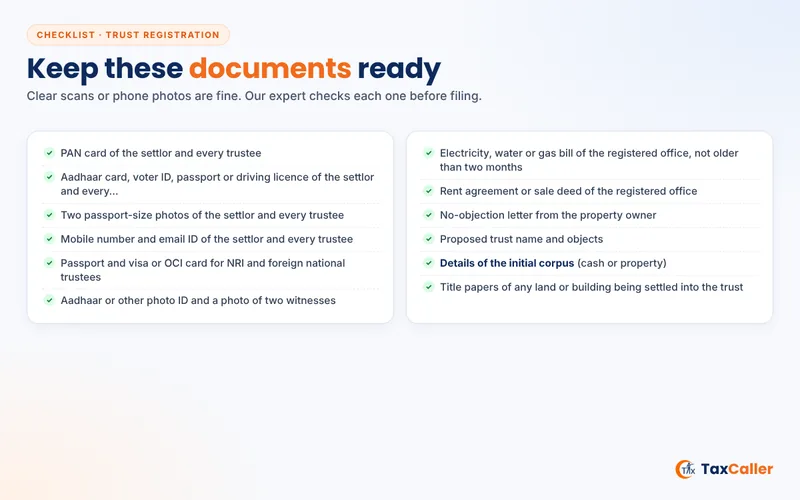
No-objection letter from the owner, if the place is rented or belongs to a relative
For the trust itself
Proposed name and objects of the trust
Details of the initial corpus (cash or property)
Title papers of any land or building being settled into the trust
Draft trust deed (we prepare this)
Stamp paper or e-stamp certificate for the state duty
In Maharashtra, the Charity Commissioner also asks for an application in the prescribed schedule, a statement of immovable property and an affidavit. We prepare these with you.
Shreya Company Registration Expert
Have a question on this topic? Ask Shreya on a free call.
Trust Registration Process: How TaxCaller Files It Online
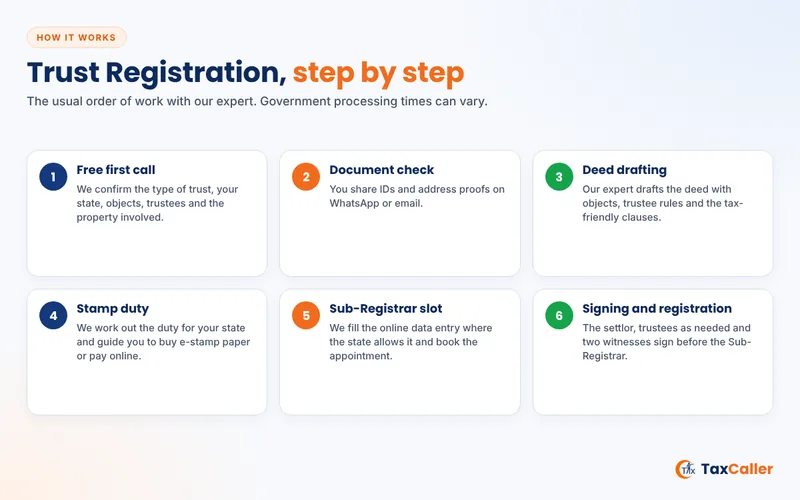
Trust Registration: how the work moves, step by step
Most of the work happens online. In most states, the settlor and witnesses still need to visit the Sub-Registrar once for signatures and biometrics. We plan everything so that one visit is enough.
Free first call: we confirm the type of trust, your state, objects, trustees and the property involved.
Document check: you share IDs and address proofs on WhatsApp or email. We check names, addresses and dates for mismatches.
Deed drafting: our expert drafts the deed with objects, trustee rules and the tax-friendly clauses. You review it and ask for changes.
Stamp duty: we work out the duty for your state and guide you to buy e-stamp paper or pay online.
Sub-Registrar slot: we fill the online data entry where the state allows it and book the appointment.
Signing and registration: the settlor, trustees as needed and two witnesses sign before the Sub-Registrar. Photos and thumb impressions are taken, and the deed is registered.
Charity Commissioner (where needed): in states with a public trust Act, we file the separate registration application.
PAN and bank account: we apply for the trust's PAN and help you open a bank account in the trust's name.
Tax and grant registrations: if you choose, we file Form 104 under Sections 332 and 354, and set up NGO Darpan.
How long each stage takes
Stage
Usual time
Call and document check
1 working day
Deed drafting and your review
2 to 4 working days
Stamp duty payment
1 working day
Sub-Registrar appointment and registration
1 to 7 working days, based on the office
PAN for the trust
A few working days after applying
Charity Commissioner registration
A few weeks to a few months, based on the office
Provisional registration under Section 332
The law sets one month from the end of the month in which you apply
In most states, the registered deed is ready in about 7 to 15 working days from the first call. Delays usually come from slow document collection or a busy Sub-Registrar office.
Stamp Duty, Registration Fee and Other Government Costs
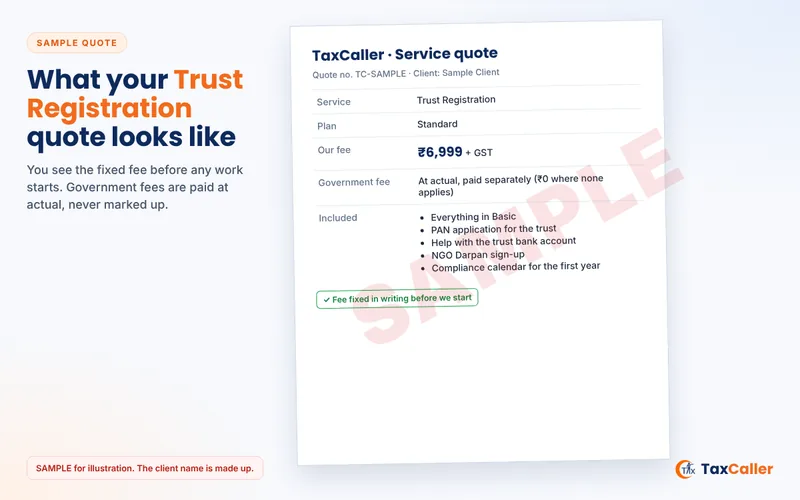
Trust Registration: SAMPLE quote, for illustration only
There is no single national fee for trust registration. The government side of the cost depends on your state and on the value of property you put into the trust.
Government cost
Who sets it
How it is worked out
Stamp duty on the trust deed
State government
Under the state stamp law (Article 64 in the central schedule). Usually a modest fixed amount or a rate on the corpus
Stamp duty when land or a building is settled
State government
Many states charge duty linked to the market value of the property, so it can be much higher
Registration fee at the Sub-Registrar
State fee table under the Registration Act
Fixed amount or a percentage, plus scanning and copy charges
Charity Commissioner fee
State public trust rules
Small fee in states such as Maharashtra
PAN for the trust
PAN service agencies
Nominal processing fee
Form 104 or Form 105
Income-tax department
No filing fee is listed in the official FAQs
NGO Darpan sign-up
NITI Aayog
Free
Rates change from time to time, and some states give concessions for charitable deeds. Before you pay anything, we tell you the exact stamp duty and registration fee for your state and property. Government fees are always paid at actual, directly to the government or through the official e-stamp channel.
TaxCaller's fee covers our professional work only. TaxCaller's fee starts at ₹4,999 + GST. Government fees (stamp duty, Sub-Registrar registration fee, PAN fee and any Charity Commissioner fee) are paid separately at actual.
Plan
What is included
Basic
Consultation, deed drafting, stamp duty guidance, Sub-Registrar appointment and registration support
Standard
Everything in Basic, plus PAN for the trust, help with the bank account and NGO Darpan sign-up
Premium
Everything in Standard, plus Form 104 for provisional registration under Section 332 and approval under Section 354
The fee for each plan is shown in the plans section of this page. Charity Commissioner filing in Maharashtra and similar states, FCRA work and yearly compliance are quoted on the first call. Nothing is added later without your approval.
Zubair Company Registration Expert
Have a question on this topic? Ask Zubair on a free call.
12A, 12AB and 80G Under the New Income-tax Act, 2025
Registering the deed does not make a trust tax-free. Tax exemption needs a separate registration with the income-tax department. Most people still search for it as "12A" and "80G". Those were section numbers in the Income-tax Act, 1961.
On 1 April 2026, the Income-tax Act, 2025 took over from the 1961 Act. The new names are:
Old (1961 Act)
New (2025 Act)
What it does
Section 12A / 12AB, Form 10A and 10AB
Section 332, Form 104 and Form 105
Registers the trust as a non-profit organisation so its income can be exempt
Section 80G(5), Form 10A and 10AB
Section 354, same Form 104 and Form 105
Approval so donors get a deduction
Section 80G deduction for donors
Section 133(1)(b)(ii)
The donor's deduction itself
Forms 104 and 105 are prescribed under Rule 181 of the Income-tax Rules, 2026. Orders are issued in Form 106 (provisional) and Form 107 (regular).
Time limits and validity under Section 332
New trust, work not started: file Form 104 any time in the tax year. Provisional registration lasts three tax years, or up to six months after work starts, whichever is earlier.
Provisional registration held and work started: file Form 105 within six months of starting activities.
Work started without any registration: file Form 105 any time in the tax year. Regular registration lasts five tax years.
Renewal: file at least six months before expiry.
Change in objects: if the objects are changed in a way that does not fit the registration conditions, file within thirty days of the change.
Small trusts: when provisional registration is made regular, or a registration is renewed, it can last ten tax years if total income was not above ₹5 crore in each of the two preceding tax years.
Conditions to qualify
The trust must be set up in India for charitable or public religious purposes.
Its property must be held under an irrevocable trust for the public.
For Section 354 approval, it must not be for a particular religious community or caste. Religious spending is capped at 5% of total income.
The deed must not allow assets to go to non-charitable uses.
It must keep regular accounts, file donation statements and give each donor a certificate.
Already have 12A or 12AB?
You do not need to apply again. Section 355 of the 2025 Act treats a valid registration under Section 12A, 12AA, 12AB or 10(23C) of the old Act as a registration under the new law. Renew it before it expires, using Form 105.
All applications are filed online on the income-tax e-filing portal. Private trusts cannot get this registration.
NGO Darpan, CSR-1 and FCRA: Registrations After the Deed
NGO Darpan
NITI Aayog runs the NGO Darpan portal. It gives each voluntary organisation a unique ID. Many central ministries ask for this ID before they consider a grant application. Sign-up is free and needs the trust's PAN, its registration details and the trustees' details.
CSR-1 for company CSR funds
Companies spend CSR money only through entities registered with the Central Government. Under Rule 4(2) of the Companies (CSR Policy) Rules, 2014, the trust files Form CSR-1 on the MCA portal. A public trust needs income-tax registration and donor approval to qualify.
FCRA for foreign donations
A trust cannot accept money from a foreign source without permission under the Foreign Contribution (Regulation) Act, 2010. The Act gives two routes:
Registration: for trusts with an established track record of work.
Prior permission: for a specific donor, amount and purpose. New trusts usually start here.
Since the 2020 amendment, all foreign money must first be received in the "FCRA Account" at the notified State Bank of India branch in New Delhi. The 2026 rules have tightened eligibility, as noted in the 2026 section below. Applications are made on the FCRA portal.
Registration is the start. A trust must keep clean records every year to keep its bank, tax and grant status.
Task
When
Who it applies to
Books of account, receipts and vouchers
Through the year
Every trust
Trustee meeting minutes
As set in the deed
Every trust
Audit of accounts
Before the return due date
Registered non-profits above the income limit, and trusts under state Acts
Income-tax return
Each year by the due date
Registered trusts, and other trusts with taxable income
Statement of donations and donor certificates
Yearly, in the prescribed form
Trusts approved for donor deduction
Renewal of tax registration
At least six months before expiry
Trusts registered under Section 332 or 354
Change reports and accounts to the Charity Commissioner
Change reports within 90 days in Maharashtra
Public trusts in states with a public trust Act
FCRA annual return
Yearly, by the due date in the FCRA Rules
FCRA-registered trusts
TDS returns and GST
Quarterly or monthly
Trusts that pay salaries or rent, or run taxable activities
Spending rules
A registered trust must spend most of its income on its objects in the same year. Under the old Act, a trust had to apply most of its income in the year, with limited accumulation allowed. The 2025 Act carries forward rules on applying income, with its own limits. We track the exact limit for each tax year.
Returns for financial year 2025-26 are filed under the 1961 Act and its forms. From tax year 2026-27, the 2025 Act and the new form numbers apply. Our accounting and bookkeeping, income tax filing and TDS return filing teams can handle this yearly work.
Abhinay Rai Company Registration Expert
Have a question on this topic? Ask Abhinay on a free call.
The deed does not affect the property and cannot be used as proof of the transfer
Deed presented late
Registration Act, Sections 23 and 25
Must be presented within four months of signing. If the delay is due to urgent necessity or unavoidable accident, a further four months is allowed with a fine of up to ten times the registration fee
Deed not stamped or under-stamped
Indian Stamp Act, 1899, Sections 35 and 40, or the state stamp law
Not accepted as evidence until the duty and a penalty are paid. Under the central Act the penalty can reach ten times the shortfall
Late registration or unreported change in Maharashtra
Maharashtra Public Trusts Act, Sections 18, 22 and 66
Fine on the trustees
Sale or lease of public trust land without sanction in Maharashtra
Maharashtra Public Trusts Act, Section 36
The transfer is invalid
Trustee misuses funds
Indian Trusts Act, Section 23
The trustee must make good the loss
Benefit to founders or trustees, or work outside the objects
Income-tax Act, 2025
Cancellation of registration and loss of exemption
Late donation statement (old Act years)
Income-tax Act, 1961
A late fee for each day of delay, and a separate penalty
Foreign money without FCRA approval
FCRA, 2010
Criminal prosecution, which can lead to a fine, imprisonment or both
Most of these risks are avoidable with a sound deed and a simple yearly calendar. We set up that calendar for every trust we register.
New Income-tax Act from 1 April 2026: the Income-tax Act, 2025 replaced the 1961 Act. Trust registration for tax now falls under Section 332, donor approval under Section 354 and the donor's deduction under Section 133(1)(b)(ii).
New forms under the Income-tax Rules, 2026: Form 104 replaced Form 10A for provisional registration, and Form 105 replaced Form 10AB for regular registration. Both are covered by Rule 181.
Old registrations carried over: Section 355 treats valid 12A, 12AA, 12AB and 10(23C) registrations as registrations under the new Act. No fresh filing is needed until renewal.
Ten-year registration for small trusts: Section 332(5) allows ten tax years, instead of five, on conversion or renewal where total income was within ₹5 crore in each of the two preceding tax years.
FCRA Amendment Rules, 2026: notified by the Ministry of Home Affairs on 22 June 2026 (S.O. 3272(E)). Applicants pick purposes from a fixed list and name the states where they will work. Each added purpose or state costs ₹300. Forms now ask for social media accounts. A trust with foreign nationals (other than persons of Indian origin) as key functionaries is generally not eligible. A new "reasonable activity" test, used for renewal and cancellation, looks for at least ₹10 lakh of foreign contribution used in the previous two financial years.
FCRA Amendment Bill, 2026: introduced in the Lok Sabha in March 2026 and sent to a Joint Parliamentary Committee. It is not law yet. We will update this page if it passes.
Also note a recent state change. The Maharashtra Public Trusts (Second Amendment) Act, 2025 added Section 30A on tenure and perpetual trustees. New deeds in Maharashtra should state each trustee's term clearly.
Shadab Company Registration Expert
Have a question on this topic? Ask Shadab on a free call.
Trust Registration in Uttar Pradesh, Delhi, Maharashtra and Other States
The basic route is the same everywhere: deed, stamp duty and registration at the Sub-Registrar. What changes is the stamp rate, the fee table and whether a second registration is needed.
Uttar Pradesh (Ghaziabad, Noida, Lucknow): the deed is registered at the Sub-Registrar of the area where the office or property is. The IGRS UP portal lets you enter deed details and book a slot online. UP has no general public trusts Act like Maharashtra's.
Delhi: the deed is registered at the Sub-Registrar office for your locality. There is no separate Charity Commissioner registration.
Maharashtra: after the Sub-Registrar, a public trust must apply to the Charity Commissioner under Section 18 within three months. See the Maharashtra Charity Commissioner portal. Under Section 36, prior sanction is needed to sell, gift or exchange trust land, or lease it for long periods.
Gujarat, Rajasthan and Madhya Pradesh: these states have their own public trust Acts and offices, so public trusts there also register with that office.
Other states: the Sub-Registrar route applies, with the state's own stamp rate and fee table.
Our office is in Ghaziabad. We draft deeds and prepare filings online for trusts in any state. For the visit to the Sub-Registrar, we brief you in advance on what to carry and what to expect.
Aadhaar card, voter ID, passport or driving licence of the settlor and every trustee
Two passport-size photos of the settlor and every trustee
Mobile number and email ID of the settlor and every trustee
Passport and visa or OCI card for NRI and foreign national trustees
Aadhaar or other photo ID and a photo of two witnesses
Electricity, water or gas bill of the registered office, not older than two months
Rent agreement or sale deed of the registered office
No-objection letter from the property owner
Proposed trust name and objects
Details of the initial corpus (cash or property)
Title papers of any land or building being settled into the trust
Stamp paper or e-stamp certificate for the state stamp duty
Draft trust deed (prepared by TaxCaller)
Why TaxCaller
Real experts, not a call centre
Your work is handled by experienced professionals who explain every step, check your documents and keep you updated.
Registered company
TaxCaller is run by TaxCaller India LLP (LLPIN AAQ-7388), serving clients since 2018.
Fee told upfront
You know the complete fee, our professional fee and the government fee, before any work starts. No hidden charges.
Support after the work
Notices, renewals, returns and compliance reminders: we stay with your business after the registration is done.
Reviewed By
Expert for this topic Trust Registration
Abhinay Rai
Advocate
Abhinay Rai is a Advocate specialising in Trust Registration. The process, documents, timelines and fees on this page are checked against the current rules and government portals, and updated whenever the law, forms or fees change.
Trust registration means registering a signed trust deed with the Sub-Registrar under the Registration Act, 1908. It is compulsory when the trust holds land or a building worth ₹100 or more. Maharashtra and some other states also require public trusts to register with the Charity Commissioner. Banks and the tax department expect a registered deed anyway.
How much does trust registration cost in India?
The cost has two parts. Government fees cover stamp duty and the Sub-Registrar's fee, and both depend on your state and the property involved. TaxCaller's fee starts at ₹4,999 + GST for deed drafting and registration support. We tell you the exact government fees for your state before any payment.
How many trustees are needed to register a trust?
No central law sets a minimum number of trustees. In practice, a private trust works well with at least two trustees. For a public charitable trust, we suggest three or more, in an odd number, so votes do not deadlock. The settlor can also be a trustee. Two adult witnesses are also needed at registration.
What is the difference between a public trust and a private trust?
A public trust works for the public or a wide group, such as poor students or patients. It can get income-tax exemption after registration. A private trust benefits named persons, usually family members, and is governed by the Indian Trusts Act, 1882. Private trusts do not get the charitable tax exemption at all.
Can I register a trust fully online?
Most steps happen online: document sharing, deed drafting, stamp duty payment and slot booking. In most states, the settlor and two witnesses must still visit the Sub-Registrar once to sign and give biometrics. We prepare everything beforehand, so the visit is short. Tax, PAN and Darpan filings are fully online.
How long does trust registration take?
In most states, the registered deed is ready in about 7 to 15 working days from the first call. Drafting takes two to four days, and the Sub-Registrar slot takes up to a week. In Maharashtra and similar states, Charity Commissioner registration can take a few more weeks or months, based on the office.
Do 12A and 80G come automatically after trust registration?
No. Deed registration only creates the trust. Tax exemption needs a separate application on the income-tax portal. From 1 April 2026, the old 12A and 80G are replaced by Sections 332 and 354 of the Income-tax Act, 2025. A new trust that has not started work files Form 104 online.
Can a trust deed be changed after registration?
Yes, if the deed has an amendment clause. Trustees pass a resolution and sign a supplementary deed, which is registered like the original. The core charitable aim should not change. A registered trust must also tell the tax department about changed objects within thirty days. Maharashtra trusts report changes within 90 days.
Can a trust own property and open a bank account?
A trust is not a company, so property is held in the names of the trustees for the trust. In practice, banks open accounts in the trust's name using its PAN and registered deed. Land or buildings bought later are recorded as held by the trustees for the trust. Maharashtra needs prior sanction to sell.
Can NRIs or foreign nationals be trustees of an Indian trust?
Yes. An NRI can be a settlor or trustee. Keep at least one resident trustee for smooth bank and tax work. Foreign national trustees can affect FCRA eligibility under the 2026 rules, unless the government allows an exception. If you expect foreign donations, plan the board carefully before the deed is signed and registered.
Is a registered trust exempt from income tax?
Not just by registering the deed. A public charitable trust must also register under Section 332 of the Income-tax Act, 2025. It must then spend most of its income on its objects, keep accounts and file returns each year. Private and family trusts are taxed under normal rules and do not get this exemption.
Can a new trust receive foreign donations?
Not without approval under the Foreign Contribution (Regulation) Act, 2010. A new trust usually applies for prior permission for a specific donor and purpose. Full FCRA registration needs a track record of work. The money must first come into an FCRA account at SBI's notified New Delhi branch. Breaking these rules is a criminal offence.
Can a registered trust be cancelled or closed?
A private trust ends when its purpose is complete, or under Section 77 of the Indian Trusts Act. It can be revoked only as Section 78 allows. A public trust is usually irrevocable, so closure follows the deed's dissolution clause and state law. Leftover assets must go to a trust with similar objects, never to trustees.
Which is better for an NGO: trust, society or Section 8 company?
A trust is the quickest and suits a small, close board. A society suits a member-run body with elections. A Section 8 company has the most formal rules and appeals to large and foreign donors. All three can get income-tax registration. Our expert helps you pick the right form on a free call.