GST Services Online for Every Stage of Your Business
GST services from registration to returns, annual return, LUT, cancellation and notice replies, handled online by TaxCaller's tax experts across India.
!Late GST return?Late fee and interest run till you file
Since 2018Trusted Experience
980+Experts Connected
220+Cities Served
1164+Agents Available
12000+Founders Trusted
S
Srishti Magoo
★★★★★
Excellent experience with TaxCaller for filing my &
my family members ITR returns. The entire process was
smooth, quick and hassle-free. They are professional,
knowledgeable and guided me through every step with patience.
O
obeid sait
★★★★★
The team has handled my taxes for the past three years,
and it's been a wonderful, hassle-free experience.
Thank you for your consistently quick and efficient service.
P
Pushkar
★★★★★
They are among the best in their field. Their work culture
is highly professional, and their client service is smooth
and reliable. They can confidently be relied on to get the job done.
P
Prasad Sheth
★★★★★
Excellent experience with TaxCaller! The ITR filing
process was smooth, quick, and completely hassle-free.
The CA was knowledgeable, responsive, and explained everything clearly.
A
Apoorv Bansal
★★★★★
Excellent service for ITR filing. The team was highly
professional, responsive, and guided me through the entire
process smoothly. My return was filed accurately and on time.
A
Abhishek Kumar
★★★★★
I was searching for a good CA firm in Ghaziabad and found
TaxCaller. The experience was excellent from start to finish.
The team is responsive, transparent, and genuinely helpful.
U
uma pandey
★★★★★
Great service! TaxCaller India made the entire ITR filing
process quick, smooth, and hassle-free. They answered all
my queries patiently and ensured maximum accuracy.
T
tanu mittal
★★★★★
Excellent job! We've been connected for many years,
and your success truly makes me happy. You are an
incredibly intelligent person. Keep shining, keep growing.
B
Bhanu Pratap Maurya
★★★★★
I am filing my ITR since past 3 years with Abhinav and
Firm is known as TaxCaller and they are professional
interms of ITR rules. They will explain and tell you all
the information.
A
ashish Sharma
★★★★★
I am providing my honest reviews:
No.1 service ...
A
AARYAN GROUP
★★★★★
Honestly, finding a good CA firm in Ghaziabad was
confusing, but TaxCaller India made it simple.
I contacted them for GST work and the experience was smooth.
N
News Speaks
★★★★★
If you're looking for a reliable CA firm in Ghaziabad,
TaxCaller India is a great choice. They provide complete
taxation and compliance solutions including GST.
A
Anshul Chaprana
★★★★★
Got my GST registration done through TaxCaller CA firm.
Process was quite smooth, they guided properly on documents
and didn't waste time. Overall good experience.
How we work
Online · Call · WhatsApp
Quick answer
GST services cover everything a business must do under GST: registration, monthly or quarterly returns, the annual return, LUT for exports, cancellation and notice replies. TaxCaller's tax experts handle each one online across India. Fees start at ₹599 + GST and differ by service. Government dues such as tax, interest and late fees are paid separately.
Reviewed by Abhinay Rai · Updated 15 Nov 2026
Most chosen GST Services options
Starting fee of each option. Open any card to see every plan, documents and steps.
Most Popular
GST
Complete your GST registration India the right way
GST services are the registrations, filings and replies a business needs to stay on the right side of the Goods and Services Tax law. They start when your turnover crosses the limit, or when you begin a business that must register from day one. They end only when your GSTIN is cancelled and the final return is filed.
In between come monthly or quarterly returns, an annual return, a yearly LUT if you export, and replies when the department writes to you. Each duty has its own form, due date and late fee under the CGST Act, 2017 and the CGST Rules, 2017.
This page is the map of that journey. It explains how GST works across the life of a business, gives you a compliance calendar, the key limits, the main penalties and the 2026 changes, and helps you pick the right TaxCaller service. Each service then has its own page with full details and fees. Every legal point here is checked against the CGST Act, the CGST Rules and official CBIC, GSTN and GST Council releases as they stand in November 2026. The page is reviewed by Abhinay Rai, Advocate.
Complete guide
Choose a topic to open it. Every answer gives the rule or section it comes from.
01 Topic 1 of 20
What Are GST Services?
GST is a tax on the supply of goods and services. It replaced VAT, service tax, central excise and several other indirect taxes from 1 July 2017. The law sits in the Central Goods and Services Tax Act, 2017 (CGST Act), the Integrated Goods and Services Tax Act, 2017 (IGST Act), the GST Act of each state and the rules made under them.
Paying the tax is only one part of GST. The law also asks you to register, issue proper invoices, report every sale, claim input tax credit (ITC) correctly, file returns on time and answer the department when it writes to you. GST services are the professional help that covers these duties, so you can run the business while the paperwork stays on track.
GST work comes in three kinds:
One-time work: new registration, change of registration details, cancellation, revocation of a cancelled GSTIN and reply to a specific notice.
Recurring work: GSTR-1 and GSTR-3B every month or quarter, ITC matching, the yearly GSTR-9 and GSTR-9C, and a fresh LUT every financial year for exporters.
Advice on demand: GST rates and HSN codes, place of supply, reverse charge, e-invoice and e-way bills, refunds and appeals.
All GST filings happen on the common portal, gst.gov.in, run by the Goods and Services Tax Network (GSTN). Acts, rules, notifications and circulars are published on the CBIC GST website (cbic-gst.gov.in). We work only on these official systems, using your own login.
Most small businesses need only the first three rows in a normal year. Exporters add the LUT. Notices and cancellation come up less often, but they carry the tightest deadlines, so it helps to know about them before they arrive.
Abhinay Rai GST Expert
Have a question on this topic? Ask Abhinay on a free call.
TaxCaller charges a professional fee for each GST service. The government charges almost nothing to file, but tax, interest and late fees are separate. The two are shown apart below.
Starting professional fee (+ GST), government fee extra
You need advice on rates, refunds or appeals, starting with a 30-minute expert call
₹799 + GST
These are starting fees for the simplest case. Higher plans cover more invoices, more months or harder work. Our expert tells you the exact fee in writing before work starts. Every TaxCaller fee is + GST, because our service is itself a taxable supply.
What the government charges
GST has very few government filing fees. Most of what you pay the government is tax, and only defaults cost extra. Here is the split.
Service
Government fee
Other government dues that may apply
GST registration
Nil
None
Return filing
Nil
Tax payable, late fee (section 47) and interest (section 50) if late
Annual return
Nil
Tax found short with interest, late fee if late
LUT filing
Nil
None
Cancellation and revocation
Nil
Amount on closing stock (section 29(5)), pending tax, late fees
Notice reply and appeal
Nil for a reply
Tax, interest and penalty if confirmed. Pre-deposit of 10% of disputed tax for a first appeal (section 107(6)).
All government dues are paid by you directly from your own electronic cash ledger, using a challan created on the GST portal. They never pass through us, and they are paid at actual.
GST is one tax with four parts. Which part you charge depends on where the supply starts and where it ends, called the place of supply.
Part
Charged on
Goes to
Law
CGST
Sales within one state, together with SGST
Centre
Section 9, CGST Act
SGST
Sales within one state, together with CGST
State
GST Act of each state
UTGST
Sales within a union territory that has no legislature, such as Chandigarh or Ladakh, together with CGST
Centre, for that territory
Section 7, UTGST Act
IGST
Inter-state sales, imports, exports and supplies to SEZs
Centre, then shared with the state where the goods or services are used
Section 5, IGST Act
Delhi and Puducherry have their own legislatures, so they charge SGST, not UTGST. Exports and SEZ supplies are zero-rated under section 16 of the IGST Act.
Rates after the September 2025 reset. From 22 September 2025, most goods and services moved to two main rates, 5% and 18%, under Notification 9/2025-Central Tax (Rate) and the matching notifications for services. A 40% rate applies to a short list of luxury and sin items. A few special rates continue, for example on gold and precious stones. The old 12% and 28% slabs were largely removed.
Common service
GST rate
Professional, consulting, IT and most business services
18%
Restaurant service outside specified hotels
5%, without ITC
Hotel rooms up to ₹7,500 a night
5%, without ITC
Salons, gyms, yoga and fitness centres
5%, without ITC
Individual life and health insurance
Exempt from 22 September 2025
Healthcare by clinical establishments, education by schools
Exempt
House let out as a residence
Exempt in most cases; reverse charge when let to a GST-registered business
Rates change only by notification. Check the rate for your HSN or SAC code before you price a new product or sign a contract. Our free tools page has a GST calculator for quick checks.
Many GST duties depend on your aggregate turnover. Under section 2(6), this is the total value of taxable, exempt, export and inter-state supplies of all your GSTINs under one PAN, across India, without the GST itself. These are the limits that matter most in November 2026.
Duty
Limit
Law
Registration, only goods
₹40 lakh (₹20 lakh for sellers of ice cream, pan masala and tobacco). ₹20 lakh in Arunachal Pradesh, Meghalaya, Puducherry, Sikkim, Telangana and Uttarakhand. ₹10 lakh in Manipur, Mizoram, Nagaland and Tripura.
Section 22, Notification 10/2019-Central Tax
Registration, services or mixed
₹20 lakh. ₹10 lakh in Manipur, Mizoram, Nagaland and Tripura.
Section 22(1)
Registration whatever the turnover
Inter-state supply of goods, casual taxable persons, reverse charge payers, e-commerce operators and sellers through them (with some exceptions), input service distributors, TDS and TCS deductors, non-resident taxable persons
Section 24
Composition scheme, goods
Up to ₹1.5 crore (₹75 lakh in some North-Eastern and hill states)
Section 10(1), Notification 14/2019-Central Tax
Composition scheme, services
Up to ₹50 lakh
Section 10(2A)
QRMP (quarterly returns)
Up to ₹5 crore
Rule 61A
GSTR-9 annual return compulsory
Above ₹2 crore
Section 44, Notification 15/2025-Central Tax
GSTR-9C reconciliation
Above ₹5 crore
Rule 80(3)
E-invoicing
Aggregate turnover above ₹5 crore in a previous financial year
Rule 48(4), Notification 10/2023-Central Tax
HSN code digits on invoices
4 digits up to ₹5 crore (may be left out on sales to unregistered buyers), 6 digits above
Notification 78/2020-Central Tax
E-way bill
Movement of goods worth more than ₹50,000 per consignment
Rule 138
Two points people often miss. First, the registration limit counts exempt sales too, so a business selling mostly exempt goods can still cross it. Second, once you are registered, every return is due even if your turnover later falls, until the GSTIN is cancelled.
Shadab GST Expert
Have a question on this topic? Ask Shadab on a free call.
Regular Scheme, Composition or QRMP: Your Filing Options
After registration, you choose how you will pay and report GST. The choice decides your forms, your due dates and whether your buyers get ITC.
Option
Who it suits
Returns
Key limits
Regular, monthly
Larger businesses, B2B sellers whose buyers want ITC every month
GSTR-1 (11th), GSTR-3B (20th), GSTR-9
Must file monthly if turnover is above ₹5 crore
Regular, QRMP
Small and mid-size businesses up to ₹5 crore
GSTR-1 and GSTR-3B quarterly, IFF optional, PMT-06 payment in months 1 and 2
Opt in or out on the portal in the window GSTN opens for each quarter
Composition
Small traders, manufacturers, restaurants and service providers selling mostly to consumers
CMP-08 (quarterly), GSTR-4 (yearly)
No ITC, cannot collect GST on invoices, no inter-state sales of goods
Composition tax rates are low, 1% for traders and manufacturers and 5% for restaurants, but you lose ITC and cannot charge GST to buyers. Section 10(2) and Notification 14/2019-Central Tax also bar some businesses, such as makers of ice cream, pan masala and tobacco products. Service providers use the separate section 10(2A) scheme at 6%.
QRMP cuts the number of returns from 24 to 8 a year. Tax is still paid every month, either by a fixed sum based on the last return or by working out the actual tax. If your B2B buyers want ITC monthly, you can upload their invoices through IFF in the first two months of the quarter.
Not sure which suits you? Our expert compares tax cost, ITC and paperwork on your actual numbers before you opt in. You can then move on to return filing under the chosen option.
Here are the GST dates a business tracks through the year. Dates fall in the month after the tax period unless the table says otherwise. The government extends a date only by notification, so always check the news section of gst.gov.in near a due date.
Due date
Return or action
Who
10th
GSTR-7 (TDS) and GSTR-8 (TCS)
Government deductors and e-commerce operators
11th
GSTR-1
Monthly filers
13th
IFF (months 1 and 2, optional) or quarterly GSTR-1 (after the quarter)
QRMP filers
18th after the quarter
CMP-08 with tax payment
Composition taxpayers
20th
GSTR-3B with tax payment
Monthly filers
22nd or 24th after the quarter
Quarterly GSTR-3B (date depends on your state)
QRMP filers
25th
PMT-06 tax payment (months 1 and 2)
QRMP filers
Before the first export of the year
LUT in RFD-11 for the new financial year
Exporters and SEZ suppliers
30 June
GSTR-4 for the previous year
Composition taxpayers
30 November
Last date to claim missed ITC and correct GSTR-1 and GSTR-3B of the previous year (sections 16(4), 37(3), 39(9))
All regular taxpayers
31 December
GSTR-9 and GSTR-9C for the previous year
Turnover above ₹2 crore (9C above ₹5 crore)
Within 15 days of a change
Amendment in REG-14
Anyone whose registration details change
Within 30 days of the event
Cancellation in REG-16
Business closed, sold or converted
Within 3 months of cancellation
Final return GSTR-10
Taxpayers whose GSTIN is cancelled
A practical rhythm: send sales data by the 5th and purchase data by the 10th. That leaves time to match ITC in IMS and GSTR-2B before GSTR-3B is due.
Good GST compliance is more than avoiding fines. It changes how buyers, banks and the department see your business.
Your buyers get ITC. A business buyer can claim ITC only if your invoice shows in their GSTR-2B (section 16(2)(aa)). Late or wrong GSTR-1 filings cost them money, and soon cost you the customer.
Lower tax cost. Correct ITC claims reduce the cash you pay. Missed claims after 30 November of the next year are lost for good.
Loans and tenders. Banks, NBFCs and government buyers often ask for GSTR-3B and GSTR-1 copies and a clean filing record.
Selling online and across states. E-commerce platforms and inter-state supplies of goods need an active GSTIN.
Smooth exports. An LUT lets you export without blocking cash in IGST, and clean returns speed up refunds.
Fewer notices. Most scrutiny notices come from mismatches between GSTR-1, GSTR-3B, GSTR-2B and the annual return. Matching them each month keeps them away.
Fewer surprises. No blocked e-way bills, no surprise suspension of your GSTIN and no interest piling up in the background.
Shreya GST Expert
Have a question on this topic? Ask Shreya on a free call.
Keep these ready for the service you need. We confirm the exact list on the first call, because it changes with the type of business and premises.
Service
Main documents
GST registration
PAN of the business, PAN and Aadhaar of owners, partners or directors, photographs, proof of business address (electricity bill plus rent agreement or consent letter, or ownership proof), bank details, incorporation certificate or partnership deed, board resolution or authorisation letter
GST return filing
GST login, sales invoices or sales register, purchase invoices, credit and debit notes, e-way bills, bank statement for payments, earlier returns
GST annual return
All GSTR-1 and GSTR-3B of the year, GSTR-2B statements, books of account, trial balance, audited financial statements (for GSTR-9C), HSN-wise sales summary
GST LUT filing
GSTIN login, details of two independent witnesses (name, address, occupation), authorised signatory details, last year's LUT reference if any
GST cancellation
Reason and date of closure, stock and capital goods statement on that date, all pending returns, proof of sale or merger if relevant
GST notice reply
Copy of the notice with its reference number, returns and GSTR-2B for the period, ledgers, invoices, earlier replies and orders, payment challans (DRC-03)
Rule 26 asks companies to verify GST applications and filings with a Class 3 Digital Signature Certificate (DSC). Most other taxpayers can sign with an Aadhaar OTP (EVC). Share documents as clear PDF scans or photos. Our expert flags anything that looks likely to draw a query before it goes to the portal.
How TaxCaller Handles GST Services Online, Step by Step
GST Services: how the work moves, step by step
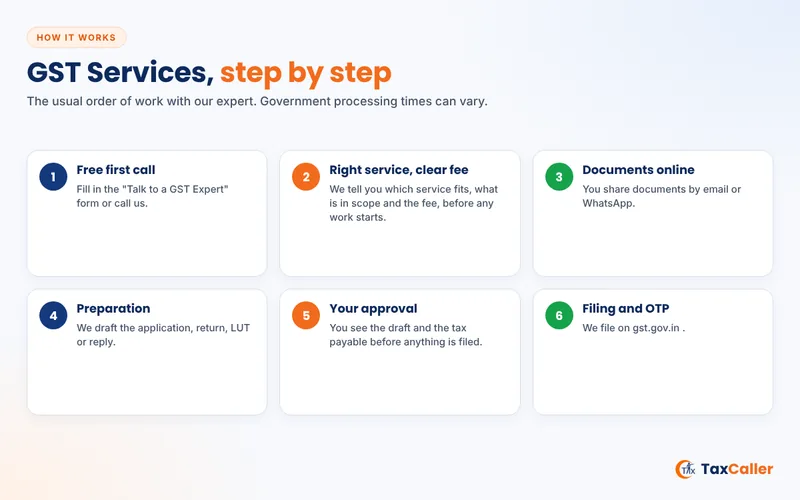
Every GST service at TaxCaller follows the same simple path. You deal with one expert from the first call to the filed acknowledgement.
Free first call. Fill in the "Talk to a GST Expert" form or call us. Our expert asks what has happened and which dates are close.
Right service, clear fee. We tell you which service fits, what is in scope and the fee, before any work starts. Our fee is charged + GST. Government dues are separate.
Documents online. You share documents by email or WhatsApp. We check them against the portal's rules and list anything missing.
Preparation. We draft the application, return, LUT or reply. For returns, we match your ITC with GSTR-2B and IMS first.
Your approval. You see the draft and the tax payable before anything is filed.
Filing and OTP. We file on gst.gov.in. You confirm with an Aadhaar OTP (EVC) or DSC, as the portal requires.
Proof. You receive the ARN, acknowledgement or filed return as a PDF for your records.
Follow-up. We track queries, notices and next due dates, and remind you before each one.
Everything happens online, so you do not need to visit our office or any GST office. Where an officer orders a physical check of your premises, we tell you what to keep ready.
Some timelines are set by law. Others depend on how fast documents come in and how the officer responds. Here is what to expect.
Service
Time limit or usual time
Law
New registration
Officer acts within 7 working days of the application. Up to 30 days if a physical check is ordered. Low-risk applicants under the simplified route can get approval within 3 working days.
Rule 9, Rule 14A
Reply to a registration query (REG-03)
7 working days
Rule 9(2)
Amendment of registration
Apply within 15 days of the change. Most changes other than the principal place of business now take effect on submission.
Rule 19
Monthly or quarterly return
By the due date of each period
Sections 37, 39
Annual return
By 31 December after the year
Section 44
LUT
Acknowledged online on submission
Rule 96A
Cancellation application
Apply within 30 days of the event
Section 29, Rule 20
Final return GSTR-10
Within 3 months of cancellation
Section 45, Rule 81
Revocation of cancellation
Within 90 days of the order, extendable by up to 180 days
Section 30, Rule 23
Reply to ASMT-10 scrutiny notice
30 days, or longer if the officer allows
Section 61, Rule 99
First appeal
3 months from the order, plus 1 month with sufficient cause
Section 107(1), 107(4)
Refund acknowledgement
10 days from the application (from 1 November 2026). Refund order within 60 days of a complete application.
Rule 90, Section 54(7)
Filing any return
Not allowed after 3 years from its due date
Sections 37(5), 39(11), 44(2), 52(15)
Our own turnaround is quick once documents are complete. We usually file within one to two working days for registration, LUT and routine returns. Notice replies take longer, because each one needs a reconciliation, and we agree a date with you on the first call.
Zubair GST Expert
Have a question on this topic? Ask Zubair on a free call.
GST defaults cost money in three ways: late fee, interest and penalty. The amounts below are as on November 2026.
Default
Cost
Law
Late GSTR-1 or GSTR-3B
₹50 a day (₹20 a day for nil returns), CGST and SGST together. Capped at ₹500 for nil returns, and ₹2,000, ₹5,000 or ₹10,000 per return depending on turnover.
Section 47(1), Notifications 19/2021 and 20/2021-Central Tax
Late GSTR-9
₹50, ₹100 or ₹200 a day by turnover slab. Capped at 0.04% of turnover (0.5% above ₹20 crore).
Section 47(2), Notification 07/2023-Central Tax
Late payment of tax
Interest at 18% a year on the net cash tax, from the day after the due date
Section 50(1)
Wrong ITC claimed and used
Interest at the rate notified under section 50(3)
Section 50(3)
Not registering when liable, supply without a proper invoice, wrong ITC and similar offences
₹10,000 or the tax involved, whichever is higher
Section 122(1)
Tax short paid, no fraud (FY 2024-25 onwards)
Tax, interest and penalty of 10% of tax or ₹10,000, whichever is higher
Section 74A
Tax short paid with fraud or suppression
Tax, interest and penalty equal to the tax, reduced if paid early
Sections 74, 74A
Breach with no specific penalty
Up to ₹25,000
Section 125
Other consequences of not filing:
A GSTR-3A notice, and then an assessment of your tax by the officer (sections 46 and 62).
E-way bills blocked after two or more tax periods of missed returns (Rule 138E).
Suspension and then cancellation of the GSTIN (section 29(2)).
Your buyers lose ITC on your bills, which hurts business relationships.
Example: a regular GSTR-3B filed 10 days late costs ₹500 in late fee. If ₹1,00,000 of tax was also paid 30 days late, interest adds about ₹1,479. Late fee must be paid in cash. ITC cannot be used for it.
Every GST notice carries its own deadline. If the date passes, the officer can decide without hearing you. These are the notices businesses see most, with the time the law gives to respond.
Notice
Why it comes
Time to respond
Law
GSTR-3A
A return was not filed
15 days, after which the officer may assess your tax
Section 46, Rule 68
REG-03
Query on a new registration
7 working days, reply in REG-04
Rule 9(2)
REG-17
Proposal to cancel your GSTIN
7 working days, reply in REG-18
Rule 22(1)
DRC-01B
Tax in GSTR-1 is higher than tax paid in GSTR-3B
7 days to pay or explain
Rule 88C
DRC-01C
ITC in GSTR-3B is higher than ITC in GSTR-2B
7 days to pay or explain
Rule 88D
ASMT-10
Gaps found in scrutiny of your returns
30 days, reply in ASMT-11
Section 61, Rule 99
ADT-01
Department audit of your records
At least 15 working days of notice before the audit
Section 65, Rule 101
DRC-01A
Intimation of tax due before a show cause notice
Pay through DRC-03 or reply in Part B by the date given
Rule 142(1A)
DRC-01
Show cause notice demanding tax
By the date in the notice, reply in DRC-06
Sections 73, 74, 74A
Which demand section applies? For FY 2017-18 to FY 2023-24, demands are raised under section 73 (no fraud) or section 74 (fraud or suppression). From FY 2024-25, both cases fall under one section, 74A. The notice must be issued within 42 months from the due date of the annual return, and the order within 12 months after that. Where there is no fraud, paying the tax with interest within 60 days of the notice means no penalty.
If the order goes against you:
First appeal: to the Appellate Authority in APL-01 within 3 months of the order, plus 1 month for sufficient cause. You pay the admitted tax and 10% of the disputed tax, capped at ₹20 crore under the CGST Act (section 107).
Second appeal: to the GST Appellate Tribunal within 3 months of the appeal order, with a further 10% pre-deposit, also capped at ₹20 crore under the CGST Act (section 112). The tribunal was launched on 24 September 2025 and takes appeals online.
Our GST notice reply service handles the reply, the reconciliation behind it and the hearing.
Common GST Mistakes and Why Applications Get Rejected
Most GST trouble starts with small errors that repeat month after month. These are the ones we see most often.
Address proof mismatch. The rent agreement, electricity bill and the address typed in REG-01 do not match. This is the top reason for registration queries and rejection.
Missing the REG-03 reply. If the query is not answered within 7 working days, the application can be rejected.
Claiming ITC not in GSTR-2B. Section 16(2)(aa) allows ITC only for invoices your supplier has reported. Claiming more invites a DRC-01C intimation or a notice.
Wrong buyer GSTIN or B2B shown as B2C. Your buyer then loses ITC, and the fix has to be made through GSTR-1A or an amendment.
Wrong place of supply. Charging CGST and SGST instead of IGST, or the other way round, means paying again and claiming a refund.
Skipping nil returns. A nil return is still due. Late fee runs even when there is no tax.
Not paying suppliers within 180 days. ITC must then be reversed with interest, under the second proviso to section 16(2).
Forgetting the yearly LUT. Exports made without a valid LUT for that year may need IGST paid on them.
Closing the business but not the GSTIN. Returns and late fees keep running until cancellation, and GSTR-10 is still due after it.
Ignoring the portal. Notices are served on the portal and by email under section 169. Many owners see them only after the reply date has passed.
Each of these can be avoided with a monthly check. That is the main reason businesses hand GST to an expert rather than filing in a rush on the last day.
Abhinay Rai GST Expert
Have a question on this topic? Ask Abhinay on a free call.
Day-to-Day GST Duties: Invoices, ITC, E-Invoice and E-Way Bill
Registration is the start. These duties run every day after that, in the background of your business.
Tax invoices. Each invoice must carry the details listed in section 31 and Rule 46: GSTIN of both parties for B2B sales, invoice number, date, HSN or SAC code, taxable value, rate and tax amount, and place of supply.
E-invoice. If your aggregate turnover crossed ₹5 crore in a previous financial year, B2B invoices must be reported to the Invoice Registration Portal to get an IRN and QR code (Rule 48(4)).
E-way bill. Goods worth more than ₹50,000 per consignment need an e-way bill before they move (Rule 138).
ITC matching. Each month, accept, reject or keep pending your purchase invoices in IMS, then check GSTR-2B before claiming ITC. ITC on items listed in section 17(5), such as most motor cars and food, is blocked.
Reverse charge. On some purchases, such as legal services from an advocate or goods transport from a GTA, you pay the GST instead of the supplier (section 9(3) and 9(4)).
Records. Keep books and invoices for 72 months from the due date of the annual return for that year (section 36).
Display. Show your GSTIN and certificate at your place of business (Rule 18).
Most of this is easier with good books. Our accounting and bookkeeping service keeps your ledgers GST-ready, so return filing becomes a monthly routine rather than a scramble.
GST for Freelancers, Online Sellers, Exporters and Shops
The same law lands differently on each kind of business. Here is what usually matters most, and which service tends to fit.
Business
What matters most
Services that usually fit
Freelancers and consultants
Register once turnover crosses ₹20 lakh (₹10 lakh in Manipur, Mizoram, Nagaland and Tripura). Work for foreign clients is an export and counts in turnover. Billing clients in other states does not by itself force registration (Notification 10/2017-Integrated Tax).
Registration, LUT, quarterly returns
Online sellers of goods
Most marketplace sellers need a GSTIN from the first sale (section 24). Small sellers within one state can sell through a marketplace without it, under Notification 34/2023-Central Tax, if conditions are met. The marketplace collects TCS from your payout under section 52.
Registration, monthly returns
Exporters
File an LUT every year. Goods must leave India within 3 months of the invoice, and payment for services must arrive within 1 year (Rule 96A). Unused ITC can be refunded (section 54(3)).
LUT, refunds, consultant
Shops and traders
₹40 lakh limit for goods in most states. Composition up to ₹1.5 crore at 1%. E-way bill for goods above ₹50,000.
Registration, composition or QRMP returns
Restaurants and cafes
5% without ITC for most restaurants, or composition at 5%. Food delivery apps pay the GST on orders placed through them (section 9(5)).
These changes come from CBIC notifications, GSTN advisories and the GST Council website. We list only what has been officially notified or announced, and we flag what is still a recommendation.
Already notified
New registration, amendment and cancellation rules (from 1 November 2026). The CGST (Amendment) Rules, 2026, notified by Notification 05/2026-Central Tax dated 26 October 2026, revised REG-01 and substituted Rules 19 and 20. Most changes in registration details, other than the principal place of business, now take effect on submission. Where returns are filed, dues are paid and set conditions are met, such as monthly output tax within ₹2.5 lakh, the portal now cancels a REG-16 application itself and confirms it in REG-38.
Rule 14B for online sellers. A seller registered in one state can register in another state using an e-commerce operator's warehouse as the place of business, if its tax on supplies to registered buyers stays within ₹2.5 lakh a month and the operator consents within 7 working days.
Faster refunds. The officer must issue the refund acknowledgement or deficiency memo within 10 days instead of 15 (Rule 90). Otherwise, the application is treated as acknowledged.
Finance Act, 2026 changes (from 1 November 2026). Notification 03/2026-Central Tax brought sections 153 to 155 of the Finance Act, 2026 into force. Post-sale discounts can now be given through a credit note, with the buyer reversing ITC (sections 15(3) and 34). Provisional refund of 90% now covers inverted duty claims (section 54(6)). The ₹1,000 minimum refund limit no longer applies to exports made with IGST paid (section 54(14)).
GSTR-3B portal changes. GSTN advisories in early 2026 made the portal compute interest in Table 5.1 and required the tax liability breakup to be saved before filing. Auto-filled liability from GSTR-1 stays locked, so corrections go through GSTR-1A.
Annual return for FY 2025-26. GSTR-9 and GSTR-9C opened on the portal on 8 October 2026 and are due on 31 December 2026. The ₹2 crore exemption continues.
Notified for 1 April 2027. The same notification substitutes Rules 21A and 22 and adds a new Rule 23A from 1 April 2027: system-based suspension and cancellation for non-filing, and revocation of such cancellation on an application in REG-21 within 180 days.
Three-year bar in action. Returns cannot be filed three years after their due date. GSTR-9 for FY 2022-23, due on 31 December 2023, cannot be filed after 31 December 2026.
Recommended by the 57th GST Council (8 October 2026), not yet law
Waiver of late fee on GSTR-3B (returns under section 39(1)) for previous-year turnover up to ₹5 crore, if filed by the end of the month in which it was due.
No show cause notice where the tax involved is below ₹10,000.
Cut in the general penalty under section 125 from ₹25,000 to ₹10,000.
Removal of arrest powers by omitting section 69, and a higher money threshold for prosecution, from ₹1 crore to ₹5 crore.
The Council's press release itself says that its recommendations take effect only through notifications, circulars or law amendments. We update this page as each one is notified.
Shadab GST Expert
Have a question on this topic? Ask Shadab on a free call.
GST Services Across India, from Our Ghaziabad Office
GST is one law, but some parts change from state to state.
Limits differ. Registration limits are lower in some North-Eastern and hill states, as shown in the thresholds table.
One GSTIN per state. Under section 25, you need a separate registration in each state from which you supply. Each GSTIN is treated as a distinct person under section 25(4), with its own returns.
Quarterly GSTR-3B dates. QRMP filers in states such as Maharashtra, Gujarat, Karnataka, Tamil Nadu and Telangana file by the 22nd. Those in states such as Uttar Pradesh, Delhi, Haryana, Punjab, Rajasthan, Bihar and West Bengal file by the 24th.
Jurisdiction. Your GSTIN is allotted to either a central or a state tax office. Notices come from that office, and replies go to it on the portal.
TaxCaller works from Ghaziabad, Uttar Pradesh, and serves clients online across India. Since all GST work happens on the common portal, a business in Mumbai, Bengaluru or Guwahati gets the same service as one in Noida or Delhi. Where a hearing needs someone in person, we tell you in advance what that involves.
One team for the whole GST journey. From the first registration to the final GSTR-10, the same team knows your history. You do not start from scratch for each notice or filing.
Tax experts, reviewed content. Our tax experts handle the work. This page is reviewed by Abhinay Rai, Advocate, and every rule here is checked against official sources.
Clear fees. Each service shows its fee. Our fee is + GST. Government fees and taxes are separate and paid by you directly at actual.
Online, with your control. You approve every draft and confirm with your own OTP. Nothing is filed without you seeing it.
Reminders before due dates. We track the calendar for you and ask for data early, not on the last day.
Working since 2018. TaxCaller has helped businesses with tax and compliance work since 2018, from its office in Ghaziabad.
Doing GST yourself or with an expert
You can do every GST filing yourself on the portal. The government charges nothing for it. So when does an expert make sense?
You can manage it yourself if
An expert helps when
You have a few sales a month, all to consumers
You have many B2B invoices and buyers who chase ITC
All your purchases appear in GSTR-2B
Suppliers file late and ITC needs matching every month
You sell in one state, at one rate
You sell across states, at several rates, or online
You have time near each due date
Due dates clash with your busy season
No notice has ever come
A notice, query or cancellation order has arrived
Under section 48, you can authorise a GST practitioner to file on your behalf. Section 48(3) is clear, though: the responsibility for correct details stays with you, the registered person. So pick help that explains each return to you, shows you the tax before filing and keeps you in control of the OTP.
Have a question first? Contact us or use the form on this page to talk to a GST expert.
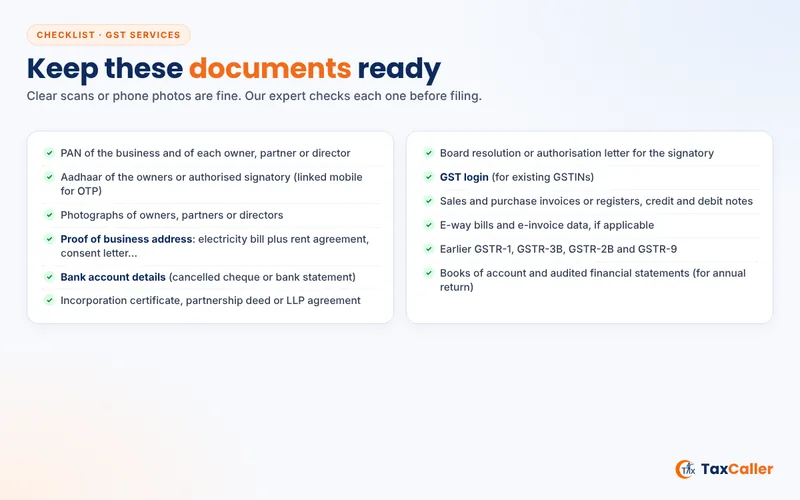
PAN of the business and of each owner, partner or director
Aadhaar of the owners or authorised signatory (linked mobile for OTP)
Photographs of owners, partners or directors
Proof of business address: electricity bill plus rent agreement, consent letter or ownership proof
Bank account details (cancelled cheque or bank statement)
Incorporation certificate, partnership deed or LLP agreement
Board resolution or authorisation letter for the signatory
GST login (for existing GSTINs)
Sales and purchase invoices or registers, credit and debit notes
E-way bills and e-invoice data, if applicable
Earlier GSTR-1, GSTR-3B, GSTR-2B and GSTR-9
Books of account and audited financial statements (for annual return)
Two witnesses' details (for LUT)
Stock statement on the closing date (for cancellation)
Copy of any GST notice or order with its reference number
Class 3 DSC for companies
Why TaxCaller
Real experts, not a call centre
Your work is handled by experienced professionals who explain every step, check your documents and keep you updated.
Registered company
TaxCaller is run by TaxCaller India LLP (LLPIN AAQ-7388), serving clients since 2018.
Fee told upfront
You know the complete fee, our professional fee and the government fee, before any work starts. No hidden charges.
Support after the work
Notices, renewals, returns and compliance reminders: we stay with your business after the registration is done.
Reviewed By
Expert for this topic GST Services
Abhinay Rai
Advocate
Abhinay Rai is a Advocate specialising in GST Services. The process, documents, timelines and fees on this page are checked against the current rules and government portals, and updated whenever the law, forms or fees change.
GST services are the professional help a business uses to meet its GST duties. They include registration, monthly or quarterly returns, the annual return, LUT for exports, amendments, cancellation, notice replies, refunds and advice. Each has its own form and due date under the CGST Act. You can file them yourself or have a tax expert do it.
Which GST services does a small business need every year?
A regular small business needs GSTR-1 and GSTR-3B every month, or every quarter under QRMP. If turnover exceeds ₹2 crore, it also files GSTR-9 by 31 December. Composition dealers file CMP-08 quarterly and GSTR-4 by 30 June. Exporters file a fresh LUT each financial year. Notice replies come up only when the department writes.
Is there a government fee for GST registration or returns?
No. The government charges nothing to apply for GST registration, file returns, file an LUT or apply for cancellation. You pay only the tax due, plus late fee and interest if you are late. TaxCaller's professional fee is separate, differs by service and is charged + GST. Government dues are paid directly from your own ledger.
What is the turnover limit for GST registration?
Most businesses supplying only goods must register above ₹40 lakh of aggregate turnover. For services or mixed supplies, the limit is ₹20 lakh. Lower limits of ₹20 lakh or ₹10 lakh apply in some North-Eastern and hill states. Inter-state sellers of goods, most e-commerce sellers and some others must register whatever their turnover, under section 24.
Can I file GST returns myself after registration?
Yes. Any taxpayer can log in to the GST portal and file GSTR-1 and GSTR-3B without paying any fee. The hard part is matching ITC with GSTR-2B, choosing the right tax heads and meeting each date. Many owners hand this to an expert because errors lead to notices, and the legal responsibility stays with them.
What happens if I do not file GST returns on time?
You pay a late fee of ₹50 a day, or ₹20 a day for nil returns, up to a cap that depends on turnover. Tax paid late carries 18% yearly interest. After two missed periods, e-way bills get blocked. A long gap can lead to an assessment notice and cancellation of your GST registration by the officer.
Do I need to file the GST annual return if my turnover is small?
Not always. Businesses with aggregate turnover up to ₹2 crore are exempt from filing GSTR-9 from FY 2024-25 onwards, under Notification 15/2025-Central Tax. They may still file it voluntarily. Above ₹2 crore it is compulsory by 31 December. Above ₹5 crore, the self-certified reconciliation statement GSTR-9C must also be filed with it.
Do exporters need to file an LUT every year?
Yes. An LUT in FORM GST RFD-11 is valid only for the financial year in which it is filed. Exporters and SEZ suppliers should file a fresh one before their first export of each new year. There is no government fee; the portal acknowledges it online. Without a valid LUT, you must pay IGST on exports and claim a refund.
How do I close my GST registration when the business stops?
File FORM GST REG-16 on the portal within 30 days of closing, after filing all pending returns. Once cancellation is approved, file the final return GSTR-10 within three months of the cancellation date or order, whichever is later. You also pay an amount on stock and capital goods held on that date, under section 29(5).
Can a cancelled GST registration be restored?
Yes, if the officer cancelled it. You can apply for revocation in FORM GST REG-21 under section 30, usually after filing all pending returns and paying dues with interest and late fee. Under Rule 23, the application is due within 90 days of the cancellation order. The Commissioner can extend this by up to 180 more days.
What should I do if I receive a GST notice?
Note the reply date first, then read what the officer is asking. Most notices concern mismatches between your returns, GSTR-2B or the annual return. Gather the ledgers and invoices for that period and prepare a point-by-point reply. Ask for a personal hearing where needed. Never let the date pass, because orders can be passed without your reply.
How much do GST services cost at TaxCaller?
Fees start at ₹599 + GST for one month of GSTR-1 and GSTR-3B. Registration starts at ₹799, LUT at ₹999, cancellation at ₹1,299, notice reply at ₹2,499 and the annual return at ₹2,999, all + GST. A consultant call starts at ₹799 + GST. Government dues such as tax, interest and late fees are paid separately at actual.
Do you provide GST services outside Ghaziabad?
Yes. TaxCaller is based in Ghaziabad, Uttar Pradesh, but GST work is done on the common online portal, so we serve businesses across India. Documents are shared by email or WhatsApp, and you confirm each filing with your own OTP. We also handle separate GSTINs if your business is registered in more than one state.
What are the four types of GST?
The four types are CGST, SGST, UTGST and IGST. CGST and SGST are charged together on a sale within one state, and the Centre and the state each keep their half. UTGST takes the place of SGST in union territories without a legislature. IGST applies to inter-state sales, imports and exports, and is shared with the consuming state later.
Can I file an old GST return after three years?
No. A GST return can no longer be filed once three years have passed from its due date. This bar covers GSTR-1, GSTR-3B, GSTR-9 and the TCS return, under sections 37(5), 39(11), 44(2) and 52(15) of the CGST Act. The portal now enforces it, so file any pending return well before its window closes.
Tell us what has happened, a new business, a notice or an export order. A TaxCaller GST expert will point you to the right service on a free first call.