Srishti Magoo
Excellent experience with TaxCaller for filing my & my family members ITR returns. The entire process was smooth, quick and hassle-free. They are professional, knowledgeable and guided me through every step with patience.
Annual compliance for your Pvt Ltd, OPC, LLP, partnership, proprietorship or Section 8 company, planned on one calendar and filed online by TaxCaller's tax experts.
Content updated 15 Nov 2026
Get your Annual Compliance done
50+ onlineHow we work
Online · Call · WhatsApp
Quick answer
Annual compliance is the set of yearly filings every business makes with the MCA, the Income Tax Department and the GST portal. Companies file AOC-4, MGT-7 and an ITR. LLPs file Form 11, Form 8 and ITR-5. Firms and proprietors file income tax, GST and TDS returns. Missed dates bring daily late fees and penalties.
Starting fee of each option. Open any card to see every plan, documents and steps.
Most Popular
Private Limited Company Compliance
ROC filing made simple for private limited companies: we prepare AOC-4, MGT-7, AGM papers and director forms, and file…
₹3,999 + GST
+ Govt. fees at actual
Fee confirmed in writing before you pay
See all plans & details →What you'll get
LLP Annual Filing
LLP annual filing handled by our tax experts: Form 11, Form 8, ITR-5 and partner KYC, filed on MCA21 V3 before any late…
₹2,499 + GST
+ Govt. fees at actual
Fee confirmed in writing before you pay
See all plans & details →What you'll get
Government fees and taxes are extra where applicable. Our expert confirms the final amount on the first call. No hidden charges.
All 10 options
Each has its own page with plans, documents, steps and the law it follows. The fee shown is our starting fee; government fees are paid at actual.
From ₹3,999 + GST
+ Govt. fees at actual
From ₹2,499 + GST
+ Govt. fees at actual
From ₹499 + GST
+ Govt. fees at actual
From ₹999 + GST
+ Govt. fees at actual
From ₹999 + GST
+ Govt. fees at actual
From ₹2,999 + GST
From ₹2,499 + GST
+ Govt. fees at actual
From ₹5,499 + GST
+ Govt. fees at actual
From ₹1,899 + GST
No govt. fee
From ₹14,999 + GST
No govt. fee
Annual compliance is the yearly work that keeps a business in good standing with the law. For a company or LLP, it means audited accounts, an annual return and director KYC filed with the Registrar of Companies, plus tax returns. For a partnership firm or proprietorship, it means income tax, GST and TDS returns. The rules differ by structure, and so do the due dates.
This page is a map. It compares the yearly duties of a Private Limited company, OPC, LLP, partnership firm, proprietorship and Section 8 company. It gives a single 2026-27 calendar, the government fees, the penalties and the changes made in 2026. Each service then has its own detailed page, linked below.
TaxCaller's tax experts plan and file these returns online for businesses across India. You get one calendar, one team and drafts to approve before anything is filed.
Complete guide
Choose a topic to open it. Every answer gives the rule or section it comes from.
01 Topic 1 of 20
Annual compliance is the set of returns, forms and meetings the law expects from your business every financial year. Some filings go to the Registrar of Companies (ROC) on the MCA portal. Others go to the income tax e-filing portal, the GST portal and TRACES. The duty starts in the year you register. It ends only when the business is formally closed.
What you file depends on your legal form:
No activity does not mean no filing. A company that did no business still files audited accounts and an annual return. An LLP with zero turnover still files Form 11 and Form 8. Relief comes only through dormant status under Section 455 or formal closure.
People often call the MCA side "ROC compliance" or "ROC annual filing". The tax side covers the ITR, GST and TDS. A sound plan treats both as one job, because the same numbers appear in every form.
Next: Annual Compliance by Business Type: Comparison Table →
02 Topic 2 of 20
The table shows the main yearly duties of each common structure. Event-based filings, such as a change of director or address, come on top of these.
| Yearly duty | Private Limited | OPC | LLP | Partnership firm | Proprietorship | Section 8 company |
|---|---|---|---|---|---|---|
| Main law | Companies Act, 2013 | Companies Act, 2013 | LLP Act, 2008 | Indian Partnership Act, 1932 | No separate law | Companies Act, 2013 |
| ROC annual forms | AOC-4 and MGT-7 (MGT-7A if a small company) | AOC-4 and MGT-7A | Form 11 and Form 8 | None | None | AOC-4 and MGT-7 |
| Audit of accounts | Every year (Section 139) | Every year | Only above ₹40 lakh turnover or ₹25 lakh contribution | Tax audit only above the Section 44AB limit | Tax audit only above the Section 44AB limit | Every year |
| Meetings | Four board meetings (two for a small company) and an AGM | One board meeting in each half-year; no AGM | None required by law | None required | None required | Board meeting at least once in six calendar months, and an AGM |
| Income tax return | ITR-6 | ITR-6 | ITR-5 | ITR-5, or ITR-4 under the presumptive scheme | ITR-3 or ITR-4 of the owner | ITR-7 if registered for exemption |
| KYC of key people | DIR-3 KYC for each director | DIR-3 KYC | DIR-3 KYC for designated partners | Not needed | Not needed | DIR-3 KYC |
| Auditor appointment form | ADT-1 | ADT-1 | Not needed | Not needed | Not needed | ADT-1 |
| Yearly workload | Highest | High | Medium | Low | Lowest | Highest, with tax-exemption filings |
A small company now means paid-up capital up to ₹10 crore and turnover up to ₹100 crore (G.S.R. 880(E), 1 December 2025). Holding, subsidiary and Section 8 companies cannot be small companies. A small LLP is one within the contribution and turnover limits of Section 2(1)(ta) of the LLP Act. It pays lower additional fees and half the penalty. GST and TDS returns apply to every structure once it is registered or holds a TAN.
Which structure has the lightest yearly load? A proprietorship, then a partnership firm, then an LLP below the audit limits. Among companies, an OPC or a small company has the fewest duties.
Still choosing a structure? Our company registration guide compares the options before you register, so you know the yearly load in advance.
← Previous Next: Compliance Calendar 2026-27: Due Dates in One Table →
03 Topic 3 of 20
This calendar lists the main dates for FY 2025-26 filings, which fall in 2026, and the regular dates of FY 2026-27. It assumes a 31 March year end. ROC dates assume an AGM on 30 September 2026. An earlier AGM moves AOC-4, MGT-7 and ADT-1 earlier too.
| Due date | Filing | Who files |
|---|---|---|
| 30 April 2026 | MSME-1 for October 2025 to March 2026 | Companies with delayed dues to micro or small suppliers |
| 30 May 2026 | Form 11, LLP annual return for FY 2025-26 | Every LLP |
| 31 May 2026 | TDS return for January to March 2026 (old Forms 24Q and 26Q) | Every deductor |
| 15 June 2026 | Form 16 for FY 2025-26; first advance tax instalment of tax year 2026-27 | Employers; taxpayers with yearly tax of ₹10,000 or more |
| 30 June 2026 | DPT-3 return of deposits; GSTR-4 for composition dealers | Most companies; composition taxpayers |
| 31 July 2026 | ITR for non-business cases; TDS return for April to June 2026 (Forms 138 and 140) | Individuals without business income; deductors |
| 31 August 2026 | ITR for business cases that need no audit | Proprietors, firms and their partners without audit |
| 27 September 2026 | AOC-4 of an OPC (180 days from year end) | OPCs |
| 30 September 2026 | AGM for FY 2025-26 | Companies other than OPCs |
| 15 October 2026 | ADT-1, within 15 days of the AGM | Companies appointing an auditor |
| 21 October 2026 | Tax audit report, extended from 30 September by CBDT Circular 07/2026 | Tax audit cases |
| 30 October 2026 | AOC-4 (30 days from AGM); LLP Form 8 | Companies; LLPs |
| 31 October 2026 | MSME-1 for April to September 2026; TDS return for July to September 2026 | Companies with delayed dues to micro or small suppliers; deductors |
| 21 November 2026 | ITR for companies and audit cases, extended from 31 October by Circular 07/2026 | Companies, audited LLPs and firms, and their partners |
| 29 November 2026 | MGT-7 or MGT-7A (60 days from AGM) | Companies |
| 30 November 2026 | ITR for transfer pricing cases (Section 92E) | Businesses with international or specified transactions |
| 31 December 2026 | GSTR-9 and GSTR-9C for FY 2025-26; belated ITR for FY 2025-26; last day to file AOC-4 without additional fee | GST taxpayers; late ITR filers; companies |
| 31 January 2027 | Last day to file MGT-7 or MGT-7A without additional fee; TDS return for October to December 2026 | Companies; deductors |
| Every month | GSTR-1 by the 11th and GSTR-3B by the 20th (quarterly filers: 13th, and 22nd or 24th) | Regular GST taxpayers |
| 30 June, once in three years | DIR-3 KYC | Every DIN holder, in the year the cycle ends |
The two "without additional fee" dates come from MCA General Circular 05/2026 of 24 October 2026. It waives only the extra fee. It does not extend the AGM date, and it does not cancel penalties for a late AGM. Want reminders? Our tools page has quick calculators and checks.
← Previous Next: Private Limited Company and OPC Compliance →
04 Topic 4 of 20
A Private Limited company holds board meetings, gets its accounts audited and holds an AGM within six months of the year end. It then files AOC-4 within 30 days of the AGM (Section 137) and MGT-7 or MGT-7A within 60 days (Section 92). ADT-1, DPT-3, DIR-3 KYC and, where needed, MSME-1 come on top. Registers, minutes and the board's report must be kept current.
An OPC holds no AGM (Section 96(1)). It files AOC-4 within 180 days of the year end and the shorter MGT-7A. OPCs and small companies pay at most half the usual penalty under Section 446B.
For the form-by-form checklist, board report items and first-year duties such as INC-20A, see our Private Limited company compliance service.
05 Topic 5 of 20
Every LLP files two ROC forms each year, even with no business. Form 11, the annual return with partner and contribution details, is due by 30 May. Form 8, the Statement of Account and Solvency, is due by 30 October. An audit is needed only when turnover goes above ₹40 lakh or contribution above ₹25 lakh (Rule 24(8), LLP Rules, 2009). The LLP then files ITR-5.
A late form attracts an additional fee that rises with the delay, from 4 times the normal fee after 15 days to 30 times after 180 days. A small LLP pays half. Designated partners also need a current DIR-3 KYC.
Our LLP annual filing service covers both forms, the audit test and the fee bands in full.
← Previous Next: Partnership Firms and Proprietorships: Tax-Side Duties →
06 Topic 6 of 20
A partnership firm or a proprietorship has no ROC annual filing. Its yearly compliance sits with the income tax, GST and TDS systems:
A registered firm also tells the state Registrar of Firms about changes in partners, name or place of business. There is no yearly return to the Registrar. Firms usually start with our income tax filing and GST services.
07 Topic 7 of 20
A Section 8 company follows most company rules, with a few relaxations and extra tax duties. It can never be a small company, so it files the full MGT-7, not MGT-7A. Under G.S.R. 466(E) of 5 June 2015, its board must meet at least once in every six calendar months.
It cannot change its objects or articles without prior approval (Section 8(4)). Breaking licence conditions can bring revocation and a fine of ₹10 lakh to ₹1 crore for the company (Section 8(11)). We handle the MCA and income tax sides together so the figures match.
← Previous Next: Public and Larger Companies: Extra Duties by Size →
08 Topic 8 of 20
A public company follows the same yearly cycle as a private one, with stricter rules on meetings and related party deals. Larger companies of either kind pick up more duties once they cross set limits. Test these limits each year against the latest audited figures.
| Extra duty | When it applies | Law |
|---|---|---|
| CSR spending and the CSR-2 report | Net worth of ₹500 crore, turnover of ₹1,000 crore or net profit of ₹5 crore or more in the previous year | Section 135 |
| Secretarial audit (Form MR-3) | Public company with paid-up capital of ₹50 crore or turnover of ₹250 crore or more; any company with bank or institution borrowings of ₹100 crore or more | Section 204, Rule 9 |
| Internal audit | Private company with turnover of ₹200 crore or more, or bank or institution borrowings above ₹100 crore; set limits for unlisted public companies | Section 138, Rule 13 |
| At least two independent directors | Public company with paid-up capital of ₹10 crore, turnover of ₹100 crore, or loans, debentures and deposits above ₹50 crore | Section 149(4), Rule 4 |
| Whole-time company secretary | Paid-up capital of ₹10 crore or more | Section 203, Rules 8 and 8A |
| Annual return certified by a practising company secretary (MGT-8) | Paid-up capital of ₹10 crore or turnover of ₹50 crore or more | Section 92(2), Rule 11(2) |
| Financial statements in XBRL format | Paid-up capital of ₹5 crore or turnover of ₹100 crore or more, or companies under Ind AS | Companies (Filing of Documents and Forms in XBRL) Rules, 2015 |
| Cost records and cost audit | Notified industries above set turnover limits | Section 148 |
A public company can never claim small company relief. Listed companies also follow SEBI rules. We flag each limit while preparing your yearly compliance map.
← Previous Next: Accounting and Bookkeeping: The Base of Every Filing →
09 Topic 9 of 20
Every yearly filing starts from your books. Section 128 of the Companies Act requires a company to keep books on the accrual basis and the double-entry system. An LLP must keep its books for eight years under Rule 24 of the LLP Rules. Firms and proprietors covered by the income tax book-keeping rules must keep books too.
Before year end, these checks save most of the trouble:
Our accounting and bookkeeping services close your books every month, so the audit and the ROC forms do not become a rush in September.
← Previous Next: Tax-Side Filings: ITR, GST and TDS Returns →
10 Topic 10 of 20
The tax side runs alongside the ROC side, and every structure has it.
Every company, LLP and firm must file an income tax return each year, even with a loss or nil income. A proprietor reports business income in the personal return.
Returns for FY 2025-26 are filed under the Income-tax Act, 1961, even though the Income-tax Act, 2025 came into force on 1 April 2026. Income from 1 April 2026 belongs to "tax year 2026-27" under the new Act. Those returns are due in 2027.
A business loss can be carried forward only if the return is filed by the due date. See the forms, regimes and fees on our income tax filing page.
A GST-registered business files GSTR-1 for sales and GSTR-3B for tax payment. Most file monthly. Small taxpayers may file quarterly under QRMP and pay tax monthly. Composition dealers pay through CMP-08 each quarter and file GSTR-4 by 30 June.
Then comes the yearly return. GSTR-9 for FY 2025-26 is due on 31 December 2026. It is optional where aggregate turnover is up to ₹2 crore (Notification 15/2025-Central Tax). Above ₹5 crore, a self-certified GSTR-9C reconciliation is also filed. GSTR-9 cannot be revised, and it is time-barred three years after its due date (Section 44(2)).
Your GST turnover should agree with the audited accounts and the ITR. See our GST return filing service for monthly work and the GST annual return service for GSTR-9 and GSTR-9C.
Every business that deducts tax at source files quarterly TDS returns by 31 July, 31 October, 31 January and 31 May. From 1 April 2026, the new Act renamed the forms. Form 138 replaced 24Q for salary, and Form 140 replaced 26Q for other payments. Quarters up to March 2026 still use the old forms.
After filing, the deductor issues certificates from TRACES. Salary certificates (old Form 16, new Form 130) are due by 15 June. Other certificates (old Form 16A, new Form 131) are due within 15 days of the return due date. A late return costs ₹200 a day, capped at the tax deducted (Section 234E, now Section 427).
Our TDS return filing service covers rates, challans and corrections.
| Figure | Where it appears |
|---|---|
| Turnover | AOC-4 or Form 8, the ITR, the tax audit report and GSTR-9 |
| Tax deducted from you | Form 26AS and AIS, the ITR and your books |
| Tax you deducted | TDS returns, challans and expense ledgers |
| Loans from directors and others | Balance sheet, DPT-3 and MGT-7 |
| Share capital and shareholders | MGT-7 or MGT-7A, AOC-4 and the register of members |
| Dues to micro and small suppliers | MSME-1 and the notes to accounts |
| Partner salary and interest | Firm or LLP accounts, ITR-5 and TDS under Section 194T (now Section 393) |
A mismatch is the most common trigger for a tax or GST notice. We reconcile these before anything is filed.
11 Topic 11 of 20
Some MCA forms are tied to people, loans or events rather than to the accounts:
LLPs have their own event forms. Form 3 records agreement changes, Form 4 records partner changes and Form 15 records a new office. Each is due within 30 days.
Abhinay Rai Compliance Expert
Have a question on this topic? Ask Abhinay on a free call.
12 Topic 12 of 20
← Previous Next: Documents Checklist for Annual Compliance →
13 Topic 13 of 20

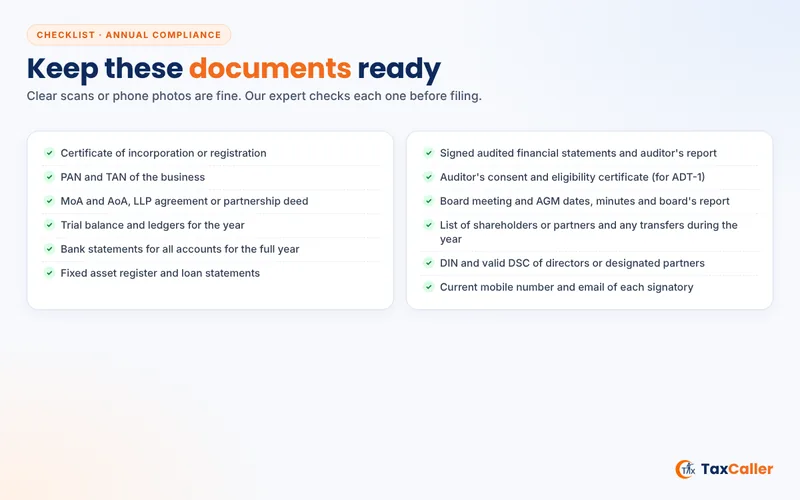
Share what applies to your structure. Our expert confirms the final list on the first call.
| Group | Documents |
|---|---|
| Entity basics | Certificate of incorporation or registration, PAN, TAN, MoA and AoA or LLP agreement, partnership deed for firms |
| Accounts | Trial balance, ledgers, bank statements for the full year, fixed asset list, loan statements |
| Audit | Signed audited financial statements, auditor's report, auditor's consent and eligibility letter for ADT-1 |
| Meetings | Board meeting and AGM dates, minutes, board's report, list of shareholders and share transfers |
| People | DIN and DSC of directors or designated partners, current mobile number and email for OTPs |
| Tax | Previous year's ITR, Form 26AS and AIS, advance tax and self-assessment challans |
| GST | GSTIN login, GSTR-1, GSTR-3B and GSTR-2B for the year, e-invoice and e-way bill data |
| TDS | TAN login, TDS challans, deductee PANs, previous returns |
| Loans and suppliers | Loan details for DPT-3, list of MSME suppliers with pending dues for MSME-1 |
← Previous Next: How TaxCaller Handles Your Annual Compliance Online →
14 Topic 14 of 20

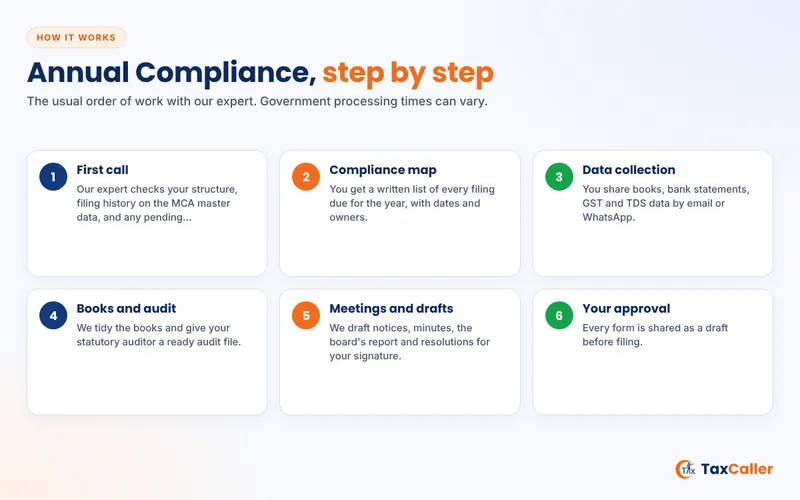
Timelines depend on you. Once the audited accounts and signed papers reach us, ROC forms usually go out within a few working days. Delays mostly come from late audits and missing DSCs.
Switching your yearly filings to us is simple. We need working DSCs, your MCA V3, income tax, GST and TRACES logins, and copies of the last filed forms. We check the MCA master data for gaps before taking over. Your statutory auditor can stay, because the company appoints the auditor, not us.
← Previous Next: Government Fees and TaxCaller Fees, Clarified →
15 Topic 15 of 20

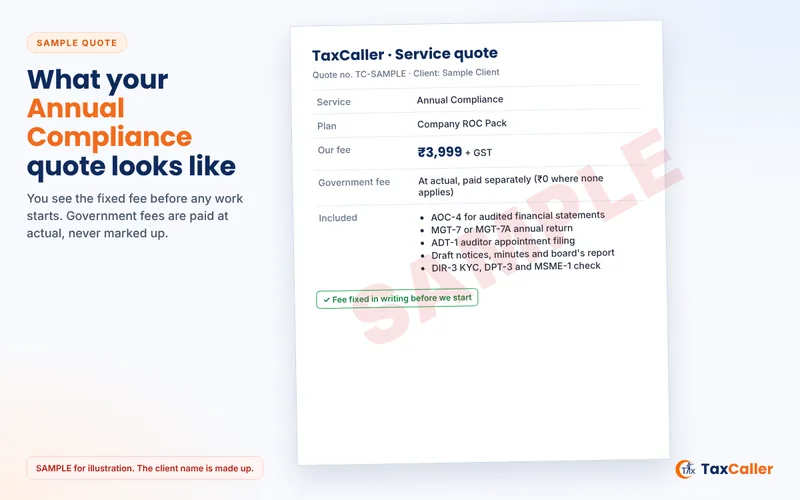
TaxCaller's fee covers our professional work, and it is always charged + GST. TaxCaller's fee starts at ₹2,999 + GST for the plans shown on this page. Government fees are paid separately at actual, straight to the portal. The statutory audit fee goes to your auditor and is not part of our fee.
| Service | Starting professional fee | Main work |
|---|---|---|
| Private Limited Company Compliance | ₹3,999 + GST | Yearly ROC filings of a Pvt Ltd company |
| LLP Annual Filing | ₹2,499 + GST | Form 11 and Form 8 of an LLP |
| Accounting and Bookkeeping | Monthly plans, fee on call | Monthly books that feed every return |
You can compare all options in the cards above. ITR, GST and TDS returns have their own pages and fees.
| Item | Government fee | Source |
|---|---|---|
| AOC-4, MGT-7, MGT-7A, ADT-1 (company with share capital) | ₹200 to ₹600 per form, by nominal share capital | Companies (Registration Offices and Fees) Rules, 2014 |
| Late AOC-4 or MGT-7 | Additional fee of ₹100 a day per form | Fees Rules, read with Section 403 |
| LLP Form 8 and Form 11 | ₹50 to ₹600 per form, by contribution | LLP (Amendment) Rules, 2022, G.S.R. 109(E) |
| Late LLP forms | 4 to 30 times the normal fee, by delay; a small LLP pays half | Same rules |
| DIR-3 KYC | Nil on time; ₹5,000 late | G.S.R. 300(E), 2026 |
| ITR, GSTR-9, GSTR-9C, TDS returns | No filing fee; tax, interest and late fees at actual | Income-tax and CGST law |
| DSC | Not a government fee; paid to the certifying agency | Market price |
Older pending years, event forms and extra GSTINs are priced per item. The amount is written in your quote before work starts.
← Previous Next: Penalties and Late Fees for Missed Annual Filings →
16 Topic 16 of 20
| Default | Consequence | Law |
|---|---|---|
| AOC-4 filed late | ₹10,000 plus ₹100 a day, up to ₹2 lakh for the company and ₹50,000 for each officer, on top of the additional fee | Section 137(3) |
| MGT-7 or MGT-7A filed late | Same amounts | Section 92(5) |
| Three years of missed filings | All directors disqualified for five years | Section 164(2) |
| No business and no filings | Name can be struck off by the ROC | Section 248(1) |
| LLP Form 8 or Form 11 late | ₹100 a day, up to ₹1 lakh for the LLP and ₹50,000 for each designated partner | Sections 34 and 35, LLP Act |
| DIR-3 KYC missed | DIN deactivated; ₹5,000 to reactivate | Rule 12A, with the Fees Rules |
| ITR late | ₹5,000 (₹1,000 if income is up to ₹5 lakh); loss not carried forward | Section 234F |
| Tax audit not done | 0.5% of turnover, up to ₹1.5 lakh | Section 271B |
| GSTR-9 late | Late fee per day, capped by turnover | Section 47(2); Notification 07/2023-Central Tax |
| TDS return late | ₹200 a day up to the tax deducted, and a penalty of ₹10,000 to ₹1 lakh | Sections 234E and 271H (Sections 427 and 461 of the new Act) |
OPCs, small companies and recognised startup companies pay at most half of the Companies Act penalties, capped at ₹2 lakh for the company and ₹1 lakh for an officer (Section 446B). Additional fees are not halved.
Late fee or penalty? They are two different charges. The additional fee is collected by the MCA portal automatically when you file late. A penalty is imposed later by the ROC as adjudicating officer under Section 454, after a notice. Paying one does not cancel the other.
← Previous Next: Behind on Filings? Catch-Up, Strike-Off and Restoration →
17 Topic 17 of 20
Many owners come to us after missing one or more years. The fix is similar in most cases: file the old years in order and stop the daily fees from growing.
Open "View Company or LLP Master Data" on the MCA portal. It shows the date of the last AGM and the last balance sheet filed. The income tax and GST portals list missed returns on their dashboards. A status of "Strike Off" or "Under Process of Striking Off" needs action at once.
Say a small company files its AOC-4 300 days after the due date, with no relief scheme open. The additional fee is ₹100 a day, so the portal asks for about ₹30,000 over the normal fee. If MGT-7A is just as late, that is another ₹30,000. A penalty order under Section 137(3) or 92(5) can still follow. One late year can cost more than a decade of on-time filing.
The ROC can remove a company that never started business within a year, or that did no business for two years without seeking dormant status (Section 248(1)). Under Section 250, a struck-off company stops operating, except to recover dues and pay liabilities. An appeal against the ROC order lies with the NCLT within three years (Section 252(1)). The company, a member, a creditor or a workman can seek restoration within 20 years of the strike-off notice (Section 252(3)). The NCLT then requires all pending filings and costs to be cleared. An LLP that stops filing can be struck off under Rule 37 of the LLP Rules, 2009.
If the business has no future, compare catch-up costs with a voluntary exit. A company can apply in STK-2 to C-PACE after filing its accounts and returns up to the year it stopped business. Dormant status in MSC-1 under Section 455 is the middle path for a company that may restart.
18 Topic 18 of 20
← Previous Next: What Changed for Annual Compliance in 2026 →
19 Topic 19 of 20
Several changes affect the 2026 filing season. Here are the ones that matter most, with their sources.
Read the official texts on the MCA portal and the Income Tax Department website before relying on any summary.
Don't have everything? Send what you have on WhatsApp. Our expert will tell you what's missing.
Send documents on WhatsAppReal experts, not a call centre
Your work is handled by experienced professionals who explain every step, check your documents and keep you updated.
Registered company
TaxCaller is run by TaxCaller India LLP (LLPIN AAQ-7388), serving clients since 2018.
Fee told upfront
You know the complete fee, our professional fee and the government fee, before any work starts. No hidden charges.
Support after the work
Notices, renewals, returns and compliance reminders: we stay with your business after the registration is done.
Expert for this topic Annual Compliance
Abhinay Rai
Advocate
Abhinay Rai is a Advocate specialising in Annual Compliance. The process, documents, timelines and fees on this page are checked against the current rules and government portals, and updated whenever the law, forms or fees change.
Annual compliance is the yearly set of filings and meetings a company must complete. It includes board meetings, an audit, the AGM, AOC-4 for accounts, MGT-7 or MGT-7A for the annual return, ADT-1, DPT-3 and DIR-3 KYC. On the tax side, the company files its ITR, GST returns and TDS returns. Every company files, even with no revenue.
Yes. A company with no business must still hold its meetings, get its accounts audited and file AOC-4 and MGT-7 or MGT-7A. It also files a nil ITR. Missing these leads to penalties, director disqualification and possible strike-off. If you expect no activity for years, ask us about dormant status or closure.
With an AGM on 30 September 2026, AOC-4 was due on 30 October 2026 and MGT-7 or MGT-7A is due on 29 November 2026. MCA General Circular 05/2026 allows AOC-4 without additional fee until 31 December 2026, and MGT-7 or MGT-7A until 31 January 2027. The AGM date itself was not extended.
ROC compliance covers only the forms filed with the Registrar of Companies on the MCA portal, such as AOC-4, MGT-7, ADT-1 and DIR-3 KYC. Annual compliance is wider. It adds the income tax return, tax audit, GST returns, GSTR-9 and TDS returns. A business must complete both sets each year, and the figures must agree.
Yes, but only on the tax side. They file no ROC forms. A firm files ITR-5, or ITR-4 under the presumptive scheme. A proprietor files ITR-3 or ITR-4. Both need a tax audit above the Section 44AB limit. They also file GST and TDS returns if registered or holding a TAN.
An LLP files Form 11, the annual return, by 30 May and Form 8, the statement of account and solvency, by 30 October. It files ITR-5 for income tax. An audit is needed only above ₹40 lakh turnover or ₹25 lakh contribution. Designated partners keep DIR-3 KYC current. GST and TDS returns apply if registered.
Under Section 164(2), every director of a company that has not filed financial statements or annual returns for three continuous years is disqualified for five years. They cannot join or be reappointed to any company board in that period. The ROC may also strike off the company under Section 248. Late fees keep growing meanwhile.
From 31 March 2026, a director files DIR-3 KYC once every three financial years, by 30 June, under Rule 12A as substituted by G.S.R. 943(E). Changes in mobile number, email or address must be updated within 30 days. Filing on time has a nil fee. Late filing or DIN reactivation costs ₹5,000.
Yes. Section 139 of the Companies Act requires every company to appoint an auditor and get its accounts audited every year. Turnover or profit does not matter. A new company appoints its first auditor within 30 days of incorporation. The auditor's appointment at the AGM is reported to the ROC in Form ADT-1 within 15 days.
No. Section 96(1) exempts a One Person Company from holding an AGM. An OPC still needs an audit and files AOC-4 within 180 days of the year end, which is 27 September for a March year end. It also files MGT-7A and its ITR. With two or more directors, it holds a board meeting each half-year.
Yes. A company with no significant transactions can apply for dormant status under Section 455 in Form MSC-1. A dormant company keeps lighter duties, such as fewer board meetings and a short yearly return. It cannot trade while dormant. If you never plan to restart, closing the company through strike-off may cost less overall.
No. The Bill was introduced in the Lok Sabha on 23 March 2026 and sent to a Joint Committee, which reported on 3 August 2026. As of November 2026, Parliament has not passed it. Its proposals, such as one board meeting a year for small companies and OPCs, do not apply yet. Follow current rules.
Voluntary strike-off of a company in Form STK-2 is processed by the Centre for Processing Accelerated Corporate Exit (C-PACE), not the local ROC. This has applied since 1 May 2023. LLP closure applications followed on 27 August 2024. Before applying, all overdue annual filings and tax dues usually need to be cleared.
Our plans on this page start at ₹2,999 + GST. Single services start at ₹2,499 + GST for LLP annual filing and ₹3,999 + GST for Private Limited company compliance. Government fees, such as ₹200 to ₹600 per ROC form, are paid separately at actual. Your auditor's fee is separate. Older pending years are priced per item.
Search your company under View Company or LLP Master Data on the MCA portal. It shows the last AGM date and the last balance sheet date. If either is more than a year old, filings are pending. Check the income tax and GST dashboards for missed returns too. Our expert runs this check on the first call.
Tell us your structure and last filing year. Our tax expert will map every form due in 2026-27 on a free first call and handle the filings online.
Mon–Fri 9:00 AM – 6:00 PM, Sat 10:00 AM – 4:00 PM · Your trust is our biggest fee.