Get ITR 6 filing done for your private limited company, OPC or public company by tax experts who read your audited accounts, test MAT and 115BAA, and file on time.
Starting from · ₹3,999 ITR-6 Filing Small Company plan
STARTING FROM₹3,999
FEE TOLD UPFRONTFree first call
!Late ITR?Fee up to ₹5,000 under Sec 234F
Since 2018Trusted Experience
980+Experts Connected
220+Cities Served
1164+Agents Available
12000+Founders Trusted
S
Srishti Magoo
★★★★★
Excellent experience with TaxCaller for filing my &
my family members ITR returns. The entire process was
smooth, quick and hassle-free. They are professional,
knowledgeable and guided me through every step with patience.
O
obeid sait
★★★★★
The team has handled my taxes for the past three years,
and it's been a wonderful, hassle-free experience.
Thank you for your consistently quick and efficient service.
P
Pushkar
★★★★★
They are among the best in their field. Their work culture
is highly professional, and their client service is smooth
and reliable. They can confidently be relied on to get the job done.
P
Prasad Sheth
★★★★★
Excellent experience with TaxCaller! The ITR filing
process was smooth, quick, and completely hassle-free.
The CA was knowledgeable, responsive, and explained everything clearly.
A
Apoorv Bansal
★★★★★
Excellent service for ITR filing. The team was highly
professional, responsive, and guided me through the entire
process smoothly. My return was filed accurately and on time.
A
Abhishek Kumar
★★★★★
I was searching for a good CA firm in Ghaziabad and found
TaxCaller. The experience was excellent from start to finish.
The team is responsive, transparent, and genuinely helpful.
U
uma pandey
★★★★★
Great service! TaxCaller India made the entire ITR filing
process quick, smooth, and hassle-free. They answered all
my queries patiently and ensured maximum accuracy.
T
tanu mittal
★★★★★
Excellent job! We've been connected for many years,
and your success truly makes me happy. You are an
incredibly intelligent person. Keep shining, keep growing.
B
Bhanu Pratap Maurya
★★★★★
I am filing my ITR since past 3 years with Abhinav and
Firm is known as TaxCaller and they are professional
interms of ITR rules. They will explain and tell you all
the information.
A
ashish Sharma
★★★★★
I am providing my honest reviews:
No.1 service ...
A
AARYAN GROUP
★★★★★
Honestly, finding a good CA firm in Ghaziabad was
confusing, but TaxCaller India made it simple.
I contacted them for GST work and the experience was smooth.
N
News Speaks
★★★★★
If you're looking for a reliable CA firm in Ghaziabad,
TaxCaller India is a great choice. They provide complete
taxation and compliance solutions including GST.
A
Anshul Chaprana
★★★★★
Got my GST registration done through TaxCaller CA firm.
Process was quite smooth, they guided properly on documents
and didn't waste time. Overall good experience.
How we work
Online · Call · WhatsApp
Quick answer
ITR 6 filing is the annual income tax return every company files, except companies claiming exemption under section 11. It is filed online with a digital signature, even when the company has a loss or no business. For AY 2026-27, most companies have until 21 November 2026 after CBDT Circular No. 07/2026 extended the date.
Reviewed by Abhinay Rai · Updated 15 Nov 2026
Pick a plan that fits
Small Company
A private limited company or OPC with audited accounts and no tax audit
₹3,999+ GST
No govt. fee
Pay now (38%)₹1,520+ GSTAfter the ITR-V₹2,479+ GST
Government fees and taxes are extra where applicable. Our expert confirms the final amount on the first call. No hidden charges.
About ITR-6 Filing
ITR 6 filing is the yearly tax return of a company registered in India or abroad. Private limited companies, one person companies, public companies and foreign companies with Indian income all use ITR-6. The only companies left out are those claiming the charitable exemption under section 11, which file ITR-7.
This year's return, for AY 2026-27, reports income of FY 2025-26, which ran from April 2025 to March 2026. It follows the Income-tax Act, 1961, even though the Income-tax Act, 2025 started on 1 April 2026. The new Act governs income from Tax Year 2026-27 onwards.
ITR-6 mirrors your audited financial statements. It also carries the tax choices your company has made: the 22% rate under section 115BAA, minimum alternate tax (MAT), loss set-off and start-up deductions. TaxCaller's tax experts prepare the return from your audited accounts, match it with the tax audit report, AIS and GST data, and file it with your director's digital signature.
Complete guide
Choose a topic to open it. Every answer gives the rule or section it comes from.
01 Topic 1 of 20
What Is ITR-6 and Why Every Company Files It
ITR-6 is the income tax return form notified for companies. A company is a separate legal person, so it pays its own income tax and files its own return. The directors and shareholders file their returns separately.
Unlike an individual, a company has no basic exemption limit. Section 139(1) asks every company to file a return for every year, whatever its income or loss. That is why a company that did no business, or made a loss, still files ITR-6.
How it is filed. ITR-6 can only be filed online on the income tax e-filing portal. It must be signed with the digital signature certificate (DSC) of the person authorised to verify it. There is no paper option and no Aadhaar OTP option for companies.
What it contains. The form asks for the balance sheet and profit and loss account in the Schedule III format, shareholding details, the tax computation under normal provisions and under MAT, losses, depreciation, tax paid, and audit details.
What ITR-6 does not cover
Directors' income: salary, sitting fees and commission are taxed in each director's own return.
Dividends: a company does not pay dividend distribution tax any more. Dividends are taxed in the shareholders' hands, and the company deducts TDS where the law requires.
GST and TDS: these have their own returns. ITR-6 only reports the figures, such as GST turnover and TDS paid.
ROC returns: annual filings with the Registrar of Companies are separate from the income tax return.
Section 8 company not claiming the section 11 exemption
Yes
Section 8 company or other company claiming exemption under section 11
No, it files ITR-7
Limited liability partnership
No, it files ITR-5
Companies that must file even with nothing to show:
A newly incorporated company that has not started business
A dormant company with only a bank account
A loss-making company with no tax payable
A company under liquidation or insolvency, through the liquidator or resolution professional
A company that was struck off or merged during the year, for the period it existed
Foreign companies. A foreign company with a branch, project office or other taxable presence in India files ITR-6 for its Indian income. It pays tax at the foreign company rate, and it may claim treaty benefits with a tax residency certificate. The return is signed by the person authorised under section 140.
A company that has just been incorporated through our company registration service files its first ITR-6 for the financial year in which it was formed.
Shadab Income Tax Expert
Have a question on this topic? Ask Shadab on a free call.
The form depends on the legal structure, not the size of the business:
If your business is a company, you file ITR-6, with one exception. A company with section 12A or 12AB registration that claims the charitable exemption files ITR-7.
If you run it as a proprietor, the business income goes into your own return, usually ITR-3 or ITR-4.
A director's salary and dividend from the company are reported in the director's personal return, not in ITR-6. Our income tax filing page explains all seven forms side by side.
A company's tax rate depends on its turnover, its regime and whether it is Indian or foreign. These are the rates for income of FY 2025-26, as shown in the Income Tax Department's rate tables:
Type of company
Base rate
Surcharge
Rate with surcharge and 4% cess
Domestic company with turnover or gross receipts up to ₹400 crore in FY 2023-24
25%
7% above ₹1 crore; 12% above ₹10 crore
26% to 29.12%
Other domestic company
30%
7% above ₹1 crore; 12% above ₹10 crore
31.2% to 34.94%
Domestic company opting for section 115BAA
22%
Flat 10%
25.168%
New manufacturing company under section 115BAB (set up on or after 1 October 2019, began production by 31 March 2024)
15%
Flat 10%
17.16%
Foreign company
35%
2% above ₹1 crore; 5% above ₹10 crore
36.4% to 38.22%
Marginal relief applies where income just crosses a surcharge slab. Some income, such as long-term capital gains on listed shares, is taxed at its own special rate in every regime.
Section 115BAA or the Normal Rates: Making the Choice
Section 115BAA lets a domestic company pay a flat 22% plus a 10% surcharge, which works out to 25.168% with cess. The trade-off is that the company gives up most exemptions and incentives, such as additional depreciation, special-zone deductions and most Chapter VI-A deductions.
How the option works
The company files Form 10-IC on or before the return due date of the first year it opts in.
Once chosen, the option cannot be withdrawn for later years.
A company under section 115BAA is outside MAT, so it does not compute book profit tax.
MAT credit from earlier years cannot be used after switching under the 1961 Act rules.
A quick comparison
Take a company with turnover of ₹50 crore and taxable profit of ₹2 crore. At the 25% rate with 7% surcharge and cess, its tax is about ₹55.6 lakh. Under section 115BAA, the same profit costs about ₹50.3 lakh. If the company had large deductions or MAT credit, the old rate might still win. We run both numbers for your company before you decide.
When the normal rates may still suit a company
It has large MAT credit that it can still use under the 1961 Act
It claims a big profit-linked deduction, such as section 80-IAC for an eligible start-up
It has losses or unabsorbed depreciation from incentive claims that would be lost on switching
Its turnover is small enough for the 25% rate, and its deductions bring tax below the 22% option
For most small and mid-sized private companies with no such claims, section 115BAA gives the lower and simpler tax. The choice is permanent, so we put the numbers in writing for your board.
Minimum Alternate Tax (MAT) for Companies on Normal Rates
MAT makes sure a company with large book profits pays at least a minimum tax. Under section 115JB of the 1961 Act, a company on normal rates pays the higher of:
tax on total income at the normal rate, or
15% of its book profit, plus surcharge and cess.
Book profit starts from the profit in the audited profit and loss account and is adjusted as the section requires. Common adjustments include:
Adding back income tax charged in the accounts
Adding back provisions for unknown liabilities and for losses of subsidiaries
Adding back amounts set aside to reserves
Reducing the lower of brought-forward book loss or unabsorbed depreciation
Reducing certain exempt income, along with its related expenses
Each adjustment needs support from the audited accounts, so we work from the final signed version, not a draft.
Example
A company shows book profit of ₹1 crore. After tax depreciation and deductions, its taxable income is only ₹20 lakh, so normal tax at 25% is ₹5 lakh. MAT at 15% of ₹1 crore is ₹15 lakh. The company pays MAT. The ₹10 lakh excess becomes MAT credit under section 115JAA.
Using MAT credit
MAT credit can be set off in a later year when normal tax is higher than MAT. Under the 1961 Act it can be carried forward for 15 assessment years. ITR-6 tracks this in Schedule MAT and Schedule MATC, so these must match the previous years' returns.
Companies taxed under section 115BAA or 115BAB do not pay MAT at all. MAT rules change from Tax Year 2026-27, as the 2026 section below explains.
Every company prepares audited accounts before it can file ITR-6. Up to three reports can be involved:
Report
Law
Who needs it
Statutory audit report
Companies Act, 2013 (sections 139 and 143)
Every company, whatever its turnover
Tax audit report: Form 3CA with Form 3CD
Section 44AB of the Income-tax Act, 1961
Turnover above ₹1 crore, or above ₹10 crore if cash receipts and payments are each within 5%
Transfer pricing report: Form 3CEB
Section 92E
Companies with international or specified domestic transactions
Because every company is audited under the Companies Act, every company falls in the audit row of the due date table. No company gets the 31 August non-audit date.
The tax audit report must be uploaded before the return. For AY 2026-27 its date moved to 21 October 2026 under CBDT Circular No. 07/2026. The ITR-6 must quote the report's acknowledgement number and carry the same disallowances.
We do not act as your auditor. We work with your statutory and tax auditors so the three reports and the return tell one story.
How TaxCaller Handles Your ITR 6 Filing, Step by Step
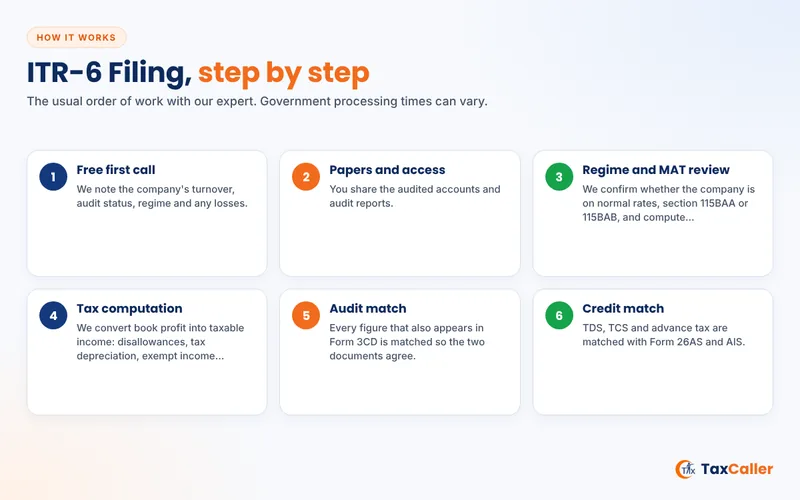
ITR-6 Filing: how the work moves, step by step
We work online with companies across India from our Ghaziabad office. You do not need to visit us.
Free first call: we note the company's turnover, audit status, regime and any losses. We confirm the fee before work starts.
Papers and access: you share the audited accounts and audit reports. With your consent we download AIS and Form 26AS.
Regime and MAT review: we confirm whether the company is on normal rates, section 115BAA or 115BAB, and compute MAT where it applies.
Tax computation: we convert book profit into taxable income: disallowances, tax depreciation, exempt income and set-off of losses.
Audit match: every figure that also appears in Form 3CD is matched so the two documents agree.
Credit match: TDS, TCS and advance tax are matched with Form 26AS and AIS. Gaps are raised with the deductor.
Director approval: we send a summary of income, tax and refund for the board's sign-off. Any balance tax is paid through e-Pay Tax.
DSC filing: we upload ITR-6 with the authorised director's DSC and share the acknowledgement.
Follow-up: we watch for the section 143(1) intimation, the refund and any notice.
Time needed: once audited accounts and the audit report are final, a standard ITR-6 is usually ready for review in three to five working days. Large groups and transfer pricing cases take longer.
Inside the ITR-6 Form: Key Schedules and Who Signs
Schedule
What it captures
Part A-GEN
Company details, CIN, status, holding and subsidiary details
Part A-BS and Part A-P&L
Audited balance sheet and profit and loss account
Schedule SH-1 and SH-2
Shareholding of unlisted companies and of start-ups
Schedule BP
Business income with additions and deductions
Schedules DPM, DOA, DEP and UD
Tax depreciation and unabsorbed depreciation
Schedules CYLA, BFLA and CFL
Current year and brought-forward losses
Schedule MAT and MATC
Book profit tax and MAT credit
Schedule ICDS
Effect of income computation and disclosure standards
Schedule GST
Turnover reported in GST returns
Schedules FSI, TR and FA
Foreign income, tax relief and foreign assets
Part B-TI and B-TTI
Total income, tax payable, interest, fee and refund
Who verifies the return
Under section 140, the managing director signs the return. If there is no managing director, or the managing director cannot sign, any director may sign. During liquidation the liquidator signs, and during an insolvency process the resolution professional signs. For a non-resident company, a person holding a valid power of attorney can sign.
Abhinay Rai Income Tax Expert
Have a question on this topic? Ask Abhinay on a free call.
Explanation 2 to section 139(1), as replaced by the Finance Act, 2026, sets the dates. Companies appear in the audit row, with transfer pricing cases in their own row.
Company
Return due date (original)
After the extension
Every company not filing a transfer pricing report
31 October 2026
21 November 2026
Company that must file Form 3CEB under section 92E
30 November 2026
30 November 2026 (unchanged)
The extension comes from CBDT Circular No. 07/2026 dated 28 September 2026. The section 44AB tax audit report date also moved to 21 October 2026. Interest is not covered by the circular, so clear any balance tax as early as you can.
Where things stand in mid-November 2026: most companies still have until 21 November 2026. After that, a belated ITR-6 under section 139(4) is possible until 31 December 2026, with the late fee and loss of carry-forward. A revised ITR-6 is allowed until 31 March 2027.
A practical year-end calendar for companies
When
Task
April to June
Close the books for the year and reconcile bank, GST and TDS
June to August
Statutory audit and board approval of the financial statements
By 30 September
Hold the annual general meeting (AGM)
Within 30 days of the AGM
File financial statements with the Registrar in Form AOC-4
By 21 October 2026 (this year)
Tax audit report uploaded, where a tax audit applies
By 21 November 2026 (this year)
ITR-6 filed with the director's DSC
Within 60 days of the AGM
Annual return in Form MGT-7 or MGT-7A
The safest plan is to finish the audit early. Most last-minute problems come from accounts that are still changing in October.
A company whose tax for the year is ₹10,000 or more after TDS pays advance tax in four instalments: 15% by 15 June, 45% by 15 September, 75% by 15 December and 100% by 15 March. MAT is also paid through advance tax. Short payment attracts interest under sections 234B and 234C at 1% a month. For Tax Year 2026-27 the rules sit in section 404 of the 2025 Act, and the third instalment is due on 15 December 2026.
Losses and share changes
Section 79 limits loss carry-forward for companies in which the public is not substantially interested, such as most private companies. If shares carrying at least 51% of voting power change hands, losses of earlier years can be lost. Eligible start-ups get relief if every shareholder who held voting shares in the loss year still holds them. We check share changes before claiming old losses.
Start-up deduction
An eligible start-up recognised by DPIIT and certified by the Inter-Ministerial Board can deduct the whole of its profits from the eligible business for any three consecutive years out of its first ten years under section 80-IAC. The ITR-6 must carry the certificate details.
Fee of ₹5,000 (₹1,000 if total income does not exceed ₹5 lakh)
234F
Tax not paid by the due date
Interest of 1% a month or part of a month
234A
Advance tax shortfall or delay
Interest of 1% a month
234B, 234C
Belated return
Business and capital losses of the year cannot be carried forward; unabsorbed depreciation survives
80
Tax audit not obtained or report not filed
Penalty of 0.5% of turnover, capped at ₹1.5 lakh
271B
Under-reporting or misreporting of income
Penalty of 50% or 200% of the tax on that income
270A
Revised return after 31 December 2026
Fee of ₹1,000 or ₹5,000
234-I
Wilful failure to file
Prosecution of the company and officers in charge
276CC
From Tax Year 2026-27, the late filing fee moves to section 428 of the Income-tax Act, 2025. That section also brings a fee for a late tax audit report: ₹75,000 for a delay of up to one month and ₹1,50,000 beyond that.
Shadab Income Tax Expert
Have a question on this topic? Ask Shadab on a free call.
After Filing ITR-6: Processing, Refunds and Notices
Intimation: CPC processes the return under section 143(1) and emails an intimation to the company's registered email.
Refund: any refund is paid into the company's pre-validated bank account, with interest under section 244A.
Proposed adjustment: a section 143(1)(a) notice gives 30 days to agree or explain.
Scrutiny: a section 143(2) notice opens a detailed assessment. Our tax consultant team can represent the company.
Revision: an error can be corrected through a revised ITR-6 under section 139(5) until 31 March 2027.
Updated return: income left out entirely can be offered later through ITR-U under section 139(8A), with additional tax.
Next year: carry the losses, MAT credit and depreciation figures forward correctly, and plan advance tax.
Keep the TDS side clean too. Companies deduct TDS on salary, rent, professional fees and dividends, and our TDS return filing service handles the quarterly returns.
1. Due date table rewritten by the Finance Act, 2026
The table in section 139(1) now has four rows. Companies stay in the 31 October row with audited entities, and transfer pricing cases stay on 30 November.
2. 21 November 2026 extension
CBDT Circular No. 07/2026 extended the AY 2026-27 return date for companies and other audit cases to 21 November 2026. Tax audit reports under section 44AB got until 21 October 2026.
3. Revised returns allowed until 31 March
A revised ITR-6 for AY 2026-27 can be filed until 31 March 2027. Filing it after 31 December 2026 attracts the new section 234-I fee.
4. The Income-tax Act, 2025
From Tax Year 2026-27 (income from 1 April 2026), companies move to the new Act:
The return and its due dates are in section 263. Companies keep 31 October, and transfer pricing cases keep 30 November.
The 22% option for domestic companies moves to section 200.
The late fee moves to section 428, with the new fee for a late audit report.
5. MAT reworked from Tax Year 2026-27
MAT now sits in section 206 of the Income-tax Act, 2025, as amended by the Finance Act, 2026. The Income Tax Department's MAT and AMT guide sets out the new rules:
MAT is 14% of book profit, plus surcharge and cess, instead of 15%.
Excess MAT paid under the new Act does not create any new MAT credit.
MAT credit standing on 31 March 2026 can be carried forward.
A domestic company can set that credit off under the concessional regime, up to 25% of the tax payable for the year.
These rules apply to income from Tax Year 2026-27, not to the AY 2026-27 return. We use them when we plan your regime for next year.
The ITR-6 you file now, for AY 2026-27, still follows the 1961 Act.
Shreya Income Tax Expert
Have a question on this topic? Ask Shreya on a free call.
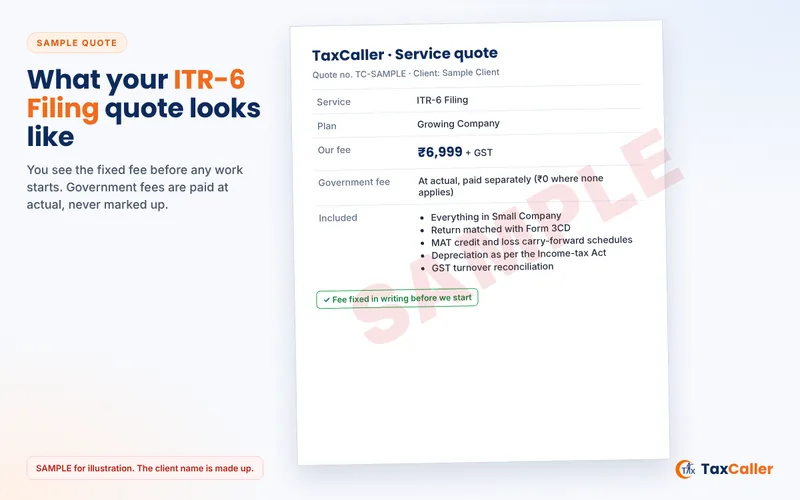
Government fee: filing ITR-6 is free of any government charge. The company pays the government only its tax, any interest under sections 234A to 234C, and the section 234F fee if the return is late. All of these are paid through e-Pay Tax, at actual.
TaxCaller's fee: our ITR-6 fee starts at ₹3,999 + GST for a small company with audited accounts and no tax audit. Tax, interest and late fee are separate government payments.
What can raise the fee:
Tax audit cases where the return is matched with Form 3CD
Large MAT credit or loss histories
Start-up claims under section 80-IAC
Transfer pricing coordination
Belated or revised returns
Not included: the statutory audit, the tax audit, ROC filings, bookkeeping, GST and TDS returns, and replies to scrutiny notices. We quote these separately on request.
Regime and MAT checked every year: we compare normal rates, section 115BAA and MAT before the return is prepared.
Aligned with your auditors: the ITR-6 carries the same figures as Form 3CD and the audited accounts.
Credit trail kept: losses, unabsorbed depreciation and MAT credit are tracked year to year.
Deadline focus: we plan work back from your due date. For AY 2026-27 that is 21 November 2026 for most companies and 30 November 2026 for transfer pricing cases.
Clear fees: our fee is quoted upfront and shown apart from tax and other government payments.
Online across India: our office is in Ghaziabad, and we serve companies in every state.
Legal review: Abhinay Rai, Advocate, has reviewed this page.
Since 2018: we have worked on tax and compliance for businesses since 2018.
Company PAN, TAN and certificate of incorporation (CIN)
Directors' names, DINs and PANs
Shareholding pattern on 31 March 2026 and share changes in the year
Board authority for the signing director
Valid DSC of the signing director
Audited balance sheet, profit and loss account and notes for FY 2025-26
Statutory auditor's report
Tax audit report (Form 3CA and 3CD), if applicable
Form 3CEB, if applicable
Fixed asset register with tax depreciation by block
Trial balance and ledgers
Form 26AS, AIS and TIS
Advance tax and self-assessment tax challans
TDS and TCS returns
GST returns, including GSTR-9 if filed
Previous years' ITR-6 with loss and MAT credit schedules
Form 10-IC acknowledgement (section 115BAA)
DPIIT recognition and section 80-IAC certificate (start-ups)
Why TaxCaller
Real experts, not a call centre
Your work is handled by experienced professionals who explain every step, check your documents and keep you updated.
Registered company
TaxCaller is run by TaxCaller India LLP (LLPIN AAQ-7388), serving clients since 2018.
Fee told upfront
You know the complete fee, our professional fee and the government fee, before any work starts. No hidden charges.
Support after the work
Notices, renewals, returns and compliance reminders: we stay with your business after the registration is done.
Reviewed By
Expert for this topic ITR-6 Filing
Abhinay Rai
Advocate
Abhinay Rai is a Advocate specialising in ITR-6 Filing. The process, documents, timelines and fees on this page are checked against the current rules and government portals, and updated whenever the law, forms or fees change.
Every company registered in India, and every foreign company with income taxable in India, files ITR-6. This covers private limited companies, one person companies, public companies, producer companies and Nidhi companies. The only exception is a company claiming the charitable exemption under section 11, which files ITR-7. LLPs are not companies and file ITR-5.
Does a company with no business or income have to file ITR-6?
Yes. Section 139(1) requires every company to file a return each year, whatever its income or loss. A newly formed company that has not started business, or a dormant company with only a bank account, still files ITR-6. Skipping it can lead to notices, late fees and, in serious cases, prosecution of the officers.
What is the ITR-6 due date for AY 2026-27?
Companies originally had until 31 October 2026. CBDT Circular No. 07/2026, dated 28 September 2026, extended this to 21 November 2026. Companies that must file a transfer pricing report in Form 3CEB have until 30 November 2026. After the due date, a belated return is allowed until 31 December 2026 with a late fee.
Can ITR-6 be filed without a digital signature?
No. A company must file ITR-6 online and sign it with a valid digital signature certificate. Aadhaar OTP and posting a paper ITR-V are not available for companies. The DSC usually belongs to the managing director or another director, and it must be registered against that person's PAN on the e-filing portal before filing.
What is the tax rate under section 115BAA?
A domestic company opting for section 115BAA pays 22% tax plus a flat 10% surcharge and 4% cess, an effective rate of 25.168%. It must give up most exemptions and incentives. The option is made by filing Form 10-IC by the return due date of the first year, and it cannot be withdrawn later.
Does MAT apply to a company that chose section 115BAA?
No. Companies taxed under section 115BAA or 115BAB are outside minimum alternate tax, so they do not compute tax on book profit. Under the 1961 Act, however, they also cannot use MAT credit built up in earlier years. That is why companies with large MAT credit often compare both options carefully before switching.
Does a Section 8 company file ITR-6 or ITR-7?
It depends on its tax registration. A Section 8 company registered under section 12A or 12AB that claims exemption under section 11 files ITR-7. A Section 8 company without that registration, or one not claiming the section 11 exemption, files ITR-6 and is taxed like any other company on its income.
What happens if a company files ITR-6 after the due date?
The company pays a late fee of ₹5,000 under section 234F, or ₹1,000 if total income is up to ₹5 lakh. Unpaid tax also carries section 234A interest of 1% a month. Business and capital losses of that year cannot be carried forward, though unabsorbed depreciation can. Wilful default can also lead to prosecution.
Is a tax audit compulsory for every company?
No. Every company needs a statutory audit under the Companies Act, but a tax audit under section 44AB applies only when turnover crosses ₹1 crore, or ₹10 crore when cash receipts and payments are each within 5%. Even without a tax audit, every company follows the audit-case due date, which is 21 November 2026 this year.
Who can sign the ITR-6 of a company?
Under section 140, the managing director signs the return. If there is no managing director or the managing director cannot sign, any director can sign. A liquidator signs during liquidation, and a resolution professional signs during an insolvency process. For a non-resident company, a person holding a valid power of attorney may sign it.
Can a private company carry forward losses after a change in shareholding?
Only if section 79 is met. In a company where the public is not substantially interested, losses lapse if shares carrying at least 51% of voting power change hands. Eligible start-ups get relief when every shareholder from the loss year still holds those shares. Unabsorbed depreciation is not affected by this rule and can still be carried forward.
Can a company revise its ITR-6 after filing?
Yes. A revised ITR-6 can be filed under section 139(5) until 31 March 2027 for AY 2026-27, or until assessment is completed, whichever is earlier. If it is filed after 31 December 2026, the new section 234-I fee of ₹1,000 or ₹5,000 applies. The revised return replaces the original in full.
What changes for company tax returns under the Income-tax Act, 2025?
From Tax Year 2026-27, the return and due dates move to section 263, the 22% option to section 200, tax audit to section 63 with Form 26, and the late fee to section 428. The AY 2026-27 ITR-6 still follows the 1961 Act. The first company return under the new law is due in 2027.
How is MAT changing from Tax Year 2026-27?
Under section 206 of the Income-tax Act, 2025, as amended by the Finance Act, 2026, MAT is 14% of book profit instead of 15%. Excess MAT no longer creates new credit. Credit held on 31 March 2026 can be carried forward, and a domestic company can use it under the concessional regime, up to 25% of each year's tax.
File your company's ITR-6 on time with expert help
Book a free first call to check your regime, MAT and due date. Our ITR-6 fee starts at ₹3,999 + GST, with tax and other government payments listed separately.