Srishti Magoo
Excellent experience with TaxCaller for filing my & my family members ITR returns. The entire process was smooth, quick and hassle-free. They are professional, knowledgeable and guided me through every step with patience.
Virtual CFO services on a monthly retainer: MIS, cash flow, budgets, investor reports and compliance oversight from one finance expert.
Content updated 16 Nov 2026
Book a Virtual CFO Call
50+ onlineHow we work
Online · Call · WhatsApp
Quick answer
Virtual CFO services give a startup or SME senior finance leadership on a monthly retainer, delivered remotely, without hiring a full-time CFO. The virtual CFO prepares MIS reports, cash flow forecasts and budgets, supports fundraising and investor reporting, and oversees GST, TDS and ROC compliance. Statutory audit stays with an independent practising chartered accountant.
Small companies and LLPs that want monthly visibility and no missed deadlines
₹14,999 + GST
No govt. fee
Fee confirmed in writing before you pay
What you'll get
Most Popular
Growing SMEs and funded startups that run on budgets and KPIs
₹29,999 + GST
No govt. fee
Fee confirmed in writing before you pay
What you'll get
Companies preparing for an equity round or a large bank loan
₹49,999 + GST
No govt. fee
Fee confirmed in writing before you pay
What you'll get
Government fees and taxes are extra where applicable. Our expert confirms the final amount on the first call. No hidden charges.
Virtual CFO services give Indian startups and small and medium businesses the planning and reporting a chief financial officer provides, for a monthly fee and without a full-time hire. You get monthly MIS, a cash forecast, a budget you can measure against, investor-ready numbers and one person watching every tax and company law deadline.
Most growing businesses have someone to record entries and someone to file returns. What they lack is someone to say what the numbers mean and what to do next. That is the gap a virtual CFO fills, a few days a month, working with your accountant and your auditor rather than replacing them.
TaxCaller has handled tax and compliance work since 2018, from our office in Ghaziabad and online across India. This page explains what a virtual CFO does, who needs one, how it differs from an accountant, a CA firm and a full-time CFO, the legal limits on the role, deliverables, KPIs, onboarding, confidentiality and fees.
Complete guide
Choose a topic to open it. Every answer gives the rule or section it comes from.
01 Topic 1 of 20
Virtual CFO services are senior finance leadership bought by the month, delivered remotely, by an expert who is not on your payroll. The virtual CFO reads your numbers, plans your cash, sets budgets, prepares reports for the board and investors, and keeps an eye on every tax and company law deadline. The day-to-day entries stay with your accountant or bookkeeping team.
Think of three layers in a finance function:
Small companies usually have the first layer and buy the second from a firm. The third layer is often missing, or the founder does it alone at night. A virtual CFO fills that gap for a fixed monthly fee, for a few hours or days each month, instead of a full-time salary.
The words "virtual CFO", "outsourced CFO", "fractional CFO" and "part-time CFO" are used loosely in India. There is no legal definition of a virtual CFO. What matters is the written scope: which reports, how often, how many review calls, and who files what. We set this out in a scope letter before work starts.
02 Topic 2 of 20
A virtual CFO turns your books into decisions and makes sure nothing statutory slips. Here is the scope we work to, area by area.
MIS means management information system: a short monthly pack that tells owners how the business did. It usually has a profit and loss statement against budget, a balance sheet, a cash flow statement, receivables and payables ageing, and a one-page KPI summary with comments. Good MIS is built on reconciled books, so the virtual CFO first checks that bank, GST and TDS records agree.
Profit and cash are different things. A growing business can show profit and still run out of money because customers pay late or stock piles up. The virtual CFO keeps a rolling cash forecast, flags weeks where cash will be short, and plans tax payments, salaries and vendor payments around it.
An annual budget by month, broken down by department, product or branch, then a monthly comparison of actual against budget. Big gaps get a short written reason and an action.
Financial model, projections, data room, answers to investor and lender queries, and coordination with the valuer, company secretary and lawyer. Bank loan and working capital proposals also fall here.
Monthly or quarterly investor updates, board packs, covenant checks for loans, and the numbers behind board decisions.
A calendar of GST, TDS, income-tax and ROC due dates, with a check each month that every return was filed and every tax was paid on time. The filing itself is done by your team or by our GST return filing, TDS return filing and annual compliance services.
Preparing schedules, the year-end close, and replies to the statutory auditor's queries, so the audit finishes before the filing dates.
Approval limits, segregation of duties between the person who books a bill and the person who pays it, monthly reconciliations, and a short list of financial risks (customer concentration, foreign exchange, loan covenants, tax disputes) reviewed every quarter.
Spend reviews by vendor and category, unit cost tracking, pricing checks and simple rules for approvals, so costs grow slower than revenue.
03 Topic 3 of 20
You need a virtual CFO when the numbers start driving big decisions but a full-time CFO is not yet affordable or needed. Common signs:
| Business stage | Typical need | What a virtual CFO adds |
|---|---|---|
| Early startup (pre-revenue or first revenue) | Burn, runway, first fundraise | Cash forecast, simple model, investor-ready numbers |
| Funded startup | Investor reporting, board meetings, hiring plan | Monthly investor MIS, budget against actual, board pack |
| Family business or SME | Margins, working capital, bank limits | Product and branch profitability, receivables control, bank proposals |
| Company preparing for an audit, sale or new lender | Clean books and clean history | Clean-up plan, reconciliations, due diligence pack |
Virtual CFO work fits most sectors. The KPIs change by industry: SaaS and tech firms watch recurring revenue and churn, D2C and e-commerce brands watch marketplace settlements and returns, manufacturers and traders watch stock and receivable days, and service firms watch utilisation and staff cost.
Indian arms of foreign groups need reports in the parent's format and calendar, plus Indian compliance. Indian companies follow an April to March financial year under Section 2(41) of the Companies Act, 2013. A company that is a holding, subsidiary or associate of a company incorporated outside India may apply to the Central Government (through the Regional Director) for a different financial year if it must follow one for consolidation abroad. The virtual CFO also tracks FEMA reporting on foreign investment and the transfer pricing records the income-tax law expects.
Very small businesses with simple sales and one bank account often need only good bookkeeping and on-time returns. In that case our accounting and bookkeeping services are the better first step, and you can add CFO support later.
← Previous Next: Virtual CFO vs Accountant, CA Firm and Full-Time CFO →
04 Topic 4 of 20
An accountant records, a CA firm audits and files, a full-time CFO runs finance as an employee, and a virtual CFO gives that CFO-level thinking part-time. The table compares them.
| Point | Accountant or bookkeeper | Practising CA firm | Virtual CFO | Full-time CFO |
|---|---|---|---|---|
| Main job | Record transactions, keep ledgers | Statutory and tax audit, certification, tax filings and advice | Planning, MIS, cash, budgets, investor numbers, compliance oversight | Runs the whole finance team and strategy |
| Time with you | Daily or weekly | Around filings and the audit | Fixed hours or days a month | Full time |
| Looks | Backward (what happened) | Backward (was it right) | Forward (what will happen, what to do) | Forward and backward |
| Can sign the statutory audit report | No | Yes, if a chartered accountant in practice and not disqualified | No | No |
| Legal officer of the company | No | No (external auditor) | No, unless formally appointed | Yes, if appointed as CFO under Section 203 |
| Cost | Lowest | Per assignment | Monthly retainer | Salary, benefits and team |
Two practical points. First, your statutory auditor must stay independent, so the same person or firm should not be both your auditor and your virtual CFO (see the next section). Second, a virtual CFO is a role, not a qualification. Ask what the person has actually done: closes, budgets, fundraises, audits handled.
You may also hear "fractional CFO". In practice it usually means more hours a week and more presence in meetings than a virtual CFO. The label matters less than the scope letter.
← Previous Next: What a Virtual CFO Cannot Do: Legal Limits in India →
05 Topic 5 of 20
A virtual CFO can plan, analyse, prepare and coordinate, but some work is reserved by law for a chartered accountant in practice or another named professional. We do not do these reserved tasks ourselves; we prepare for them and work with the right professional.
| Task | Who can do it | Legal basis |
|---|---|---|
| Statutory audit of a company | Only a chartered accountant holding a certificate of practice, or a firm whose majority of partners practising in India are so qualified | Section 141(1), Companies Act, 2013 |
| Tax audit report for tax year 2026-27 onwards | An "accountant": a chartered accountant with a valid certificate of practice, who is not disqualified | Section 63 and Section 515(3)(b), Income-tax Act, 2025 (Section 44AB of the 1961 Act for FY 2025-26 and earlier) |
| Valuation for issue of shares to a foreign investor | A chartered accountant, a SEBI-registered merchant banker or a practising cost accountant | Pricing rules under the Foreign Exchange Management (Non-Debt Instruments) Rules, 2019 |
| Valuation for a preferential allotment by an unlisted company | A registered valuer | Section 62(1)(c), Companies Act, 2013, with Rule 13 of the Share Capital and Debentures Rules, 2014 |
| Signing financial statements | The board approves them; the chairperson (if authorised by the board) or two directors, one of them the managing director if there is one, sign, along with the CEO, CFO and company secretary where appointed | Section 134(1), Companies Act, 2013 |
| Whole-time CFO as key managerial personnel | Required for listed companies and other public companies with paid-up capital of ₹10 crore or more | Section 203 with Rule 8, Companies (Appointment and Remuneration of Managerial Personnel) Rules, 2014 |
Section 144 of the Companies Act, 2013 bars a company's auditor from providing, directly or indirectly, accounting and bookkeeping, internal audit, design of financial information systems, investment advisory, investment banking, outsourced financial services and management services to the company, its holding company or its subsidiary. A virtual CFO engagement falls squarely in these areas. Under Section 141(3)(i), a person who renders these services is not eligible to be appointed auditor. So keep the two roles with different firms.
A listed company's CEO and CFO must also give the board a compliance certificate on the financial statements under Regulation 17(8) of the SEBI Listing Regulations. That is a duty of the appointed officers, and a virtual CFO cannot take it over.
Abhinay Rai Compliance Expert
Have a question on this topic? Ask Abhinay on a free call.
← Previous Next: Engagement Models: Monthly Retainer, Project and Hybrid →
06 Topic 6 of 20
A monthly retainer suits most businesses, a one-time project suits a single goal, and a hybrid plan combines CFO work with bookkeeping. Pick by how often you need decisions and how clean your books are today.
| Model | How it works | Good for |
|---|---|---|
| Monthly retainer | Fixed scope each month: close review, MIS, cash forecast, compliance check and a review call. Fixed fee. | Businesses that want a steady finance rhythm |
| Project | One defined output: annual budget, financial model, fundraise pack, books clean-up or due diligence. | A fundraise, a bank loan or a one-time fix |
| Hybrid | Bookkeeping and filings by the execution team, plus CFO review and reporting on top. | Companies without an in-house accountant |
| Interim CFO | More days a month for a fixed period, while you hire a full-time CFO or handle a crisis. | A CFO exit, a turnaround or an audit under pressure |
| Review only | Your accountant does the books; the virtual CFO reviews, reports and advises. | Companies with a capable in-house team |
The retainer covers a defined number of reports and calls. Extra work, such as a second fundraise model or a special audit, is quoted before it starts. Scope, fee, deliverable dates, access rights and confidentiality terms go into a written engagement letter.
A virtual CFO is usually the right fit until the finance team, the number of entities or the investor and lender demands need someone in the office every day. Two triggers are legal: listing, or becoming a public company with paid-up capital of ₹10 crore or more, makes a whole-time CFO compulsory under Rule 8. When that time comes, a virtual CFO can write the role, help hire and hand over.
← Previous Next: Monthly Deliverables and Reporting Calendar →
07 Topic 7 of 20
Each month you get a fixed set of outputs on fixed dates, so the board and investors know when numbers arrive. A typical cycle looks like this (exact dates are set in your scope letter):
| When | What happens | Output |
|---|---|---|
| Days 1 to 7 of the month | Previous month's books closed; bank, GST and TDS records reconciled | Close checklist with open items |
| By the 7th | TDS deducted in the previous month deposited (30 April for March deductions) | Challan check |
| By the 11th | Monthly GSTR-1 filed | Filing check |
| By the 20th | Monthly GSTR-3B filed and tax paid | Filing and payment check |
| Mid-month | MIS pack and KPI dashboard shared | MIS with comments |
| Mid to late month | Review call with owners | Action list |
| Every week | Cash forecast rolled forward | Updated forecast |
| Each quarter | Board pack, investor update, TDS statements, advance tax check | Quarterly pack |
GST dates above are for monthly filers. Quarterly (QRMP) filers have later dates for their returns. The deposit date for TDS comes from Rule 218 of the Income-tax Rules, 2026.
The MIS pack normally has:
Our plans include one monthly review call with the owners, plus email or chat for quick questions. Growth and fundraise plans add weekly cash check-ins and attendance at board meetings by video. The number of calls is fixed in the scope letter.
We work on the accounting software you already use, such as Tally, Zoho Books or QuickBooks, and build MIS in spreadsheets or a dashboard tool. If your system cannot give clean reports or does not keep the audit trail that companies need, we help you choose and set up a better one before the next financial year.
← Previous Next: KPIs a Virtual CFO Tracks for Indian Businesses →
08 Topic 8 of 20
A virtual CFO picks 8 to 12 measures that fit your business model and tracks them every month. These are the most common, with simple formulas.
| KPI | Formula | What it tells you |
|---|---|---|
| Gross margin | (Revenue minus direct costs) divided by revenue | Whether each sale makes money before overheads |
| EBITDA margin | Earnings before interest, tax, depreciation and amortisation divided by revenue | Operating profitability |
| Net burn | Cash out minus cash in, for the month | How fast cash is used |
| Runway | Cash in hand divided by average monthly net burn | Months left before cash runs out |
| Receivable days (DSO) | Trade receivables divided by revenue for the period, multiplied by days in the period | How long customers take to pay |
| Payable days (DPO) | Trade payables divided by purchases for the period, multiplied by days | How long you take to pay suppliers |
| Inventory days | Average stock divided by cost of goods sold, multiplied by days | How long stock sits before it sells |
| Cash conversion cycle | Inventory days plus receivable days minus payable days | Days your cash is locked in operations |
| Budget variance | Actual minus budget, as an amount and a percentage | Where the plan went off track |
| Customer acquisition cost | Sales and marketing spend divided by new customers | Cost to win one customer |
| Monthly recurring revenue and churn | Recurring revenue at month end; customers or revenue lost in the month | Health of subscription businesses |
| Current ratio | Current assets divided by current liabilities | Short-term ability to pay; often a bank covenant |
Example (illustrative figures): a company's trade receivables are ₹30 lakh at the end of a quarter, and quarterly revenue is ₹90 lakh. Receivable days = 30 ÷ 90 × 90 = 30 days. If the target is 21 days, the virtual CFO lists the overdue customers and agrees a collection plan with the sales team.
← Previous Next: Cash Flow Forecasting and Working Capital →
09 Topic 9 of 20
Cash planning is the first job of a virtual CFO, because a business stops when cash stops, not when profit falls. In the Growth and Fundraise plans we keep a 13-week rolling cash forecast, updated every week, and a 12-month view for planning.
Example (illustrative figures): a D2C brand has ₹40 lakh in the bank and spends ₹5 lakh a month more than it collects. Runway = 40 ÷ 5 = 8 months. A round usually takes several months to close, so the virtual CFO advises starting talks now, and lists three levers: collect marketplace dues faster, cut slow stock, and move one large vendor to 30-day terms.
Under Section 15 of the MSMED Act, 2006, a buyer must pay a micro or small enterprise supplier within the agreed period, which cannot exceed 45 days from acceptance; with no written agreement, the limit is 15 days. Section 16 adds compound interest at three times the RBI bank rate on late payments. Companies with dues to such suppliers beyond 45 days also file a half-yearly MSME-1 return with the ROC. Your cash plan must respect these dates.
10 Topic 10 of 20

A budget is the plan you measure the year against. The virtual CFO builds it with you before the year starts, then compares actuals every month and updates the forecast every quarter.
Example (illustrative figures): a services firm budgets staff cost at 55% of revenue. In the second quarter it reaches 63%, because two hires joined before the client contracts they were hired for. The virtual CFO shows the gap, the owners delay the next two hires by one month, and the forecast is updated.
← Previous Next: Fundraising and Investor Reporting Support →
11 Topic 11 of 20
Investors fund numbers they can trust. A virtual CFO prepares those numbers, answers diligence questions and then keeps investors updated after the money comes in.
For bank funding, the virtual CFO prepares the projections and the CMA (credit monitoring arrangement) data that banks commonly ask for, the stock and receivable statements for drawing power, and the covenant reports after sanction.
When you buy a business, sell a stake or restructure, the virtual CFO prepares the financial side of due diligence, models the deal and coordinates with the valuer, lawyer and company secretary. Legal approvals and documents stay with them.
Startups planning a round may also benefit from DPIIT recognition; see Startup India registration. Legal drafting of share subscription and shareholder agreements is done by your lawyer.
← Previous Next: Compliance Oversight: GST, TDS, ROC and Income Tax →
12 Topic 12 of 20
The virtual CFO keeps one compliance calendar and checks every month that each return was filed and each tax paid. Late filing costs fees, interest and sometimes input credit. Here are the main items and what a miss costs.
| Law | Item and due date | Cost of missing it |
|---|---|---|
| GST | GSTR-1 by the 11th and GSTR-3B by the 20th of the next month (monthly filers); annual return GSTR-9 by 31 December | Late fee under Section 47 and interest under Section 50 of the CGST Act, 2017 |
| GST | Input tax credit for a financial year must be claimed by 30 November of the next year, or the annual return date if earlier, under Section 16(4) | Credit lost for good |
| TDS | Deposit by the 7th of the next month (30 April for March); quarterly statements by 31 July, 31 October, 31 January and 31 May | Interest under Section 398 (1% or 1.5% a month); late fee of ₹200 a day under Section 427, up to the TDS amount |
| Income tax | Advance tax instalments in June, September, December and March; tax audit report one month before the return due date | Interest; for tax year 2026-27 onwards a fee under Section 428(c) of ₹75,000 for a tax audit report up to one month late and ₹1,50,000 after that |
| Labour laws | PF contribution by the 15th of the next month; ESI contributions monthly; professional tax where the state levies it | Interest and damages under the PF and ESI laws |
| Companies Act | AGM within six months of year end; AOC-4 within 30 days and MGT-7 within 60 days of the AGM | ₹100 a day additional fee per form; penalty under Sections 137(3) and 92(5) |
| Companies Act | Books of account kept under Section 128 | Fine of ₹50,000 to ₹5 lakh on the officers responsible under Section 128(6) |
TDS sections above are from the Income-tax Act, 2025, which applies to payments from 1 April 2026: salary TDS sits in Section 392 and most other TDS in Section 393. For earlier periods the 1961 Act rules continue. Official guidance is on the Income Tax Department website, the GST portal and the MCA portal.
Oversight is not the same as filing. If you want us to file, the work runs through our GST return filing, TDS return filing, income tax filing and annual compliance services, and the virtual CFO reviews the output.
13 Topic 13 of 20
A smooth audit starts in the first month of the year, not the last. The virtual CFO runs the year-end close and is the auditor's single point of contact for numbers.
The auditor stays independent. We prepare and explain; the auditor tests and gives the opinion.
← Previous Next: Onboarding: Documents, Access and Steps in the First Month →
14 Topic 14 of 20

Onboarding moves from scope to first MIS in a set order. We aim to share the first MIS and cash forecast within the first month; the exact date depends on how current the books are.
If the books are months behind, the clean-up comes first. That can be done through our accounting and bookkeeping services before the CFO cycle starts.
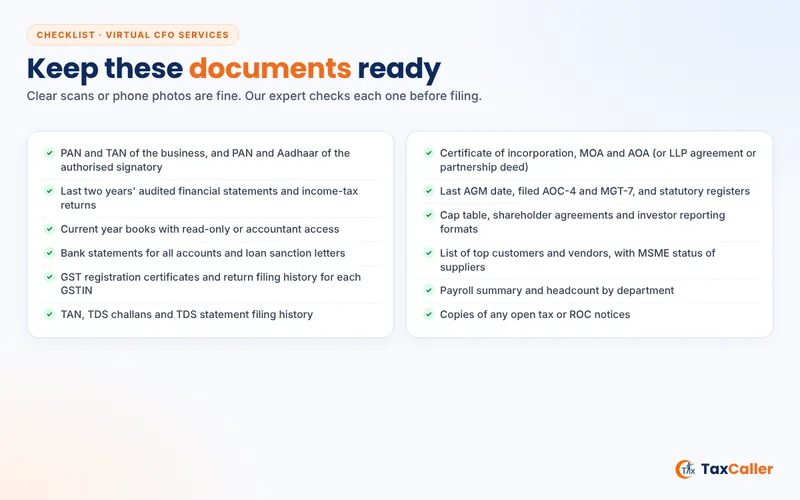
To begin, we need your past financials, your filing history and read-only access to your systems. A typical list:
We do not need your bank passwords or OTPs. Where a portal needs an OTP, the step is done with you on a call.

← Previous Next: Confidentiality, Data Security and Access Control →
15 Topic 15 of 20
A virtual CFO sees your most sensitive numbers, so access is limited, written down and removed when the engagement ends. This is how we handle it:
← Previous Next: Virtual CFO Services Fees: Our Fee and Other Costs, Clarified →
16 Topic 16 of 20
TaxCaller's virtual CFO fee starts at ₹14,999 + GST a month, for the plan and scope agreed in your scope letter. There is no government fee for CFO work itself, but these costs sit outside our fee and are paid at actual:
Public price lists and guides show a wide market range, from a few thousand rupees a month for compliance-led packages to well over ₹1 lakh a month for strategic CFO work. Some providers also bill projects as a lump sum or by the hour. Compare the written scope, not only the headline price.
What changes the fee: number of entities and GSTINs, monthly transaction volume, whether bookkeeping is included, number of review calls and reports, and fundraise work. We quote the exact monthly fee after the discovery call and health check, before any work starts.
| Plan | Suits | Core outputs |
|---|---|---|
| CFO Essentials | Small companies that need monthly visibility | Monthly MIS, cash view, compliance oversight, one review call |
| CFO Growth | Growing SMEs and funded startups | Everything in Essentials, 13-week forecast, budget and variance, KPI dashboard, audit coordination |
| CFO Fundraise | Companies raising equity or large debt | Everything in Growth, financial model, data room, diligence support, investor and board reporting |
← Previous Next: Choosing a Virtual CFO: Checklist and Mistakes to Avoid →
17 Topic 17 of 20
Pick a virtual CFO on scope, experience and independence, and avoid the mistakes below. The most common mistake is buying reports before the books are clean. Other common ones:
Choose on scope, experience and independence, not on the monthly price alone. Ask these questions before you sign:
A full-time CFO costs a salary plus benefits, hiring time and often a team under them. A virtual CFO costs a monthly retainer for a fixed share of senior time. The trade-off is availability: a virtual CFO is not in the office every day. For most companies before listing or large scale, the retainer buys the outputs that matter: cash planning, MIS, budgets and investor numbers.
Abhinay Rai Compliance Expert
Have a question on this topic? Ask Abhinay on a free call.
← Previous Next: Virtual CFO Services in Ghaziabad, Delhi NCR, Mumbai and Other Cities →
18 Topic 18 of 20
Virtual CFO work is delivered online, so your city does not limit who can help you. Our office is in Ghaziabad, which makes meetings in Delhi NCR easy when you want one in person. Businesses in Mumbai, Bengaluru, Pune, Hyderabad and other cities can work with us over video calls and shared folders.
What does change by state is part of the compliance calendar:
We map these at onboarding so the calendar fits your locations.
← Previous Next: What Changed in 2026 for Finance Teams in India →
19 Topic 19 of 20
2026 brought a new income-tax law and several company and GST changes that a virtual CFO now plans around:
We recheck each of these before acting for you, since dates and forms can change again by notification.
20 Topic 20 of 20
TaxCaller has handled tax, registration and compliance work since 2018, from our office in Ghaziabad and online across India. For virtual CFO work that means:
Need only one part of this? Start with bookkeeping, GST returns, TDS returns or annual compliance, and add CFO support when you are ready. Contact us to book a free consultation.
Don't have everything? Send what you have on WhatsApp. Our expert will tell you what's missing.
Send documents on WhatsAppReal experts, not a call centre
Your work is handled by experienced professionals who explain every step, check your documents and keep you updated.
Registered company
TaxCaller is run by TaxCaller India LLP (LLPIN AAQ-7388), serving clients since 2018.
Fee told upfront
You know the complete fee, our professional fee and the government fee, before any work starts. No hidden charges.
Support after the work
Notices, renewals, returns and compliance reminders: we stay with your business after the registration is done.
Expert for this topic Virtual CFO Services
Abhinay Rai
Advocate
Abhinay Rai is a Advocate specialising in Virtual CFO Services. The process, documents, timelines and fees on this page are checked against the current rules and government portals, and updated whenever the law, forms or fees change.
A virtual CFO plans and reports on your finances part-time and remotely. The work covers monthly MIS, cash flow forecasts, budgets, cost control, fundraising support, investor and board reports, audit coordination and oversight of GST, TDS and ROC deadlines. Your accountant keeps recording entries, while the virtual CFO turns those numbers into decisions for the owners.
Fees depend on scope, transaction volume, number of entities and how many reports and calls you need. Market retainers range from a few thousand rupees a month for compliance-led packages to over a lakh for fundraise-heavy work. TaxCaller's fee starts at the plan price shown, plus GST, with taxes and government fees paid separately at actual.
No. A virtual CFO is a role, not a qualification. Some virtual CFOs are chartered accountants, others are finance professionals. What differs legally is reserved work: a statutory audit or a tax audit report can be signed only by a chartered accountant holding a certificate of practice, who must also be independent of the company.
No. Section 144 of the Companies Act, 2013 bars a company's auditor from giving accounting, internal audit, outsourced financial or management services to that company, its holding company or its subsidiary. Section 141(3)(i) makes a person giving these services ineligible for appointment as auditor. Keep your virtual CFO and auditor separate.
Usually not. Under Section 203 and Rule 8 of the managerial personnel rules, whole-time key managerial personnel, including a CFO, are required for listed companies and other public companies with paid-up capital of ₹10 crore or more. Private companies are not covered by Rule 8, so many use a virtual CFO instead of a full-time hire.
Both are part-time CFOs. In common use, a virtual CFO works mostly remotely for a fixed set of monthly outputs, while a fractional CFO usually gives more hours each week and attends more meetings in person. Neither term has a legal definition in India, so compare the written scope, hours and deliverables rather than the label.
Possibly. An accountant records transactions and keeps returns on time. A virtual CFO looks ahead: cash runway, budgets, pricing, hiring plans and investor numbers. If you already have clean monthly books but no one turning them into decisions, a review-only virtual CFO plan works well and builds on your accountant's work.
Yes, on the numbers side. A virtual CFO builds the financial model, reconciles past financials with filings, prepares the data room and answers diligence queries. Share valuation is certified by the professional the law names, such as a registered valuer, or for foreign investors a chartered accountant, SEBI merchant banker or practising cost accountant.
A typical monthly pack has a one-page summary, profit and loss against budget, balance sheet, cash flow statement, receivables and payables ageing, a KPI dashboard and a compliance status list. Growth and fundraise plans add a weekly rolling cash forecast, quarterly board packs and investor updates. Exact reports and dates are fixed in your scope letter.
Confidentiality is written into the engagement letter, and we can sign a separate NDA. We use read-only or accountant-level access, never bank passwords or OTPs, and only named people work on your file. Your books stay in your own software. When the engagement ends, we hand over working files and you remove our access.
We aim to share the first MIS pack and cash forecast within the first month of the engagement. Onboarding covers a discovery call, a signed scope letter, access set-up, a health check of books and filings, and a fix plan. If books are several months behind, the clean-up comes first, which can extend the time before the first full report.
Yes. Our fee is shown + GST, and GST is added at the applicable rate on each monthly invoice. Registered businesses can usually claim this GST as input tax credit if the service is used for business. Taxes you owe, government filing fees, late fees and auditors' fees are separate and paid at actual.
Yes. Under Section 2(2) of the Chartered Accountants Act, 1949, a member in practice may provide accounting services and other services the ICAI Council permits, and many CA firms offer virtual CFO work. The limit is independence: the CA firm that audits your company cannot also act as its virtual CFO, because Section 144 of the Companies Act bars it.
Start with cash in hand, monthly net burn and runway, gross margin, EBITDA margin, receivable and payable days, inventory days, the cash conversion cycle and budget variance. Subscription businesses add recurring revenue and churn; consumer brands add customer acquisition cost. A virtual CFO usually tracks eight to twelve measures that fit your model.
Tell us your business, your numbers and your next big decision. Our fee starts at ₹14,999 + GST a month, and taxes and government fees are paid at actual.
Mon–Fri 9:00 AM – 6:00 PM, Sat 10:00 AM – 4:00 PM · Your trust is our biggest fee.