Fire NOC: Fire Safety Certificate for Your Building or Business
Get your fire NOC from the right state fire service, with the documents, drawings and inspection prepared by an expert who checks your state's rules first.
Excellent experience with TaxCaller for filing my &
my family members ITR returns. The entire process was
smooth, quick and hassle-free. They are professional,
knowledgeable and guided me through every step with patience.
O
obeid sait
★★★★★
The team has handled my taxes for the past three years,
and it's been a wonderful, hassle-free experience.
Thank you for your consistently quick and efficient service.
P
Pushkar
★★★★★
They are among the best in their field. Their work culture
is highly professional, and their client service is smooth
and reliable. They can confidently be relied on to get the job done.
P
Prasad Sheth
★★★★★
Excellent experience with TaxCaller! The ITR filing
process was smooth, quick, and completely hassle-free.
The CA was knowledgeable, responsive, and explained everything clearly.
A
Apoorv Bansal
★★★★★
Excellent service for ITR filing. The team was highly
professional, responsive, and guided me through the entire
process smoothly. My return was filed accurately and on time.
A
Abhishek Kumar
★★★★★
I was searching for a good CA firm in Ghaziabad and found
TaxCaller. The experience was excellent from start to finish.
The team is responsive, transparent, and genuinely helpful.
U
uma pandey
★★★★★
Great service! TaxCaller India made the entire ITR filing
process quick, smooth, and hassle-free. They answered all
my queries patiently and ensured maximum accuracy.
T
tanu mittal
★★★★★
Excellent job! We've been connected for many years,
and your success truly makes me happy. You are an
incredibly intelligent person. Keep shining, keep growing.
B
Bhanu Pratap Maurya
★★★★★
I am filing my ITR since past 3 years with Abhinav and
Firm is known as TaxCaller and they are professional
interms of ITR rules. They will explain and tell you all
the information.
A
ashish Sharma
★★★★★
I am providing my honest reviews:
No.1 service ...
A
AARYAN GROUP
★★★★★
Honestly, finding a good CA firm in Ghaziabad was
confusing, but TaxCaller India made it simple.
I contacted them for GST work and the experience was smooth.
N
News Speaks
★★★★★
If you're looking for a reliable CA firm in Ghaziabad,
TaxCaller India is a great choice. They provide complete
taxation and compliance solutions including GST.
A
Anshul Chaprana
★★★★★
Got my GST registration done through TaxCaller CA firm.
Process was quite smooth, they guided properly on documents
and didn't waste time. Overall good experience.
How we work
Online · Call · WhatsApp
Quick answer
A fire NOC is the fire department's written clearance that a building meets fire safety rules for its use. It comes in two stages: a provisional NOC on building plans, then a final fire safety certificate before occupancy. State fire laws decide who needs it, fees and validity. Most hotels, restaurants, hospitals, schools, factories and tall buildings need one.
Reviewed by Abhinay Rai · Updated 15 Nov 2026
Pick a plan that fits
Fire NOC Basic
Renewal, half-yearly Form B or maintenance certificate, or a small premises with systems already in place
₹2,999+ GST
+ Govt. fees at actual
Handled by a TaxCaller Expert Licence & Registration Expert
One handover call covering all fire documents and due dates
Government fees and taxes are extra where applicable. Our expert confirms the final amount on the first call. No hidden charges.
About Fire NOC
A fire NOC (no objection certificate) is the clearance your state fire service gives once it is satisfied that a building has the fire safety measures its use demands. Restaurants, hotels, hospitals, schools, factories, malls, warehouses and taller homes and offices usually need one. Municipal bodies, licensing departments, banks and insurers often ask for it before they act.
There is no single national fire law. Each state has its own fire service Act and rules. The technical standard behind them has long been Part 4 of the National Building Code of India 2016. In 2026 the Bureau of Indian Standards replaced that code with the National Building Construction Standards 2026, Delhi amended its fire rules, and Telangana reportedly raised its height limit for residential buildings.
TaxCaller has handled registrations and licences since 2018, from our office in Ghaziabad and online across India. This page explains the two stages of a fire NOC, who needs it, state laws, portals, documents, inspection, fees, validity, penalties and rejection reasons, in plain words.
Complete guide
Choose a topic to open it. Every answer gives the rule or section it comes from.
01 Topic 1 of 20
What Is a Fire NOC?
A fire NOC is a certificate from the state fire service confirming that a building's fire prevention and life safety measures meet the law for its use. It covers the building and the activity inside it, not the business entity. If you move or change the use, the clearance has to be looked at again.
Different states use different names for the same idea. The table shows the official names you will see on forms and portals.
State
Official name
Legal basis
Delhi
Fire Safety Certificate (issued in Form H)
Delhi Fire Service Act, 2007 and Rule 35 of the Delhi Fire Service Rules, 2010
Maharashtra
Provisional Fire Safety Approval and Final Fire Safety Approval
Section 3 of the Maharashtra Fire Prevention and Life Safety Measures Act, 2006, as amended by Maharashtra Act No. XXIV of 2023
Uttar Pradesh
Fire safety certificate
Sections 26 and 27 of the Uttar Pradesh Fire and Emergency Services Act, 2022
Telangana
No Objection Certificate
Section 13 of the Telangana Fire Service Act, 1999
Karnataka
No Objection Certificate for high-rise buildings
Section 13 of the Karnataka Fire Force Act, 1964, as amended in 2023
What the fire service checks
Means of escape: staircases, exits, travel distance, exit signs and emergency lighting.
Detection and alarm: smoke detectors, manual call points and the fire alarm panel.
Firefighting: extinguishers, hose reels, hydrants, risers, sprinklers, pumps and fire water tanks.
Construction: fire doors, compartments, refuge areas and smoke control.
Access: a road wide and strong enough for fire tenders to reach the building.
Many people call it a fire licence or fire certificate. In this guide, "fire NOC" means all of these state approvals.
A provisional NOC is issued on the building plans before construction, and the final fire safety certificate is issued after the measures are installed and inspected, before anyone occupies the building. The Delhi Fire Service's own FAQ describes these as the two stages of a fire NOC.
Point
Provisional stage (building plan)
Final stage (occupancy)
When
Before plans are sanctioned and construction starts
After construction, before an occupancy or completion certificate
The building itself: every measure installed, tested and working
Delhi
Fire Prevention Wing issues fire safety measures on the plans within three weeks (Rule 34(4))
Fire Safety Certificate in Form H after inspection (Rule 35)
Maharashtra
Provisional Fire Safety Approval, which the 2023 amendment defines as a recommendation
Final Fire Safety Approval, needed before a completion or occupancy certificate
Telangana
NOC under Section 13 before building plans are submitted
Inspection for the occupancy certificate
Why the difference matters
A provisional NOC is not permission to occupy. In May 2026, the Brihanmumbai Municipal Corporation reminded architects and developers that a Provisional Fire Safety Approval is only a recommendation, not a Fire Safety Certificate, as reported. Officials said such approvals had sometimes been treated as final.
The law also links the final stage to occupation. Section 26(2) of the UP Act bars the authority from issuing an occupancy certificate until fire safety requirements are met. In Telangana, Section 13 stops the plan approving authority from passing plans without a required NOC.
Existing buildings and tenants
If you rent space in a building that already has a certificate, check whether your use needs its own clearance. A restaurant inside an office building, for example, is an assembly use, not a business use. The certificate of the building may not cover it.
Zubair Licence & Registration Expert
Have a question on this topic? Ask Zubair on a free call.
You need a fire NOC when your state's fire law lists your building's occupancy and it crosses a set limit of height, storeys, floor area or seating. The limits differ by state. Delhi has the most detailed list, in Rule 27 of the Delhi Fire Service Rules, 2010, as revised by the Delhi Fire Service (Amendment) Rules, 2025, notified on 26 May 2026.
Occupancy (Delhi Rule 27)
Needs a fire safety certificate when
Pandal
Seating for more than 50 persons, or covered area above 50 sq m
Residential (not hotels)
Height above 15 m, or five or more storeys
Hotels and guest houses
Height above 12 m, or four or more storeys
Educational
Height above 9 m, or three or more storeys
Institutional (hospitals and similar)
Height above 9 m, or three or more storeys
Assembly
All assembly buildings
Business (offices)
Height above 15 m, or five or more storeys
Mercantile (shops, markets)
Height above 9 m, or three or more storeys
Industrial
Covered area above 250 sq m on all storeys
Storage
Covered area above 250 sq m on all storeys
Hazardous
Covered area above 100 sq m on all storeys
Underground structures
Two or more levels
Storeys include mezzanine and stilt floors above ground level.
Other states in short
Uttar Pradesh: Section 26(3) of the 2022 Act covers multi-storeyed buildings over 15 m, special buildings (educational, institutional, assembly, business, mercantile, industrial, storage and hazardous, as defined in the National Building Code) and mixed occupancies with these uses over 500 sq m of covered area.
Telangana: Section 13 covers commercial buildings over 15 m and public congregation buildings such as schools, cinema halls, function halls and places of worship on plots over 500 sq m or 6 m or more in height. The Act's text says 18 m for residential buildings. As reported, from 7 October 2026 fresh provisional NOC applications for residential apartments need a NOC only at 24 m and above.
Karnataka: anyone building a high-rise of 21 m or more needs a NOC from the Karnataka State Fire and Emergency Services under Section 13(3) of the Fire Force Act.
Maharashtra: buildings listed in Schedule I of the 2006 Act must provide the minimum fire installations and get the approvals under Section 3.
Businesses that commonly need it
Hotels, restaurants and banquet halls, hospitals and nursing homes, schools and coaching centres, factories, malls and multiplexes, warehouses and godowns, cinema halls, and any unit storing flammable goods. Offices and homes usually need it only above the height limit.
Use this table as a first check: it shows whether a common business usually needs fire clearance and why. The final answer depends on your state's rule, your building's height and area, and how many people use it.
Your business
Usually needs a fire NOC?
Reason
Small shop on the ground floor of a low building
Often no
Mercantile limits in Delhi start above 9 m or three storeys; check your state and city
Restaurant or cafe with 50 or more seats
Yes
The National Building Code treats a place where 50 or more people gather as assembly; Delhi covers all assembly buildings
Cloud kitchen with no seating
Depends
Not assembly, but LPG, cooking area and building height can still bring it in
Hotel or guest house
Yes above the limit
Delhi: above 12 m or four storeys
Hospital, nursing home or clinic with beds
Yes above the limit
Institutional use; Delhi: above 9 m or three storeys
School or coaching centre
Yes above the limit
Educational use; Delhi: above 9 m or three storeys; Telangana covers schools on large plots too
Office in a tall building
Building needs it
Business use; Delhi: above 15 m or five storeys
Factory or workshop
Yes above the limit
Industrial; Delhi: above 250 sq m covered area
Warehouse or godown
Yes above the limit
Storage; Delhi: above 250 sq m, or 100 sq m if goods are hazardous
Mall or multiplex
Yes
Assembly and mercantile mix
Wedding or event pandal
Yes above the limit
Delhi: more than 50 seats or above 50 sq m
Apartment society
Yes above the limit
Delhi: above 15 m; Telangana: 24 m and above for new provisional NOCs
Not sure where your premises fall? Send us the building height, floor area and seating on a free first call. We map it to your state's rule before you spend on drawings.
Occupancy Classes Under the National Building Code
The National Building Code of India 2016, Part 4 (Fire and Life Safety), sorts every building into nine occupancy groups, A to J, and fire rules apply group by group. Clause 3.1.1 lists the groups. Many state fire laws, including Delhi's and UP's, use these occupancy types.
B-1 schools up to senior secondary, B-2 other training institutions
C
Institutional
C-1 hospitals and sanatoria, C-2 custodial, C-3 penal and mental institutions
D
Assembly
D-1 to D-7, including theatres and halls, and D-6 mixed buildings with shopping and cinemas, such as multiplexes
E
Business
E-1 offices and banks, E-2 laboratories and clinics, E-3 call centres, E-4 telephone exchanges, E-5 broadcasting
F
Mercantile
F-1 shops up to 500 sq m, F-2 shops over 500 sq m, F-3 underground shopping centres
G
Industrial
G-1 low hazard, G-2 moderate hazard, G-3 high hazard
H
Storage
Warehouses and godowns
J
Hazardous
Buildings storing or handling highly flammable or explosive material
Three definitions that decide most cases
High rise building (clause 2.38): a building 15 m or above in height, whatever its occupancy.
Assembly (clause 3.1.5): a building where not less than 50 persons gather for amusement, recreation, social, religious and similar purposes. Restaurants are among the examples.
Height of building (clause 2.6): measured from the average ground level to the terrace of the last livable floor, for flat roofs.
The 2026 replacement
The National Building Construction Standards 2026 (SP 7:2026) replaced the 2016 code (SP 7:2016) from 30 April 2026. The fire chapter is now Part F, and it defines a high rise building as 24 m or above (clause 2.39). State fire laws and bye-laws still decide what is mandatory in your state. Several of them, like Delhi's Rule 27, set their own limits.
Abhinay Rai Licence & Registration Expert
Have a question on this topic? Ask Abhinay on a free call.
State Fire Laws: Delhi, Maharashtra, UP, Karnataka and Telangana
Fire NOCs are issued under state law, so your state's fire service Act and rules decide who needs one, the process and the fee. Here is what we confirmed for five large states.
Delhi
Law: Delhi Fire Service Act, 2007 and Delhi Fire Service Rules, 2010.
Rule 27 lists the buildings that need a Fire Safety Certificate. Rule 33 sets the fire prevention measures, following building bye-laws and the National Building Code.
Rule 35: you apply to the Director in Form I with a certificate from the architect and owner that the Rule 33 measures are in place. A team of fire officers inspects, and the Director grants the certificate in Form H or rejects it with written reasons.
The Delhi Fire Service (Amendment) Rules, 2025 were notified on 26 May 2026 under Section 63 of the Act. The amended Rules 34 to 38, including the new third-party auditor system, are deferred up to 20 May 2027 (see the 2026 section).
Maharashtra
Law: Maharashtra Fire Prevention and Life Safety Measures Act, 2006, amended by Maharashtra Act No. XXIV of 2023, and the Maharashtra Fire Prevention and Life Safety Measures Rules, 2009.
Section 3 makes the owner, or the occupier, provide the measures in Schedule I and keep them in good repair at all times.
Form A (Rule 4(1)): a Licensed Agency certifies that the fire measures comply with the Act.
Form B (Rule 4(2)): a Licensed Agency certifies twice a year, in January and July, that the measures are maintained in good repair.
Under Sections 9 and 10, fire prevention and life safety work is done by a Licensed Agency, unless the Chief Fire Officer authorises someone else in writing.
Section 45A, added in 2023, requires the owner or occupier to get a fire and life safety audit by a licensed auditor every two years.
Section 27(1): the Fire Officer issues the certificate within one month of an application with the required documents.
Section 26(5): the owner files a maintenance certificate twice a year, in January and July.
Section 28: premises specified by state government order must appoint a qualified fire safety officer.
Karnataka
Law: Karnataka Fire Force Act, 1964, amended by Act No. 24 of 2023.
Section 13(3) requires a NOC from the Karnataka State Fire and Emergency Services for any high-rise building of 21 m or more, following the fire and life safety provisions of the National Building Code 2016.
Telangana
Law: Telangana Fire Service Act, 1999 (Act No. 15 of 1999), adapted from the Andhra Pradesh law in 2015.
Section 13: apply to the Director General before submitting building plans. The decision must come within 60 days, with conditions or written reasons for refusal.
Fees are fixed by government orders, listed in the fees section below.
Other states, such as Gujarat, Tamil Nadu, Haryana and West Bengal, have their own Acts. We confirm the law for your address before filing.
Most states now take fire applications online, either on the fire service website or through the state's single window portal. The right portal depends on your state and, in big cities, on the municipal body.
Building plans go through the sanctioning body (MCD, DDA, NDMC, Delhi Cantonment Board or DUSIB). The Fire Safety Certificate application goes to the Director, Delhi Fire Service.
The Directorate's e-fire page says a provisional NOC is issued within 7 working days after receipt of the online payment UTR number. Final NOC inspections are done by the Chief Fire Officer of the local or special planning authority.
A fire safety certificate lets you occupy and run the building legally, and it is often the paper other departments ask for first. The benefits are practical.
Legal occupation: in UP, no occupancy certificate is issued until fire safety requirements are met (Section 26(2)). In Telangana, plans needing a NOC cannot be approved without it (Section 13).
Other licences move faster: trade licences, eating house and hotel registrations, hospital registrations and factory licences often ask for fire clearance or a fire safety declaration.
Insurance and loans: insurers and lenders commonly ask for the certificate for buildings that need one. A missing certificate can complicate a claim.
Lower risk of sealing: fire laws let officers seal unsafe buildings and cut power and water.
Safer people: the inspection forces you to test alarms, pumps and exits, which protects staff and customers.
Buyer and tenant confidence: a valid certificate makes a property easier to sell or lease.
The certificate is also a record. If a fire happens, it shows that you took the steps the law asks for.
Shadab Licence & Registration Expert
Have a question on this topic? Ask Shadab on a free call.
Fire NOC documents fall into three sets: ownership and identity papers, building drawings, and certificates from the people who designed and installed the fire systems. The exact list depends on the state and the stage.
For the provisional stage (building plans)
Application addressed to the fire authority, on the applicant's letterhead where asked.
Two sets of architectural drawings with the fire measures marked, and a block plan.
Notes on the building's activity and occupancy.
Smoke ventilation plans with calculations, and sprinkler plans with hydraulic calculations as per IS 15105 (Delhi).
A 3D building model for buildings above 15 m (Delhi).
We manage the paperwork, the portal and the follow-up, while your architect and a licensed fire agency handle the design and installation. You approve each step and pay the government fee directly.
Free first call: we note your state, address, building height, floor area, seating and activity.
Classify the building: we map your use to the occupancy group and your state's limits.
Find the authority: state directorate, city fire brigade or single window portal, and the right stage (provisional, final or renewal).
Gap check: we compare your drawings and site photos with the checklist your state uses.
Coordinate: we tell your architect and fire agency which drawings, calculations and certificates the file needs.
Build the file: we check names, areas and dates across every document.
File online: we fill the form on the portal and you approve it before submission.
Fee payment: you pay the fire department's fee on the portal, at actual.
Inspection support: a pre-inspection checklist, and replies to any observations.
Handover: the certificate, its number and expiry date, and a calendar for Form B, maintenance or renewal filings.
We do not design or install fire systems, and we do not issue audit certificates. Those come from licensed agencies, architects and auditors your state recognises. Use our tools page to plan your other compliance dates.
During the inspection, fire officers walk through the building and test whether every measure on the approved plan is installed and working. In Delhi, Rule 35 sends a team of fire officers, who recommend grant or refusal to the Director.
In Maharashtra (Section 5) and UP (Section 29), officers generally give three hours' notice and inspect between sunrise and sunset. Both Acts allow inspection at other times when an industry is running or an entertainment event is on.
Pre-inspection checklist
Item
What to confirm before the visit
Fire extinguishers
Right type for each risk, refilled, tagged with the last service date, mounted and visible
Hose reels and hydrants
Pressure tested, valves open, hoses not damaged
Sprinklers
Installed as per the approved drawing, heads not painted or blocked by storage
Fire alarm and detectors
Panel shows no fault, detectors in every required area, manual call points working
Fire pumps
Auto start works; diesel pump has fuel; jockey pump holds pressure
Fire water tank
Full to the approved capacity
Exits and staircases
Clear of goods, doors open outward where required, no locks on escape routes
Signs and lighting
Exit signs visible; no point in an exit access more than 30 m from a visible exit sign (clause 3.4.7.4, Part 4); emergency lights work on battery
Fire doors and compartments
Self-closing, not wedged open, no holes in fire walls
Electrical
Panels covered, no loose wiring, no overloaded sockets
Kitchen and LPG
Gas bank outside or in a ventilated area, leak detector where needed
Access road
Entry clear for a fire tender, no parking on the fire lane
People and records
Trained staff, evacuation plan displayed, mock drill and maintenance records ready
If the officer finds gaps, you get observations to fix. In Delhi, Rule 39 lets the authority allow up to 90 days to complete measures, extendable by the Director up to 180 days. The certificate stays suspended until you comply.
Shreya Licence & Registration Expert
Have a question on this topic? Ask Shreya on a free call.
A fire NOC usually takes between one week and two months, depending on the stage, the state and how ready the building is. The law sets some outer limits.
Step
Time limit or usual time
Source
Delhi: fire safety measures on building plans
Within three weeks of submission
Rule 34(4), Delhi Fire Service Rules, 2010
Maharashtra: provisional NOC from the Directorate
Within 7 working days after the online payment UTR
Maharashtra Fire and Emergency Services e-fire page
Uttar Pradesh: fire safety certificate
Within one month of an application with the required documents
Section 27(1), UP Act of 2022
Telangana: NOC decision
Within 60 days
Section 13, Telangana Fire Service Act, 1999
Delhi: time to fix observations
Up to 90 days, extendable to 180 days
Rule 39
Most delays come from three things: drawings that do not match the site, a fire system that is not complete at inspection, and slow replies to queries. Our own work, from complete documents to filing, usually takes two to three working days. The fire department's time runs after that.
Fire NOC Fees: Government Fee and Our Fee, Clarified
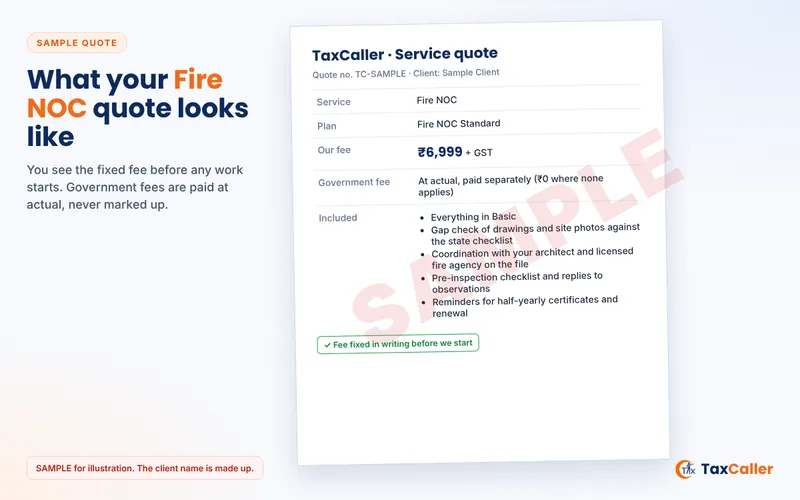
Fire NOC: SAMPLE quote, for illustration only
A fire NOC has two separate costs: the fire department's fee, set by each state, and TaxCaller's professional fee. We keep them apart so you see each one.
The fire department's fee
There is no national fee. Most states charge by built-up area, height and occupancy. Here is what we confirmed from official sources:
State
Official fee
Source
Telangana
Fire precaution fee of ₹10 per sq m of total built-up area, including basements and stilt floors
Extra user charge of ₹100 per sq m for high-rise buildings above 30 m and up to 45 m
G.O.Ms.No. 181 (Home), 3 November 2016
Telangana
Inspection for occupancy certificate: 10 per cent of the statutory fee, up to ₹50,000. Inspection for NOC renewal: ₹10,000
G.O.Ms.No. 71 (Home), 1 April 2010
Maharashtra
Fire and Emergency Service Fee as a percentage of the Annual Statement of Rates (ready reckoner rate) per sq m of built-up area, from 0.25 per cent for residential buildings up to 45 m to 1 per cent for commercial and industrial buildings above 45 m
Schedule II, as substituted by Maharashtra Act No. XXIV of 2023
Maharashtra
Annual fee of one per cent of the minimum fees in the Schedules
Section 13 of the 2006 Act
Delhi
₹1,000 with an auditor-issued certificate and ₹1,000 with each yearly Form K, once Rules 35 and 38 as amended start (deferred up to 20 May 2027). Appeal fee ₹5,000
Delhi Fire Service (Amendment) Rules, 2025; Rule 42
Uttar Pradesh, Karnataka and other states
Set by the state
State rules and orders
Government buildings are exempt from the Telangana fire precaution fee under G.O.Ms.No. 139 of 26 July 2016.
TaxCaller's fee
TaxCaller's fee for a fire NOC starts at ₹2,999 + GST for one premises. The final fee depends on the plan, the stage and the size of the building. We confirm it in writing on the first call.
Item
Paid to
Amount
Classification, document check, filing and follow-up
TaxCaller
From ₹2,999 + GST
Fire NOC fee, inspection or renewal fee
State fire department
Set by the state, at actual
Fire system design, installation and Form A or Form B certificates
Your architect or licensed fire agency
As quoted by them
Fire extinguishers, pumps, sprinklers and repairs
Equipment vendors
As quoted by them
Stamp paper for affidavits or undertakings
State (stamp duty)
As per state stamp law
Government fees are never part of our invoice. You pay them directly to the fire department.
How long a fire NOC lasts depends on the state: Delhi certificates now run three or five years, while Maharashtra and UP also want a maintenance certificate every January and July. Keep both the expiry date and the half-yearly dates in your calendar.
State
Validity and ongoing filings
Delhi (up to 20 May 2027)
Rule 36: 5 years for residential buildings, 3 years for non-residential buildings including hotels. Rule 37: apply for renewal six months before expiry. Rule 38: a yearly declaration that the measures are in good repair.
Delhi (after 20 May 2027, as now scheduled)
The certificate stays valid unless suspended or cancelled, as long as a yearly Form K declaration with ₹1,000 is filed before each one-year mark. Separate renewal goes away.
Maharashtra
Form B from a Licensed Agency every January and July (Rule 4(2)). The January form covers July to December of the past year; the July form covers January to June. An audit by a licensed auditor is also due every two years under Section 45A.
Uttar Pradesh
Maintenance certificate to the Fire Officer every January and July (Section 26(5)).
Telangana
Renewal involves an inspection, charged at ₹10,000 under G.O.Ms.No. 71.
Karnataka and others
As per state rules.
How renewal works
Renewal is lighter than a fresh application if nothing has changed. You usually submit the old certificate, fresh maintenance or test certificates and the fee, and an officer may inspect. If you have added floors, changed the use or altered exits, it is not a simple renewal. You need fresh approval.
Our Standard and Premium plans include reminders before every half-yearly and renewal date.
Zubair Licence & Registration Expert
Have a question on this topic? Ask Zubair on a free call.
Running a building without the required fire clearance, or letting its systems fail, can lead to fines, prosecution, sealing and disconnection of power and water. Here is what the main Acts say.
State
Provision
Consequence
Maharashtra
Section 36, 2006 Act
Rigorous imprisonment of six months to three years and a fine of ₹20,000 to ₹50,000; up to ₹3,000 a day for a continuing offence
Maharashtra
Section 8 and Section 37
Sealing and disconnection where there is imminent danger; tampering with fire equipment and removing a seal are cognizable and non-bailable
Uttar Pradesh
Section 31, 2022 Act
Up to six months' imprisonment, a fine up to ₹50,000, or both; up to ₹3,000 a day for a continuing offence
Uttar Pradesh
Section 33
Not appointing a fire safety officer: ₹10 to ₹50 per sq m of built-up area for each month of default
Uttar Pradesh
Section 58
Sealing of a dangerous building; breaking the seal can mean up to three months' jail, a fine up to ₹25,000, or both
Telangana
Section 31, 1999 Act
Up to three months' imprisonment, a fine up to ₹25,000, or both; up to ₹3,000 a day after conviction for a continuing offence
Delhi
Rule 38(3) and Rule 43
The Director may declare a building unfit and cut electricity and water. Offences under Section 54 can be compounded: up to ₹10,000 by a Deputy Chief Fire Officer, up to ₹50,000 by a Chief Fire Officer, and above that by the Director
Who is liable
For companies, the person in charge of the business is liable. Directors and managers can also be liable if the offence happened with their consent or neglect (Section 38 in Maharashtra, Section 40 in UP and Section 32 in Telangana).
A missing fire NOC can also stall your trade licence, hotel or hospital registration, and insurance claims.
Most fire NOC rejections come from a short list of gaps: missing or expired extinguishers, sprinklers not as per plan, blocked or too few exits, a weak hydrant system and papers that do not match the building. Each can be fixed before you apply.
Fire extinguishers: wrong type for the risk, not refilled or not tagged with a service date.
Sprinklers: missing in a required area, or not installed as per the approved drawing and IS 15105.
Exits: too few exits, staircases used for storage, locked escape doors or too long a travel distance.
Hydrant and pumps: low pressure, dry risers without water, or a pump that does not start on its own.
Water tank: smaller than approved. Delhi's FAQ asks for a replenishment rate of 1,000 litres per minute.
Smoke control: no ducted system or calculations where Delhi asks for them.
Refuge areas: missing in buildings above 24 m, which Delhi requires under bye-law 9.3.6 of UBBL 2016.
Access road: too narrow, blocked by parking or a gate a fire tender cannot pass.
Plan deviation: extra floors, covered setbacks or a basement used for storage instead of parking.
Change of use: an office turned into a restaurant or coaching centre without fresh approval. Clause 3.1.14 of Part 4 needs a certificate of occupancy before a change in occupancy.
Missing agency certificate: no Form A in Maharashtra, or no architect and owner certificate with Form I in Delhi.
Paper mismatch: different names, areas or addresses across the deed, drawings and application.
False declaration: Delhi's Rule 38(4) treats a false declaration as a default.
Before filing, we check each of these. If a gap needs building work, we tell you honestly before you pay us.
A 60-seat restaurant in Delhi needs a Fire Safety Certificate, because Rule 27 covers all assembly buildings and the National Building Code counts a place where 50 or more people gather as assembly. Here is how the file usually runs.
The situation
Ravi rents the first floor of a three-storey commercial building in Delhi for a 60-seat restaurant with an LPG kitchen. The building has no fire certificate for this use.
The steps
Check the building: confirm the sanctioned plan, the landlord's papers and whether the floor can be used as an eating place.
Plan the measures: a fire consultant or architect marks extinguishers, detectors, alarm, emergency lights, exit signs and the second exit on the drawings, as per Rule 33.
Install and test: a fire agency installs and tests the system and gives its certificates.
Apply: the application goes to the Director in Form I, with the architect's and owner's certificate that the Rule 33 measures are in place.
Inspection: a team of fire officers visits and recommends grant or refusal.
Fix and certificate: any observations are fixed, and the Fire Safety Certificate is issued in Form H.
Next licences: with the certificate, Ravi moves to the health trade licence, FSSAI licence and GST.
The costs to plan for
Fire equipment and installation, paid to vendors.
Consultant or architect drawings, paid to them.
Any government fee, at actual.
Our professional fee, plus GST, confirmed in writing on the first call.
After the certificate
Under the current Rule 36, a non-residential certificate is valid for three years, and Rule 37 asks for renewal six months before expiry. Ravi keeps the extinguisher service tags, alarm test log and staff training record ready for the yearly declaration. If the restaurant later adds a rooftop seating area, that is a change needing fresh approval.
Abhinay Rai Licence & Registration Expert
Have a question on this topic? Ask Abhinay on a free call.
Fire rules changed in several ways in 2026: a new national building standard replaced the 2016 code, Delhi amended its fire rules, and Telangana and Karnataka moved or proposed to move height limits. Items marked "as reported" come from news reports. Check your state portal for anything newer.
1. National Building Construction Standards 2026 replace NBC 2016 (30 April 2026)
The Bureau of Indian Standards established the National Building Construction Standards 2026 (SP 7:2026) by a notification in the Gazette of India dated 30 April 2026, and withdrew the National Building Code of India 2016 (SP 7:2016) from the same date. The fire chapter is now Part F, and clause 2.39 defines a high rise building as 24 m or above. BIS says fire norms were rationalised by removing height restrictions, relaxing travel distance and optimising water storage. Part F mostly says "should" where the 2016 code said "shall", and news reports call the fire provisions advisory. Your state fire Act, rules and bye-laws still decide what is mandatory.
2. Delhi Fire Service (Amendment) Rules, 2025 (notified 26 May 2026)
Notified under Section 63 of the Delhi Fire Service Act, 2007, vide F. No. DFS/HQ/Misc./2025/01(E-259159)/237 (Delhi Gazette Extraordinary No. 143).
The Rule 27 and compounding changes applied from notification. The other changes were to start 90 days later.
Rule 27's list of risky occupancies was revised, including underground structures of two or more levels.
Compounding limits rose: up to ₹10,000 by a Deputy Chief Fire Officer and up to ₹50,000 by a Chief Fire Officer.
Empanelled third-party Fire Safety Auditors will inspect and issue certificates, with at least 5 per cent checked at random each quarter.
Certificates will stay valid with a yearly Form K declaration and ₹1,000, instead of renewal.
Covered buildings will need an Automated Continuous Monitoring System.
3. Delhi: auditor system deferred to 20 May 2027 (16 October 2026)
Rules 34 to 38 and the First and Seventh Schedules were to start 90 days after notification. A notification of 16 October 2026 (F. No. 6/DFS/MS/HQ/MISC/2026/01/631, Delhi Gazette Extraordinary No. 314) extended this by 270 days from 24 August 2026, up to 20 May 2027. News reports said no auditor had been empanelled by August 2026. Until then, the existing Rules 34 to 38 continue for applications. A plea against the auditor system is also before the Delhi High Court, which issued notice to the Delhi government in September 2026, as reported.
4. Mumbai: provisional approval is only a recommendation (May 2026)
As reported, BMC issued revised application formats for new buildings, alterations, repairs, temporary structures and final approvals. It stressed that a Provisional Fire Safety Approval is not a Fire Safety Certificate.
5. Telangana: residential NOC limit raised to 24 m (7 October 2026)
As reported, fresh provisional NOC applications for residential apartments from 7 October 2026 need a fire NOC only at 24 m and above, up from 18 m. Buildings of 24 m and above need a fire tower and a fire command centre. Other occupancies are unchanged. The revised requirements were issued by the Director General of Telangana Fire Services; the Act's text still says 18 m.
6. Karnataka: draft to raise the high-rise limit to 24 m (November 2026)
A draft notification of 4 November 2026 proposes moving the high-rise limit from 21 m to 24 m in the zonal regulations, as reported. It is not final. Until it is notified, the 21 m rule applies.
A fire NOC answers one question: is this building safe for this use? Your business will need other registrations too. Our business licences guide shows the full set. In short:
Need permission from your city to run the trade at the address? Get a trade licence. Many cities ask for fire clearance first for eateries, hotels and godowns.
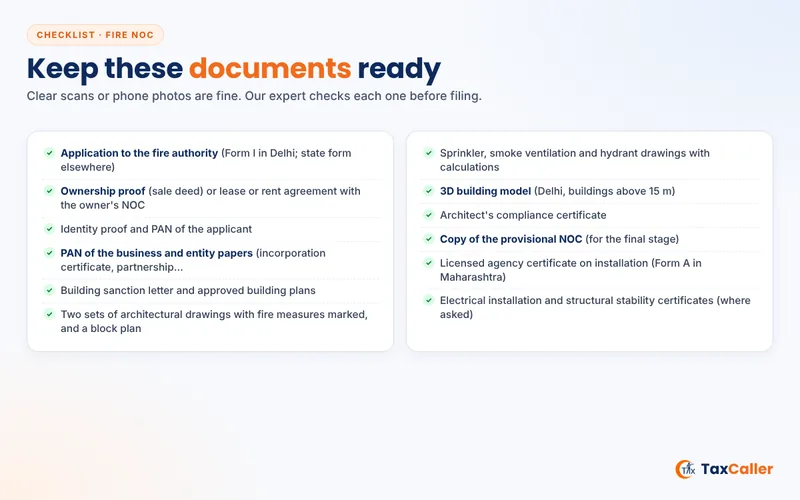
Application to the fire authority (Form I in Delhi; state form elsewhere)
Ownership proof (sale deed) or lease or rent agreement with the owner's NOC
Identity proof and PAN of the applicant
PAN of the business and entity papers (incorporation certificate, partnership deed or LLP agreement)
Building sanction letter and approved building plans
Two sets of architectural drawings with fire measures marked, and a block plan
Sprinkler, smoke ventilation and hydrant drawings with calculations
3D building model (Delhi, buildings above 15 m)
Architect's compliance certificate
Copy of the provisional NOC (for the final stage)
Licensed agency certificate on installation (Form A in Maharashtra)
Electrical installation and structural stability certificates (where asked)
Fire system test reports and annual maintenance contract
Occupancy or completion certificate (existing buildings)
Photographs of the premises and fire installations
Fee payment receipt
Why TaxCaller
Real experts, not a call centre
Your work is handled by experienced professionals who explain every step, check your documents and keep you updated.
Registered company
TaxCaller is run by TaxCaller India LLP (LLPIN AAQ-7388), serving clients since 2018.
Fee told upfront
You know the complete fee, our professional fee and the government fee, before any work starts. No hidden charges.
Support after the work
Notices, renewals, returns and compliance reminders: we stay with your business after the registration is done.
Reviewed By
Expert for this topic Fire NOC
Abhinay Rai
Advocate
Abhinay Rai is a Advocate specialising in Fire NOC. The process, documents, timelines and fees on this page are checked against the current rules and government portals, and updated whenever the law, forms or fees change.
A fire NOC is a certificate from the state fire service confirming that a building has the fire safety measures its use needs. The state fire directorate or the city's chief fire officer issues it under the state fire Act. Delhi calls it a Fire Safety Certificate, and Maharashtra calls it a Fire Safety Approval, issued in two stages.
Is a fire NOC mandatory for a small shop?
Often not. Small shops on the ground floor of low buildings usually fall below the limits. In Delhi, mercantile buildings need a certificate only above 9 m or three storeys. But a shop storing flammable goods, or inside a mall or tall building, may be covered. Check your state's rule, or ask us on a free first call.
Do restaurants need a fire NOC?
Usually yes, if 50 or more people can be seated. The National Building Code treats such places as assembly buildings, and Delhi's Rule 27 covers every assembly building. Smaller eateries may still need one because of building height, LPG use or city licence rules. Many cities ask for fire clearance before the health trade licence.
What is the difference between a provisional and a final fire NOC?
A provisional NOC is given on the building plans before construction, after the fire department checks the drawings. A final fire NOC or fire safety certificate is given after the building is built and its fire systems are inspected. Maharashtra's law calls the provisional approval a recommendation. Only the final certificate lets you occupy the building.
How much does a fire NOC cost?
There are two costs. The government fee is set by each state; for example, Telangana charges a fire precaution fee of ₹10 per sq m of built-up area. TaxCaller's professional fee is separate and stated in writing on the first call, plus GST. Fire equipment, drawings and agency certificates are paid to those vendors directly.
How long does it take to get a fire NOC?
It usually takes one week to two months. UP's Act asks the Fire Officer to issue the certificate within one month of a complete application. Telangana's Act allows 60 days for a decision. Maharashtra's Directorate issues a provisional NOC within 7 working days of online payment. Incomplete fire systems at inspection cause most delays.
What is the validity of a fire NOC?
It depends on the state. In Delhi, a certificate is valid for five years for residential buildings and three years for others under the current Rule 36. After 20 May 2027, as now scheduled, it will stay valid with a yearly Form K declaration. Maharashtra and UP also need a maintenance certificate every January and July.
What is Form B in Maharashtra?
Form B is a certificate from a Licensed Agency that a building's fire prevention and life safety measures are in good repair and working. Under Rule 4(2) of the Maharashtra Fire Prevention and Life Safety Measures Rules, 2009, it is filed twice a year, in January and July. Form A is the agency's certificate after installation.
Can I apply for a fire NOC online?
Yes, in most states. Delhi takes applications through the Delhi Fire Service, Maharashtra through its e-fire system, Mumbai through the BMC portal, and Uttar Pradesh through the Nivesh Mitra single window. Telangana's fire portal is linked with HMDA, GHMC and DTCP. Inspections still happen in person, so the building must be ready before you apply.
What happens if I run a business without a fire NOC?
You risk fines, prosecution and sealing. Maharashtra's Section 36 provides for six months to three years of rigorous imprisonment and a fine of ₹20,000 to ₹50,000. UP's Section 31 allows a fine up to ₹50,000. Officers can also cut power and water. Your trade licence and insurance claims can be affected too.
Is a fire NOC needed for a trade licence or FSSAI licence?
They are separate approvals from separate departments. FSSAI deals with food safety, while the fire NOC deals with the building and its use. But many cities ask for a fire NOC or fire safety declaration before issuing a trade or health licence to eateries, hotels and godowns. So for a restaurant, plan the fire NOC early.
Who will issue fire safety certificates in Delhi after the 2026 amendment?
Under the Delhi Fire Service (Amendment) Rules, 2025, empanelled third-party Fire Safety Auditors will inspect buildings and issue certificates, and Delhi Fire Service will check at least 5 per cent at random. A notification of 16 October 2026 deferred this to 20 May 2027. Until then, Delhi Fire Service handles applications under the existing rules.
Does the 2026 building standard remove the need for a fire NOC?
No. The National Building Construction Standards 2026 replaced the 2016 code and raised the high-rise definition to 24 m, but a fire NOC comes from your state's fire Act and rules. Delhi, Maharashtra, UP, Karnataka and Telangana laws still apply. Some states may revise their limits later, so check before you plan.
Do I need my own fire NOC for a rented office in a high-rise?
Usually the building owner holds the fire certificate for an office tower. If you only use the space as an office, the building's certificate generally covers you. If you change the use, add a kitchen, store goods or alter exits, your part may need fresh approval. Ask the landlord for a copy before signing.
Get your fire NOC filed with the right fire service
Tell us your state, building and business, and our expert will map the fire rules that apply and file your application. Our fee starts at ₹2,999 + GST, and the fire department's fee is paid at actual.