Trademark Opposition: File or Defend Your Brand Online
Trademark opposition help for both sides: we file Form TM-O against copycat marks and defend your application with a counter-statement, evidence and hearing support.
Starting from · ₹5,999 Trademark Opposition File an Opposition plan
STARTING FROM₹5,999
FEE TOLD UPFRONTFree first call
!Brand not protected?Your rights count from the filing date, so file early
Since 2018Trusted Experience
980+Experts Connected
220+Cities Served
1164+Agents Available
12000+Founders Trusted
S
Srishti Magoo
★★★★★
Excellent experience with TaxCaller for filing my &
my family members ITR returns. The entire process was
smooth, quick and hassle-free. They are professional,
knowledgeable and guided me through every step with patience.
O
obeid sait
★★★★★
The team has handled my taxes for the past three years,
and it's been a wonderful, hassle-free experience.
Thank you for your consistently quick and efficient service.
P
Pushkar
★★★★★
They are among the best in their field. Their work culture
is highly professional, and their client service is smooth
and reliable. They can confidently be relied on to get the job done.
P
Prasad Sheth
★★★★★
Excellent experience with TaxCaller! The ITR filing
process was smooth, quick, and completely hassle-free.
The CA was knowledgeable, responsive, and explained everything clearly.
A
Apoorv Bansal
★★★★★
Excellent service for ITR filing. The team was highly
professional, responsive, and guided me through the entire
process smoothly. My return was filed accurately and on time.
A
Abhishek Kumar
★★★★★
I was searching for a good CA firm in Ghaziabad and found
TaxCaller. The experience was excellent from start to finish.
The team is responsive, transparent, and genuinely helpful.
U
uma pandey
★★★★★
Great service! TaxCaller India made the entire ITR filing
process quick, smooth, and hassle-free. They answered all
my queries patiently and ensured maximum accuracy.
T
tanu mittal
★★★★★
Excellent job! We've been connected for many years,
and your success truly makes me happy. You are an
incredibly intelligent person. Keep shining, keep growing.
B
Bhanu Pratap Maurya
★★★★★
I am filing my ITR since past 3 years with Abhinav and
Firm is known as TaxCaller and they are professional
interms of ITR rules. They will explain and tell you all
the information.
A
ashish Sharma
★★★★★
I am providing my honest reviews:
No.1 service ...
A
AARYAN GROUP
★★★★★
Honestly, finding a good CA firm in Ghaziabad was
confusing, but TaxCaller India made it simple.
I contacted them for GST work and the experience was smooth.
N
News Speaks
★★★★★
If you're looking for a reliable CA firm in Ghaziabad,
TaxCaller India is a great choice. They provide complete
taxation and compliance solutions including GST.
A
Anshul Chaprana
★★★★★
Got my GST registration done through TaxCaller CA firm.
Process was quite smooth, they guided properly on documents
and didn't waste time. Overall good experience.
How we work
Online · Call · WhatsApp
Quick answer
A trademark opposition is a formal challenge, filed in Form TM-O within four months of a mark's publication in the Trade Marks Journal, asking the Registrar to refuse it. The applicant must file a counter-statement within two months, or the application is treated as abandoned. The official fee is ₹2,700 per class on e-filing.
Reviewed by Abhinay Rai · Updated 15 Nov 2026
Pick a plan that fits
File an Opposition
Brand owners who found a similar mark in the Trade Marks Journal
Government fees and taxes are extra where applicable. Our expert confirms the final amount on the first call. No hidden charges.
About Trademark Opposition
Trademark opposition is the stage where anyone can challenge a brand name or logo before it is registered. It opens when the mark appears in the Trade Marks Journal and lasts four months. If you spot a copycat of your brand, this is your chance to stop it at a low cost.
It also works the other way. If someone has opposed your application, you have two months to reply with a counter-statement. Miss it and your application is abandoned under Section 21(2) of the Trade Marks Act, 1999.
TaxCaller's trademark experts handle both sides online. We file Form TM-O, draft counter-statements, prepare affidavit evidence and get you ready for the hearing. Every legal fact on this page is checked against the Trade Marks Act, 1999 on India Code and the Trade Marks Rules, 2017 on IP India.
Complete guide
Choose a topic to open it. Every answer gives the rule or section it comes from.
01 Topic 1 of 20
Trademark Opposition Explained: A Third-Party Challenge Before Registration
Trademark opposition is a legal objection by a third party to a pending trademark application. It is filed after the mark appears in the Trade Marks Journal and before it is registered. The opponent asks the Registrar to refuse the mark.
Think of the Journal as a public notice board. The Registry has already examined the mark and found no reason to refuse it. Publication gives everyone else a fixed window to raise their own concerns. Once the window closes with no opposition, the mark moves to registration under Section 23(1).
An opposition turns the application into a contested case. Both sides file written pleadings, then evidence on affidavit, then argue at a hearing. The Registrar decides under Section 21(5). The Registrar may even refuse on a ground the opponent did not raise.
So there are always two parties:
The opponent: the person who files Form TM-O to stop the mark.
The applicant: the person who filed the trademark and now has to defend it.
TaxCaller works for either side. This page explains both roles in full, so you know what to expect whichever letter you are holding.
Opposition, Objection or Rectification: Which One Is Yours?
People often mix up three different stages. Each has its own form, deadline and page on our site.
Point
Objection
Opposition
Rectification
Who raises it
The Registry examiner
Any third party
Any person aggrieved
When
After examination, before publication
Within four months of Journal publication
After the mark is registered
Law
Examination report, Sections 9 and 11
Section 21, Rules 42 to 51
Section 57
Decided by
Registrar
Registrar after evidence and hearing
Registrar or High Court
Your reply
Written reply to the report
Counter-statement in Form TM-O
Counter-statement in the cancellation case
If the examiner raised the issue, you need a trademark objection reply, not this service. If a stranger filed against your mark after publication, you are in opposition. If the rival mark is already registered, opposition is closed. The route then is a rectification petition under Section 57.
Zubair Trademark Expert
Have a question on this topic? Ask Zubair on a free call.
Who Can Oppose a Trademark, and When It Makes Sense
Section 21(1) says "any person" may oppose. You do not need a registered trademark of your own. You do not even need to trade in the same field. In practice, most opponents fall into these groups:
Owners of a registered or pending mark that looks or sounds similar.
Prior users of an unregistered brand who have built goodwill in the market.
Owners of a well-known mark, even for unrelated goods.
Copyright owners, such as the creator of an original logo or artwork.
Businesses whose former partner, distributor or employee filed their brand in their own name.
Trade bodies or members of the public, where a mark is deceptive or uses a protected emblem.
How to read a Journal entry
IP India publishes the Trade Marks Journal online. Each entry shows the application number and date, the class, the mark, the applicant's name and address, the address for service, the user date claimed and the goods or services. Note the Journal number and date. Your four months run from that date.
Cases where opposing pays off
The new mark is identical or deceptively similar to yours, for the same or related goods.
You used your brand first, even without registration.
The applicant copied your logo design or trade dress.
You suspect a squatter is trying to block you or sell the mark back to you.
When it may not be worth it
The marks share only a common word used by the whole trade.
The goods are unrelated and your mark is not well known.
You have no proof of use and no earlier application date.
We give you a frank view on the first call. Sometimes a simple letter to the applicant settles the issue faster than a full case.
Grounds for Opposing a Mark: Sections 9, 11 and Bad Faith
A notice of opposition must state its grounds. Rule 43 requires it to name the application, the goods or services opposed, the earlier mark or right relied on and the grounds. Strong notices usually combine several of the grounds below.
Absolute grounds under Section 9
No distinctive character: the mark cannot tell one trader's goods from another's (Section 9(1)(a)).
Descriptive words: the mark only describes the kind, quality, quantity, purpose, value or origin of the goods (Section 9(1)(b)).
Common trade words: the mark has become customary in the current language or trade (Section 9(1)(c)).
Deceptive marks: the mark may deceive the public or cause confusion (Section 9(2)(a)).
Religious or obscene matter: the mark may hurt religious feelings or contains scandalous or obscene matter (Section 9(2)(b) and (c)).
Protected emblems: use is barred under the Emblems and Names (Prevention of Improper Use) Act, 1950 (Section 9(2)(d)).
Functional shapes: a shape that comes from the goods, gives a technical result or adds substantial value (Section 9(3)).
Note the proviso to Section 9(1). A mark is not refused if it gained distinctiveness through use before the application date, or if it is well known.
Relative grounds under Section 11
Likelihood of confusion: the mark is identical or similar to an earlier mark for identical or similar goods, so the public may be confused or assume a link (Section 11(1)).
Well-known marks: even for different goods, a mark that takes unfair advantage of, or harms, a well-known mark in India can be refused (Section 11(2)).
Passing off and copyright: the mark can be stopped where its use could be prevented by the law of passing off or by copyright law (Section 11(3)).
How similarity is judged
The Registry does not compare marks letter by letter. It asks how an ordinary buyer with an imperfect memory would react. The usual factors are:
Look, sound and idea of the two marks, taken as a whole.
The main or dominant part of each mark, such as the leading word in a logo.
How close the goods or services are, and whether they are sold side by side.
Who buys them, and how much care those buyers take.
The strength and reputation of the earlier mark.
Section 11(4) is the flip side. If the earlier owner consents, the Registrar may allow the later mark.
Bad faith and false ownership claims
Section 18(1) lets only a person "claiming to be the proprietor" apply. If the applicant is not the true owner, such as a former distributor, the opponent pleads that the claim is false. Section 11(10)(ii) also directs the Registrar to consider bad faith of the applicant or the opponent. Copying a known brand, filing to resell it, or filing a rival's name to block its launch are typical bad faith facts.
Every ground needs proof. We map each ground to the documents you hold before we draft a single paragraph. You can read the grounds in full in the Trade Marks Act, 1999 on India Code.
Opposition is the cheapest and quickest moment to fight over a brand. Once a mark is registered, the owner gets the right to sue for infringement. Removing it later means a rectification case before the Registrar or the High Court.
Lower cost: the official fee is a fixed amount per class, and there is no court fee.
No registration needed: a prior user with only invoices and adverts can still oppose.
Protects your market: a confusing mark that reaches the register can divert your buyers for years.
Bargaining power: a well-drafted notice often brings the applicant to the table to limit goods or withdraw.
For applicants: a timely counter-statement keeps your application alive and puts the burden back on the opponent.
Clear record: a mark that survives opposition stands on firmer ground in later disputes.
Good evidence wins oppositions. Collect what you can early, even if you do not file it all at once.
Papers the opponent needs
Application number, class, and Journal number and date of the mark you want to oppose.
Your own trademark details: registration certificate or application number, if any.
Proof of first use: dated invoices, bills, purchase orders and GST returns showing the brand.
Marketing proof: adverts, brochures, website archives, social media pages and press coverage.
Year-wise sales and advertising figures, ideally certified by your accountant.
For logos: the original artwork file and proof of who created it.
Any letters, agreements or emails with the applicant, such as a distributor deal.
Authorisation for us to act in Form TM-M (Rule 19), signed by the opponent.
Identity and address proof of the opponent.
Papers the applicant needs
The notice of opposition as served on you, and the date and mode you received it.
Your TM-A application, examination report and any objection reply already filed.
Proof of use from the date claimed in your application, year by year.
The story of how you chose the name, with dated design files or domain records.
Proof that your goods or customers differ from the opponent's, if true.
Authorisation for us to act in Form TM-M (Rule 19), signed by the applicant.
Documents in a language other than Hindi or English need an attested translation under Rule 49. A copy must also go to the other side. Affidavits are sworn before a notary or oath commissioner.
Trademark Opposition: how the work moves, step by step
Here is how we file an opposition for you, fully online, from any city in India.
Check the date: we confirm the Journal date and count four months. Section 21(1) fixes this limit in the Act itself. Section 131 allows extensions only for periods the Act does not fix, so treat it as final.
Case review: we compare both marks for look, sound, meaning and goods. We tell you plainly if the case is weak.
Choose classes: under Rule 42, a separate fee applies for each class you oppose in a multi-class application.
Draft the notice: we set out your rights, the facts and every ground under Sections 9, 11 and 18, in numbered paragraphs.
Verify: Rule 43 requires a verification at the foot. It states which paragraphs are from personal knowledge and which are from information believed true, with date and place.
Your approval: you read the draft and we finalise it with you.
File and pay: we file Form TM-O on the IP India e-filing portal and pay the official fee of ₹2,700 per class at actual.
Track: under Rule 42, the Registrar ordinarily serves a copy on the applicant within three months. We track the opposition number and the counter-statement deadline.
Partial oppositions are allowed. If you oppose only some classes, Rule 42 says the unopposed classes go ahead only after the applicant divides the application through Form TM-M. Official fees are listed on the IP India Form and Fees page.
Shadab Trademark Expert
Have a question on this topic? Ask Shadab on a free call.
How to Defend a Trademark Opposition: The Counter-Statement
If you are the applicant, the clock starts when you receive the notice of opposition. Section 21(2) and Rule 44 give you two months to file a counter-statement in Form TM-O. If you do not, the application is deemed abandoned. There is no warning letter before that happens.
What a counter-statement must do
Answer each paragraph of the notice, saying which facts you admit and which you deny.
Set out your own story: when you adopted the mark, why and how you have used it.
Explain why the marks are different, or why the goods, buyers or trade channels differ.
Rebut bad faith claims with dated facts.
Be verified in the same way as the notice, under Rule 44 read with Rule 43.
How we prepare it
We note the date of receipt and set an internal deadline well before the two months end.
We read the notice line by line and list every allegation.
We collect your proof of use and adoption story on a call.
We draft a para-wise reply and a short statement of your case.
You approve it, and we file Form TM-O at the official fee of ₹2,700 per class on e-filing.
The Registrar ordinarily serves your counter-statement on the opponent within two months.
Choosing your defence strategy
Fight in full: suits you when you used the mark first or the marks are clearly different.
Limit and continue: delete the clashing goods and keep the rest of the application alive.
Negotiate: file the counter-statement to protect your position, then talk settlement.
Rebrand early: if the opponent's rights are strong, a new mark may cost less than a long case.
Do not stay silent because you think the opposition is weak. A missed counter-statement ends the application, however strong your case.
After the counter-statement, the case moves to evidence. Evidence is filed by affidavit, with documents attached as exhibits. Each side must also deliver copies to the other and tell the Registrar.
Rule
Who files
Time limit
If nothing is filed
Rule 45
Opponent: evidence in support of opposition, or a letter relying on the notice
Two months from service of the counter-statement
Opposition is deemed abandoned
Rule 46
Applicant: evidence in support of application, or a letter relying on the counter-statement
Two months from receipt of the opponent's evidence or letter
Application is deemed abandoned
Rule 47
Opponent: evidence in reply, limited to answering the applicant's evidence
One month from receipt of the applicant's evidence
Optional stage
Rule 48
Either side: further evidence
Only with the Registrar's leave
Not allowed as of right
What good evidence looks like
A main affidavit by the owner or a director, telling the story of the brand.
Year-wise sales and promotion figures, backed by sample invoices from each year.
Proof of reach: dealers in different states, online listings and export bills.
Third-party material such as press articles and trade fair entries.
Clear, legible, page-numbered exhibits with an index.
Rules 45 to 47 do not provide for extensions of these periods. We treat each date as final and file early. A reliance letter saves time when your pleadings already say everything. But it means you go to the hearing without fresh proof. We help you choose.
When evidence closes, the Registrar fixes a hearing. Rule 50 says the first hearing date must be at least one month after the notice of hearing. Under Rule 115, hearings may also be held by video conferencing.
Adjournments
A party may seek an adjournment on Form TM-M with the prescribed fee, at least three days before the hearing.
No party gets more than two adjournments, and each can be for up to thirty days (Rule 50(2)).
If a party does not appear
If the applicant is absent at the adjourned hearing, the application may be treated as abandoned.
If the opponent is absent, the opposition may be dismissed for want of prosecution. The mark can then proceed, subject to Section 19.
At the hearing
The hearing officer reads the pleadings and evidence and hears both sides. The Registrar must also consider written arguments that a party submits. We prepare a short written note with the key facts, grounds and exhibit references. The decision is given in writing and sent to the address for service.
The decision follows Section 21(5). The Registrar may allow the mark, refuse it, or allow it with conditions or limits.
Shreya Trademark Expert
Have a question on this topic? Ask Shreya on a free call.
Here is the full path of a contested case, with the legal time limit at each step.
Stage
Who acts
Time limit
Law
Mark published in the Trade Marks Journal
Registry
Start of the window
Rule 39
Notice of opposition (Form TM-O)
Opponent
Within four months of publication
Section 21(1), Rule 42
Copy of notice served on applicant
Registry
Ordinarily within three months of receipt
Rule 42
Counter-statement (Form TM-O)
Applicant
Within two months of receipt
Section 21(2), Rule 44
Copy served on opponent
Registry
Ordinarily within two months
Rule 44
Evidence in support of opposition
Opponent
Two months from service
Rule 45
Evidence in support of application
Applicant
Two months from receipt
Rule 46
Evidence in reply
Opponent
One month from receipt
Rule 47
Hearing notice
Registry
At least one month before the hearing
Rule 50
Appeal against the decision
Losing party
Three months from the order being communicated
Section 91
Add up the legal limits and the filing stages alone take about a year. The real wait depends on Registry service and hearing slots, so many cases take much longer. Settlement can close a case at any stage.
While the case is pending, the applicant can keep using the ™ symbol. The ® symbol is allowed only after registration.
Trademark Opposition: SAMPLE quote, for illustration only
An opposition has two kinds of cost. The official fee goes to IP India. Our professional fee is for drafting, filing and follow-up. They are always shown separately.
Official fees (First Schedule, Trade Marks Rules, 2017)
Filing
Form
E-filing
Physical filing
Notice of opposition, per class
TM-O
₹2,700
₹3,000
Counter-statement, per class
TM-O
₹2,700
₹3,000
Evidence affidavits under Rules 45 to 47
No fee form
No official fee
No official fee
Adjournment, division and similar requests
TM-M
As per the First Schedule
As per the First Schedule
The TM-O fee is the same for every filer, including individuals and small enterprises. Source: the IP India Form and Fees page, checked in November 2026.
TaxCaller's fee
TaxCaller's fee starts at ₹5,999 + GST. Government fees are paid separately at actual. The final quote depends on your side of the case, the number of classes and how much evidence is needed. We confirm the full scope in writing before we start.
Other costs to plan for
Notary charges for affidavits.
Translation of documents not in Hindi or English.
Travel, only if a hearing must be attended in person.
Security for costs, if the Registrar orders it under Section 21(6) and Rule 51.
The Trade Marks Act does not charge late fees for opposition steps. The penalty for delay is harsher: you lose the case without a hearing.
Lapse
Result
Law
Opposition filed after four months
Not allowed; only rectification after registration remains
Section 21(1)
No counter-statement in two months
Application deemed abandoned
Section 21(2), Rule 44
Opponent files no evidence or letter
Opposition deemed abandoned
Rule 45
Applicant files no evidence or letter
Application deemed abandoned
Rule 46
Applicant absent at adjourned hearing
Application may be treated as abandoned
Rule 50
Opponent absent at hearing
Opposition may be dismissed
Rule 50
Party outside India fails to give security for costs
Opposition or application may be treated as abandoned
Section 21(6), Rule 51
Wrong use of ®
An applicant whose mark is under opposition must not use ®. Representing an unregistered mark as registered is barred by Section 107(1). Since 1 August 2024, under the Jan Vishwas Act, 2023, the penalty is half a percent of total sales or turnover, or ₹5 lakh, whichever is less.
False statements
Notices, counter-statements and affidavits are verified statements. Do not sign facts you cannot prove. A false statement can damage your case and expose you to legal risk.
Zubair Trademark Expert
Have a question on this topic? Ask Zubair on a free call.
Possible Outcomes and Settling Outside the Registry
Every opposition ends in one of these ways:
Opposition allowed: the Registrar refuses the application, fully or for some goods.
Opposition dismissed: the mark goes to registration under Section 23(1), dated back to the application date.
Allowed with conditions: the mark is registered with limits, such as fewer goods.
Abandoned: one side misses a deadline or a hearing, as shown in the table above.
Withdrawn: the opponent withdraws, often after a settlement.
Settlement options
Most brand disputes are commercial, not personal. A deal can save both sides years of waiting.
Limit the goods: the applicant deletes the goods that clash.
Coexistence agreement: both sides agree on separate markets, colours or styles.
Consent: the earlier owner gives written consent, which the Registrar may accept under Section 11(4).
Change of mark: the applicant drops the mark and files a new one.
Assignment: one side buys the other's mark. See our trademark assignment service.
We draft settlement terms that the Registry can act on, such as a withdrawal letter or an amendment request. Costs can be settled between the parties as part of the deal.
Appeals to the High Court After the Tribunals Reforms Act, 2021
If you lose before the Registrar, you can appeal. Section 91(1) lets any person aggrieved by the Registrar's order appeal within three months of the date the order is communicated. Under Section 91(2), a late appeal may be admitted if there was sufficient cause.
Before April 2021, these appeals went to the Intellectual Property Appellate Board. The Tribunals Reforms Act, 2021 (Act 33 of 2021) abolished that Board with effect from 4 April 2021. Section 91 now says "High Court" in place of "Appellate Board", as the footnotes in the Trade Marks Act, 1999 on India Code show.
What this means in practice
The appeal is a court case, filed by an advocate, with court fees and timelines set by that High Court.
Some High Courts, such as the Madras High Court, have set up special IP divisions with their own rules.
The appeal is decided mainly on the Registry record, so the evidence filed at the opposition stage matters most.
No appeal lies against an order on extension of time under Section 131(2).
We prepare the case record and a clear summary of the grounds. For the appeal itself, we work with you and your advocate, and the scope and fee are agreed separately.
The core law is still Section 21 of the Act and Rules 42 to 51 of the 2017 Rules. Several official notices in 2026 affect how oppositions run. Sources: the IP India news and updates page and the notices it links.
Special drive on old oppositions (2 November 2026): the Office of the Controller General of Patents, Designs and Trade Marks issued a public notice dated 2 November 2026 under the Swachhata Abhiyan. All opposition proceedings pending up to 2010, across all Registry offices, are listed for final hearing. The notice covers matters from 1996 to 2010.
In-person hearings for these cases: old files often lack a current email or phone number, so these hearings will be held in person at the jurisdictional Registry office. Individual notices go by registered post to the address for service.
Bring paper copies: parties must bring self-attested copies of pleadings, powers of attorney and evidence as originally filed. If you get no hearing notice, the notice asks you to contact the Head of Office for your jurisdiction.
Few adjournments: in the special drive, adjournments are given only in exceptional cases. A rescheduled date cannot be more than seven days after the original.
Mandatory e-KYC: e-KYC is now compulsory for anyone using IP India's online services. The final extension ran to 30 September 2026. Anyone filing Form TM-O online now needs a completed e-KYC.
Squatting and AI: after a Delhi High Court order of 13 October 2026, a public notice dated 16 October 2026 invited suggestions within three weeks for guidelines on AI misuse and trademark squatting. No final guidelines are out yet. Squatting is a common reason to oppose.
Refund of duplicate payments: if you paid a trademark fee twice by mistake, a procedure dated 14 October 2026 and posted on 22 October 2026 sets out how to get it back.
Draft Trade Marks Manual (21 August 2026): IP India posted a revised draft manual of practice and procedure. It is a draft and cannot override the Act or Rules.
Fees unchanged: Form TM-O still costs ₹2,700 per class on e-filing as of November 2026.
Were you a party to an opposition filed before 2011? Check your address for service now. We can help you prepare the old file for a special drive hearing.
Why TaxCaller, and Is This the Right Service for You?
TaxCaller has helped Indian businesses with tax and registration work since 2018. Our team sits in Ghaziabad and works online with clients across the country.
Both sides covered: we file oppositions and defend them, so we know how the other side thinks.
Deadline-first process: every case gets its legal dates diarised on day one.
Plain advice: we tell you if a case is weak, or if a settlement makes more sense.
Clear fees: our fee is shown + GST, and official fees are paid at actual.
Legal review: pleadings are reviewed by Abhinay Rai, Advocate.
Registry office and hearings
Under Rule 4, a case is handled by the Registry office for the applicant's principal place of business in India. There are five offices: Delhi, Mumbai, Kolkata, Chennai and Ahmedabad. The Delhi office covers Uttar Pradesh, so Ghaziabad and Noida cases go there. Hearings can run by video under Rule 115, so you can be anywhere in India.
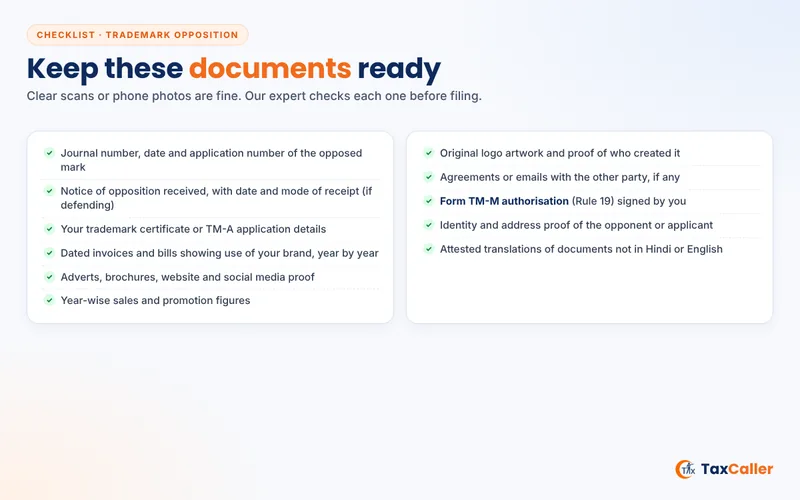
Journal number, date and application number of the opposed mark
Notice of opposition received, with date and mode of receipt (if defending)
Your trademark certificate or TM-A application details
Dated invoices and bills showing use of your brand, year by year
Adverts, brochures, website and social media proof
Year-wise sales and promotion figures
Original logo artwork and proof of who created it
Agreements or emails with the other party, if any
Form TM-M authorisation (Rule 19) signed by you
Identity and address proof of the opponent or applicant
Attested translations of documents not in Hindi or English
Why TaxCaller
Real experts, not a call centre
Your work is handled by experienced professionals who explain every step, check your documents and keep you updated.
Registered company
TaxCaller is run by TaxCaller India LLP (LLPIN AAQ-7388), serving clients since 2018.
Fee told upfront
You know the complete fee, our professional fee and the government fee, before any work starts. No hidden charges.
Support after the work
Notices, renewals, returns and compliance reminders: we stay with your business after the registration is done.
Reviewed By
Expert for this topic Trademark Opposition
Abhinay Rai
Advocate
Abhinay Rai is a Advocate specialising in Trademark Opposition. The process, documents, timelines and fees on this page are checked against the current rules and government portals, and updated whenever the law, forms or fees change.
What is the time limit to file a trademark opposition in India?
You must file the notice of opposition within four months of the date the mark is published in the Trade Marks Journal. Section 21(1) of the Trade Marks Act sets this limit, and Rule 42 repeats it. Because the Act itself fixes the period, it cannot be extended. After it ends, only rectification after registration is left.
What is the government fee for filing Form TM-O?
The official fee for Form TM-O is ₹2,700 per class on e-filing and ₹3,000 per class on physical filing. The same fee applies to a notice of opposition and to a counter-statement. It is listed in the First Schedule to the Trade Marks Rules, 2017. TaxCaller's professional fee is separate and is charged plus GST.
Can I oppose a trademark if my own brand is not registered?
Yes. Section 21(1) allows any person to oppose. A prior user of an unregistered brand can rely on Section 11(3), which blocks marks whose use could be stopped by passing off law. You will need strong proof of earlier use, such as dated invoices, adverts and sales figures, to show your goodwill came first.
What happens if I do not file a counter-statement?
Your application is treated as abandoned. Section 21(2) and Rule 44 give the applicant two months from receipt of the notice of opposition to file a counter-statement in Form TM-O. There is no reminder and no late fee option. Once abandoned, you would have to file a fresh application, which loses your earlier filing date.
How long does a trademark opposition take to finish?
The legal steps alone, from notice to evidence in reply, add up to about a year. Waiting for Registry service and a hearing slot adds more time. Many contested cases take two years or longer. A settlement between the parties can end the case at any stage, which is often the quickest route to a result.
How does an opposition differ from an examiner's objection to a trademark?
An objection is raised by the Registry examiner before publication, in the examination report. An opposition is filed by a third party after the mark is published in the Journal. An objection needs a written reply to the examiner. An opposition is a contested case with pleadings, affidavit evidence and a hearing before the Registrar.
What are the common grounds for trademark opposition?
Common grounds include similarity with an earlier mark under Section 11(1), harm to a well-known mark under Section 11(2), passing off or copyright under Section 11(3), and lack of distinctiveness or deceptive nature under Section 9. Opponents also plead bad faith and that the applicant is not the true proprietor under Section 18(1).
What is a reliance letter in an opposition case?
Under Rules 45 and 46, a party may skip filing affidavit evidence. Instead it tells the Registrar and the other side in writing that it will rely on the facts already stated. The opponent relies on the notice, and the applicant on the counter-statement. This saves time, but it means going to the hearing without fresh proof.
Can a trademark opposition be settled or withdrawn?
Yes. The parties can settle at any stage. Common terms include limiting the goods, a coexistence agreement, written consent under Section 11(4), or the opponent withdrawing the notice. The settlement must be reflected in a filing the Registry can act on, such as a withdrawal letter or a request to amend the application.
How many adjournments are allowed in an opposition hearing?
Rule 50(2) allows each party no more than two adjournments, each for up to thirty days. The request is made on Form TM-M with the prescribed fee, at least three days before the hearing. In the November 2026 special drive for old cases, adjournments are given only in exceptional cases and for at most seven days.
Where do I appeal if I lose an opposition?
Appeals now go to the High Court under Section 91 of the Trade Marks Act. The Tribunals Reforms Act, 2021 abolished the Intellectual Property Appellate Board from 4 April 2021. The appeal must be filed within three months of the order being communicated. A late appeal may be admitted if there was sufficient cause for the delay.
Can I use the ® symbol while my mark is under opposition?
No. You may use ™ while the application is pending, including during opposition. Using ® before registration breaks Section 107(1) of the Trade Marks Act. Since 1 August 2024 the penalty is half a percent of total sales or turnover, or ₹5 lakh, whichever is less. Switch to ® only after the certificate issues.