APEDA Registration Online: Get Your RCMC for Agri Exports
APEDA registration for exporters of fruits, vegetables, processed foods, rice, meat, dairy and other scheduled products, filed with you on the DGFT e-RCMC portal.
Starting from · ₹2,999 APEDA Registration APEDA RCMC Basic plan
STARTING FROM₹2,999
FEE TOLD UPFRONTFree first call
!GSTR-3B due?Last date 20 Nov 2026 · 3 days left
Since 2018Trusted Experience
980+Experts Connected
220+Cities Served
1164+Agents Available
12000+Founders Trusted
S
Srishti Magoo
★★★★★
Excellent experience with TaxCaller for filing my &
my family members ITR returns. The entire process was
smooth, quick and hassle-free. They are professional,
knowledgeable and guided me through every step with patience.
O
obeid sait
★★★★★
The team has handled my taxes for the past three years,
and it's been a wonderful, hassle-free experience.
Thank you for your consistently quick and efficient service.
P
Pushkar
★★★★★
They are among the best in their field. Their work culture
is highly professional, and their client service is smooth
and reliable. They can confidently be relied on to get the job done.
P
Prasad Sheth
★★★★★
Excellent experience with TaxCaller! The ITR filing
process was smooth, quick, and completely hassle-free.
The CA was knowledgeable, responsive, and explained everything clearly.
A
Apoorv Bansal
★★★★★
Excellent service for ITR filing. The team was highly
professional, responsive, and guided me through the entire
process smoothly. My return was filed accurately and on time.
A
Abhishek Kumar
★★★★★
I was searching for a good CA firm in Ghaziabad and found
TaxCaller. The experience was excellent from start to finish.
The team is responsive, transparent, and genuinely helpful.
U
uma pandey
★★★★★
Great service! TaxCaller India made the entire ITR filing
process quick, smooth, and hassle-free. They answered all
my queries patiently and ensured maximum accuracy.
T
tanu mittal
★★★★★
Excellent job! We've been connected for many years,
and your success truly makes me happy. You are an
incredibly intelligent person. Keep shining, keep growing.
B
Bhanu Pratap Maurya
★★★★★
I am filing my ITR since past 3 years with Abhinav and
Firm is known as TaxCaller and they are professional
interms of ITR rules. They will explain and tell you all
the information.
A
ashish Sharma
★★★★★
I am providing my honest reviews:
No.1 service ...
A
AARYAN GROUP
★★★★★
Honestly, finding a good CA firm in Ghaziabad was
confusing, but TaxCaller India made it simple.
I contacted them for GST work and the experience was smooth.
N
News Speaks
★★★★★
If you're looking for a reliable CA firm in Ghaziabad,
TaxCaller India is a great choice. They provide complete
taxation and compliance solutions including GST.
A
Anshul Chaprana
★★★★★
Got my GST registration done through TaxCaller CA firm.
Process was quite smooth, they guided properly on documents
and didn't waste time. Overall good experience.
How we work
Online · Call · WhatsApp
Quick answer
APEDA registration is the Registration-cum-Membership Certificate (RCMC) that exporters of scheduled agri and food products get from APEDA. Section 12 of the APEDA Act, 1985 asks exporters to apply within one month of starting exports. You need an IEC first, apply on the DGFT e-RCMC portal, and pay ₹5,900. The RCMC is valid for five years.
Reviewed by Abhinay Rai · Updated 16 Nov 2026
Pick a plan that fits
APEDA RCMC Basic
Merchant exporters who already hold an active IEC
₹2,999+ GST
+ Govt. fees at actual
Handled by a TaxCaller Expert Licence & Registration Expert
First rice contract (RCAC) walkthrough for rice exporters
Reminder plan for the April to June IEC update and RCMC renewal
Government fees and taxes are extra where applicable. Our expert confirms the final amount on the first call. No hidden charges.
About APEDA Registration
APEDA registration is how an exporter of agricultural and processed food products gets on the books of the Agricultural and Processed Food Products Export Development Authority. APEDA works under the Ministry of Commerce and Industry. Once you are registered, it issues you a Registration-cum-Membership Certificate, called the RCMC. The duty to register comes from section 12 of the APEDA Act, 1985, and the fee and documents are set out in APEDA's registration procedure.
Since 17 July 2023 APEDA issues the RCMC through the DGFT common digital platform, under the e-RCMC service. So the steps are simple on paper: get your Import Export Code (IEC), log in to DGFT, choose APEDA, attach your documents and pay ₹5,900. In practice, files get stuck on small things: the wrong exporter type, a missing manufacturing proof, or a product that belongs to another board.
This guide covers who needs the RCMC, the full product list, documents for merchant and manufacturer exporters, the e-RCMC steps, fees, validity, renewal, penalties after the 2026 amendment, and the schemes you can use once registered. Every rule is linked to the Act, an APEDA notice or a DGFT document, so you can check it yourself.
Complete guide
Choose a topic to open it. Every answer gives the rule or section it comes from.
01 Topic 1 of 20
What Is APEDA Registration (RCMC)?
APEDA registration is a certificate that shows you are a registered exporter of APEDA's scheduled products. APEDA calls it the Registration-cum-Membership Certificate, or RCMC. It is both a registration under the Act and a membership of APEDA as an export promotion body.
The law behind it
The Act: The Agricultural and Processed Food Products Export Development Authority Act, 1985 (Act No. 2 of 1986) set up APEDA. It replaced the old Processed Food Export Promotion Council.
Section 10(2)(b): lists registration of exporters of scheduled products, on payment of a fee, as one of APEDA's functions.
Section 12: says every person exporting scheduled products must apply for registration. The registration stays in force until APEDA cancels it.
Section 13: leaves the form, fee, procedure and conditions to rules.
Section 14: says registered exporters must file the returns that the rules prescribe. APEDA may inspect a plant to check them.
Where the RCMC fits in trade policy
The Foreign Trade Policy (FTP) 2023 also uses the RCMC. Paragraph 2.57 says you need an RCMC from the right registering authority to apply for an authorisation or any other benefit under the FTP. APEDA is the registering authority for its products. The Handbook of Procedures (HBP) 2023, paragraphs 2.77 to 2.84, covers how the RCMC is issued, how long it lasts and how it can be withdrawn.
Who Needs APEDA Registration and When It Is Mandatory
APEDA registration is mandatory for anyone who exports a product listed in the First Schedule of the APEDA Act, or Basmati rice in the Second Schedule. It does not matter whether you are a proprietor, a partnership, an LLP, a company or a cooperative.
The legal deadline
Section 12(1) asks you to apply within one month of the date you start exporting a scheduled product. (For the first exporters in 1986, the limit was three months from the date the section came into force, whichever was later.) APEDA may extend the time if you show sufficient cause. In practice, most exporters register before the first shipment, because buyers, banks and schemes ask for the RCMC early.
Who usually applies
Merchant exporters: traders who buy goods from farmers, mills or processors and export them.
Manufacturer exporters: units that grow, process or make the product themselves, such as a fruit pulp plant, a rice mill or a dairy.
Manufacturer cum merchant exporters: units that export their own goods and also buy from others.
New exporters and startups: people and new businesses that have an IEC and plan their first agri shipment. APEDA's procedure sets no minimum turnover or export history.
Online sellers: sellers who ship packaged foods abroad through courier or e-commerce. Low-value shipments get some relief from 2026 (see the 2026 section), but the Act still applies.
When you may not need it
If your product is not on APEDA's list, you register with another body. Spices go to the Spices Board, tea to the Tea Board, coffee to the Coffee Board and fish to MPEDA. Products not covered by any council go to FIEO under HBP para 2.80(b). We cover this in the section on choosing the right council below.
Shreya Licence & Registration Expert
Have a question on this topic? Ask Shreya on a free call.
APEDA covers 15 groups of scheduled products under the First Schedule of the Act, plus Basmati rice as a special product in the Second Schedule. Here is the list as it stands in the Act on India Code:
Entry
Scheduled product group
Common examples
1
Fruits, vegetables and their products
Fresh mangoes, grapes, onions, fruit pulp, dehydrated vegetables, frozen peas
The examples are our guide to common items, not words from the Act. APEDA also keeps a detailed product catalogue on its website. When you apply, you pick your exact products on the DGFT form, so it helps to know the ITC (HS) code of each item before you start.
Is APEDA the right council for your product?
HBP para 2.80(a) says you declare your main line of business and get the RCMC from the council that covers it. If your main export is not on APEDA's list, another body registers you.
The exporter type you choose decides which documents you upload. APEDA's procedure names two types: merchant exporter, and manufacturer or manufacturer cum merchant exporter.
Point
Merchant exporter
Manufacturer or manufacturer cum merchant
Who
Buys and exports, has no plant
Grows, processes or makes the product
Core document
Signed and sealed copy of the IEC
Signed and sealed copy of the IEC
Extra document
None
Proof of manufacturing for the product, from the agency APEDA names
Government fee
₹5,900
₹5,900
Typical example
A trader exporting onions bought at a mandi
A pickle unit in Ghaziabad exporting its own brand
Accepted manufacturing proof, by product
Product group
Proof accepted by APEDA
Floriculture and seeds
Department of Horticulture
Fresh fruits and vegetables
FSSAI, Udyam registration, Department of Horticulture or MSME certificate
If you need the proof first, we can help with FSSAI registration or MSME (Udyam) registration. A merchant exporter of food still needs an FSSAI licence for the food business itself, but that is a food law duty, not an APEDA document.
You cannot apply for an APEDA RCMC without an active Import Export Code. APEDA's own procedure says to apply only after getting the IEC from DGFT, because the e-RCMC form is built on your IEC profile.
Same login: you apply for the RCMC from the same DGFT account that holds your IEC.
Auto-filled details: the e-RCMC system pulls your name, address, PAN and other details from the IEC profile. DGFT checks PAN, CIN and DIN against tax and MCA records.
Yearly update: the IEC must be confirmed or updated online every April to June, or it is deactivated. A deactivated IEC can block your RCMC application.
Matching details: your bank, address and business name must be correct in the IEC before you apply. A mismatch here is a common reason for a deficiency letter.
If you do not have an IEC yet, start with our IEC registration service. The DGFT fee for a new IEC is ₹500. We can file the IEC and the APEDA RCMC one after the other in the same engagement.
Zubair Licence & Registration Expert
Have a question on this topic? Ask Zubair on a free call.
The document list for APEDA registration is short, because most details come from your IEC profile. No hard copies are needed. Keep clear scans in PDF or JPEG.
For every exporter
IEC certificate copy, signed and sealed by the authorised person.
DGFT login linked to that IEC, with the IEC updated for the current year.
List of products you will export, ideally with ITC (HS) codes.
Names of the countries you export to, or plan to.
Details of the authorised contact person: name, designation, mobile and email.
Payment of ₹5,900 online through the DGFT payment gateway.
Extra for manufacturer exporters
Proof of manufacturing for each product group, signed and sealed, from the agency in the table above (for example FSSAI licence, Udyam certificate, Horticulture Department certificate or Excise licence).
Make sure the name and address on the proof match the IEC.
Good to keep ready
PAN of the business and GST registration certificate, if you have one. Our GST registration page explains when exporters need GST.
Certificate of incorporation, partnership deed or LLP agreement, in case the officer asks.
Cancelled cheque or bank letter, if the IEC bank details need a fix.
Step-by-Step Application on the DGFT e-RCMC Portal
The APEDA registration process runs fully online on the DGFT e-RCMC page. These are the steps an exporter follows, based on APEDA's notice and the DGFT e-RCMC help file.
Log in to DGFT: open dgft.gov.in and log in with the user ID linked to your IEC.
Open the service: go to Services, then e-RCMC, then Apply for e-RCMC. Choose Start Fresh Application, or continue a saved draft.
Confirm your profile: declare that your IEC profile is up to date, then Save and Next.
RCMC details: select APEDA as the Export Promotion Council or Commodity Board. The fee details appear on screen. Add your export products (keep the 8-digit ITC (HS) codes handy) and your authorised contact persons. Under Other Information, pick the countries you export to.
Exporter type and main line of business: declare whether you are a merchant or manufacturer exporter, and your main line of business, as HBP para 2.80(a) requires.
Attachments: upload the signed IEC copy and, for manufacturers, the proof of manufacturing.
Declaration: tick the declaration and enter the place.
Sign: review the Application Summary and click Sign. Use the signing option the portal offers you, such as a digital signature or Aadhaar e-sign.
Pay: click Payment for RCMC and pay ₹5,900 online. Download the e-payment receipt.
Track: watch My Dashboard, then Submitted Applications, then RCMC. The status shows as In-Progress, Deficient, Approved or Rejected.
Reply to deficiencies: if APEDA marks the file Deficient, read the remark and reply with the missing item from the same page.
Get the RCMC: once approved, the RCMC is issued electronically. Its details show in your DGFT profile under Manage Profile, then RCMC.
DGFT sends updates on the dashboard, by email and by SMS. DGFT Trade Notice 35/2021-22 of 24 February 2022 made filing of RCMC applications on the DGFT platform compulsory from 1 April 2022, as reported, and APEDA moved its RCMC to the platform on 17 July 2023.
APEDA Registration: how the work moves, step by step
We do the checking and the form work. You keep your DGFT login, OTPs and payment in your own hands.
Free first call: we note your products, exporter type, IEC status and target countries.
Council check: we confirm that every product is APEDA's and not a Spices Board, MPEDA or other board item. Mixed product lists get a plan.
IEC health check: we check that the IEC is active, updated for the year, and that the name, address and bank match your documents.
Document review: you share scans on WhatsApp or email. We check signatures, seals, names and the right manufacturing proof.
Product mapping: we list your products with ITC (HS) codes so the form is accurate.
Filing session: we fill the e-RCMC form with you on a screen-share. You sign and pay ₹5,900 to APEDA through DGFT.
Follow-up: we track the dashboard and reply to any deficiency remark.
Handover: you get the RCMC, a note of its validity end date, and a reminder plan for renewal and the IEC update.
Exporters who need the IEC, FSSAI or Udyam first can do everything with one team. Our business licences page lists the other approvals a food exporter may need.
Abhinay Rai Licence & Registration Expert
Have a question on this topic? Ask Abhinay on a free call.
APEDA Registration Fees: Government Fee and Our Fee
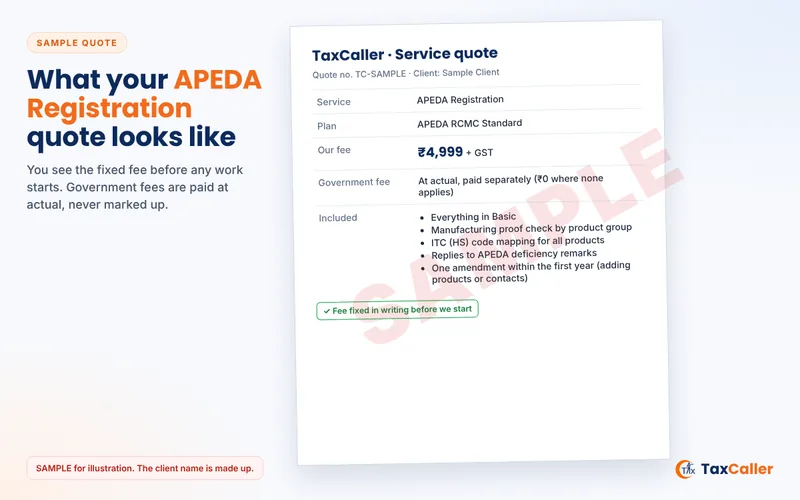
APEDA Registration: SAMPLE quote, for illustration only
The APEDA fee is ₹5,000 plus 18% GST, so you pay ₹5,900 in total. APEDA's registration procedure note lists these amounts.
What APEDA and DGFT charge
Item
Fee
Paid to
New APEDA RCMC
₹5,000 + ₹900 GST = ₹5,900
APEDA, through DGFT
Renewal of RCMC
₹5,000 + ₹900 GST = ₹5,900
APEDA, through DGFT
Amendment or modification after issue
Nil
Not applicable
New IEC (if you do not have one)
₹500
DGFT
Basmati RCAC (per contract)
₹70 per tonne + 18% GST = ₹82.60 per tonne
APEDA
Non-Basmati rice RCAC (per contract)
₹8 per tonne + 18% GST, minimum ₹50
APEDA
The fee is the same for every business size and turnover. APEDA's procedure note shows no separate yearly membership fee and no lower regional rate, so if someone quotes one, ask for the APEDA notice.
TaxCaller's fee
TaxCaller's fee for APEDA registration starts at ₹2,999 + GST. Government fees (the ₹5,900 APEDA fee, and the ₹500 DGFT fee for a new IEC if needed) are paid separately at actual, directly to the government through the portal. We confirm the full quote in writing before we start.
Item
Paid to
Amount
Product and council check, document review, filing, follow-up
APEDA and DGFT do not publish a fixed service time for the RCMC. Several exporter guides report about 7 to 15 days for a complete file. The real time depends on three things.
Your readiness: an active, updated IEC and the right manufacturing proof save the most time.
Deficiency letters: each round of questions adds days. Most come from mismatched names or the wrong proof.
Workload at APEDA: some months are busier, for example around crop seasons.
Stage
Who acts
Usual time
IEC check or new IEC
You and DGFT
Same day if active; a new IEC adds its own time
Document collection and review
You and TaxCaller
1 to 2 working days once scans arrive
e-RCMC filing and payment
You with TaxCaller
One session
Scrutiny and issue
APEDA
Varies; no official deadline
The times in the second and third rows are our working estimates, not government promises. Plan the RCMC at least a few weeks before your first shipment or scheme claim.
An APEDA RCMC is valid for five years. HBP para 2.81 says an RCMC is treated as valid from 1 April of the licensing year in which it was issued, and runs for five years ending on 31 March, unless stated otherwise.
Two ideas that confuse people
Registration under the Act: section 12(2) says your registration as an exporter stays in force until APEDA cancels it.
The certificate: the RCMC itself has a five-year life under APEDA's procedure and the HBP. You renew it to keep a current certificate for schemes and FTP benefits.
Some websites still call APEDA registration one-time, and some say it lasts three years. Both are out of date. Go by APEDA's own note: five years, then renewal.
How renewal works
Log in to DGFT and open Services, then e-RCMC, then Renewal of RCMC.
Select your existing RCMC file and click Renewal.
Confirm your profile, check the products and contacts, and add any new attachments.
Sign and pay the renewal fee of ₹5,900.
Track it under Submitted Applications, as for a new RCMC.
Note the end date when you get the RCMC. A lapsed RCMC can hold up scheme claims and FTP benefits until it is renewed.
Amendments and changes
You must tell APEDA about any change in ownership, constitution, name or address within one month of the change. HBP para 2.82 sets this rule, and the registering authority may condone a delay on merits.
How to amend: on DGFT, open Services, then e-RCMC, then Amendment for RCMC. Only an active RCMC can be amended. Earlier details come pre-filled.
Fee: APEDA charges no fee for amendments after the RCMC is issued.
Update the IEC first: a new address or name must be changed in the IEC before the RCMC, because the RCMC reads from it.
Adding products: add new APEDA products through an amendment, so your RCMC matches what you ship.
De-registration and appeal
HBP para 2.83: the registering authority may de-register an RCMC holder for a set period for breaking the conditions of registration. It must first issue a show cause notice and give a fair chance to reply.
HBP para 2.84: anyone unhappy with a decision on the RCMC may appeal to DGFT or its designated officer within 45 days. That decision is final.
Section 13 of the Act: leaves the conditions and procedure for cancelling registration to the rules. Several guides report that registration can be cancelled for false information, a breach of the rules, or no export of scheduled products for 12 months in a row. Check the current rules with APEDA before relying on this.
Returns to APEDA
Section 14 of the Act says registered exporters must file the returns the rules prescribe, and section 22 now penalises a missed or false return. The old APEDA form asked for online export performance reports every quarter. Guides today disagree on the frequency, so we check what your exporter login asks for and set reminders.
Shadab Licence & Registration Expert
Have a question on this topic? Ask Shadab on a free call.
The main benefit of APEDA registration is that you can export scheduled products legally and claim support that is open only to registered exporters.
Legal compliance: you meet section 12 of the Act and avoid penalty proceedings.
FTP benefits: under FTP para 2.57, an RCMC is needed for authorisations and other FTP benefits, subject to the exemptions in that paragraph.
Financial assistance: APEDA's Financial Assistance Scheme is open mainly to APEDA-registered exporters.
Rice contracts: only registered member exporters get the APEDA login used to register Basmati and non-Basmati rice contracts.
Trade fairs and buyer meets: APEDA runs and supports Indian pavilions and buyer-seller meets abroad.
Market data: APEDA's AgriExchange portal shares export data and market information.
Startup support: APEDA's BHARATI acceleration programme for agri-food startups accepts non-members, but they must get an RCMC before the acceleration phase.
Buyer trust: foreign buyers and banks often ask for the RCMC before they sign.
APEDA's Financial Assistance Scheme (FAS)
The FAS guidelines cover the 2021-22 to 2025-26 cycle. They give help in three areas:
Up to 40% of cost, capped at ₹200 lakh per sub-component
Quality development
HACCP and ISO 22000 certification, residue testing, traceability devices
Up to 50%, for example capped at ₹5 lakh per certification
Market development
Trial shipments, brand and IPR registration abroad, trade fairs
Up to 50%, for example capped at ₹20 lakh for brand registration abroad
Higher rates of up to 75% applied to North Eastern states, Himalayan and other difficult areas, island territories, and SC, ST or women beneficiaries. The 2021-26 cycle ended on 31 March 2026. Check APEDA's website for the guidelines and application window of the current cycle before you plan an investment around a subsidy.
Rice Exports: RCAC Contract Registration for Basmati and Non-Basmati
Rice exporters need more than the RCMC. Every export contract for Basmati rice, and since September 2025 for non-Basmati rice, must be registered with APEDA to get a Registration-cum-Allocation Certificate (RCAC).
Point
Basmati rice
Non-Basmati rice
Rule
DGFT Notification 18/2015-20; APEDA trade notice of 1 October 2025
LC, contract or proforma invoice; lab or EIC/EIA certificates where needed
LC, contract or proforma invoice
The Basmati trade notice also sets grain standards and country conditions. For example, rice for the USA and China must come from mills registered with the Directorate of Plant Protection, Quarantine and Storage. DGFT Notification 47/2026-27 of 9 November 2026, as reported by trade publications, limits the compulsory EIC or EIA inspection certificate to the EU, the UK, Iceland, Liechtenstein, Norway and Switzerland. For other European countries it is not mandatory until 1 April 2027.
Register only the quantity you can ship within 45 days. APEDA's RCAC FAQ says you cannot apply without a valid RCMC, and that RCAC processing usually takes 2 to 3 working days. Each RCAC covers one destination country and one port of discharge.
APEDA Login, Registration Form and Certificate Download
The APEDA registration login today is your DGFT login. The old APEDA paper and online forms have been replaced by the e-RCMC service since 17 July 2023.
Which login does what
Task
Where
Apply, renew or amend the RCMC
DGFT portal, Services, e-RCMC
Track the RCMC application
DGFT, My Dashboard, Submitted Applications
See or print RCMC details
DGFT, Manage Profile, RCMC (copy, Excel, CSV or print)
Rice contract registration (RCAC)
APEDA exporter login, given to registered member exporters
Scheme applications
APEDA website and its online services
The old APEDA registration form PDF
An older APEDA registration packet still circulates online. It has Form-I (application), Form-II (certificate details), a bank certificate and a demand draft of ₹5,000 to a regional office. APEDA now issues the RCMC through DGFT, so do not send paper forms or drafts for a new RCMC. File on DGFT and pay ₹5,900 online.
Downloading the certificate
Once APEDA approves the file, the status turns Approved and DGFT tells you by email and SMS. Open your DGFT profile to view and print the RCMC details. Keep a PDF copy with your export file, because banks, buyers and scheme officers often ask for it.
APEDA basics people search for
Full form: Agricultural and Processed Food Products Export Development Authority.
Ministry: Ministry of Commerce and Industry, Department of Commerce.
Head office: New Delhi, with regional offices listed on the APEDA website.
Helpdesk: the number shown on APEDA's RCMC page is +91-9228132200.
Shreya Licence & Registration Expert
Have a question on this topic? Ask Shreya on a free call.
Other Approvals Food Exporters Need Besides the RCMC
The RCMC registers you as an exporter. It does not replace product licences or shipment certificates. Most agri exporters need some of these as well.
Approval
Who needs it
Issued by
FSSAI licence or registration
Every food business, including food exporters
FSSAI
Phytosanitary certificate
Plants and plant products, as the buyer country requires
Plant quarantine authority
EIC or EIA inspection certificate
Products and markets where DGFT or the buyer country requires it, for example rice to the EU
Export Inspection Council or Agency
Health certificate for meat
Each meat consignment, applied through APEDA's Meat.Net by registered processing plants
State veterinary officials
Organic certification under NPOP
Anyone selling exports as organic; data kept on APEDA's TraceNet
Accredited certification bodies
Traceability registration
Some fresh fruits and vegetables sent to markets such as the EU (HortiNet)
APEDA's HortiNet traceability system
Halal certificate
Meat and some foods for buyer countries that ask for it
Recognised certification bodies
Start with the FSSAI registration if your food business does not have one yet. For a branded range, protect the name early with trademark registration in India before you register it abroad.
Penalties Under the APEDA Act After the 2026 Amendment
Penalties under the APEDA Act changed on 23 June 2026. The Jan Vishwas (Amendment of Provisions) Act, 2026 (Act 8 of 2026) replaced the old penalty sections with civil penalties decided by an adjudicating officer. Here is the current position from the amended Act on India Code.
Section
What it covers
Penalty now
Section 19(3)
Breaking a Central Government order that restricts or bans export or import of a scheduled product
Not less than ₹10,000, up to twice the value of the goods, plus Customs Act action
Section 22
Not filing a required return
Warning for the first breach; then ₹10,000 to ₹50,000
Section 22
Filing a return you know is false
₹10,000 to ₹1 lakh
Section 24
Any other breach of the Act (the general penalty, which can cover not registering under section 12)
Warning for the first breach; then ₹10,000 up to the value of the goods; ₹1,000 a day for a continuing breach, up to twice the value of the goods
How a penalty is decided
Section 25A: the Secretary of APEDA, or an officer of equal rank, adjudicates after giving you a hearing.
Appeal: to the Chairman of APEDA within 30 days of receiving the order. The appeal should be decided within 60 days.
Recovery: an unpaid penalty is recovered as an arrear of land revenue.
Procedure rules: the APEDA (Adjudication of Penalties) Rules, 2026 (G.S.R. 741(E), published on 19 August 2026) set the show cause notice (Form I), a reply time of at least 7 days, an inquiry to be finished within six months, and the appeal format (Form II).
Old sections 23 (obstruction and records) and 26 (court jurisdiction) were omitted from the same date. New section 25A sets up this adjudication, and section 25 still makes the people in charge of a company or firm answerable for its breach.
Four changes in 2026 matter for anyone getting or holding an APEDA RCMC.
Civil penalties (23 June 2026): the Jan Vishwas (Amendment of Provisions) Act, 2026 rewrote sections 19, 22 and 24 of the APEDA Act, added warnings for first breaches, omitted sections 23 and 26, and added section 25A on adjudication. The India Code text shows these changes in force from 23 June 2026.
Adjudication rules (19 August 2026): the APEDA (Adjudication of Penalties) Rules, 2026 set out notices, hearings and appeals to the Chairman.
Low-value shipments (15 September 2026): DGFT Notification 36/2026-27, listed on the DGFT notifications page as a de minimis exemption from RCMC requirements for low-value exports, adds para 2.57(c) to the FTP. Under it, an export consignment up to a set FOB value does not need an RCMC for FTP purposes. Reported figures for the limit differ, so we confirm the current limit in para 2.57(c) on DGFT before you rely on it. This relief is under the FTP. It does not amend section 12 of the APEDA Act.
Rice inspection (9 November 2026): Notification 47/2026-27, as reported, limits the compulsory inspection certificate for rice to the EU, the UK, Iceland, Liechtenstein, Norway and Switzerland, with other European countries exempt until 1 April 2027.
DGFT and APEDA also issue product notices through the year, for example on meat, honey and organic exports, so we check the latest notices for your product before you ship. See our halal certification page if you export meat.
Zubair Licence & Registration Expert
Have a question on this topic? Ask Zubair on a free call.
Most APEDA files that get stuck have one of these problems. Each is easy to avoid before you file.
Inactive IEC: the yearly April to June IEC update was missed, so the profile is deactivated.
Wrong council: spices, tea, coffee or seafood filed with APEDA. Pick the board that covers your main line of business.
Wrong exporter type: a trader selects manufacturer and then has no manufacturing proof, or a unit selects merchant and loses its manufacturer status.
Wrong proof: an FSSAI registration for a different address, or a Udyam certificate in another name.
Unsigned copies: APEDA asks for signed and sealed copies. Plain downloads may be marked deficient.
Name mismatch: the name in the IEC, PAN and proof differ, for example a trade name used in one and the legal name in another.
Incomplete product list: products not added, so you later need an amendment before a scheme claim.
Payment not linked: the payment fails or is made twice, and the application stays in draft.
Ignoring the deficiency remark: the file sits as Deficient because nobody checked the dashboard.
Forgetting renewal: the five-year end date passes, and a scheme claim gets held up.
Using an old document list: some websites still ask for a bank certificate, a director list on letterhead or a demand draft. Those came from the old offline APEDA form. Today the e-RCMC reads bank, PAN and address details from your IEC profile.
Quick checklist before you file
Active IEC, updated this year, with correct bank and address.
Main export product on APEDA's list.
Exporter type decided: merchant or manufacturer.
For manufacturers, the right proof (FSSAI, Udyam, Horticulture or Excise) in the same name and address.
8-digit ITC (HS) codes of your products.
Export countries and an authorised contact person.
Worked Example: A Ghaziabad Pickle Maker Gets Its RCMC
Here is how a typical file runs. The business and numbers are an example, not a real client.
The business: Sharma Foods, a partnership in Ghaziabad, makes mango pickle and papad. It has an FSSAI State licence and a Udyam certificate. A buyer in Dubai has asked for a first trial order.
Council check: pickles and papads are entry 11 of the First Schedule, so APEDA is the right body.
IEC: the firm has no IEC. We file one first. DGFT fee: ₹500.
Exporter type: manufacturer exporter, because the firm makes the goods.
Proof: the FSSAI licence is accepted proof for processed foods. Its address matches the IEC.
Filing: we add products with their ITC (HS) codes, add the UAE as a target country, and attach the signed IEC and FSSAI licence.
Payment: the firm pays ₹5,900 to APEDA through DGFT.
Result: APEDA issues the RCMC. It is valid until 31 March of the fifth licensing year, counted from 1 April of the year of issue.
Cost item
Amount
DGFT IEC fee
₹500
APEDA RCMC fee
₹5,900
TaxCaller fee
As per plan, + GST
The firm also plans its GST refund route for exports. Our GST return filing team can handle the monthly returns once shipments start.
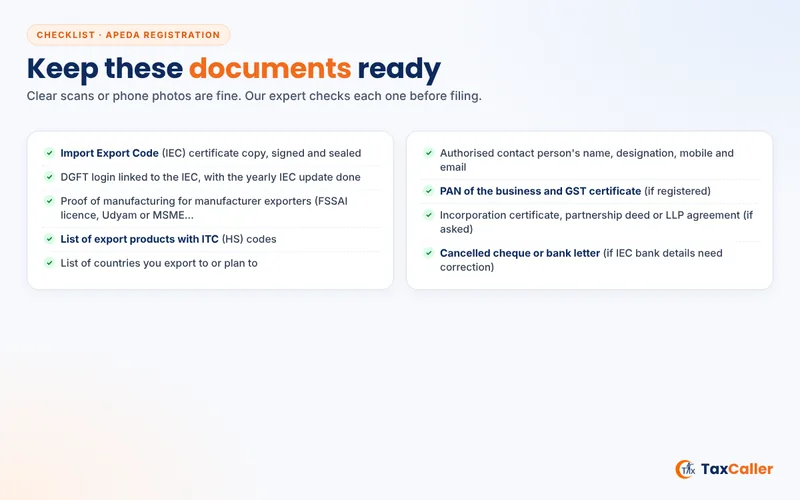
Import Export Code (IEC) certificate copy, signed and sealed
DGFT login linked to the IEC, with the yearly IEC update done
Proof of manufacturing for manufacturer exporters (FSSAI licence, Udyam or MSME certificate, Horticulture Department certificate or Excise licence, as per product)
List of export products with ITC (HS) codes
List of countries you export to or plan to
Authorised contact person's name, designation, mobile and email
PAN of the business and GST certificate (if registered)
Incorporation certificate, partnership deed or LLP agreement (if asked)
Cancelled cheque or bank letter (if IEC bank details need correction)
Why TaxCaller
Real experts, not a call centre
Your work is handled by experienced professionals who explain every step, check your documents and keep you updated.
Registered company
TaxCaller is run by TaxCaller India LLP (LLPIN AAQ-7388), serving clients since 2018.
Fee told upfront
You know the complete fee, our professional fee and the government fee, before any work starts. No hidden charges.
Support after the work
Notices, renewals, returns and compliance reminders: we stay with your business after the registration is done.
Reviewed By
Expert for this topic APEDA Registration
Abhinay Rai
Advocate
Abhinay Rai is a Advocate specialising in APEDA Registration. The process, documents, timelines and fees on this page are checked against the current rules and government portals, and updated whenever the law, forms or fees change.
APEDA registration is the Registration-cum-Membership Certificate, or RCMC, issued by the Agricultural and Processed Food Products Export Development Authority. It records you as a registered exporter of scheduled agri and food products under section 12 of the APEDA Act, 1985. You need an IEC first, and you apply online through the DGFT e-RCMC service.
Is APEDA registration mandatory?
Yes, for scheduled products. Section 12 of the APEDA Act asks every exporter of a First Schedule product, or Basmati rice, to apply within one month of starting exports. Spices, tea, coffee and seafood are registered with their own boards. A breach can now attract a warning and then a civil penalty under section 24.
What is the APEDA registration fee?
APEDA charges ₹5,000 plus 18% GST of ₹900, so ₹5,900 in total, for a new RCMC. Renewal costs the same ₹5,900. Amendments after issue have no fee. You pay online through the DGFT portal. Professional fees, such as TaxCaller's, are separate, are charged + GST and do not include these government fees.
How long is the APEDA RCMC valid?
The APEDA RCMC is valid for five years. Under HBP para 2.81 it counts from 1 April of the licensing year of issue and ends on 31 March five years later. Your registration under section 12 continues until APEDA cancels it, but you renew the certificate itself every five years for ₹5,900.
How do I register with APEDA?
Log in to the DGFT portal with the account linked to your IEC. Open Services, then e-RCMC, then Apply for e-RCMC. Select APEDA, add your products, contacts and countries, upload the signed IEC and any manufacturing proof, sign the application and pay ₹5,900. Then track it under Submitted Applications on your dashboard.
Is IEC required for APEDA registration?
Yes. APEDA asks exporters to apply only after getting an Import Export Code from DGFT. The e-RCMC form reads your details from the IEC profile, so the IEC must be active and updated for the year. A new IEC costs ₹500. We can file the IEC and the APEDA RCMC together in one engagement.
Which products come under APEDA?
APEDA covers fruits, vegetables and their products, meat, poultry, dairy, biscuits and bakery items, honey, jaggery and sugar products, cocoa and chocolates, beverages, cereal products, cashews, groundnuts, peanuts, walnuts, pickles, chutneys, papads, guar gum, floriculture, herbal and medicinal plants and de-oiled rice bran. Basmati rice is listed separately as a special product.
What documents are needed for APEDA registration?
A merchant exporter needs a signed and sealed copy of the IEC. A manufacturer exporter also needs signed proof of manufacturing, such as an FSSAI licence, Udyam certificate, Horticulture Department certificate or Excise licence, depending on the product. Keep your product list, ITC (HS) codes, export countries and contact person details ready for the form.
How many days to get an APEDA certificate?
There is no official service time. Exporter guides commonly report about 7 to 15 days for a complete file. Delays usually come from an inactive IEC, a name mismatch or the wrong manufacturing proof. We check these before filing and reply quickly to any deficiency remark that APEDA raises on the DGFT dashboard.
How do I renew my APEDA RCMC?
On the DGFT portal, open Services, then e-RCMC, then Renewal of RCMC. Select your RCMC file, confirm your profile, review the products and attachments, sign and pay the renewal fee of ₹5,900. Track the renewal under Submitted Applications. Note your end date, because a lapsed RCMC can hold up scheme claims.
Do small or e-commerce exporters still need an APEDA RCMC?
DGFT Notification 36/2026-27 of 15 September 2026 added a de minimis exemption to FTP para 2.57(c), so a low-value export consignment does not need an RCMC for FTP purposes. Reported limits differ, so we confirm the current FOB limit on DGFT. The APEDA Act duty to register remains, so regular exporters should still hold an RCMC.
What is the penalty for exporting without APEDA registration?
Since 23 June 2026, section 24 of the amended APEDA Act gives a warning for a first breach. A repeat breach can cost ₹10,000 or more, up to the value of the goods, plus ₹1,000 a day while it continues, capped at twice the goods value. An APEDA officer decides after a hearing, with appeal to the Chairman.
Can I add products or change my address in the RCMC?
Yes. Use Services, then e-RCMC, then Amendment for RCMC on the DGFT portal. APEDA charges no fee for amendments. HBP para 2.82 asks you to report a change in name, address, ownership or constitution within one month. Update the IEC first, because the RCMC takes its details from the IEC profile.
Does APEDA registration give financial assistance?
Registration makes you eligible to apply. APEDA's Financial Assistance Scheme for 2021-26 helped registered exporters with pack houses, cold chain, certifications, testing, trial shipments and brand registration abroad, often up to 40% or 50% of cost within caps. That cycle ended in March 2026, so check APEDA's current guidelines and application window before you plan.
Share your IEC, products and any FSSAI or Udyam proof, and our expert will file your e-RCMC with you on DGFT. Our fee starts at ₹2,999 + GST; the ₹5,900 APEDA fee is paid at actual.