BIS Certification Online: ISI Mark Licence and CRS Registration
Get BIS certification for your product, from the QCO check and lab testing to the ISI licence or CRS registration on the BIS portal, handled by our expert.
Starting from · ₹11,999 BIS Certification BIS CRS Registration plan
STARTING FROM₹11,999
FEE TOLD UPFRONTFree first call
!GSTR-3B due?Last date 20 Nov 2026 · 4 days left
Since 2018Trusted Experience
980+Experts Connected
220+Cities Served
1164+Agents Available
12000+Founders Trusted
S
Srishti Magoo
★★★★★
Excellent experience with TaxCaller for filing my &
my family members ITR returns. The entire process was
smooth, quick and hassle-free. They are professional,
knowledgeable and guided me through every step with patience.
O
obeid sait
★★★★★
The team has handled my taxes for the past three years,
and it's been a wonderful, hassle-free experience.
Thank you for your consistently quick and efficient service.
P
Pushkar
★★★★★
They are among the best in their field. Their work culture
is highly professional, and their client service is smooth
and reliable. They can confidently be relied on to get the job done.
P
Prasad Sheth
★★★★★
Excellent experience with TaxCaller! The ITR filing
process was smooth, quick, and completely hassle-free.
The CA was knowledgeable, responsive, and explained everything clearly.
A
Apoorv Bansal
★★★★★
Excellent service for ITR filing. The team was highly
professional, responsive, and guided me through the entire
process smoothly. My return was filed accurately and on time.
A
Abhishek Kumar
★★★★★
I was searching for a good CA firm in Ghaziabad and found
TaxCaller. The experience was excellent from start to finish.
The team is responsive, transparent, and genuinely helpful.
U
uma pandey
★★★★★
Great service! TaxCaller India made the entire ITR filing
process quick, smooth, and hassle-free. They answered all
my queries patiently and ensured maximum accuracy.
T
tanu mittal
★★★★★
Excellent job! We've been connected for many years,
and your success truly makes me happy. You are an
incredibly intelligent person. Keep shining, keep growing.
B
Bhanu Pratap Maurya
★★★★★
I am filing my ITR since past 3 years with Abhinav and
Firm is known as TaxCaller and they are professional
interms of ITR rules. They will explain and tell you all
the information.
A
ashish Sharma
★★★★★
I am providing my honest reviews:
No.1 service ...
A
AARYAN GROUP
★★★★★
Honestly, finding a good CA firm in Ghaziabad was
confusing, but TaxCaller India made it simple.
I contacted them for GST work and the experience was smooth.
N
News Speaks
★★★★★
If you're looking for a reliable CA firm in Ghaziabad,
TaxCaller India is a great choice. They provide complete
taxation and compliance solutions including GST.
A
Anshul Chaprana
★★★★★
Got my GST registration done through TaxCaller CA firm.
Process was quite smooth, they guided properly on documents
and didn't waste time. Overall good experience.
How we work
Online · Call · WhatsApp
Quick answer
BIS certification is permission from the Bureau of Indian Standards to use the ISI mark or Standard Mark on a product that meets its Indian Standard. It is compulsory for goods under a Quality Control Order. Indian factories use Scheme-I, electronics use CRS registration, and foreign makers use FMCS with an Indian representative.
Reviewed by Abhinay Rai · Updated 15 Nov 2026
Pick a plan that fits
BIS CRS Registration
Electronics, IT or solar products under CRS (Scheme-II), one product with one test report
₹11,999+ GST
+ Govt. fees at actual
Handled by a TaxCaller Expert Licence & Registration Expert
Licence agreement, indemnity bond and bank security paperwork
Importer briefing on customs and marking
Government fees and taxes are extra where applicable. Our expert confirms the final amount on the first call. No hidden charges.
About BIS Certification
BIS certification lets a manufacturer print the ISI mark, or a Standard Mark with an R-number, on goods that meet an Indian Standard. The Bureau of Indian Standards grants it under the BIS Act, 2016 and the BIS (Conformity Assessment) Regulations, 2018. For hundreds of products, from pressure cookers and toys to power banks and solar panels, it is not optional. A Quality Control Order makes it compulsory, and selling without it is an offence.
The rules moved a lot in 2025 and 2026. Licences now run for up to five years. CRS has a new fee table. MSME fee concessions run to 31 May 2029. Several QCOs were withdrawn, while new ones, such as the 2026 order for household electrical appliances, came in.
This page explains each scheme, who needs which, the documents, the Manak Online process, official fees and concessions, timelines, renewal, penalties under Section 29, how to check a BIS licence online, and the common mistakes that delay a BIS licence. TaxCaller has handled registrations since 2018, from Ghaziabad and online across India.
Complete guide
Choose a topic to open it. Every answer gives the rule or section it comes from.
01 Topic 1 of 20
What Is BIS Certification? Meaning and Full Form
BIS certification is proof from the Bureau of Indian Standards that a product meets the Indian Standard (IS) written for it. When BIS is satisfied, it lets the maker put a Standard Mark on the product. That mark tells buyers, customs officers and marketplaces that the goods were tested and that the factory is under BIS watch.
BIS stands for Bureau of Indian Standards. It is the National Standards Body of India. Its older avatar was the Indian Standards Institution, set up on 6 January 1947. That is where the letters on the famous ISI mark come from.
What "BIS certified" means on a product
A product is BIS certified when it carries a valid BIS mark linked to a live licence or registration. You will usually see one of these:
ISI mark with the IS number above it and a licence number starting with CM/L below it. This is the product certification mark under Scheme-I.
Standard Mark with an R-number, used on electronics and IT goods registered under the Compulsory Registration Scheme (CRS).
Hallmark with a six-character HUID on gold jewellery and artefacts.
BIS certificate, BIS licence and BIS registration
People use these words loosely. In BIS language, an ISI mark is granted through a licence. Electronics under CRS get a registration. A few schemes give a certificate of conformity. All three are BIS certification in the everyday sense, and this page covers all of them.
The certification is voluntary for most goods. It becomes compulsory when the Central Government issues a Quality Control Order (QCO) for a product, as explained below. Source: the BIS product certification page.
The Law Behind It: BIS Act 2016 and the 2018 Regulations
Two documents run the whole system: the BIS Act, 2016 and the BIS (Conformity Assessment) Regulations, 2018. The Act gives the powers. The Regulations set the schemes, forms, fees and procedures.
Replaced the BIS Act, 1986. It came into force on 12 October 2017.
Section 13
Lets BIS grant a licence to use the Standard Mark, or a certificate of conformity, when goods meet an Indian Standard.
Section 14 and 15
Hallmarking of precious metal articles and sale through certified jewellers.
Section 16
Lets the Central Government make a standard and mark compulsory for goods in the public interest, for health, safety, environment or national security, or to stop unfair trade practices. QCOs are issued under this power.
Section 17
Bars making, importing, selling, storing or exhibiting for sale any notified goods without a valid licence and mark.
Section 29
Penalties, covered in detail further down.
BIS (Conformity Assessment) Regulations, 2018
Schedule-II lists ten schemes. Seven cover products and three cover systems, services and processes.
The Regulations have been amended many times. The latest big change is the BIS (Conformity Assessment) Amendment Regulations, 2026, dated 25 February 2026. It moved most licences to an initial term of up to five years and rewrote the Scheme-II (CRS) fee table.
Abhinay Rai Licence & Registration Expert
Have a question on this topic? Ask Abhinay on a free call.
Is BIS Certification Mandatory? Quality Control Orders Explained
BIS certification is mandatory only for products covered by a Quality Control Order (QCO) or a similar order under Section 16 of the BIS Act. For every other product it is voluntary. A QCO names the product, the Indian Standard, the scheme and the date from which the mark is compulsory.
Who issues QCOs
QCOs come from the ministry in charge of the product, after consulting BIS. Examples include DPIIT (toys, appliances, footwear, furniture), the Ministry of Electronics and IT (CRS electronics), MNRE (solar modules and inverters), and the steel, chemicals and textiles ministries.
How many products are covered
In a Lok Sabha reply of 12 March 2025, the government said 187 QCOs covered 769 products. The list keeps moving, both up and down:
Withdrawn: on 13 November 2025 the government reportedly scrapped QCOs for 14 chemical and petrochemical products, such as PTA, MEG, polyester fibre, PVC resin and polycarbonate. QCOs on some metals, such as aluminium, nickel and zinc, were reportedly dropped at the same time.
Revoked: the Machinery and Electrical Equipment Safety (Omnibus Technical Regulation) Order, 2024 was withdrawn by the Ministry of Heavy Industries on 16 January 2026.
Added: the Safety of Household, Commercial and Similar Electrical Appliances (Quality Control) Order, 2026, notified on 6 April 2026, applies from 1 October 2026 under IS 302 (Part 1):2024. Small units get until 1 January 2027 and micro units until 1 April 2027, as reported.
BIS Schemes Compared: ISI Mark, CRS, FMCS, Scheme-IV and Scheme-X
Most businesses meet one of four routes. The 2026 amendment groups the ten schemes by whether BIS visits your site: Schemes I, IV, V, IX and X include a site assessment, while Schemes II and VII do not.
Route
Who uses it
Factory visit
Output
Scheme-I, Indian maker (ISI mark)
Domestic manufacturers of steel, cement, appliances, toys, helmets, pressure cookers and many more
Yes
Licence with CM/L number
Scheme-I via FMCS
Foreign manufacturers of ISI-mark products
Yes, at the overseas factory
Licence with CM/L number
Scheme-II (CRS)
Makers of notified electronics, IT goods, solar items and a few others, Indian or foreign
No; lab test report and self-declaration
Registration with R-number
Scheme-IV
Products where the order calls for a certificate of conformity
Yes
Certificate of conformity
Scheme-X
Products whose order calls for it; the machinery order that used it was withdrawn in January 2026
Yes
Licence
Which one applies to you?
You do not choose the scheme. The QCO or the Indian Standard decides it. For example, a power bank is a CRS item, while a domestic pressure cooker needs an ISI licence. Our first step is to read your product's QCO and confirm the scheme and IS number.
Under the Transition QCO
From 25 June 2026, the Transition Facilitation (Quality Control) Order, 2026 offers a Scheme-II route instead of Scheme-I for products in ten QCOs, such as toys, footwear, air conditioners, furniture and appliances. Only companies that get permission from a DPIIT committee can use it. Details are in the 2026 section below.
ISI Mark Licence (Scheme-I) for Indian Manufacturers
An ISI mark licence lets an Indian factory stamp the ISI mark on a named product made at a named address. BIS grants it after it checks your factory set-up and tests samples against the Indian Standard.
Two options for grant
Point
Option-1 (normal)
Option-2 (with your own test report)
Test report
BIS draws samples during the factory visit and sends them to a lab
You file a test report from a BIS lab or a BIS-recognised lab with the application
Machinery that can make the product to the standard.
An in-house lab with the test equipment listed in the product's Scheme of Inspection and Testing.
Calibrated instruments, with valid calibration certificates.
Trained quality control staff and test records.
Raw material checks and a traceable batch system.
One licence, one product, one factory
BIS needs a separate application for each product and IS number, even in the same factory. It also needs a separate application for each factory, even for the same product. Extra varieties of the same product can be added later through an inclusion request.
Shadab Licence & Registration Expert
Have a question on this topic? Ask Shadab on a free call.
BIS CRS registration is the Scheme-II route for notified electronics and IT goods. There is no factory audit. You get your product tested at a BIS-recognised lab, file the report with a self-declaration, and BIS issues a registration number that you print as an R-number with the Standard Mark.
Electronics and IT items under CRS
The BIS Scheme-II product list shows 64 entries under the Ministry of Electronics and IT order, plus solar PV items under MNRE and a few chemical items. Common ones are:
Mobile phones, laptops, tablets and notebooks
Power banks and power adaptors for IT equipment
LED lamps, LED luminaires and LED modules
CCTV cameras and recorders
Smart watches, wireless earphones and speakers
Solar PV modules, inverters and storage batteries
What the 2026 rules ask for
A separate application in Form-I for each product, with third-party test reports.
An undertaking in Form-II and an affidavit in Form-III A, B or C, based on the type of applicant.
A nominated Indian representative in Form-IV if the maker is outside India.
Quality complaints must be looked into and closed within 90 days, not counting testing time.
Marking the product
After registration, print the Standard Mark with your R-number and the IS number on the product, packaging or label, as the labelling guidelines say. A registration covers only the brand, models and factory listed in it. New models need a scope extension.
Foreign Manufacturers: FMCS, AIR and Importing into India
A foreign factory that wants an ISI mark applies under the Foreign Manufacturers Certification Scheme (FMCS). Electronics under CRS follow Scheme-II instead. In both cases the application must come from the manufacturer, not the importer.
It should be a senior person of the maker's Indian office. If there is none, the maker nominates someone on its letterhead in the set format.
The AIR should be an Indian national living in India. A foreign national working for the Indian office and living here may also act.
One AIR represents only one manufacturer. The limit does not apply to makers in the same group of companies, or to a related importer acting as AIR.
FMCS steps in short
Application and fee on Manak Online.
Scrutiny and queries by email.
Factory inspection abroad, with samples drawn.
Samples tested only in BIS labs or BIS-recognised labs in India.
Licence fee and advance minimum marking fee paid.
Agreement, indemnity bond and a performance security of USD 10,000 from an RBI-approved bank branch in India.
BIS says FMCS takes about six months on average from a complete application.
Can you import without a BIS certificate?
Not for goods under a QCO that is in force. Section 17 of the BIS Act bars their import without a valid licence and mark, and customs checks this at clearance. Goods outside every QCO can be imported freely. You will also need an Import Export Code; see our IEC registration page.
BIS Certification Process on Manak Online, Step by Step
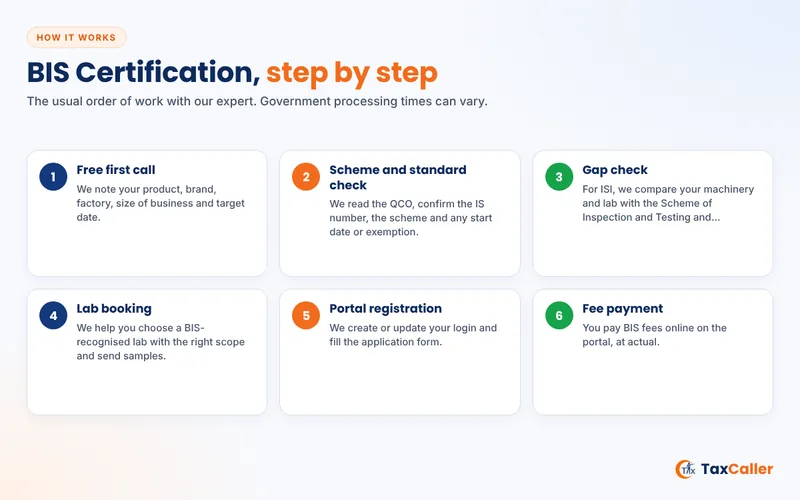
BIS Certification: how the work moves, step by step
All BIS applications and payments are made online. Product certification runs on Manak Online, as the BIS apply-for-a-licence page says. Here is how we handle it for you.
Free first call: we note your product, brand, factory, size of business and target date.
Scheme and standard check: we read the QCO, confirm the IS number, the scheme and any start date or exemption.
Gap check: for ISI, we compare your machinery and lab with the Scheme of Inspection and Testing and list what is missing.
Lab booking: we help you choose a BIS-recognised lab with the right scope and send samples.
Portal registration: we create or update your login and fill the application form.
Fee payment: you pay BIS fees online on the portal, at actual.
Queries: we draft replies to BIS queries. The Regulations give 30 days to remove a deficiency, extendable for good reason.
Factory visit (ISI and FMCS): we prepare you with a checklist and a mock walk-through.
Grant: once tests and the visit are fine, you pay the licence fee and minimum marking fee and BIS grants the licence or registration.
Handover: you get the licence copy, the marking rules for your product and a calendar of annual dues and renewal.
Testing and the factory visit
For Option-2 ISI and for CRS, the lab report is the core evidence. Only reports from BIS labs or BIS-recognised or empanelled labs count. For ISI, a BIS officer usually spends one day at an Indian factory and two days at a foreign one. The officer checks production, lab and records, and may draw a sample plus a counter sample.
Time is driven by lab queues and how fast you reply. These are BIS's own targets or averages, from a complete application.
Route
Official target or average
What usually adds time
Scheme-I, Option-2
About one month on average
Report older than 90 days, failed sample
Scheme-I, Option-1
About four months
Visit dates, lab time, queries
All-India first licence (no product guidelines yet)
Longer; BIS guidelines of 2019 said up to 180 days
Fixing test methods and fees
FMCS
About six months on average
Overseas visit, sample shipment
Scheme-II (CRS)
No fixed public target; typically several weeks to a few months
Lab waiting time, document corrections
Lab testing is often the longest single step. Our own work, from complete documents to filing, usually takes three to five working days. Start at least six months before a QCO start date.
Zubair Licence & Registration Expert
Have a question on this topic? Ask Zubair on a free call.
BIS Certificate Cost: Government Fees, MSME Concessions and Our Fee
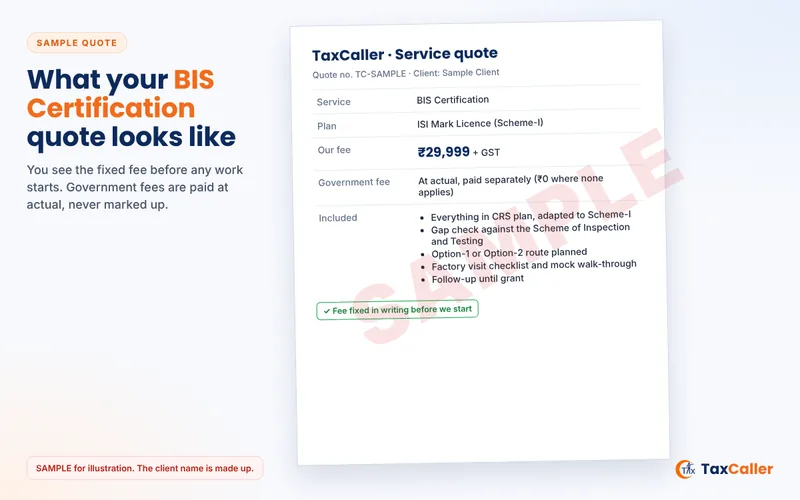
BIS Certification: SAMPLE quote, for illustration only
BIS certificate cost has three parts: BIS fees, lab testing charges and our professional fee. Each is paid to a different party. Only the BIS fees are fixed by law.
Scheme-I (ISI) government fees
Item
Amount
Source
Application fee
₹1,000
BIS FAQ Q14
Inspection fee for the first visit
₹7,000 per person per day
BIS FAQ Q14
Annual licence fee
₹1,000 a year
BIS FAQ Q14
Minimum marking fee
Product-wise, in the BIS marking fee schedule
Notification CMD-2/G-18
Inclusion of a new variety
₹5,000 per variety or group
2018 Regulations, Scheme-I
Late fee if annual dues are paid within the 90-day suspension window
₹5,000
2026 amendment
Concession on the minimum marking fee (notification CMD-2/G-18 of 17 March 2026, valid to 31 May 2029): 80% for micro units, 80% for start-ups, 50% for small units, and an extra 10% for women-led micro, small or medium units, all measured against the large-unit fee.
Scheme-II (CRS) government fees
Item
Amount
Application fee
₹1,000
Annual licence fee
₹1,000
Processing fee
₹25,000 per application per year, in advance
Each extra test report
₹20,000
Scope extension for new models
₹30,000 per application
Service request after grant
₹5,000 per request
Renewal application fee
₹1,000, plus the processing fee
Concession on the CRS processing fee up to 31 May 2029: 80% for micro units and start-ups, 50% for small units and 20% for medium units. From 1 June 2029 it becomes 20% for all MSMEs. Source: the BIS (Conformity Assessment) Amendment Regulations, 2026.
FMCS extras
Foreign makers pay in US dollars (SAARC makers may pay in rupees). On top of the ₹1,000 fees, there are visit charges of ₹7,000 per man-day, travel and stay of officers, a ₹10,000 contingency fund, and the USD 10,000 performance security.
Worked example: a micro unit filing CRS for one product
Item
Amount
Application fee
₹1,000
Annual licence fee
₹1,000
Processing fee after 80% concession (₹25,000 less ₹20,000)
₹5,000
BIS fees for year one
₹7,000 plus any tax BIS levies
Lab testing
As per the lab's quote
A large company would pay ₹27,000 in BIS fees for the same filing. That gap is why we always ask for your Udyam certificate first.
Our fee
TaxCaller's fee starts at ₹11,999 + GST for one CRS registration with one test report. ISI and FMCS work is quoted after we read your QCO. Government fees, lab charges, inspection travel and the bank security are paid separately at actual, directly to BIS or the lab.
Since 25 February 2026, a BIS licence under Scheme-I is granted initially for up to five years and can be renewed for up to five more years. Before that date, the first term was one to two years. CRS registrations also run for up to five years, renewable for up to five more.
Keeping the licence alive
Annual fee in advance: the licence fee and minimum marking fee are paid every year before the due date.
Production statement: file it with the annual dues so BIS can work out the actual marking fee.
Missed dues: the licence is suspended for 90 days. Pay within that window with a ₹5,000 late fee and the suspension is lifted. If not, the licence is cancelled.
CRS renewal: apply in Form-VI three months before expiry.
ISI renewal: apply on Manak Online from the licensee dashboard before expiry, with production details.
Changes during the licence
Tell BIS before you change the factory address, name, brand or models. A licence covers only the factory address named in it, so ask BIS before you move production. New varieties or models need an inclusion or scope extension. BIS also inspects factories and picks market samples during the licence term.
How to Check a BIS Licence, R-Number or HUID Online
Anyone can check a BIS licence in under a minute. Use the free BIS Care app on Android or iPhone, or the licence search links on bis.gov.in.
What you want to check
Where
What you enter
ISI licence (CM/L number)
BIS Care app, "Verify Licence Details"
The licence number printed under the ISI mark
CRS registration (R-number)
BIS Care app, "Verify R-No under CRS"
The eight-digit R-number on the label
Gold hallmark
BIS Care app, "Verify HUID"
The six-character HUID on the jewellery
Licence status, product list or licensees by IS number
Licence search and lists on bis.gov.in
IS number, firm name or licence number
The app shows the details BIS holds against that number. If the details do not match the product in your hand, you can complain through the same app. Complaints cover misuse of the ISI mark, Registration Mark or Hallmark, poor quality and misleading ads.
BIS certificate download
BIS issues the licence or registration online. The licensee downloads it from its own login on the BIS portal once it is granted. Buyers do not get a copy from BIS. They verify the number on the app instead. When we file for you, we hand over the PDF and your login details.
Abhinay Rai Licence & Registration Expert
Have a question on this topic? Ask Abhinay on a free call.
Breach of Section 11 (copying or publishing Indian Standards without authority) or Section 26(1)
Fine up to ₹5 lakh
Section 29(2)
Breach of Section 14(6), 14(8) or 15 (hallmarking and sale of notified precious metal articles)
Jail up to 1 year, or fine from ₹1 lakh up to five times the value of the goods, or both
Section 29(3)
Breach of Section 17: making, importing, selling or storing QCO goods without a licence, using the mark on goods that fail the standard, or misusing the mark
Jail up to 2 years, or fine of at least ₹2 lakh (first offence) or ₹5 lakh (repeat), up to ten times the value of the goods, or both
If the value of the goods cannot be found, a year's production is presumed and the last year's turnover is taken as the value.
The Section 29(3) offence is cognizable. A police officer of DSP rank or above can search and seize without a warrant (Section 32).
Directors and officers in charge are also liable for a company's offence (Section 30).
A licensee must compensate a consumer hurt by marked goods that fail the standard (Section 31).
BIS also runs search and seizure drives and can suspend or cancel a licence under Regulations 10 and 11.
Hallmarking is BIS certification for gold and silver articles. It runs under Sections 14 and 15 of the BIS Act and the BIS (Hallmarking) Regulations, 2018. For gold jewellery and artefacts, it is mandatory in notified districts under the Hallmarking of Gold Jewellery and Gold Artefacts Order, 2020.
The jeweller registers with BIS. The article is then tested and marked at a BIS-recognised Assaying and Hallmarking Centre.
Each hallmarked gold article carries a six-character HUID, which buyers can check on the BIS Care app.
The sixth phase from 2 March 2026 added seven districts, taking coverage to 380. The order was amended again on 28 April and 3 August 2026, and coverage passed 390 districts by November 2026, as reported. Check the current district list.
Silver hallmarking remains voluntary, as reported in November 2026, but hallmarked silver must carry a HUID from 1 September 2025.
Hallmarking is a separate registration from the product licences on this page. Tell us on the first call if you need it.
Shadab Licence & Registration Expert
Have a question on this topic? Ask Shadab on a free call.
2026 was a busy year for BIS rules. These are the changes that matter for a new applicant, with the official source where we could open it.
Longer licences: the BIS (Conformity Assessment) Amendment Regulations, 2026 (F. No. BS/XI/11/01/2025-26, 25 February 2026) set the first term at up to five years for Schemes I, II, IV, VII, IX and X, renewable for up to five years. A corrigendum of 28 April 2026 changed "for five years" to "up to five years" for certificates of conformity.
Annual fees in advance: the same amendment requires annual dues in advance, a 90-day suspension for non-payment, a ₹5,000 late fee to revive, and cancellation after that. Suspension for other reasons generally needs 21 days' notice.
New CRS fee table: processing fee of ₹25,000 per year, ₹20,000 per extra report, ₹30,000 per scope extension, and renewal three months before expiry in Form-VI. MSME concessions of 80%, 50% and 20% run to 31 May 2029.
Marking fee concession extended: notification CMD-2/G-18 of 17 March 2026 kept the 80% (micro and start-up), 50% (small) and extra 10% (women-led) concessions on the Scheme-I minimum marking fee until 31 May 2029. A similar notice covers Scheme-X.
Machinery order revoked: the Omnibus Technical Regulation for machinery and electrical equipment was withdrawn on 16 January 2026, so machinery under that order no longer needs Scheme-X certification.
Appliance QCO: the Safety of Household, Commercial and Similar Electrical Appliances (Quality Control) Order, 2026 was notified on 6 April 2026 and applies from 1 October 2026.
Transition QCO: DPIIT notified the Transition Facilitation (Quality Control) Order, 2026 on 25 June 2026 (see the PIB release of 25 June 2026). It offers a risk-based Scheme-II route for ten QCOs. Units with three years of clean QCO compliance are also covered.
Hallmarking: a sixth phase from 2 March 2026, more districts added later in the year, and the BIS (Hallmarking) Amendment Regulations of 14 September 2026.
The late-2025 withdrawal of QCOs on chemicals, polymers and some metals also still matters. If you were holding a licence only because of those QCOs, it is now your choice to keep it.
BIS or ISO: Is This the Right Certification for You?
BIS and ISO answer different questions. BIS product certification says a product meets an Indian Standard and lets you use a legal mark. ISO 9001 and similar certificates say your management system meets an international standard. Private certification bodies issue those after an audit.
Point
BIS product certification
ISO certification
What is certified
A product, made at a named factory
A management system of the business
Who issues it
Bureau of Indian Standards, a statutory body
Accredited certification bodies
Legal force
Compulsory for QCO products
Voluntary
Mark
ISI mark, Standard Mark with R-number, Hallmark
No product mark
Meets a QCO?
Yes
No
Many factories hold both. An ISO system helps you run the in-house lab and records that BIS checks. Read our ISO certification guide for that side.
Not sure which licences your business needs overall? Our business licences guide maps them by business type. A new manufacturer usually also needs GST registration and Udyam. Start-ups recognised by DPIIT get the start-up concession, so see Startup India registration too.
TaxCaller has handled registrations and tax work since 2018, from our office in Ghaziabad and online across India. For BIS work we keep it simple and checkable:
QCO first: we read the order and standard before you spend on testing.
Fees kept apart: BIS fees and lab charges are paid by you at actual. Our fee is shown separately, plus GST.
Concession check: we apply the MSME, start-up and women-entrepreneur concessions where you qualify.
One expert, start to finish: the same person tracks your portal, queries and factory visit.
After the grant: reminders for annual dues, production statements and renewal.
Talk to us through the contact page, or try the calculators on our tools page for your other compliance dates.
Shreya Licence & Registration Expert
Have a question on this topic? Ask Shreya on a free call.
Certificate of incorporation, partnership deed or proprietor ID
GST registration certificate
Udyam certificate (for MSME fee concessions) or DPIIT start-up recognition
Factory address proof and location map
Manufacturing process flow chart
List of plant and machinery (ISI and FMCS)
List of test equipment with valid calibration certificates (ISI and FMCS)
Details of quality control staff (ISI and FMCS)
Test report from a BIS lab or BIS-recognised lab (CRS, and ISI Option-2)
Trademark certificate or brand owner's authorisation
Authorisation letter or board resolution for the signatory
Undertaking in Form-II and affidavit in Form-III (CRS)
Nomination of Authorised Indian Representative (foreign makers)
Why TaxCaller
Real experts, not a call centre
Your work is handled by experienced professionals who explain every step, check your documents and keep you updated.
Registered company
TaxCaller is run by TaxCaller India LLP (LLPIN AAQ-7388), serving clients since 2018.
Fee told upfront
You know the complete fee, our professional fee and the government fee, before any work starts. No hidden charges.
Support after the work
Notices, renewals, returns and compliance reminders: we stay with your business after the registration is done.
Reviewed By
Expert for this topic BIS Certification
Abhinay Rai
Advocate
Abhinay Rai is a Advocate specialising in BIS Certification. The process, documents, timelines and fees on this page are checked against the current rules and government portals, and updated whenever the law, forms or fees change.
BIS certified means the Bureau of Indian Standards has checked that a product meets its Indian Standard and allowed the maker to use a BIS mark. You will see the ISI mark with a CM/L number, a Standard Mark with an R-number, or a hallmark with a HUID. Each number can be checked on the BIS Care app.
What is the full form of BIS and ISI?
BIS stands for Bureau of Indian Standards, the National Standards Body of India working under the BIS Act, 2016. ISI stands for Indian Standards Institution, the body set up on 6 January 1947 that BIS replaced. The ISI mark kept the old name, and it now shows that a product meets an Indian Standard.
Is BIS certification mandatory for every product?
No. It is voluntary for most goods. It becomes mandatory only when the Central Government issues a Quality Control Order under Section 16 of the BIS Act for that product. A March 2025 Lok Sabha reply put the count at 187 QCOs covering 769 products. Some were withdrawn later and new ones added, so check the live list.
Can I import without a BIS certificate?
Not if the product is under a Quality Control Order that is in force. Section 17 of the BIS Act bars import of such goods without a valid licence and mark, and customs checks this before clearance. The foreign manufacturer must hold the licence or CRS registration. Goods outside every QCO can be imported without BIS certification.
How do I get BIS certification?
First confirm the Indian Standard and scheme in your product's QCO. Then get samples tested at a BIS-recognised lab, apply online on the BIS portal with your documents, and pay the fees. For an ISI licence, BIS also inspects your factory. Once tests and the visit are fine, BIS grants the licence or registration online.
What is the difference between ISO and BIS?
BIS certifies a product against an Indian Standard and lets you use a legal mark such as the ISI mark. ISO certificates, like ISO 9001, certify a company's management system and are issued by private certification bodies. BIS is compulsory for QCO products, while ISO is voluntary. An ISO certificate never satisfies a Quality Control Order.
How much does a BIS certificate cost?
For an ISI licence, BIS charges ₹1,000 to apply, ₹7,000 per person-day for the visit, ₹1,000 a year as licence fee, plus a product-wise marking fee. For CRS, add a ₹25,000 yearly processing fee to the ₹1,000 fees. Micro units and start-ups get 80% off some fees. Lab charges and our fee are separate.
How long does BIS certification take?
BIS says an ISI licence takes about one month on average under Option-2, where you file your own lab report, and about four months under Option-1. Foreign makers under FMCS take about six months. CRS has no fixed public target and usually takes several weeks to a few months, mostly depending on lab waiting time.
What is the validity of a BIS licence?
Since the amendment of 25 February 2026, an ISI licence is granted initially for up to five years and can be renewed for up to five more. CRS registrations also run up to five years. The annual licence fee and marking fee must still be paid every year in advance, or the licence is suspended.
How can I check a BIS licence or R-number online?
Install the BIS Care app. Use Verify Licence Details for an ISI licence number, Verify R-No under CRS for the eight-digit R-number, and Verify HUID for gold jewellery. The result shows the licensee, address, product and status. You can also use the licence search on bis.gov.in, and complain through the app if details do not match.
Where can I download my BIS certificate?
BIS issues the licence or registration online, and the licence holder downloads it from its own login on the BIS portal after grant. Buyers and marketplaces do not download it from BIS; they verify the number on the BIS Care app instead. When TaxCaller files your application, we share the PDF and your portal login with you.
What is the difference between an ISI mark and CRS registration?
The ISI mark is granted under Scheme-I after a factory inspection and testing, for products like appliances, cement, steel and toys. CRS registration under Scheme-II covers notified electronics, IT and solar goods. It needs no factory visit and relies on a BIS-recognised lab report and self-declaration. CRS products show an R-number instead of a CM/L number.
Can an importer or trader apply for a BIS licence?
Generally no. BIS licences and CRS registrations are granted to the manufacturer of the product, and under FMCS the application must come from the foreign maker itself. An importer can help by acting as the Indian contact or AIR where rules allow. A trader simply buys and sells goods that already carry a valid mark.
Do MSMEs get any concession on BIS fees?
Yes. Until 31 May 2029, micro units and start-ups get 80% off the Scheme-I minimum marking fee and small units get 50%. Women-led units get another 10%. Under CRS, the processing fee is cut by 80% for micro units and start-ups, 50% for small and 20% for medium units. You need valid Udyam or start-up proof.
What is the penalty for selling without BIS certification?
Under Section 29(3) of the BIS Act, making, importing or selling QCO goods without a licence can mean jail up to two years, or a fine of at least ₹2 lakh for a first offence and ₹5 lakh for a repeat, up to ten times the goods' value, or both. The offence is cognizable.
Tell us your product and factory, and our expert will confirm the QCO, scheme and lab before you spend on testing. Our fee starts at ₹11,999 + GST; BIS fees and lab charges are paid at actual.