!Late GST return?Late fee and interest run till you file
Since 2018Trusted Experience
980+Experts Connected
220+Cities Served
1164+Agents Available
12000+Founders Trusted
S
Srishti Magoo
★★★★★
Excellent experience with TaxCaller for filing my &
my family members ITR returns. The entire process was
smooth, quick and hassle-free. They are professional,
knowledgeable and guided me through every step with patience.
O
obeid sait
★★★★★
The team has handled my taxes for the past three years,
and it's been a wonderful, hassle-free experience.
Thank you for your consistently quick and efficient service.
P
Pushkar
★★★★★
They are among the best in their field. Their work culture
is highly professional, and their client service is smooth
and reliable. They can confidently be relied on to get the job done.
P
Prasad Sheth
★★★★★
Excellent experience with TaxCaller! The ITR filing
process was smooth, quick, and completely hassle-free.
The CA was knowledgeable, responsive, and explained everything clearly.
A
Apoorv Bansal
★★★★★
Excellent service for ITR filing. The team was highly
professional, responsive, and guided me through the entire
process smoothly. My return was filed accurately and on time.
A
Abhishek Kumar
★★★★★
I was searching for a good CA firm in Ghaziabad and found
TaxCaller. The experience was excellent from start to finish.
The team is responsive, transparent, and genuinely helpful.
U
uma pandey
★★★★★
Great service! TaxCaller India made the entire ITR filing
process quick, smooth, and hassle-free. They answered all
my queries patiently and ensured maximum accuracy.
T
tanu mittal
★★★★★
Excellent job! We've been connected for many years,
and your success truly makes me happy. You are an
incredibly intelligent person. Keep shining, keep growing.
B
Bhanu Pratap Maurya
★★★★★
I am filing my ITR since past 3 years with Abhinav and
Firm is known as TaxCaller and they are professional
interms of ITR rules. They will explain and tell you all
the information.
A
ashish Sharma
★★★★★
I am providing my honest reviews:
No.1 service ...
A
AARYAN GROUP
★★★★★
Honestly, finding a good CA firm in Ghaziabad was
confusing, but TaxCaller India made it simple.
I contacted them for GST work and the experience was smooth.
N
News Speaks
★★★★★
If you're looking for a reliable CA firm in Ghaziabad,
TaxCaller India is a great choice. They provide complete
taxation and compliance solutions including GST.
A
Anshul Chaprana
★★★★★
Got my GST registration done through TaxCaller CA firm.
Process was quite smooth, they guided properly on documents
and didn't waste time. Overall good experience.
How we work
Online · Call · WhatsApp
Quick answer
LUT in GST is a Letter of Undertaking filed online in Form GST RFD-11 that lets you export goods or services, or supply to an SEZ, without paying IGST. It is valid for one financial year and must be filed before you export. The portal charges no fee. TaxCaller's experts file it online for you.
Reviewed by Abhinay Rai · Updated 15 Nov 2026
Pick a plan that fits
LUT Filing
Exporters and SEZ suppliers who need this year's LUT filed
Reply to deficiency memo or officer query on the refund
Government fees and taxes are extra where applicable. Our expert confirms the final amount on the first call. No hidden charges.
About LUT in GST
If you export goods or services, or supply to an SEZ, GST treats that sale as zero-rated. You can bill it without IGST, but only if a Letter of Undertaking is on record first. That is what LUT in GST means: a yearly undertaking in Form GST RFD-11, filed on the GST portal.
Some exporters learn about the LUT only after a query from the department. By then, IGST and interest may already be due. A few minutes of filing at the start of the year avoids that. It also keeps your cash in the business instead of waiting in a refund queue.
This page explains who can file, how long an LUT lasts, how it differs from a bond, and what it means for export of services, goods and SEZ supplies. It covers refunds of unutilised ITC, penalties and the changes made in 2026. It also shows how TaxCaller's tax experts file your GST LUT online.
Complete guide
Choose a topic to open it. Every answer gives the rule or section it comes from.
01 Topic 1 of 20
What Is LUT in GST? Meaning and Legal Basis
LUT stands for Letter of Undertaking. It is a declaration you give the GST department in Form GST RFD-11. In it, you promise to follow the export conditions. You also promise to pay the tax with interest if you fail. In return, you can make zero-rated supplies without paying IGST first.
The law sits in four places:
Section 16 of the IGST Act, 2017 defines zero-rated supply. Section 16(3) lets a registered person supply under bond or Letter of Undertaking without paying IGST. The person can then claim a refund of unutilised input tax credit under section 54 of the CGST Act.
Rule 96A of the CGST Rules, 2017 sets the procedure. The bond or LUT must be furnished in Form GST RFD-11 before the export.
Notification 37/2017-Central Tax, dated 4 October 2017, opened the LUT route to almost every registered person.
Circular 8/8/2017-GST, of the same date, explains who signs, how long the LUT is valid and how fast it must be accepted.
You can read the current text of section 16 on the CBIC tax information portal. In plain words, an LUT is a yearly promise that lets you bill exports without tax. The promise is backed by your liability to pay if you break the rules.
An LUT works only for zero-rated supplies. Section 16(1) of the IGST Act covers three situations:
Export of goods: taking goods out of India to a place outside India.
Export of services: a service that meets all five conditions of section 2(6) of the IGST Act. These are explained in the services section below.
Supplies to an SEZ unit or SEZ developer, but only for their authorised operations.
Some supplies look like exports but are not zero-rated. An LUT does not cover them:
Deemed exports under section 147 of the CGST Act, such as notified supplies to an EOU. Tax is charged on the invoice and a refund is claimed later.
Sales to an Indian merchant exporter. This is a domestic sale. A concessional 0.1% rate is available under Notification 40/2017-Central Tax (Rate) and its IGST twin, subject to conditions. The merchant exporter then exports under its own LUT.
Services whose place of supply is in India, even if the client pays in dollars. Hotel stays and work on goods located in India are common examples.
If the supply is not zero-rated, an LUT gives no protection. That is why our expert checks the nature of each supply before filing.
Abhinay Rai GST Expert
Have a question on this topic? Ask Abhinay on a free call.
Under Notification 37/2017-Central Tax, any registered person making zero-rated supplies can file an LUT. There is no turnover limit. No past export record is needed. A business that got its GSTIN yesterday can file today.
Who can file:
Exporters of goods, whether manufacturers or traders
Exporters of services, such as IT firms, software developers, freelancers, designers, consultants, BPOs and digital agencies
Suppliers of goods or services to SEZ units and SEZ developers
Proprietors, partnership firms, LLPs, companies, trusts and societies with an active GSTIN
Who cannot file:
A person prosecuted for an offence under the CGST Act, the IGST Act or any existing law, where the tax evaded is more than ₹250 lakh. Such a person must furnish a bond instead.
Composition taxpayers. Exports are inter-State supplies under section 7(5) of the IGST Act. Section 10 of the CGST Act does not allow composition dealers to make inter-State outward supplies.
Unregistered persons. An LUT is filed against a GSTIN, so registration comes first.
A taxpayer whose LUT facility stands withdrawn under rule 96A(3), until the dues are paid.
A note for small service exporters: exports count in your aggregate turnover. If your total stays below the GST registration threshold, you may not need a GSTIN at all. In that case there is no LUT to file. If you do need a GSTIN, our GST registration team can get it for you first.
Both an LUT and a bond let you export without paying IGST. Both use Form GST RFD-11. The difference is the security you give.
Point
Letter of Undertaking (LUT)
Bond
Who uses it
Almost every registered exporter
Persons prosecuted for tax evasion above ₹250 lakh, or anyone who chooses it
Form
GST RFD-11, filed online on the GST portal
GST RFD-11, executed on non-judicial stamp paper
Security from your bank
Not needed
Bank security (BG) of up to 15% of the bond amount
Stamp duty
None
As per your State's stamp law
Amount covered
No amount; it is a promise
Must cover your estimated IGST on exports
Validity
The whole financial year in which it is filed
A running bond; a fresh bond is needed if the cover runs short
Government fee
Nil
Cost of stamp paper
These rules come from paragraphs 2(a), 2(f) and 2(g) of Circular 8/8/2017-GST. The circular says bonds are needed only by persons who are not eligible for an LUT. For everyone else, the LUT is simpler and costs nothing. A bond locks up bank limits, so we suggest it only when the law requires it.
Exporting Under LUT vs Paying IGST and Claiming a Refund
Section 16 of the IGST Act gives an exporter two routes. Under section 16(3), you export under LUT or bond without IGST. Under section 16(4), notified classes of persons or goods may pay IGST and claim that tax back.
Point
Under LUT (no IGST)
With IGST payment
Cash flow
No tax paid at the time of export
IGST paid first, refund later
What you claim back
Unutilised input tax credit, in Form GST RFD-01
The IGST paid; for goods, the shipping bill is treated as the refund claim under rule 96
Who can use it
Every eligible registered person
Only notified classes of persons, goods or services, since 1 October 2023
Goods subject to export duty
No ITC refund (section 16(5))
No IGST refund (section 16(5))
Suits
Most exporters, especially service firms and small traders
Exporters with large credit balances who pay IGST from ITC
CBIC has notified that most goods and services can still be exported on payment of IGST (Notifications 01/2023 and 05/2023-Integrated Tax). A few goods are left out, such as pan masala, certain tobacco products and some mint oils. Exporters of those goods must use an LUT or bond.
For most of our clients, the LUT route is simpler. You do not block cash in tax. You also avoid waiting for an IGST refund to reach your bank.
Shadab GST Expert
Have a question on this topic? Ask Shadab on a free call.
LUT Validity: File Before You Export, Every Financial Year
An LUT is valid for the whole financial year in which it is filed (Circular 8/8/2017-GST, para 2(b)). It ends on 31 March. The portal then shows it as Expired. There is no auto-renewal, so you file a fresh LUT every year.
Rule 96A(1) says the LUT must be furnished before the export. In practice:
FY 2026-27 (1 April 2026 to 31 March 2027): GSTN enabled online filing in February 2026. If you have not filed yet, file before your next export invoice.
FY 2027-28: plan to file in March 2027, so the LUT is ready from 1 April 2027.
Acceptance time. The officer must accept the LUT within three working days. If not, it is deemed accepted (Circular 8/8/2017-GST, para 2(e)).
Status on the portal. Your LUT moves through these stages:
Submitted: filed successfully, ARN generated.
Pending for Clarification: the officer has raised a query.
Pending for Order: you replied, or 15 working days passed without a reply.
Approved, Rejected or Deemed Approved: the outcome.
Expired: the financial year is over.
Exported before filing? Para 4.1 of Circular 37/11/2018-GST allows the delay to be condoned. The LUT can then be accepted on an ex post facto basis, based on the facts. The portal also lets you pick the previous financial year. Treat this as a rescue option, not a plan.
Export of Services Under LUT: IT, Freelancers and Agencies
Many LUT filers are service exporters. Section 2(6) of the IGST Act treats a service as exported only when all five conditions are met:
The supplier is located in India.
The recipient is located outside India.
The place of supply is outside India.
Payment is received in convertible foreign exchange, or in Indian rupees where RBI permits.
The supplier and the recipient are not merely establishments of the same person.
Time to receive payment. Under rule 96A(1)(b), payment must come in within one year of the invoice. Where FEMA and RBI allow a longer period, that period applies if it ends later. If payment does not arrive, you pay the IGST with interest within 15 days after that period.
Keep proof. Save the bank's foreign inward remittance advice or certificate for each invoice. You need it to match payments, claim refunds and answer queries.
Intermediaries, a 2026 change. The Finance Act, 2026 omitted section 13(8)(b) of the IGST Act. Commission agents and brokers who arrange supplies for foreign clients now follow the general rule. Their place of supply is the client's location. If the other four conditions are met, such services can now be exports. An LUT lets you bill them without IGST.
Common examples are software built for a US client, design work for a UK firm, and marketing services for a client in Dubai. Each of these needs an LUT to be billed without IGST.
Shreya GST Expert
Have a question on this topic? Ask Shreya on a free call.
Export of Goods Under LUT: Shipping Bills and the 3-Month Rule
For goods, you also need an Importer-Exporter Code (IEC) from the DGFT. The usual flow is:
Raise a tax invoice with the LUT wording required by rule 46.
File the shipping bill with customs against that invoice.
Report the invoice in Table 6A of GSTR-1. Rule 96A(2) sends this data to the customs system, which confirms the export back to the GST portal.
Make sure the goods leave India within three months of the invoice date. The Commissioner can allow more time.
If the goods are not exported in time, pay the IGST with interest within 15 days after the three months (rule 96A(1)(a)).
Payment for goods. Receiving the money is not a condition for processing a goods refund (Circular 37/11/2018-GST, para 12). But the proviso to section 16(3) applies if the sale proceeds are never realised. You must then deposit the refund received, with interest, within 30 days after the FEMA time limit.
Courier and e-commerce exports follow the same GST logic. The customs paperwork differs, so tell us your shipping mode on the first call.
Supplies to an SEZ unit or developer are zero-rated only when they are for authorised operations. This condition is in section 16(1)(b) of the IGST Act, as amended from 1 October 2023. Rule 96A applies to such supplies in the same way as it does to exports.
One LUT covers both. You do not need a separate LUT for SEZ supplies.
Rupee payment is fine. Supplies to an SEZ under LUT are allowed whether you are paid in rupees or foreign exchange, as RBI rules permit (Circular 8/8/2017-GST, para 2(k)).
Get the SEZ endorsement. For a refund, goods must be admitted into the SEZ for authorised operations, as endorsed by the specified officer of the Zone. For services, keep the officer's endorsement of receipt.
Report it correctly. SEZ supplies go in Table 6B of GSTR-1, not in Table 4.
Refund statement. The refund of unutilised ITC is claimed in RFD-01 using the SEZ (without payment of tax) statement.
Ask your SEZ buyer for a written confirmation that the supply is for authorised operations. Without it, the zero-rating can be questioned.
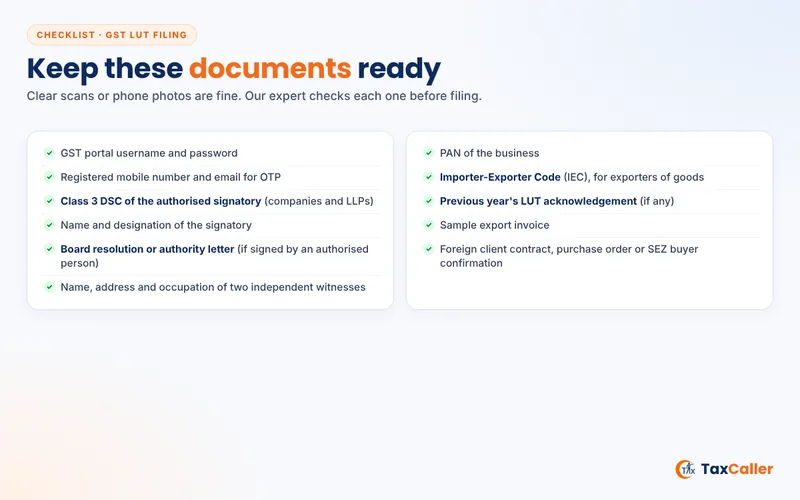
The portal form is short, but the details must be right. Keep these ready:
GSTIN and GST portal login, with the registered mobile and email for OTP
Class 3 DSC of the authorised signatory, for companies and LLPs (rule 26 of the CGST Rules)
Name and designation of the person signing
Board resolution or authority letter, if someone other than the proprietor, partner or director signs
Names, addresses and occupations of two independent witnesses
PAN of the business
IEC, for exporters of goods
Copy of the previous year's LUT acknowledgement, if any
A list of your expected exports or SEZ supplies, so we can check zero-rating
Sample export invoice and the foreign client contract or purchase order
The portal accepts a self-declaration that you have not been prosecuted. Under para 2(d) of Circular 8/8/2017-GST, officers accept such declarations unless they have specific information to the contrary.
Zubair GST Expert
Have a question on this topic? Ask Zubair on a free call.
After Filing: Invoices, Returns and Refund of Unutilised ITC
Invoice wording. Under the proviso to rule 46 of the CGST Rules, an export or SEZ invoice under LUT must carry this line: "SUPPLY MEANT FOR EXPORT/SUPPLY TO SEZ UNIT OR SEZ DEVELOPER FOR AUTHORISED OPERATIONS UNDER BOND OR LETTER OF UNDERTAKING WITHOUT PAYMENT OF INTEGRATED TAX". An export invoice also shows the recipient's name and address, the delivery address and the country of destination. Many exporters print the LUT ARN too.
Returns.
GSTR-1: exports in Table 6A, marked as without payment of tax. SEZ supplies in Table 6B.
GSTR-3B: zero-rated supplies in Table 3.1(b), with tax as zero.
GSTR-9: the yearly total of zero-rated supplies. Our GST annual return team can match it for you.
Refund of unutilised ITC. Exporting under LUT often leaves credit unused. You can claim it in Form GST RFD-01 under section 54 of the CGST Act. Key points:
The amount follows the formula in rule 89(4): zero-rated turnover multiplied by net ITC, divided by adjusted total turnover.
The claim must be filed within two years from the relevant date (section 54(1)). For goods, this is usually the date the ship or aircraft leaves India. For services, it is usually the date payment is received.
For zero-rated supplies, 90% can be paid provisionally under section 54(6), with the rest after final checks.
Keep invoices, shipping bills, bank advices and the LUT acknowledgement. Section 36 of the CGST Act asks you to keep records for 72 months from the due date of the annual return.
Abhinay Rai GST Expert
Have a question on this topic? Ask Abhinay on a free call.
There is no late fee for the LUT itself. The cost of missing it comes in other ways:
Situation
What follows
Legal basis
Export without LUT and without IGST
IGST becomes payable, with interest at 18% a year
Section 50(1) of the CGST Act; Notification 13/2017-Central Tax
Tax not paid after a notice
Demand of tax, interest and penalty
Section 73 or 74 of the CGST Act; section 74A for FY 2024-25 onwards
Goods not exported within 3 months
Pay IGST with interest within 15 days after the period
Rule 96A(1)(a)
Service payment not received in time
Pay IGST with interest within 15 days after the period
Rule 96A(1)(b)
Dues under rule 96A not paid
LUT facility withdrawn; amount recovered
Rule 96A(3); section 79
Dues paid later
LUT facility restored at once
Rule 96A(4)
Export proceeds for goods never realised
Refund received must be repaid with interest
Proviso to section 16(3) of the IGST Act
While the LUT facility is withdrawn, you can export only on payment of IGST or under a bond (Circular 8/8/2017-GST, para 2(b)). A missing LUT can also weaken a refund claim for that period. Condonation is possible, but it depends on the officer and the facts.
Filing after the first export. The LUT must come before the invoice. Late filing invites questions.
Wrong financial year. Selecting last year in the dropdown by mistake leaves the current year uncovered.
Forgetting the renewal. Many exporters file once and assume it carries on. It expires every 31 March.
Weak witness details. Witnesses must be independent, with full name, address and occupation.
Wrong signatory. Only a proprietor, working partner, managing director, company secretary or an authorised person can sign.
Treating every foreign payment as an export. If the place of supply is in India, the supply is taxable even if paid in dollars.
Missing invoice wording. The rule 46 line must be on every LUT invoice.
Wrong return tables. Exports shown in Table 4 of GSTR-1 or Table 3.1(a) of GSTR-3B look like taxable sales.
Not tracking payment deadlines. A service invoice unpaid after the allowed period means IGST with interest.
Pending returns or a suspended GSTIN. Officers look at your filing record. Clear old returns first.
One LUT for many GSTINs. An LUT is filed per GSTIN. Each State registration that exports needs its own.
Officers can reject an LUT or ask for clarification. Typical triggers are a prosecution history, wrong signatory details or doubts about the business. If your status shows Pending for Clarification, reply on time. If it goes beyond a reply, our GST notice reply service can help.
These changes are from CBIC notifications, circulars and the Finance Act, 2026. Rule 96A and Form GST RFD-11 themselves did not change, so the LUT filing steps stay the same.
LUT for FY 2026-27 opened early. GSTN enabled online filing of RFD-11 for FY 2026-27 in February 2026 and asked taxpayers to file well in advance.
Intermediary services can now be exports. The Finance Act, 2026 omitted section 13(8)(b) of the IGST Act. It took effect when the Act was enacted on 30 March 2026. Intermediaries serving foreign clients should now check export status and file an LUT.
Refund threshold change. The Finance Act, 2026 amended section 54(14) of the CGST Act. The ₹1,000 minimum no longer applies to IGST refunds on goods exported with payment of tax. Notification 03/2026-Central Tax brought this into force on 1 November 2026.
Faster refund processing from 1 November 2026. The CGST (Amendment) Rules, 2026 (Notification 05/2026-Central Tax, dated 26 October 2026) cut the time for a deficiency memo from 15 to 10 days, with deemed acknowledgement after that. The provisional refund order in RFD-04 is to issue within three working days of acknowledgement.
Bigger refunds for goods exporters. The same notification omitted the rule 89(4) cap that limited zero-rated turnover of goods to 1.5 times the value of like goods sold in India, from 1 November 2026.
New RFD-01 from 1 December 2026. The refund form is replaced. Exports without payment of tax and SEZ supplies without payment of tax keep separate statements.
Rule 96(10) clarity. Circular 264/10/2026-GST, dated 26 October 2026, follows the Supreme Court's August 2026 judgment. It says the omission of rule 96(10), and of rules 89(4A) and 89(4B), applies to pending matters too.
We will update this page when CBIC issues more changes on exports or refunds.
Shadab GST Expert
Have a question on this topic? Ask Shadab on a free call.
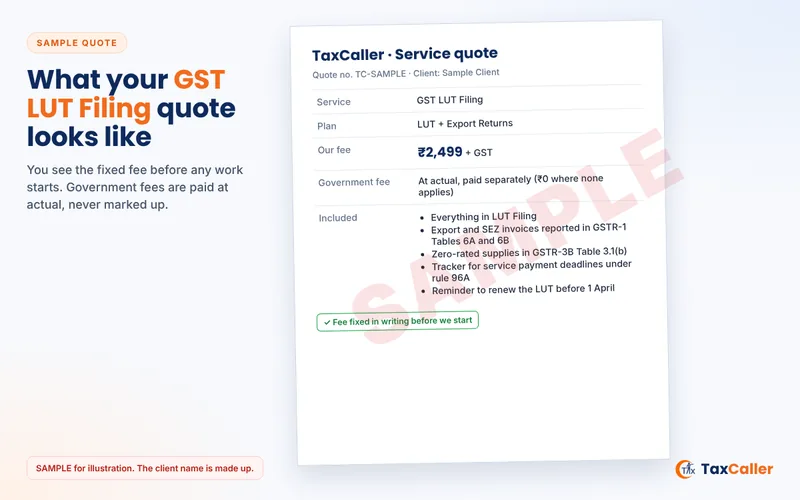
GST LUT Filing: SAMPLE quote, for illustration only
We show two things separately: the fee you pay us and any amount you pay the government.
TaxCaller's fee: our fee for LUT filing starts at ₹999 + GST. The final fee depends on the plan you choose and is confirmed on your first call, before any work starts.
Government fees: the GST portal charges no fee to file an LUT in Form GST RFD-11. If the law requires a bond instead, stamp duty and bank charges are paid separately at actual, directly by you.
Item
Paid to
Amount
LUT preparation and filing
TaxCaller
From ₹999 + GST
Filing fee for Form GST RFD-11
Government
Nil
Stamp duty on a bond (only if a bond is needed)
State government
As per State stamp law, at actual
Bank security for a bond (only if needed)
Your bank
Bank charges, at actual
IGST and interest, if conditions are broken
Government
As per law, at actual
What changes our fee: the number of GSTINs, whether you need returns or a refund claim with the LUT, and any pending officer query.
We have handled tax and compliance work for businesses since 2018. We are based in Ghaziabad and serve clients all over India online. An LUT is filed online, so your State does not matter.
Real experts. A tax expert checks whether your supply is zero-rated before filing.
Fee told upfront. You know our fee, and any government cost, before we start.
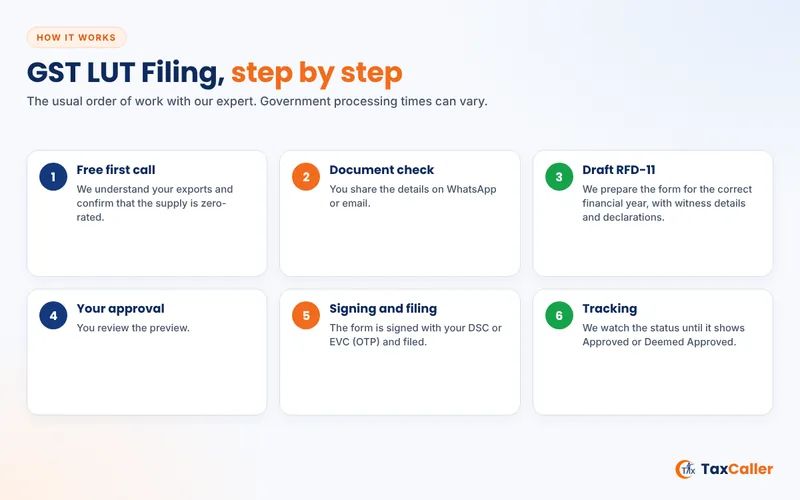
You approve first. We share the RFD-11 preview before it is signed.
Support after filing. We help with officer queries, invoice wording and refunds.
Reviewed content. This page is reviewed by Abhinay Rai, Advocate.
Class 3 DSC of the authorised signatory (companies and LLPs)
Name and designation of the signatory
Board resolution or authority letter (if signed by an authorised person)
Name, address and occupation of two independent witnesses
PAN of the business
Importer-Exporter Code (IEC), for exporters of goods
Previous year's LUT acknowledgement (if any)
Sample export invoice
Foreign client contract, purchase order or SEZ buyer confirmation
Why TaxCaller
Real experts, not a call centre
Your work is handled by experienced professionals who explain every step, check your documents and keep you updated.
Registered company
TaxCaller is run by TaxCaller India LLP (LLPIN AAQ-7388), serving clients since 2018.
Fee told upfront
You know the complete fee, our professional fee and the government fee, before any work starts. No hidden charges.
Support after the work
Notices, renewals, returns and compliance reminders: we stay with your business after the registration is done.
Reviewed By
Expert for this topic GST LUT Filing
Abhinay Rai
Advocate
Abhinay Rai is a Advocate specialising in GST LUT Filing. The process, documents, timelines and fees on this page are checked against the current rules and government portals, and updated whenever the law, forms or fees change.
LUT in GST is a Letter of Undertaking filed in Form GST RFD-11. It lets a registered person export goods or services, or supply to an SEZ, without paying IGST. In it, you promise to meet the export conditions and to pay tax with interest if you fail. It is filed online on the GST portal.
Is LUT mandatory for export of services?
No, it is optional. But without an LUT or bond, you must pay IGST on the export and claim a refund later. Since 1 October 2023, that route is open only to notified cases. Paying first also blocks your cash. So most service exporters file an LUT. It costs nothing.
Who is eligible to file an LUT?
Any registered person making zero-rated supplies can file an LUT under Notification 37/2017-Central Tax. There is no turnover limit and no past export record needed. The only exclusion is a person prosecuted for tax evasion above ₹250 lakh. Such a person must use a bond. Composition taxpayers cannot export, so they cannot file.
What is the validity of an LUT under GST?
An LUT is valid for the whole financial year in which it is filed. For example, an LUT for FY 2026-27 covers exports from 1 April 2026 to 31 March 2027. It expires on 31 March and does not renew on its own. You must file a fresh one each year before exporting.
Can I file an LUT after making exports?
The law says the LUT must be filed before the export. If you missed it, Circular 37/11/2018-GST allows the delay to be condoned and the LUT accepted on an ex post facto basis. This depends on the facts and the officer. File as soon as you notice, and keep proof that exports actually happened.
Is there any government fee for filing an LUT?
No. The GST portal charges no fee to file Form GST RFD-11. A bond, needed only in rare cases, needs stamp paper and a bank security, which cost money. TaxCaller's professional fee for LUT filing is separate and is charged + GST. We confirm it on your first call, before any work starts.
What documents are needed for LUT filing?
You need your GST portal login, the authorised signatory's DSC or registered mobile for EVC, and details of two independent witnesses. Exporters of goods also need an IEC. Keep the previous year's LUT acknowledgement and a board resolution or authority letter if someone other than the owner, partner or director signs.
Who can sign the LUT application?
The LUT can be signed by the proprietor, a working partner, the managing director or the company secretary. It can also be signed by a person authorised by them or by the board of directors. On the portal, the authorised signatory signs with DSC or EVC. Companies and LLPs sign with a DSC.
How do I check my LUT status and download it?
Log in to the GST portal and go to Services, then User Services, then View My Submitted LUTs. You will see the ARN and status, such as Submitted, Approved or Deemed Approved. You can download the acknowledgement as a PDF. You also get an SMS and email after successful filing.
What is the difference between an LUT and a bond?
Both let you export without paying IGST. An LUT is a simple promise filed online, with no stamp paper or bank security. A bond is executed on stamp paper, must cover your estimated tax, and needs a bank security of up to 15%. Only persons prosecuted for evasion above ₹250 lakh must use a bond.
Do freelancers need to file an LUT?
A freelancer with a GSTIN who serves foreign clients should file an LUT. It lets you bill without IGST if the export of service conditions are met. If your aggregate turnover is below the registration threshold, you may not need a GSTIN at all. Our expert can confirm which case applies to you.
What happens if export payment is not received in time?
For services, payment must come within one year of the invoice, or a longer FEMA period. If it does not, pay IGST with interest within 15 days after that period. If you do not pay, the LUT facility is withdrawn under rule 96A(3). It is restored once you pay the dues.
Can I claim an ITC refund when exporting under an LUT?
Yes. Section 16(3) of the IGST Act allows a refund of unutilised input tax credit on exports made under an LUT. You file Form GST RFD-01 within two years from the relevant date. The amount follows the rule 89(4) formula. Ninety per cent can be paid provisionally for zero-rated supplies.
Do I need a separate LUT for SEZ supplies?
No. One LUT for the financial year covers both exports and supplies to SEZ units or developers. The SEZ supply must be for authorised operations. Report it in Table 6B of GSTR-1. Payment in Indian rupees is allowed for SEZ supplies, as permitted under RBI rules, under Circular 8/8/2017-GST. This saves you a second filing.
Share your GSTIN and export details, and our tax expert will file your LUT in Form GST RFD-11. Our fee starts at ₹999 + GST, and the GST portal charges no government fee.