Startup India Registration: Get DPIIT Recognition Online
Startup India registration for companies, LLPs and firms, with eligibility checks, write-up drafting, NSWS filing and tax holiday support from our tax experts.
Starting from · ₹1,999 Startup India Registration Basic plan
STARTING FROM₹1,999
FEE TOLD UPFRONTFree first call
!GSTR-3B due?Last date 20 Nov 2026 · 3 days left
Since 2018Trusted Experience
980+Experts Connected
220+Cities Served
1164+Agents Available
12000+Founders Trusted
S
Srishti Magoo
★★★★★
Excellent experience with TaxCaller for filing my &
my family members ITR returns. The entire process was
smooth, quick and hassle-free. They are professional,
knowledgeable and guided me through every step with patience.
O
obeid sait
★★★★★
The team has handled my taxes for the past three years,
and it's been a wonderful, hassle-free experience.
Thank you for your consistently quick and efficient service.
P
Pushkar
★★★★★
They are among the best in their field. Their work culture
is highly professional, and their client service is smooth
and reliable. They can confidently be relied on to get the job done.
P
Prasad Sheth
★★★★★
Excellent experience with TaxCaller! The ITR filing
process was smooth, quick, and completely hassle-free.
The CA was knowledgeable, responsive, and explained everything clearly.
A
Apoorv Bansal
★★★★★
Excellent service for ITR filing. The team was highly
professional, responsive, and guided me through the entire
process smoothly. My return was filed accurately and on time.
A
Abhishek Kumar
★★★★★
I was searching for a good CA firm in Ghaziabad and found
TaxCaller. The experience was excellent from start to finish.
The team is responsive, transparent, and genuinely helpful.
U
uma pandey
★★★★★
Great service! TaxCaller India made the entire ITR filing
process quick, smooth, and hassle-free. They answered all
my queries patiently and ensured maximum accuracy.
T
tanu mittal
★★★★★
Excellent job! We've been connected for many years,
and your success truly makes me happy. You are an
incredibly intelligent person. Keep shining, keep growing.
B
Bhanu Pratap Maurya
★★★★★
I am filing my ITR since past 3 years with Abhinav and
Firm is known as TaxCaller and they are professional
interms of ITR rules. They will explain and tell you all
the information.
A
ashish Sharma
★★★★★
I am providing my honest reviews:
No.1 service ...
A
AARYAN GROUP
★★★★★
Honestly, finding a good CA firm in Ghaziabad was
confusing, but TaxCaller India made it simple.
I contacted them for GST work and the experience was smooth.
N
News Speaks
★★★★★
If you're looking for a reliable CA firm in Ghaziabad,
TaxCaller India is a great choice. They provide complete
taxation and compliance solutions including GST.
A
Anshul Chaprana
★★★★★
Got my GST registration done through TaxCaller CA firm.
Process was quite smooth, they guided properly on documents
and didn't waste time. Overall good experience.
How we work
Online · Call · WhatsApp
Quick answer
Startup India registration is DPIIT recognition for an eligible company, LLP, registered firm or cooperative under 10 years old with turnover up to ₹200 crore. You apply online with your incorporation certificate and an innovation write-up. DPIIT charges no fee. TaxCaller's fee starts at ₹1,999 + GST, and other government fees are extra.
Reviewed by Abhinay Rai · Updated 15 Nov 2026
Pick a plan that fits
Basic
An eligible startup that needs DPIIT recognition only
₹1,999+ GST
No govt. fee
Pay now (38%)₹760+ GSTAfter the DPIIT certificate₹1,239+ GST
Handled by a TaxCaller Expert Licence & Registration Expert
Government fees and taxes are extra where applicable. Our expert confirms the final amount on the first call. No hidden charges.
About Startup India Registration
Startup India registration gives a young, innovative business official DPIIT recognition. The certificate is free from the government, but the benefits that come with it are real: a three-year tax holiday for eligible companies and LLPs, half-price trademark filing, low patent fees, procurement relief and access to government-backed funds.
The rules changed in 2026. DPIIT issued a new startup definition on 4 February 2026. It doubled the turnover limit to ₹200 crore and added cooperatives and a deep tech category with longer limits. From 1 April 2026, the tax holiday sits in section 140 of the Income-tax Act, 2025. This page explains both, with links to the official texts.
TaxCaller helps founders prepare a clear write-up, file the application through the official portal and reply to DPIIT queries. For companies and LLPs, we also prepare the separate application to the Inter-Ministerial Board for the tax holiday.
Complete guide
Choose a topic to open it. Every answer gives the rule or section it comes from.
01 Topic 1 of 20
What Is Startup India Registration (DPIIT Recognition)?
Startup India registration is the common name for recognition by the Department for Promotion of Industry and Internal Trade (DPIIT). Once recognised, your entity gets a certificate and a recognition number. That certificate is the entry ticket to tax, funding, IPR and procurement benefits set aside for startups.
Recognition does not create a company. You must first exist as a private limited company, LLP, registered partnership firm or cooperative society. DPIIT then checks whether your business is new enough, small enough and innovative or scalable enough to count as a startup.
The rules sit in DPIIT notification G.S.R. 108(E), dated 4 February 2026. It replaced the earlier notification G.S.R. 127(E) of 19 February 2019. DPIIT charges no fee for recognition, and the Startup India portal warns that it has appointed no agents or franchises for certificates.
Point
Rule today
Who recognises
DPIIT, Ministry of Commerce and Industry
Where you apply
Startup India portal, through the National Single Window System
Age limit
10 years from incorporation (20 years for deep tech)
Turnover limit
₹200 crore in any year (₹300 crore for deep tech)
Government fee
Nil
Tax holiday
Separate certificate from the Inter-Ministerial Board, for companies and LLPs only
Eligibility Under the 2026 DPIIT Notification (G.S.R. 108(E))
Para 1(a) of the notification sets four tests. You must meet all of them on the day you apply.
Entity type: a private limited company under the Companies Act, 2013; a partnership firm registered under section 59 of the Indian Partnership Act, 1932; an LLP; a multi-state cooperative society; or a cooperative registered under a state or UT law.
Age: not more than 10 years from the date of incorporation or registration.
Turnover: not above ₹200 crore in any financial year since incorporation. Turnover has the meaning in section 2(91) of the Companies Act, 2013.
Purpose: working towards innovation, development or improvement of products, processes or services, or running a scalable model with high potential for jobs or wealth creation.
Who is left out
An entity formed by splitting up or reconstructing a business that already exists.
Sole proprietorships and unregistered partnerships, because they are not in the list of entity types.
An entity that has crossed 10 years or ₹200 crore turnover. Status ends automatically at that point.
Deep tech startups
The 2026 notification adds a deep tech category with higher limits: 20 years and ₹300 crore turnover. On top of the normal tests, the business must show four things:
A solution built on new scientific or engineering knowledge that is still being developed.
High spending on research and development compared to revenue or funding.
Ownership or creation of significant new intellectual property, with steps to commercialise it.
Long development cycles, heavy capital needs and real technical uncertainty.
DPIIT assesses deep tech claims against its own framework and the documents you upload. Read the full text in the DPIIT notification G.S.R. 108(E) (PDF).
Shreya Licence & Registration Expert
Have a question on this topic? Ask Shreya on a free call.
Recognition helps when you plan to raise funds, claim the tax holiday, file patents or trademarks at lower fees, or bid for government tenders. It adds little for a trading shop or a small service firm that is not building anything new.
Not yet incorporated? Start with company registration. A private limited company or LLP keeps the 80-IAC route open.
Running as a proprietor? You cannot apply until you convert to an eligible entity.
Need other licences too? Our business licence guide shows the full list by business type.
Small manufacturer or service firm?Udyam (MSME) registration may suit you better, or alongside recognition.
Benefits of Startup India Registration at a Glance
Recognition makes you eligible to apply for benefits. Each benefit has its own conditions and its own application. The Startup India benefits playbook (April 2026, PDF) lists them. This table shows the main ones.
Benefit
What it means
Extra approval needed?
Tax holiday
100% profit deduction for 3 consecutive years out of the first 10
Yes, IMB certificate (companies and LLPs only)
Trademark fee
Pay ₹4,500 per class instead of ₹9,000 on e-filing
No, quote recognition in the application
Patent fee and speed
Lower fee scale and expedited examination
No, claim startup status in the forms
Self-certification
Self-certify under specified labour and environment laws
Yes, on the portal
Public procurement
EMD exemption and relaxed turnover and experience rules
Tender-specific
Funding access
Fund of Funds through AIFs, CGSS credit cover, seed support
Scheme-specific
Companies Act relief
Higher sweat equity, ESOPs for promoters, lower penalties
Tax Holiday: Section 80-IAC and Section 140 of the Income-tax Act, 2025
The most popular benefit is a 100% deduction of profits for three consecutive years. You choose the three years from the first ten years after incorporation. Most startups pick their first profitable years.
Which law applies to which year
Financial year 2025-26 and earlier: section 80-IAC of the Income-tax Act, 1961.
The startup must be a company or an LLP. Partnership firms and cooperatives get recognition but not this deduction.
It must be incorporated on or after 1 April 2016 and before 1 April 2030.
Total turnover must not exceed ₹100 crore in the tax year of the claim.
It must hold a certificate of eligible business from the Inter-Ministerial Board of Certification (IMB).
It must not be formed by splitting up or reconstructing an existing business, or by moving used plant and machinery to a new business. Used assets up to 20% of the total value are allowed.
Accounts must be audited, and the audit report filed in the prescribed form by the due date.
How the IMB certificate works
Under para 3 of G.S.R. 108(E), a recognised company or LLP applies to the IMB in Form-1 through the DPIIT portal. The form asks for the constitution document, up to three years of audited accounts, and evidence of innovation, jobs and wealth creation. The Board grants or rejects the certificate with reasons. Para 6 lets the Board revoke a certificate obtained on false information.
Other tax relief linked to eligible startups includes deferred tax on ESOP perquisites for employees, and relaxed loss carry-forward rules after a change in shareholding, now in section 119 of the 2025 Act. We plan these with your income tax filing.
Zubair Licence & Registration Expert
Have a question on this topic? Ask Zubair on a free call.
"Angel tax" was the charge under section 56(2)(viib) of the Income-tax Act, 1961. It taxed share premium received by a closely held company above fair market value as income. Startups feared it because a high valuation could turn investor money into taxable income.
Old route: the 2019 DPIIT notification let recognised startups claim an exemption from this charge by filing a declaration.
Abolition: the Finance (No. 2) Act, 2024 removed the charge for all classes of investors. The Income Tax Department confirms it does not apply from assessment year 2025-26.
New Act: the Income-tax Act, 2025, in force from 1 April 2026, renumbers the law. We check each share issue against the provisions that apply to your tax year.
2026 notification: G.S.R. 108(E) no longer contains an angel tax exemption process.
What still matters is clean paperwork. Share allotments must follow the Companies Act and, for foreign investors, FEMA pricing rules. A valuation report is still useful for those purposes and for future funding rounds.
Self-Certification Under Labour and Environment Laws
Recognised startups can self-certify their compliance under specified labour and environment laws. The aim is to cut inspector visits in the early years, when founders have little time and small teams.
Labour: the Startup India playbook (April 2026) lists self-certification under various labour laws as a benefit for recognised startups.
Environment: the same playbook lists self-certification under specified environment laws. Check which laws and categories apply before you rely on it.
Labour codes: the four labour codes took effect on 21 November 2025. Registration duties, such as provident fund, now follow the Code on Social Security, 2020.
Self-certification is not an exemption from the law. Wages, PF, ESI, safety and pollution rules still apply in full. It only changes how compliance is checked. If you hire, plan PF, ESI and TDS on salaries from the first payroll.
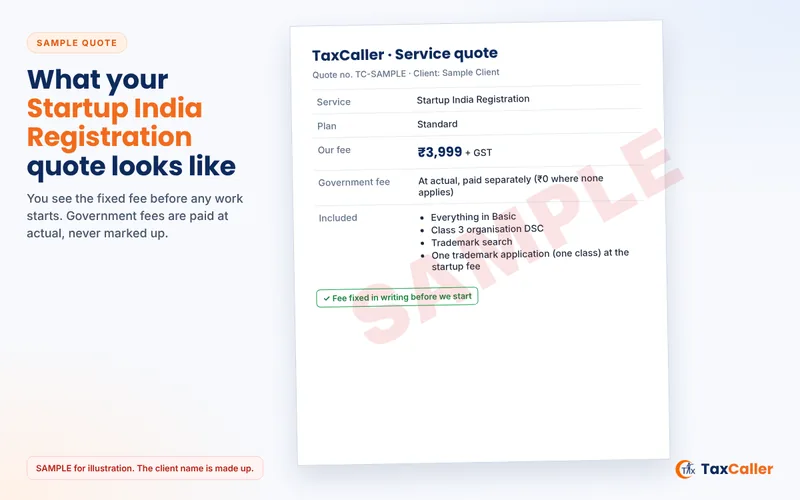
Startup India Registration: SAMPLE quote, for illustration only
Patents and trademarks are often a startup's main assets. Recognised startups pay lower official fees and can ask for faster examination.
Filing
Startup or individual fee
Fee for other entities
Trademark application (TM-A), e-filing, per class
₹4,500
₹9,000
Trademark expedited examination (TM-M)
₹20,000
₹40,000
Patent application (Form 1), e-filing
₹1,600
₹8,000
Patent request for examination (Form 18), e-filing
₹4,000
₹20,000
Expedited patent examination: startups can request it under Rule 24C of the Patents Rules, 2003, which can cut years off the wait.
Facilitator support: the startup IP protection scheme lists facilitators whose professional fees for patents, designs and trademarks are paid by the government, within set limits.
Proof: attach the DPIIT certificate when you claim the startup fee. The definitions are in Rule 2 of the Trade Marks Rules and the Patents Rules.
Funding Support: Fund of Funds, CGSS Credit Cover and Seed Grants
Fund of Funds for Startups (FFS): the government does not invest directly. It commits capital to SEBI-registered Alternative Investment Funds, which then invest in startups through equity and equity-linked instruments.
New Fund of Funds: the Union Budget 2025-26 announced a new Fund of Funds with ₹10,000 crore to widen support, as reported in the PIB release on Budget 2025-26 measures.
CGSS credit cover: the government's credit scheme for startups (CGSS) backs collateral-free loans, working capital and venture debt from lenders. Budget 2025-26 announced that the cover would double from ₹10 crore to ₹20 crore per startup.
Startup India Seed Fund Scheme: early-stage grants and debt are given through selected incubators, for proof of concept, prototypes and market entry.
Angel funds: SEBI-registered angel funds can invest in recognised startups that meet SEBI's conditions.
Recognition does not mean funding. Investors still judge the team, product and numbers. What recognition does is make you eligible for these channels and many state schemes.
Startup India Registration: documents to keep ready
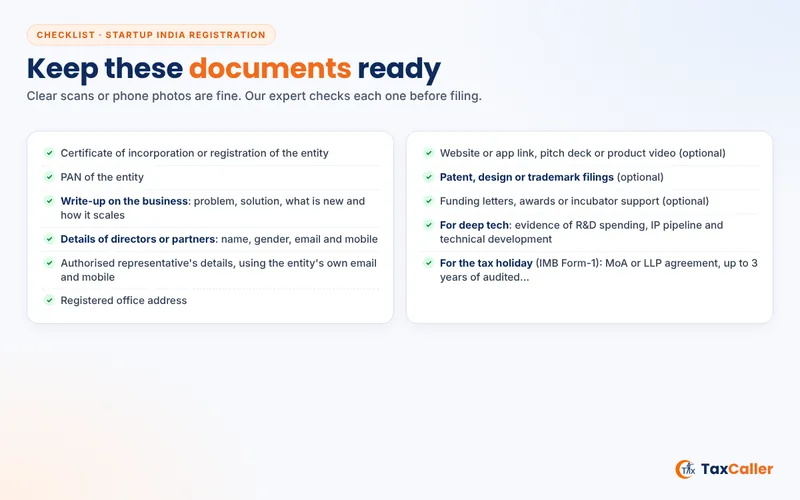
The notification asks for two core items: the incorporation or registration certificate, and a write-up showing innovation or scalability. The portal form asks for supporting details as well. Keep these ready.
Document or detail
Why it is needed
Certificate of incorporation or registration
Proves entity type and date
PAN of the entity
Identity and tax link
Write-up on the business (problem, solution, innovation, scalability)
Main basis of DPIIT's decision
Details of directors or partners (name, gender, contact)
Portal profile and women-led status
Authorised representative details with email and mobile
Official contact for DPIIT
Registered office address
Location and state
Website, app link, pitch deck or product video (if any)
Supports the innovation claim
Patent, design or trademark filings (if any)
Strengthens the application
Funding letters, awards or incubator support (if any)
Optional evidence of traction
Deep tech evidence: R&D spend, IP pipeline, technical notes
Needed only for the deep tech category
Use the entity's own email and mobile number. The Startup India portal asks founders not to hand these to agents.
Government Fee for DPIIT Recognition and Related Costs
DPIIT charges no fee for the recognition certificate or for the certificate of eligibility from the IMB. This is stated on the official Startup India recognition page. Be careful with anyone who presents a payment as a government fee for recognition.
Item
Government charge
Source
DPIIT recognition certificate
Nil
Startup India recognition page
IMB certificate for section 80-IAC or section 140
Nil
Startup India recognition page
Trademark filing after recognition
₹4,500 per class (e-filing)
IP India fee schedule
Digital signature for the entity (if needed)
Charged by the certifying authority
Market rate
Costs you may face around recognition are for incorporation, DSCs, trademark or patent filings and audits. Each of these is separate from recognition itself.
TaxCaller's fee pays for our work: eligibility review, write-up drafting, filing, query replies and follow-up. TaxCaller's fee starts at ₹1,999 + GST for DPIIT recognition. Government fees, such as trademark or patent fees and any DSC charge, are paid separately at actual.
Written quote first: you see the full fee before we start.
Plans: Basic covers recognition. Standard adds an organisation DSC and a trademark application. Premium adds the IMB application for the tax holiday.
No success fee: we do not charge a share of tax saved or funds raised.
Re-filing: if DPIIT rejects an application we drafted, our expert reviews the reasons and confirms the re-filing terms on the call.
Deduction under section 80-IAC or section 140 can be withdrawn, with tax and interest
Income-tax law
Accounts not audited or report not filed on time
Tax holiday not allowed for that year
Section 140(8), Income-tax Act, 2025
Turnover crosses ₹200 crore (or ₹300 crore for deep tech)
Startup status ends automatically
Explanation to para 1(a)
False declaration in Form-1
Rejection, revocation and possible action under other laws
Form-1 declaration
There is also a benefit on the penalty side. Under section 446B of the Companies Act, 2013, a startup company pays at most half of certain penalties, with caps of ₹2 lakh for the company and ₹1 lakh for an officer. This relief does not cover additional fees for late filing.
1. New startup definition: G.S.R. 108(E), 4 February 2026
DPIIT replaced the 2019 notification. The new text keeps the 10-year age limit and doubles the turnover limit from ₹100 crore to ₹200 crore. It adds multi-state and state cooperative societies as eligible entities, creates a deep tech category with 20 years and ₹300 crore limits, adds rules on use of funds and restricted investments, and allows revocation of IMB certificates obtained on false information.
2. Income-tax Act, 2025 from 1 April 2026
The startup tax holiday moved from section 80-IAC of the 1961 Act to section 140 of the 2025 Act for tax year 2026-27 onwards. The incorporation window still ends on 31 March 2030, and the ₹100 crore turnover cap and IMB certificate remain.
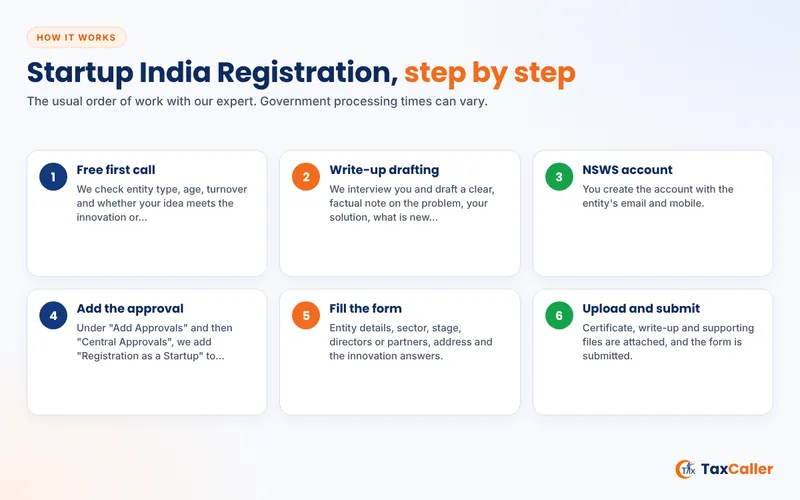
3. Applications through the National Single Window System
The Startup India portal now routes new recognition applications through NSWS under "Central Approvals". The steps are listed on the Startup India recognition page.
4. Updated benefits playbook
Startup India published a benefits playbook for recognised startups in April 2026. It lists tax, IPR, procurement, Companies Act and funding benefits under the current laws.
5. Labour codes in force
The four labour codes took effect on 21 November 2025. Startups that hire in 2026 should plan wages, PF and ESI under the new codes and the rules that apply in their state.
Zubair Licence & Registration Expert
Have a question on this topic? Ask Zubair on a free call.
Startup Recognition in Ghaziabad, Delhi NCR and State Policies
DPIIT recognition is central, so the process is the same across India. Many states add their own startup policies on top, with benefits such as rent support, patent cost reimbursement or seed grants. Most of them ask for DPIIT recognition as a starting point.
Uttar Pradesh: startups in Ghaziabad, Noida and Lucknow can check the state's startup policy for incubator and incentive support.
Delhi and Haryana: founders in Delhi and Gurugram often combine DPIIT recognition with incubator programmes run by universities and industry bodies.
Other states: Karnataka, Maharashtra, Gujarat, Kerala and Telangana run active state startup missions with their own portals.
We file DPIIT applications online for founders in every state from our Ghaziabad office. Your state's rules for professional tax and the Shop Act still apply after recognition.
Certificate of incorporation or registration of the entity
PAN of the entity
Write-up on the business: problem, solution, what is new and how it scales
Details of directors or partners: name, gender, email and mobile
Authorised representative's details, using the entity's own email and mobile
Registered office address
Website or app link, pitch deck or product video (optional)
Patent, design or trademark filings (optional)
Funding letters, awards or incubator support (optional)
For deep tech: evidence of R&D spending, IP pipeline and technical development
For the tax holiday (IMB Form-1): MoA or LLP agreement, up to 3 years of audited accounts, and evidence of innovation and jobs
Why TaxCaller
Real experts, not a call centre
Your work is handled by experienced professionals who explain every step, check your documents and keep you updated.
Registered company
TaxCaller is run by TaxCaller India LLP (LLPIN AAQ-7388), serving clients since 2018.
Fee told upfront
You know the complete fee, our professional fee and the government fee, before any work starts. No hidden charges.
Support after the work
Notices, renewals, returns and compliance reminders: we stay with your business after the registration is done.
Reviewed By
Expert for this topic Startup India Registration
Abhinay Rai
Advocate
Abhinay Rai is a Advocate specialising in Startup India Registration. The process, documents, timelines and fees on this page are checked against the current rules and government portals, and updated whenever the law, forms or fees change.
Startup India Registration: your questions answered
What is Startup India registration?
Startup India registration means getting recognised as a startup by DPIIT under notification G.S.R. 108(E) of 4 February 2026. An eligible company, LLP, registered firm or cooperative applies online. The recognition certificate lets you apply for tax, IPR, funding and procurement benefits. It does not create a company, so incorporation must come first.
Who is eligible for DPIIT startup recognition in 2026?
A private limited company, LLP, registered partnership firm or cooperative society can apply if it is under 10 years old, its turnover has never crossed ₹200 crore in a year, and it works on innovation or a scalable model. Deep tech startups get 20 years and ₹300 crore. Businesses formed by splitting an existing one are excluded.
Is there a government fee for Startup India registration?
No. DPIIT charges no fee for the recognition certificate or for the certificate of eligibility for the tax holiday. The official Startup India page warns that DPIIT has not appointed any agents for certificates. A consultant's fee, if you use one, is for drafting and filing work, not a government charge.
Can a sole proprietorship get Startup India recognition?
No. The 2026 notification lists only private limited companies, registered partnership firms, LLPs and cooperative societies. A proprietor must first convert the business into one of these forms. If you plan to claim the tax holiday later, choose a private limited company or LLP, because only those two can get the IMB certificate.
Does DPIIT recognition give the 80-IAC tax exemption automatically?
No. Recognition is the first step only. A recognised company or LLP must apply separately to the Inter-Ministerial Board in Form-1 and get a certificate of eligible business. It must be incorporated before 1 April 2030, keep turnover within ₹100 crore in the claim year, and get its accounts audited before claiming the deduction.
What is the new section for the startup tax holiday under the 2025 Act?
From tax year 2026-27, the startup tax holiday is in section 140 of the Income-tax Act, 2025. It replaces section 80-IAC of the 1961 Act, which still applies to financial year 2025-26 and earlier. The benefit stays the same: a 100% profit deduction for any three consecutive years out of the first ten.
Is angel tax still applicable to startups?
No. The Finance (No. 2) Act, 2024 removed the charge under section 56(2)(viib) for all investors, and the Income Tax Department confirms it does not apply from assessment year 2025-26. The 2026 DPIIT notification has no exemption process. Founders should still follow Companies Act and FEMA pricing rules for share issues, and keep a valuation report for investors and records.
How long does Startup India registration take?
Preparing the write-up and filing usually takes 2 to 4 working days. DPIIT then reviews the application, which often takes 2 to 4 weeks. It can take longer if DPIIT asks for clarification or more documents. The separate IMB certificate for the tax holiday is a longer process and can take several months.
What documents are needed for DPIIT recognition?
You need the certificate of incorporation or registration and a write-up explaining how your business is innovative or scalable. The portal also asks for the entity's PAN, address, director or partner details and an authorised representative's contact. A pitch deck, website, patents or funding letters are optional but help. Deep tech applicants submit extra R&D evidence.
How long is DPIIT recognition valid?
Recognition lasts up to 10 years from the date of incorporation or registration, or 20 years for a recognised deep tech startup. It ends earlier if turnover crosses ₹200 crore, or ₹300 crore for deep tech, in any financial year. There is no renewal fee, but keep your portal profile and filings up to date.
What trademark and patent fee benefits do startups get?
A recognised startup pays ₹4,500 per class to e-file a trademark instead of ₹9,000, and ₹20,000 instead of ₹40,000 for expedited examination. For patents, it pays the lower fee scale, such as ₹1,600 instead of ₹8,000 for e-filing an application, and can request expedited examination under Rule 24C of the Patents Rules.
What is self-certification for startups under labour laws?
Recognised startups can declare their own compliance under specified labour and environment laws through the self-certification feature on the Startup India portal. The April 2026 Startup India playbook lists this among startup benefits. Self-certification does not waive any duty. Wages, PF, ESI and safety rules still apply to every employee.
Can an existing business that is over 10 years old apply?
No. An entity older than 10 years from incorporation cannot be recognised as a startup, unless it qualifies as a deep tech startup, which has a 20-year limit. Forming a new company to take over the old business does not help either, because entities formed by splitting up or reconstruction are excluded by the notification.
Can DPIIT cancel a startup's tax holiday certificate?
Yes. Para 6 of notification G.S.R. 108(E) lets the Inter-Ministerial Board revoke a tax holiday certificate obtained on false information. A revoked certificate is treated as never issued, so any deduction claimed on it can be withdrawn with tax and interest. Truthful, documented answers in Form-1 protect you from this risk.