Srishti Magoo
Excellent experience with TaxCaller for filing my & my family members ITR returns. The entire process was smooth, quick and hassle-free. They are professional, knowledgeable and guided me through every step with patience.
Get your factory license, plan approval and renewals filed online by a compliance expert who checks your state's current OSH Code rules first.
Content updated 15 Nov 2026
Get your Factory Licence
50+ onlineHow we work
Online · Call · WhatsApp
Quick answer
A factory license is the state's permission to run a manufacturing unit with 20 or more workers using power, or 40 or more without power. Since 21 November 2025 it is issued under the OSH Code, 2020, which replaced the Factories Act, 1948. You need plan approval first, then apply online on your state portal.
A unit whose building already has plan approval and needs the licence
₹6,999 + GST
+ Govt. fees at actual
Fee confirmed in writing before you pay
What you'll get
Most Popular
New units that are building or extending a factory shed
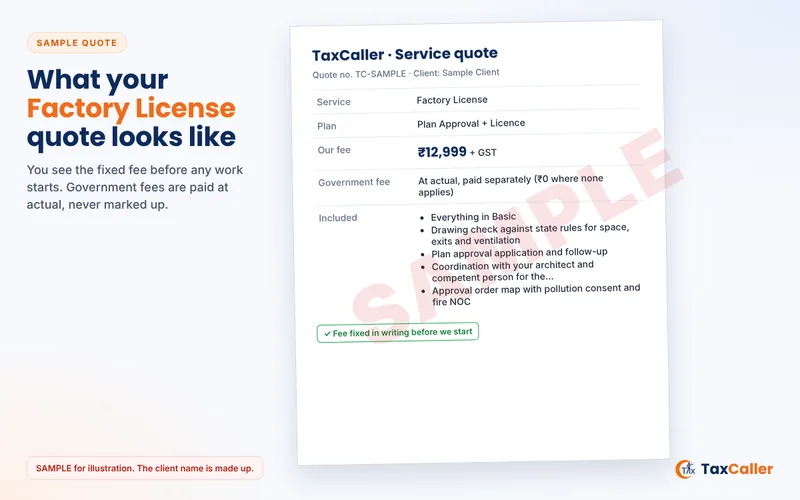
₹12,999 + GST
+ Govt. fees at actual
Fee confirmed in writing before you pay
What you'll get
Manufacturers who want the licence and first-year labour compliance planned together
₹21,999 + GST
+ Govt. fees at actual
Fee confirmed in writing before you pay
What you'll get
Government fees and taxes are extra where applicable. Our expert confirms the final amount on the first call. No hidden charges.
A factory license is the permission a manufacturing unit needs from the state before it starts production. Since 21 November 2025, it is granted under the Occupational Safety, Health and Working Conditions Code, 2020, and not under the Factories Act, 1948. The worker limits doubled, the forms are moving to new state rules, and penalties went up.
Yet most guides still describe the old Act. This page explains both: what the law says today, and how old licences, old forms and old fee tables still apply during the changeover. It covers plan approval, the stability certificate, documents, online filing on state portals such as Nivesh Mitra in Uttar Pradesh, fees, validity, renewal, annual returns, penalties, and how pollution consent and fire NOC fit in.
TaxCaller has handled registrations and compliance since 2018, from our office in Ghaziabad and online across India. Tell us your state, workers and installed power, and our expert will map every approval your unit needs.
Complete guide
Choose a topic to open it. Every answer gives the rule or section it comes from.
01 Topic 1 of 19
A factory license is the state's written permission to run a manufacturing unit at a named place, with a set number of workers and a set amount of installed power. The state factories directorate issues it. In many states this office is called the Directorate of Industrial Safety and Health, or the Department of Factories and Boilers.
For 77 years the licence came from Section 6 of the Factories Act, 1948. That changed on 21 November 2025. On that date the four Labour Codes came into force, as the Labour Ministry release of 21 November 2025 confirms. The Factories Act is one of the thirteen laws repealed by Section 143 of the Occupational Safety, Health and Working Conditions Code, 2020 (the OSH Code).
So the old name stays in daily use. People still say "factory licence", "factory act license" or "factory license registration". The legal base is now the OSH Code and the state rules made under it. Where a state has not yet notified final rules, its old Factories Rules still run the forms and fees. The Labour Ministry's FAQs say old rules stay in force until new rules are notified.
The licence is held by the occupier. That is the person with final control over the factory's affairs. In a company, a director is named as the occupier. The licence is tied to one address. A second plant needs its own licence.
Next: What Counts as a Factory: Old Act vs OSH Code Thresholds →
02 Topic 2 of 19
A place is a factory under the OSH Code if a manufacturing process runs there and the worker count crosses a limit. The limits doubled from the Factories Act.
| Test | Factories Act, 1948 (Section 2(m)) | OSH Code, 2020 (Section 2(1)(w)) |
|---|---|---|
| Manufacturing with the aid of power | 10 or more workers | 20 or more workers |
| Manufacturing without power | 20 or more workers | 40 or more workers |
| Counting period | Any day of the preceding 12 months | Any day of the preceding 12 months |
| Status today | Repealed from 21 November 2025 | In force |
The text of Section 2(1)(w) says "twenty or more workers are working, or were working on any day of the preceding twelve months" where power is used, and forty or more where it is not. You can read it in the OSH Code, 2020 (India Code).
The test looks at any single day in the last twelve months. A unit with 15 workers most of the year and 22 on one festive-season day is a factory, if it uses power.
Section 81 lets the state apply the factory provisions to any place where a manufacturing process runs, whatever the headcount. States use this for risky trades. Hazardous processes listed in the First Schedule, such as foundries and metal smelting, also face extra rules under the Code.
The definition leaves out mobile units of the armed forces, railway running sheds, and hotels, restaurants and eating places. Mines are dealt with under their own provisions of the Code.
Zubair Licence & Registration Expert
Have a question on this topic? Ask Zubair on a free call.
← Previous Next: Who Needs a Licence and Who Only Needs Registration →
03 Topic 3 of 19
Crossing the factory limit means you need a factory licence. Staying below it does not mean you need nothing. The OSH Code also covers smaller "establishments", and those need registration under Section 3.
| Your unit | Factory licence? | What you still need |
|---|---|---|
| Uses power, 20 or more workers on any day in 12 months | Yes | Plan approval, licence, registers, annual return |
| No power, 40 or more workers | Yes | Same as above |
| Uses power, 10 to 19 workers | No, unless the state notifies it under Section 81 | Registration as an establishment under Section 3, plus state shop or labour registration if your state asks for it |
| Below 10 workers, no hazardous process | No | Usually no OSH registration; check trade licence, pollution consent and fire rules |
| Hazardous process listed in the First Schedule | Check with us at any size | Site appraisal under Section 83 and stricter plan review |
Ravi plans a plastic moulding unit in an industrial area of Ghaziabad. He will run four moulding machines and employ 25 workers. Here is how we would plan his approvals:
Had Ravi kept 18 workers, he would not need a factory licence. He would still need Section 3 registration and ESI. That is why the worker count you plan for matters more than any other number.
Yes, if the unit crosses the limit. Udyam registration does not replace a factory licence. The test is workers and power, not turnover or investment.
← Previous Next: Factory Licence vs Registration, Trade Licence and MCD Licence →
04 Topic 4 of 19
Four different papers are often confused. They come from different laws and different offices.
| Paper | Law | Issued by | Who needs it |
|---|---|---|---|
| Factory licence | OSH Code, Section 79 and Section 119, with state rules | State factories directorate | Units that are factories under Section 2(1)(w) |
| Registration of establishment | OSH Code, Section 3 | Registering officer of the appropriate government | Establishments covered by the Code, including smaller units |
| Municipal trade or factory licence | State municipal law | Municipal corporation or local body | Units that run listed trades or industries in the city |
| Udyam certificate | MSMED Act, 2006 | Ministry of MSME | MSMEs that want the benefits; voluntary |
Delhi is the clearest case. The Delhi Labour Department issues the factory licence under the factory law. The Municipal Corporation of Delhi (MCD) separately licenses factories under Sections 416 and 417 of the Delhi Municipal Corporation Act, 1957. The MCD factory licence portal says all applicants must apply for the MCD factory licence through that portal only. It also says:
In July 2025, as widely reported, MCD stopped asking for a separate factory licence from units in industrial areas notified by the Delhi government or set up by DSIIDC. The allotment letter or lease deed, or the Udyam certificate for MSMEs, acts as a deemed licence. A fee of 5% of annual property tax is paid with the property tax. This is a municipal change. It does not replace the Labour Department licence for units above the factory limit.
Outside Delhi, most cities issue a trade license for industrial trades. It deals with nuisance, health and zoning. It does not replace the factory licence.
← Previous Next: Plan Approval and Stability Certificate Before You Build →
05 Topic 5 of 19
Plan approval is the first step for a new factory, and it comes before construction or extension. Section 79(1) of the OSH Code lets the state make rules on submitting plans, permission for the site, and permission to build or extend.
Section 79(2) says that if no order is sent within the period set by the rules, up to thirty days, the permission is treated as granted. Section 79(3) gives a right of appeal within thirty days if the site or licence is refused.
Replacing or adding machinery is not an "extension" if it does not cut the minimum clear working space or worsen environmental conditions. That is the Explanation to Section 79. So swapping an old machine for a similar new one does not need fresh plan approval in that case.
Before the licence is granted, most states ask for a stability certificate for the building. A competent person recognised by the state signs it after checking the structure and its load. Most state portals ask for it with the licence application. If you add floors, heavy machines or new sheds, expect a fresh certificate.
For a hazardous process, Section 83 gives a site appraisal committee the job of recommending on the first location or expansion of the factory, within thirty days. Plan review is stricter and takes longer.
Our tip: get the architect, the competent person and the factory consultant talking before the drawings are frozen. Most plan queries come from exits, aisle widths and toilets that were not planned for the real worker count.
Abhinay Rai Licence & Registration Expert
Have a question on this topic? Ask Abhinay on a free call.
06 Topic 6 of 19

Keep these documents ready. States ask for slightly different lists, so we send you your state's exact list on the first call.
Scan every document as a clear PDF. The Delhi Labour Department's factory licence FAQ, for example, asks for the existing building plan under Rule 3A of the Delhi Factories Rules, 1950, along with the process flow chart, raw material list and machinery list.
← Previous Next: How to Apply for a Factory License Online: Step by Step →
07 Topic 7 of 19

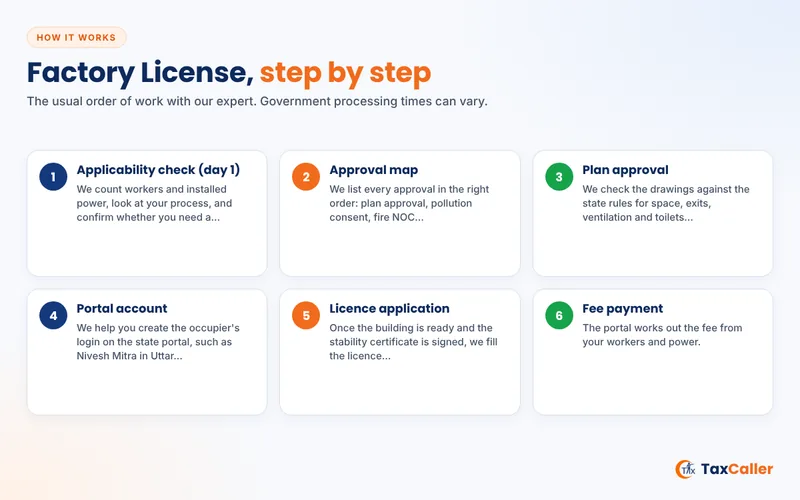
You apply online on your state's labour or single window portal. Here is how TaxCaller handles it, from first call to licence.
Section 119 of the OSH Code allows one common licence covering a factory, contract labour and certain industrial premises. It is applied for electronically. If the authority does not issue it within forty-five days, Section 119(4) says it is treated as issued and auto generated. States are bringing this into their portals at different speeds.
You sign as occupier, approve the form and pay the state fee. We prepare, check, file and follow up. Nothing is submitted until you have seen it. You can also look up approvals for your state on the National Single Window System.
← Previous Next: State Portals: Uttar Pradesh, Delhi, Haryana and Others →
08 Topic 8 of 19
The factory licence is a state process, so the portal depends on where your unit is. Under the OSH Code, the state is the appropriate government for most factories.
UP's industrial approvals run through Nivesh Mitra, the state's online single window, along with the UP Labour Department portal. The usual flow is:
Nivesh Mitra's own reform page says UP extended factory licence validity up to 10 years. UP notified its final Occupational Safety, Health and Working Conditions Rules on 27 August 2026 (Notification No. 962/XXXVI-03-2026-1903305, as reported in legal updates). Forms and screens are moving to the new rules, so we check the live portal before every filing.
The Labour Department's factory licence is applied for on the e-District Delhi portal, as the department's FAQ explains. You may choose a licence for one, five or ten years. The MCD municipal licence is separate and goes through the MCD portal.
Haryana's Labour Department handles factory plan approval and licences. As in most states, expect to give the approved plan and a stability certificate. Haryana also runs a self-certification scheme for some units.
Applications go through the Telangana Factories Department portal. The portal offers online plan approval, licence grant, amendment and transfer, and payment of licence fees for up to 10 years. New units can also use the state's TG-iPASS single window.
Maharashtra routes many industrial approvals through its MAITRI single window. Madhya Pradesh and other states run labour services on their own portals. Forms are still named under the old Factories Rules in states that have not notified final OSH rules.
Shadab Licence & Registration Expert
Have a question on this topic? Ask Shadab on a free call.
← Previous Next: Factory License Fees: Government Fee and Our Fee, Clarified →
09 Topic 9 of 19

There are two separate costs. The government fee goes to the state. Our professional fee covers the work we do. They are never mixed.
Every state charges a licence fee based on two things: installed power (horsepower or kilowatts) and the maximum number of workers on any day of the year. Plan approval may carry its own scrutiny fee. As an official example, here is part of the Delhi Labour Department fee schedule for a one-year factory licence, in force since 1 January 2001 and used for grant and renewal:
| Installed power | Up to 20 workers | 21 to 50 | 51 to 100 | 101 to 250 | Above 1,000 |
|---|---|---|---|---|---|
| Nil | ₹100 | ₹200 | ₹400 | ₹1,000 | ₹5,000 |
| Up to 10 HP | ₹200 | ₹400 | ₹480 | ₹1,200 | ₹6,000 |
| Above 10 to 50 HP | ₹400 | ₹600 | ₹800 | ₹2,000 | ₹10,000 |
| Above 50 to 100 HP | ₹800 | ₹1,000 | ₹1,200 | ₹3,000 | ₹15,000 |
| Above 100 HP | ₹1,200 | ₹1,600 | ₹2,000 | ₹4,000 | ₹20,000 |
The full Delhi table also has bands for 251 to 500, 501 to 750 and 751 to 1,000 workers. Other states set their own amounts. If you choose a longer licence period, the portal shows the fee for the full period. The portal calculates the exact fee before you pay, and we show it to you first.
TaxCaller's fee starts at ₹6,999 + GST for a factory licence application in one state. Government fees, such as the licence fee, scrutiny fee and consent fees, are paid separately at actual. The plans below show what each level covers. You see the full quote before we start.
10 Topic 10 of 19
A clean application usually takes a few weeks from plan approval to licence. The real time depends on your state, your building and how fast queries are answered.
| Stage | Time limit in law or usual time | Source |
|---|---|---|
| Applicability check and document list | 1 to 2 working days | TaxCaller's own work |
| Plan approval | Deemed granted if no order within the period in the rules, which can be up to 30 days | OSH Code, Section 79(2) |
| Common licence | Deemed issued if not issued within 45 days | OSH Code, Section 119(4) |
| Registration of establishment | Apply within 60 days of the Code applying to you | OSH Code, Section 3(1) |
| Appeal against refusal | Within 30 days | OSH Code, Sections 79(3) and 119(6) |
State rules set their own timelines within these limits. Some states, such as Haryana, also run self-certification schemes that reduce inspections for eligible units.
Do not start production on the strength of a pending application unless the state's rules treat it as deemed granted. If in doubt, ask us on the first call.
11 Topic 11 of 19
Validity depends on your state and on the period you choose and pay for. Some states issue licences for one year at a time. Others allow up to ten years.
| State | Validity | Source |
|---|---|---|
| Uttar Pradesh | Up to 10 years | Nivesh Mitra reform page (official) |
| Delhi (Labour Department) | One, five or ten years | Delhi Labour Department factory FAQ (official) |
| Delhi (MCD municipal licence) | Up to 31 March of the financial year; late renewal penalty after 30 April | MCD factory licence portal (official) |
| Telangana | Licence fees can be paid online for up to 10 years | Telangana Factories Department portal (official) |
| Other states | Set by state rules; often yearly or in blocks of years | State rules |
Section 119(5) of the OSH Code treats licences obtained under the earlier central labour laws as obtained under the Code. They stay valid for their original period. After that, you renew under the Code and the state's new rules. So a licence that runs to December 2027 stays good till then.
Changes in the occupier, manager, name, workers or power above the licensed level need an amendment. Do not wait for renewal. Running above your licensed workers or power can lead to penalties, so amend first.
Shreya Licence & Registration Expert
Have a question on this topic? Ask Shreya on a free call.
← Previous Next: Annual Returns, Registers and Notices After the Licence →
12 Topic 12 of 19
The licence is the start. Running a factory brings records, returns and notices every year.
Section 33 asks every employer to keep registers in the prescribed form, electronically or otherwise. It also asks for wage slips to workers, electronically or otherwise. States set the actual registers: workers, attendance, wages, overtime, leave, accidents and so on.
Section 133(2)(v) lets the government make rules on returns and the periods for filing them. Each state's rules set the form and the due date, so we confirm both for your state. Section 33 asks for returns to be filed with the Inspector-cum-Facilitator, and new rules are moving this filing online.
| When | Task |
|---|---|
| Every month | Wage slips, attendance and overtime registers |
| On any accident | Report as per state rules |
| By the state's due date | Annual return on the state portal |
| Before expiry | Licence renewal, consent renewal, fire NOC renewal |
| On any change | Licence amendment and portal update |
Section 96 sets a penalty of ₹50,000 to ₹1 lakh for not keeping registers or not filing returns.
← Previous Next: Safety Officer, Welfare Officer and Other Duties by Size →
13 Topic 13 of 19
As your workforce grows, the OSH Code adds staff and facilities you must provide. Here are the thresholds from the Code itself.
| Requirement | When it applies | Section |
|---|---|---|
| First-aid boxes or cupboards | Every establishment | 24(1)(vii) |
| Creche | More than 50 workers | 24(3) |
| Canteen | 100 or more workers, counting contract labour | 24(1)(v) |
| Welfare officer | 250 or more workers in a factory | 24(2)(iv) |
| Safety officers | 500 or more workers; 250 or more if a hazardous process is carried on | 22(2) |
| Safety committee | Set by rules; the Labour Ministry says 500 or more workers | 22(1) |
| Ambulance room | More than 500 workers | 24(2)(i) |
Section 43 lets women work before 6 a.m. and after 7 p.m. with their consent, subject to safety, holiday and working-hour conditions set by the government. The employer must arrange safe transport and other conditions under state rules.
The licence application asks for your expected maximum workforce. Plan facilities for that number, not today's headcount.
14 Topic 14 of 19
Penalties under the OSH Code are higher than under the Factories Act. The old Act's Section 92 allowed up to two years' prison, a fine up to ₹1 lakh, or both. Here is the new scale.
| Section | Default | Penalty |
|---|---|---|
| 94 | General contravention by the employer, where no other penalty is set | ₹2 lakh to ₹3 lakh, plus up to ₹2,000 a day if it continues after conviction |
| 96 | Not keeping registers or records, or not filing returns | ₹50,000 to ₹1 lakh; repeat: ₹50,000 to ₹2 lakh |
| 97 | Contravening certain provisions, rules or orders | ₹50,000 to ₹1 lakh; repeat: up to 3 months' prison, fine up to ₹2 lakh, or both |
| 99 | Not furnishing plans, returns, notices or records without reasonable excuse | ₹1 lakh to ₹2 lakh |
| 102 | Breach of duties on hazardous processes | Up to 2 years' prison and fine up to ₹5 lakh; up to ₹25,000 a day if continued |
| 103 | Safety breach causing death | Up to 2 years' prison, fine of at least ₹5 lakh, or both |
| 103 | Safety breach causing serious bodily injury | Up to 1 year's prison, fine of ₹2 lakh to ₹4 lakh, or both |
Section 110 gives the employer an opportunity to comply within 30 days before prosecution starts. This does not apply to accidents, or to the same violation repeated within three years. Courts take cognizance only on a complaint filed within six months of the inspector learning of the offence.
Section 114 allows many offences to be settled by paying an amount. For a penalty, it is 50% of the maximum. For an offence with a fine, it is 75% of the maximum fine. Compounding is not available for a repeat within three years.
Under Section 109, persons in charge of a company's business can be proceeded against, unless they show they did not know or used due diligence. The occupier is the first person the inspector looks at.
Zubair Licence & Registration Expert
Have a question on this topic? Ask Zubair on a free call.
← Previous Next: Pollution Consent, Fire NOC and Other Approvals Alongside →
15 Topic 15 of 19
A factory licence is rarely the only approval. Most units also need pollution consent and fire approval, and the factories office often asks for them.
Section 25 of the Water (Prevention and Control of Pollution) Act, 1974 and Section 21 of the Air (Prevention and Control of Pollution) Act, 1981 need the State Pollution Control Board's consent for many industries. There are two stages:
Industries are grouped as red, orange, green or white by pollution potential. White category units generally do not need consent, but they may need to inform the board. Red and orange units face longer review.
The state fire service issues fire approval based on building height, area and the materials stored. A unit storing solvents, plastics or gas cylinders usually needs it. Read our fire NOC guide for the process. In Delhi, the MCD portal says fire NOC is not needed for its household category, or for units on land under 250 square metres.
| Stage | Approval |
|---|---|
| Before construction | Plan approval, CTE, building permission, fire approval of plans where needed |
| Before production | Stability certificate, CTO, fire NOC, factory licence |
| As headcount grows | Section 3 registration from 10 workers, PF and ESI where limits are met |
| Ongoing | Renewals, annual return, registers |
16 Topic 16 of 19
These are the problems we see most often. Each one can delay the licence by weeks.
Fee paid on the Delhi portal is not refunded, as the Labour Department's FAQ says. So a rejected file can mean paying twice. A check before filing saves money.
← Previous Next: What Changed for Factory Licences in 2025 and 2026 →
17 Topic 17 of 19
The biggest change in decades came in November 2025. These are the changes we could confirm. Check your state's portal for anything newer.
The four Labour Codes took effect on 21 November 2025, as the Labour Ministry release of 21 November 2025 says. The release promises one registration, one licence and one return for safety and working conditions. It also says existing provisions, rules and notifications continue during the transition.
The factory definition moved from 10 to 20 workers with power, and from 20 to 40 without power, under Section 2(1)(w).
The Labour Ministry FAQs on the Labour Codes say old rules stay in force until final new rules are notified under the Code. So in states without final rules, the old Factories Rules forms and fees still apply.
The Occupational Safety, Health and Working Conditions (Central) Rules, 2026 were notified on 8 May 2026, as legal updates report. They set a single electronic registration on the Shram Suvidha portal for establishments where the central government is the appropriate government. Factories in the state sphere follow state rules.
By October 2026, legal updates reported final OSH rules in Andhra Pradesh, Arunachal Pradesh, Bihar, Gujarat, Jammu and Kashmir, Ladakh, Lakshadweep, Rajasthan and Uttar Pradesh. Uttar Pradesh notified its rules on 27 August 2026. Delhi, Haryana and Maharashtra were not on that list, so their old Factories Rules still apply.
Under Section 25(1)(b), the Labour Ministry notified on 13 May 2026 (S.O. 2517(E)) that no worker shall work continuously for more than five hours without a rest interval of at least 30 minutes, as reported in legal updates. It was issued by the central government, so check your state's notification for factories in the state sphere.
Haryana, Maharashtra and Karnataka were reported to exempt establishments registered under the OSH Code from separate Shops and Establishments registration. In Maharashtra and Karnataka this covers units with 10 or more workers.
Units in notified industrial areas and DSIIDC estates no longer need a separate MCD factory licence. They pay 5% of annual property tax as the licence fee, as reported in July 2025. In September 2025 MCD was reported to link this fee to its property tax portal.
Abhinay Rai Licence & Registration Expert
Have a question on this topic? Ask Abhinay on a free call.
← Previous Next: Is a Factory Licence the Right Licence for You? →
18 Topic 18 of 19
A factory licence answers one question: can you run this manufacturing unit, with these workers and this power, at this address? Your business will need other registrations too. Our business licences guide shows the full set. In short:
Starting from scratch? Set up the entity first with company registration, so the licence is in the right name from day one.
19 Topic 19 of 19
TaxCaller has worked on tax and business compliance since 2018. We are based in Ghaziabad, close to the industrial areas of Ghaziabad and Noida, and serve clients online across India.
Contact us to book your free first call. Tell us your state, workers and installed power, and we will tell you the licence you need.
Don't have everything? Send what you have on WhatsApp. Our expert will tell you what's missing.
Send documents on WhatsAppReal experts, not a call centre
Your work is handled by experienced professionals who explain every step, check your documents and keep you updated.
Registered company
TaxCaller is run by TaxCaller India LLP (LLPIN AAQ-7388), serving clients since 2018.
Fee told upfront
You know the complete fee, our professional fee and the government fee, before any work starts. No hidden charges.
Support after the work
Notices, renewals, returns and compliance reminders: we stay with your business after the registration is done.
Expert for this topic Factory License
Abhinay Rai
Advocate
Abhinay Rai is a Advocate specialising in Factory License. The process, documents, timelines and fees on this page are checked against the current rules and government portals, and updated whenever the law, forms or fees change.
A factory licence is the state's permission to run a manufacturing unit at a named address, with a stated number of workers and installed power. It is now issued under the OSH Code, 2020 and state rules, which replaced the Factories Act, 1948 on 21 November 2025. The state factories directorate grants it after plan approval and checks.
Under Section 2(1)(w) of the OSH Code, a unit is a factory if 20 or more workers work there with the aid of power, or 40 or more without power. The count is on any day of the previous twelve months. The old Factories Act limits of 10 and 20 workers no longer apply.
Yes, if the unit crosses the factory limit. Being an MSME or holding a Udyam certificate does not exempt you. The test is workers and power: 20 or more workers with power, or 40 or more without. Smaller MSME units may still need registration as an establishment under Section 3 of the OSH Code.
First get plan approval for the building. Then create an occupier login on your state's labour or single window portal. Fill in workers, power, process and occupier details, upload documents and pay the fee online. Answer queries, attend any inspection and download the licence. TaxCaller can handle these steps for you.
Delhi has two licences. The Labour Department's factory licence is applied for on the e-District Delhi portal, for one, five or ten years. The MCD municipal factory licence is applied for on the MCD portal. Units in notified industrial areas and DSIIDC estates were moved to a deemed MCD licence in July 2025.
Units in Noida, Greater Noida and Ghaziabad apply through Nivesh Mitra, Uttar Pradesh's single window, and the UP Labour Department portal. Get plan approval, pollution consent and fire approval first. Uttar Pradesh notified its final OSH rules on 27 August 2026, so check the current form on the portal before you file.
Yes. Section 119(5) of the OSH Code treats licences granted under the earlier central labour laws as granted under the Code. They stay valid for their original period. When that period ends, you renew under the Code and your state's new rules. Keep your old licence copy and fee receipts safe for inspections.
It depends on the state and the period you pay for. Uttar Pradesh allows up to 10 years. Delhi's Labour Department offers one, five or ten years. Delhi's MCD municipal licence runs to 31 March each year. Other states follow their own rules, so we confirm the period for your state before filing.
The state fee depends on installed power and the maximum workers. In Delhi, a one-year licence ranges from ₹100 for no power and up to 20 workers, to ₹20,000 for above 100 HP and over 1,000 workers. Other states set their own tables. TaxCaller's professional fee is separate, plus GST.
You should not, unless your state's rules treat the licence as deemed granted. Section 119(4) of the OSH Code says a common licence not issued within forty-five days is treated as issued. Keep proof of the date you applied. Running without a licence can attract penalties, such as the general penalty under Section 94.
Yes, in almost every state. Section 79 lets the state require plan approval and site permission before you build or extend a factory. If no order comes within the period in the rules, up to 30 days, permission is deemed granted. Swapping machines without reducing safe space is not an extension.
It is a certificate from a competent person, recognised by the state, saying the factory building is structurally safe for its use and load. Most states ask for it with the licence application. You need a fresh certificate when you add floors, heavy machines or new sheds. Keep a copy at the factory.
The occupier is the person with final control over the factory's affairs. In a company, one of the directors, other than an independent director, must be named as occupier. In a firm, a partner is named. The occupier signs the licence application and answers for compliance under the Code. A manager is named separately.
Under the OSH Code, a general contravention by the employer carries ₹2 lakh to ₹3 lakh under Section 94, plus up to ₹2,000 a day if continued after conviction. Section 110 gives a 30-day chance to comply before prosecution, except for accidents and repeats within three years. Many offences can be compounded under Section 114.
Tell us your state, workers and installed power, and our expert will confirm what you need and file it online. Our fee starts at ₹6,999 + GST, and state fees are paid at actual.
Mon–Fri 9:00 AM – 6:00 PM, Sat 10:00 AM – 4:00 PM · Your trust is our biggest fee.