ISO Certification in India: ISO 9001 and More, Done Right
ISO certification for Indian businesses: we prepare your system and documents, check the certification body's accreditation and support you through every audit.
Starting from · ₹3,999 ISO Certification Basic plan
STARTING FROM₹3,999
FEE TOLD UPFRONTFree first call
!GSTR-3B due?Last date 20 Nov 2026 · 4 days left
Since 2018Trusted Experience
980+Experts Connected
220+Cities Served
1164+Agents Available
12000+Founders Trusted
S
Srishti Magoo
★★★★★
Excellent experience with TaxCaller for filing my &
my family members ITR returns. The entire process was
smooth, quick and hassle-free. They are professional,
knowledgeable and guided me through every step with patience.
O
obeid sait
★★★★★
The team has handled my taxes for the past three years,
and it's been a wonderful, hassle-free experience.
Thank you for your consistently quick and efficient service.
P
Pushkar
★★★★★
They are among the best in their field. Their work culture
is highly professional, and their client service is smooth
and reliable. They can confidently be relied on to get the job done.
P
Prasad Sheth
★★★★★
Excellent experience with TaxCaller! The ITR filing
process was smooth, quick, and completely hassle-free.
The CA was knowledgeable, responsive, and explained everything clearly.
A
Apoorv Bansal
★★★★★
Excellent service for ITR filing. The team was highly
professional, responsive, and guided me through the entire
process smoothly. My return was filed accurately and on time.
A
Abhishek Kumar
★★★★★
I was searching for a good CA firm in Ghaziabad and found
TaxCaller. The experience was excellent from start to finish.
The team is responsive, transparent, and genuinely helpful.
U
uma pandey
★★★★★
Great service! TaxCaller India made the entire ITR filing
process quick, smooth, and hassle-free. They answered all
my queries patiently and ensured maximum accuracy.
T
tanu mittal
★★★★★
Excellent job! We've been connected for many years,
and your success truly makes me happy. You are an
incredibly intelligent person. Keep shining, keep growing.
B
Bhanu Pratap Maurya
★★★★★
I am filing my ITR since past 3 years with Abhinav and
Firm is known as TaxCaller and they are professional
interms of ITR rules. They will explain and tell you all
the information.
A
ashish Sharma
★★★★★
I am providing my honest reviews:
No.1 service ...
A
AARYAN GROUP
★★★★★
Honestly, finding a good CA firm in Ghaziabad was
confusing, but TaxCaller India made it simple.
I contacted them for GST work and the experience was smooth.
N
News Speaks
★★★★★
If you're looking for a reliable CA firm in Ghaziabad,
TaxCaller India is a great choice. They provide complete
taxation and compliance solutions including GST.
A
Anshul Chaprana
★★★★★
Got my GST registration done through TaxCaller CA firm.
Process was quite smooth, they guided properly on documents
and didn't waste time. Overall good experience.
How we work
Online · Call · WhatsApp
Quick answer
ISO certification is an audit-based certificate showing your business follows an ISO standard, such as ISO 9001 for quality. ISO writes the standards; accredited certification bodies audit and certify. There is no government fee. The certificate lasts three years with yearly surveillance audits. TaxCaller's fee starts at ₹3,999 + GST; the audit fee is paid at actual.
Reviewed by Abhinay Rai · Updated 15 Nov 2026
Pick a plan that fits
Basic
A small single-site business that needs ISO 9001 for a buyer or tender
₹3,999+ GST
No govt. fee
Handled by a TaxCaller Expert Licence & Registration Expert
ISO/IEC 27001: risk assessment, Statement of Applicability and control policies
Or one integrated manual and audit plan for two or three standards
Internal audit across all standards
Guidance on ZED certification support for eligible MSMEs
Support through the first surveillance audit
Government fees and taxes are extra where applicable. Our expert confirms the final amount on the first call. No hidden charges.
About ISO Certification
ISO certification tells buyers, tender committees and partners that your business works to an agreed international standard and that an independent auditor has checked it. In India, the most requested ones are ISO 9001 certification for quality, ISO 14001 for environment, ISO 45001 for safety and ISO/IEC 27001 for information security.
This page explains how the system really works: who writes the standards, who audits you, why accreditation by NABCB matters, how to spot a fake certificate, what the audit fee depends on, which government support is live today and what changed in 2026, including ISO 9001:2026 and ISO 14001:2026.
TaxCaller is your consultant, not the certification body. Our experts prepare your documents, train your team, run the internal audit and stay with you through the external audits. You choose an accredited certification body and pay its fee directly, so the audit stays independent.
Complete guide
Choose a topic to open it. Every answer gives the rule or section it comes from.
01 Topic 1 of 20
What Is ISO Certification and How Does It Work in India?
ISO certification is a written confirmation, issued after an audit, that your business runs a management system meeting a published ISO standard. The audit checks how you actually work: how you plan, control, record and improve your processes. It does not test a single product.
Three different bodies are involved, and people often mix them up:
Body
What it does
Who it is in India
ISO (International Organization for Standardization)
Writes and publishes the standards. It does not audit or certify any business.
BIS represents India in ISO.
Certification body (CB)
Audits your business and issues the certificate.
Private and public CBs, Indian and foreign.
Accreditation body
Checks that the CB itself is competent and impartial.
NABCB, a board of the Quality Council of India (QCI). Foreign bodies that are members of the global recognition arrangement also accredit CBs working in India.
ISO says this plainly in its own help note: ISO does not certify companies. So a certificate that says "issued by ISO" or "ISO approved" is a warning sign. A genuine certificate names the CB, its accreditation body, the standard, your scope and your sites.
In short, the process is: you build the system, the CB audits it, and the CB issues a certificate valid for three years, kept alive by yearly audits.
No Indian law makes ISO certification compulsory for businesses in general. It is a voluntary certification. In practice, though, many businesses cannot win work without it. You will usually need it if:
A government department or PSU tender lists ISO 9001 (or 14001 or 45001) as an eligibility condition.
A large customer or OEM puts it in the vendor registration form.
An export buyer asks for it before placing the first order.
An IT, BPO or SaaS client asks you to prove information security (ISO/IEC 27001).
You make medical devices. The Medical Devices Rules, 2017 require a quality management system under the Fifth Schedule, and ISO 13485 certification is the usual way to show it to buyers abroad.
You run a food business supplying to large retailers or exporters, who often ask for ISO 22000 or a similar food safety certificate.
Here is what buyers typically ask for, by type of business:
Type of business
Standards usually asked for
Civil, electrical or facility contractor bidding for government work
ISO 9001, often with 14001 and 45001
Auto, engineering or electronics component supplier
ISO 9001, and the customer's own sector requirements
Software, SaaS, payroll or BPO company
ISO 9001 and ISO/IEC 27001
Food processor, bakery, spice or snack exporter
ISO 22000 along with FSSAI
Medical device maker or trader
ISO 13485
School, coaching institute, hospital or lab
ISO 9001 (labs usually also need separate testing accreditation)
Trader or distributor registering with a large buyer
ISO 9001
Size does not matter. A proprietorship, partnership firm, LLP, company, trust or society can be certified, and so can a one-room service business. What matters is that your activities are real and you can show records of them.
Zubair Licence & Registration Expert
Have a question on this topic? Ask Zubair on a free call.
Main ISO Standards and Which One Fits Your Business
There are thousands of ISO standards, but only some are "management system" standards that a CB can certify. These are the ones Indian businesses ask for most:
Standard
What it covers
Who usually needs it
ISO 9001
Quality management
Almost every business: manufacturers, traders, contractors, schools, IT and service firms, tender bidders
ISO 14001
Environmental management
Factories, chemical and pharma units, construction, waste handlers, exporters to Europe
ISO 45001
Occupational health and safety
Factories, construction, logistics, facility management, mining and power contractors
ISO/IEC 27001
Information security
IT, SaaS, fintech, BPO, data centres, any firm that handles client data
Medical device makers, their component suppliers and service providers
ISO 50001
Energy management
Energy-heavy plants: steel, cement, textiles, large buildings
A closer look at ISO/IEC 27001
The current edition is ISO/IEC 27001:2022. Its Annex A lists 93 controls in four themes: organisational, people, physical and technological. You do not have to apply every control. You assess your information risks, pick the controls that treat them and explain each choice in a Statement of Applicability. The auditor then checks that the chosen controls really work, for example access reviews, backups, supplier checks and incident logs.
ISO 14001 and ISO 45001 in short
ISO 14001 asks you to list the environmental aspects of your work, such as waste, emissions, water and energy, and to control the significant ones. It also checks that you meet environmental laws, like your pollution board consent. ISO 45001 asks you to find workplace hazards, assess risks, involve workers and plan for emergencies. Both expect a register of legal requirements that you review regularly.
ISO 14001, 45001, 27001 and 50001 share the same high-level clause structure as ISO 9001. That is why many businesses run two or three of them as one integrated system with one set of audits. Food businesses still need their FSSAI licence: ISO 22000 does not replace it. See our FSSAI registration page for that part.
ISO 9001 Certification: What the Standard Asks For
ISO 9001 is the most common starting point. The current edition is ISO 9001:2026, published on 16 September 2026, which replaces ISO 9001:2015. Both editions use the same ten-clause layout. Clauses 4 to 10 hold the requirements:
Context (clause 4): your business, its interested parties, the scope of the system and your key processes.
Leadership (clause 5): the owner or top management sets the quality policy and stays involved.
Planning (clause 6): risks, opportunities, quality objectives and planned changes.
Support (clause 7): people, skills, equipment, calibration, records and communication.
Operation (clause 8): how you take orders, design, buy, produce or deliver, and control faulty output.
Improvement (clause 10): corrective action and continual improvement.
ISO 9001 is not only for factories. A consultancy, school, travel agency or IT firm applies the same clauses to its own service: how enquiries become orders, how work is planned and checked, how complaints are handled and how staff are trained. Design and development (clause 8.3) can be left out only when you truly do not design anything, and you must explain why.
The standard does not ask for a thick manual. It asks for documented information where it matters, plus records that prove you follow your own rules. A small business can meet it with a short, practical set of documents.
Accreditation: NABCB, IAF and Why It Decides Your Certificate's Value
Anyone can register a company in India and call it a certification body. No licence is needed to print a certificate. Accreditation is the only objective check. That is the main point of the NABCB guidance on choosing a certification body (BCB 602).
Here is how the chain of trust works:
NABCB (National Accreditation Board for Certification Bodies) works under QCI. It accredits CBs operating in India and lists them in its online directory.
International recognition: NABCB is a signatory to the multilateral recognition arrangements now run by Global Accreditation Cooperation Incorporated (Global ACI). Global ACI took over the work of IAF and ILAC from 1 January 2026. So an accredited Indian certificate is accepted abroad on the same footing as one from other signatory countries.
Foreign accreditation: some CBs in India hold accreditation from a foreign body. This is valid if that body is a signatory, but NABCB notes that foreign bodies rarely inspect Indian franchisees, so oversight is thinner.
NABCB's guidance also says a CB must not provide consultancy to the same client, and that a scope of accreditation is granted by industry sector. So check that the CB is accredited for your sector, not just for ISO 9001 in general. TaxCaller acts as your consultant only. We never issue certificates, and we keep the CB independent.
Certificates sold as "non-audited", "online in one day" or "no visit needed" for a first certification usually come from unaccredited bodies. Many tender committees and foreign buyers reject them.
Abhinay Rai Licence & Registration Expert
Have a question on this topic? Ask Abhinay on a free call.
Before you pay any CB, and before you trust a supplier's certificate, run these checks:
Search the certificate on IAF CertSearch, the global database of accredited certificates, by company name or certificate number.
Look up the CB in the NABCB directory (Directory, then Accredited Bodies, then Management Systems) and confirm the standard and sector are inside its scope.
Check the CB's own website for a certificate verification page.
Match the details: legal name, every site address, scope wording, issue date, expiry date and the edition of the standard.
Look for the accreditation symbol next to the CB's own logo. Under NABCB 010, clause 5.3 (May 2026 revision), NABCB-accredited bodies must use the NABCB Accreditation Symbol on their certificates, with effect from 1 July 2026.
Questions to ask a certification body before you sign
Which accreditation body accredits you, and is my industry sector in your scope?
Will I get a signed certification agreement and a written quote for the full three-year cycle?
Will you send an audit plan and the names of the audit team before each audit? (You may object to an auditor with a conflict of interest.)
Will nonconformities and the audit report be given in writing?
Will my certificate show both your logo and the accreditation symbol, and appear on IAF CertSearch?
These points come straight from the documents NABCB asks clients to insist on. A CB that cannot answer them clearly is not worth the saving.
Red flags: no accreditation body named, an accreditation body you cannot find in the global list, no audit plan or report, a certificate issued without any audit, or a "marketing agent" who does everything while the CB never contacts you. If you doubt a certificate, NABCB accepts complaints and has run validation visits at certified sites.
ISO is about how your business is managed. It is not a licence to trade. Before spending on it, make sure your basic registrations are in place, because a CB will ask for them. Our business licences guide shows which registrations each type of business needs.
BIS (ISI mark) is different: products under a Quality Control Order need BIS product certification. An ISO certificate does not satisfy a QCO.
ZED is different: the MSME Sustainable (ZED) certification is a government scheme for MSMEs. It is independent of ISO and you may hold both.
FSSAI is different: a food licence is a legal must. ISO 22000 is voluntary on top of it.
If a buyer or tender has asked for ISO, or you want a working quality system, ISO is the right step. If you only need a certificate to show, with no system behind it, the surveillance audits will expose that within a year.
Benefits: Tenders, GeM, Exports and Better Control
The real value comes from both the certificate and the system behind it:
Government tenders: many central, state and PSU bids list an ISO certificate as a qualifying condition. Missing it can knock you out at the technical stage.
GeM: registering as a seller on GeM does not need ISO, but buyers can add certification conditions to a bid. A valid accredited certificate keeps you eligible for more bids.
Exports: foreign buyers use accredited certificates to shortlist suppliers they have never visited. Pair it with your IEC registration.
Bigger customers: OEMs, hospitals, banks and IT clients often ask for 9001, 13485 or 27001 in vendor audits.
Fewer mistakes: clear procedures, trained staff and corrective action reduce rework and complaints.
Owner freedom: when processes are written down, work does not stop when one person is absent.
Data protection: ISO/IEC 27001 helps show the reasonable security safeguards that Section 8(5) of the Digital Personal Data Protection Act, 2023 expects from data fiduciaries.
Shadab Licence & Registration Expert
Have a question on this topic? Ask Shadab on a free call.
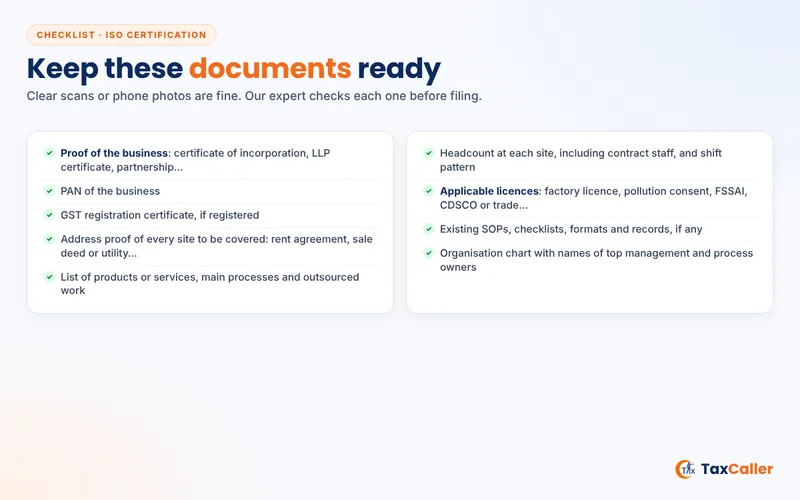
There are two kinds of documents: business records that prove who you are, and system documents that prove how you work. You give us the first set. We draft the second set with you.
Business documents you provide
Proof of the business: certificate of incorporation, LLP certificate, partnership deed, or proprietor's PAN and Udyam certificate
PAN of the business and GST certificate, if registered
Address proof of every site to be covered (rent agreement, sale deed or utility bill)
List of products or services, main processes and any outsourced work
Headcount at each site and shift pattern (the CB uses this to set audit days)
Licences that apply to you: factory licence, pollution consent, FSSAI, CDSCO, trade licence
Existing SOPs, checklists, formats or records, if any
System documents we prepare with you
Scope statement and process map
Policy (quality, environment, safety or security) and measurable objectives
Risk and opportunity register (aspects register for 14001, hazard register for 45001, risk assessment and Statement of Applicability for 27001)
Key procedures and work instructions
Record formats: training, supplier evaluation, calibration, complaints, nonconformity and corrective action
Internal audit report and management review minutes
ISO Certification Process: How TaxCaller Gets You Certified
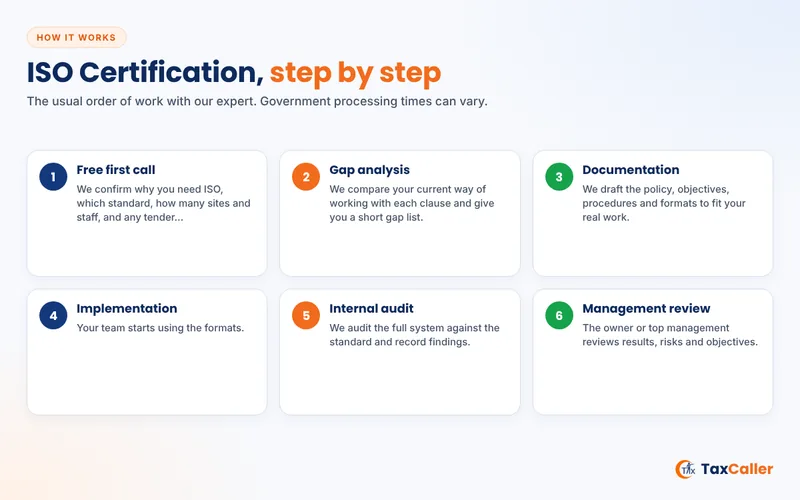
ISO Certification: how the work moves, step by step
We handle the consulting and paperwork online. The CB's audit is done by the CB, on your premises or remotely as it decides. This is the path we follow:
Free first call: we confirm why you need ISO, which standard, how many sites and staff, and any tender deadline.
Gap analysis: we compare your current way of working with each clause and give you a short gap list.
Documentation: we draft the policy, objectives, procedures and formats to fit your real work. No copy-paste manuals.
Implementation: your team starts using the formats. We train key staff online so that they can answer the auditor.
Internal audit: we audit the full system against the standard and record findings.
Management review: the owner or top management reviews results, risks and objectives. We prepare the agenda and minutes.
Choosing the CB: we help you compare written quotes from accredited CBs and check their scope. You sign the contract directly with the CB and pay it directly.
Stage 1 audit: the CB reviews your documents and readiness.
Stage 2 audit: the CB checks that the system works in practice.
Closing findings: we help you answer any nonconformities with root cause and corrective action.
Certificate: the CB's decision maker reviews the audit and issues the certificate.
What we need from you: one coordinator in your team, about two to four hours a week during the project, access to your current records, and the owner's time for the policy, objectives and management review. Everything else, from drafting to audit preparation, is our job.
After that, we remind you before each surveillance audit and help you keep records up to date.
Check that the system is followed in daily work and is effective
Where
Often partly remote, sometimes on site
Usually on site; the CB decides
What the auditor sees
Policy, objectives, procedures, records, plans
Staff interviews, live work, records, samples, complaints, corrective actions
Output
Stage 1 report with areas of concern
Audit report with any nonconformities and a recommendation
Findings come in two levels. A major nonconformity means a requirement is missing or failing in a way that affects results. The CB will not certify until it is closed, sometimes with a follow-up visit. A minor nonconformity is a smaller lapse. You submit a correction plan and the CB checks it later. Most first audits raise a few minors, which is normal.
Shreya Licence & Registration Expert
Have a question on this topic? Ask Shreya on a free call.
Time depends mostly on how ready your business already is, and on the CB's audit calendar. These are typical ranges we see for a small or medium business with clean cooperation:
Step
Typical time
Gap analysis
2 to 5 working days
Documentation drafting
1 to 3 weeks
Implementation and building records
3 to 8 weeks
Internal audit and management review
About 1 week
Stage 1 to Stage 2 audit
1 to 4 weeks, as per CB slots
Closing findings and CB decision
1 to 3 weeks
What speeds things up: a named coordinator, quick replies on drafts, existing SOPs or registers, and booking the CB early. What slows things down: owners who cannot spare time for the management review, records that start only a week before the audit, missing legal licences, and a CB with no free audit slot near your deadline.
So a small ISO 9001 project usually takes about 6 to 12 weeks from start to certificate. ISO/IEC 27001 and integrated systems take longer, often 3 to 6 months, because the risk assessment and controls need more evidence. If someone promises a certificate in one or two days with no audit, it is not an accredited certificate.
ISO Certification Cost in India: What Decides the Audit Fee
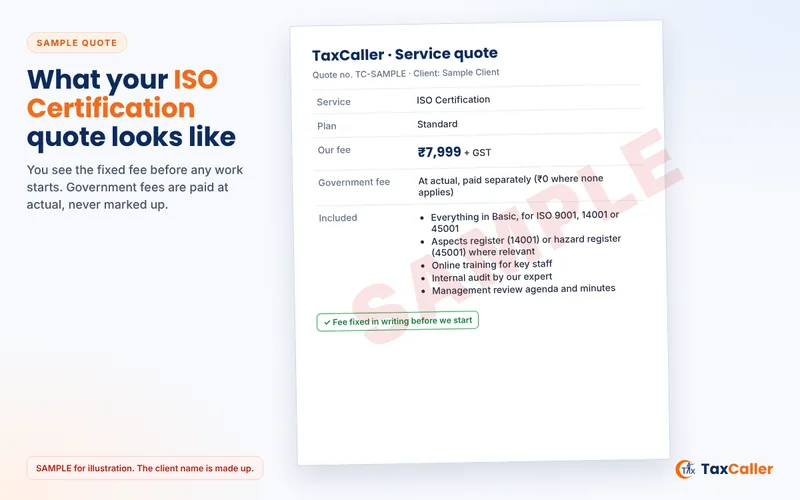
ISO Certification: SAMPLE quote, for illustration only
There is no government fee for ISO certification. Your total cost has three parts:
Certification body fee: for Stage 1, Stage 2, the certificate and the yearly surveillance audits. You pay this directly to the CB.
Consultant fee: for gap analysis, documents, training and internal audit. This is TaxCaller's part.
Your own costs: staff time, calibration of instruments, safety equipment or IT tools, if the gap analysis shows they are missing.
The CB fee is mainly driven by audit days. CBs work these out from accreditation rules, such as IAF Mandatory Document 5 for 9001, 14001 and 45001, using:
effective number of employees, including contract staff and shifts
number of sites and how far apart they are
the standard, and whether you combine several standards
risk and complexity of your activities
the auditor's travel and stay
Multi-site and integrated audits
If you have several branches doing the same work under one central office, accreditation rules allow the CB to audit a sample of sites rather than every one. This can cut audit days. If you take two or three standards together, an integrated audit usually needs fewer days than separate audits, because records like training, internal audit and management review are checked once. Ask the CB to quote both ways.
Because these vary so much, we do not publish a CB fee. Ask each CB for a written quote that shows the initial audit, each surveillance audit and the recertification audit separately, plus GST and travel. Then compare like with like. A very low quote with no surveillance plan is a red flag.
TaxCaller's fee starts at ₹3,999 + GST. It covers consulting and documentation as per the plan you choose. The certification body's audit fee is paid separately at actual, directly to the CB, against its written quote. There is no government fee for ISO certification.
Item
Who you pay
Amount
Consulting, documents, training, internal audit
TaxCaller
As per plan, + GST
Stage 1, Stage 2 and certificate
Certification body
At actual, as per CB quote
Yearly surveillance audits
Certification body
At actual, as per CB quote
Government fee
None
Nil
We confirm the scope and our fee in writing before you pay. You can choose any accredited CB you like. If you plan to claim the ZED support explained below, keep the CB invoice in the business name.
Zubair Licence & Registration Expert
Have a question on this topic? Ask Zubair on a free call.
Government Support: ZED Scheme and the Old ISO Reimbursement
Many websites still quote an old central scheme that repaid 75% of ISO certification charges, up to ₹75,000, for small enterprises. We could not find it among the central schemes running today. The Ministry of MSME also said in an August 2021 circular that its CLCS-TUS scheme for technology and quality upgradation is no longer in operation; it ran until 31 March 2020. The CLCS-TUS circulars are on the DC (MSME) website. Do not budget for the old reimbursement unless your MSME-DFO confirms it in writing.
The QCI FAQs describe the scheme for Udyam-registered manufacturing MSMEs, so check that your unit is covered before you plan around it.
ZED has three levels: Bronze, Silver and Gold, with certification costs of ₹10,000, ₹40,000 and ₹90,000.
The government pays 80% of that cost for micro, 60% for small and 50% for medium enterprises, with extra support for women-owned units and units in special regions.
After you achieve a ZED level, you can claim support of 75% of the cost of one testing, management system or product certification, capped at ₹50,000.
The management system certificate must come from a NABCB-accredited CB, and only certification charges count, not consultancy fees.
How an MSME uses ZED for its ISO certificate
Register on the ZED portal with your Udyam number and take the ZED pledge.
Achieve a ZED certification level. Bronze is the entry level.
Get your ISO certificate from a NABCB-accredited certification body, with the invoice in the business name.
Apply for the support on the ZED portal with the certificate and invoice, as per the process shown there at that time.
If you take ISO first and ZED later, the FAQs say reimbursement is open only after a ZED level is achieved, so plan the order with us before you pay the CB.
You need Udyam registration to join ZED. If you do not have it yet, see our MSME registration service. Some states also run their own quality certification incentives under their industrial policies; check your state's current policy before you claim.
After Certification: Surveillance, Recertification and Logo Rules
The certificate is valid for three years, but only if you keep passing the audits in between. Under ISO/IEC 17021-1, clause 9.1.3, the three-year cycle includes:
Surveillance audit 1: no later than 12 months from the certification decision.
Surveillance audit 2: in the second year. Surveillance audits take place at least once each calendar year, except in the recertification year.
Recertification audit: in the third year, before the certificate expires.
Surveillance audits are shorter. The auditor samples parts of the system, checks complaints and corrective actions, and looks at changes. To stay ready:
Run one internal audit and one management review each year.
Keep records live, not written the week before the audit.
Tell the CB about changes in name, address, sites, scope or ownership.
Use the CB's certification mark only as its rules allow. Never print the ISO logo itself, and never put a system certification mark on a product as if the product were tested.
Changing the CB, adding a site or adding a standard
You can move a valid accredited certificate to another accredited CB. The new CB reviews your certificate, past audit reports and open findings before it takes over. A suspended certificate cannot be moved this way. To add a new site, product line or standard, ask the CB for a scope extension. It may combine the extra audit with your next surveillance visit to save cost.
If you skip a surveillance audit or fail to close a major finding, the CB can suspend or withdraw the certificate. A withdrawn certificate is no longer valid, and a check with the CB or on IAF CertSearch will not show it as a valid certificate.
Not having ISO is not an offence. Claiming ISO when you do not have a valid certificate is a different matter:
Situation
Possible result
Expired, suspended or fake certificate used in a tender
Bid rejection, forfeiture of bid security and debarment under the buyer's tender conditions
False "ISO certified" claim in ads or on packaging
Misleading advertisement under Section 2(28) of the Consumer Protection Act, 2019; the CCPA can impose a penalty up to ₹10 lakh under Section 21(2), up to ₹50 lakh for repeat cases
Same false advertisement, criminal route
Section 89 of the same Act: imprisonment up to 2 years and fine up to ₹10 lakh; up to 5 years and ₹50 lakh for a repeat offence
Fake certificate shown to a private customer
Contract termination, claims for loss and loss of future business
The simple fix is to quote only the exact scope on your valid certificate, update marketing material when a certificate lapses, and keep the surveillance calendar.
Abhinay Rai Licence & Registration Expert
Have a question on this topic? Ask Abhinay on a free call.
New emphasis on quality culture and ethics, risk and opportunity, change management and organisational knowledge. Climate change considerations stay in.
2026 onwards
ISO 45001 marked for revision, planned as ISO 45001:2027
No action yet. Current 45001 certificates stay valid.
Transition: a three-year transition is expected for ISO 9001, so ISO 9001:2015 certificates should stay valid until about September 2029. The final dates come from Global ACI and each CB. Some CBs plan to stop new 2015-edition audits well before the end. If you are starting now, ask your CB whether it can audit you to the 2026 edition, so you do not need a transition audit later.
Note also that ISO/IEC 27001:2013 certificates stopped being valid after 31 October 2025. Any 27001 certificate shown to you now should be to the 2022 edition.
Why Businesses Choose TaxCaller, and Related Services
TaxCaller has served businesses since 2018 from our office in Ghaziabad, and we work online across India. For ISO, that means:
Independent advice: we are consultants, not a CB. You pick any accredited CB and pay it directly.
Accreditation check first: we verify the CB's accreditation and sector scope before you sign.
Documents that fit: written for your actual processes, in simple language your staff can follow.
Fee told upfront: our fee + GST in writing; the CB's fee shown separately.
One team for compliance: the same experts can handle the registrations a CB or buyer will ask for.
Our consulting work is fully online, so location does not limit you. Whether the CB audits on site or remotely is the CB's decision. Clients in Ghaziabad, Noida and Delhi can also meet our team at our Ghaziabad office by appointment.
Existing SOPs, checklists, formats and records, if any
Organisation chart with names of top management and process owners
Why TaxCaller
Real experts, not a call centre
Your work is handled by experienced professionals who explain every step, check your documents and keep you updated.
Registered company
TaxCaller is run by TaxCaller India LLP (LLPIN AAQ-7388), serving clients since 2018.
Fee told upfront
You know the complete fee, our professional fee and the government fee, before any work starts. No hidden charges.
Support after the work
Notices, renewals, returns and compliance reminders: we stay with your business after the registration is done.
Reviewed By
Expert for this topic ISO Certification
Abhinay Rai
Advocate
Abhinay Rai is a Advocate specialising in ISO Certification. The process, documents, timelines and fees on this page are checked against the current rules and government portals, and updated whenever the law, forms or fees change.
ISO certification is a certificate issued by an accredited certification body after it audits your business against an ISO management system standard, such as ISO 9001 for quality. ISO itself only writes the standards. The certificate shows buyers, tender committees and partners that your processes are planned, controlled, recorded and improved in a consistent, checkable way.
Is ISO certification mandatory in India?
No general Indian law makes ISO certification compulsory. It is voluntary. However, many government tenders, PSU vendor lists, export buyers and large customers ask for it as a condition. Some sectors, like medical devices, must run a quality management system by law, and ISO 13485 certification is the usual way to show that abroad.
Who issues ISO certificates in India?
Certification bodies issue ISO certificates after an audit. ISO and the Indian government do not issue them. Choose a body accredited by NABCB, which works under the Quality Council of India, or by another accreditation body in the global recognition arrangement. Accreditation is what makes a certificate acceptable to tenders and foreign buyers.
How much does ISO certification cost in India?
There is no government fee. You pay the certification body for its audits, and a consultant if you use one. The audit fee depends on employee count, number of sites, the standard and risk level, so ask for a written quote. TaxCaller's consulting fee is separate, quoted in writing and charged plus GST.
How long does it take to get ISO certification?
A small business usually completes ISO 9001 in about 6 to 12 weeks. That covers gap analysis, documents, a few weeks of records, internal audit, management review and the two-stage audit. ISO 27001 and integrated systems often take 3 to 6 months. Same-day certificates without an audit are not accredited and are often rejected.
How long is an ISO certificate valid?
An ISO certificate is valid for three years. It stays valid only if you pass a surveillance audit in each of the first two years, with the first one within 12 months of certification. In the third year, a recertification audit before expiry starts a fresh three-year cycle. Missing an audit can lead to suspension.
How can I check whether an ISO certificate is genuine?
Search the certificate on IAF CertSearch, then check the certification body in the NABCB directory or with its foreign accreditation body. Confirm the legal name, site addresses, scope, standard edition and expiry date. Since July 2026, NABCB-accredited certificates must show the NABCB Accreditation Symbol. Be careful if no accreditation body is named at all.
Which ISO certification does my business need?
Start with ISO 9001 if a buyer or tender simply asks for ISO. Choose ISO 14001 for environmental impact, ISO 45001 for worker safety, ISO 27001 for data security, ISO 22000 for food safety, ISO 13485 for medical devices and ISO 50001 for energy use. Always read the exact standard named in your tender.
Can a proprietorship or small startup get ISO certified?
Yes. Any business with real, ongoing activities can be certified, including a proprietorship, partnership, LLP or a small startup. The system and audit are scaled to your size, so a ten-person firm needs fewer documents and audit days than a factory. You must still show records that your processes are actually followed.
Is there a government subsidy for ISO certification?
Do not rely on the old 75% up to ₹75,000 reimbursement many sites quote; we could not find it among current central schemes. Today, MSMEs that reach a ZED level can claim 75% of one management system certification cost, up to ₹50,000, if a NABCB-accredited body issues it. Consultancy fees are not covered.
Does ISO certification help on GeM and government tenders?
Yes, in many cases. GeM seller registration does not need ISO, but buyers can add certification conditions to a bid, and many tenders ask for ISO 9001, 14001 or 45001. A valid accredited certificate in the bidding entity's own name keeps you eligible. Expired or unaccredited certificates can lead to rejection or debarment.
What changed with ISO 9001:2026?
ISO published ISO 9001:2026 on 16 September 2026. It keeps the familiar clause structure but adds emphasis on quality culture, ethics, risk and opportunity, change management and organisational knowledge. A three-year transition is expected, so 2015-edition certificates should remain valid until about September 2029, subject to final accreditation rules and your certification body.
What is the difference between certification and accreditation?
Certification is when a certification body audits your business and confirms it meets a standard. Accreditation is when a body like NABCB audits the certification body itself and confirms it is competent and impartial. You get certified; the certification body gets accredited. Only certificates from accredited bodies carry wide recognition in India and abroad.
Can I get ISO certification online without an audit?
Not a genuine accredited one. A first certification needs a Stage 1 and Stage 2 audit by the certification body, which may be on site or partly remote as it decides. Consulting, documents and training can be fully online, which is how TaxCaller works. Certificates sold with no audit are usually unaccredited and rejected.
Book a free first call to confirm the right standard, timeline and total cost. Our fee starts at ₹3,999 + GST, and the certification body's audit fee is paid separately at actual.