Excellent experience with TaxCaller for filing my &
my family members ITR returns. The entire process was
smooth, quick and hassle-free. They are professional,
knowledgeable and guided me through every step with patience.
O
obeid sait
★★★★★
The team has handled my taxes for the past three years,
and it's been a wonderful, hassle-free experience.
Thank you for your consistently quick and efficient service.
P
Pushkar
★★★★★
They are among the best in their field. Their work culture
is highly professional, and their client service is smooth
and reliable. They can confidently be relied on to get the job done.
P
Prasad Sheth
★★★★★
Excellent experience with TaxCaller! The ITR filing
process was smooth, quick, and completely hassle-free.
The CA was knowledgeable, responsive, and explained everything clearly.
A
Apoorv Bansal
★★★★★
Excellent service for ITR filing. The team was highly
professional, responsive, and guided me through the entire
process smoothly. My return was filed accurately and on time.
A
Abhishek Kumar
★★★★★
I was searching for a good CA firm in Ghaziabad and found
TaxCaller. The experience was excellent from start to finish.
The team is responsive, transparent, and genuinely helpful.
U
uma pandey
★★★★★
Great service! TaxCaller India made the entire ITR filing
process quick, smooth, and hassle-free. They answered all
my queries patiently and ensured maximum accuracy.
T
tanu mittal
★★★★★
Excellent job! We've been connected for many years,
and your success truly makes me happy. You are an
incredibly intelligent person. Keep shining, keep growing.
B
Bhanu Pratap Maurya
★★★★★
I am filing my ITR since past 3 years with Abhinav and
Firm is known as TaxCaller and they are professional
interms of ITR rules. They will explain and tell you all
the information.
A
ashish Sharma
★★★★★
I am providing my honest reviews:
No.1 service ...
A
AARYAN GROUP
★★★★★
Honestly, finding a good CA firm in Ghaziabad was
confusing, but TaxCaller India made it simple.
I contacted them for GST work and the experience was smooth.
N
News Speaks
★★★★★
If you're looking for a reliable CA firm in Ghaziabad,
TaxCaller India is a great choice. They provide complete
taxation and compliance solutions including GST.
A
Anshul Chaprana
★★★★★
Got my GST registration done through TaxCaller CA firm.
Process was quite smooth, they guided properly on documents
and didn't waste time. Overall good experience.
How we work
Online · Call · WhatsApp
Quick answer
ADT 1 is the e-form a company files with the Registrar of Companies to report the appointment of its statutory auditor. It is due within 15 days of the meeting that appoints the auditor, under Section 139(1) and Rule 4(2). The ROC fee is ₹200 to ₹600, by share capital, and late filing adds extra fees.
Reviewed by Abhinay Rai · Updated 15 Nov 2026
Pick a plan that fits
ADT-1 Filing
Companies whose AGM or board has already appointed the auditor and only need the form filed
Route planned: resignation, removal or end of term
Board and general meeting papers for the casual vacancy
ADT-2 and MGT-14 drafting in removal cases
Special notice draft for a change at the AGM
Coordination with the outgoing auditor's ADT-3
Government fees and taxes are extra where applicable. Our expert confirms the final amount on the first call. No hidden charges.
About ADT 1 Filing
ADT 1 is the form your company files to tell the Registrar of Companies who its statutory auditor is. It is filed after the AGM that appoints the auditor, and in some other cases too. These include a new company's first auditor, a change of auditor, or an auditor appointed to fill a vacancy.
The form looks short, but mistakes are common. Wrong dates in ADT-1 can block your AOC-4 later. An auditor who is not eligible can make the appointment invalid. The rules on first auditors and casual vacancies are also still unclear in 2026. This page explains all of it in plain words.
TaxCaller has handled company and tax filings since 2018, from our office in Ghaziabad and online across India. Below you will find the law, documents, fees, due dates, penalties, the change of auditor process and the latest MCA changes.
Complete guide
Choose a topic to open it. Every answer gives the rule or section it comes from.
01 Topic 1 of 20
What Is Form ADT 1?
Form ADT-1 is the notice a company sends to the Registrar of Companies (ROC) when it appoints a statutory auditor. It is filed online on the MCA V3 portal. Once filed, the ROC's record shows who audits the company and for which years.
The duty comes from the fourth proviso to Section 139(1) of the Companies Act, 2013. The company must tell the auditor about the appointment. It must also file a notice of the appointment with the Registrar within 15 days of the meeting that appointed the auditor. Rule 4(2) of the Companies (Audit and Auditors) Rules, 2014 names ADT-1 as the form for this notice. You can read the sections in the Companies Act, 2013 (India Code).
Point
Detail
Official name
Form ADT-1, notice to the Registrar by company for appointment of auditor
Law
Section 139(1), fourth proviso, read with Rule 4(2), Companies (Audit and Auditors) Rules, 2014
Who files
The company, not the auditor
Time limit
Within 15 days of the meeting that appoints the auditor
Where
MCA V3 portal, as an online web form
Who signs
A director, manager, CEO, CFO or company secretary, with a digital signature
ROC fee
₹200 to ₹600, based on nominal share capital; ₹200 for a company without share capital
Processing
Straight-through processing (STP), so the system takes it on record without an officer's review
One ADT-1 covers the whole term. If the AGM appoints an auditor for five years, you file once, not every year. Members stopped ratifying auditors every year from 7 May 2018, when the Companies (Amendment) Act, 2017 removed that rule. So there is no yearly ADT-1 for ratification any more.
ADT-1 form purpose: it tells the Registrar of Companies who the company's statutory auditor is, from when and for how long, so the appointment is on the public record and the auditor's details can be matched with the financial statements filed later in AOC-4.
Every company that appoints an auditor at a meeting must file ADT-1, because every company under the Companies Act, 2013 must have its accounts audited. This covers private limited companies, one person companies (OPCs), small companies, Section 8 companies and public companies. Turnover does not matter. A new company with no sales still needs an auditor.
These events trigger a filing:
Appointment at the first AGM for a term up to the sixth AGM (Section 139(1)).
Reappointment of the retiring auditor for a fresh term (Section 139(9)).
A new auditor at an AGM in place of the retiring one, after a special notice (Section 140(4)).
A casual vacancy caused by resignation, death or disqualification (Section 139(8)). The law does not say this expressly, but the form has an option for it.
Appointment after removal of the earlier auditor with Central Government approval (Section 140(1)).
Appointment by the C&AG, the Tribunal or the Central Government, where the law gives them that power.
First auditor appointed by the Board under Section 139(6). The law is less clear here, so we cover it in the next section.
An OPC does not hold an AGM. Its member communicates the resolution, which is entered in the minutes book and signed and dated by the member. Under Section 122(3), that date counts as the meeting date. The OPC files ADT-1 within 15 days of that date.
LLPs never file ADT-1. An LLP needs an audit only above ₹40 lakh turnover or ₹25 lakh contribution (Rule 24(8), LLP Rules, 2009); see LLP annual filing.
Shreya Compliance Expert
Have a question on this topic? Ask Shreya on a free call.
The law does not clearly require ADT-1 for a first auditor appointed by the Board, but the published V3 e-form FAQs recommend filing it. We file it for every new company. Here is why the question exists and how to handle it.
What the law says
Section 139(6) says the Board must appoint the first auditor within 30 days of registration. If the Board fails, it must inform the members. The members then appoint the auditor at an extraordinary general meeting within 90 days.
The first auditor holds office until the end of the first AGM.
The 15-day filing rule sits in the fourth proviso to Section 139(1). Rule 4(2) also refers only to Section 139(1). Section 139(6) has no filing clause of its own.
What changed in practice
The new ADT-1, brought in by G.S.R. 359(E) dated 30 May 2025 and used from 14 July 2025, has a "Nature of appointment" field. One option reads "First auditor by Board of directors/members/C&AG".
The FAQs issued for the V3 company e-forms (FAQ 35) accept that Rule 4(2) mentions only Section 139(1). They still say companies are recommended to file ADT-1 even for the first auditor.
The same FAQ says that if no ADT-1 SRN exists for the first auditor, the company can enter Z99999999 as the SRN in AOC-4.
On 16 April 2026, the Institute of Company Secretaries of India asked the Ministry to clarify this point and the casual vacancy point (ICSI letter of 16 April 2026). As of 15 November 2026, we found no MCA circular that settles it.
Our advice
Choice
What happens
File ADT-1 for the first auditor
The ROC record shows the auditor from day one. AOC-4 later gets a real SRN. The cost is one ROC fee.
Do not file
You rely on the legal gap and on the portal accepting the placeholder SRN in AOC-4. You may have to explain the gap if a query comes later.
We treat the 15 days after the board meeting as the deadline for the first auditor's ADT-1. That keeps the filing clean and avoids any late-fee question. If your company was registered recently, see private limited company registration for the other first-month steps.
Section 139: How Auditors Are Appointed and for How Long
Section 139 decides who appoints the auditor, by when, and for how long. The table below covers the common cases.
Situation
Who appoints
Time limit
Holds office until
Section
First auditor, non-government company
Board
30 days from registration
End of first AGM
139(6)
Board fails to appoint first auditor
Members at an EGM
90 days
End of first AGM
139(6)
First auditor, government company
C&AG; then Board; then members
60 days; then 30 days; then 60 days
End of first AGM
139(7)
Auditor at the first AGM
Members
At the AGM
End of sixth AGM
139(1)
Casual vacancy, other than resignation
Board
30 days
Next AGM
139(8)
Casual vacancy from resignation
Board, then members approve
Board in 30 days; general meeting within three months of the Board's recommendation
Next AGM
139(8)
Auditor of a government company
C&AG
180 days from start of the financial year
End of the AGM
139(5)
Other rules that matter
Selection: Rule 3 asks the audit committee, or the Board where there is none, to consider the auditor's qualifications, experience and any pending conduct proceedings.
Reappointment: At an AGM, the retiring auditor may be reappointed. This does not apply if the auditor is disqualified, gives written notice of unwillingness, or a special resolution appoints someone else (Section 139(9)).
No appointment at the AGM: The existing auditor continues (Section 139(10)).
Audit committee: Where Section 177 requires a committee, every appointment must consider its recommendation (Section 139(11)).
Fees of the auditor: Members fix the auditor's pay in a general meeting. The Board may fix the pay of the first auditor it appoints (Section 142(1)).
Rotation means a listed company, or a company in a prescribed class, cannot keep the same auditor beyond fixed terms. An individual auditor can serve one term of five consecutive years. An audit firm can serve two terms of five consecutive years. After that, a five-year cooling-off period applies before the same auditor can return.
Rule 5 of the Companies (Audit and Auditors) Rules, 2014 lists the classes covered, apart from listed companies:
Class of company
Rotation applies when
Unlisted public company
Paid-up share capital of ₹10 crore or more
Private limited company
Paid-up share capital of ₹50 crore or more (raised from ₹20 crore by G.S.R. 621(E) of 22 June 2017)
Any company below these limits
Public borrowings from banks or financial institutions, or public deposits, of ₹50 crore or more
Rule 5 leaves out OPCs and small companies. Since G.S.R. 880(E) of 1 December 2025, a small company means paid-up capital up to ₹10 crore and turnover up to ₹100 crore. So most startups and family companies are outside rotation.
Section 139(2) also stops a firm that shares a partner with the outgoing firm from taking over during the cooling-off period. Members may also decide to rotate the audit partner and team inside the firm (Section 139(3)).
Companies outside rotation may keep the same auditor term after term. Each new term is a fresh appointment, and each needs a fresh ADT-1. The new ADT-1 asks whether the company falls under Section 139(2) and asks tenure questions under Rule 6. Answer these from the latest audited figures.
Zubair Compliance Expert
Have a question on this topic? Ask Zubair on a free call.
Only a chartered accountant in practice can be a company's auditor. A firm, including an LLP, can be appointed in its firm name if most of its partners practising in India are qualified (Section 141(1)). Only partners who are chartered accountants in practice may sign for the firm (Section 141(2)).
Section 141(3) lists who cannot be appointed:
Clause
Disqualified person
(a)
A body corporate, other than an LLP
(b)
An officer or employee of the company
(c)
A partner or employee of an officer or employee of the company
(d)
A person who, or whose relative or partner, holds securities, owes money or stands surety for a debt beyond the limits in Rule 10. A relative may hold securities up to ₹1 lakh face value. Debt above ₹5 lakh, or surety above ₹1 lakh, disqualifies.
(e)
A person with a business relationship of the prescribed kind with the company or its group
(f)
A person whose relative is a director or key managerial person of the company
(g)
A person in full-time employment elsewhere, or already auditor of more than 20 companies
(h)
A person convicted of an offence involving fraud in the last ten years
(i)
A person giving the company, its holding or subsidiary, the non-audit services listed in Section 144
The limit of 20 companies does not count OPCs, dormant companies, small companies and private companies with paid-up capital below ₹100 crore (G.S.R. 464(E), 5 June 2015). From 13 June 2017, a private company gets this exclusion only if it has not defaulted in filing its financial statements or annual return.
If an auditor becomes disqualified after appointment, the auditor must vacate office. The vacancy is treated as a casual vacancy (Section 141(4)). The new ADT-1 asks whether the 20-company limit under Section 141(3)(g) is met, so ask your auditor to confirm the count in writing. If you still need to find an auditor, the CA firm services page explains how audit work is arranged.
Before the appointment, the auditor must give written consent and a certificate that the appointment meets the law. Section 139(1) requires both. The certificate must also confirm that the auditor meets the criteria in Section 141.
Under Rule 4(1), the certificate states that:
the auditor is eligible and not disqualified under the Companies Act, the Chartered Accountants Act, 1949 and the rules made under them;
the proposed appointment is for the term the Act allows;
the appointment is within the limits set by or under the Act; and
the list of pending proceedings on professional conduct against the auditor, the firm or any partner, as disclosed, is true and correct.
What a good consent letter contains
Firm name and firm registration number (FRN), or the individual's name.
Name and membership number of the partner who will sign.
PAN, address and email of the auditor.
The financial years the appointment will cover.
The Rule 4(1) statements and the number of company audits already held.
A date before the meeting, and the auditor's signature.
Agree the audit fee and scope in a separate engagement letter. Standard on Auditing 210, issued by ICAI, deals with agreeing the terms of an audit. The engagement letter stays in your records and is not filed with ADT-1.
ADT-1 needs only two mandatory attachments: the company's letter informing the auditor of the appointment, and the auditor's written consent. The rest of the papers support the appointment and stay in your records. Keep them ready, because an inspection or a later query can ask for them.
Document
Prepared by
Attached to ADT-1?
Letter informing the auditor of the appointment
Company
Yes, mandatory
Written consent of the auditor
Auditor
Yes, mandatory
Eligibility certificate under Rule 4(1)
Auditor
Often given inside the consent letter; keep the original
Board resolution (first auditor, casual vacancy, or AGM recommendation)
Board
Its number and date go in the declaration; a copy can be added as an optional attachment
AGM or EGM notice and ordinary resolution
Company
Optional; keep with the minutes
Resignation letter of the earlier auditor
Outgoing auditor
Optional, in casual vacancy cases
Central Government order, where it appoints the auditor
Central Government
Optional
Approval of removal on ADT-2
Regional Director
Not a listed attachment; keep on record
Special notice and auditor's representation
Members and auditor
Not attached; keep on record
Engagement letter
Company and auditor
Not attached; keep on record
Details you will type into the form
CIN, registered office address and company email.
Nature of appointment, meeting date and whether it was an AGM.
Auditor category (individual or firm), FRN, membership number, name, PAN, address and email.
Period of account from and to, and the number of financial years.
Answers on Section 139(2), the 20-company limit, Rule 6 tenure and the audit committee under Section 177.
For casual vacancies: reason, date of vacancy and the related SRN.
The signing director or officer needs a valid class 3 digital signature linked to the MCA account. If it has expired, get a digital signature certificate first.
Abhinay Rai Compliance Expert
Have a question on this topic? Ask Abhinay on a free call.
We collect the facts, check the auditor's eligibility, draft the papers, fill the V3 web form and file it with your signatory's digital signature. You approve the draft before anything is filed. Here is the process step by step.
First call. We note the meeting type and date, the nature of appointment, the term, and the auditor's details.
Eligibility check. We match the auditor against Section 141, the 20-company limit, and rotation limits if they apply.
Drafting. We prepare the board resolution, the AGM notice item and resolution, the letter to the auditor, and a consent and certificate format for the auditor to sign.
Login and form. We log in to the MCA portal with your company's registered user ID and open ADT-1 under company e-filing. Company details pre-fill from the CIN.
Data entry. We enter the nature of appointment, auditor details, period of account and number of years. We answer the Section 139(2), Section 141(3)(g), Rule 6 and Section 177 questions.
Attachments. We attach the intimation letter and the consent, plus any optional papers.
Signing and payment. Your director or officer signs with a digital signature. The portal works out the ROC fee. You pay it online and the SRN is created.
Record and reminders. Being an STP form, ADT-1 is taken on record by the system. We share the filed form and payment receipt, and add the term end date to your compliance calendar.
Our own work, from complete documents to filing, usually takes one to two working days. Delays mostly come from late consent letters or an expired digital signature, so we ask for those first.
ADT-1 form download: on the MCA V3 portal ADT-1 is a web form filled online after logging in, so there is no offline form to download, fill and upload. Only the attachments (the intimation to the auditor and the auditor's consent) are prepared as PDF files.
ADT-1 is due within 15 days of the meeting that appoints the auditor. The day of the meeting is not counted. So an AGM held on 30 September has its ADT-1 due by 15 October.
Event
Meeting that appoints
ADT-1 due
First auditor of a new company
Board meeting within 30 days of registration
Within 15 days of the board meeting (recommended filing)
AGM held on 30 September 2026
AGM
15 October 2026
AGM held on 25 September 2026
AGM
10 October 2026
Auditor reappointed for a second term
AGM
Within 15 days of the AGM
New auditor after removal
General meeting after Central Government approval
Within 15 days of that meeting
Casual vacancy
Board meeting, and for resignations a general meeting too
The law is silent; we file within 15 days of the meeting that makes the appointment
Worked example: a company registered on 10 May 2026
Board appoints the first auditor by 9 June 2026, which is within 30 days of registration.
We file ADT-1 within 15 days of that board meeting.
The first financial year ends on 31 March 2027. The first AGM must be held by 31 December 2027 (Section 96(1)).
Say the first AGM is on 20 September 2027 and appoints the auditor. ADT-1 is due by 5 October 2027.
That auditor audits FY 2027-28 to FY 2031-32 and holds office until the end of the sixth AGM, in 2032.
Before that sixth AGM, the company reappoints the auditor or appoints a new one, and files a fresh ADT-1.
The ROC fee for ADT-1 is ₹200 to ₹600, based on the company's nominal (authorised) share capital. It is set by Rule 12 and the Annexure of the Companies (Registration Offices and Fees) Rules, 2014. Paid-up capital does not decide the slab.
Nominal share capital
ROC fee per filing
Less than ₹1 lakh
₹200
₹1 lakh to less than ₹5 lakh
₹300
₹5 lakh to less than ₹25 lakh
₹400
₹25 lakh to less than ₹1 crore
₹500
₹1 crore or more
₹600
Company without share capital
₹200
TaxCaller's fee starts at ₹999 + GST. Government fees, meaning the ROC fee and any additional fee for delay, are paid separately at actual. A new digital signature, if needed, is also extra.
What our fee covers and what it does not
Covered: eligibility check, drafting, form filling, filing and the filed copy.
Not covered: the audit itself. The auditor's fee is agreed between your company and the auditor under Section 142.
Not covered: the ROC fee and additional fees, which go straight to the MCA.
Shadab Compliance Expert
Have a question on this topic? Ask Shadab on a free call.
A late ADT-1 can still be filed, but the portal adds an additional fee that is a multiple of the normal fee. The scale comes from G.S.R. 12(E) dated 11 January 2022, in force from 1 July 2022. It has special shorter steps for forms under Section 139, which includes ADT-1.
Delay after the due date
Additional fee
Up to 15 days
1 time the normal fee
More than 15 days, up to 30 days
2 times
More than 30 days, up to 60 days
4 times
More than 60 days, up to 90 days
6 times
More than 90 days, up to 180 days
10 times
More than 180 days
12 times
Worked example: what a delay costs
Take two companies. One has ₹1 lakh authorised capital, so its normal fee is ₹300. The other has ₹10 lakh, so its normal fee is ₹400. Totals include the normal fee.
Days late
Multiple
Total at ₹1 lakh capital
Total at ₹10 lakh capital
10
1x
₹600
₹800
25
2x
₹900
₹1,200
45
4x
₹1,500
₹2,000
75
6x
₹2,100
₹2,800
120
10x
₹3,300
₹4,400
200
12x
₹3,900
₹5,200
ADT-1 does not carry the ₹100 a day fee that applies to AOC-4 and MGT-7 under Section 403. The higher additional fee for repeat defaults applies to INC-22 and PAS-3, not ADT-1. The money is small, but the penalty risk under Section 147 stays, so file on time.
ADT-1 late fees in short: the late fee is the additional fee shown above, a multiple of the normal ROC fee that rises with each slab of delay, so filing within 15 days of the meeting is always the cheapest route.
Section 147 punishes breaches of Sections 139 to 146, which include the duty to appoint an auditor and file ADT-1. Section 140(3) separately penalises an auditor who resigns without filing ADT-3.
Default
Section
Amount
Company breaches any of Sections 139 to 146
147(1)
Fine of ₹25,000 to ₹5 lakh
Each officer in default
147(1)
Fine of ₹10,000 to ₹1 lakh; the jail term was removed by the Companies (Amendment) Act, 2020, from 21 December 2020
Auditor breaches Section 139, 144 or 145
147(2)
₹25,000 to ₹5 lakh, or four times the audit fee, whichever is less
Auditor breaches them knowingly, to deceive
147(2), proviso
Jail up to one year, and fine of ₹50,000 to ₹25 lakh or eight times the audit fee, whichever is less
Resigning auditor does not file ADT-3
140(3)
₹50,000 or the audit fee, whichever is less, plus ₹500 a day while it continues, up to ₹2 lakh
The ADT-1 declaration also warns that Sections 448 and 449 apply to false statements and false evidence. Check every date and number before signing.
A missing ADT-1 also causes practical trouble. AOC-4 asks for the ADT-1 SRN and checks that the financial year falls inside the period reported in ADT-1. So a skipped ADT-1 can hold up your yearly accounts filing.
Change of Auditor: Resignation, Casual Vacancy and Removal
A company can change its auditor in three ways: the auditor resigns, the company removes the auditor before the term ends, or the AGM appoints someone else when the term ends. Each route has its own forms, and each ends with an ADT-1 for the new auditor.
1. The auditor resigns
The auditor files ADT-3 with the company and the ROC within 30 days of resigning, giving reasons (Section 140(2)).
The Board fills the casual vacancy within 30 days (Section 139(8)).
Because the vacancy came from a resignation, members must approve the appointment at a general meeting called within three months of the Board's recommendation.
The new auditor holds office until the next AGM. The company files ADT-1 using the casual vacancy option, with the reason, the vacancy date and the related SRN.
2. The company removes the auditor before the term ends
The Board passes a resolution proposing removal.
The company applies to the Central Government in ADT-2 within 30 days of that resolution (Rule 7). The power is delegated to Regional Directors.
The auditor gets a reasonable chance to be heard (Section 140(1)).
After approval, members pass a special resolution at a general meeting held within 60 days of receiving the approval.
The special resolution is filed in MGT-14 within 30 days (Section 117). The new auditor's appointment is then filed in ADT-1.
3. A new auditor when the term ends
A resolution at an AGM to appoint someone other than the retiring auditor needs a special notice (Section 140(4)).
This does not apply where the retiring auditor has completed five years, or ten years under the rotation rule in Section 139(2).
Under Section 115 and Rule 23, members with at least 1% of voting power, or shares with at least ₹5 lakh paid up, give the special notice. It must reach the company at least 14 days before the meeting.
The retiring auditor may send a written representation to be circulated to members.
The four ADT forms at a glance
Form
Purpose
Filed by
Time limit
ADT-1
Notice of auditor appointment
Company
15 days from the meeting
ADT-2
Application to remove an auditor before the term ends
Company
30 days from the board resolution
ADT-3
Notice of resignation by the auditor
Auditor
30 days from resignation
ADT-4
Auditor's report on a fraud of ₹1 crore or more to the Central Government
Auditor
As set in Rule 13
Shreya Compliance Expert
Have a question on this topic? Ask Shreya on a free call.
Which Auditor Form Do You Need? A Quick Decision Table
Use this table to see which form your situation needs, who files it, and by when. It covers the cases we see most often.
Your situation
Form(s)
Filed by
Time limit
New company, Board appointed the first auditor
ADT-1 (recommended)
Company
15 days from the board meeting
First AGM appoints the auditor for five years
ADT-1
Company
15 days from the AGM
AGM in the middle of a five-year term
No ADT-1; there is no yearly ratification
Not applicable
Not applicable
Same auditor reappointed for a second term
ADT-1
Company
15 days from the AGM
Auditor resigns
ADT-3, then ADT-1 for the new auditor (law not explicit; we file it)
Auditor, then company
30 days; then 15 days from the meeting
Auditor dies or becomes disqualified
ADT-1 for the new auditor (law not explicit; we file it)
Company
15 days from the meeting
Company wants the auditor out mid-term
ADT-2, MGT-14, then ADT-1
Company
30 days; 30 days; 15 days
Two or more joint auditors appointed
One ADT-1 listing all of them
Company
15 days from the meeting
Auditor finds a fraud of ₹1 crore or more
ADT-4
Auditor
Rule 13 timelines
If your case does not fit any row, such as an AGM that was never held, book a call. Under Section 139(10), the existing auditor continues if no appointment is made, but the facts decide the next step.
Most ADT-1 problems come from wrong dates, wrong options or missing papers, not from the law itself. These are the mistakes we fix most often.
Appointing for one year at a time. Section 139(1) sets the term up to the sixth AGM. Short appointments lead to repeated filings and confusion in AOC-4.
Wrong period of account. AOC-4 checks that each financial year falls between the from and to dates in ADT-1. A wrong date blocks the accounts filing.
Wrong nature of appointment. Marking a reappointment as a fresh appointment, or a casual vacancy as an AGM appointment.
Missing mandatory attachments. The intimation letter and the consent must both be attached.
Consent dated after the meeting. Section 139(1) needs consent and the certificate before the appointment.
Ignoring disqualifications. A relative of a director, a loan above ₹5 lakh, or more than 20 audits can make the appointment invalid.
Counting from the wrong date. The 15 days run from the meeting date, not from the date the minutes are typed.
Digital signature problems. An expired signature, or one not linked to the signatory's MCA account, stops filing.
No special notice. Replacing a retiring auditor at the AGM without a special notice, when Section 140(4) needs one.
Thinking the auditor files it. The company files ADT-1. The auditor files only ADT-3 and ADT-4.
Missing rotation. A growing company can cross ₹50 crore paid-up capital or borrowings and come under Rule 5 without noticing.
After Filing: Linking ADT-1 to AOC-4 and Yearly Compliance
After filing, the ADT-1 SRN becomes a key input for your yearly accounts filing in AOC-4. The V3 FAQs confirm that one ADT-1 filed for five years can be quoted in AOC-4 for each of those years. Keep the SRN and the filed copy in your statutory records.
Every year: quote the ADT-1 SRN in AOC-4 and check the year falls inside the period reported.
At each AGM: no auditor resolution is needed in the middle of a term, but the auditor's report is placed before members.
Before the sixth AGM: plan the reappointment or the change, collect consent, and prepare a fresh ADT-1.
If capital or borrowings grow: recheck the rotation limits in Rule 5.
If the auditor changes: follow the route in the change of auditor section above.
The main changes are a new ADT-1 form on the V3 portal, a 2026 late-fee relief scheme, an open question on first auditors, and a pending Bill. Here is what each means for you.
New ADT forms, in use through 2026. G.S.R. 359(E), dated 30 May 2025, substituted Forms ADT-1 to ADT-4. They apply from 14 July 2025, as web forms on MCA V3. The new ADT-1 has a "Nature of appointment" list covering first auditors, AGM appointments, reappointments, casual vacancies, removal cases, and C&AG, Tribunal and Central Government appointments.
New questions in the form. ADT-1 now asks about Section 139(2) rotation, the 20-company limit, Rule 6 tenure and the audit committee. Only the intimation letter and the consent are mandatory attachments.
First auditor guidance. The V3 FAQs (FAQ 35) recommend ADT-1 for first auditors and allow Z99999999 as the ADT-1 SRN in AOC-4 where none exists.
Companies Compliance Facilitation Scheme, 2026. General Circular 01/2026 of 24 February 2026 let companies file overdue ADT-1, AOC-4, MGT-7 and some other forms. They paid the normal fee and only 10% of the additional fee. It ran from 15 April 2026 and was extended by General Circulars 03/2026 and 04/2026 to 15 September 2026. It has now closed.
ICSI's request for clarity. On 16 April 2026, ICSI asked the MCA whether ADT-1 is mandatory for first auditors and casual vacancies. We found no MCA answer as of 15 November 2026.
October 2026 relaxation. Reports on General Circular 05/2026 of 24 October 2026 name only AOC-4 and MGT-7. Plan ADT-1 on the normal 15-day rule.
Corporate Laws (Amendment) Bill, 2026. It was introduced in the Lok Sabha on 23 March 2026, and the Joint Committee reported on 3 August 2026. The PRS Bill tracker shows it is not yet law. It proposes letting companies that meet prescribed conditions skip appointing an auditor. It also proposes monetary penalties in place of criminal punishment under Section 147. As introduced, it also wanted every audit firm partner registered with a recognised professional body, but the Joint Committee recommended dropping that proviso. None of this applies until Parliament passes it and the Government notifies it.
Small company limits. Since 1 December 2025 (G.S.R. 880(E)), more companies count as small, so more stay outside rotation.
ADT-1 filing alone is right if your company only needs to report an auditor appointment and the rest of its yearly work is in hand. Pick a wider service if more is due.
Your need
Better fit
Only the auditor appointment or change
This ADT-1 service
AGM, AOC-4, MGT-7, ADT-1 and board papers for a private company
TaxCaller has handled company filings and tax work since 2018. Our office is in Ghaziabad, and we work online with companies across India. For ADT-1, that means one team checks the law, drafts the papers and files the form.
We check the auditor against Section 141 and rotation rules before filing.
We draft the resolution, the intimation letter and the consent format, so nothing is missing.
We share drafts for your approval before anything is filed.
We record the term end date and remind you before the next appointment is due.
We keep the government fee separate on every quote, so you see exactly what goes to the MCA.
Page content reviewed by Abhinay Rai, Advocate.
Have a question first? Contact us to book your first call.
Abhinay Rai Compliance Expert
Have a question on this topic? Ask Abhinay on a free call.
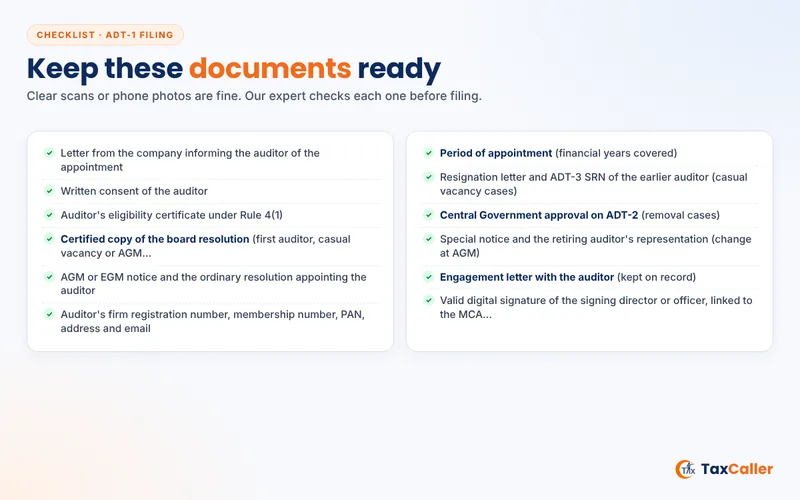
Letter from the company informing the auditor of the appointment
Written consent of the auditor
Auditor's eligibility certificate under Rule 4(1)
Certified copy of the board resolution (first auditor, casual vacancy or AGM recommendation)
AGM or EGM notice and the ordinary resolution appointing the auditor
Auditor's firm registration number, membership number, PAN, address and email
Period of appointment (financial years covered)
Resignation letter and ADT-3 SRN of the earlier auditor (casual vacancy cases)
Central Government approval on ADT-2 (removal cases)
Special notice and the retiring auditor's representation (change at AGM)
Engagement letter with the auditor (kept on record)
Valid digital signature of the signing director or officer, linked to the MCA account
Why TaxCaller
Real experts, not a call centre
Your work is handled by experienced professionals who explain every step, check your documents and keep you updated.
Registered company
TaxCaller is run by TaxCaller India LLP (LLPIN AAQ-7388), serving clients since 2018.
Fee told upfront
You know the complete fee, our professional fee and the government fee, before any work starts. No hidden charges.
Support after the work
Notices, renewals, returns and compliance reminders: we stay with your business after the registration is done.
Reviewed By
Expert for this topic ADT-1 Filing
Abhinay Rai
Advocate
Abhinay Rai is a Advocate specialising in ADT-1 Filing. The process, documents, timelines and fees on this page are checked against the current rules and government portals, and updated whenever the law, forms or fees change.
ADT-1 is the e-form a company files with the Registrar of Companies to report the appointment of its statutory auditor. It comes from the fourth proviso to Section 139(1) and Rule 4(2) of the Companies (Audit and Auditors) Rules, 2014. The company files it on the MCA V3 portal within 15 days of the meeting.
Is ADT-1 mandatory for the first auditor appointed by the Board?
The law does not clearly require it, because Rule 4(2) refers only to Section 139(1), while first auditors fall under Section 139(6). Still, the V3 FAQs recommend filing ADT-1 for first auditors, and the new form has an option for it. We file it within 15 days of the board meeting to keep records clean.
What is the due date for filing ADT-1?
ADT-1 is due within 15 days of the meeting that appoints the auditor. For an AGM held on 30 September, the last date is 15 October. For the first auditor, we treat 15 days from the board meeting as the deadline. A late filing is still accepted, but with an additional fee.
Is ADT-1 required every year?
No. Since 7 May 2018, members no longer ratify the auditor every year. One ADT-1 filed after the AGM covers the full term, up to the sixth AGM. You file again only when the auditor is reappointed, replaced, or a casual vacancy is filled. The same SRN is quoted in AOC-4 each year.
What is the government fee for ADT-1?
The ROC fee depends on nominal share capital: ₹200 below ₹1 lakh, ₹300 below ₹5 lakh, ₹400 below ₹25 lakh, ₹500 below ₹1 crore, and ₹600 at ₹1 crore or more. A company without share capital pays ₹200. It is paid online on the MCA portal. Additional fees apply for delay, and our professional fee is charged separately.
What happens if ADT-1 is filed late?
The portal charges an additional fee as a multiple of the normal fee. It is one time up to 15 days late, two times up to 30 days, and rises to twelve times after 180 days. The company and its officers can also face fines under Section 147(1), so file within the 15 days.
Who signs and files ADT-1, the company or the auditor?
The company files ADT-1, not the auditor. A director, manager, CEO, CFO or company secretary signs it with a digital signature, under authority from a board resolution. The auditor only gives written consent and an eligibility certificate before the appointment. The auditor's own forms are ADT-3 on resignation and ADT-4 for fraud reporting.
Which documents are attached to ADT-1?
Two attachments are mandatory: the company's letter informing the auditor of the appointment, and the auditor's written consent. The eligibility certificate, board resolution, AGM resolution and resignation letter can be added as optional files. You also need the auditor's firm registration number, membership number, PAN, email and the period of appointment.
How do I change the auditor of my company?
If the auditor resigns, the auditor files ADT-3 and the Board fills the vacancy within 30 days, with members approving within three months. To remove an auditor mid-term, file ADT-2 for Central Government approval and pass a special resolution. At the end of a term, use a special notice. Each route ends with ADT-1.
Can a relative of a director be the company's auditor?
No. Section 141(3)(f) disqualifies a person whose relative is a director or key managerial person of the company. Other bars include holding securities beyond Rule 10 limits, owing the company over ₹5 lakh, or auditing more than 20 companies. Check these before the meeting, because ADT-1 asks about the 20-company limit.
Do OPCs and small companies file ADT-1?
Yes. Every company must appoint an auditor, so OPCs and small companies file ADT-1 too. An OPC has no AGM. Its member's resolution is entered in the minutes book, and the date the minutes are signed counts as the meeting date. Rotation rules under Rule 5 do not apply to OPCs and small companies.
Can one ADT-1 cover joint auditors?
Yes. The new ADT-1 asks whether joint auditors were appointed and how many. You list each auditor's details in the same form and attach each one's consent. Every joint auditor must pass the Section 141 tests on their own. The single filing fee is still worked out from the company's nominal share capital.
Is ADT-1 needed when an auditor resigns?
Two forms are involved. The resigning auditor files ADT-3 within 30 days under Section 140(2). The company appoints a new auditor to fill the casual vacancy and reports it in ADT-1, which now has a casual vacancy option. The law does not spell out ADT-1 for this case, but we file it so the ROC record matches.
Share your meeting date and auditor details, and our expert will draft the papers and file ADT-1 on the MCA portal. Our fee starts at ₹999 + GST, and the ROC fee is paid at actual.