NGO Registration in India: Trust, Society or Section 8 Company
NGO registration done the right way: pick the legal form that fits your cause, then get Darpan, 12A, 80G and CSR-1 in the right order with a tax expert.
Starting from · ₹4,999 NGO Registration NGO Basic plan
STARTING FROM₹4,999
FEE TOLD UPFRONTFree first call
!GSTR-3B due?Last date 20 Nov 2026 · 3 days left
Since 2018Trusted Experience
980+Experts Connected
220+Cities Served
1164+Agents Available
12000+Founders Trusted
S
Srishti Magoo
★★★★★
Excellent experience with TaxCaller for filing my &
my family members ITR returns. The entire process was
smooth, quick and hassle-free. They are professional,
knowledgeable and guided me through every step with patience.
O
obeid sait
★★★★★
The team has handled my taxes for the past three years,
and it's been a wonderful, hassle-free experience.
Thank you for your consistently quick and efficient service.
P
Pushkar
★★★★★
They are among the best in their field. Their work culture
is highly professional, and their client service is smooth
and reliable. They can confidently be relied on to get the job done.
P
Prasad Sheth
★★★★★
Excellent experience with TaxCaller! The ITR filing
process was smooth, quick, and completely hassle-free.
The CA was knowledgeable, responsive, and explained everything clearly.
A
Apoorv Bansal
★★★★★
Excellent service for ITR filing. The team was highly
professional, responsive, and guided me through the entire
process smoothly. My return was filed accurately and on time.
A
Abhishek Kumar
★★★★★
I was searching for a good CA firm in Ghaziabad and found
TaxCaller. The experience was excellent from start to finish.
The team is responsive, transparent, and genuinely helpful.
U
uma pandey
★★★★★
Great service! TaxCaller India made the entire ITR filing
process quick, smooth, and hassle-free. They answered all
my queries patiently and ensured maximum accuracy.
T
tanu mittal
★★★★★
Excellent job! We've been connected for many years,
and your success truly makes me happy. You are an
incredibly intelligent person. Keep shining, keep growing.
B
Bhanu Pratap Maurya
★★★★★
I am filing my ITR since past 3 years with Abhinav and
Firm is known as TaxCaller and they are professional
interms of ITR rules. They will explain and tell you all
the information.
A
ashish Sharma
★★★★★
I am providing my honest reviews:
No.1 service ...
A
AARYAN GROUP
★★★★★
Honestly, finding a good CA firm in Ghaziabad was
confusing, but TaxCaller India made it simple.
I contacted them for GST work and the experience was smooth.
N
News Speaks
★★★★★
If you're looking for a reliable CA firm in Ghaziabad,
TaxCaller India is a great choice. They provide complete
taxation and compliance solutions including GST.
A
Anshul Chaprana
★★★★★
Got my GST registration done through TaxCaller CA firm.
Process was quite smooth, they guided properly on documents
and didn't waste time. Overall good experience.
How we work
Online · Call · WhatsApp
Quick answer
NGO registration in India means registering your cause as a trust, a society or a Section 8 company. There is no separate NGO law. A trust deed goes to the Sub-Registrar, a society files with the state Registrar of Societies, and a Section 8 company gets a licence from MCA. After that, add PAN, NGO Darpan, 12A and 80G.
Reviewed by Abhinay Rai · Updated 16 Nov 2026
Pick a plan that fits
NGO Basic
Founders who have chosen a trust or society and want it registered in one state
₹4,999+ GST
+ Govt. fees at actual
Handled by a TaxCaller Expert Company Registration Expert
Section 8 company option through SPICe+ with licence
Form No. 104 for provisional registration under Section 332 (old 12A) and approval under Section 354 (old 80G)
Form No. 105 later: separate fee, quoted when due
Donation receipt format with the new section references
Guidance on CSR-1 and FCRA timing
One review call after the tax orders arrive
Government fees and taxes are extra where applicable. Our expert confirms the final amount on the first call. No hidden charges.
About NGO Registration
NGO registration is the first legal step for anyone who wants to run a cause with donations, grants or volunteers. NGO stands for Non-Governmental Organisation. The term is popular, but no Indian law creates a thing called an NGO. You register your organisation in one of three legal forms: a public charitable trust, a society or a Section 8 company. Each one is a different law, a different office and a different set of rules for the rest of its life.
So the real question is not how to register an NGO, but which form suits your work. A family running a small school, a group of ten friends running a blood bank and a corporate foundation taking CSR money need different answers. This page compares all three, then shows the short process for each and the registrations that follow: NGO Darpan, 12A and 80G under the new Income-tax Act, 2025, CSR-1 and FCRA.
Choose a topic to open it. Every answer gives the rule or section it comes from.
01 Topic 1 of 21
What NGO Registration Means When No Law Is Called NGO
NGO registration means giving your cause a legal identity under one of three existing laws. The organisation can then hold a bank account, own property, sign agreements and apply for tax benefits in its own name.
NGO full form and meaning
The full form of NGO is Non-Governmental Organisation. It means a body run by private people, not by the government, for a public or social purpose. You will also see NPO (non-profit organisation) and VO (voluntary organisation). The new income tax law uses the term "registered non-profit organisation" for a body registered with the tax department.
The three legal forms
Public charitable trust: created by a trust deed. Public trusts are governed by state law where a state has a public trusts Act, such as the Maharashtra Public Trusts Act, 1950. The Indian Trusts Act, 1882 does not apply to public charitable endowments; it covers private trusts. Public trust law is not the same across India: Maharashtra, Rajasthan (Rajasthan Public Trusts Act, 1959) and Madhya Pradesh (Madhya Pradesh Public Trusts Act, 1951) have their own Acts, while in Delhi the deed is simply registered with the Sub-Registrar.
Section 8 company: a company licensed under Section 8 of the Companies Act, 2013 for charitable objects, which cannot pay dividends to its members.
What registration lets you do
A registered NGO can open a bank account, own property, sign agreements and hire staff in its own name. It can then apply for tax approvals, sign up on Darpan for government grants, file CSR-1 for company funds and seek FCRA approval for foreign money. Registration also puts the name on an official record, which donors and banks check. In practice, NGOs work through trustees or a governing board that sets policy, staff or volunteers who run the programmes, and audited accounts that show donors how money was spent.
Common sources of money for a registered NGO:
Donations from individuals, who get a deduction once the NGO holds Section 354 approval
Government grants through ministry portals that ask for the Darpan ID
CSR funds from companies, after CSR-1
Foreign contributions, only after FCRA approval
Membership fees, fees for services, and online donation platforms that list registered NGOs
What registration does not do by itself
Registration gives a legal form. It does not make income tax free, does not let donors claim a deduction and does not allow foreign money. Those need separate approvals: Section 332 registration (old 12A/12AB), Section 354 approval (old 80G), and FCRA. Many first-time founders miss this, so we plan the full sequence on the first call.
Trust vs Society vs Section 8 Company: Side-by-Side Comparison
The short answer: a trust is the simplest and most controlled, a society is the most democratic, and a Section 8 company carries the most credibility with large donors. The table puts the facts side by side.
Point
Public charitable trust
Society
Section 8 company
Law
State public trusts Act where one exists; otherwise the trust deed plus the Registration Act, 1908
Societies Registration Act, 1860 or the state's own Act
Companies Act, 2013, Section 8 and Rules 19 to 22 of the Incorporation Rules
Minimum people
No legal minimum; one settlor and at least two trustees is common practice
Sub-Registrar; Charity Commissioner in states like Maharashtra
State Registrar of Societies
Registrar of Companies through the MCA portal
Main document
Trust deed on stamp paper
Memorandum of Association and Rules
MoA in Form INC-13 and Articles
Typical time (our experience)
1 to 3 weeks after the deed is ready
3 to 8 weeks; depends on the state
3 to 5 weeks
Government cost heads
Stamp duty, registration fee, copy charges
State registration fee, affidavit stamp paper, notary
Name reservation ₹1,000, stamp duty, DSC
Governance
Trustees decide; settlor can fix who succeeds
Members elect a governing body
Board of directors; meetings and filings under company law
Changing or closing
Hard; deed often fixes objects for good
Three-fifths vote under Sections 12 and 13
Changes need prior approval under Section 8(4); closure with Tribunal oversight
Yearly filings with the registering office
Few in most states
Annual list of governing body (Section 4); renewal in some states
AOC-4, MGT-7, AGM, board meetings, DIR-3 KYC
Credibility for CSR and foreign donors
Good
Good
Highest; public records on MCA
All three can get Section 332 registration, Section 354 approval, CSR-1 and FCRA. The legal form decides the paperwork and control, not the tax benefits.
Abhinay Rai Company Registration Expert
Have a question on this topic? Ask Abhinay on a free call.
Choose by asking who will control the organisation, where the money will come from and how much yearly paperwork you can handle. Here is a quick decision guide.
Your situation
Usual fit
Why
A family or two or three people who want firm control
Trust
No elections; the deed fixes trustees and succession
A group of 7 or more people who want equal say
Society
Members elect the governing body
Plan to approach large companies for CSR or foreign donors
Section 8 company
Board structure, audited filings and public MCA records
Religious or temple work
Trust
Long tradition; many state trust laws are built for it
School, college or hospital with many stakeholders
Society or Section 8 company
Clear membership and governance rules
Corporate group setting up its own foundation
Section 8 company
Company law familiar to the group; easy board control
Want to keep yearly cost lowest
Trust
Fewest filings with the registering office
Three questions we ask every founder
Who must stay in control ten years from now?
Will you need money from companies, government schemes or abroad?
Will you work in one state or across India?
A society registered with a state Registrar can work outside the state in many cases, but some states limit this, so check the rules before you choose. A Section 8 company and a trust have no such issue. If you are still unsure, our expert gives a written recommendation on the first call.
NGO or a private limited company?
Pick an NGO form only if no one will take profits. If the founders want to earn from the work, a normal company fits better; see company registration.
Point
Trust, society or Section 8 company
Private limited company
Profit to owners
Not allowed; surplus stays in the cause
Allowed as dividend
Section 332 registration and Section 354 approval
Can apply
Not available for a profit-making company
CSR-1 to receive CSR funds
Eligible under Rule 4(1)
Not in the Rule 4(1) list
Members
Trust: trustees; society: 7 or more; Section 8: as private or public company
At least 2 (Section 3) and up to 200 (Section 2(68)) under the Companies Act, 2013
Any Indian adult competent to contract can found an NGO, alone or with others, subject to the minimum numbers each form needs. Companies, existing trusts and societies can also be founders in some forms.
Trust: under Section 7 of the Indian Trusts Act, any person competent to contract can create a trust. For public trusts, the same idea is followed. A company can be a settlor. A trust created on behalf of a minor needs permission of a principal civil court.
Society: seven or more persons. Indian citizens, foreigners and registered bodies can be members in many states, but state rules differ. Members should be adults.
Section 8 company: individuals, companies and firms can be members. At least one director must stay in India for 182 days or more during the financial year. The same two people can be both members and directors of a private Section 8 company, which can have up to 200 members under Section 2(68); a public one has no upper limit. No minimum capital is needed.
Office: every NGO needs an address in India, which goes into the deed, memorandum or company records.
Purposes that qualify
Your objects must be charitable or for the public good. Typical objects are education, health, relief of the poor, environment, animal welfare, art, culture, sport, science and research. Section 8 lists commerce, art, science, sports, education, research, social welfare, religion, charity and environment protection. Section 20 of the 1860 Act gives a similar list for societies.
Who should not be a founder
Someone who wants a share of profits should not join an NGO. None of the three forms can pass surplus to members or trustees. People who plan to take foreign money should also check FCRA rules on key office bearers before they join the board.
You need identity and address proof of every founder, proof of the office address, and the founding document of your chosen form. Common items are below, with the extras for each form.
Common to all three
PAN of each founder, trustee, member or director
Aadhaar, voter ID, passport or driving licence of each
Recent passport-size photos
Office address proof: electricity or water bill (usually not older than 2 months)
No-objection letter from the owner; rent agreement if the office is rented
Proposed name (two or three options) and a clear list of objects
Extra papers by form
Trust
Society
Section 8 company
Trust deed on stamp paper of the right value
Memorandum of Association signed by all seven or more members
MoA in Form INC-13 and Articles of Association
Details of the settlor and trustees
Rules and regulations certified by at least three governing body members (Section 2)
Estimate of income and expenditure for the next three years
Two witnesses at the Sub-Registrar
Covering letter and list of governing body
Declarations by directors and subscribers
Initial trust property (corpus) stated in the deed
Affidavit of the president or secretary, as the state asks
Digital signature certificate of each director
For a Section 8 company, every director also needs a digital signature certificate. A DIN is allotted to up to three directors inside SPICe+ itself. The licence application also carries a declaration by a professional that the MoA and Articles follow Section 8 and its rules, as Rule 19(3)(b) of the Incorporation Rules requires. For states like UP, the society file also needs a list of general body members. We send a checklist made for your state and form, so nothing is missing at the counter.
Shadab Company Registration Expert
Have a question on this topic? Ask Shadab on a free call.
Each form has a short, separate path. Here is the outline; the linked guides cover every step in detail.
Public charitable trust
Fix the settlor, trustees, name, objects and initial corpus.
Draft the trust deed with clauses on trustees, powers, meetings, accounts and dissolution.
Buy stamp paper or e-stamp for the duty your state fixes.
Book a slot with the Sub-Registrar, where the settlor and two witnesses sign. In Maharashtra, apply to the Charity Commissioner under Section 18 of the Maharashtra Public Trusts Act within three months of creation.
Collect the registered deed. Apply for the trust's PAN.
Reserve the name through SPICe+ Part A (fee ₹1,000; name held for 20 days).
Prepare MoA in Form INC-13, Articles and the three-year estimate.
File SPICe+ Part B with DIN details for the directors. Under Rule 19, the licence application is part of it for a new company, so no separate Form INC-12 is filed.
Receive the licence (INC-16), certificate of incorporation with the CIN, PAN and TAN.
Full guide: Section 8 company registration. An existing company can convert by applying in Form INC-12 under Rule 20. Some guides still name Form INC-31 for the Articles. References to that form were switched to the SPICe forms (INC-34 for the Articles) by an October 2016 MCA amendment; today the Articles are drafted to meet Section 8 and attached with the licence application.
NGO Darpan: Unique ID From NITI Aayog and Why Grants Need It
NGO Darpan is a NITI Aayog portal where registered NGOs sign up and get a Unique ID. Most central ministries and many state schemes ask for this ID before they consider a grant. It is not a registration under any Act, and it does not replace your trust deed, society certificate or company licence.
Why the Darpan ID matters
Government grants: ministry grant portals ask for it. For example, the Ministry of Tribal Affairs NGO portal asks for the Unique ID "obtained from NGO-Darpan Portal" with the NGO's PAN, and the Development Commissioner (Handicrafts) empanelment form asks for the "NGO Darpan ID given by NITI Ayog".
Bank accounts: under paragraph 46A of the RBI KYC Master Direction, banks must make sure that a non-profit customer is registered on Darpan, and register it if it is not.
Visibility: donors and partners can find you on a public government list.
What the Darpan portal itself says
No certificate: NITI Aayog issues only a Unique ID. It does not issue any physical or digital certificate to an NGO, and asks people to report anyone who shows one.
Not an endorsement: the ID is based on self-declared information given by the NGO.
PAN is compulsory: the government made the PAN of NGOs mandatory on the portal.
Where the ID is needed: grants from central ministries, bank accounts under the 2023 amendments to the money-laundering record rules, FCRA registration or renewal, and tax exemption approvals.
Help: the portal lists a helpdesk phone number and email for sign-up help on working days.
Fill the profile: registration number, date, registering authority, address, key issues and areas of work.
Add the NGO's PAN and the details of office bearers. Guides commonly say PAN and Aadhaar of at least three members are needed.
Upload the registration certificate or deed.
After verification, generate the Unique ID.
There is no government fee for Darpan sign-up. The portal's page title now reads NPO Darpan, so do not be confused by the name. Keep the profile updated whenever office bearers or the address change, because a mismatch with your PAN or registration record can hold up grant applications.
From 1 April 2026, the old Sections 12A/12AB and 80G of the 1961 Act have new numbers. NGO income tax registration now sits in Section 332 of the Income-tax Act, 2025, and approval for donor deduction (old 80G(5)) sits in Section 354. Donors claim their deduction under Section 133(1)(b)(ii). The benefits are much the same; the section and form numbers changed.
Purpose
Old (1961 Act)
New (2025 Act, from 1 April 2026)
Registration of the NGO for tax exemption
Sections 12A, 12AB
Section 332
Approval so donors can claim deduction
Section 80G(5)
Section 354
Donor's deduction
Section 80G
Section 133(1)(b)(ii)
Provisional registration or approval form
Form 10A
Form No. 104
Regular registration or approval form
Form 10AB
Form No. 105
Statement of donations / donor certificate
Form 10BD / 10BE
Form No. 113 / 114
How it works for a new NGO
Provisional first: a new NGO whose work has not started applies in Form No. 104 any time in the tax year. The order comes within one month from the end of the month of application, as the Income Tax Department FAQs on Form No. 104 explain. The order is issued in Form No. 106. Provisional registration is valid for three tax years, or up to six months after activities start, whichever is earlier.
Regular next: once activities start, apply in Form No. 105 within six months of the start, as per the Form No. 105 FAQs. If activities have still not started, apply at least six months before the provisional registration expires. The order comes in Form No. 107, within six months from the end of the quarter in which you apply. Regular registration is generally valid for five tax years; on renewal, an NGO whose income stayed within ₹5 crore in each of the two preceding tax years gets ten tax years.
Renewal: apply at least six months before expiry.
Existing NGOs: under the definitions in Section 355, a body with a valid registration under the old Sections 12A, 12AA, 12AB or 10(23C) counts as a registered non-profit organisation while that registration lasts.
What donors get under Section 133
For most registered NGOs with Section 354 approval, the donor deducts 50% of the donation under Section 133(1)(b)(ii). This is within a qualifying limit: under Section 133(2), such donations above 10% of the donor's adjusted gross total income are ignored. The 100% deduction, often with no limit, is for certain government funds listed in Section 133(1)(a), such as the PM CARES Fund. Under Section 133(5), a donation above ₹2,000 qualifies only if paid other than in cash. The NGO reports donations in Form No. 113 and gives donors Form No. 114.
Both forms are filed online on the income tax portal and need the NGO's PAN. The FAQs list no filing fee. Tax years up to 2025-26 still follow the 1961 Act, so old certificates and receipts for those years keep the old section numbers.
Shreya Company Registration Expert
Have a question on this topic? Ask Shreya on a free call.
To receive CSR money from companies, an NGO must register with the Central Government by filing Form CSR-1 on the MCA portal. This is required under Rule 4(2) of the Companies (CSR Policy) Rules, 2014, as amended by the Companies (CSR Policy) Amendment Rules, 2021, in force from 1 April 2021.
Who can file CSR-1
A Section 8 company, a registered public trust or a registered society.
It must hold income tax registration under the old 12A and approval under the old 80G (now Sections 332 and 354). Rule 4(1) lists both.
Where a company engages an entity not set up by itself, Rule 4(1) also asks for a track record of at least three years in similar work.
How it is filed
Keep the NGO's PAN, registration certificate and income tax approvals ready.
Fill CSR-1 on the MCA portal with the DSC of an authorised signatory.
A practising chartered accountant, company secretary or cost accountant verifies the form.
MCA generates a CSR registration number, which you share with donor companies.
A new NGO usually gets CSR-1 after its tax approvals. Plan for this if CSR is your main source of funds.
An NGO cannot accept money from abroad without permission under the Foreign Contribution (Regulation) Act, 2010. There are two routes: full registration for organisations with a track record, and prior permission for a specific amount from a specific donor, usually used by new NGOs.
All foreign money must first land in the "FCRA account" at the State Bank of India, New Delhi Main Branch, 11 Sansad Marg, under Section 17(1) as amended in 2020. The government notified this branch in October 2020.
The Darpan portal states that its Unique ID is needed for FCRA registration and renewal.
Foreign money cannot be passed on to another organisation.
Administrative spending from foreign money is capped at 20%.
Applications are made on the FCRA online portal of the Ministry of Home Affairs.
The FCRA (Amendment) Rules, 2026 were notified by the Home Ministry on 22 June 2026, as reported by legal trackers. They changed the forms and conditions, including purposes chosen from a fixed list. An FCRA Amendment Bill, 2026 is with a Joint Parliamentary Committee, as reported in August 2026, and is not law yet. FCRA is a large topic, so plan it with an expert before you approach any foreign donor. Taking foreign money without approval can lead to prosecution.
Often not. Entry 1 of Notification No. 12/2017-Central Tax (Rate) exempts charitable activities, as that notification defines them, of an entity registered under section 12AA or 12AB of the 1961 Act. But an NGO that sells goods, rents out halls, runs paid training or receives sponsorship may have taxable supplies. If these cross the threshold for your state, GST registration becomes compulsory. Grants and donations with nothing given in return are generally not treated as supply. We check your income streams on the first call.
Zubair Company Registration Expert
Have a question on this topic? Ask Zubair on a free call.
How TaxCaller Registers Your NGO Online, Step by Step
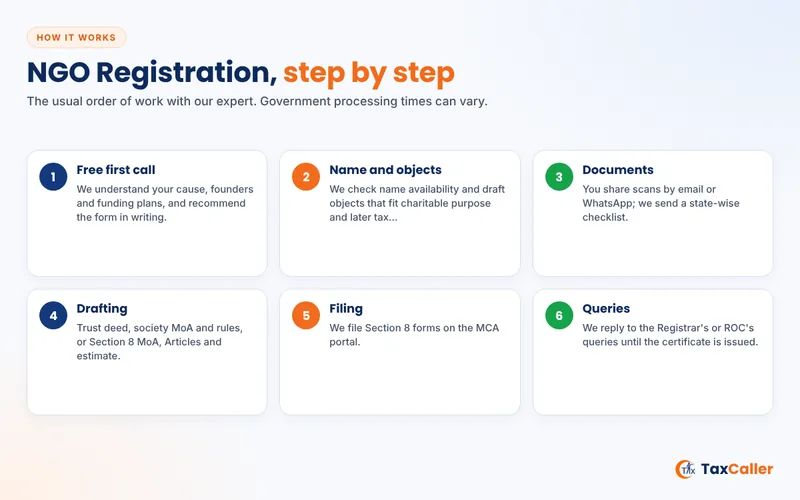
NGO Registration: how the work moves, step by step
We handle NGO registration online from start to finish. You visit an office only where your state's law needs founders to sign in person, such as the Sub-Registrar for a trust deed.
Free first call: we understand your cause, founders and funding plans, and recommend the form in writing.
Name and objects: we check name availability and draft objects that fit charitable purpose and later tax approval.
Documents: you share scans by email or WhatsApp; we send a state-wise checklist.
Drafting: trust deed, society MoA and rules, or Section 8 MoA, Articles and estimate.
Filing: we file Section 8 forms on the MCA portal. For a society, we file on the state Registrar's portal with the applicant's own login and OTP where the state allows it, or prepare the file for the counter. For a trust, we book the Sub-Registrar slot. We track every step.
Queries: we reply to the Registrar's or ROC's queries until the certificate is issued.
After registration: PAN, bank account letter, Darpan sign-up and Form No. 104, as per your plan.
Handover: certificate, deed or licence, plus a calendar of yearly dates.
Typical timelines
Our drafting: 2 to 4 working days after documents are complete.
Trust: 1 to 3 weeks after drafting, depending on Sub-Registrar slots.
Society: 3 to 8 weeks, depending on the state Registrar.
Section 8 company: 3 to 5 weeks, including name approval and licence.
Provisional 12A and 80G: up to about two months, given the one-month rule after the month of filing.
These are typical times from our work, not legal deadlines. Government offices can take longer.
NGO Registration Fees: Government Costs and Our Fee
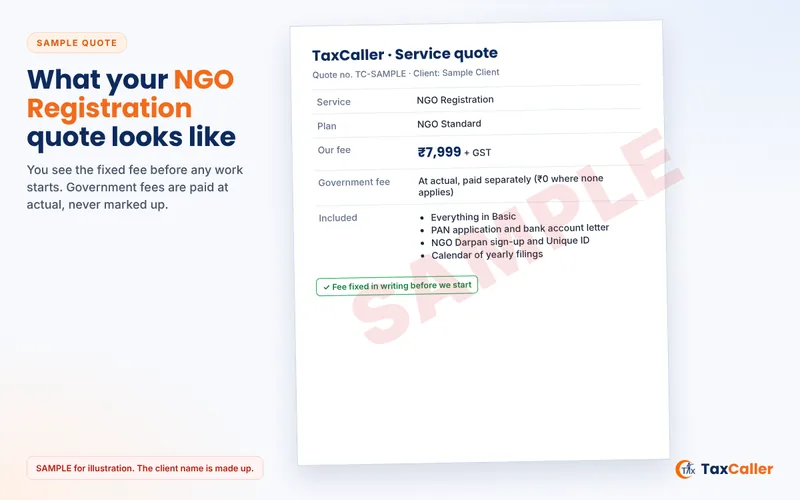
NGO Registration: SAMPLE quote, for illustration only
The cost has two parts: government charges paid to the state or MCA at actual, and TaxCaller's professional fee. We show both separately before any work starts.
Government costs (paid at actual)
Form
Main government heads
Known amounts
Trust
Stamp duty on the deed, Sub-Registrar registration fee, copy charges
Set by each state's stamp and registration law; often linked to the corpus
Society
State registration fee, stamp paper for affidavits, notary, certified copies
Set by the state under Section 3; for example ₹50 in Goa and ₹2,000 plus ₹45 user charges in Telangana
Section 8 company
Name reservation, stamp duty on MoA and AoA, DSC
Name reservation ₹1,000. SPICe+ filing fee is nil where authorised capital is up to ₹15 lakh
Tax approvals
Forms 104 and 105
No fee listed in the official FAQs
Darpan
Sign-up
No fee
Online guides quote all-in cost ranges, but these are planning estimates. There is no all-India official fee schedule for trusts and societies, so check your state's registration or Registrar portal.
TaxCaller's fee
TaxCaller's fee for NGO registration starts at ₹4,999 + GST. Government fees, stamp duty, DSC and notary charges are paid separately at actual. Our expert gives you the full estimate, our fee + GST and the expected government costs, on the first call. There are three plans below. Basic and Standard cover a trust or society; a Section 8 company is in the Complete plan. Form No. 105 for regular registration, filed after work starts, is a separate service with its own fee, quoted when it falls due.
Can you start an NGO without money?
Almost. A society and a Section 8 company need no minimum capital or fund. A trust needs some trust property, but a small corpus is accepted. You still pay the government charges above. Many NGOs start with founders' contributions and raise donations only after PAN, bank account and 80G approval are in place.
State Rules: Delhi, Uttar Pradesh (Ghaziabad, Noida) and Other States
Trusts and societies are run by state offices, so the state decides the portal, the fee and some extra rules. A Section 8 company follows one central system, with only the Registrar of Companies office differing by state.
Delhi
Society: Delhi follows the Societies Registration Act, 1860. Societies register with the Registrar of Societies of the Delhi Government.
Trust: Delhi has no separate public trusts Act. The deed is registered with the Sub-Registrar of the area.
Section 8: ROC Delhi.
Uttar Pradesh, including Ghaziabad and Noida
Society: registered with the Registrar of Firms, Societies and Chits, Uttar Pradesh. As reported, in UP the application is made online on the Registrar's portal (uprfsc.gov.in), with documents at the district office where asked. We prepare and check every document and file it with the applicant's own portal login and OTP; government fee at actual. UP uses the 1860 Act as amended by the state. Under Section 3-A, the certificate is valid for five years and must then be renewed. A society that does not renew within one year of expiry is treated as unregistered under Section 3-A(5).
Trust: registered with the Sub-Registrar of the district, with appointments and stamp payment through the UP registration department system.
Section 8: companies in Ghaziabad and Noida fall under ROC Kanpur.
Law under change: the UP Government has said it will replace the 1860 Act with a new state law. Until a new law is passed and notified, the amended 1860 Act applies.
Other states
State
Society law
West Bengal
West Bengal Societies Registration Act, 1961
Madhya Pradesh
Madhya Pradesh Society Registrikaran Adhiniyam, 1973; online filing on the MP Online system
Karnataka
Karnataka Societies Registration Act, 1960
Tamil Nadu
Tamil Nadu Societies Registration Act, 1975
Maharashtra
1860 Act plus the Maharashtra Public Trusts Act, 1950; Charity Commissioner handles both
A public charitable trust or society in Maharashtra also registers as a public trust with the Charity Commissioner.
Abhinay Rai Company Registration Expert
Have a question on this topic? Ask Abhinay on a free call.
Government NGO Portals That Are Not Registration Offices
Many government portals with "NGO registration" in their name do not create an NGO. They are scheme or panel sign-ups for organisations that are already registered as a trust, society or Section 8 company. Search results show several of them, so it helps to know which is which.
Portal
What it really is
NGO Darpan (NITI Aayog)
Common database and Unique ID for grants; you need an existing registration first
The National Trust (Union Social Justice Ministry)
Registration for NGOs working with persons with autism, cerebral palsy, intellectual disability and multiple disabilities, to join its schemes. As per the National Trust registration guidelines, voluntary organisations need income and spending of at least ₹3 lakh a year and at least 20 beneficiaries with UDID over the last two years
Ministry of Tribal Affairs NGO portal
Sign-in for NGOs seeking the ministry's support; asks for the Darpan Unique ID (in a format like UP/2016/0103002) and the PAN registered on Darpan
Development Commissioner (Handicrafts)
Empanelment of NGOs for handicraft schemes; asks for the Darpan ID, the PAN and a declaration that the NGO is not blacklisted. Individual exporters and entrepreneurs do not need Darpan there
UP Relief Commissioner (Rahat portal)
Directory form for NGOs and corporate bodies that help in disaster relief: district, work level (block to all India), areas such as relief material or rehabilitation, specialisation, manpower and whether services are paid
National Portal of India (india.gov.in)
Lists an "Apply online for Registration of a Society" service; the filing itself is with your state Registrar
Vidyanjali (Ministry of Education)
Volunteer and contribution platform linking NGOs and donors with schools and colleges
Ministry of External Affairs NGO form
Profile form for diaspora-related support; asks under which Act you are registered
National Trust panel: rules in short
The National Trust site handles new NGO applications, edits, status checks and renewal. Its guidelines apply only to that body's schemes:
Everything is uploaded online as PDF files of up to 5 MB each; no hard copies.
Documents include the MoA or trust deed with the registrar's stamp, by-laws, a registration certificate under the Rights of Persons with Disabilities Act, 2016, Aadhaar of governing body members, the last year's activity report, two years' audited accounts, the NGO's PAN and Form E.
Three categories: associations of persons with disabilities, associations of parents (over 50% of the governing body in each case) and voluntary organisations.
Voluntary organisations need donations and CSR funds of at least 20% of income; 12A and 80G are optional.
Modification requests must be met within 60 days. A rejected applicant can reapply only after six months, and false information leads to cancellation and blacklisting.
These portals, and online guides about them, are not the law. Check any guide against the Act, the rules and the official portal before you file.
In short, first register under one of the three laws, then get Darpan, then apply on the scheme portal that matches your work. Any site that offers to "register your NGO" without a deed, memorandum or MCA filing is giving you a listing, not a legal identity.
How to Check an NGO's Registration and Download Its Certificate
You check an NGO through the office that registered it, and through Darpan for its Unique ID. There is no single national register of every NGO.
Form
Where to check
Certificate copy
Section 8 company
"View Company/LLP Master Data" on the MCA portal, by name or CIN
Certificate of incorporation and licence are emailed on approval; copies can be viewed through MCA's public documents service for a fee
Society
State Registrar of Societies portal, where a search is offered
Certificate from the Registrar; certified copies on request
Trust
Sub-Registrar records; the registered deed carries the registration number and book details
Certified copy from the Sub-Registrar
Any of the three
Darpan, if the NGO has signed up
Darpan Unique ID details (not a registration certificate)
What an "NGO registration certificate" is
It is the document your registering office issues: the registered trust deed, the society's certificate under Section 3 of the 1860 Act, or the company's certificate of incorporation with the Section 8 licence. The Darpan ID, the Form No. 106 or 107 tax order and the CSR-1 number are approvals that come later. Keep all of them in one folder; banks, donors and grant portals ask for them together.
Checking an NGO before you donate
Ask for its PAN, registration certificate, current tax approval with its Unique Registration Number, and the latest audited accounts. Check that the name matches on all of them.
Annual Compliance and Penalties After Registration
Every registered NGO must keep accounts, file an income tax return every year and stay current with its registering office. Missing these can cost the tax exemption.
Item
Trust
Society
Section 8 company
Books of account and audit
Yes
Yes
Yes, statutory audit
Income tax return
Yes, every year
Yes, every year
Yes, every year
Donation statement and donor certificates (Form No. 113 and 114)
If Section 354 approval held
If Section 354 approval held
If Section 354 approval held
Registering office filings
Change reports where the state Act asks
Annual list under Section 4; renewal in UP and some states
AOC-4, MGT-7, AGM, DIR-3 KYC
Meetings and registers
Trustee meetings as the deed says
Governing body and general meetings as the rules say
At least one board meeting within every six calendar months (2015 exemption notification); statutory registers under Section 88
Section 8 company: Section 8(11) fines the company ₹10 lakh to ₹1 crore for breach of licence conditions; officers face ₹25,000 to ₹25 lakh. Late annual returns attract ₹100 a day additional fee.
Society in UP: no renewal within one year of expiry means the society is treated as unregistered (Section 3-A(5)).
Any NGO: late tax filings, private benefit to founders or misuse of funds can lead to cancellation of Section 332 registration and tax on income.
FCRA: foreign money taken without approval can lead to prosecution.
Shadab Company Registration Expert
Have a question on this topic? Ask Shadab on a free call.
Most problems come from choosing the wrong form or drafting weak documents. These are the mistakes we see most often.
Picking a form by price alone: a cheap trust may not suit a group that wants elections, and changing later is hard.
Vague objects: objects like "any welfare work" or anything with profit to members can block tax approval later.
Religious and charitable mix without care: Section 354 approval is not given to bodies working for a particular religious community or caste.
Names that are too close to an existing one: or names that suggest government links. Use of certain official names and emblems is barred by central law.
Missing dissolution clause: the deed or rules must say surplus goes to a similar charity, never to members.
Trust deed with revocation power: Section 332 needs property held under an irrevocable trust.
Not applying for Form No. 104 early: donors cannot get a deduction until Section 354 approval is in place.
Taking a foreign donation in a normal account: it must go to the FCRA account.
Ignoring Darpan: it holds up bank KYC and grant applications.
Forgetting UP society renewal: five years pass quickly.
Trusting outdated guides: some still show Form INC-12 or INC-31 for a new Section 8 company, a 12A that never needs renewal, or only the 1961 Act section numbers. Regular registration now runs for a fixed term, generally five tax years.
Worked Example: A Ghaziabad Education NGO From Idea to 80G
Here is how a typical case runs. Names and figures are for illustration.
The founders. Three teachers in Ghaziabad want to run evening classes for children of daily-wage workers. They want to keep control within the three of them and hope to approach local companies for CSR later.
The choice. Seven members are not available, so a society is out. A Section 8 company is possible, but the yearly MCA filings feel heavy for now. We recommend a public charitable trust with all three as trustees and an irrevocable deed.
The timeline.
Week 1: first call, name check, deed drafted with education objects, a dissolution clause and a small corpus.
Week 2: stamp duty paid as per the UP schedule; deed registered at the Sub-Registrar with two witnesses.
Week 3: PAN applied for; bank account opened after PAN arrives; Darpan profile created.
10 December: Form No. 104 filed for provisional registration under Section 332 and provisional approval under Section 354.
By 31 January: the order is due, since the rule allows one month from the end of the month of application.
Classes start in March: Form No. 105 for regular registration must be filed within six months, so by early September.
After three years of work: CSR-1 filed on MCA, so companies can fund the classes.
The founders paid government charges at actual and TaxCaller's fee + GST, and got a yearly calendar for returns, audit and donor statements.
Pre-filing checklist
Form chosen and reasons written down
Two or three name options checked
Objects written as charitable purposes
All founders' PAN, ID and address proofs collected
Office proof and owner's NOC ready
Dissolution and no-profit clauses in the draft
Plan for PAN, bank, Darpan and Form No. 104 right after registration
The biggest change in 2026 is the new income tax law. Here is what changed this year and what to watch.
Income-tax Act, 2025 in force from 1 April 2026: it replaced the 1961 Act. NGO registration moved from Sections 12A/12AB to Section 332; donor approval moved from 80G(5) to Section 354; donor deduction is now Section 133(1)(b)(ii).
New forms under the Income-tax Rules, 2026: Form No. 104 replaces 10A, Form No. 105 replaces 10AB, and Forms 113 and 114 replace 10BD and 10BE.
Old registrations continue: under Section 355, a body with a valid 12A, 12AA, 12AB or 10(23C) registration counts as a registered non-profit organisation.
FCRA (Amendment) Rules, 2026: notified on 22 June 2026, as reported, with purposes now chosen from a fixed list. An amendment Bill is with a Joint Parliamentary Committee.
DIR-3 KYC for Section 8 directors: once every three financial years from 31 March 2026.
Draft company incorporation rules: MCA put out draft Companies (Incorporation) Amendment Rules, 2026 in April 2026 that would simplify Section 8 filings. As of mid-November 2026 we have not seen final rules notified.
Uttar Pradesh society law: the state has said it will replace the 1860 Act. No new law is in force yet.
Darpan name: the portal's title now reads NPO Darpan; the Unique ID process stays the same.
What did not change: the three legal forms, the minimum members, and the need for separate tax, CSR and FCRA approvals.
Shreya Company Registration Expert
Have a question on this topic? Ask Shreya on a free call.
Working since 2018: registrations and tax work for small businesses and organisations.
Advice before filing: we recommend the form in writing, with reasons, before you pay for drafting.
Full sequence planned: registration, PAN, bank, Darpan, Section 332 and 354, CSR-1 and yearly dates in one plan.
Fee told upfront: our fee + GST and expected government costs before work starts.
Expert-reviewed: this page is reviewed by Abhinay Rai, Advocate and founder of TaxCaller.
Local and online: office in Ghaziabad for UP and Delhi NCR; online across India.
TaxCaller is a private firm. We are not linked with any Registrar, NITI Aayog or government department. Government fees go directly to the government. See all pricing, try our tools, ask a tax consultant, or contact us to book your free first call.
PAN card of each founder, trustee, member or director
Aadhaar, voter ID, passport or driving licence of each founder
Passport-size photo of each founder
Office address proof: electricity or water bill not older than 2 months
No-objection letter from the property owner
Rent agreement (if rented) or ownership papers (if owned)
Proposed NGO name (two or three options) and list of objects
Trust: details of settlor, trustees and initial corpus; two witnesses
Society: Memorandum of Association signed by 7 or more members and rules certified by 3 governing body members
Section 8: DSC of each director, MoA (INC-13), Articles and three-year income and expenditure estimate
After registration: NGO PAN, bank account details and office bearers' details for NGO Darpan
Why TaxCaller
Real experts, not a call centre
Your work is handled by experienced professionals who explain every step, check your documents and keep you updated.
Registered company
TaxCaller is run by TaxCaller India LLP (LLPIN AAQ-7388), serving clients since 2018.
Fee told upfront
You know the complete fee, our professional fee and the government fee, before any work starts. No hidden charges.
Support after the work
Notices, renewals, returns and compliance reminders: we stay with your business after the registration is done.
Reviewed By
Expert for this topic NGO Registration
Abhinay Rai
Advocate
Abhinay Rai is a Advocate specialising in NGO Registration. The process, documents, timelines and fees on this page are checked against the current rules and government portals, and updated whenever the law, forms or fees change.
Yes, mostly. A Section 8 company is filed fully online on the MCA portal. Many states accept society applications online. A trust deed is usually signed in person before the Sub-Registrar, though slots and stamp duty are booked online. Darpan, Form No. 104 and CSR-1 are online. We prepare the papers and file or guide each step for you.
Can I start my own NGO without money?
Almost. A society and a Section 8 company need no minimum capital or fund. A trust needs some trust property, but a small corpus is accepted. You still pay government charges such as stamp duty and registration fee, and our fee + GST. Many founders start with their own small contribution and raise donations after 80G approval.
Which NGO registration type is right for me?
There is no single right answer. A trust suits two or three people who want firm control and low yearly work. A society suits seven or more people who want elected management. A Section 8 company suits groups planning CSR or foreign funding at scale. Tell us your plans and our expert recommends one in writing.
Who is eligible for NGO registration?
Any adult Indian who can enter a contract can be a founder. A trust needs a settlor and trustees, a society needs seven persons, and a Section 8 company needs two members and two directors at least. Companies can also be founders in some forms. The objects must be charitable, with no profit going to members.
What are the NGO registration fees?
There are two parts. Government charges, such as stamp duty, Registrar fee or MCA name fee, are paid at actual and depend on your state and form. TaxCaller's fee is separate and charged + GST. Darpan has no fee, and the official FAQs list none for Forms 104 and 105. Our Form No. 105 work is a separate service.
Does every new NGO need a Darpan ID?
It is not needed to register a trust, society or Section 8 company. But ministries ask for the Darpan Unique ID before grants, and RBI KYC rules require banks to make sure a non-profit customer is on Darpan. So in practice every active NGO should sign up soon after getting its PAN. There is no fee for it.
What is the full form of NGO?
NGO stands for Non-Governmental Organisation. It is a body run by private people, not the government, for a social or public purpose. In India an NGO is registered as a trust, a society or a Section 8 company. The new Income-tax Act, 2025 calls a body registered with the tax department a registered non-profit organisation.
How do I download an NGO registration certificate?
It depends on the form. A Section 8 company receives its certificate of incorporation and licence by email from MCA. A society gets its certificate from the state Registrar, often as a PDF where the state portal is online. A trust gets back its registered deed from the Sub-Registrar. Darpan gives a Unique ID, not a certificate.
How can I check if an NGO is registered?
For a Section 8 company, search its name or CIN under View Company/LLP Master Data on the MCA portal. For a society, use the state Registrar's portal or ask for a certified copy. For a trust, ask for the registered deed. Also check the Darpan Unique ID, and the Section 332 or 12A order with its registration number.
What is the official government website for NGO registration?
There is no single central authority or website. Section 8 companies register on mca.gov.in. Societies register with the state Registrar, such as the Registrar of Firms, Societies and Chits in Uttar Pradesh. Trusts register with the Sub-Registrar. Then ngodarpan.gov.in gives the Unique ID, and the income tax portal handles 12A and 80G. Scheme portals are not registration offices.
How long does NGO registration take?
A trust typically takes about 1 to 3 weeks once the deed is drafted, a society 3 to 8 weeks depending on the state, and a Section 8 company 3 to 5 weeks. Provisional 12A and 80G add up to two months, since the order is due one month after the month you apply. Government delays can extend these.
Can one person start an NGO?
One person can create a trust as the settlor, but a trust normally has at least two trustees for smooth working. A society needs seven persons, and a Section 8 company needs at least two members and two directors. So a single founder usually forms a trust with a family member or trusted friend as co-trustee.
Can a new NGO get CSR funds or foreign donations?
CSR funds need CSR-1 registration with MCA, which requires 12A and 80G status. Where a company engages an NGO it did not set up, a three-year track record is also needed. Foreign money needs FCRA approval. A new NGO usually applies for prior permission for a specific donation, since full registration needs a working track record.
How do I become a member of an NGO in India?
It depends on the NGO's form and rules. A society admits members as its rules say, often by application and a fee. A Section 8 company adds members by issuing shares or admitting them to membership under its Articles. A trust has trustees, not members, and new trustees are appointed as the deed says. Volunteering needs no membership.
Book a free call to choose between a trust, society and Section 8 company. We show our fee + GST and the government costs separately before any work starts.