Starting from · ₹1,999 Trademark Assignment Assignment Basic plan
STARTING FROM₹1,999
FEE TOLD UPFRONTFree first call
!Brand not protected?Your rights count from the filing date, so file early
Since 2018Trusted Experience
980+Experts Connected
220+Cities Served
1164+Agents Available
12000+Founders Trusted
S
Srishti Magoo
★★★★★
Excellent experience with TaxCaller for filing my &
my family members ITR returns. The entire process was
smooth, quick and hassle-free. They are professional,
knowledgeable and guided me through every step with patience.
O
obeid sait
★★★★★
The team has handled my taxes for the past three years,
and it's been a wonderful, hassle-free experience.
Thank you for your consistently quick and efficient service.
P
Pushkar
★★★★★
They are among the best in their field. Their work culture
is highly professional, and their client service is smooth
and reliable. They can confidently be relied on to get the job done.
P
Prasad Sheth
★★★★★
Excellent experience with TaxCaller! The ITR filing
process was smooth, quick, and completely hassle-free.
The CA was knowledgeable, responsive, and explained everything clearly.
A
Apoorv Bansal
★★★★★
Excellent service for ITR filing. The team was highly
professional, responsive, and guided me through the entire
process smoothly. My return was filed accurately and on time.
A
Abhishek Kumar
★★★★★
I was searching for a good CA firm in Ghaziabad and found
TaxCaller. The experience was excellent from start to finish.
The team is responsive, transparent, and genuinely helpful.
U
uma pandey
★★★★★
Great service! TaxCaller India made the entire ITR filing
process quick, smooth, and hassle-free. They answered all
my queries patiently and ensured maximum accuracy.
T
tanu mittal
★★★★★
Excellent job! We've been connected for many years,
and your success truly makes me happy. You are an
incredibly intelligent person. Keep shining, keep growing.
B
Bhanu Pratap Maurya
★★★★★
I am filing my ITR since past 3 years with Abhinav and
Firm is known as TaxCaller and they are professional
interms of ITR rules. They will explain and tell you all
the information.
A
ashish Sharma
★★★★★
I am providing my honest reviews:
No.1 service ...
A
AARYAN GROUP
★★★★★
Honestly, finding a good CA firm in Ghaziabad was
confusing, but TaxCaller India made it simple.
I contacted them for GST work and the experience was smooth.
N
News Speaks
★★★★★
If you're looking for a reliable CA firm in Ghaziabad,
TaxCaller India is a great choice. They provide complete
taxation and compliance solutions including GST.
A
Anshul Chaprana
★★★★★
Got my GST registration done through TaxCaller CA firm.
Process was quite smooth, they guided properly on documents
and didn't waste time. Overall good experience.
How we work
Online · Call · WhatsApp
Quick answer
Trademark assignment is the written transfer of a trademark's ownership from one person to another, with or without the business goodwill. The new owner files Form TM-P under Section 45 to get recorded on the register. The e-filing fee is ₹9,000 per mark. Stamp duty on the deed depends on your state.
Reviewed by Abhinay Rai · Updated 15 Nov 2026
Pick a plan that fits
Assignment Basic
One registered mark moving with goodwill, for example proprietorship to company
₹1,999+ GST
+ TM-P ₹9,000 per mark
Pay now (38%)₹760+ GSTAfter the TM-P receipt₹1,239+ GST
Due diligence on all marks, licences and pending matters
Name or address correction on the register first
Transfer of pending applications and open cases
Licence back or registered user (TM-U) paperwork
Renewal calendar for all transferred marks
Government fees and taxes are extra where applicable. Our expert confirms the final amount on the first call. No hidden charges.
About Trademark Assignment
Trademark assignment is how a brand changes hands in India. The owner (the assignor) transfers the mark to a new owner (the assignee) through a signed deed. The new owner then asks the Trade Marks Registry to record the change. Until that happens, the official register still names the old owner.
The rules sit in Chapter V of the Trade Marks Act, 1999, Sections 37 to 45, and in Rules 75 to 81 of the Trade Marks Rules, 2017. They cover registered and unregistered marks, full and partial transfers, and transfers with or without the goodwill of the business. Each choice changes the paperwork, the deadlines and the government fee.
This page explains the whole process in plain words. You will see how assignment differs from licensing, what the deed must say, how stamp duty works, which forms and fees apply, and what can go wrong. TaxCaller's trademark experts draft the deed, check the stamp duty and file Form TM-P online for you.
Complete guide
Choose a topic to open it. Every answer gives the rule or section it comes from.
01 Topic 1 of 20
What Is Trademark Assignment? Meaning Under the Law
An assignment is a transfer of ownership. Section 2(1)(b) of the Trade Marks Act, 1999 (India Code) defines it as an assignment in writing by act of the parties concerned. So a spoken promise or a handshake deal does not transfer a trademark. You need a written document signed by the parties.
Section 37 gives the registered proprietor the power to assign the mark and to give a valid receipt for the price. This power is subject to the Act and to any rights of other people that already appear on the register. Section 38 then says a registered mark can be assigned with or without the goodwill of the business. It can cover all the goods or services it is registered for, or only some of them.
Assignment vs transmission. The Act also uses the word "transmission". Section 2(1)(zc) defines it as a transfer by operation of law, such as passing to the legal heirs of a deceased owner, or any other mode of transfer that is not an assignment. A sale of a brand is an assignment. A brand that passes to heirs on death is a transmission. Both are recorded in the same way, through Form TM-P.
Term
What it means
Assignor
The current owner who transfers the mark
Assignee
The new owner who receives the mark
Consideration
The price or other value paid for the mark (it can also be nil, as in a gift)
Goodwill
The reputation and customer pull of the business that uses the mark
Assignment deed
The signed, stamped document that transfers the mark
Form TM-P
The Registry form used to record the new owner and for related requests
Trademark Assignment vs Licensing: Which One Fits You?
Many owners mix up assignment and licensing of a trademark. They are very different. Assignment hands over ownership for good. Licensing only gives permission to use the mark, while ownership stays with you.
Point
Assignment
Licence (registered user)
Ownership
Moves to the assignee
Stays with the owner
Law
Sections 37 to 45
Sections 48 and 49 (registered users); "permitted use" in Section 2(1)(r)
Registry form
Form TM-P
Form TM-U, filed jointly by owner and user
Government fee (e-filing)
₹9,000 per mark
₹4,500 per mark
Payment
Usually a one-time price
Usually a royalty or periodic fee
Control after the deal
None for the old owner
Owner sets quality rules and can end the licence as per the agreement
Who renews and enforces
New owner
Owner (the agreement may share some tasks)
Under Section 48(2), use of the mark by a registered user counts as use by the owner. This helps the owner if anyone later claims the mark has not been used. A written licence with the owner's consent is also "permitted use" under Section 2(1)(r), even if the user is not registered. Formal registration as a registered user (Section 49) adds a public record of the arrangement.
Change of name is not an assignment. If your company only changes its name, the owner is the same legal person. You record the new name under Section 58 instead. But when a proprietorship or partnership turns into a company or LLP, the owner changes. That needs a proper assignment.
Is this the right service for you? Choose assignment if ownership must move. If you are still protecting a new brand, start with our trademark registration service. If your mark has an examination report or an opposition, see trademark objection reply or trademark opposition.
Zubair Trademark Expert
Have a question on this topic? Ask Zubair on a free call.
Types of Trademark Assignment: Complete, Partial, With or Without Goodwill
Every trademark assignment falls into two choices. The first is how much of the mark you transfer. The second is whether the goodwill of the business goes with it.
1. Complete assignment. The owner transfers all rights in the mark, for every class and every listed good or service. The old owner keeps nothing. This is common when a business or brand is sold outright.
2. Partial assignment. The owner transfers the mark only for some goods or services. Section 38 allows this. For example, a brand registered for clothing and footwear may be assigned only for footwear. The old owner keeps the mark for clothing. The Registry checks that the split will not confuse buyers (Section 40).
3. Assignment with goodwill. The mark moves along with the reputation and business tied to it. The buyer can keep using the brand's history, such as "serving customers since" claims. No extra advertisement step is needed.
4. Assignment without goodwill. Only the mark moves. The old owner keeps the business and its goodwill, often for other products. This is also called a gross assignment. Section 42 adds a condition: the assignee must apply for advertisement directions within six months, or the assignment does not take effect. We explain this step in full below.
Two cases are not treated as "without goodwill" under the Explanation to Section 42:
A partial assignment for some goods or services, if the goodwill of the business in those goods or services moves too.
An assignment of a mark used for goods exported from India, or services used outside India, if the goodwill of the export business moves with it.
Type
What moves
Extra step
Complete with goodwill
Whole mark and business reputation
None beyond Form TM-P
Complete without goodwill
Whole mark only
Section 42 directions and advertisement
Partial with goodwill
Mark for some goods or services, with that goodwill
You need an assignment whenever the legal owner of a brand changes. These are the situations we see most often:
Proprietorship to company or LLP. The owner registered the mark in his or her own name. The business is now a company or LLP. The company is a separate legal person, so the mark must be assigned to it. See our company registration service if you are still setting up the company.
Director or founder to company. A founder filed the trademark personally before the company was formed. Investors usually ask for the brand to sit in the company's name before they invest.
Sale of a business or brand. A buyer purchases the business, or only the brand. The deed and the TM-P record the transfer.
Mergers and group restructuring. Brands move between group companies, or to a holding company that licenses them back.
Partnership changes. A partner leaves, a firm dissolves, or partners split the brands among themselves.
Family transfers. A parent gifts a brand to a child, or brands are divided in a family settlement.
Death of the owner. The mark passes to legal heirs by transmission. They record their title with Form TM-P.
Foreign and Indian parties. A foreign owner assigns an Indian mark to an Indian company, or the reverse.
When to act. Sign the deed as part of the deal, not months later. Then file Form TM-P soon after. If the transfer is without goodwill, the Section 42 clock of six months starts on the date of the assignment.
You do not need a registration certificate to sell a brand. Section 39 says an unregistered trademark can be assigned or transmitted, with or without goodwill. The owner of an unregistered mark has rights built up through use. Section 27(2) keeps the right to bring a passing off action, even without registration. Those rights can be sold.
There are some practical points:
No Section 45 entry for an unregistered mark. Section 45 deals with a registered trade mark. For a mark that is not on the register, the deed itself is the main proof of the buyer's title. Keep the original deed safe.
Section 42 still applies. Section 42 covers marks "whether registered or unregistered". So an unregistered mark assigned without goodwill also needs advertisement directions. Under Rule 80, the application must show the mark and give details of its use.
Use evidence matters. List invoices, sales figures and dates of first use in the deed or its schedule. The buyer will need this proof to defend the brand later.
Apply soon. The buyer should file a new application under its own name. See our trademark registration page for that process.
Pending applications. Many brands are sold while the application is still under examination. The buyer can ask the Registry to record the change in the pending application, supported by the deed. We check the current status first. If there is an open examination report or opposition, the reply or hearing must continue in the right name.
Abhinay Rai Trademark Expert
Have a question on this topic? Ask Abhinay on a free call.
Legal Limits on Assignment: Sections 40, 41, 43 and 44
The Act lets owners transfer marks freely, but it also protects buyers from confusion. Four sections set limits.
Section 40: no confusing split of rights. A mark cannot be assigned if the result would give more than one person exclusive rights in the same or similar marks for the same or similar goods or services, where use by both is likely to deceive or confuse. A proviso allows it where the limits on each person's rights stop them from being used together. The owner can ask the Registrar for a certificate under Section 40(2) on whether a proposed assignment is valid. The e-filing fee is ₹2,700.
Section 41: no split by region. An assignment that would create exclusive rights in different parts of India is not allowed without the Registrar's approval. The Registrar may approve it if it is not against the public interest. The e-filing fee for approval is ₹2,700.
Section 43: certification marks. A certification trade mark cannot be assigned or transmitted without the Registrar's consent. The application must be in writing in the prescribed manner. The e-filing fee is ₹1,800.
Section 44: associated marks. Associated trade marks can only be assigned as a whole, not one by one. If your brand has associated marks on the register, the deed must cover all of them.
We check the register for associated marks, similar marks owned by the same assignor, and any registered users before drafting. This avoids a refusal after the deal is signed.
Assignment Without Goodwill: Section 42 Advertisement Directions
Section 42 is the step most people miss. It applies when a trademark, registered or unregistered, is assigned without the goodwill of the business in which it is used.
The rule. The assignment does not take effect unless the assignee does two things:
Applies to the Registrar for directions on advertising the assignment, within six months from the date of the assignment. The Registrar may extend this by up to three months in total.
Advertises the assignment in the form, manner and time the Registrar directs.
Rule 80(1): the request for directions is made in Form TM-P. It must state the date of the assignment and the registration details. For an unregistered mark, it must show the mark and describe its use.
Rule 80(3): a request to extend the time is also made in Form TM-P.
The Registrar may call for evidence or more information, then issues written directions.
The Registrar may refuse to consider the request where Section 41 applies, unless approval under that section has been obtained.
Rule 81: when the new owner later files to record the title, the application must say whether the assignment was made apart from the goodwill. If so, the applicant leaves a copy of the directions and proof of the advertisement with the Registry.
Section 42 request
E-filing fee
Physical filing fee
Directions for advertisement of assignment without goodwill
₹2,700
₹3,000
Extension of time under Section 42
₹1,800
₹2,000
If the six months (plus any extension) pass without a request, the assignment simply does not take effect. The parties would then need a fresh deed. So we put the Section 42 date in your tracker on the day the deed is signed.
Signing the deed transfers the mark between the parties. Recording tells the world. Section 45 sets the rules for registered marks.
Section 45(1): a person who becomes entitled to a registered mark by assignment or transmission must apply to the Registrar to register the title. The Registrar then registers that person as proprietor for the goods or services covered, and enters the details on the register.
Section 45(2): the Registrar may ask for more proof of title only where there is a reasonable doubt about a statement or document.
Section 45(3): if the parties dispute the validity of the assignment, the Registrar may refuse to record it until a competent court decides. In other cases, the Registrar disposes of the application within the prescribed period.
Section 45(4): until the application is filed, the assignment is ineffective against a person who acquires a conflicting interest in the mark without knowing about the assignment.
Until the change is recorded, the register still shows the old owner as proprietor. Registry notices, renewal reminders and public searches all point to that old owner. That is why we file soon after the deed is signed.
The Rules.
Rule 75: the application to register the title of the new owner is made in Form TM-P.
Rule 76: it is filed with a duly certified copy of the deed or instrument and a statement of case. The Registrar disposes of it ordinarily within three months from the date of application.
Rule 77: the Registrar may ask for further proof only on reasonable doubt.
Rule 78: an instrument that is not duly stamped is impounded and dealt with under Chapter IV of the Indian Stamp Act, 1899.
Rule 79: where a law controls sending money outside India, the Registrar will not record the title unless the needed permission is shown.
Form TM-P is filed online on the IP India e-filing portal by the new owner or by an authorised trade marks agent or advocate. The government fee is charged per trade mark.
Shadab Trademark Expert
Have a question on this topic? Ask Shadab on a free call.
The deed is the heart of the transfer. The Registry reads it to decide whether the new owner's title is clear. A weak deed causes queries, delays or disputes later. A good deed covers these points:
Parties. Full legal names, addresses and status (individual, firm, company, LLP) of assignor and assignee. The assignor's name must match the register.
Recitals. How the assignor owns the mark: application number, registration number, class, date of first use.
Schedule of marks. Every mark covered, with a clear image of each logo or label.
Goods or services. All of them, or the specific items in a partial assignment.
Goodwill clause. A clear statement that the transfer is with goodwill, or without goodwill.
Consideration. The price and how it is paid. If nil, say so (for example, a gift within a family).
Effective date. The date the rights move. This date also starts the Section 42 clock where it applies.
Territory. India as a whole. A split by region needs Registrar approval under Section 41.
Warranties. The assignor confirms it owns the mark, has not licensed or pledged it except as disclosed, and knows of no pending dispute.
Licences and registered users. What happens to existing licences.
Pending matters. Who handles open objections, oppositions, renewals or court cases.
Further assurance. The assignor agrees to sign any extra papers the Registry asks for.
Use of the mark after transfer. The assignor agrees to stop using it, except where the deed allows.
Governing law and disputes. Indian law, with a court or arbitration clause.
Signatures and witnesses. Signed by both parties or their authorised signatories, usually before two witnesses. For a company or LLP, attach the board or partners' resolution.
Notarisation is common practice and helps as extra proof, though Rule 76 only asks for a duly certified copy of the deed. Keep the original deed safe for life.
Stamp Duty on the Assignment Deed: State-Wise Rules
The assignment deed must carry the correct stamp duty. Stamp duty is a state subject. Each state either applies the Indian Stamp Act, 1899 with its own changes, or has its own Stamp Act. So the duty is not the same across India.
How the duty is worked out.
The rate depends on the state where the deed is signed and on how its stamp schedule classifies the deed.
In many states, a transfer for a price is charged on the value of the consideration. Other states charge a fixed amount for some agreements.
A gift or a transfer for nil price may be charged differently from a sale.
If a deed signed in one state is later used in another, some states ask for the difference in duty.
How it is paid. Many states sell e-stamp paper. Buy it in the name of one of the parties, for the correct value, before the deed is signed.
Why it matters for the Registry. Under Rule 78, if the Registrar finds the deed is not properly stamped, it is impounded and dealt with under Chapter IV of the Indian Stamp Act, 1899. That means delay, and the duty shortfall plus a penalty must be paid before the deed is accepted.
State note. TaxCaller works from Ghaziabad and handles clients across India online. We check the current stamp schedule of your state before you buy stamp paper. If the parties are in different states, we tell you which state's duty applies and whether any extra duty is needed. For the Registry side, Ghaziabad and Noida fall under the New Delhi office of the Trade Marks Registry, which covers Delhi, Uttar Pradesh, Haryana, Punjab and nearby states.
Trademark Assignment: how the work moves, step by step
You can finish the whole process with us online. Here is how our team runs it.
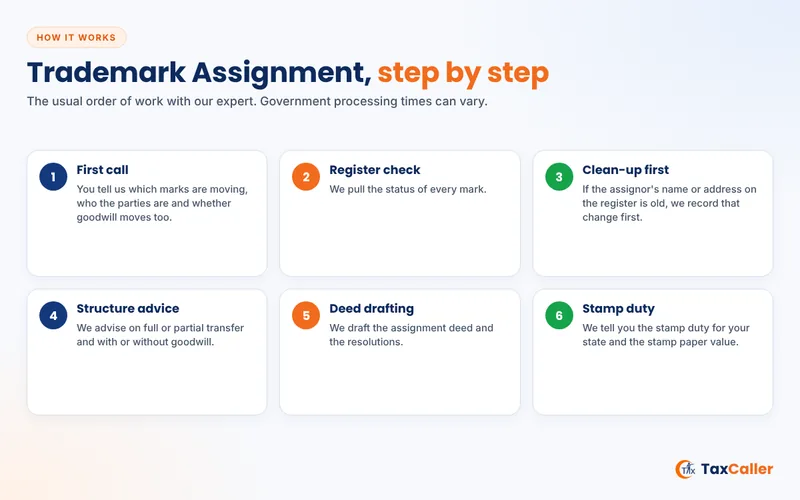
First call. You tell us which marks are moving, who the parties are and whether goodwill moves too. We confirm our fee before any work starts.
Register check. We pull the status of every mark. We check the recorded owner's name and address, associated marks, registered users, renewal dates and open objections or oppositions.
Clean-up first. If the assignor's name or address on the register is old, we record that change first. Otherwise the Registry may question the link between the deed and the register.
Structure advice. We advise on full or partial transfer and with or without goodwill. We flag any Section 40, 41, 43 or 44 issue.
Deed drafting. We draft the assignment deed and the resolutions. You review, and we revise.
Stamp duty. We tell you the stamp duty for your state and the stamp paper value. You buy the e-stamp paper and both parties sign before witnesses.
Section 42 request, if needed. For a transfer without goodwill, we file the request for directions in Form TM-P well within six months. We then publish the advertisement as directed and keep the proof.
Form TM-P filing. We file Form TM-P to record the new owner, with the certified deed and statement of case. You receive the filing receipt.
Follow-up. We track the request and reply to any Registry query or proof request under Rule 77.
Closing. Once the register shows the new owner, we share the updated record and a list of other records to update.
Timeline: How Long the Transfer Takes, Stage by Stage
The time taken depends on the Registry and on how ready your papers are. Here is a realistic plan.
Stage
Usual time
Basis
Register check and advice
1 to 2 working days
Our process
Deed drafting and review
2 to 5 working days
Depends on your comments
Stamp paper and signing
1 to 3 days
Depends on the parties
Form TM-P filing
Same or next working day after signing
Our process
Section 42 request (without goodwill only)
Within 6 months of the assignment, extendable by up to 3 months
Section 42
Registry decision on TM-P
Ordinarily within 3 months of application
Rule 76(2)
Extra time for queries or disputes
Varies
Section 45(2) and (3), Rule 77
The three months under Rule 76(2) is the ordinary target, not a fixed promise. Queries, unclear deeds or a dispute between the parties can take longer. The paperwork on our side usually takes about one to two weeks.
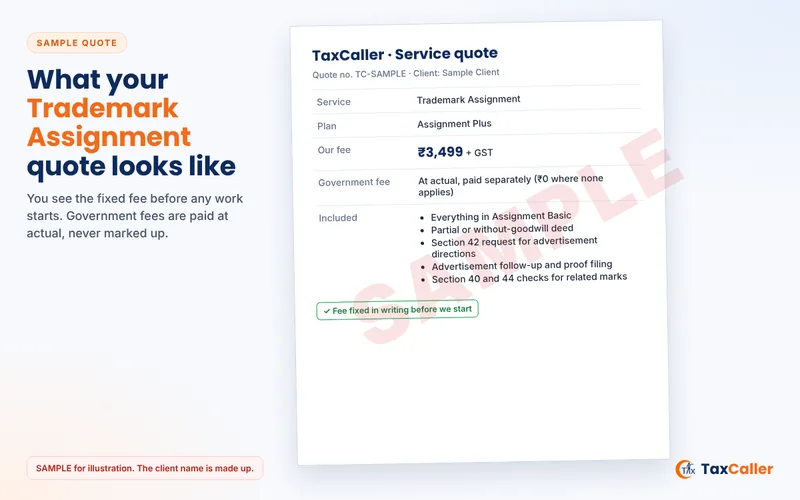
Trademark Assignment: SAMPLE quote, for illustration only
A trademark assignment has three kinds of cost. We show them apart so you know where each rupee goes.
1. Government fees. These come from the First Schedule to the Trade Marks Rules, 2017, shown on the IP India Form and Fees page. They are per trade mark. Unlike the TM-A filing fee, these assignment fees have no lower rate for individuals, startups or small enterprises.
Request (First Schedule, entry 4 or 5)
E-filing
Physical filing
Form TM-P: record subsequent owner after assignment or transmission (Section 45)
₹9,000
₹10,000
Directions to advertise an assignment without goodwill (Section 42)
₹2,700
₹3,000
Certificate on validity of a proposed assignment (Section 40(2)) or approval under Section 41
₹2,700
₹3,000
Extension of time under Section 42, or consent to assign a certification mark (Section 43)
₹1,800
₹2,000
Change of name or description of the owner (Section 58)
₹1,800
₹2,000
Change of address of the owner (Section 58)
₹900
₹1,000
Form TM-U: registered user (Section 49), for licensing
₹4,500
₹5,000
Example: a company buys three registered marks with goodwill. The TM-P fee is ₹9,000 x 3 = ₹27,000 on e-filing.
2. Stamp duty. Paid to your state government on the deed, as per your state's stamp law. Any advertisement cost under Section 42 is also paid at actual.
3. TaxCaller's fee. TaxCaller's fee starts at ₹1,999 + GST for one mark. Government fees (TM-P and other Registry fees, stamp duty and advertisement costs) are paid separately at actual. Extra marks, transfers without goodwill and disputed cases are quoted on the first call, before any work starts.
Zubair Trademark Expert
Have a question on this topic? Ask Zubair on a free call.
Tax on Selling a Trademark: Income Tax and GST Basics
A trademark is a valuable asset. Selling it can have tax effects for both sides. Plan for them before you sign.
Income tax for the seller. A trademark used in a business is a capital asset. Its sale can lead to capital gains. Under Section 55(2)(a) of the Income-tax Act, 1961, the cost of acquisition of a self-created trade mark or brand name is taken as nil. So most of the price can become a gain. Transfers made on or before 31 March 2026 fall under the 1961 Act. For transfers from 1 April 2026, the Income-tax Act, 2025 applies. Its Section 90(3)(c) keeps the same nil cost for a trade mark or brand name not bought from someone else. Your tax adviser should work out the gain under the Act that applies to your year.
For the buyer. A purchased trademark is an intangible asset in the buyer's books. Record it at cost, with the deed and payment proof. Our accounting and bookkeeping team can help with the entries.
GST. A transfer of a trademark for a price is generally treated as a supply of service under GST. A seller registered under GST must issue a tax invoice and charge GST at the rate notified for transfer of intellectual property rights. A gift between related persons can also have GST effects. Confirm this with your tax consultant before signing.
Cross-border deals. If the buyer pays a foreign seller, tax may need to be deducted at source and foreign exchange rules apply. Rule 79 of the Trade Marks Rules also requires any permission needed under the law on sending money outside India.
Risks of Not Recording the Transfer and Related Penalties
There is no separate fine for filing Form TM-P late. But the cost of delay can be high. Here is what can go wrong.
Third-party risk (Section 45(4)). Until the TM-P application is filed, the assignment is ineffective against a person who gets a conflicting interest in the mark without knowing of the assignment.
Register shows the old owner. Registry letters, renewal notices and search results go to the old owner. A buyer who cannot be traced on the register may miss deadlines.
Weak position in disputes. The Registry and courts start from the register entry. An unrecorded buyer must prove title through the deed and its stamping.
Assignment without goodwill fails. Under Section 42, if the request for directions is not made within six months (plus up to three months extension), the assignment does not take effect at all.
Stamp duty penalty. An under-stamped deed is impounded under Rule 78. The shortfall plus a penalty under the state's stamp law must be paid. The penalty can be several times the shortfall in some states.
Loss through non-use. Under Section 47, a registered mark can be removed for five years' continuous non-use. Plan who uses the mark during and after the transfer.
False ® claims. The buyer of an unregistered or pending mark must not use ®. Under Section 107, falsely representing a mark as registered attracts a penalty of up to ₹5 lakh or 0.5% of turnover, whichever is less.
Common Mistakes and Why the Registry Raises Queries
Most delays come from avoidable errors. These are the ones we fix most often.
Name mismatch. The assignor's name in the deed differs from the register. Record the name or address change first.
Unstamped or under-stamped deed. The deed gets impounded under Rule 78.
Missing goodwill clause. The deed does not say whether goodwill moves. The Registry cannot tell if Section 42 applies.
Missed Section 42 deadline. The six months from the assignment pass without a request for directions.
Associated marks left out. Section 44 needs associated marks to move together.
Classes or goods not listed. A deed that says "all rights" but omits a class or registration number invites a query.
Wrong signatory. A company signs without a board resolution, or a firm without all partners' consent.
Using old fee tables. Some websites still show older fee slabs based on how late you file. The current First Schedule has a flat TM-P fee of ₹9,000 (e-filing) per mark.
Treating a conversion as a name change. A proprietorship that became a company files a name change instead of an assignment. The owner has changed, so an assignment is needed.
Splitting by region. The deed gives North India to one buyer and South India to another, without Section 41 approval.
Ignoring licences. Existing licensees are not told, or the registered user entries are not updated.
Waiting too long. The deed is signed but TM-P is never filed. Years later, at renewal or in a dispute, the gap surfaces.
Abhinay Rai Trademark Expert
Have a question on this topic? Ask Abhinay on a free call.
After the Assignment: Records, Renewal and Brand Use
Recording the new owner is not the end. Update these records so the brand works smoothly in the new owner's hands.
Renewal. A registration lasts ten years from the filing date and must be renewed under Section 25. The new owner now renews it. Note the date and see our trademark renewal service.
Brand watch. Keep watching the Trade Marks Journal for copycat marks. Oppose them in time through our trademark opposition service.
Open cases. Continue any examination reply or hearing in the new owner's name, as agreed in the deed.
Licences. Sign fresh licence agreements in the new owner's name. Register them under Section 49 if you want a public record.
Business records. Update packaging, invoices, website, domain names, marketplace brand stores and social media accounts.
Tax and business registrations. If the brand now belongs to a new company, update its GST registration details and trade names where needed. A new small business can also get MSME (Udyam) registration.
Certified copies. Keep a certified copy of the updated register entry for bank, investor and legal use.
The Trade Marks Act, 1999 and the Trade Marks Rules, 2017 remain the core law. Here is what is new or worth knowing in 2026, based on the IP India news and updates page and its archive.
TM-P fees unchanged. As of November 2026, the First Schedule still shows ₹9,000 (e-filing) and ₹10,000 (physical) per mark to record an assignment or transmission.
Mandatory e-KYC. A public notice dated 9 July 2026 made e-KYC compulsory for all IP attorneys on the register of the Office of the CGPDTM. A notice dated 7 August 2026 moved the deadline from 9 August to 31 August 2026. A final extension to 30 September 2026 came through a notice dated 31 August 2026. If an agent or advocate files your Form TM-P, check that their e-KYC is complete.
Revised draft Trade Marks Manual. On 21 August 2026, IP India posted a revised draft Manual of the Trade Marks Office (Practice and Procedure). It is still a draft. It cannot override the Act or the Rules.
Refund of duplicate payments. A procedure dated 14 October 2026, posted on 22 October 2026, explains how to claim back a trademark fee paid twice by mistake. Claims should ideally be made within one year.
Warning on misuse of IP India's name. On 11 November 2026, IP India posted a notice prohibiting unauthorised commercial use of its name, logo and content. Deal only with the official portal for filings and fee payments.
AI and squatting. After a Delhi High Court order of 13 October 2026, a public notice dated 16 October 2026 invited suggestions for guidelines on the use and misuse of AI and on trademark squatting. No final guidelines are out yet.
New Income-tax Act. The Income-tax Act, 2025 applies from 1 April 2026. Capital gains on brand sales made from that date fall under the new Act's sections.
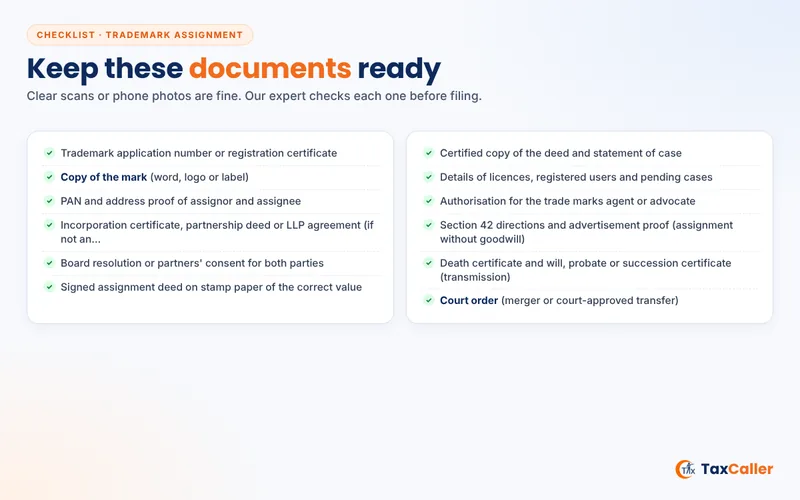
Trademark application number or registration certificate
Copy of the mark (word, logo or label)
PAN and address proof of assignor and assignee
Incorporation certificate, partnership deed or LLP agreement (if not an individual)
Board resolution or partners' consent for both parties
Signed assignment deed on stamp paper of the correct value
Certified copy of the deed and statement of case
Details of licences, registered users and pending cases
Authorisation for the trade marks agent or advocate
Section 42 directions and advertisement proof (assignment without goodwill)
Death certificate and will, probate or succession certificate (transmission)
Court order (merger or court-approved transfer)
Why TaxCaller
Real experts, not a call centre
Your work is handled by experienced professionals who explain every step, check your documents and keep you updated.
Registered company
TaxCaller is run by TaxCaller India LLP (LLPIN AAQ-7388), serving clients since 2018.
Fee told upfront
You know the complete fee, our professional fee and the government fee, before any work starts. No hidden charges.
Support after the work
Notices, renewals, returns and compliance reminders: we stay with your business after the registration is done.
Reviewed By
Expert for this topic Trademark Assignment
Abhinay Rai
Advocate
Abhinay Rai is a Advocate specialising in Trademark Assignment. The process, documents, timelines and fees on this page are checked against the current rules and government portals, and updated whenever the law, forms or fees change.
Trademark assignment is the transfer of ownership of a trademark from its owner to a new owner through a written deed. Section 2(1)(b) of the Trade Marks Act, 1999 requires it to be in writing. The new owner then files Form TM-P with the Registry under Section 45, so the register shows the new proprietor.
What is the government fee for trademark assignment?
The First Schedule to the Trade Marks Rules, 2017 sets the Form TM-P fee at ₹9,000 per mark for e-filing and ₹10,000 for physical filing. There is no lower rate for startups or individuals. Stamp duty on the deed is separate and depends on your state. TaxCaller's fee is charged separately, plus GST.
Can an unregistered trademark be assigned?
Yes. Section 39 allows an unregistered trademark to be assigned or transmitted, with or without goodwill. The buyer gets the rights built up through use, including the right to sue for passing off. If it is assigned without goodwill, Section 42 directions are still needed. The buyer should also file its own application soon.
What is the difference between trademark assignment and licensing?
Assignment transfers ownership for good, and the new owner records it with Form TM-P. Licensing only gives someone permission to use the mark, while you remain the owner. A licensee can be recorded as a registered user under Section 49 with Form TM-U. Licences usually earn royalties, while assignments usually involve a one-time price.
Is a trademark assignment agreement the same as an assignment deed?
In practice, yes. A trademark assignment agreement is the written document by which the owner transfers the mark, and it is usually called the assignment deed. Section 2(1)(b) needs it in writing. It should list the marks, goods, goodwill position, price and effective date, carry correct stamp duty, and be filed with Form TM-P.
Is there a time limit to file Form TM-P after assignment?
The current Rules set no late fee slab for filing Form TM-P, and the fee is flat. But delay is risky. Under Section 45(4), the transfer is ineffective against an unaware third party until the application is filed. For assignments without goodwill, the Section 42 request must be made within six months of the assignment date.
What happens if a trademark assignment is not recorded?
The register keeps showing the old owner as proprietor. Registry notices, renewal reminders and searches point to that person. The buyer must prove title through the deed in any dispute. Under Section 45(4), the transfer is ineffective against a person who gets a conflicting interest without knowing about it, until the TM-P is filed.
Is stamp duty payable on a trademark assignment deed?
Yes. The deed must be stamped under the stamp law of the state where it is signed, and rates differ by state. Many states charge duty on the price paid. Under Rule 78, the Registrar impounds an under-stamped deed and deals with it under the Indian Stamp Act, 1899. We confirm your state's current rate before signing.
What is assignment of a trademark without goodwill?
It means only the mark is transferred, while the old owner keeps the business and its goodwill. Section 42 then requires the new owner to apply to the Registrar for advertisement directions within six months, extendable by up to three months. The assignment is advertised as directed. Otherwise, the assignment does not take effect at all.
How long does the Registry take to record an assignment?
Rule 76(2) of the Trade Marks Rules, 2017 says the Registrar ordinarily disposes of a Form TM-P request within three months of the application date. Queries, unclear deeds or a dispute between parties can extend this. Our drafting, stamping and filing work usually takes one to two weeks before the request reaches the Registry.
Can I transfer my trademark from my proprietorship to my company?
Yes, and you should. A company or LLP is a separate legal person, so the mark must be assigned to it through a deed. Filing only a change of name is not correct here. The company then files Form TM-P to be recorded as owner. Investors and banks often check this before funding a business.
Can a trademark be assigned for only some goods or services?
Yes. Section 38 allows a registered mark to be assigned for all or only some of the goods or services it covers. This is a partial assignment. The Registry checks that it will not cause confusion under Section 40. If the goodwill in those goods moves too, it is not treated as an assignment without goodwill.
What happens to a trademark when the owner dies?
The trademark passes to the legal heirs by transmission, which Section 2(1)(zc) treats as transfer by operation of law. The heirs apply in Form TM-P to be recorded as proprietors. They file the death certificate and proof of title, such as a will, probate, succession certificate or legal heir certificate, along with a statement of case.
Can a pending trademark application be assigned?
Yes. A brand can be sold while its application is still under examination or opposition. The deed should list the application number, class and goods. The buyer then asks the Registry to record the change in the pending application. Any objection reply or hearing must continue in the correct name to avoid abandonment.
Who can file Form TM-P for a trademark assignment?
The new owner, or the legal heirs in a transmission, files Form TM-P. Under Section 145 of the Act, a registered trade marks agent or a legal practitioner can file and act for them. An agent or advocate who files must have completed IP India's e-KYC. TaxCaller prepares the deed, the statement of case and the filing.
Share your brand details and our trademark expert will draft the deed, check the stamp duty and file Form TM-P. TaxCaller's fee starts at ₹1,999 + GST; government fees are paid separately at actual.