Starting from · ₹999 Shop Act Registration Shop Act Basic plan
STARTING FROM₹999
FEE TOLD UPFRONTFree first call
!GSTR-3B due?Last date 20 Nov 2026 · 3 days left
Since 2018Trusted Experience
980+Experts Connected
220+Cities Served
1164+Agents Available
12000+Founders Trusted
S
Srishti Magoo
★★★★★
Excellent experience with TaxCaller for filing my &
my family members ITR returns. The entire process was
smooth, quick and hassle-free. They are professional,
knowledgeable and guided me through every step with patience.
O
obeid sait
★★★★★
The team has handled my taxes for the past three years,
and it's been a wonderful, hassle-free experience.
Thank you for your consistently quick and efficient service.
P
Pushkar
★★★★★
They are among the best in their field. Their work culture
is highly professional, and their client service is smooth
and reliable. They can confidently be relied on to get the job done.
P
Prasad Sheth
★★★★★
Excellent experience with TaxCaller! The ITR filing
process was smooth, quick, and completely hassle-free.
The CA was knowledgeable, responsive, and explained everything clearly.
A
Apoorv Bansal
★★★★★
Excellent service for ITR filing. The team was highly
professional, responsive, and guided me through the entire
process smoothly. My return was filed accurately and on time.
A
Abhishek Kumar
★★★★★
I was searching for a good CA firm in Ghaziabad and found
TaxCaller. The experience was excellent from start to finish.
The team is responsive, transparent, and genuinely helpful.
U
uma pandey
★★★★★
Great service! TaxCaller India made the entire ITR filing
process quick, smooth, and hassle-free. They answered all
my queries patiently and ensured maximum accuracy.
T
tanu mittal
★★★★★
Excellent job! We've been connected for many years,
and your success truly makes me happy. You are an
incredibly intelligent person. Keep shining, keep growing.
B
Bhanu Pratap Maurya
★★★★★
I am filing my ITR since past 3 years with Abhinav and
Firm is known as TaxCaller and they are professional
interms of ITR rules. They will explain and tell you all
the information.
A
ashish Sharma
★★★★★
I am providing my honest reviews:
No.1 service ...
A
AARYAN GROUP
★★★★★
Honestly, finding a good CA firm in Ghaziabad was
confusing, but TaxCaller India made it simple.
I contacted them for GST work and the experience was smooth.
N
News Speaks
★★★★★
If you're looking for a reliable CA firm in Ghaziabad,
TaxCaller India is a great choice. They provide complete
taxation and compliance solutions including GST.
A
Anshul Chaprana
★★★★★
Got my GST registration done through TaxCaller CA firm.
Process was quite smooth, they guided properly on documents
and didn't waste time. Overall good experience.
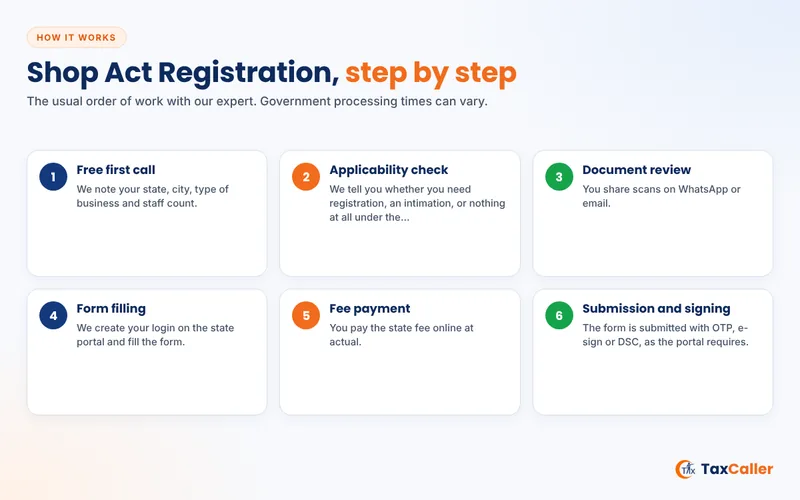
How we work
Online · Call · WhatsApp
Quick answer
Shop Act registration is the record of your shop, office or other premises under your state's Shops and Establishments Act. Each state sets its own rules. Uttar Pradesh now requires registration only at 20 or more employees. Smaller units in other states may file a simple intimation or be exempt. Fees and renewal also vary by state.
Reviewed by Abhinay Rai · Updated 15 Nov 2026
Pick a plan that fits
Shop Act Basic
One shop or office that needs registration or intimation in one state
₹999+ GST
+ Govt. fees at actual
Pay now (38%)₹380+ GSTAfter the certificate₹619+ GST
Handled by a TaxCaller Expert Licence & Registration Expert
Professional tax registration for the employer (and enrolment where required)
First professional tax return or payment schedule set up
Government fees and taxes are extra where applicable. Our expert confirms the final amount on the first call. No hidden charges.
About Shop Act Registration
Shop Act registration, also called shop and establishment registration, puts your workplace on the books of the state labour department. It covers shops, offices, restaurants, hotels, warehouses and many service businesses. In Maharashtra people often call the certificate a Gumasta licence. Banks, landlords and other departments ask for it as proof that your business exists at an address.
There is no single national law for this. Every state and Union Territory has its own Shops and Establishments Act, its own portal and its own fee. Rules changed in 2025 and 2026. Uttar Pradesh now requires registration only at 20 or more employees, and Maharashtra's worker limit has been under revision. So the answer to "do I need it?" depends on where you work and how many people you employ.
TaxCaller has handled registrations and tax work since 2018, from our office in Ghaziabad and online across India. This page covers the state laws, the Model Act of 2016, documents, fees, timelines, renewal, penalties and the 2026 position, in plain words.
Complete guide
Choose a topic to open it. Every answer gives the rule or section it comes from.
01 Topic 1 of 20
What Is Shop Act Registration?
A Shops and Establishments Act is a state labour law. It controls working conditions at places of business that are not factories. Registration is the first step under it. The state gives your establishment a number and a certificate, or an acknowledgement.
The law looks after the people who work at your premises. Most state Acts deal with these matters:
Daily and weekly working hours and rest breaks
Opening and closing hours of the business
A weekly holiday, paid leave and national holidays
Overtime pay and the time limit for paying wages
Rules on employing women at night and on young persons
Registers, records and display of notices
The certificate itself is a simple document. It shows the name of the establishment, the employer, the address, the category of business and the number of workers. You keep it at the premises and show it on inspection.
Shop Act registration is not a tax registration. It does not give you a GSTIN, a PAN or an MSME number. It sits next to those registrations, and many owners need all of them.
Labour matters fall under the Concurrent List of the Constitution. States wrote their own Shops Acts, many of them decades ago. That is why a café in Pune and a café in Lucknow follow different rules.
State or UT
Law that applies
Maharashtra
Maharashtra Shops and Establishments (Regulation of Employment and Conditions of Service) Act, 2017
In June 2016 the Union Cabinet cleared the Model Shops and Establishments (Regulation of Employment and Conditions of Service) Bill, 2016. It is a template, not a law that binds anyone. States may adopt it as it is, change it, or ignore it.
The main ideas in the model were:
It applies to establishments with ten or more workers, other than manufacturing units.
Shops, cinemas, malls and similar places may stay open on all 365 days, with freedom over opening and closing times.
Women may work night shifts if shelter, rest rooms, toilets, protection of dignity and transport are provided.
Registration happens through one common online process.
Facilities such as a creche or canteen may be shared by a group of establishments.
Maharashtra's 2017 Act and Gujarat's 2019 Act use the same long title, "Regulation of Employment and Conditions of Service". Many older state laws, such as those of Delhi and Tamil Nadu, still follow the earlier pattern.
For you, the takeaway is simple. The Model Act explains why newer state laws rely on online filing and worker-count limits. Your duties still come only from your own state's Act.
Most state Acts cover any place where trade, business or a profession is carried on for profit, other than a factory. In practice that includes:
Retail and wholesale shops, showrooms and kiosks
Offices of companies, LLPs, firms, consultants and professionals
Restaurants, cafés, eating houses, hotels and lodges
Warehouses, godowns and storerooms used for business
Theatres, gyms, salons, coaching centres and other places of service or amusement
IT and back-office units, unless the state treats them differently
Who is usually outside the Act: factories covered by factory law, offices of the Central and State Governments, and some public bodies. Each Act lists its own exemptions.
Home-based and online businesses
A home office or an online store has no shopfront, but it may still be an establishment. Whether you must register depends on your state and your staff count. In states with a worker threshold, such as Uttar Pradesh at 20 employees, a one-person online seller usually falls outside the duty to register. In states that cover every establishment, the same seller may need to apply.
When the duty starts
The clock usually starts on the day you begin business at the premises, or on the day you cross the staff threshold. Delhi allows 90 days. Uttar Pradesh now allows six months for establishments with 20 or more employees. Other states set their own time limits.
Maharashtra's 2017 Act replaced the old 1948 Act. It splits establishments into two groups based on the number of workers.
Workers
What you file
Result
At or above the worker limit
Application for registration (section 6), in Form A
Registration certificate in Form B from the Facilitator, due within seven working days of a complete application
Below the worker limit
Intimation of business (section 7), in Form F
Acknowledgement, no certificate needed
The 2017 Act set the limit at ten workers. The Maharashtra Shops and Establishments (Amendment) Ordinance, 2025 (Mah. Ord. VIII of 2025) changed "ten" to "twenty" in sections 1(3), 6 and 7. It took effect on 1 October 2025. A Bill to replace it, L.A. Bill No. LXXXIX of 2025, followed later that year.
The position in 2026 is not settled. A March 2026 press report said the state was rolling back the ordinance's working-hour reforms to match the Labour Codes. A Maharashtra government circular of 30 April 2026, as reported by law firms, still refers to establishments with fewer than ten workers filing an intimation. Some guides still quote 20. We check the current limit on the state portal before filing.
What the ordinance also changed
Daily working hours from nine to ten, with the weekly limit still 48 hours.
Continuous work without a break from five hours to six.
A daily spread-over cap of twelve hours.
The overtime limit from 125 to 144 hours a quarter.
The March 2026 report said these hour changes were being withdrawn, because the Labour Codes keep an eight-hour day. Follow the hours your current registration and the portal show.
Practical points in Maharashtra
The filing is online on the labour department system. Our team checks the current link with the Maharashtra labour department.
Name boards must show the name in Marathi (Devanagari script). Other scripts may also appear.
If your staff grows past the limit, move from intimation to full registration.
Ask your bank in advance whether it accepts the intimation acknowledgement as a business proof.
Shreya Licence & Registration Expert
Have a question on this topic? Ask Shreya on a free call.
Delhi follows the Delhi Shops and Establishments Act, 1954. It came into force on 1 February 1955. Registration under it works through a statement filed with the Chief Inspector.
Section 5(1): the occupier of every establishment files a statement with the name of the employer and manager, the postal address, the category of business and the number of employees.
Section 5(5): a new establishment files within 90 days from the date it starts work.
Section 5(2) and 5(3): the Chief Inspector registers it and issues a certificate, which must be shown prominently at the premises.
Section 6: any change in the registered details is reported within 30 days.
Section 7: closure is reported in writing within 15 days.
The fee and the renewal interval come from the Delhi rules. The process today is online. We confirm the current fee on the portal before you pay anything.
Late-hour exemption from August 2025
On 7 August 2025 Delhi notified an exemption for shops and commercial establishments, other than liquor shops, from sections 14, 15 and 16 of the Act. These sections deal with women's working hours, opening and closing times and the weekly close day. The exemption comes with conditions. They include a nine-hour day and 48-hour week, consent and transport for women at night, CCTV with footage kept for a month, and compliance with the POSH Act. The establishment also gives its details and an undertaking to the Delhi Labour Department.
For decades the UP Act covered shops and commercial establishments of every size in the areas where it applied. That changed in late 2025. An amendment, first made by ordinance and then enacted by the legislature and notified in early 2026, applies from 19 November 2025. Its main points are:
The Act now applies to establishments with 20 or more employees.
Such establishments register online within six months of starting business.
The definition of commercial establishment now covers medical practitioners, architects and service providers such as delivery services.
Workers engaged through outsourcing agencies now count as employees.
The daily work limit rose from eight to nine hours. Overtime may go up to 144 hours a quarter.
Women may work between 7 pm and 6 am with their consent, with safety, transport and rest facilities.
Fines rose to up to ₹2,000 for a first offence and ₹10,000 for later offences.
Before prosecution for most offences, an inspector gives a written improvement notice with 15 days to comply.
What this means in Ghaziabad and Noida
A shop, clinic or office in Ghaziabad, Noida or Greater Noida with fewer than 20 employees no longer needs UP Shop Act registration. If you already hold one, keep it safe. The amendment does not clearly say what happens to existing certificates. If you employ 20 or more people, you must register within six months of starting.
Small owners who wanted the certificate only as a bank proof can use other documents. An Udyam certificate through our MSME registration service, or a GST certificate, usually works. The municipal trade licence of the city is a separate matter, and Labour Code registration may apply as its rules take effect.
Outside Maharashtra, Delhi and UP, the basic pattern is the same: register on the state labour portal, pay the state fee, display the certificate and report changes. The details differ.
Karnataka: the Karnataka Shops and Commercial Establishments Act, 1961 applies. Registration is done through the state labour department's online service. Renewal follows the state rules.
Gujarat: the 2019 Act shares the long title of the 2016 Model Act. Filing is through the state labour department online.
Tamil Nadu: the 1947 Act applies, with registration through the state labour department.
West Bengal and Telangana: each has its own Act and portal, listed in the table above.
We do not publish fixed fee tables for these states. Fees and slabs are revised from time to time, and many online lists are out of date. Instead, we read the fee off the state portal on the day we file, and you pay it at actual.
If your business runs from more than one state, each premises follows its own state law. A head office in Bengaluru and a branch in Mumbai need two separate filings under two different Acts.
Zubair Licence & Registration Expert
Have a question on this topic? Ask Zubair on a free call.
Registration is a legal duty where your state requires it. It also brings practical gains:
Bank account: a certificate or licence under the Shop and Establishment Act is one of the documents banks accept to open a current account for a proprietorship.
Proof of address: the certificate links your trade name to a specific premises. Other departments rely on it.
Late hours and holidays: when a state relaxes opening hours or weekly closure, being on its records makes it easier to show you qualify.
Fewer disputes: clear records of hours, leave and wages help if a worker raises a complaint.
Payment platforms: payment gateways and marketplaces often ask for a business proof during onboarding.
Clean due diligence: investors and buyers check that the workplace is properly registered.
A Shop Act certificate does not give you any tax benefit. Its value is legal compliance and proof of the business. If you need loan or tender benefits, look at Udyam registration as well.
Time depends on the state portal and on whether an inspection is needed. These are typical ranges once your documents are complete:
Case
Typical time
What drives it
Maharashtra intimation (below the worker limit)
Same day to a few days
Portal processing
Maharashtra registration (at or above the limit)
About 7 working days
Facilitator review
Delhi registration
A few days to two weeks
Chief Inspector verification
UP registration (20 or more employees)
One to three weeks
Labour office review
Other states
One to three weeks
State process and any inspection
Our own work, from document check to filing, usually finishes within two working days of receiving complete papers. Delays mostly come from missing NOCs, address mismatches or portal downtime.
Do not wait until the last day of your state's deadline. Apply as soon as you begin business at the premises.
Shop Act Registration: SAMPLE quote, for illustration only
There are two separate costs. We keep them apart so you can see each one.
TaxCaller's fee: our fee for Shop Act registration starts at ₹999 + GST. The final fee depends on the plan you pick and the state, and we confirm it on your first call.
Government fees: the state labour department fee is paid separately at actual, directly on the portal. It varies by state, often by the number of workers, and sometimes by the period you register for. Some states charge nothing for an intimation.
Item
Paid to
Amount
Applicability check, form filing and follow-up
TaxCaller
From ₹999 + GST
Registration or intimation fee
State labour department
As per state schedule, at actual
Late fee or penalty, if any
State government
As per state law, at actual
Stamp paper for an NOC or affidavit, if needed
State (stamp duty)
As per state stamp law
We show you the portal fee screen before you pay. You never pay a government fee through a markup in our invoice.
Validity is one of the biggest differences between states.
Maharashtra intimation: a filing for small establishments below the worker limit. You must update details when they change.
Maharashtra registration: the certificate can be issued for the period applied for, up to ten years. Renewal is applied for online at least 30 days before expiry, and late renewal attracts a late fee.
Delhi: the Act says certificates are renewed at intervals set by the rules.
Other states: each sets its own term and renewal rule. Check the validity printed on your certificate.
Keep these dates in your calendar
The expiry date printed on your certificate
A reminder about 30 days before expiry
The date your staff count crosses your state's threshold
When you renew, check that the address, owner and staff details are still correct. If anything changed, file the change first. A renewal based on old data can create problems during an inspection.
Our Standard plan includes renewal reminders, so the date does not slip.
Shadab Licence & Registration Expert
Have a question on this topic? Ask Shadab on a free call.
Penalties are set by each state Act. They usually apply to running without registration where it is required, not displaying the certificate, not reporting changes, and breaking the rules on hours, leave or wages.
State
Penalty position
Uttar Pradesh
Up to ₹2,000 for a first offence and up to ₹10,000 for later offences, after the 2025 amendment. A 15-day improvement notice comes first for most offences.
Maharashtra
Fines under the 2017 Act and its rules
Delhi
Fines under the 1954 Act and its rules
Other states
Fines, and in some Acts prosecution, for repeat breaches
Beyond fines, an unregistered business faces practical losses. Banks may refuse a current account. Workers can complain to the labour department about hours or wages, and you will have no records to show.
If you missed your deadline, register now. Inspectors usually treat a business that comes forward better than one found during an inspection.
Wrong state law. Applying a rule seen online for another state. A Pune rule does not apply in Noida.
Old threshold. Relying on an old article for your state's worker limit. UP changed its limit in 2025, and Maharashtra's limit has been revised and revisited.
Address mismatch. The rent agreement says one address and the electricity bill another.
No NOC. Using a relative's property without a signed consent letter.
Wrong staff count. Leaving out family members or outsourced workers, who count as employees in some states, including UP after the amendment.
Wrong category. Choosing "shop" when the business is an office or commercial establishment.
Name board issues. In Maharashtra, a board without the Marathi name can lead to trouble on inspection.
Not reporting changes. A new address, a new partner or closure not filed within the time allowed.
Missing the renewal date. This leads to a late fee and a lapse in proof of business.
The certificate is the start, not the end. Most state Acts expect these steps:
Display: keep the certificate or acknowledgement at the premises, where an inspector can see it.
Registers: keep attendance, wages, overtime and leave records, physically or digitally, as your state allows.
Working hours: follow the daily, weekly and overtime limits. Uttar Pradesh changed them in 2025.
Leave and holidays: give the weekly off, paid leave and national holidays required by your state.
Women at night: follow the consent, safety and transport conditions before rostering late shifts.
Changes: report changes in name, address, owner, business type or staff count within the time allowed.
Closure: report closure in writing. Delhi allows 15 days.
Renewal: renew before expiry where your state requires it.
Other duties may also apply as your team grows. They include professional tax in states that levy it, PF and ESI after their thresholds, and TDS on salaries. For payroll records, our accounting and bookkeeping team can help.
Shreya Licence & Registration Expert
Have a question on this topic? Ask Shreya on a free call.
What Changed for Shop Act Registration in 2025 and 2026
The last year has seen the biggest changes to these laws in a long time:
Maharashtra changed, then revisited, its worker limit. Ordinance VIII of 2025 raised the limit from ten to twenty workers from 1 October 2025, with longer daily hours and overtime. L.A. Bill No. LXXXIX of 2025 was brought to replace it. A March 2026 press report said the state was rolling these reforms back to match the Labour Codes, and an April 2026 circular still refers to the ten-worker line. We confirm the current limit before filing.
Uttar Pradesh limited registration to 20 or more employees. The amendment Act, which replaced an ordinance, applies from 19 November 2025. Coverage now includes doctors, architects and delivery services, and outsourced staff count as employees. Fines are higher, but a 15-day improvement notice comes first for most offences.
Delhi eased opening hours. The 7 August 2025 notification exempts shops and establishments, other than liquor shops, from sections 14 to 16, subject to safety and welfare conditions and an undertaking to the Labour Department.
The four Labour Codes came into force on 21 November 2025. The Ministry of Labour's release promises a single registration, a PAN-India single licence and a single return. During the transition, relevant provisions of the existing labour Acts stay in force. A Maharashtra circular of 30 April 2026, as reported, says that once an establishment registers under the Occupational Safety, Health and Working Conditions Code, a separate Shops Act registration is not needed where the requirements overlap. Until then, Shops Act registration continues.
Many online articles still show the old all-establishment rule for UP, and guides disagree on Maharashtra's limit. We file on the current law only.
Is a Shop Act Licence the Right Registration for You?
A Shop Act licence answers one question: is your workplace registered under your state's labour law? Your business may need other licences too. Our business licences guide compares them all. In short:
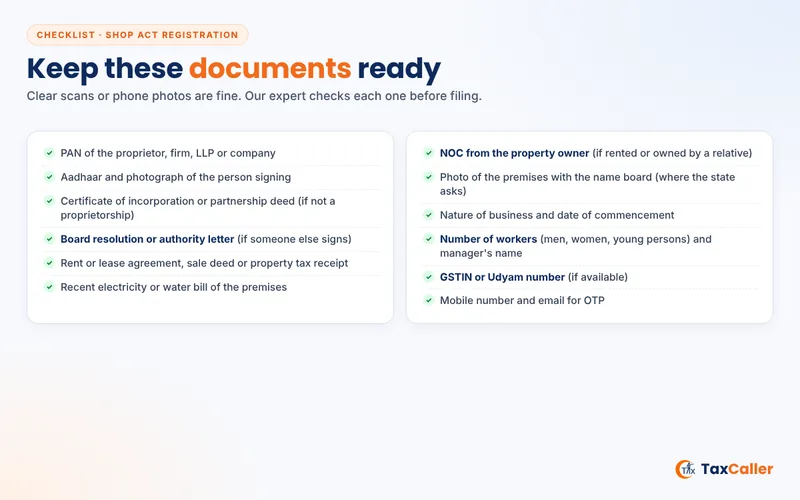
Certificate of incorporation or partnership deed (if not a proprietorship)
Board resolution or authority letter (if someone else signs)
Rent or lease agreement, sale deed or property tax receipt
Recent electricity or water bill of the premises
NOC from the property owner (if rented or owned by a relative)
Photo of the premises with the name board (where the state asks)
Nature of business and date of commencement
Number of workers (men, women, young persons) and manager's name
GSTIN or Udyam number (if available)
Mobile number and email for OTP
Why TaxCaller
Real experts, not a call centre
Your work is handled by experienced professionals who explain every step, check your documents and keep you updated.
Registered company
TaxCaller is run by TaxCaller India LLP (LLPIN AAQ-7388), serving clients since 2018.
Fee told upfront
You know the complete fee, our professional fee and the government fee, before any work starts. No hidden charges.
Support after the work
Notices, renewals, returns and compliance reminders: we stay with your business after the registration is done.
Reviewed By
Expert for this topic Shop Act Registration
Abhinay Rai
Advocate
Abhinay Rai is a Advocate specialising in Shop Act Registration. The process, documents, timelines and fees on this page are checked against the current rules and government portals, and updated whenever the law, forms or fees change.
Is Shop Act registration mandatory for a business run from home?
It depends on your state and staff count. A home office is still a place of business under many state Acts. In Uttar Pradesh, fewer than 20 employees now means no registration. In Maharashtra, a small unit below the worker limit files only an intimation. Other states may cover every establishment, so check your state rule first.
Do I need a Shop Act licence if I have no employees?
Often not, but it varies. Uttar Pradesh now ties registration to 20 employees, and in Maharashtra a small unit files only an intimation. Some older state Acts cover every establishment regardless of staff. Even where it is optional, owners sometimes apply because banks accept the certificate as business proof for a current account.
What is a Gumasta licence?
Gumasta is the common name in Maharashtra for the certificate under the state Shops and Establishments Act. The current law is the 2017 Act. Establishments at or above the worker limit get a registration certificate. Smaller ones file an intimation in Form F. A 2025 ordinance raised the limit from 10 to 20, so we confirm it before filing.
How many days does it take to get Shop Act registration?
A Maharashtra intimation is often acknowledged within a day or two. Full registration there takes about seven working days. Delhi and most other states take a few days to three weeks, depending on verification. Our part, checking documents and filing, usually takes two working days after we receive complete papers from you.
What is the validity of a Shop Act licence?
Validity depends on the state. In Maharashtra, a registration certificate can be issued for up to ten years and is renewed online before expiry. Delhi renews certificates at intervals set by its rules. Other states set their own terms. Always check the expiry date printed on yours and set a reminder a month before it.
Can I open a current account using a Shop Act certificate?
Yes, for a proprietorship. Banks accept a certificate or licence under the Shop and Establishment Act as one of the business proofs for a current account. Most banks want two such proofs. If your state no longer requires registration, a GST certificate or Udyam certificate can serve as the other proof.
Do online sellers and e-commerce businesses need shop and establishment registration?
If you run your online business from an office, warehouse or home with staff, the state Act may cover that premises. The threshold decides it. In UP, fewer than 20 employees means no registration, and in Maharashtra a small unit files only an intimation. In states that cover all establishments, even a small online seller may need to apply.
What is the difference between a Shop Act licence and a trade licence?
A Shop Act licence comes from the state labour department and covers working conditions, hours and leave. A trade licence comes from the local municipal body and covers health, safety and the type of trade at that location. They are separate. Some businesses, such as eateries or salons, may need both.
Do I need a separate Shop Act registration for each branch?
Yes. Registration is tied to a premises, not to a PAN. Each shop, office or warehouse is a separate establishment under the state Act. If your branches are in different states, each one follows its own state law, threshold, fee and renewal rules, so the filings are done separately on each state portal.
What happens if I do not register under the Shop Act when required?
You can be fined under your state Act. In Uttar Pradesh, the amended law allows up to ₹2,000 for a first offence and ₹10,000 for later ones, usually after a 15-day improvement notice. You may also lose practical benefits, such as using the certificate as business proof for a bank account or a payment gateway.
Do shops in Ghaziabad still need Shop Act registration?
Only if they have 20 or more employees. The UP amendment in force from 19 November 2025 limits the Act to such establishments, with registration due within six months of starting. A smaller shop in Ghaziabad or Noida can rely on GST or Udyam for business proof. Municipal licences are a separate question.
Can I apply for Shop Act registration without a rent agreement?
Usually yes, if you have another valid proof of the premises. An owned property can be shown with a sale deed or property tax receipt. For a relative's property, a signed NOC with their ID and a utility bill normally works. The exact list depends on what your state portal accepts.
What is Form F intimation in Maharashtra?
Form F is the online intimation that a small establishment, below the state's worker limit, files under section 7 of the Maharashtra Act. It tells the labour department that your business exists. You get an acknowledgement, not a registration certificate. Keep it updated if your name, address, staff count or other details change later.
Get your Shop Act licence filed under the right state law
Tell us your state, city and staff count, and our tax expert will confirm what you need and file it online. Our fee starts at ₹999 + GST, and the state fee is paid at actual.