Starting from · ₹6,999 EPR Registration EPR Basic plan
STARTING FROM₹6,999
FEE TOLD UPFRONTFree first call
!GSTR-3B due?Last date 20 Nov 2026 · 3 days left
Since 2018Trusted Experience
980+Experts Connected
220+Cities Served
1164+Agents Available
12000+Founders Trusted
S
Srishti Magoo
★★★★★
Excellent experience with TaxCaller for filing my &
my family members ITR returns. The entire process was
smooth, quick and hassle-free. They are professional,
knowledgeable and guided me through every step with patience.
O
obeid sait
★★★★★
The team has handled my taxes for the past three years,
and it's been a wonderful, hassle-free experience.
Thank you for your consistently quick and efficient service.
P
Pushkar
★★★★★
They are among the best in their field. Their work culture
is highly professional, and their client service is smooth
and reliable. They can confidently be relied on to get the job done.
P
Prasad Sheth
★★★★★
Excellent experience with TaxCaller! The ITR filing
process was smooth, quick, and completely hassle-free.
The CA was knowledgeable, responsive, and explained everything clearly.
A
Apoorv Bansal
★★★★★
Excellent service for ITR filing. The team was highly
professional, responsive, and guided me through the entire
process smoothly. My return was filed accurately and on time.
A
Abhishek Kumar
★★★★★
I was searching for a good CA firm in Ghaziabad and found
TaxCaller. The experience was excellent from start to finish.
The team is responsive, transparent, and genuinely helpful.
U
uma pandey
★★★★★
Great service! TaxCaller India made the entire ITR filing
process quick, smooth, and hassle-free. They answered all
my queries patiently and ensured maximum accuracy.
T
tanu mittal
★★★★★
Excellent job! We've been connected for many years,
and your success truly makes me happy. You are an
incredibly intelligent person. Keep shining, keep growing.
B
Bhanu Pratap Maurya
★★★★★
I am filing my ITR since past 3 years with Abhinav and
Firm is known as TaxCaller and they are professional
interms of ITR rules. They will explain and tell you all
the information.
A
ashish Sharma
★★★★★
I am providing my honest reviews:
No.1 service ...
A
AARYAN GROUP
★★★★★
Honestly, finding a good CA firm in Ghaziabad was
confusing, but TaxCaller India made it simple.
I contacted them for GST work and the experience was smooth.
N
News Speaks
★★★★★
If you're looking for a reliable CA firm in Ghaziabad,
TaxCaller India is a great choice. They provide complete
taxation and compliance solutions including GST.
A
Anshul Chaprana
★★★★★
Got my GST registration done through TaxCaller CA firm.
Process was quite smooth, they guided properly on documents
and didn't waste time. Overall good experience.
How we work
Online · Call · WhatsApp
Quick answer
EPR registration is the CPCB online registration that producers, importers and brand owners need before selling plastic packaging, electronics, batteries, tyres or lubricating oil in India. Each system has its own portal, fee and yearly target. You meet the target by buying EPR certificates from registered recyclers and filing returns, mostly due by 30 June.
Reviewed by Abhinay Rai · Updated 16 Nov 2026
Pick a plan that fits
EPR Basic
One business that needs one EPR registration (plastic, e-waste, battery, tyre or used oil) in one role
₹6,999+ GST
+ Govt. fees at actual
Handled by a TaxCaller Expert Licence & Registration Expert
Everything in Standard, for up to three registrations
Mapping of all products across plastic, e-waste and battery EPR
Quarterly returns where the rules need them
Recycled content and reuse records for the 2026 plastic rules
Portal updates for address, product or authorised person changes for one year
Government fees and taxes are extra where applicable. Our expert confirms the final amount on the first call. No hidden charges.
About EPR Registration
EPR registration is the online registration that producers, importers and brand owners must get from the Central Pollution Control Board (CPCB) before they put plastic packaging, electronics, batteries, tyres or lubricating oil on the Indian market. EPR stands for Extended Producer Responsibility. It means the company that sells a product also pays for collecting and recycling the waste it becomes.
India runs five separate EPR systems, each under its own rules made under the Environment (Protection) Act, 1986. Each has its own CPCB portal, fee, documents, targets and return dates. A single company can need two or three of them. For example, an electronics importer usually needs e-waste EPR, battery EPR and plastic packaging EPR.
TaxCaller has handled registrations and compliance work since 2018, from Ghaziabad and online across India. This page explains who needs EPR registration, the official fees, documents, targets, EPR certificates, returns, penalties and the 2026 changes, in plain words, with links to the official rules.
Complete guide
Choose a topic to open it. Every answer gives the rule or section it comes from.
01 Topic 1 of 20
What Is EPR Registration?
EPR registration is a producer's entry on CPCB's centralised portal for its waste stream, which gives it a registration number and a yearly recycling target. Without it, the law treats the company as not allowed to do that business.
The idea is simple. If you place 100 tonnes of plastic packaging on the market, you must make sure that a matching quantity of plastic waste is collected and processed by registered recyclers. You prove this with EPR certificates bought from those recyclers. You then report it in an annual return.
The five EPR systems in India
Waste stream
Governing rules
Who registers you
Plastic packaging
Plastic Waste Management Rules, 2016, Schedule II (EPR Guidelines), as amended in 2022, 2024 and 2026
CPCB, or the State Pollution Control Board (SPCB) through the same portal
Electrical and electronic equipment
E-Waste (Management) Rules, 2022
CPCB
Batteries
Battery Waste Management Rules, 2022
CPCB
Tyres
Hazardous and Other Wastes (Management and Transboundary Movement) Rules, 2016, as amended in 2022
CPCB
Used oil (base oil and lubricants)
Same Hazardous Waste Rules, as amended by the Second Amendment Rules, 2023
CPCB
All these rules are made under sections 3, 6 and 25 of the Environment (Protection) Act, 1986. The registration is digital. You get a certificate with a registration number on the portal. You print this number on invoices, and buyers and marketplaces may ask for it.
The Environment Ministry has since extended the EPR idea to more streams, such as end-of-life vehicles. Those have separate rules and portals and are not covered on this page.
Producer, Importer and Brand Owner: Who Counts as What
You are a producer, importer or brand owner (PIBO) if you make, import or sell under your own brand a product that is covered by one of the EPR rules. The exact definitions differ in each rule, so check the one that applies to your product.
Role
What the rules say, in short
Brand owner (plastic)
Rule 3(b) of the Plastic Waste Management Rules: a person or company who sells any commodity under a registered brand label or trademark.
Producer (plastic)
Rule 3, as amended on 14 March 2024: a person engaged in manufacturing plastic packaging or the intermediate material used to make it. It also covers contract manufacturers who pack products for brand owners.
Importer (plastic)
Rule 3(k): a person who imports for commercial use any plastic packaging, or any commodity with plastic packaging.
Producer (e-waste)
Anyone who sells electrical or electronic equipment under its own brand, sells assembled equipment under its own brand, sells imported equipment, or imports used equipment.
Producer (battery)
Anyone who makes or sells batteries under its own brand, sells batteries made by others under its brand, or imports batteries or equipment that contains them.
Producer (tyre)
Makers of new tyres, brand sellers of tyres made by others, importers of new tyres or of vehicles fitted with them, and importers of waste tyres.
Producer (used oil)
Anyone who sells base oil or lubricating oil in India under its own brand, made by itself or by others, or who sells imported base or lubricating oil.
Points that confuse most businesses
One company can hold more than one role. A brand that imports some products registers both as a brand owner and as an importer.
Selling online does not change the role. The battery, tyre and used oil definitions apply whatever the sales channel is.
A trader who only buys and resells another company's branded product is usually not the producer. The brand owner carries the obligation.
Under the used oil rules, a vehicle or machine maker is not a producer unless it buys oil and sells it under its own brand.
Zubair Licence & Registration Expert
Have a question on this topic? Ask Zubair on a free call.
EPR registration is needed by every producer, importer and brand owner covered by the five rules, and also by the recyclers and processors who generate EPR certificates. The table shows who must register in each system.
System
Must register
Main exclusions
Plastic packaging
Producers, importers, brand owners, plastic waste processors, makers and importers of plastic raw material, and makers of compostable or biodegradable plastic
Micro and small producers and brand owners are kept out of the EPR obligation (paragraph 4 of Schedule II). A micro or small producer's obligation is met by its raw material supplier, but it must still meet recycled content targets (paragraph 7.8). Export-oriented units are treated as exempt in CPCB's FAQ.
E-waste
Manufacturers, producers, refurbishers and recyclers of items listed in Schedule I
Micro enterprises, waste batteries, packaging plastics and radioactive waste are outside these rules (rule 2)
Battery
Producers of all battery types, plus recyclers and refurbishers
Batteries in military equipment and equipment sent into space
Tyres
Producers, recyclers and retreaders
Tyres exported by the producer carry no EPR obligation
Used oil
Producers, collection agents, recyclers and used oil importers
Vehicle and machine makers that do not sell oil under their own brand
The rules are strict on trade. Paragraph 6.2 of the plastic EPR Guidelines says a covered entity shall not carry on business without registration. Paragraph 6.3 says it shall not deal with an unregistered entity. The E-Waste Rules work the same way, and rule 4(15) of the Battery Rules bars producers from dealing with unregistered entities. So even a small brand can lose a large customer if it has no EPR number.
A company that operates in many states registers once on the central portal. For plastic packaging, CPCB handles PIBOs that work in more than two states or union territories. The SPCB or Pollution Control Committee handles those in one or two states, through the same portal.
Plastic packaging EPR covers any business that makes plastic packaging, imports packed goods, or sells goods in plastic packaging under its own brand. It is the most common EPR registration in India because almost every packed product uses some plastic.
The four packaging categories
Category
What it covers
Category I
Rigid plastic packaging, such as bottles, jars and tubs
Category II
Flexible plastic packaging of single or multiple layers of the same plastic, including sheets, carry bags, sachets and pouches
Category III
Multi-layered plastic packaging, with at least one layer of plastic and at least one layer of another material
Category IV
Plastic sheets and carry bags made of compostable plastic
Key points of the plastic system
You register in each role separately. CPCB's FAQ asks for a separate email ID for each registration, while the company KYC stays the same.
Your EPR target is based on the plastic packaging you put on the market. It is set category by category.
Certificates can only be used within the same category. A Category II surplus does not cover a Category I shortfall.
For multi-layered packaging, the full weight of the packaging counts for EPR, as clarified by the Environment Ministry's office memorandum of 3 February 2023.
A contract manufacturer that packs for an unbranded buyer may have to carry the EPR liability. The brand owner or producer it sells to takes it over once that buyer registers.
The Guidelines count both post-consumer waste (packaging left after the buyer uses the product) and pre-consumer waste (rejects and scrap created before the product reaches a buyer). EPR is separate from the ban on identified single-use plastic items, which has applied since 1 July 2022 under a 2021 amendment. A registered brand still cannot use banned items.
E-waste EPR applies to every producer of the electrical and electronic equipment listed in Schedule I of the E-Waste (Management) Rules, 2022. These rules were notified as G.S.R. 801(E) on 2 November 2022 and came into force on 1 April 2023.
Which products are covered
Schedule I lists 106 equipment codes in seven groups:
IT and telecom equipment, such as laptops, phones and routers
Consumer electronics and solar photovoltaic panels
Large and small electrical and electronic appliances, such as refrigerators, washing machines and fans
Electrical and electronic tools
Toys, leisure and sports equipment
Medical devices
Laboratory instruments
How e-waste registration works
You apply online on CPCB's e-waste EPR portal. CPCB's SOP says hard-copy applications are not accepted.
You give sales data in tonnes for past years, covering the average life of each product. A chartered accountant certifies it.
You give RoHS self-declarations, because the rules also limit hazardous substances in products.
You submit an awareness plan: how you will tell buyers to return used products.
CPCB issues the registration within 30 working days of a complete application, as per its SOP. It is valid for five years.
Producers who have just started sales follow Schedule IV. Their target is a share of sales from an earlier year, so the first years are lighter.
Abhinay Rai Licence & Registration Expert
Have a question on this topic? Ask Abhinay on a free call.
Battery EPR Under the Battery Waste Management Rules, 2022
Battery EPR applies to every producer of batteries, whether sold alone or inside a product. The Battery Waste Management Rules, 2022 were notified on 22 August 2022 (S.O. 3984(E)) and replaced the Batteries (Management and Handling) Rules, 2001.
Battery categories
Category
Meaning under the rules
Portable battery
Sealed, under 5 kg, and not made for industrial, electric vehicle or automotive use
Automotive battery
Used only for starter, lighting or ignition power in vehicles
Industrial battery
Designed for industrial use, other than the three types listed here
Electric vehicle battery
Designed to give traction to hybrid and electric road vehicles
What a battery producer must do
Register on CPCB's portal in Form 1(A). The registration certificate is issued in Form 1(B). Rule 11(4) makes it valid for five years.
Apply for renewal in Form 1(A) at least 60 days before expiry.
Meet the collection and recycling targets in Schedule II for each battery category.
File the annual return in Form 3 by 30 June of the next financial year.
Use a minimum share of domestically recycled material in new batteries under rule 4(14): from 2024-25 for automotive and industrial batteries, and from 2027-28 for portable and electric vehicle batteries.
Mark batteries with the crossed-out wheeled bin symbol and the required chemical symbols.
The Battery Waste Management Amendment Rules, 2025 (S.O. 958(E), 24 February 2025) let producers give their EPR registration number through a barcode or QR code on the battery, pack, equipment or packaging, after informing CPCB in writing.
Tyre makers, tyre importers and sellers of lubricating oil also need EPR registration, under the Hazardous and Other Wastes Rules, 2016. These two systems are newer and use the same model: producers buy EPR certificates only from registered recyclers.
Rules for tyre makers and importers
EPR for waste tyres came in through G.S.R. 593(E) dated 21 July 2022.
Producers, recyclers and retreaders register on CPCB's waste tyre EPR portal. Someone in two roles registers separately in each.
The portal asks you to submit the registration within 30 days of sign-up. A registration is valid for two years.
The target was 35% for 2022-23 and 70% for 2023-24. From 2024-25 it is 100% of the new tyres made or imported two years earlier.
Recyclers can earn certificates for reclaimed rubber, crumb rubber, crumb rubber modified bitumen, recovered carbon black and pyrolysis oil or char.
Retreading certificates only defer the obligation by one year.
Rules for base oil and lubricant sellers
EPR for used oil came in through the Second Amendment Rules, 2023 (G.S.R. 677(E), 18 September 2023). The used oil EPR chapter commenced on 1 April 2024, and the first obligation year was 2024-25.
Producers register on CPCB's used oil EPR portal. CPCB's SOP says applications are processed within 21 working days.
The target is 5% for 2024-25, 10% for 2025-26 and 20% for 2026-27. It rises to 50% from 2030-31, each time measured on oil sold two years earlier.
Used oil importers must cover 100% of the used oil they imported in the previous year.
Producers file the annual return by 30 June after the financial year, as per CPCB's used oil FAQ.
The documents for EPR registration are mostly company KYC, proof of the authorised person, and data on how much you put on the market. Each portal adds a few of its own. Keep everything in PDF.
Common to all five systems
PAN of the company or firm
GST registration certificate (for plastic, CPCB's FAQ asks for GST details of every state where you operate)
Certificate of incorporation or CIN (for companies and LLPs)
Importer Exporter Code, if you import
PAN and Aadhaar of the authorised person, with a board resolution or authority letter
Covering letter and self-declaration on letterhead, in the format the portal gives
Email and mobile number that will stay with the company
Extra documents by system
System
Extra documents
Plastic packaging
EPR action plan (part of the application form); Consent to Establish or Operate from the SPCB for producers with a factory; process flow diagram for producers; Udyam or DIC proof if you claim micro or small status; category-wise packaging quantity data
E-waste
Year-wise sales in tonnes, certified by a chartered accountant; RoHS self-declaration and declaration on RoHS technical documents; awareness plan
Battery
Air and Water Act consents with hazardous waste authorisation where you manufacture; DIC certificate; previous year's GSTR-9 or balance sheet; battery data by type and chemistry
Tyres
Tyres made or imported in the preceding two years, by weight; documents listed on the portal's instruction sheet
Used oil
Procurement and sales data certified by a chartered accountant; signed undertaking on letterhead; sales-to-other-producers template if you sell to other producers
Names must match across PAN, GST and the incorporation certificate. A mismatch is the most common reason for a query.
Shadab Licence & Registration Expert
Have a question on this topic? Ask Shadab on a free call.
The EPR registration process is fully online: you sign up on the right CPCB portal, fill in the company and product details, upload documents, pay the fee and track the application. The steps below follow CPCB's own SOPs.
Pick the system and role. Decide whether you are a producer, importer or brand owner, and under which rules. Register separately for each role.
Sign up on the portal. Create a login with the company email and mobile. Plastic registration needs a separate email ID for each category of registration.
Enter company details. PAN, GST, CIN, IEC, addresses and the authorised person's PAN and Aadhaar. Some portals fetch details from the GST number.
Enter product and quantity data. Plastic packaging by category, EEE items with sales in tonnes, battery types and chemistry, tyre weights or oil volumes.
Upload documents. Use the portal's formats for the covering letter, declarations and certificates.
Pay the fee online. The portal shows the fee for your slab before payment.
Answer queries. CPCB or the SPCB returns the application with remarks if anything is missing. You reply on the portal.
Download the certificate. It carries your registration number. For e-waste and battery, it also shows your EPR obligations.
Which portal, login and lost credentials
Each system has its own CPCB portal: plastic packaging, e-waste, battery, tyres and used oil. CPCB's tyre portal now shows single sign-on at epr.cpcb.gov.in, the common EPR portal. Compliance news services report that CPCB announced on 28 June 2026 that the old plastic packaging portal would be discontinued and its functions moved to the Common EPR Portal from 1 July 2026. Always start from CPCB's own site, not a search ad. If you lose your login, the battery and tyre portals have a lost credential option. Use a company email, not a personal one.
For plastic packaging, CPCB's 2022 SOP says an application not processed within 15 days becomes a deemed registration. Rule 13(8), as amended in 2024, gives deemed registration after 30 days for registrations under rule 13. Do not rely on either. Wait for the certificate.
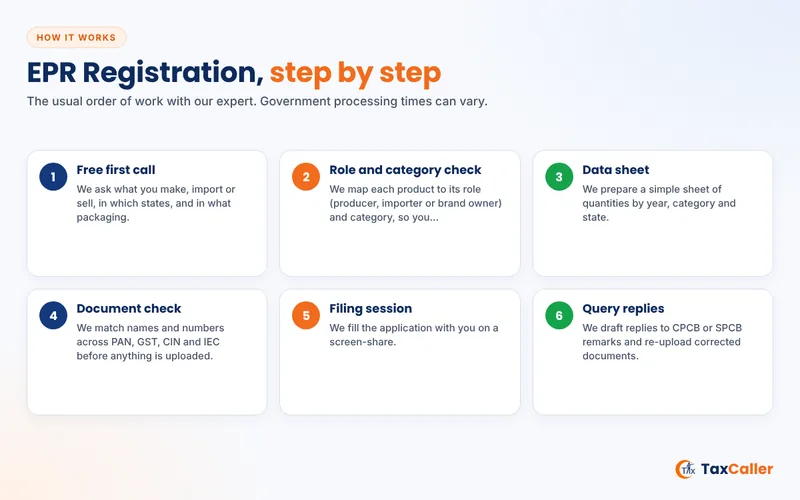
EPR Registration: how the work moves, step by step
TaxCaller handles your EPR application online from start to finish, while the portal login, OTPs and payment stay in your company's control.
Free first call. We ask what you make, import or sell, in which states, and in what packaging. We tell you which EPR systems apply and which do not.
Role and category check. We map each product to its role (producer, importer or brand owner) and category, so you register under the right heads.
Data sheet. We prepare a simple sheet of quantities by year, category and state. This becomes the base for your target and your returns.
Document check. We match names and numbers across PAN, GST, CIN and IEC before anything is uploaded.
Filing session. We fill the application with you on a screen-share. You enter OTPs and make the payment.
Query replies. We draft replies to CPCB or SPCB remarks and re-upload corrected documents.
Handover. You get the certificate, a note of your targets and a calendar of return dates.
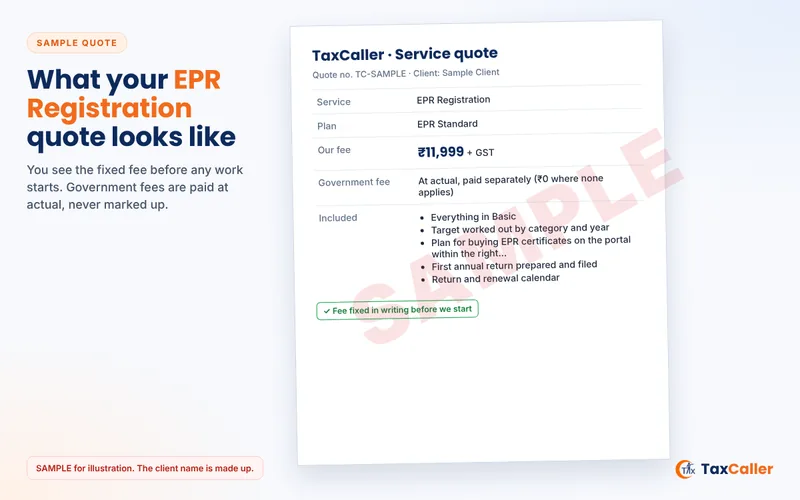
If you also need the first annual return, help buying EPR certificates, or registration in more than one system, we cover that in the higher plans. You can see our general pricing approach on the pricing page or contact us for a quote.
CPCB's official processing time ranges from about two weeks to 30 working days, depending on the system. The table shows the official figures and the validity of the registration.
System
Official processing time
Validity
Plastic packaging (PIBO)
15 days, as per CPCB's 2022 SOP published by state boards
Fresh registration 1 year; renewal 3 years, as per the same SOP. Renewal is filed four months before expiry.
E-waste (producer)
30 working days for a complete application; shortcomings told within 25 working days
5 years; renewal filed 120 days before expiry
Battery (producer)
Two weeks after a complete application (rules); about 15 days (SOP)
5 years (rule 11(4)); renewal filed 60 days before expiry
Tyres (producer)
Submit within 30 days of sign-up; processing as shown on the portal
2 years, as stated on the tyre portal
Used oil (producer)
21 working days
Shown on the certificate
In practice the time depends on how clean your data and documents are. A query adds days. Our part, from complete documents to filing, usually takes a few working days. This is our estimate, not an official timeline.
Renewal is blocked if returns are pending. The plastic SOP and the battery SOP both say so. Keep returns current before renewal is due.
Shreya Licence & Registration Expert
Have a question on this topic? Ask Shreya on a free call.
TaxCaller's fee for one EPR registration starts at ₹6,999 + GST. Government fees are paid separately at actual, directly to CPCB on the portal. The final fee depends on the plan, the number of systems and roles, and the data work involved. We confirm it in writing on the first call.
Item
Paid to
Amount
Role check, data sheet, document check, filing and query replies
TaxCaller
From ₹6,999 + GST
Registration fee, processing or maintenance charge
Your EPR target is the quantity of waste you must get collected and processed in a year. It is worked out from what you placed on the market in earlier years.
Targets for the current years
System
2025-26
2026-27
Base
Plastic (overall obligation)
100%
100%
Packaging placed on the market (100% from 2023-24 under paragraph 7.2)
E-waste
70%
70%
EEE placed on the market in year Y minus average product life (Schedule III); rises to 80% from 2027-28
Portable batteries (collection)
50%
60%
Batteries placed on the market in earlier years (Schedule II); 70% from 2027-28
Tyres
100%
100%
New tyres made or imported two years earlier
Used oil
10%
20%
Oil sold or imported two years earlier
Plastic: minimum recycling share
Within the plastic target, a minimum share must be met by recycling, not by end-of-life disposal such as co-processing. Paragraph 7.2(b) sets it at 50% for Category I and 30% for Categories II and III in 2024-25. It rises to 60% and 40% in 2025-26, 70% and 50% in 2026-27, and 80% and 60% from 2027-28.
Worked example: a Ghaziabad snack brand
Take a snack brand in Ghaziabad that sells in Uttar Pradesh, Delhi and Haryana. It puts 40 tonnes of multi-layered pouches (Category III) and 10 tonnes of rigid jars (Category I) on the market in a year. It works in three states, so CPCB registers it.
Registration fee: under 1,000 tonnes, so ₹10,000 for the brand owner registration, as per the plastic FAQ.
Yearly target: 40 tonnes for Category III and 10 tonnes for Category I, because the overall obligation is 100%.
It buys Category III certificates for 40 tonnes and Category I certificates for 10 tonnes from registered processors, within the recycling share for each category.
It files the annual return by 30 June of the next year, with sales, certificates and recycled content details.
It also checks the recycled content and reuse rules for its jars, explained in the 2026 section below.
This is a simplified example. Your real target also adjusts for pre-consumer waste, supplies to other registered entities and any carried-forward shortfall.
EPR Certificates: How They Work and What They Cost
An EPR certificate is a digital credit that a registered recycler or processor earns on the portal for waste it has processed. Producers buy these certificates to meet their target. They are not the same as your registration certificate.
System
Key certificate rules
Plastic
Used only within the same category. Surplus can offset an earlier shortfall, be carried forward, or be sold. Paragraph 8.8 lets CPCB fix a maximum and minimum price at 100% and 30% of the environmental compensation for non-fulfilment.
E-waste
Generated for registered recyclers (rule 14). Valid for two years from the end of the year of generation. A producer may buy up to its current liability, plus any leftover liability, plus 5%.
Battery
Generated by CPCB on the portal for recycled or refurbished quantities (rule 10). Valid for seven years. Used only within the same battery category.
Tyres
Bought from registered recyclers. Retreading certificates only defer the obligation by one year.
Used oil
Bought from registered recyclers only. Valid for two years. Not tradable between producers. A producer may buy up to its liability plus 10%.
Points to watch when buying
Buy only on the portal and only from a registered recycler or processor. Certificates bought outside the portal do not count.
Match the category and the year. A mismatch leaves a shortfall.
Keep invoices and transfer records with your return.
Fake certificates attract environmental compensation for both the seller and the buyer under the rules.
For e-waste, a 2024 amendment brought in a price band for certificates. Several large electronics makers have challenged the floor price in the Delhi High Court, as reported by Business Standard and Newslaundry. Check the current position before you sign a long purchase contract.
Zubair Licence & Registration Expert
Have a question on this topic? Ask Zubair on a free call.
Every registered producer must file returns on the portal, showing what it sold and how it met its target. Missing a return is a separate default from missing a target.
System
Return
Due date
Plastic (PIBO)
Annual return
30 June of the next financial year (paragraph 10.6 of Schedule II)
Plastic waste processors
Annual return
30 April of the next financial year (paragraph 11.2)
E-waste (producer)
Quarterly and annual returns
By the end of the month after the quarter or year (rules 5 to 9)
Battery (producer)
Annual return in Form 3
30 June of the next financial year
Tyres (producer)
Quarterly and annual returns
By the end of the month after the quarter
Used oil (producer)
Annual return
30 June after the financial year
CPCB sometimes extends a due date by notice on the portal. Watch the portal's notice section, but plan for the original date.
What goes into a plastic annual return
Packaging placed on the market, by category and state
EPR certificates bought and used, by category
Recycled content used in your packaging, with supporting documents
Reuse data for rigid packaging, where it applies
Any exemption you claim, for example where food safety rules bar recycled plastic
Other compliance continues too. Update the portal when your address, products or authorised person change. If you also run a factory, your SPCB consents and factory licence stay separate from EPR.
If you miss an EPR target, CPCB or the SPCB levies environmental compensation (EC) on the polluter pays principle. Running without registration or giving false data can also lead to revocation and penalties under the Environment (Protection) Act.
Environmental compensation in each system
System
Provision
Refund if you clear the shortfall later
Plastic
Paragraph 9 of Schedule II
75% within one year, 60% within two years, 40% within three years; forfeited after that
E-waste
Rule 22
85% after one year, 60% after two years, 30% after three years; nothing after that
Battery
Rule 13
75% within one year, 60% within two years, 40% within three years; forfeited after that
Used oil
EPR chapter of the Hazardous Waste Rules
EC for missed targets, false certificates and working without registration; CPCB publishes the rates
CPCB fixes the EC rates in its own guidelines, and they can change. Check the latest rate on the portal before planning.
Other consequences
Revocation: false information can lead to revocation for one year (plastic), up to three years (e-waste) or up to five years (used oil), after a hearing.
Penalty under the Act: section 15 of the Environment (Protection) Act, 1986, as substituted by the Jan Vishwas (Amendment of Provisions) Act, 2023, provides a penalty of ₹10,000 up to ₹15 lakh for each contravention, plus ₹10,000 a day while it continues.
Loss of business: registered buyers and sellers cannot deal with you.
Paying EC does not end the obligation. The shortfall carries forward for up to three years, and you must still meet it.
The biggest 2026 change is the Plastic Waste Management (Amendment) Rules, 2026, notified by the Environment Ministry as G.S.R. 237(E) on 31 March 2026. Other systems moved to higher targets under their existing schedules.
Plastic Waste Management (Amendment) Rules, 2026
Recycled content: the amendment revised the minimum recycled plastic that producers, importers and brand owners must use in Category I to III packaging. For Category III, only the weight of the plastic layers counts.
Carry-forward: unmet recycled content targets for food-contact packaging from 2025-26 can be carried forward for up to three years from 2026-27, clearing at least one-third each year.
Importers: recycled content already in imported packaging does not count. Importers buy equivalent certificates from PIBOs with surplus, through a mechanism CPCB will build on the portal.
Exemptions: targets do not apply where a law, rule or mandatory Indian Standard bars recycled plastic or reuse. The legal basis goes in the annual return.
New definitions: "seller" (sellers of resin, pellets and other plastic raw material), "reuse" and "registered environment auditor" under the Environment Audit Rules, 2025.
End-of-life disposal: now covers co-processing, waste-to-energy, waste-to-oil and road building. Turning waste into feedstock or new plastic counts as recycling.
Labels: recycled plastic packaging must meet IS 14534:2023 and carry recycled content marking, with FSSAI labelling rules for food-contact use.
Audits: CPCB is to issue verification guidelines within six months.
Minimum recycled content
2025-26
2026-27
2027-28
2028-29 onwards
Category I
30%
40%
50%
60%
Category II
10%
10%
20%
20%
Category III
5%
5%
10%
10%
Reuse by brand owners (Category I rigid)
2025-26
2026-27
2027-28
2028-29
0.9 to under 4.9 litre or kg
10%
15%
20%
25%
4.9 litre or kg and above, drinking water
70%
75%
80%
85%
4.9 litre or kg and above, other products
10%
10%
15%
15%
These figures come from the notification (Gazette ID CG-DL-E-31032026-271465), as reproduced in a stock exchange filing of 1 April 2026 and reported by LiveLaw.
Other 2026 changes
E-waste: the target is 70% for 2025-26 and 2026-27, up from 60%. It goes to 80% from 2027-28.
Portable batteries: the collection target rises to 60% for 2026-27.
Used oil: the target doubles to 20% for 2026-27.
Battery labels: the 2025 amendment's barcode or QR code option for the EPR number is available to producers who inform CPCB.
Common EPR portal: CPCB's tyre portal shows single sign-on for EPR portals at epr.cpcb.gov.in. Compliance news services report that CPCB announced on 28 June 2026 that the old plastic portal would be discontinued, with its functions moved to the Common EPR Portal from 1 July 2026. A CPCB notice of 27 August 2026, as reported, asks all entities under the plastic rules to register there.
Return dates for 2025-26: CPCB's tyre portal extended the annual and quarterly return date for 2025-26 to 30 September 2026. E-waste quarterly and annual returns for 2025-26 were reported extended to 30 September 2026. For plastic, an Environment Ministry office memorandum of 28 August 2026 was reported to extend the 2025-26 annual return to 31 December 2026 for PIBOs and 31 October 2026 for processors.
Abhinay Rai Licence & Registration Expert
Have a question on this topic? Ask Abhinay on a free call.
Most EPR applications are returned for data and document problems, not for legal reasons. These are the issues we see most often, and what the rules say.
Wrong role. Registering only as a brand owner when you also import. CPCB's FAQ asks you to register as both, reporting imports in each.
Wrong category. Putting a laminated pouch in Category II instead of Category III. Your certificates then do not match.
Name mismatch. The company name differs across PAN, GST and CIN. Fix it first.
Missing state GST. For plastic, CPCB wants GST details for every state where you operate.
Weak sales data. E-waste and used oil need data certified by a chartered accountant. Unsupported numbers draw queries.
Missing consents. A producer with a factory must upload SPCB consents.
Late renewal. Renewal is blocked if returns are pending.
Buying certificates off the portal. They do not count, and fake ones attract EC.
Ignoring the Udyam proof. A small brand claiming exemption from plastic EPR needs Udyam registration to show it is micro or small.
Not reading the 2026 changes. Recycled content and reuse now need supporting documents with the annual return.
A rejected plastic application needs a fresh application and a fresh fee, as per CPCB's FAQ. So it pays to check everything before you submit.
You need EPR registration if you place a covered product or packaging on the Indian market under your own name or brand, or import it. Use this table as a quick check.
Your situation
EPR needed?
You sell packed food, cosmetics or household goods under your own brand
Yes, plastic packaging EPR as brand owner (unless micro or small)
You import goods in plastic packaging for sale
Yes, plastic packaging EPR as importer
You sell phones, laptops, appliances or LED products under your brand or import them
Yes, e-waste EPR; often battery and plastic EPR too
You sell power banks, inverter batteries or EV batteries
Yes, battery EPR
You make or import tyres, or import vehicles fitted with new tyres
Yes, tyre EPR
You sell engine oil or lubricants under your brand
Yes, used oil EPR
You only resell another company's branded goods
Usually no; the brand owner registers
You only collect waste and sell it to recyclers
No processor registration for pure collection under plastic EPR, as per CPCB's FAQ
GST registration certificate (for plastic, GST details of every state where you operate)
Certificate of incorporation or CIN (companies and LLPs)
Importer Exporter Code (IEC), if you import
PAN and Aadhaar of the authorised person
Board resolution or authority letter for the authorised person
Covering letter and self-declaration on letterhead (portal format)
Udyam or DIC certificate, if you claim micro or small status
Consent to Establish or Operate from the SPCB (producers with a factory)
Process flow diagram (plastic producers)
EPR action plan (plastic application)
Quantity data by year: plastic packaging by category, EEE sales in tonnes, battery types, tyre weights or oil volumes
Chartered accountant certificate for sales or procurement data (e-waste and used oil)
RoHS self-declaration and declaration on technical documents (e-waste)
Awareness plan (e-waste)
Previous year's GSTR-9 or balance sheet (battery)
Company email ID and mobile number for the portal login
Why TaxCaller
Real experts, not a call centre
Your work is handled by experienced professionals who explain every step, check your documents and keep you updated.
Registered company
TaxCaller is run by TaxCaller India LLP (LLPIN AAQ-7388), serving clients since 2018.
Fee told upfront
You know the complete fee, our professional fee and the government fee, before any work starts. No hidden charges.
Support after the work
Notices, renewals, returns and compliance reminders: we stay with your business after the registration is done.
Reviewed By
Expert for this topic EPR Registration
Abhinay Rai
Advocate
Abhinay Rai is a Advocate specialising in EPR Registration. The process, documents, timelines and fees on this page are checked against the current rules and government portals, and updated whenever the law, forms or fees change.
EPR registration is the online registration that producers, importers and brand owners get from CPCB before selling plastic packaging, electronics, batteries, tyres or lubricating oil in India. It gives a registration number and a yearly recycling target. You meet the target by buying EPR certificates from registered recyclers and filing returns on the portal.
Who needs EPR registration in India?
Any business that makes, imports or sells under its own brand a product covered by the plastic, e-waste, battery, tyre or used oil EPR rules needs it. Recyclers and processors who issue EPR certificates must register too. A trader who only resells another company's branded goods is usually not covered, because the brand owner registers.
Is EPR registration mandatory for importers?
Yes. Importers are named in every EPR system. A plastic importer registers for packaging on imported goods. Electronics, battery and tyre importers are producers under their rules. A used oil importer must cover all used oil imported the previous year. Under the 2026 plastic amendment, recycled content in imported packaging does not count toward targets.
What is the government fee for EPR registration?
It depends on the system. Plastic PIBOs pay ₹10,000, ₹20,000 or ₹50,000 by tonnes of plastic waste. E-waste producers pay ₹2,500 to ₹15,00,000 by recycling target. Battery producers pay ₹10,000 to ₹40,000 by turnover. Used oil starts at ₹25,000 and tyres at ₹25,000 plus a per-tonne charge. TaxCaller's professional fee is separate and charged + GST.
How long does EPR registration take?
CPCB's SOPs give about 15 days for plastic and battery applications, 21 working days for used oil and 30 working days for e-waste, once the application is complete. Queries add time. Clean data and matching documents are the main factors. Plan for a few weeks in total, and do not start selling a new covered product before registration.
What is the validity of EPR registration?
E-waste and battery producer registrations are valid for five years. For plastic PIBOs, CPCB's SOP gives one year for a fresh registration and three years after renewal. Tyre and used oil validity is shown on the certificate. Renewal must be filed before expiry, and pending returns can block it, so keep returns current.
What is the cost of an EPR certificate?
An EPR certificate is a digital credit a registered recycler earns on the CPCB portal. Its price is set by trade between buyer and recycler, not by a fixed government fee. For plastic, CPCB may fix a band of 30% to 100% of the environmental compensation rate. Prices vary by category and year, so budget for them separately.
Do online marketplaces ask for an EPR registration number?
They may. The rules stop registered entities from dealing with unregistered ones, so large buyers and online marketplaces may check the EPR number of brand owners and importers of covered products. Keep your registration certificate handy, print the number on invoices, and make sure each covered product and role is registered before listing it.
What happens if I sell without EPR registration?
The rules bar covered businesses from operating without registration, and registered entities cannot deal with you. CPCB or the SPCB can levy environmental compensation. Section 15 of the Environment (Protection) Act, as amended in 2023, provides a penalty of ₹10,000 to ₹15 lakh per contravention, plus ₹10,000 for each day it continues.
Are small businesses exempt from plastic EPR?
Paragraph 4 of the plastic EPR Guidelines keeps micro and small producers and brand owners out of the EPR obligation, with status decided under the MSMED Act. A micro or small producer's obligation is met by its raw material supplier, but recycled content targets still apply. Importers get no such exclusion. Check your status each year.
Which documents are needed for EPR registration?
You need the company PAN, GST certificate, CIN or incorporation certificate, IEC if you import, and the authorised person's PAN and Aadhaar. Add quantity data for your products. E-waste and used oil need sales data certified by a chartered accountant. Factory owners add SPCB consents. Plastic needs GST details for each state you operate in.
Who issues EPR registration, CPCB or the state board?
CPCB runs all the EPR portals. For e-waste, battery, tyre and used oil, CPCB registers producers. For plastic packaging, CPCB registers PIBOs working in more than two states, while the SPCB or Pollution Control Committee registers those in one or two states. Both apply through the same centralised portal, so the steps look the same.
When is the EPR annual return due?
Plastic PIBOs and battery producers file the annual return by 30 June of the next financial year, and used oil producers also by 30 June. Plastic waste processors file by 30 April. E-waste and tyre producers file by the end of the month after the period. For 2025-26, extensions to 30 September or 31 December 2026 were notified or reported.
What changed in plastic EPR in 2026?
The Plastic Waste Management (Amendment) Rules, 2026 (G.S.R. 237(E), 31 March 2026) revised minimum recycled content targets, with Category I rising from 30% in 2025-26 to 60% by 2028-29. They added reuse targets for rigid packaging, a carry-forward for food-contact shortfalls, a seller definition, environment auditors and IS 14534:2023 labelling.
Do I need separate EPR registration for each product type?
You need a separate registration for each system and each role. An electronics importer may need e-waste, battery and plastic packaging registrations, and plastic itself may need both brand owner and importer registrations. Within one e-waste registration, you can add more equipment codes by amendment. Plan all of them together to avoid repeat KYC work.
Get your EPR registration filed right the first time
Tell us what you make, import or sell, and our expert will map your EPR roles and file with you online. Our fee starts at ₹6,999 + GST; CPCB's government fee is paid separately at actual.