Excellent experience with TaxCaller for filing my &
my family members ITR returns. The entire process was
smooth, quick and hassle-free. They are professional,
knowledgeable and guided me through every step with patience.
O
obeid sait
★★★★★
The team has handled my taxes for the past three years,
and it's been a wonderful, hassle-free experience.
Thank you for your consistently quick and efficient service.
P
Pushkar
★★★★★
They are among the best in their field. Their work culture
is highly professional, and their client service is smooth
and reliable. They can confidently be relied on to get the job done.
P
Prasad Sheth
★★★★★
Excellent experience with TaxCaller! The ITR filing
process was smooth, quick, and completely hassle-free.
The CA was knowledgeable, responsive, and explained everything clearly.
A
Apoorv Bansal
★★★★★
Excellent service for ITR filing. The team was highly
professional, responsive, and guided me through the entire
process smoothly. My return was filed accurately and on time.
A
Abhishek Kumar
★★★★★
I was searching for a good CA firm in Ghaziabad and found
TaxCaller. The experience was excellent from start to finish.
The team is responsive, transparent, and genuinely helpful.
U
uma pandey
★★★★★
Great service! TaxCaller India made the entire ITR filing
process quick, smooth, and hassle-free. They answered all
my queries patiently and ensured maximum accuracy.
T
tanu mittal
★★★★★
Excellent job! We've been connected for many years,
and your success truly makes me happy. You are an
incredibly intelligent person. Keep shining, keep growing.
B
Bhanu Pratap Maurya
★★★★★
I am filing my ITR since past 3 years with Abhinav and
Firm is known as TaxCaller and they are professional
interms of ITR rules. They will explain and tell you all
the information.
A
ashish Sharma
★★★★★
I am providing my honest reviews:
No.1 service ...
A
AARYAN GROUP
★★★★★
Honestly, finding a good CA firm in Ghaziabad was
confusing, but TaxCaller India made it simple.
I contacted them for GST work and the experience was smooth.
N
News Speaks
★★★★★
If you're looking for a reliable CA firm in Ghaziabad,
TaxCaller India is a great choice. They provide complete
taxation and compliance solutions including GST.
A
Anshul Chaprana
★★★★★
Got my GST registration done through TaxCaller CA firm.
Process was quite smooth, they guided properly on documents
and didn't waste time. Overall good experience.
How we work
Online · Call · WhatsApp
Quick answer
PF registration is the employer's online enrolment with EPFO, compulsory once an establishment has 20 or more employees. You get a PF code, create UANs for staff and deposit 12% employee and 12% employer contributions by the 15th of each month. From 17 September 2026, the wage ceiling for compulsory membership is ₹25,000.
Reviewed by Abhinay Rai · Updated 15 Nov 2026
Pick a plan that fits
Basic
Employers that need a PF code and will run payroll in-house
₹1,999+ GST
No govt. fee
Pay now (38%)₹760+ GSTAfter the PF code₹1,239+ GST
Handled by a TaxCaller Expert Licence & Registration Expert
Government fees and taxes are extra where applicable. Our expert confirms the final amount on the first call. No hidden charges.
About PF Registration
PF registration is the process by which an employer enrols its business with the Employees' Provident Fund Organisation (EPFO). It gives the business an establishment code. Once registered, the employer must enrol eligible staff, deduct their share from salary, add its own share and pay both every month.
The duty starts when your business employs 20 or more people. Smaller employers can join by choice. Since 21 November 2025, these rules come from the Code on Social Security, 2020, which replaced the EPF and MP Act, 1952. The new EPF Scheme, 2026 and a higher wage ceiling of ₹25,000 also changed the numbers this year.
TaxCaller has handled tax and compliance work for businesses since 2018, from our office in Ghaziabad and online across India. Our tax experts file your EPFO application, set up your staff records and run your first monthly return with you. This page explains who needs PF, what it costs, how to register, the penalties and the 2026 changes in plain words.
Complete guide
Choose a topic to open it. Every answer gives the rule or section it comes from.
01 Topic 1 of 20
PF Registration Explained: EPFO and Its Three Schemes
Provident fund, or PF, is a compulsory savings scheme for salaried workers. The employee and the employer both pay a fixed share of wages into the employee's account every month. The money earns interest and is paid out on retirement, on leaving a job in some cases, or for approved needs like a house or illness.
EPFO runs three schemes together. Registration covers all three at once:
Employees' Provident Fund (EPF): the savings account that builds up for each employee.
Employees' Pension Scheme (EPS): a monthly pension after 58, funded from part of the employer's share.
Employees' Deposit Linked Insurance (EDLI): life cover paid to the family if a member dies in service.
When an employer registers, EPFO allots an establishment ID, often called the PF code. It has 15 characters: letters for the state and the EPFO office, then numbers for your establishment and an extension. Every payment, return and inspection is linked to this code.
Each employee gets a Universal Account Number (UAN). The UAN stays the same for life. When a person changes jobs, the new employer links a fresh member ID to the same UAN. So PF registration has two layers: one code for the business and one UAN for each worker.
All of this happens online on the EPFO employer portal. You never need to visit an EPFO office for the basic registration.
When PF Registration Is Mandatory: The 20-Employee Rule
PF becomes compulsory for an establishment that employs 20 or more persons. The Code on Social Security, 2020 says this in its First Schedule for Chapter III, the provident fund chapter. The old EPF and MP Act, 1952 had the same number in Section 1(3), for factories in listed industries and for notified establishments like shops, offices and service firms.
How to count your 20
Count everyone you employ on any day, whether paid monthly, daily or by piece rate.
Include workers supplied by a contractor, if they work for your business.
Include staff earning above the wage ceiling. They count towards the 20, even if they need not join the fund.
Count all branches and units of the same establishment together.
When the duty starts
The legal duty starts on the day your headcount first reaches 20. Contributions are due from that day, not from the day you apply. If you register late, EPFO can work out dues for the past months and add interest and damages.
Once covered, always covered
Coverage does not end if your staff later drops below 20. Section 1(5) of the 1952 Act said so, and Section 1(8) of the Code keeps the rule. You keep paying for eligible staff even with five or ten people on the rolls.
Situation
Is PF registration needed?
19 employees, steady
Not compulsory; voluntary option open
20th employee joins on 10 March
Compulsory from 10 March
Fell from 22 to 15 employees
Yes, coverage continues
Company formed through SPICe+ with no staff yet
PF number issued at incorporation; deposits begin when the Code applies or you join by choice
Zubair Licence & Registration Expert
Have a question on this topic? Ask Zubair on a free call.
A business with fewer than 20 employees can still join EPFO. The employer and a majority of the employees must agree and apply. Section 1(4) of the 1952 Act allowed this. Under the Code, Section 1(5) lets the Central Provident Fund Commissioner extend the PF chapter to such an establishment.
Why a small employer may choose PF
To hire people who want PF as part of their salary package.
To match the offer of larger competitors for skilled staff.
To prepare early, if you expect to cross 20 people soon.
To give staff pension and insurance cover through EPS and EDLI.
Voluntary coverage is not a trial. Once you are in, the same monthly duties and penalties apply as for any covered employer. So decide after a clear look at the cost. The standard rate is 12%. Under section 16 of the Code, a lower 10% rate applies only where the Central Government notifies it, so we confirm your rate first.
Our tax experts can work out the yearly cost for your current payroll before you apply. That way the decision is based on real numbers.
Once your business is covered, every eligible employee must be enrolled from the day they join. The wage ceiling decides who is eligible on a compulsory basis.
The wage ceiling is now ₹25,000
The Union Cabinet raised the ceiling for compulsory EPFO membership from ₹15,000 to ₹25,000 a month on 16 September 2026, with effect from 17 September 2026. The ₹15,000 figure had stood since September 2014. See the Labour Ministry note on the Cabinet decision for the details.
Wages up to ₹25,000 a month: membership is compulsory.
Wages above ₹25,000 when the person first joins: the employee is an excluded employee. Joining is optional, by choice of the employee and employer.
Existing members whose pay later rises above the ceiling: they stay members. Their PF continues.
Other groups to watch
Contract workers: the contractor should cover them. If the contractor fails, the principal employer can be made to pay.
Apprentices: those engaged under the Apprentices Act, 1961 are generally not treated as employees for PF.
International workers: foreign nationals working in India are covered under special rules, unless a social security agreement with their country exempts them.
Directors and partners: a working director on salary can be an employee. A partner or proprietor drawing profit is not.
Staff now inside the new ceiling
Some of your current staff may earn between ₹15,001 and ₹25,000 and were never enrolled, because they were above the old limit. The PIB note says those excluded only for that reason can now be enrolled. Review this group in your next payroll run and add them from the right month. Ask each one for their old UAN, if any, before creating a new one.
Getting this list right on day one avoids the most common EPFO inquiry, which is about staff who were left out.
Contributions are calculated on wages. The standard rate is 12% from the employee and 12% from the employer. The employer's share is then split between the three schemes. The employer also pays small charges on top.
Component
Rate
Paid by
Goes to
Employee share
12% of wages
Employee (deducted from salary)
EPF account
Employer share: pension
8.33% of wages up to the ceiling
Employer
EPS
Employer share: provident fund
Balance of the 12%
Employer
EPF account
Insurance contribution
0.50% of wages up to the ceiling
Employer
EDLI
Administrative charges
0.50% of wages, minimum ₹500 a month
Employer
EPFO administration
Worked example: ₹20,000 wages, under the ceiling
Employee share: 12% = ₹2,400, cut from salary.
Employer share: 12% = ₹2,400. Of this, ₹1,666 goes to EPS (8.33%) and ₹734 to EPF.
EDLI: 0.50% = ₹100.
Admin charges: 0.50% = ₹100, but the minimum for the establishment is ₹500 a month in total.
When wages of ₹40,000 cross the ceiling
This employee joined earlier and is an existing member. The employer may limit contributions to the ₹25,000 ceiling. Then the employee pays ₹3,000. The employer pays ₹3,000, of which about ₹2,083 goes to EPS and about ₹917 to EPF. If both agree to contribute on full pay, PF is worked out on ₹40,000, but the pension share still follows the ceiling.
A lower rate of 10% applies only to establishments that the Central Government notifies. The employer can never cut its own share from the worker's pay. Section 12 of the 1952 Act barred this, and the same principle continues under the Code.
Abhinay Rai Licence & Registration Expert
Have a question on this topic? Ask Abhinay on a free call.
The base for PF used to be basic wages plus dearness allowance and retaining allowance. Many employers kept basic pay low and paid the rest as allowances. That cut their PF cost.
The Code changed the definition. Section 2(88) defines wages to include basic pay, dearness allowance and retaining allowance. It leaves out items such as house rent allowance, overtime, bonus, conveyance and the employer's own PF share. But there is a check: if the excluded items add up to more than half of total pay, the excess is added back into wages.
Example of the 50% rule
Item
Amount (₹ a month)
Basic pay plus DA
8,000
HRA, conveyance and other allowances
12,000
Total pay
20,000
Half of total pay
10,000
Excess of allowances over half
2,000
Wages for PF
8,000 + 2,000 = 10,000
So a salary built mostly from allowances will now attract more PF. Review your salary structure before your first ECR under the new scheme. We flag such cases when we set up your payroll data, so your deductions are right from the start.
Benefits of Provident Fund for Employers and Staff
For employees
A disciplined savings pot, built from both their own and the employer's money.
Interest declared each year by EPFO on the balance.
A pension under EPS after the required years of service.
Life cover for the family under EDLI if the member dies while in service.
One UAN that moves with them from job to job, so the balance is never lost.
Online claims, transfers and passbook through the member portal and the UMANG app.
For employers
Legal compliance, which protects the owners and directors from prosecution.
A stronger offer when hiring. Many candidates ask about PF before salary.
The employer's share is a business expense for income tax, if paid on time.
Eligibility for government employment incentives that are paid through EPFO, such as the Pradhan Mantri Viksit Bharat Rozgar Yojana, which offers employers up to ₹3,000 a month for each additional job kept for at least six months, for jobs created from 1 August 2025 to 31 July 2027.
Clean records for due diligence when you raise funds, take a loan or sell the business.
Eligibility to bid for tenders and vendor contracts that ask for a PF code.
For a business with 20 or more people, PF is not optional. But even then, a well-run PF account is a selling point when you hire and retain staff.
PF is one of several employer registrations. Most businesses that hire staff also need some of these:
ESI: health insurance and cash benefits for staff within the ESIC wage limit, compulsory from 10 employees. See our ESI registration page.
Shop and Establishment registration: the state licence for shops, offices and commercial premises. See Shop Act registration.
Professional tax: a state tax on employment that the employer deducts from salary in many states. See professional tax registration.
Which mix you need depends on your state, headcount and premises. Our business licences guide compares them side by side. This page covers only PF in full depth.
Shadab Licence & Registration Expert
Have a question on this topic? Ask Shadab on a free call.
How TaxCaller Completes Your PF Registration Online
PF Registration: how the work moves, step by step
First call: our tax expert checks your headcount, date of coverage, wage structure and entity type. We confirm whether PF is compulsory or voluntary for you.
Document check: you share scans on WhatsApp or email. We check names, PAN, address and the DSC before filing, because a mismatch is the main cause of rejection.
Employer sign-up: we create the employer login on the EPFO portal, using the business PAN and the signatory's details.
Application: we fill in the establishment details, owners, branches, activity code and the date of coverage. The authorised signatory signs with DSC or e-sign.
Code allotment: EPFO issues the establishment ID and a login for the employer portal. We share the code and the registration letter with you.
DSC registration: we register the signatory's DSC on the employer portal, which is needed to approve KYC and returns.
Employee UANs: we link existing UANs and help create new ones after Aadhaar verification.
First ECR: we prepare the first Electronic Challan cum Return, show you the amount, and you pay online through net banking.
Older guides send employers to the Labour Ministry's Shram Suvidha Portal, which earlier handled this application. Today we file it on the EPFO employer portal itself.
You get a short note on the monthly cycle after that: what data we need from you, by which date, and what you will pay.
Aadhaar not linked to mobile, Aadhaar verification fails
First ECR and payment
By the 15th of the next month
Missing wage data
Times are typical, not promised. EPFO's own processing can vary by region and by season. We track the application and reply to any query the same day we receive it.
If you are already late, do not wait for a perfect file. Register first, then sort out the past months with our help. Interest and damages grow every month.
Shreya Licence & Registration Expert
Have a question on this topic? Ask Shreya on a free call.
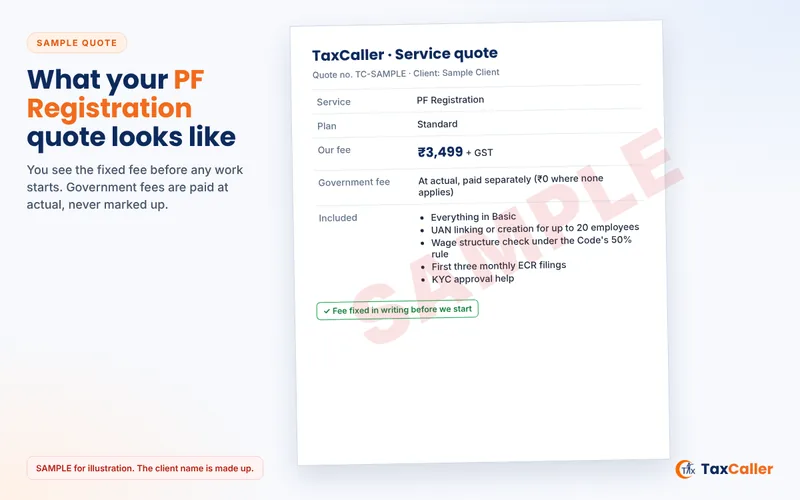
PF Registration: SAMPLE quote, for illustration only
EPFO charges no fee for registering an establishment. The application on the portal is free of government charges. The money you pay EPFO later is contribution and charges on wages, not a registration fee.
Item
Amount
Source
Establishment registration
Nil
EPFO portal
EPF administrative charges
0.50% of wages, minimum ₹500 a month
EPFO rate schedule
EDLI contribution
0.50% of wages up to the ceiling
EDLI Scheme
Inspection charges (only for exempted establishments with their own PF trust)
Notified rate; the PF rate was corrected to 0.18% of wages in 2026, with EDLI inspection charges extra
Notification under the Code, 2026, as corrected
Class 3 DSC (if you do not have one)
Charged by the certifying authority
Market rate
Check rates and circulars on the EPFO website. Any site that asks for a government fee to register your establishment is not EPFO.
TaxCaller's fee for PF registration starts at ₹1,999 + GST. Government charges, contributions and the DSC cost are paid separately at actual. We keep the two apart on every invoice.
What our fee covers
A free first call to check whether PF applies and from which date
Document review and the online application
Establishment ID, employer login and DSC registration
Replies to routine EPFO queries on the application
A short guide to your monthly PF cycle
What is charged separately
Monthly ECR filing and payroll work, unless you choose a plan that includes it
Past-period dues, interest and damages, and replies to EPFO inquiries for earlier months
DSC purchase, if needed
We share the full fee in writing on the first call. You pay only after you agree to it. Plans are listed in the pricing section of this page.
Registration is the start. The real work is monthly, and it runs as long as the business is covered.
The ECR by the 15th
Each month you file an Electronic Challan cum Return (ECR) on the employer portal. It lists each member's wages and contributions. The portal then creates a challan, which you pay online. Both must be done within 15 days of the close of the month. So wages for October are due by 15 November.
Joining and leaving
Enrol each new eligible employee in the month they join. Link the existing UAN or create a new one.
Mark the date of exit when someone leaves, with the reason. Without it, they cannot withdraw or transfer their money.
Approve transfer requests when a new joiner moves an old PF balance.
KYC and approvals
Employees seed Aadhaar, PAN and bank details. You approve them on the portal with the registered DSC. Clean KYC means faster claims and fewer complaints from staff.
Records to keep
Wage registers and attendance, linked to the ECR figures
Nomination forms and joining declarations
Payment proofs for every challan
Contractor PF challans for any contract labour
If your business has 20 or more staff, you may also need ESI, TDS on salary and professional tax. Our TDS return filing service handles quarterly salary returns. Our accounting and bookkeeping team can keep payroll and PF entries in one set of books.
Zubair Licence & Registration Expert
Have a question on this topic? Ask Zubair on a free call.
Penalties for Late PF Payment: Sections 14B, 7Q and the Code
EPFO treats delay seriously. Interest and damages are added for each month of delay, and non-payment can lead to prosecution.
Default
Consequence
Law
Late payment of dues
Simple interest of 12% a year from the due date
Section 7Q, EPF and MP Act, 1952; Section 127 of the Code, at the 12% rate notified under it
Late payment of dues
Damages of 1% of arrears for each month of delay, for defaults from 14 June 2024; capped at the arrears
Section 14B, EPF and MP Act, 1952; Section 128 of the Code
Not registering or not paying for some staff
EPFO inquiry to fix dues for all past months
Section 7A of the 1952 Act and the matching powers under the Code
Employee share deducted but not paid
Prison term of 1 to 3 years and a fine of ₹1 lakh
Section 133, Code on Social Security, 2020
Other failure to pay contributions
Shorter prison term and a fine of ₹50,000
Section 133 of the Code
Repeat offence of non-payment
Prison term of 2 to 3 years and a fine of ₹3 lakh
Section 134 of the Code
Before 14 June 2024, damages under paragraph 32A of the EPF Scheme went up in slabs from 5% to 25% a year. Defaults from that date carry the flat 1% a month.
Settling old damages disputes
EPFO notified the VISHWAS, 2026 scheme on 29 June 2026, as part of the EPF Scheme, 2026 (G.S.R. 525(E)). It lets employers settle damages disputes for defaults before 14 June 2024 at 0.25% to 1% a month, if the interest under Section 7Q or Section 127 is paid in full. It runs for six months from notification, so until about the end of December 2026. See the PIB release on VISHWAS and AMNESTY 2026.
This year brought major PF changes. Here is what applies now, with official sources.
Change
Date
What it means for you
Code on Social Security, 2020 in force
21 November 2025
The EPF and MP Act, 1952 is repealed by Section 164. PF now runs under Chapter III of the Code. The 20-employee rule stays.
Single registration under Section 3 of the Code
21 November 2025
Establishments register electronically. An existing PF code counts as registration under the Code, so you do not register again.
Social Security (Central) Rules, 2026, G.S.R. 344(E)
8 May 2026
Central rules under the Code, including the working of the EPF board and electronic registration.
Interest and inspection charges under the Code
2026
Interest on late dues notified at 12% a year under Section 127. New inspection charges for employers running their own PF trusts, with the PF rate later corrected to 0.18% of wages.
EPF Scheme, 2026, with VISHWAS and AMNESTY, G.S.R. 525(E)
29 June 2026
A new scheme replaces the EPF Scheme, 1952. VISHWAS settles old damages disputes. AMNESTY regularises some private PF trusts.
Wage ceiling raised to ₹25,000
17 September 2026
Staff earning ₹15,001 to ₹25,000 must now be enrolled. Pension share is worked out on up to ₹25,000.
The 12% standard rate and the 15-day deadline for monthly payment.
No government fee for registration.
Some state rules under the Code are still being finalised. Where the appropriate government is the state, rules can differ. We check the rule that applies to your establishment before filing.
Abhinay Rai Licence & Registration Expert
Have a question on this topic? Ask Abhinay on a free call.
PF for New Companies, Startups and Multi-State Employers
A company incorporated through the SPICe+ form gets its EPFO registration number along with incorporation. Many founders do not notice it until a notice arrives. If you formed your company through our company registration service, check the certificate pack for the PF number. The deposits start once the law applies or you opt in.
Startups
Startups with fewer than 20 people do not need PF by law. But many offer it to attract talent. If you plan rapid hiring, register before you cross 20. It is simpler than registering in a hurry later.
Several branches or states
One establishment ID can cover all branches. Each branch can get a sub-code if you want separate returns. PF is a central scheme run by EPFO, so the same Code and scheme apply in every state. We map your branches before filing, so each staff member sits under the right code.
Contractors and manpower firms
A contractor that supplies staff must have its own PF code. The principal employer should collect proof of the contractor's monthly PF deposits. Without it, the principal employer can be held liable.
Your business will change over the years. EPFO records must keep pace, or notices go to the wrong place and the wrong people.
Changes you must report
New registered address or a move of the main office
Change of directors, partners or the proprietor's legal heir
A new authorised signatory, with a fresh DSC registration
New branches that need sub-codes
Change in the bank account used for payments
Most of these are made online from the employer login. Some need a request letter to the EPFO office, signed by the employer. Keep the old and new proofs ready, such as a board resolution or an amended partnership deed.
Change of ownership
When a business is sold or transferred, the PF dues do not vanish. The new owner and the old owner can both be held liable for dues up to the date of transfer. So check the PF account before you buy a business. Ask for ECR copies, challans and any pending inquiry notices.
When the business closes
Section 3 of the Code lets an establishment that is closing apply to cancel its registration. Before you apply, pay all dues, mark exits for every member and help staff with their claims or transfers. A PF code that stays open with no returns can draw notices for years. If you simply stop paying, EPFO may assume the business still runs.
We handle address and signatory changes, sub-codes and closure applications as part of our ongoing support. Tell us early, and the update goes in before the next return.
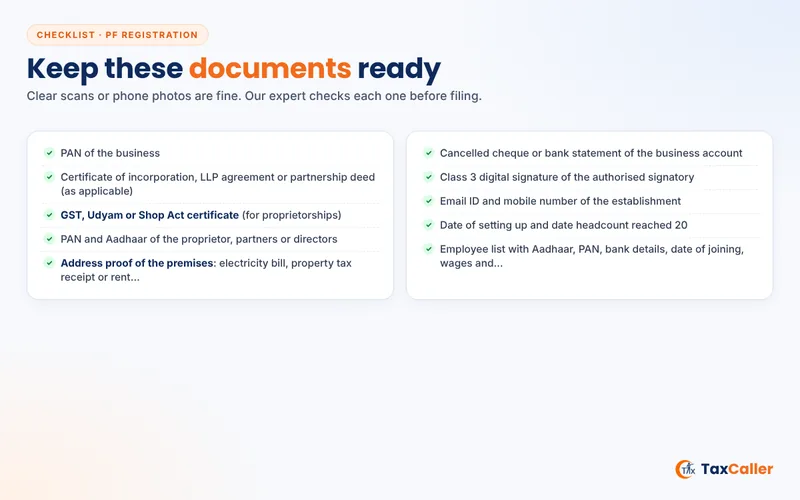
Certificate of incorporation, LLP agreement or partnership deed (as applicable)
GST, Udyam or Shop Act certificate (for proprietorships)
PAN and Aadhaar of the proprietor, partners or directors
Address proof of the premises: electricity bill, property tax receipt or rent agreement
Cancelled cheque or bank statement of the business account
Class 3 digital signature of the authorised signatory
Email ID and mobile number of the establishment
Date of setting up and date headcount reached 20
Employee list with Aadhaar, PAN, bank details, date of joining, wages and existing UAN
Why TaxCaller
Real experts, not a call centre
Your work is handled by experienced professionals who explain every step, check your documents and keep you updated.
Registered company
TaxCaller is run by TaxCaller India LLP (LLPIN AAQ-7388), serving clients since 2018.
Fee told upfront
You know the complete fee, our professional fee and the government fee, before any work starts. No hidden charges.
Support after the work
Notices, renewals, returns and compliance reminders: we stay with your business after the registration is done.
Reviewed By
Expert for this topic PF Registration
Abhinay Rai
Advocate
Abhinay Rai is a Advocate specialising in PF Registration. The process, documents, timelines and fees on this page are checked against the current rules and government portals, and updated whenever the law, forms or fees change.
Is PF registration mandatory for a business with fewer than 20 employees?
No. The law makes PF compulsory only when an establishment employs 20 or more persons. A smaller employer can still join by choice, if the employer and most employees agree and apply. Once covered, the business stays covered even if staff falls later. So plan the cost before opting in, because monthly duties apply in full.
Is there any government fee for EPFO registration?
No. EPFO does not charge any fee to register an establishment on its portal. You pay only the monthly contributions, administrative charges and EDLI amounts on wages after registration. TaxCaller's professional fee and the cost of a digital signature, if you need one, are separate. Any website asking for a government registration fee is not the official EPFO portal.
What is the PF wage ceiling in 2026?
The ceiling for compulsory membership is ₹25,000 a month from 17 September 2026. Before that it was ₹15,000, a figure that had stood since 2014. Employees earning up to ₹25,000 must be enrolled. A person earning more on the day of joining may stay out, unless the employee and employer both choose to contribute.
How much do the employer and employee pay into PF each month?
The usual rate is 12% of wages from each side. The employer's 12% is split: 8.33% of wages up to the ceiling goes to the pension scheme, and the rest goes to the employee's PF account. The employer also pays 0.50% for EDLI insurance and 0.50% as administrative charges, with a ₹500 monthly minimum.
What is the due date for paying PF and filing the ECR?
Contributions for a month must be paid within 15 days after that month closes. So October wages are due by 15 November. You file the Electronic Challan cum Return on the employer portal, generate the challan and pay online. Late payment attracts 12% yearly interest and damages for each month of delay, so plan payroll early.
Can I apply for PF registration without a digital signature?
The portal lets the employer sign some applications with Aadhaar e-sign. But you still need a Class 3 digital signature of an authorised signatory to approve employee KYC and handle many employer tasks. So most businesses buy a DSC at the start. We check your DSC before filing, so expiry or a name mismatch does not hold up the application.
How long does it take to get a PF code?
Once documents are ready, the online application takes about a day to file and sign. EPFO usually allots the establishment ID within a few working days, though regional offices may take longer or raise queries. Creating UANs for staff is quick if their Aadhaar is linked to a working mobile number. Delays mostly come from document mismatches.
What happens if an employer does not register for PF on time?
EPFO can inquire and assess all dues from the date your headcount reached 20, under Section 7A of the old Act or the matching power under the Code. You then pay both shares, 12% yearly interest and damages. If deducted employee money is not paid, prosecution can follow under Section 133 of the Code. Late registration only grows the bill.
Do I need PF registration if my company was formed through SPICe+?
Companies incorporated through SPICe+ receive an EPFO registration number along with incorporation, so you do not apply again. But the number alone is not compliance. You must activate the employer login, register your digital signature, enrol eligible staff and pay monthly once the law applies or you choose to start contributions. Many founders miss this step.
Does the Code on Social Security change PF registration for existing employers?
Not the registration itself. Under Section 3 of the Code, an establishment already registered under an earlier central labour law is treated as registered. Your PF code continues. What changes are the rules behind it: the new definition of wages, the EPF Scheme, 2026, the ₹25,000 ceiling and penalties now listed in Sections 127, 128 and 133.
Are contract workers covered under the employer's PF?
Contract workers count towards your 20-employee threshold and must get PF. Usually the contractor deducts and deposits it under its own PF code. If the contractor fails, the principal employer can be made to pay. So ask every contractor for monthly ECR and challan copies, and keep them with your own PF records.
What is a UAN and who creates it?
A UAN, or Universal Account Number, is a lifelong 12-digit number for each PF member. The employer creates it on the employer portal when a first-time member joins. If the person had PF before, you link the old UAN instead. A new UAN is created only after the employee's Aadhaar details are verified.
Can a proprietor or partner join PF as a member?
No. PF is for employees who work for wages. A sole proprietor or a partner who takes a share of profit is an owner, not an employee, so they cannot join their own firm's PF. A director drawing a salary from a company can be an employee, since the company is a separate legal person.
Can a PF code be cancelled when a business shuts down?
Yes. Section 3 of the Code on Social Security lets an establishment that is closing apply to cancel its registration. First pay all pending dues, mark exit dates for every member and settle or transfer their balances. Do not just stop filing returns. An open code with no filings keeps drawing EPFO notices for the owners.