Excellent experience with TaxCaller for filing my &
my family members ITR returns. The entire process was
smooth, quick and hassle-free. They are professional,
knowledgeable and guided me through every step with patience.
O
obeid sait
★★★★★
The team has handled my taxes for the past three years,
and it's been a wonderful, hassle-free experience.
Thank you for your consistently quick and efficient service.
P
Pushkar
★★★★★
They are among the best in their field. Their work culture
is highly professional, and their client service is smooth
and reliable. They can confidently be relied on to get the job done.
P
Prasad Sheth
★★★★★
Excellent experience with TaxCaller! The ITR filing
process was smooth, quick, and completely hassle-free.
The CA was knowledgeable, responsive, and explained everything clearly.
A
Apoorv Bansal
★★★★★
Excellent service for ITR filing. The team was highly
professional, responsive, and guided me through the entire
process smoothly. My return was filed accurately and on time.
A
Abhishek Kumar
★★★★★
I was searching for a good CA firm in Ghaziabad and found
TaxCaller. The experience was excellent from start to finish.
The team is responsive, transparent, and genuinely helpful.
U
uma pandey
★★★★★
Great service! TaxCaller India made the entire ITR filing
process quick, smooth, and hassle-free. They answered all
my queries patiently and ensured maximum accuracy.
T
tanu mittal
★★★★★
Excellent job! We've been connected for many years,
and your success truly makes me happy. You are an
incredibly intelligent person. Keep shining, keep growing.
B
Bhanu Pratap Maurya
★★★★★
I am filing my ITR since past 3 years with Abhinav and
Firm is known as TaxCaller and they are professional
interms of ITR rules. They will explain and tell you all
the information.
A
ashish Sharma
★★★★★
I am providing my honest reviews:
No.1 service ...
A
AARYAN GROUP
★★★★★
Honestly, finding a good CA firm in Ghaziabad was
confusing, but TaxCaller India made it simple.
I contacted them for GST work and the experience was smooth.
N
News Speaks
★★★★★
If you're looking for a reliable CA firm in Ghaziabad,
TaxCaller India is a great choice. They provide complete
taxation and compliance solutions including GST.
A
Anshul Chaprana
★★★★★
Got my GST registration done through TaxCaller CA firm.
Process was quite smooth, they guided properly on documents
and didn't waste time. Overall good experience.
How we work
Online · Call · WhatsApp
Quick answer
ITR 3 filing is the return for individuals and HUFs with business or professional income, including F&O traders and partners in firms. For AY 2026-27, non-audit cases were due by 31 August 2026 and audit cases have until 21 November 2026. TaxCaller's fee starts at ₹2,999 + GST, and taxes or late fees are paid separately.
Reviewed by Abhinay Rai · Updated 15 Nov 2026
Pick a plan that fits
Trader
Salaried or full-time traders with F&O, intraday and share trades
₹2,999+ GST
No govt. fee
Pay now (38%)₹1,140+ GSTAfter the ITR-V₹1,859+ GST
Government fees and taxes are extra where applicable. Our expert confirms the final amount on the first call. No hidden charges.
About ITR 3 Filing
ITR 3 filing is the way individuals and HUFs report income from a business or profession when that income comes from real accounts. It covers F&O and intraday traders, partners in firms, consultants who claim actual expenses and businesses whose books need a tax audit. The return carries a full profit and loss account and balance sheet, so it needs more care than a salary return.
This page explains ITR-3 for AY 2026-27 (FY 2025-26) in full depth. You will find who must use it, its schedules, the F&O rules, tax audit limits, the new due dates, loss carry-forward, the regime switch rule, advance tax, documents, penalties and every 2026 change, with section numbers and official links.
TaxCaller has helped taxpayers since 2018. Our tax experts read your AIS, check your books and file your ITR-3 online, wherever you live in India. You approve every figure before we file.
Complete guide
Choose a topic to open it. Every answer gives the rule or section it comes from.
01 Topic 1 of 20
What Is the ITR-3 Form?
ITR-3 is the income tax return form for individuals and Hindu Undivided Families (HUFs) who earn profits or gains from a business or profession. The e-filing portal describes it in exactly those words. It is the form for people whose business income is worked out from real accounts, not on a fixed presumptive rate.
ITR-3 is the widest form open to an individual. Along with business income, it takes salary or pension, rent from house property, capital gains, crypto gains and other income such as interest and dividends. That is why traders, consultants and partners in firms usually end up here.
The form for AY 2026-27 was notified by CBDT on 30 March 2026 through G.S.R. 228(E), the Income-tax (Fourth Amendment) Rules, 2026. It applies to income earned in FY 2025-26. You can read the full official ITR-3 form for AY 2026-27 on the Income Tax Department website.
ITR-3 at a glance
Point
ITR-3 for AY 2026-27
Who files it
Individuals and HUFs with business or professional income
Income year covered
FY 2025-26 (1 April 2025 to 31 March 2026)
Law that applies
Income-tax Act, 1961, kept alive for this year by section 536 of the Income-tax Act, 2025
Accounts
Balance sheet and profit and loss account, or key figures where books are not required
Due date
31 August 2026 (no audit) or 21 November 2026 (audit cases)
You file ITR-3 when you have income under the head "profits and gains of business or profession" and you cannot use ITR-4. The common cases are:
Proprietors who keep regular books: shop owners, traders, manufacturers and service businesses that report actual profit instead of a presumptive rate.
Professionals who do not use section 44ADA: doctors, lawyers, architects, consultants and freelancers who claim actual expenses or whose receipts cross the presumptive limit.
F&O traders: futures and options income is non-speculative business income, so it goes in ITR-3, even for salaried people.
Intraday equity traders: intraday gains are speculative business income and also need ITR-3.
Partners in a firm or LLP: salary, bonus, commission or interest from the firm is business income in the partner's hands.
Presumptive taxpayers who cannot use ITR-4: for example, total income above ₹50 lakh, a company directorship, unlisted shares, foreign assets or a capital loss brought forward. They report section 44AD or 44ADA income inside ITR-3.
HUFs that run a family business.
NRIs with business or professional income in India. ITR-4 is not open to them.
Who cannot use ITR-3
Partnership firms and LLPs file ITR-5. Companies file ITR-6. Trusts file ITR-7. An individual with no business or professional income at all should use ITR-1 or ITR-2, not ITR-3.
Why filing ITR-3 on time matters
Your F&O or business loss can be carried forward only if the return is filed by the due date.
The old tax regime stays open to you only if Form 10-IEA is filed by the due date.
Banks ask for two or three years of ITRs with a P&L and balance sheet before a business loan.
Visa offices and tender authorities treat the ITR as proof of income.
TDS cut by your clients or broker comes back as a refund only after you file.
Shadab Income Tax Expert
Have a question on this topic? Ask Shadab on a free call.
Business or profession with actual profit, F&O, intraday, or partner in a firm
ITR-3 (this page)
A single rupee of F&O income or a partner's salary moves you to ITR-3. The rule is simple: once business income exists and ITR-4 is not allowed, ITR-3 is the answer.
If you are not sure where you stand, our pillar guide on income tax return filing explains every form side by side. Or book a free first call, and our expert will read your AIS and tell you the right form.
ITR-3 is long because it asks for both your tax computation and your business accounts. The form has a Part A with financial statements and a Part B with the tax working, plus many schedules. Here are the ones most filers touch.
Part or schedule
What goes in it
Part A-General
Personal details, filing status, regime choice and audit information
Part A-BS
Balance sheet as on 31 March 2026
Part A-Manufacturing Account and Trading Account
Stock, purchases, sales, and turnover of intraday and F&O trades
Part A-P&L
Profit and loss account for FY 2025-26
Part A-OI and Part A-QD
Other information, such as disallowances, and quantity details of stock
Schedule S, HP, CG, OS
Salary, house property, capital gains and other sources
Schedule BP
Computation of business or professional income from the P&L
Schedule DPM, DOA, DEP
Depreciation on plant, machinery and other assets
Schedule VDA
Income from crypto and other virtual digital assets
Schedule CYLA, BFLA, CFL, UD
Set-off of losses, losses carried forward and unabsorbed depreciation
Schedule ICDS
Effect of Income Computation Disclosure Standards on profit
Schedule EI and IF
Exempt income, and details of firms you are a partner in, with your share of profit
Schedule AL
Assets and liabilities at year end, only if total income exceeds ₹1 crore
Schedule GST
Turnover or gross receipts reported in GST returns
Schedule FA and FSI
Foreign assets and foreign income, for residents
Schedule AMT and AMTC
Alternate Minimum Tax under section 115JC, where it applies
Part B-TI and Part B-TTI
Total income, tax, interest, TDS, TCS, advance tax and refund
You do not fill every schedule. The utility shows only the ones linked to the income you select. Still, each figure must tie back to your books, AIS and bank statements.
Traders are the biggest group of new ITR-3 filers. The tax law treats their trades as business, not as capital gains. That changes the form, the tax rate and the loss rules.
How trading income is classified
Type of trade
Tax treatment
Loss carry-forward
Futures and options on a recognised stock exchange
Non-speculative business income under section 43(5)(d), taxed at slab rates
8 assessment years under section 72
Intraday equity (no delivery)
Speculative business income under section 43(5)
4 assessment years under section 73(4), only against speculative income
Delivery-based shares held as investment
Capital gains under section 111A or 112A
Capital loss rules apply
New F&O fields in the 2026 form
The ITR-3 for AY 2026-27 asks for F&O figures on their own lines in the trading account. Item 12c asks for "Turnover from Futures & Options Trading". Item 12d asks for F&O income transferred to the profit and loss account. Items 12a and 12b ask the same for intraday trades. Leaving these blank when you traded can lead to a defective return notice.
What we work out for a trader
Trading turnover from your broker's tax P&L, using the method followed for tax audit purposes.
Expenses you can claim, such as brokerage, exchange charges, advisory fees, internet and depreciation on your computer.
Whether a tax audit applies, based on turnover and the profit you declare.
Set-off of losses with other business income, and carry-forward of the balance.
Advance tax on trading profit, since brokers do not deduct TDS on it.
Securities transaction tax paid on these trades is a deductible expense when you compute business income. It is not a credit against tax.
Shreya Income Tax Expert
Have a question on this topic? Ask Shreya on a free call.
Partners in a Firm: Reporting Your Income Correctly
If you are a partner in a partnership firm or an LLP, your own return is ITR-3. The firm files its own ITR-5. Your share of the firm's money falls into three buckets.
What you receive
How it is taxed
Where it goes in ITR-3
Salary, bonus, commission or remuneration
Taxable business income under section 28(v)
Schedule BP
Interest on capital
Taxable business income under section 28(v)
Schedule BP
Share of profit
Exempt in your hands under section 10(2A), since the firm already paid tax
Schedule IF (firms you are a partner in)
Only the amount the firm was allowed to deduct under section 40(b) is taxed in your hands. So your figures must match the firm's return. We ask the firm's accountant for the partner-wise statement before we file.
The due date also follows the firm. A partner of a firm that needs a tax audit gets the later audit-case date. A partner of a non-audit firm gets 31 August.
ITR-3 asks for a profit and loss account and a balance sheet. These come from your books. Section 44AA decides who must keep books.
Specified professionals (doctors, lawyers, engineers, architects, accountants, technical consultants, interior decorators and others notified) must keep the books listed in Rule 6F when receipts exceed ₹1.5 lakh in each of the three preceding years.
Other businesses and professions run by individuals or HUFs must keep books if income exceeds ₹2.5 lakh or turnover exceeds ₹25 lakh in any one of the three preceding years.
Small businesses that leave section 44AD within five years of choosing it must keep books and get them audited, if total income exceeds the basic exemption limit.
Not keeping required books can attract a penalty of ₹25,000 under section 271A.
What a clean set of books looks like
A cash book and ledger for every bank account used for the business.
Sales and purchase registers that match your GST returns.
A stock statement at year end, with the method of valuation.
A fixed asset register for depreciation.
Bills and vouchers for expenses, especially payments above ₹10,000 to one person in a day made in cash, which section 40A(3) disallows.
Many small businesses only have a bank statement and a pile of bills. We can build the books for you through our accounting and bookkeeping services, then prepare the P&L and balance sheet for ITR-3.
Tax Audit Under Section 44AB, and Section 63 From Tax Year 2026-27
A tax audit is a check of your books by a chartered accountant in practice. The audit report must be filed before your ITR-3. These are the main triggers under section 44AB for FY 2025-26:
Who
Audit needed when
Business
Turnover or gross receipts above ₹1 crore
Business with cash receipts and cash payments each up to 5%
Turnover above ₹10 crore
Profession
Gross receipts above ₹50 lakh
Presumptive taxpayer under section 44ADA or 44AE
Income declared is lower than the presumptive income, on the conditions in that section
Business that left section 44AD within five years of choosing it (section 44AD(4))
Total income exceeds the basic exemption limit
Professionals who declare income under section 44ADA follow that section's own limits, so we check your case before deciding. The ITR-3 itself asks for these facts in its audit block. It asks your turnover band (up to ₹1 crore, ₹1 crore to ₹10 crore, above ₹10 crore) and whether cash receipts and payments were above or below 5%.
Audit report forms and dates for this year
For AY 2026-27, the audit report is still filed in Form 3CA or 3CB with the statement in Form 3CD, under Rule 6G. CBDT Circular No. 07/2026 extended the audit report date to 21 October 2026 and the ITR date for audit cases to 21 November 2026.
What changes from tax year 2026-27
Under the Income-tax Act, 2025, the tax audit moves to section 63, which matches section 44AB of the old Act. The report becomes a single Form No. 26 under Rule 47 of the Income-tax Rules, 2026. As per the CBDT FAQs on Form No. 26, Form 26 applies to tax years starting on or after 1 April 2026. It is due one month before the return due date under section 263(1). The money limits stay the same.
Penalty for skipping the audit
Under section 271B, the penalty is 0.5% of turnover or gross receipts, capped at ₹1.5 lakh. It can be waived only for a reasonable cause.
Zubair Income Tax Expert
Have a question on this topic? Ask Zubair on a free call.
Under the Finance Act, 2026, the due date table in Explanation 2 to section 139(1) was redrawn. Business filers without an audit now get a full extra month. The official ITR help page confirms these dates.
Your case
Due date for ITR-3
Business or profession, no tax audit, and partners of such firms
31 August 2026
Accounts needing audit, and partners of audited firms
31 October 2026, extended to 21 November 2026
Cases needing a transfer pricing report under section 92E
30 November 2026
Belated return under section 139(4)
31 December 2026
Revised return under section 139(5)
31 March 2027
Updated return (ITR-U) under section 139(8A)
31 March 2031
The 21 November date comes from CBDT Circular No. 07/2026 dated 28 September 2026. As of mid-November 2026, the non-audit date has passed. If you missed it, a belated return is still open until 31 December 2026, but with a late fee and loss of carry-forward. Audit cases still have time until 21 November 2026.
A belated or revised return closes earlier if your assessment is finished first. For AY 2025-26 and earlier years, only an updated return is now possible. See our guide on updated ITR filing for that route.
Old vs New Regime: The Section 115BAC(6) Rule for Business Income
The new tax regime under section 115BAC is the default. Salaried people can pick a regime fresh every year in the return. Business and professional filers do not have that freedom. The regime rules on the e-filing portal explain the difference.
How the switch works for ITR-3 filers
To use the old regime, you must file Form 10-IEA on or before the due date under section 139(1). This is the opt-out under section 115BAC(6).
Once you opt out, the old regime continues for later years too.
A return to the new regime is allowed only once. After that, the old regime is closed to you for as long as you have business income.
If you miss the due date, Form 10-IEA cannot be filed and the new regime applies for that year.
The ITR-3 asks about this directly. It asks whether you filed ITR-3 or ITR-4 with Form 10-IEA for any earlier year. Your answer must match your past filings, so we check your history on the portal first.
New regime slabs for FY 2025-26
Total income
Rate
Up to ₹4 lakh
Nil
₹4 lakh to ₹8 lakh
5%
₹8 lakh to ₹12 lakh
10%
₹12 lakh to ₹16 lakh
15%
₹16 lakh to ₹20 lakh
20%
₹20 lakh to ₹24 lakh
25%
Above ₹24 lakh
30%
A rebate under section 87A of up to ₹60,000 applies in the new regime when total income is up to ₹12 lakh. Health and education cess of 4% is added to tax. We compare both regimes on your real numbers before advising a switch, because the choice is hard to undo.
Loss rules matter most to traders and new businesses. Get them wrong and a genuine loss is lost for good.
Set-off in the same year
A non-speculative business loss, such as an F&O loss, can be set off against any income except salary. Section 71(2A) blocks set-off against salary.
A speculative loss, such as an intraday loss, can be set off only against speculative income.
Capital losses cannot be set off against business income.
Carry-forward to later years
Type of loss
How long
Set off against
Non-speculative business loss (F&O, trading, business)
8 assessment years, section 72
Business income only
Speculative loss (intraday)
4 assessment years, section 73(4)
Speculative income only
Unabsorbed depreciation
No time limit, section 32(2)
Any income except salary
Short-term capital loss
8 assessment years
Short-term or long-term gains
Long-term capital loss
8 assessment years
Long-term gains only
The due date condition
Section 80 lets you carry forward a business or capital loss only if the return was filed by the due date under section 139(1). A belated return loses this benefit. Unabsorbed depreciation and house property loss are the exceptions.
Every year's loss should also show in Schedule CFL, so your return matches the department's records. We rebuild the loss table from your past returns before we file.
Abhinay Rai Income Tax Expert
Have a question on this topic? Ask Abhinay on a free call.
Business income has no TDS from an employer. So you must pay advance tax during the year if your tax for the year, after TDS, is ₹10,000 or more. This rule is in section 208.
Due date
Cumulative advance tax
15 June
At least 15%
15 September
At least 45%
15 December
At least 75%
15 March
100%
Taxpayers on presumptive income under section 44AD or 44ADA may pay the whole amount by 15 March. Resident senior citizens aged 60 or more with no business income need not pay advance tax, but that relief does not help ITR-3 filers with business income.
Interest for short payment
Section 234B: 1% a month if advance tax paid is less than 90% of the tax due.
Section 234C: 1% a month for each instalment paid late or short.
F&O profits are hard to predict, so traders often miss instalments. Paying tax soon after a big profit keeps the interest low. When we file your ITR-3, we also look at your trading so far in the current year and tell you what advance tax to pay next.
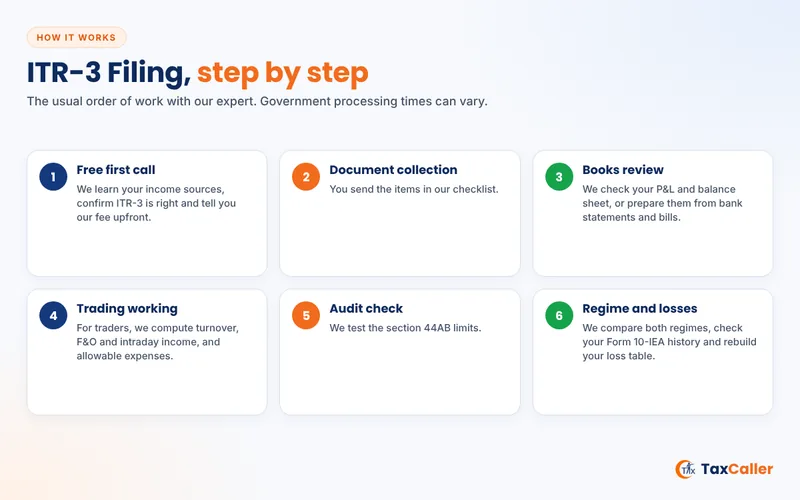
How TaxCaller Handles Your ITR 3 Filing, Step by Step
ITR-3 Filing: how the work moves, step by step
Everything happens online. You share documents on WhatsApp or email, and our expert does the rest.
Free first call: we learn your income sources, confirm ITR-3 is right and tell you our fee upfront.
Document collection: you send the items in our checklist. We download AIS, TIS and 26AS with your consent.
Books review: we check your P&L and balance sheet, or prepare them from bank statements and bills.
Trading working: for traders, we compute turnover, F&O and intraday income, and allowable expenses.
Audit check: we test the section 44AB limits. If an audit applies, we tell you before going further.
Regime and losses: we compare both regimes, check your Form 10-IEA history and rebuild your loss table.
Tax computation: you get a clear sheet showing income, deductions, tax, interest and refund.
Your approval: nothing is filed until you approve the computation.
Tax payment: if tax is due, we help you pay self-assessment tax through e-Pay Tax.
Filing and e-verification: we upload ITR-3 and help you e-verify with Aadhaar OTP or net banking.
Follow-up: we track processing and help with any intimation or defect notice.
How long it takes
Stage
Usual time
Books ready, no audit
2 to 4 working days after all documents arrive
Books to be prepared from bank statements
5 to 10 working days, depending on volume
Return processing by CPC
Within 9 months from the end of the financial year of filing, under section 143(1), often much sooner
Filing it yourself on the portal
You can also file ITR-3 yourself. The portal offers an online form and an Excel utility. The utility for AY 2026-27 was first released on 18 June 2026, and version 1.4 came out on 15 October 2026, as shown on the e-filing downloads page. Self-filing works if your books are ready and you know the schedules. Most first-time traders and partners find the trading account and loss schedules hard, which is where expert help saves time.
Shadab Income Tax Expert
Have a question on this topic? Ask Shadab on a free call.
These charges apply to ITR-3 for AY 2026-27 under the Income-tax Act, 1961. They are paid to the government, never to TaxCaller.
Provision
When it applies
Amount
Section 234F
Return filed after the due date
₹5,000, or ₹1,000 if total income is up to ₹5 lakh
Section 234-I
Revised return filed after 31 December 2026
₹5,000, or ₹1,000 if total income is up to ₹5 lakh
Section 234A
Tax unpaid and return filed late
1% a month on unpaid tax
Sections 234B and 234C
Advance tax short or late
1% a month
Section 271A
Required books not kept
₹25,000
Section 271B
Tax audit not done or report not filed
0.5% of turnover, up to ₹1.5 lakh
Section 270A
Under-reported income
50% of tax on it, or 200% for misreporting
Late filing also costs you the right to carry forward business and capital losses. From tax year 2026-27, the late fee moves to section 428 of the Income-tax Act, 2025, with the same amounts.
A wrong ITR-3 can get a defect notice under section 139(9), a mismatch intimation under section 143(1), or worse. These are the mistakes we fix most often.
Filing ITR-4 or ITR-2 with F&O income. F&O is business income, so it belongs in ITR-3.
Leaving the F&O turnover fields blank. The 2026 form has separate lines for this.
Treating F&O loss as a capital loss. It then cannot be carried forward correctly.
Setting off business loss against salary. Section 71(2A) does not allow it.
Missing Form 10-IEA. Claiming old-regime deductions without filing it on time brings a demand.
Wrong turnover figure. This can hide a tax audit that was needed.
GST and ITR turnover mismatch. Schedule GST is compared with your GST returns.
Ignoring AIS entries. Interest, dividends and high-value transactions in AIS must be reported or explained.
Partner's share of profit shown as taxable, or remuneration missed altogether.
Balance sheet that does not balance, or capital that does not match last year.
Claiming personal expenses, or cash payments above ₹10,000 to one person in a day, which section 40A(3) disallows.
Not e-verifying within 30 days. An unverified return is treated as not filed.
A defect notice under section 139(9) usually gives 15 days to fix the return. If you do not reply in time, the return is treated as invalid.
After Filing: Verification, Notices and Ongoing Compliance
Filing is not the last step. Here is what follows.
E-verify within 30 days of upload. If you verify later, the verification date becomes your filing date. This is the 30-day e-verification rule on the portal.
Processing under section 143(1): CPC Bengaluru checks the return and sends an intimation with any demand or refund.
Refund: it goes to your pre-validated bank account, with interest under section 244A where due.
Notices: a defect notice, mismatch query or scrutiny notice needs a careful reply. Our income tax notice reply service handles these.
Mistakes found later: you can revise until 31 March 2027, or file an updated return within 48 months from the end of the assessment year.
Ongoing compliance for business owners
Advance tax for tax year 2026-27 under the new Act.
2026 brought both a new ITR-3 and a new income tax law. Here is what matters for business and trading filers, from official sources only.
New ITR-3 notified on 30 March 2026. G.S.R. 228(E), the Income-tax (Fourth Amendment) Rules, 2026, replaced the form for AY 2026-27 from 31 March 2026.
Separate F&O lines. The trading account now asks for F&O turnover and F&O income on their own lines, next to intraday figures.
31 August due date for non-audit business returns. The Finance Act, 2026 split the old 31 July date. Salary-only returns stayed at 31 July.
Audit cases extended to 21 November 2026.CBDT Circular No. 07/2026 also moved the tax audit report to 21 October 2026.
Longer revised return window. A revised return can be filed until 31 March 2027, with a fee under new section 234-I after 31 December 2026.
Updated returns widened. From 1 March 2026, an ITR-U may in some cases reduce a loss declared earlier, and may be filed after a section 148 notice.
Income-tax Act, 2025 in force from 1 April 2026. The CBDT press release confirms it. Your FY 2025-26 return still uses the 1961 Act. FY 2026-27 becomes "Tax Year 2026-27", with the return under section 263.
Tax audit moves to section 63 and Form No. 26. From tax year 2026-27, one Form 26 under Rule 47 replaces Forms 3CA, 3CB and 3CD.
Updated utility. The ITR-3 Excel utility reached version 1.4 on 15 October 2026.
We track these changes for you, so your books and audit for tax year 2026-27 are planned under the new rules from the start.
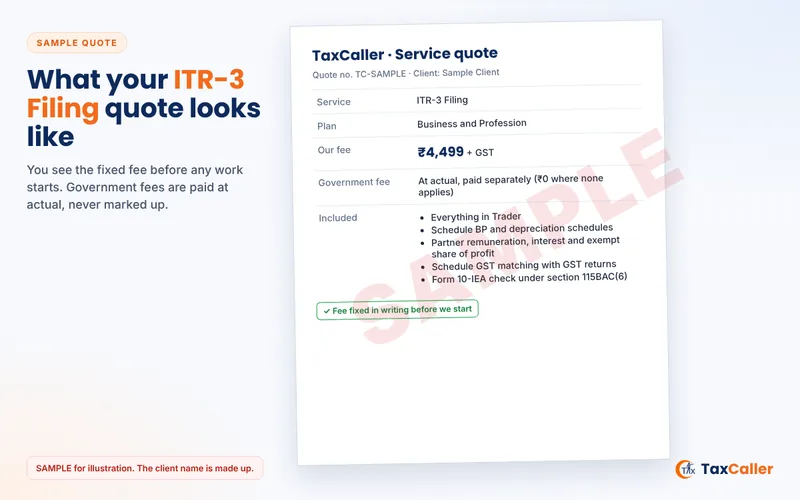
TaxCaller's fee for ITR 3 filing starts at ₹2,999 + GST. The final fee depends on how many income sources you have, how many trades, and whether your books are ready. We tell you the exact fee on the first call, before any work starts.
What the fee covers
Choosing the right form and regime after reading your AIS.
Schedule BP, trading account, P&L and balance sheet entry from your books.
F&O and intraday income working, and loss carry-forward.
Capital gains, rent and other income in the same return.
Filing, e-verification help and support on the processing intimation.
Government fees are separate
The Income Tax Department charges no government fee to file ITR-3 on time. Any amount you owe the government is paid directly by you at actual. This covers income tax, interest under sections 234A, 234B and 234C, late fee under section 234F, revised return fee under section 234-I and additional tax on an updated return. None of these is part of TaxCaller's fee.
Work quoted separately
Writing up full books from raw bank statements.
Tax audit, which must be signed by a chartered accountant in practice. Its fee is separate.
Bank account details with IFSC, pre-validated on the portal
AIS, TIS and Form 26AS for FY 2025-26
Form 16 (if salaried) and Form 16A (TDS on fees, rent or contracts)
Profit and loss account and balance sheet for FY 2025-26, or books to prepare them
Bank statements of all accounts used for business
GSTR-1 and GSTR-3B returns for the year (if GST registered)
Broker's tax P&L for F&O, intraday and delivery trades
Fixed asset purchase bills and stock statement as on 31 March 2026
Partner's statement from the firm (remuneration, interest, profit share) and firm's PAN
Advance tax and self-assessment tax challans
Last year's ITR and Form 10-IEA acknowledgement (if old regime chosen)
Tax audit report acknowledgement (Form 3CA/3CB with 3CD), if audit applies
Deduction proofs for 80C, 80D, 80G (old regime only)
Why TaxCaller
Real experts, not a call centre
Your work is handled by experienced professionals who explain every step, check your documents and keep you updated.
Registered company
TaxCaller is run by TaxCaller India LLP (LLPIN AAQ-7388), serving clients since 2018.
Fee told upfront
You know the complete fee, our professional fee and the government fee, before any work starts. No hidden charges.
Support after the work
Notices, renewals, returns and compliance reminders: we stay with your business after the registration is done.
Reviewed By
Expert for this topic ITR-3 Filing
Abhinay Rai
Advocate
Abhinay Rai is a Advocate specialising in ITR-3 Filing. The process, documents, timelines and fees on this page are checked against the current rules and government portals, and updated whenever the law, forms or fees change.
ITR-3 is the income tax return for individuals and HUFs who earn profits from a business or profession. You file it if you trade in F&O or intraday, earn salary or interest as a partner in a firm, or run a business with real books. It also covers your salary, rent, capital gains and other income in one return.
Can a salaried person with F&O trades file ITR-3?
Yes, and they must. F&O income is non-speculative business income under section 43(5)(d), so ITR-1 and ITR-2 cannot carry it. You report your salary in Schedule S and your trades in the trading account and Schedule BP of the same ITR-3. A loss from F&O cannot be set off against your salary, but it can be carried forward.
What is the last date for ITR 3 filing for AY 2026-27?
For business or professional income without a tax audit, the due date was 31 August 2026 under the Finance Act, 2026. Audit cases and partners of audited firms have until 21 November 2026, as extended by CBDT Circular No. 07/2026. Transfer pricing cases have until 30 November 2026. A belated return is open until 31 December 2026.
What is the difference between ITR-3 and ITR-4?
ITR-4 is a short form for residents who declare presumptive income under section 44AD, 44ADA or 44AE, with total income up to ₹50 lakh. ITR-3 is for business income from actual accounts, with a full P&L and balance sheet. Directors, NRIs, F&O traders and people with losses to carry forward must use ITR-3, not ITR-4.
Is a tax audit required for F&O traders?
Only if your trading turnover crosses the section 44AB limit, or in some cases where you declare a loss or low profit after earlier using section 44AD. The limit is ₹1 crore, or ₹10 crore when cash receipts and payments are each within 5%. Turnover for F&O is not the contract value, so we calculate it before deciding.
Can I carry forward F&O losses if I file ITR-3 late?
No. Section 80 allows business and capital losses to be carried forward only if the return is filed by the due date under section 139(1). A belated ITR-3 loses this benefit for that year's loss. F&O losses filed on time can be carried for eight years, and intraday losses for four years, against matching income only.
Can I switch between the old and new regime in ITR-3?
Not freely. With business income, the new regime is the default. To use the old regime, you file Form 10-IEA by the due date under section 115BAC(6). After opting out, you can return to the new regime only once. After that, the old regime closes for as long as you have business or professional income.
Do partners in a firm or LLP file ITR-3?
Yes. Salary, bonus, commission and interest on capital from the firm are business income under section 28(v), so partners file ITR-3. Their share of the firm's profit is exempt under section 10(2A) and is shown in Schedule IF. The firm itself files ITR-5. Partners of audited firms get the later audit-case due date.
Is a balance sheet mandatory in ITR-3?
If you keep books under section 44AA, you must fill the balance sheet and profit and loss account in Part A of ITR-3. Separately, Schedule AL listing your personal assets and liabilities is needed only when total income exceeds ₹1 crore. If your books are not ready, we can prepare them from your bank statements and bills.
What if I missed the 31 August 2026 due date for ITR-3?
You can still file a belated return under section 139(4) until 31 December 2026. A late fee of ₹5,000 applies under section 234F, or ₹1,000 if total income is up to ₹5 lakh. Interest under section 234A runs on unpaid tax. You also lose the right to carry forward this year's business and capital losses.
Do I need a chartered accountant to file ITR-3?
No. Any taxpayer can file ITR-3 on the e-filing portal, or take help from a tax expert. A chartered accountant is legally needed only for the tax audit report under section 44AB, when your turnover or receipts cross the audit limits. TaxCaller's tax experts prepare and file ITR-3, and audit work is quoted separately.
Can I revise my ITR-3 after filing it?
Yes. Under section 139(5), a revised return for AY 2026-27 can be filed until 31 March 2027, or until assessment is completed if earlier. A fee under section 234-I applies if you revise after 31 December 2026. After that window, an updated return under section 139(8A) is possible, with additional tax under section 140B.
Is my ITR-3 for AY 2026-27 filed under the new Income-tax Act, 2025?
No. The new Act came into force on 1 April 2026, but income of FY 2025-26 is still assessed under the Income-tax Act, 1961, as saved by section 536 of the new Act. The new Act first applies to Tax Year 2026-27, whose return is filed in 2027 under section 263. You do not file two returns in 2026.
What is Form 26 and does it apply to my audit this year?
Form No. 26 is the new tax audit report under section 63 of the Income-tax Act, 2025 and Rule 47 of the Income-tax Rules, 2026. It applies from tax year 2026-27. For FY 2025-26 audits, filed with your AY 2026-27 ITR-3, Forms 3CA, 3CB and 3CD still apply, as CBDT's own FAQs confirm.