Nidhi Company Registration in India: Rules, NDH-4 and Process
Nidhi company registration done right: we incorporate your public company, build members and Net Owned Funds, and file Form NDH-4 for the Central Government declaration.
Starting from · ₹12,999 Nidhi Company Registration Nidhi Incorporation plan
STARTING FROM₹12,999
FEE TOLD UPFRONTFree first call
!New company?File INC-20A within 180 days of incorporation
Since 2018Trusted Experience
980+Experts Connected
220+Cities Served
1164+Agents Available
12000+Founders Trusted
S
Srishti Magoo
★★★★★
Excellent experience with TaxCaller for filing my &
my family members ITR returns. The entire process was
smooth, quick and hassle-free. They are professional,
knowledgeable and guided me through every step with patience.
O
obeid sait
★★★★★
The team has handled my taxes for the past three years,
and it's been a wonderful, hassle-free experience.
Thank you for your consistently quick and efficient service.
P
Pushkar
★★★★★
They are among the best in their field. Their work culture
is highly professional, and their client service is smooth
and reliable. They can confidently be relied on to get the job done.
P
Prasad Sheth
★★★★★
Excellent experience with TaxCaller! The ITR filing
process was smooth, quick, and completely hassle-free.
The CA was knowledgeable, responsive, and explained everything clearly.
A
Apoorv Bansal
★★★★★
Excellent service for ITR filing. The team was highly
professional, responsive, and guided me through the entire
process smoothly. My return was filed accurately and on time.
A
Abhishek Kumar
★★★★★
I was searching for a good CA firm in Ghaziabad and found
TaxCaller. The experience was excellent from start to finish.
The team is responsive, transparent, and genuinely helpful.
U
uma pandey
★★★★★
Great service! TaxCaller India made the entire ITR filing
process quick, smooth, and hassle-free. They answered all
my queries patiently and ensured maximum accuracy.
T
tanu mittal
★★★★★
Excellent job! We've been connected for many years,
and your success truly makes me happy. You are an
incredibly intelligent person. Keep shining, keep growing.
B
Bhanu Pratap Maurya
★★★★★
I am filing my ITR since past 3 years with Abhinav and
Firm is known as TaxCaller and they are professional
interms of ITR rules. They will explain and tell you all
the information.
A
ashish Sharma
★★★★★
I am providing my honest reviews:
No.1 service ...
A
AARYAN GROUP
★★★★★
Honestly, finding a good CA firm in Ghaziabad was
confusing, but TaxCaller India made it simple.
I contacted them for GST work and the experience was smooth.
N
News Speaks
★★★★★
If you're looking for a reliable CA firm in Ghaziabad,
TaxCaller India is a great choice. They provide complete
taxation and compliance solutions including GST.
A
Anshul Chaprana
★★★★★
Got my GST registration done through TaxCaller CA firm.
Process was quite smooth, they guided properly on documents
and didn't waste time. Overall good experience.
How we work
Online · Call · WhatsApp
Quick answer
A Nidhi company is a public company that takes deposits from, and lends only to, its own members under section 406 of the Companies Act, 2013. You incorporate it with seven members, three directors and ₹10 lakh paid-up capital. Within 120 days you need 200 members, ₹20 lakh Net Owned Funds and an NDH-4 application for Central Government declaration.
Reviewed by Abhinay Rai · Updated 16 Nov 2026
Pick a plan that fits
Nidhi Incorporation
Founders who have seven members and three directors ready and only need the company formed
₹12,999+ GST
+ Govt. fees at actual
Handled by a TaxCaller Expert Company Registration Expert
Government fees and taxes are extra where applicable. Our expert confirms the final amount on the first call. No hidden charges.
About Nidhi Companies
A Nidhi company is a mutual benefit company. Its members save with it, and it lends their pooled money back to members only. The word "Nidhi" means a fund or treasure, so the Nidhi company meaning is simply a members' own savings fund run as a company. Section 406 of the Companies Act, 2013 and the Nidhi Rules, 2014 govern it, and the Ministry of Corporate Affairs (MCA) regulates it.
Since the 2019 and 2022 amendments, a company does not become a Nidhi just by registering. It is first incorporated as a public limited company. It then builds 200 members and ₹20 lakh of Net Owned Funds, and applies in Form NDH-4. Only after the Central Government declares it a Nidhi can it take deposits, give loans or use the words "Nidhi Limited" in its name.
This page explains the rules, the registration process, documents, government fees, ongoing returns and penalties, with rule numbers. It is written for founders who want to start a Nidhi, and for members who want to check one. TaxCaller handles the company setup and the NDH-4 work online across India.
Complete guide
Choose a topic to open it. Every answer gives the rule or section it comes from.
01 Topic 1 of 20
What Is a Nidhi Company? Section 406 Explained
A Nidhi company is a public company that exists to build the habit of thrift and savings among its members. It accepts deposits from members and lends only to members, for their mutual benefit. That is the definition in section 406(1) of the Companies Act, 2013.
Since 15 August 2019, section 406 also requires a declaration. The Central Government must declare the company a Nidhi or Mutual Benefit Society by notification in the Official Gazette. Before that, many companies simply registered with "Nidhi" in the name and started taking deposits. That is no longer allowed.
The rules that apply
Law or notification
What it does
Section 406, Companies Act, 2013
Defines a Nidhi and lets the Central Government frame rules and exemptions
Nidhi Rules, 2014 (G.S.R. 258(E))
Main rulebook: capital, members, deposits, loans, branches, returns, penalty
Nidhi (Amendment) Rules, 2019 (G.S.R. 467(E), in force 15 August 2019)
Brought back the Central Government declaration through Form NDH-4
Nidhi (Amendment) Rules, 2022 (G.S.R. 301(E), 19 April 2022)
₹10 lakh capital, ₹20 lakh NOF, NDH-4 within 120 days, fit and proper test, 45-day deemed approval
Nidhi (Amendment) Rules, 2023 (G.S.R. 35(E), 20 January 2023)
Replaced Nidhi forms, including NDH-1 and NDH-2
Nidhi (Amendment) Rules, 2024 (G.S.R. 413(E), 16 July 2024)
"Nidhi Limited" may be used in the name only after the declaration
You can read the Act on India Code. Forms and company records are on the MCA portal. Older Nidhis were recognised under section 620A of the Companies Act, 1956, and the 2014 Rules apply to them too.
A Nidhi works like a closed savings and credit circle run as a company. Members buy shares, place deposits and borrow, and nobody outside the membership can do any of these.
Joining: a person becomes a member by buying equity shares. Shares have a face value of at least ₹10, and each deposit holder must get at least 10 equity shares or shares worth ₹100. A savings or recurring deposit holder needs at least one ₹10 share (rule 7).
Saving: members place fixed, recurring or savings deposits on the terms in rule 13.
Safety buffer: at least 10% of outstanding deposits sits in unencumbered term deposits with a scheduled commercial bank or the post office (rule 14).
Lending: the Nidhi lends to members against gold, silver, jewellery, property, fixed deposits or approved securities (rule 15).
Earning: the gap between loan interest and deposit interest pays costs and, if allowed, a dividend to members.
Typical Nidhi products
Fixed deposits for 6 to 60 months
Recurring deposits for 12 to 60 months
Savings deposit accounts, with interest on balances up to ₹1 lakh (rule 13)
Gold and silver jewellery loans
Loans against property or the member's own deposits
Locker facility for members, if rental income stays within 20% of gross income (rule 6)
Who owns a Nidhi? Its shareholders, who are also its members. Directors must themselves be members (rule 17). There is no outside owner who can take deposits from the public.
Shreya Company Registration Expert
Have a question on this topic? Ask Shreya on a free call.
Nidhi Finance Company, Nidhi Bank and Nidhi Limited: What the Names Mean
A "Nidhi finance company" and a "Nidhi bank" are everyday names for the same thing: a Nidhi company under section 406. Legally it is neither a bank nor an RBI-registered NBFC.
Not a bank: a Nidhi has no banking licence. It cannot offer current accounts to members (rule 6) or serve the public.
Not a regular finance company: it cannot lend to non-members or to any company, and it cannot do leasing or hire purchase.
"Nidhi Limited": since the Nidhi (Amendment) Rules, 2024, a company may use these words only after it is declared a Nidhi under section 406(1). The Companies (Incorporation) Amendment Rules of July 2024 also dropped the old rule that a proposed Nidhi name must end with "Nidhi Limited".
So a company name with "Nidhi" in it, or a signboard saying "Nidhi bank", proves nothing. Members should check the declaration, as explained in the 2026 section below.
A Nidhi suits a group that already trusts each other and wants to save and borrow within that group. It is a poor fit for anyone who wants to lend to the general public or raise outside investment.
Good fit
Poor fit
A community, trade or employee group that can bring 200 members
A lender who wants customers from the open market
Promoters who can fund ₹20 lakh of Net Owned Funds
A business that needs bank or institutional borrowing to lend (barred by rule 6(l))
Gold loan or small secured lending to members within one state
Plans for branches in many states (branches must stay within the home state, rule 10)
Founders with a clean record who pass the fit and proper test
Chit fund, insurance, leasing or investment business (all barred by rule 6)
Benefits
No RBI registration, because it deals only with members
Entry capital far lower than an NBFC: ₹10 lakh paid up and ₹20 lakh NOF
Limited liability for members, as in any company
Lower credit risk, since borrowers are known members and loans are secured
Legal standing for a community savings group that once ran informally
Limits
Growth depends on adding members; no advertising for deposits
Branches stay in one state, and only after three profitable years
Business limited to member deposits and secured loans
Deposits capped at 20 times NOF
Half-yearly and yearly returns, audit and member records to maintain
Member deposits have no deposit insurance
If you only want a regular business, a private company is simpler. See our company registration guide to compare structures.
Minimum Requirements: Members, Directors, Capital and NOF
A new Nidhi must meet two sets of numbers: one at incorporation and one before it applies for declaration. The table lists both, with the rule for each.
Requirement
Minimum
When
Source
Type of company
Public company limited by shares
At incorporation
Rule 4(1)
Subscribers (members)
7
At incorporation
Section 3(1)(a)
Directors
3, at least one resident in India
At incorporation
Section 149(1) and 149(3)
Paid-up equity share capital
₹10 lakh
At incorporation
Rule 4(1), raised from ₹5 lakh in 2022
Members
200
Before NDH-4, within 120 days
Rule 3B(1)
Net Owned Funds (NOF)
₹20 lakh
Before NDH-4, and always after
Rules 3B(1) and 9
NOF to deposits
Deposits not more than 20 times NOF
Always
Rule 11
Unencumbered term deposits
10% of outstanding deposits
Always
Rule 14
How NOF is worked out
Net Owned Funds means paid-up equity capital plus free reserves, minus accumulated losses and intangible assets, as per the last audited balance sheet (rule 3). Money from preference shares does not count, and a Nidhi cannot issue preference shares at all (rule 4).
Worked example (illustration only)
Seven founders bring ₹1,50,000 each, so paid-up capital is ₹10,50,000. Then 193 more members join and take shares of ₹5,000 each, adding ₹9,65,000. Paid-up capital is now ₹20,15,000 with 200 members. Say setup costs leave an accumulated loss of ₹45,000. NOF is then ₹19,70,000, which is ₹30,000 short of ₹20 lakh.
If each new member takes ₹6,000 of shares instead, members add ₹11,58,000. Paid-up capital becomes ₹22,08,000 and NOF is ₹21,63,000. At 1:20, deposits can then go up to about ₹4.32 crore. Plan a buffer above ₹20 lakh, because losses and intangible assets reduce NOF.
Who can be a member
A body corporate or a trust cannot be a member (rule 8).
A minor cannot be a member. A guardian who is a member can make deposits in the minor's name.
Membership must not fall below 200 at any time after the declaration.
During the term of a loan or deposit, a member cannot transfer more than 50% of their shares (rule 8(4)).
Zubair Company Registration Expert
Have a question on this topic? Ask Zubair on a free call.
Two Stages: Incorporation, Then Declaration Under Form NDH-4
Becoming a Nidhi is a two-stage process: the ROC incorporates a public company, and then the Central Government declares it a Nidhi on an NDH-4 application. Until stage two is done, the company cannot run any Nidhi business.
Stage 1: incorporation
The company is formed through SPICe+ as a public company with objects limited to Nidhi business. Our public limited company registration page explains the general SPICe+ steps.
Stage 2: declaration
Rule 3B, added by the 2022 amendment, applies to every company incorporated as a Nidhi from 19 April 2022:
Apply in Form NDH-4 within 120 days of incorporation, once the company has at least 200 members and NOF of ₹20 lakh or more.
Attach a fit and proper declaration from every promoter and director.
The Central Government decides within 45 days of receipt. If it does not, the application is deemed approved.
After approval, the company is notified in the Official Gazette. It files the approval with the ROC along with Form INC-20A under section 10A.
The company can commence business only after the approval.
A company that misses rule 3B(1) cannot file Form SH-7 (change in capital) or Form PAS-3 (return of allotment).
Companies incorporated as Nidhis before 19 April 2022 follow rule 5 instead. They had one year to reach 200 members and NOF, filed Form NDH-1, and could seek an extension in Form NDH-2. Those that did not get declared cannot accept deposits from or give loans to members under rule 3A. Rule 5 does not apply to companies incorporated on or after 19 April 2022 (rule 5(5)).
Nidhi Company Registration Process: How TaxCaller Does It Online
Nidhi Company Registration: how the work moves, step by step
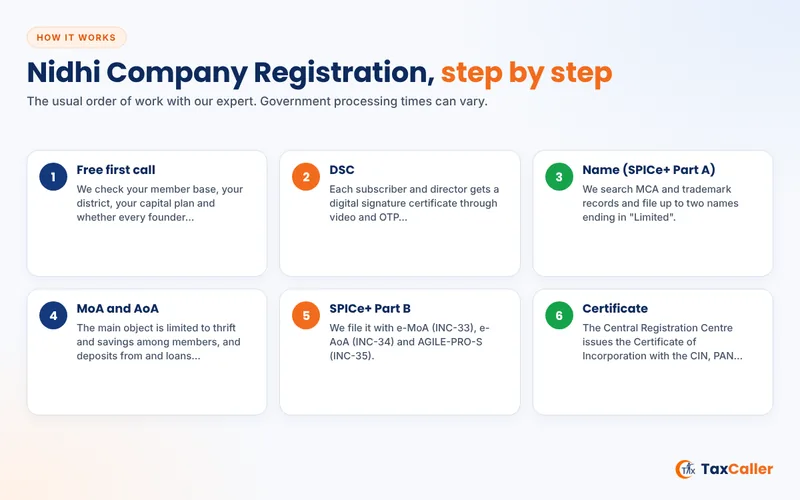
We handle Nidhi company registration online in ten steps, from the first call to the INC-20A after approval. You do not need to visit any office.
Free first call: we check your member base, your district, your capital plan and whether every founder passes the fit and proper test. You get our fee and the government cost estimate in writing.
Name (SPICe+ Part A): we search MCA and trademark records and file up to two names ending in "Limited". The fee is ₹1,000. "Nidhi Limited" is used only after the declaration.
MoA and AoA: the main object is limited to thrift and savings among members, and deposits from and loans to members only. The AoA follows the Nidhi Rules on shares, membership and directors.
SPICe+ Part B: we file it with e-MoA (INC-33), e-AoA (INC-34) and AGILE-PRO-S (INC-35). DINs for up to three directors come through the form.
Certificate: the Central Registration Centre issues the Certificate of Incorporation with the CIN, PAN and TAN.
Capital and members: founders pay at least ₹10 lakh into the company's bank account. You then enrol members with full KYC, and we prepare share allotment papers and Form PAS-3.
NOF check: we compute NOF from the books with your auditor and confirm 200 members and ₹20 lakh NOF before filing.
Form NDH-4: we file it within 120 days of incorporation, with the member list, NOF proof, board resolution and fit and proper declarations. We reply to any query from the Ministry.
After approval: we file the approval with INC-20A, within 180 days of incorporation. We share a starting checklist for deposits, loans and returns.
Count your days from the incorporation date. If NDH-4 is filed on day 120 and the Ministry takes the full 45 days, the decision lands on day 165. That leaves little time before the 180-day INC-20A limit. File NDH-4 early wherever possible. Our INC-20A filing page explains the declaration.
Documents Required, Including Fit and Proper Declarations
Nidhi Company Registration: documents to keep ready
You need personal KYC for founders, office proof for the company, and member and financial records for NDH-4. Names, dates of birth and addresses must match across PAN, ID proof and DSC.
For incorporation
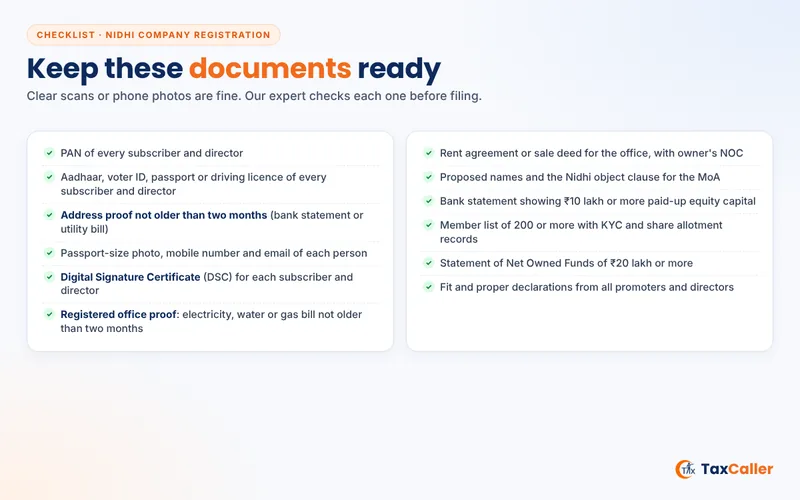
PAN of every subscriber and director
Aadhaar, voter ID, passport or driving licence
Address proof not older than two months, such as a bank statement or utility bill
Photo, mobile number and email ID of each person
Office proof: a utility bill not older than two months, the rent agreement or sale deed, and the owner's NOC
Two proposed names, the object clause and the capital plan
Consent in DIR-2 and declarations in INC-9, generated with SPICe+
For Form NDH-4
List of 200 or more members, with KYC kept on record
Share allotment details and the PAS-3 filing
Statement of NOF of ₹20 lakh or more, backed by the books and bank statements
Board resolution approving the application
Fit and proper declaration from every promoter and director
Any other attachment the form or the Ministry asks for
The fit and proper test under rule 3B(3)
The test looks at integrity, honesty, ethics, reputation, fairness and character. A person fails it if, for example:
a criminal complaint under section 154 of the Code of Criminal Procedure, filed by a person authorised by the Central Government, or a charge sheet for an economic offence, is pending against them;
a restraint, prohibition or debarment order is in force against them;
they were convicted of an offence involving moral turpitude;
they are an undischarged insolvent, found to be of unsound mind, with that finding in force, a wilful defaulter or a fugitive economic offender;
they are already a director in five or more Nidhis, or a promoter of three or more.
Check this for every founder before you spend on incorporation. One failing director can sink the whole application.
Abhinay Rai Company Registration Expert
Have a question on this topic? Ask Abhinay on a free call.
Incorporation usually takes 10 to 20 working days in our experience, and the law gives 120 days from incorporation to file NDH-4. The Ministry then has 45 days to decide.
Stage
Usual time
Legal limit
KYC review and DSC for all signers
1 to 3 working days
None
Name approval in SPICe+ Part A
1 to 3 working days
Name valid for 20 days, extendable for a fee
Drafting and SPICe+ Part B
2 to 3 working days
Within name validity
Certificate of Incorporation
3 to 7 working days after filing
None
Capital paid, 200 members, ₹20 lakh NOF
Depends on your member drive
Before NDH-4
Form NDH-4 filed
As soon as the numbers are met
Within 120 days of incorporation
Central Government decision
Up to 45 days
Deemed approved after 45 days
INC-20A with the approval
Soon after approval
Within 180 days of incorporation
Working-day ranges are our estimates from experience, not government limits. A query from the CRC or the Ministry adds time.
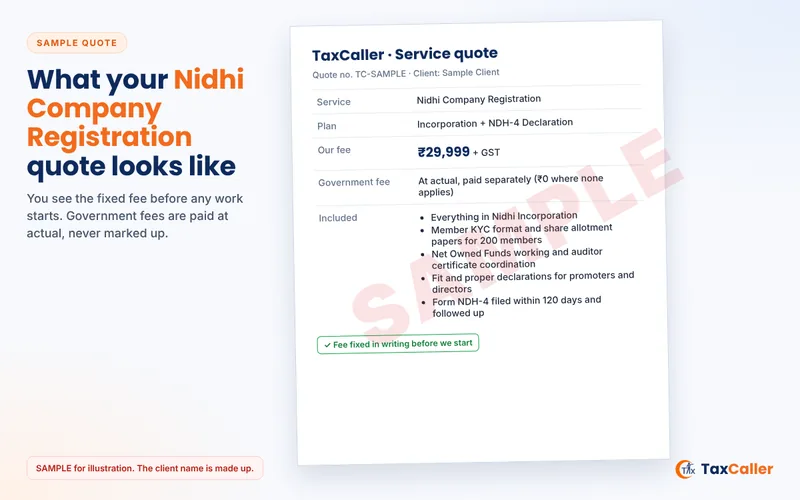
Nidhi Company Registration: SAMPLE quote, for illustration only
A Nidhi has three kinds of cost: government fees, third-party charges and our professional fee. The ₹10 lakh capital and ₹20 lakh NOF are the company's own money, not fees.
Government and third-party costs
Item
Amount
Source
Name reservation (SPICe+ Part A)
₹1,000
Companies (Registration Offices and Fees) Rules, 2014
SPICe+ registration fee, authorised capital up to ₹15 lakh
Nil
MCA fee schedule
SPICe+ registration fee, capital above ₹15 lakh
Slab fee by authorised capital
Table of fees, same rules
Stamp duty on MoA and AoA
Depends on your state and capital
State stamp law, paid on the MCA portal
NDH-4, PAS-3, INC-20A and later e-forms
As per the MCA fee table
Companies (Registration Offices and Fees) Rules, 2014
DSC for each signer
Charged by the certifying authority
Market rate
If authorised capital is set at ₹20 lakh to cover NOF, the SPICe+ slab fee applies, because it is above ₹15 lakh. We show you both options on the first call.
TaxCaller's fee
TaxCaller's fee for Nidhi company registration starts at ₹12,999 + GST for incorporation. Government fees, stamp duty and DSC charges are paid separately at actual, and you get every receipt. The NDH-4 and first-year plans cost more, because member records and NOF work take time.
Item
Paid to
Amount
Incorporation work
TaxCaller
From ₹12,999 + GST
Name, SPICe+ and stamp duty
MCA and state
At actual
DSC
Certifying authority
At actual
Published guides put other costs at very different levels. Ignore any quote that mixes the capital with fees. We confirm our fee in writing before you pay.
A Nidhi can only borrow from and lend to its members in its own name; rule 6 bans almost everything else. Breaking these limits is the fastest way to lose the declaration.
Allowed
Not allowed
Deposits from members
Deposits from, or loans to, non-members or any body corporate
Loans to members against approved security
Chit fund, hire purchase, leasing or insurance business
Locker facility for members, rent within 20% of gross income
Buying securities of any body corporate, or control of another company's board
Circulating deposit scheme details to members, marked for members only
Advertising in any form to solicit deposits
Savings, fixed and recurring deposit accounts
Current accounts for members
Equity shares for members
Preference shares, debentures or other debt instruments
Own funds and member deposits for lending
Loans from banks, financial institutions or others to lend on to members (rule 6(l))
Business in its own name
Partnership arrangements in borrowing or lending
Holding members' pledged assets
Pledging assets lodged by members
Staff on salary
Brokerage or incentive for mobilising deposits or granting loans
A Nidhi that wants to do any of the barred activities needs a different structure and, for most finance businesses, an RBI licence.
Shadab Company Registration Expert
Have a question on this topic? Ask Shadab on a free call.
Deposit Rules: Tenure, Interest and the 1:20 Ratio
Deposits are capped at 20 times NOF and must follow fixed tenures and interest ceilings. The limits come from rules 11, 13 and 14.
Point
Rule
Fixed deposit tenure
6 to 60 months (rule 13)
Recurring deposit tenure
12 to 60 months (rule 13)
Savings deposit interest
Not more than 2% above the savings rate of nationalised banks (rule 13)
Fixed and recurring deposit interest
Not more than the maximum rate RBI allows NBFCs on public deposits (rule 13)
Premature repayment
Not in the first three months. Between three and six months, no interest is paid. After that, the rate is cut by 2% (rule 13)
Total deposits
Not more than 20 times NOF as per the last audited accounts (rule 11)
Safety buffer
10% of outstanding deposits in unencumbered term deposits with a scheduled commercial bank or the post office (rule 14)
What the deposit form must show
Rule 12 lists what the deposit application form must carry. It includes the company's details, the date of its Nidhi declaration, directors with DIN, recent profits and dividends, and the deposit terms. It must also state that the Government and the RBI do not insure or back the deposits. Every new depositor must be introduced and give identity and address proof.
So a Nidhi cannot pay any rate it likes. A promise of very high returns is a warning sign, which is exactly what the MCA said in its 2026 advisory.
A Nidhi can lend only to members, within a per-member ceiling that depends on its total deposits. Rule 15 sets the limits, and rule 16 caps the interest.
Total deposits of the Nidhi
Maximum loan to one member
Below ₹2 crore
₹2 lakh
₹2 crore to ₹20 crore
₹7.5 lakh
₹20 crore to ₹50 crore
₹12 lakh
Above ₹50 crore
₹15 lakh
If the Nidhi has not made a net profit in each of the last three years, new loans are capped at half these limits. A member who has defaulted on an earlier loan cannot get a new one.
Security accepted
Gold, silver and jewellery: repayable within one year. The loan-to-value ratio cannot exceed 80% (rule 20).
Immovable property: loan up to 50% of the property's value, repayable within seven years. Property loans as a group are also limited to 50% of total loans, except registered mortgages.
Fixed deposits, NSCs, government securities and insurance policies: the security is pledged with the Nidhi, and a loan against a fixed deposit cannot run beyond the deposit's remaining term.
Interest cap
Loan interest cannot exceed 7.5% above the highest rate the Nidhi pays on deposits. It is charged on the reducing balance, and the same class of loans carries the same rate. Rates must be displayed at the registered office and every branch (rule 16).
A Nidhi can open branches only after three straight years of net profit after tax, and only inside its home state. Rules 10, 17, 18 and 19 cover branches and governance.
Branches (rule 10)
Up to three branches within the district of the registered office, without approval
More than three in the district, or any outside it, needs the Regional Director's prior approval in Form NDH-2
Intimate the ROC within 30 days of opening
No branch outside the state of the registered office
No branch while accounts or annual returns with the ROC are pending
Closing a branch needs board approval and the Regional Director's approval in Form NDH-2, sought at least 60 days ahead. A notice in Form NDH-5 then goes in a local language newspaper at least 30 days before closure
Collection or deposit centres that are not branches had to close under the 2022 amendment, with intimation in Form NDH-2 (rule 10(7))
Dividend (rule 18)
A Nidhi cannot declare a dividend above 25% in a financial year. The 2022 amendment replaced the older rule, which had allowed a higher dividend with the Regional Director's approval.
Directors (rule 17)
Every director must be a member. A director can hold office for up to ten consecutive years. Re-appointment is possible only after a two-year gap.
Auditors (rules 19 and 22)
Rule 19 limits how long the same auditor can continue. Every year the auditor also certifies whether the Nidhi complied with the rules, and lists any rule it did not follow (rule 22).
Shreya Company Registration Expert
Have a question on this topic? Ask Shreya on a free call.
Ongoing Nidhi Company Compliance: NDH-3, AOC-4, MGT-7 and More
A declared Nidhi files the Nidhi-specific half-yearly return plus every yearly filing of a public company. Missing them can stop dividends, branches and, in time, the business itself.
Filing or task
Due
Law
Registered office verification (INC-22), if not given in SPICe+
Within 30 days of incorporation
Section 12(2)
Director disclosures (MBP-1, DIR-8)
First board meeting of each year
Sections 184 and 164
Event filings: change of directors, office, auditor or capital
Within the time set for each form
Companies Act and rules
Half-yearly return in Form NDH-3
Within 30 days of each half-year end, so by 30 October and 30 April
Rule 21, certified by a practising CS, CA or cost accountant
Auditor's certificate on Nidhi Rules compliance
With the yearly audit report
Rule 22
Financial statements (AOC-4)
Within 30 days of the AGM
Section 137
Annual return (MGT-7, not MGT-7A)
Within 60 days of the AGM
Section 92
Auditor appointment (ADT-1)
Within 15 days of the AGM that appoints
Section 139
Board meetings
At least four a year, gap not over 120 days
Section 173
AGM
Within six months of year end (first one within nine months)
Section 96
Director KYC (DIR-3-KYC)
Once every three years, by 30 June
Rule 12A, as amended in 2025
Income-tax return and TDS returns
As per income-tax due dates
Income-tax law
NDH-1 return and NDH-2 extension request (older Nidhis only)
As per rule 5
Rule 5, not for companies incorporated from 19 April 2022 (rule 5(5)). NDH-2 is still used by every Nidhi for branch approvals under rule 10
Records that make filings easy
Keep the member register, share register, deposit ledger and loan ledger in one system, digital or manual, that ties to the books. NDH-3, the auditor certificate and the NOF ratio all draw on these records. Gaps here are the most common reason returns go wrong.
A Nidhi is a public company, so it files the full MGT-7. The small-company relief does not apply. Our annual compliance service covers the ROC calendar, and DIR-3 KYC is handled for every director. For the general company calendar, see company compliance. Tax filings are on our income tax filing and TDS return filing pages.
Breaking the Nidhi Rules attracts a fine of up to ₹5,000, plus up to ₹500 a day while it continues, under rule 24. The bigger risks are losing the right to take deposits and Companies Act penalties.
Default
Consequence
Source
Any breach of the Nidhi Rules
Company and each officer in default: fine up to ₹5,000, plus up to ₹500 a day after the first day
Rule 24
NDH-4 not filed within 120 days
No SH-7 or PAS-3 filing; no business
Rule 3B(1), 3B(5) and 3B(6)
Older company not declared
Cannot accept deposits or give loans
Rule 3A
Rule violations or acting against the articles
A special officer can be appointed to take over management, after a hearing
Rule 23
INC-20A not filed in 180 days
Company ₹50,000; each officer ₹1,000 a day, up to ₹1,00,000
Section 10A(2)
Annual return not filed
Company ₹10,000 plus ₹100 a day, up to ₹2 lakh; officer up to ₹50,000
Section 92(5)
Financial statements not filed
Company ₹10,000 plus ₹100 a day, up to ₹2 lakh; officer up to ₹50,000
Section 137(3)
AOC-4 or MGT-7 filed late
Additional fee of ₹100 a day per form; other late e-forms pay additional fees under the fees rules
A Nidhi deals only with its members and is regulated by the MCA, while an NBFC needs an RBI certificate of registration and a chit fund runs under the Chit Funds Act, 1982. The table gives the main differences.
Point
Nidhi
NBFC
Chit fund
Law
Section 406, Companies Act and Nidhi Rules, 2014
RBI Act, 1934 (section 45-IA registration) and RBI directions
Chit Funds Act, 1982
Regulator
MCA
RBI
State Registrar of Chits
Approval
Central Government declaration on NDH-4
RBI certificate of registration
Registration of each chit with the state
Who it serves
Members only
Customers in general; public deposits only if RBI permits
Subscribers to each chit
Company form
Public company only
Private or public company
Usually a company or firm under state rules
Entry capital
₹10 lakh paid up, ₹20 lakh NOF
Minimum NOF set by RBI, far higher than a Nidhi's
As per the Chit Funds Act and state rules
Main activity
Member deposits and secured loans to members
Lending, investment or other financial activity
Members contribute monthly; the pot goes to one member each round by auction or draw
A Nidhi cannot run a chit fund (rule 6). If you need to lend to the public, you need an NBFC licence from the RBI, not a Nidhi. The RBI has exempted notified Nidhis from sections 45-IA, 45-IB and 45-IC of the RBI Act. Since a Nidhi may lend only to its members, it cannot run a microfinance business for the public.
Zubair Company Registration Expert
Have a question on this topic? Ask Zubair on a free call.
Most Nidhi problems come from treating incorporation as the finish line. These are the mistakes we see most and the rules they break.
Taking deposits before the declaration: rule 3B(5) allows business only after approval.
Using "Nidhi Limited" too early: barred until the declaration under the 2024 proviso to rule 4(5).
Missing the 120-day window: the company then cannot file SH-7 or PAS-3 and is stuck.
NOF counted wrongly: losses and intangible assets reduce NOF; preference capital never counts.
Members who do not qualify: companies and trusts cannot be members, and paper-only members fail scrutiny.
A founder who fails the fit and proper test: for example a pending economic offence charge sheet, or too many other Nidhi directorships.
Advertising for deposits or paying agents: both are barred by rule 6.
Collection centres: any place other than the office or a lawful branch had to close under rule 10(7).
Branches too early or outside the state: rule 10 needs three profitable years and keeps branches in the home state.
Weak records: member KYC, share registers and board minutes that do not match the NDH-4 data.
The MCA said in September 2026 that many NDH-4 applications showed incomplete compliance with the Act and the Rules. A clean, complete file avoids most queries.
The main 2026 change is an official MCA warning to depositors, plus company-law updates that affect every Nidhi. We found no amendment to the Nidhi Rules in 2025 or 2026; the last one we found was in July 2024.
1. MCA advisory on Nidhi companies (24 September 2026)
a Nidhi may deal only with its members, and must be declared by the Central Government;
while examining NDH-4 applications, the Ministry found many companies not fully complying with the Act and the Rules;
deposits with a Nidhi are not covered by DICGC deposit insurance, the scheme that protects bank deposits;
people should check that a company has been declared a Nidhi before investing.
News reports of the advisory say 395 companies have been declared Nidhis under the 1956 and 2013 Acts, and that the MCA published the company-wise list with the advisory.
How a member can check a Nidhi
Find the company's CIN and status in the company master data on the MCA portal.
Look for the company in the MCA list of companies declared as Nidhis.
Ask for the Gazette notification or approval of its declaration, and its date.
Check that it lends and takes deposits only from members, at rates within rules 13 and 16.
2. Director KYC once in three years
From 31 March 2026, directors file DIR-3-KYC once every three financial years, by 30 June after the block ends (G.S.R. 943(E), 31 December 2025). Changes in mobile, email or address must be updated within 30 days.
3. New Regional Director offices
From 16 February 2026 the MCA has ten Regional Director offices instead of seven (S.O. 699(E)). For the north, Northern Region Directorate I in New Delhi replaced the Noida office (S.O. 700(E)). Branch approvals and other Nidhi matters go to the revised office for your state. ROCs were also re-notified as adjudicating officers under section 454 (S.O. 698(E)).
4. Income-tax Act, 2025
The Income-tax Act, 2025 replaced the 1961 Act from 1 April 2026. A Nidhi is taxed like any other domestic company, now for each "tax year". Returns for financial year 2025-26 still follow the 1961 Act.
5. Proposals that are not law yet
Draft Companies (Incorporation) Amendment Rules, 2026 were published for comments in April 2026. The Corporate Laws (Amendment) Bill, 2026 is still a Bill. As of November 2026 neither changes Nidhi registration, and the current forms apply.
Aadhaar, voter ID, passport or driving licence of every subscriber and director
Address proof not older than two months (bank statement or utility bill)
Passport-size photo, mobile number and email of each person
Digital Signature Certificate (DSC) for each subscriber and director
Registered office proof: electricity, water or gas bill not older than two months
Rent agreement or sale deed for the office, with owner's NOC
Proposed names and the Nidhi object clause for the MoA
Bank statement showing ₹10 lakh or more paid-up equity capital
Member list of 200 or more with KYC and share allotment records
Statement of Net Owned Funds of ₹20 lakh or more
Fit and proper declarations from all promoters and directors
Board resolution approving the NDH-4 application
Certificate of Incorporation, MoA and AoA
Why TaxCaller
Real experts, not a call centre
Your work is handled by experienced professionals who explain every step, check your documents and keep you updated.
Registered company
TaxCaller is run by TaxCaller India LLP (LLPIN AAQ-7388), serving clients since 2018.
Fee told upfront
You know the complete fee, our professional fee and the government fee, before any work starts. No hidden charges.
Support after the work
Notices, renewals, returns and compliance reminders: we stay with your business after the registration is done.
Reviewed By
Expert for this topic Nidhi Company Registration
Abhinay Rai
Advocate
Abhinay Rai is a Advocate specialising in Nidhi Company Registration. The process, documents, timelines and fees on this page are checked against the current rules and government portals, and updated whenever the law, forms or fees change.
A Nidhi company collects savings from its members and lends that money back to members only. It offers fixed, recurring and savings deposits, and loans against gold, silver, jewellery, property or deposits. It cannot deal with the public, run chit funds, sell insurance or invest in shares. Its purpose is mutual benefit, as section 406 of the Companies Act states.
Is a Nidhi company regulated by RBI?
No. A Nidhi is regulated by the Ministry of Corporate Affairs under section 406 of the Companies Act, 2013 and the Nidhi Rules, 2014. It does not need an RBI certificate of registration like an NBFC. RBI rates still matter indirectly, because rule 13 caps fixed and recurring deposit interest at the maximum RBI allows NBFCs on public deposits.
What is the difference between a Nidhi company and a chit fund?
A Nidhi takes deposits from members and gives them loans, under the Companies Act and the Nidhi Rules. A chit fund collects regular contributions from subscribers and gives the pot to one subscriber each round by auction or draw, under the Chit Funds Act, 1982 and state rules. Rule 6 bars a Nidhi from running any chit fund business.
Which are the top Nidhi companies in India?
There is no official ranking of Nidhi companies. The MCA keeps a list of companies declared as Nidhis, and news reports of its 2026 advisory put the count at 395. Before you deposit, check that the company is on that list and is active on the MCA portal. Judge it by compliance and rates, not by its size or advertising.
Is a Nidhi company private or public?
A Nidhi must be a public company limited by shares, as rule 4(1) of the Nidhi Rules requires. That means at least seven members and three directors at incorporation, and ₹10 lakh paid-up equity capital. A private limited company cannot work as a Nidhi. It still deals only with its members, not with the general public.
Who owns a Nidhi company?
A Nidhi is owned by its shareholders, who are also its members and depositors. Founders usually hold a large share at the start, but every member holds equity shares. Directors must be members too, under rule 17. A body corporate or a trust cannot be a member, so no company can own a Nidhi.
How many members are needed to start a Nidhi company?
You need seven members to incorporate the public company, and three directors. Before applying for declaration in Form NDH-4, the company must have at least 200 members. This must happen within 120 days of incorporation under rule 3B. After the declaration, membership must never fall below 200, as rule 8 requires.
What is the minimum capital for Nidhi company registration?
Minimum paid-up equity share capital is ₹10 lakh at incorporation, under rule 4(1) as amended in 2022. Before NDH-4, Net Owned Funds must reach ₹20 lakh, and rule 9 keeps that floor afterwards. This money stays in the company's own accounts. It is separate from government fees and from TaxCaller's professional fee, which is plus GST.
How long does Nidhi company registration take?
Incorporation through SPICe+ usually takes 10 to 20 working days, in our experience. After that, you have up to 120 days from incorporation to reach 200 members and ₹20 lakh NOF and file Form NDH-4. The Central Government then has 45 days to decide, failing which the application is deemed approved. We estimate about four to six months overall.
Can a Nidhi company accept deposits from the public?
No. A Nidhi can accept deposits only from its members, and only after the Central Government declares it a Nidhi. Rule 6 bars deposits from non-members and from any body corporate. A person must first become a member by buying shares. Each deposit holder gets 10 shares or ₹100 of shares, or one share for savings and recurring accounts.
Can a Nidhi company open a current account for members?
No. Rule 6 of the Nidhi Rules bars a Nidhi from opening current accounts for its members. It can offer savings, fixed and recurring deposit accounts within the limits in rule 13. The Nidhi itself keeps ordinary bank accounts for its operations, and places at least 10% of deposits in unencumbered term deposits.
How do I become a member of a Nidhi company?
Apply with your identity and address proof and buy the Nidhi's equity shares. A deposit holder needs at least 10 shares or ₹100 of shares, or one ₹10 share for a savings or recurring account. A body corporate or trust cannot join. Check first that the company is a declared Nidhi on the MCA list, not just named Nidhi.
Are deposits in a Nidhi company insured?
No. Deposits with a Nidhi are not covered by DICGC deposit insurance, which protects bank deposits, as the MCA's September 2026 advisory points out. Rule 12 also requires the deposit form to say the Government and RBI do not insure or back these deposits. If a Nidhi fails, recovering money can be slow and incomplete.
What is the interest rate in a Nidhi company?
Each Nidhi sets its own rates within the rules. Fixed and recurring deposit rates cannot exceed the maximum RBI allows NBFCs on public deposits. Savings interest is capped at 2% above nationalised banks' savings rate. Loan interest cannot exceed 7.5% above the Nidhi's highest deposit rate, on a reducing balance, under rule 16.
Can a Nidhi company open branches in other states?
No. Rule 10 bars a Nidhi from opening a branch outside the state of its registered office. Inside the state, it can open branches only after three straight years of net profit after tax. Up to three branches in its district need no approval; any more, or outside the district, need the Regional Director's approval.
Tell us your district, your founding members and your capital plan. Our expert will map the 120-day path to NDH-4. Our fee starts at ₹12,999 + GST, and government fees are paid at actual.