Srishti Magoo
Excellent experience with TaxCaller for filing my & my family members ITR returns. The entire process was smooth, quick and hassle-free. They are professional, knowledgeable and guided me through every step with patience.
Outsourced payroll services that compute salaries under the new Labour Codes, deduct TDS, PF, ESI and professional tax on time, and send payslips every month.
Content updated 16 Nov 2026
Get your Payroll Plan
50+ onlineHow we work
Online · Call · WhatsApp
Quick answer
Payroll services mean an outside team computes your staff salaries, deductions and payslips every month and files the related returns. That covers TDS on salary under section 392 of the Income-tax Act, 2025, PF, ESI, professional tax and labour welfare fund. It also covers full and final settlements, bonus, gratuity and the registers the Labour Codes require.
Small teams of up to 10 employees in one state
₹1,899 + GST
No govt. fee
Fee confirmed in writing before you pay
What you'll get
Most Popular
Growing teams of up to 25 employees
₹3,499 + GST
+ Govt. fees at actual
Fee confirmed in writing before you pay
What you'll get
Teams of up to 50 employees or staff in more than one state
₹5,999 + GST
+ Govt. fees at actual
Fee confirmed in writing before you pay
What you'll get
Government fees and taxes are extra where applicable. Our expert confirms the final amount on the first call. No hidden charges.
Payroll services take the monthly salary work off your desk. Every month someone has to collect attendance and leave, work out each person's gross pay, deduct TDS, PF, ESI and professional tax, pay the net salary, deposit the dues and keep the records. Miss one step and the cost shows up later as interest, late fees or an unhappy employee.
The rules also changed. The four Labour Codes came into force on 21 November 2025, and the Income-tax Act, 2025 replaced the 1961 Act from 1 April 2026. Salary TDS now sits in section 392. Form 16 is now Form 130, and Form 24Q is now Form 138. In September 2026 the PF wage ceiling went up from ₹15,000 to ₹25,000. Each change touches how a payslip is built.
TaxCaller has handled tax and compliance work since 2018, from our office in Ghaziabad and online across India. This page explains what payroll outsourcing covers, the law behind each deduction, due dates, documents, our monthly process and fees, in plain words.
Complete guide
Choose a topic to open it. Every answer gives the rule or section it comes from.
01 Topic 1 of 20
Payroll services cover everything from attendance input to the final payslip and the government filings that follow. The employer still decides pay and approves it. The payroll team does the maths, the deductions, the filings and the records.
A complete payroll service in India has these parts:
HR hires people, sets pay and handles policies. Payroll turns those decisions into correct monthly numbers and filings. Accounting then posts the salary, PF, ESI and TDS entries in your books. We do payroll here. If you also want the books kept, see our accounting and bookkeeping services.
Next: Who Needs Payroll Services and How to Choose a Provider →
02 Topic 2 of 20
Any business that pays salaries needs payroll, from a two-person startup to a factory with hundreds of workers. The real question is who runs it. Outsourcing makes the most sense when you have staff but no one who tracks the law full time.
Payroll becomes heavier at these points:
| Option | Works well when | Watch out for |
|---|---|---|
| In-house staff on spreadsheets | Very few employees, simple pay, owner has time | Formula errors, missed due dates, no backup when the person is away |
| Payroll software run by you | An HR or accounts person who knows the law | Software computes, but someone must still check rules, file and answer notices |
| Outsourced payroll services | Growing teams, several states, no full-time payroll expert | You must send inputs on time and keep approval rights |
Two other models exist. In third-party payroll, staff sit on a staffing agency's rolls. Foreign companies with no Indian entity often use an employer of record. This page is about payroll for a business that employs staff in its own name in India.
Outsourcing does not move legal responsibility. Under the Code on Wages, 2019 the employer stays responsible for paying wages, and the employer stays liable for PF, ESI and TDS. A good payroll partner reduces the risk. It does not remove your duty to approve and fund the payroll.
← Previous Next: The Four Labour Codes and What They Change in Payroll →
03 Topic 3 of 20
The four Labour Codes came into force on 21 November 2025 and replaced 29 older labour laws. This is stated in the Labour Ministry press release. The four Codes are the Code on Wages, 2019, the Industrial Relations Code, 2020, the Code on Social Security, 2020 and the Occupational Safety, Health and Working Conditions Code, 2020 (OSH Code).
| Code | Old laws it replaced (payroll side) | What it means for payroll |
|---|---|---|
| Code on Wages, 2019 | Payment of Wages Act, Minimum Wages Act, Payment of Bonus Act, Equal Remuneration Act | One definition of wages, pay dates, permitted deductions, wage slips, minimum and floor wage, bonus |
| Code on Social Security, 2020 | EPF Act, ESI Act, Payment of Gratuity Act, Maternity Benefit Act and others | PF, ESI, gratuity, maternity benefit, gig and platform workers |
| OSH Code, 2020 | Factories Act, Contract Labour Act, Plantations Labour Act and others | Appointment letters, working hours, overtime, annual leave and its encashment |
| Industrial Relations Code, 2020 | Industrial Disputes Act, Standing Orders Act, Trade Unions Act | Fixed-term employment, retrenchment and notice, standing orders |
In May 2026 the Central Government notified central rules under the Codes, including the rules under the Code on Wages and the Code on Social Security, as widely reported. State rules are at different stages, so a payroll partner must check the state where each employee works.
← Previous Next: The 50% Wages Rule and Building a Compliant Salary Structure →
04 Topic 4 of 20
Under section 2(y) of the Code on Wages, "wages" means basic pay, dearness allowance and retaining allowance. Listed items such as HRA, conveyance, overtime, commission and employer PF are excluded. But if the excluded items in clauses (a) to (i) cross 50% of total pay, the excess is added back to wages. The Labour Ministry FAQs explain this add-back.
This matters because wages are the base for PF, gratuity, bonus, leave encashment and overtime. A structure with a very low basic used to cut PF and gratuity. That no longer works the same way.
Remuneration in kind counts as wages only up to 15% of total wages. Any pay item that is not on the exclusion list needs a careful look, and we flag such items during the structure review.
| Component | Old structure | Labour Code check |
|---|---|---|
| Basic + DA | ₹20,000 | ₹20,000 counted as wages |
| HRA | ₹22,000 | Excluded item |
| Conveyance allowance | ₹8,000 | Excluded item |
| Total pay | ₹50,000 | 50% limit = ₹25,000 |
| Excluded items | ₹30,000 | ₹5,000 above the limit, added back |
| Wages for PF, gratuity, bonus | ₹20,000 | ₹25,000 |
In this example the PF base rises from ₹20,000 to ₹25,000. At 12% the employee share goes from ₹2,400 to ₹3,000, and the employer share rises by the same ₹600. Gratuity, when it falls due, is also worked out on ₹25,000. Take-home pay falls slightly unless CTC is reworked.
← Previous Next: TDS on Salary Under Section 392 of the Income-tax Act, 2025 →
05 Topic 5 of 20
From tax year 2026-27, the employer deducts TDS on salary under section 392 of the Income-tax Act, 2025, which replaced section 192 of the 1961 Act. Tax is deducted at the average rate on the employee's estimated salary income for the year.
Under section 202, the new tax regime applies unless the person opts out. A salaried employee without business income can choose the old regime each year with the return. Employers usually ask staff to declare their choice at the start of the year. If someone says nothing, we compute TDS under the new regime.
| Income slab (new regime, section 202(1)) | Rate |
|---|---|
| Up to ₹4,00,000 | Nil |
| ₹4,00,001 to ₹8,00,000 | 5% |
| ₹8,00,001 to ₹12,00,000 | 10% |
| ₹12,00,001 to ₹16,00,000 | 15% |
| ₹16,00,001 to ₹20,00,000 | 20% |
| ₹20,00,001 to ₹24,00,000 | 25% |
| Above ₹24,00,000 | 30% |
The standard deduction under section 19 is ₹75,000 in the new regime and ₹50,000 in the old regime. The rebate under section 156 (the old section 87A) removes tax for a resident individual with income up to ₹12 lakh in the new regime. So a salaried person with gross salary up to ₹12.75 lakh usually has no TDS. Professional tax is deductible only in the old regime.
| Purpose | Old form (1961 Act) | New form (2025 Act) |
|---|---|---|
| Quarterly salary TDS statement | Form 24Q | Form 138 |
| Yearly salary TDS certificate | Form 16 | Form 130, issued by 15 June |
| Employee's claims and proofs (HRA, loans, deductions) | Form 12BB | Form 124 |
Salary for March 2026 and earlier stays under the 1961 Act. So the Form 16 for 2025-26 was the last one under the old law, and Form 130 starts with tax year 2026-27. Filing the quarterly statement is covered in detail on our TDS return filing page.
← Previous Next: PF, ESI, Professional Tax and LWF Deductions Explained →
06 Topic 6 of 20
Four statutory deductions sit next to TDS on most Indian payslips. Two are central (PF and ESI). Two are state levies (professional tax and labour welfare fund). Each has its own base, ceiling and due date.
| Deduction | Applies when | Employee share | Employer share | Due |
|---|---|---|---|---|
| Provident Fund (EPF, EPS, EDLI) | 20 or more employees, or voluntary cover | 12% of PF wages | 12% (8.33% to EPS on wages up to ₹25,000, rest to EPF), plus EDLI 0.5% and admin 0.5% | ECR and payment by the 15th of next month |
| ESI | 10 or more employees in a notified area; staff with wages up to ₹21,000 | 0.75% of wages | 3.25% of wages | By the 15th of next month |
| Professional tax | States that levy it | As per state slab, up to ₹2,500 a year | Employer deducts and deposits | As per state law |
| Labour welfare fund | States that levy it | Small fixed sum | Usually a larger fixed sum | Yearly or half-yearly, by state |
PF now runs under the Code on Social Security, 2020 and the EPF Scheme, 2026. The wage ceiling for mandatory cover rose from ₹15,000 to ₹25,000 by a gazette notification of 17 September 2026, as the PIB release explains. For an employee with PF wages of ₹25,000 or more, the employer pays ₹3,000: ₹2,083 to EPS and ₹917 to EPF. The employee also pays ₹3,000. Section 16 of the Code sets the base rate, and 12% is the notified rate for most employers. Contributions are filed through an ECR on the EPFO portal.
ESI covers employees whose wages are up to ₹21,000 a month. For an employee earning ₹18,000, the employee pays ₹135 and the employer pays ₹585. Employees whose average daily wage is up to ₹176 do not pay their share, but the employer still pays. Contribution periods run April to September and October to March. Cover continues to the end of a period even if pay crosses ₹21,000 mid-way.
Article 276 of the Constitution caps professional tax at ₹2,500 a person a year. Maharashtra, Karnataka, West Bengal, Tamil Nadu, Gujarat, Telangana, Andhra Pradesh and several other states levy it. Delhi, Uttar Pradesh, Haryana and Rajasthan do not. Two examples:
The employer registers, deducts and deposits. Our professional tax registration page covers state slabs and returns.
LWF is a small state levy that funds welfare schemes for workers. Amounts and periods differ by state. In Maharashtra, for example, it is collected half-yearly for June and December, with ₹25 from the employee and ₹75 from the employer. We check whether your state and your category of establishment are covered before adding it to the payslip.
← Previous Next: Payslips, Pay Dates and Permitted Deductions →
07 Topic 7 of 20
Under section 17 of the Code on Wages, monthly wages must be paid before the end of the seventh day of the next month. Section 50(3) requires a wage slip for every employee, and section 18 limits what you can deduct from wages.
| Wage period | Pay by |
|---|---|
| Daily | End of the shift |
| Weekly | Last working day of the week, before the weekly holiday |
| Fortnightly | Before the end of the second day after the fortnight |
| Monthly | Before the expiry of the seventh day of the next month |
| Removal, dismissal, retrenchment, resignation or closure | Within two working days |
The central rules under the Code on Wages, notified in May 2026, set a standard wage slip format for establishments under the Central Government. State rules may differ, so we use the format your state asks for.
You can deduct only for the purposes listed in section 18(2). These include fines, absence from duty, damage or loss due to neglect, housing and amenities supplied, recovery of advances and loans, income tax and other statutory levies, PF and other social security, co-operative society payments and, with written consent, trade union fees or relief fund contributions.
Total deductions in a wage period cannot exceed 50% of wages under section 18(3). If a recovery is larger, it must be spread over later months.
| Line | Amount | Why |
|---|---|---|
| Basic + DA | ₹25,000 | Counted as wages |
| HRA | ₹20,000 | Excluded item |
| Conveyance allowance | ₹5,000 | Excluded item; excluded items total exactly 50%, so nothing is added back |
| Gross pay | ₹50,000 | |
| Employee PF | (₹3,000) | 12% of wages of ₹25,000 |
| ESI | Nil | Wages of ₹25,000 are above the ₹21,000 ESI limit |
| Professional tax | (₹200) | Maharashtra slab (₹300 in February) |
| TDS | Nil | Yearly salary ₹6 lakh, no tax in the new regime after rebate |
| Net pay | ₹46,800 | Paid by the 7th of next month |
The employer also pays its own ₹3,000 PF plus EDLI and admin charges. That cost sits in CTC but not on the net pay line.
← Previous Next: Bonus, Gratuity and Leave Encashment Rules →
08 Topic 8 of 20
Bonus is paid under the Code on Wages, gratuity under the Code on Social Security, and leave encashment under the OSH Code. All three use the new wages definition, so the 50% rule affects them too.
Example: last wages ₹26,000 and 7 years 8 months of service. Years counted: 8. Gratuity = ₹26,000 × 15 ÷ 26 × 8 = ₹1,20,000.
Section 19 of the Income-tax Act, 2025 lists the deductions for these receipts. Gratuity under the old Gratuity Act is deductible up to the amount worked out under that Act. Other non-government gratuity is deductible up to the least of the amount received, half a month's average salary per completed year, and the notified limit. Leave encashment on retirement for non-government staff is deductible up to the least of four limits, one of which is a notified cap reported as ₹25 lakh.
← Previous Next: Full and Final Settlement When an Employee Leaves →
09 Topic 9 of 20
Full and final settlement is the last salary calculation for a leaving employee. Section 17(2) of the Code on Wages says wages must be paid within two working days of resignation, removal, dismissal or retrenchment. Gratuity, where due, must be paid within 30 days.
| Item | How we treat it |
|---|---|
| Salary up to the last working day | Pro-rata for days worked, with overtime and arrears |
| Leave encashment | Accrued leave paid on the wages base, as section 32 of the OSH Code and your policy require |
| Notice period | Pay in lieu or recovery, as the appointment letter says and the law permits |
| Bonus | Pro-rata statutory bonus if eligible, plus any contractual bonus |
| Gratuity | Checked for eligibility (five years, or one year for fixed-term staff) |
| Recoveries | Advances, loans and assets not returned, within the section 18 limits |
| TDS | Final TDS for the year so far, with tax on leave encashment and gratuity worked out |
| PF and ESI | Last contribution, date of exit marked on the EPFO portal, ESI record updated |
We prepare the statement, share it for your approval and send the bank file so you can pay on time.
← Previous Next: Registers, Records and Returns Employers Must Keep →
10 Topic 10 of 20
Payroll records are the proof that wages, overtime and deductions were correct. Section 50 of the Code on Wages requires registers, and the central rules notified in May 2026 allow registers and wage slips to be kept electronically, as reported. Inspectors now work as Inspector-cum-Facilitators under section 51.
Under section 54(2) of the Code on Wages, not keeping proper records can draw a fine up to ₹10,000. Under section 54(3), before prosecuting for these record lapses or other breaches under section 54(1)(c), the Inspector-cum-Facilitator first gives a written chance to comply, unless the same lapse is repeated within five years.
Payroll is not the only workplace duty. An employer with 10 or more employees must also set up an Internal Committee under Section 4 of the POSH Act and file its annual report; payroll records often help that committee with staff lists and leave data.
← Previous Next: Monthly and Yearly Payroll Compliance Calendar →
11 Topic 11 of 20
Most payroll due dates fall in the first half of each month. Salary must be paid by the 7th, TDS on salary deposited by the 7th, and PF and ESI paid by the 15th. Quarterly and yearly dates come on top.
| When | What | Law |
|---|---|---|
| By the 7th of next month | Pay monthly salaries | Section 17, Code on Wages |
| By the 7th of next month (30 April for March) | Deposit TDS on salary | Rule 218, Income-tax Rules, 2026 |
| By the 15th of next month | PF ECR and payment | EPF Scheme, 2026 (15 days after the month, as reported) |
| By the 15th of next month | ESI contributions | ESI rules under the Code |
| Monthly or yearly, by state | Professional tax payment and return | State PT law |
| Half-yearly or yearly, by state | Labour welfare fund | State LWF law |
| 31 July, 31 October, 31 January, 31 May | Quarterly salary TDS statement, Form 138 | Rule 219 |
| 15 June | Form 130 to every employee | Income-tax Rules, 2026 |
| 30 November (April to March year) | Statutory bonus | Section 39, Code on Wages |
| Within 2 working days of exit | Final wages | Section 17(2), Code on Wages |
| Within 30 days of becoming payable | Gratuity | Section 56, Code on Social Security |
If a due date falls on a holiday, we still plan to finish before it. Portals often slow down near the deadline.
Abhinay Rai Compliance Expert
Have a question on this topic? Ask Abhinay on a free call.
← Previous Next: What You Get Every Month: Our Payroll Deliverables →
12 Topic 12 of 20
Each month you receive a closed payroll pack. It holds the final numbers, the files to pay with and the proof that each statutory due was met.
| Deliverable | Format | Who uses it |
|---|---|---|
| Payroll summary and variance report | PDF and Excel | Owner or finance head, for approval |
| Salary register | Excel | Accounts and auditors |
| Payslips | Password-protected PDF | Each employee |
| Bank transfer file or payment advice | Bank format or Excel | You, to pay salaries |
| TDS computation and challan | Excel and challan PDF | Accounts |
| PF ECR and challan, ESI contribution file | Portal files and receipts | Accounts and inspectors |
| PT and LWF challans and returns | Receipts | Accounts and state officers |
| Accounting journal for salary | Excel | Your accountant |
| Compliance tracker | One-page status | Owner |
You keep full control. Nothing is paid or filed without your approval, and every file stays in a shared folder you own.
← Previous Next: Documents and Data Needed to Start Payroll →
13 Topic 13 of 20

To start payroll we need your company registrations, a salary master for each employee and your policies. Most of it is a one-time setup. After that, only monthly changes are needed.
Attendance can come as an export from your biometric machine or HR software. We ask only for the personal data payroll and filings need, nothing more.
← Previous Next: How TaxCaller Runs Your Payroll Services, Step by Step →
14 Topic 14 of 20

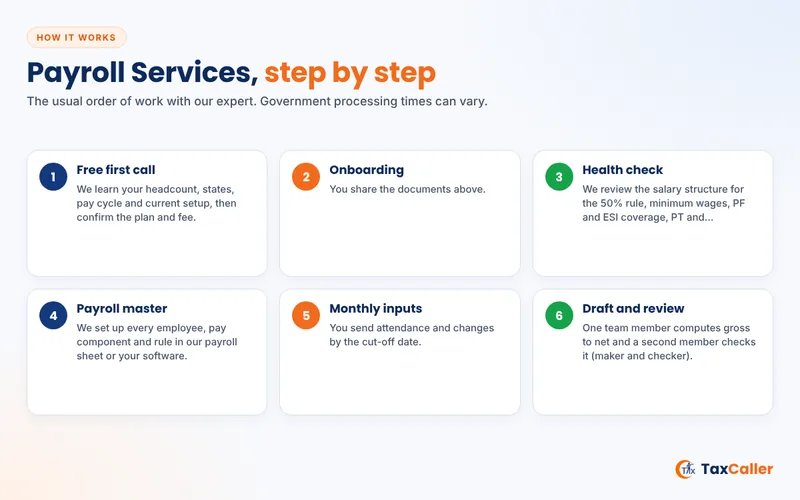
We run payroll in fixed monthly steps with your approval at the key points. The first month takes longer because we set up the master and check past data. After that it follows the same calendar every month.
| Stage | Typical time |
|---|---|
| Onboarding and health check | 3 to 5 working days after documents |
| First payroll run | Within the next pay cycle |
| Monthly draft after inputs | 2 to 3 working days |
| Full and final statement | Within 1 working day of exit details |
These are our working times, not legal deadlines. They depend on how quickly inputs and approvals arrive.
Change at the start of a month, and ideally at the start of a quarter, so one person files each Form 138. We take year-to-date salary, TDS, PF and ESI figures from the old registers and challans. For the first month we can run a parallel payroll and compare it with the old output before going live. This is also the point where we do a short payroll audit of past months and list any gaps to fix.
← Previous Next: Payroll Services Fees: Statutory Dues and Our Fee →
15 Topic 15 of 20

TaxCaller's payroll fee starts at ₹1,899 + GST a month. It covers our professional work only. PF, ESI, TDS, professional tax and LWF are statutory dues paid from your bank at actual. There is no government fee for running payroll itself.
| Cost | Who receives it | Amount |
|---|---|---|
| TaxCaller payroll fee | TaxCaller | From ₹1,899 + GST a month, by plan and headcount |
| TDS on salary | Income Tax Department | As computed for each employee |
| PF contributions and charges | EPFO | 12% + 12% of PF wages, plus EDLI and admin charges |
| ESI contributions | ESIC | 0.75% + 3.25% of wages for covered staff |
| Professional tax and LWF | State government or welfare board | As per state schedule |
| Late fees, interest and damages | The department concerned | Only if a past default exists, at actual |
We share the fee in writing before work starts. If headcount grows past your plan, we tell you before changing the fee.
← Previous Next: Penalties, Interest and Late Fees for Payroll Defaults →
16 Topic 16 of 20
Payroll defaults cost money in three ways: interest on late tax or contributions, late fees on returns, and fines under the Labour Codes. Most of these grow every month, so fixing a default early is cheaper.
| Default | Consequence | Section |
|---|---|---|
| TDS on salary not deducted | Interest 1% a month or part | Section 398, Income-tax Act, 2025 |
| TDS deducted but deposited late | Interest 1.5% a month or part | Section 398 |
| Form 138 filed late | Late fee ₹200 a day, capped at the TDS amount | Section 427 |
| Form 138 not filed | Penalty ₹10,000 to ₹1,00,000 | Section 461 |
| Late PF or ESI | Interest at the notified rate (reported as 12% a year) and damages up to the arrears | Sections 127 and 128, Code on Social Security |
| Employee PF or ESI share deducted but not paid | Imprisonment of 1 to 3 years and fine of ₹1 lakh | Section 133, Code on Social Security |
| Paying less than wages due | Fine up to ₹50,000; repeat within five years can mean jail up to three months or fine up to ₹1 lakh | Section 54(1), Code on Wages |
| Other breaches of the Code on Wages | Fine up to ₹20,000 | Section 54(1)(c) |
| Records not kept properly | Fine up to ₹10,000 | Section 54(2) |
Section 56 of the Code on Wages allows many first offences punishable only with a fine to be compounded for 50% of the maximum fine. State PT and LWF laws have their own interest and penalties. For PF defaults from 14 June 2024, damages are reported at 1% a month.
17 Topic 17 of 20
Most payroll problems come from a handful of repeat errors. Each one is easy to avoid with a monthly checklist.
← Previous Next: Confidentiality and Data Security for Salary Data →
18 Topic 18 of 20
Salary data is personal and sensitive, so we limit who sees it and how it travels. Payroll needs PAN, Aadhaar, bank accounts and pay details. Each is a target for misuse if handled carelessly.
The Digital Personal Data Protection Rules, 2025 were notified on 14 November 2025 with an 18-month phase-in for compliance. Under the DPDP Act, 2023, a business that holds personal data must keep reasonable security safeguards. Employee salary and identity records fall in this category, so choose a payroll partner that follows clear access rules.
19 Topic 19 of 20
2026 was the first full year of payroll under the Labour Codes and the first tax year under the Income-tax Act, 2025. The table lists the changes that affect monthly salary work.
| Change | Date | Effect on payroll |
|---|---|---|
| Four Labour Codes in force | 21 November 2025 | New wages definition, pay dates, wage slips, fixed-term gratuity |
| Income-tax Act, 2025 in force | 1 April 2026 | Salary TDS under section 392; Forms 130, 138 and 124 replace Forms 16, 24Q and 12BB |
| Central rules under the Code on Wages and the Code on Social Security notified | 8 May 2026 (reported) | Formats for registers, wage slips and contribution procedures |
| EPF Scheme, 2026 notified, replacing the 1952 Scheme | 29 June 2026 | PF administration under the Code on Social Security |
| Bonus eligibility and calculation limits notified (₹21,000 and ₹7,000) | 25 August 2026 (reported) | Who gets statutory bonus and on what amount |
| PF wage ceiling raised from ₹15,000 to ₹25,000 | Gazette of 17 September 2026 | More staff covered; higher PF and EPS for many |
| Professional tax repealed in Odisha | From 1 April 2026 (reported) | No PT deduction for Odisha staff from that date |
| New West Bengal PT schedule | From 1 October 2026 (Notification 1407-F.T. of 18 August 2026, as reported) | Nil up to ₹20,000 a month, new slabs above |
Two more points matter now. The ESI wage ceiling was still ₹21,000 when we reviewed this page in November 2026, and no revision had been notified. And statutory bonus for 2025-26 is due by 30 November 2026 for businesses with an April to March year.
20 Topic 20 of 20
Questions first? Contact us and book a free first call.
Don't have everything? Send what you have on WhatsApp. Our expert will tell you what's missing.
Send documents on WhatsAppReal experts, not a call centre
Your work is handled by experienced professionals who explain every step, check your documents and keep you updated.
Registered company
TaxCaller is run by TaxCaller India LLP (LLPIN AAQ-7388), serving clients since 2018.
Fee told upfront
You know the complete fee, our professional fee and the government fee, before any work starts. No hidden charges.
Support after the work
Notices, renewals, returns and compliance reminders: we stay with your business after the registration is done.
Expert for this topic Payroll Services
Abhinay Rai
Advocate
Abhinay Rai is a Advocate specialising in Payroll Services. The process, documents, timelines and fees on this page are checked against the current rules and government portals, and updated whenever the law, forms or fees change.
Payroll services mean a specialist team handles your monthly salary work. That includes computing gross and net pay, deducting TDS, PF, ESI and professional tax, issuing payslips, and depositing and filing these dues on time. A good service also handles bonus, gratuity, leave encashment, full and final settlements and the wage registers the Labour Codes require.
It usually includes salary structure review, monthly gross-to-net computation, payslips, a bank transfer file, TDS on salary under section 392, PF ECR, ESI contributions, professional tax and labour welfare fund. Quarterly Form 138 support and yearly Form 130 are also part of it. Exits, bonus, gratuity and registers complete a full payroll service for Indian employers.
Most providers charge either a flat monthly fee for a set headcount or a fee per employee per month. TaxCaller's fee depends on headcount and states, and it is quoted in writing + GST before work starts. Statutory dues like PF, ESI, TDS and professional tax are separate. They go to the government at actual.
Yes, outsourcing payroll is legal and common in India. But legal responsibility stays with the employer. The Code on Wages makes the employer responsible for paying wages, and PF, ESI and TDS duties also rest on the employer. Your payroll partner does the work and flags risks. You approve the numbers and fund every payment and deposit.
Section 2(y) of the Code on Wages counts basic pay, dearness allowance and retaining allowance as wages. Excluded items like HRA, conveyance, overtime and commission are capped at 50% of total pay. Anything above that limit is added back to wages. The higher wages figure is then used for PF, gratuity, bonus and other benefits.
Under section 17 of the Code on Wages, monthly wages must be paid before the end of the seventh day of the following month. Weekly wages are paid before the weekly holiday. When an employee resigns, is removed or is retrenched, wages must be paid within two working days. Gratuity, where due, has its own 30-day limit.
Form 130 replaced Form 16 for salary paid from tax year 2026-27. The employer issues it by 15 June after the year ends, using the TRACES download. Form 138 replaced Form 24Q for the quarterly salary TDS statement. Form 124 replaced Form 12BB for employee claims. Salary paid up to March 2026 stays on the old forms.
The new regime under section 202 is the default for tax year 2026-27. An employee without business income can choose the old regime each year. Most employers ask staff to declare their choice at the start of the year. If an employee says nothing, TDS is worked out under the new regime with the ₹75,000 standard deduction.
PF is 12% of PF wages from the employee and 12% from the employer, with 8.33% of wages up to ₹25,000 going to EPS. The PF wage ceiling became ₹25,000 in September 2026. ESI is 0.75% from the employee and 3.25% from the employer, for staff earning up to ₹21,000 a month.
Full and final settlement adds salary up to the last day, leave encashment, any bonus due, gratuity if eligible and notice pay where it applies. It then subtracts advances, recoveries, TDS and the employee's PF and ESI share. Wages must be paid within two working days of exit. Gratuity must be paid within 30 days.
Permanent employees still need five years of continuous service, except on death or disablement. Fixed-term employees qualify after one year, as the Labour Ministry explained when the Codes started. Gratuity is 15 days' wages for every completed year, on the last wages drawn. The ceiling is ₹20 lakh. It must be paid within 30 days.
An employee who worked at least 30 days in the year and earns within the notified limit gets bonus under section 26. Notifications of August 2026, reported widely, set the limit at ₹21,000 a month and the calculation base at ₹7,000. Bonus is 8.33% to 20% and is due within eight months of the year end.
There is no official ranking. Large firms suit big and multi-country payrolls, software tools suit teams with an in-house expert, and smaller tax firms suit small and mid-size employers who want hands-on help. Compare written scope, states covered, current-law readiness, approval steps, data security, turnaround and total monthly cost, not brand size alone.
Yes. Even five employees need correct TDS, payslips, wage records and timely pay under the Code on Wages. PF and ESI may not apply yet, but professional tax may, depending on your state. A small monthly plan keeps these basics right and gets you ready for PF at 20 employees and ESI at 10.
Yes, we treat salary data as confidential. Only the team on your account can see your files. Payslips go out as password-protected PDFs, and files stay in a folder you own. Portal logins remain yours, and we use them only for filings you approve. We can also sign a confidentiality agreement before we start.
Book a free first call with headcount and states. Our fee starts at ₹1,899 + GST a month, and PF, ESI, TDS and PT are paid at actual.
Mon–Fri 9:00 AM – 6:00 PM, Sat 10:00 AM – 4:00 PM · Your trust is our biggest fee.