Starting from · ₹5,999 POSH Act Compliance POSH Policy and IC Setup plan
STARTING FROM₹5,999
FEE TOLD UPFRONTFree first call
!GSTR-3B due?Last date 20 Nov 2026 · 3 days left
Since 2018Trusted Experience
980+Experts Connected
220+Cities Served
1164+Agents Available
12000+Founders Trusted
S
Srishti Magoo
★★★★★
Excellent experience with TaxCaller for filing my &
my family members ITR returns. The entire process was
smooth, quick and hassle-free. They are professional,
knowledgeable and guided me through every step with patience.
O
obeid sait
★★★★★
The team has handled my taxes for the past three years,
and it's been a wonderful, hassle-free experience.
Thank you for your consistently quick and efficient service.
P
Pushkar
★★★★★
They are among the best in their field. Their work culture
is highly professional, and their client service is smooth
and reliable. They can confidently be relied on to get the job done.
P
Prasad Sheth
★★★★★
Excellent experience with TaxCaller! The ITR filing
process was smooth, quick, and completely hassle-free.
The CA was knowledgeable, responsive, and explained everything clearly.
A
Apoorv Bansal
★★★★★
Excellent service for ITR filing. The team was highly
professional, responsive, and guided me through the entire
process smoothly. My return was filed accurately and on time.
A
Abhishek Kumar
★★★★★
I was searching for a good CA firm in Ghaziabad and found
TaxCaller. The experience was excellent from start to finish.
The team is responsive, transparent, and genuinely helpful.
U
uma pandey
★★★★★
Great service! TaxCaller India made the entire ITR filing
process quick, smooth, and hassle-free. They answered all
my queries patiently and ensured maximum accuracy.
T
tanu mittal
★★★★★
Excellent job! We've been connected for many years,
and your success truly makes me happy. You are an
incredibly intelligent person. Keep shining, keep growing.
B
Bhanu Pratap Maurya
★★★★★
I am filing my ITR since past 3 years with Abhinav and
Firm is known as TaxCaller and they are professional
interms of ITR rules. They will explain and tell you all
the information.
A
ashish Sharma
★★★★★
I am providing my honest reviews:
No.1 service ...
A
AARYAN GROUP
★★★★★
Honestly, finding a good CA firm in Ghaziabad was
confusing, but TaxCaller India made it simple.
I contacted them for GST work and the experience was smooth.
N
News Speaks
★★★★★
If you're looking for a reliable CA firm in Ghaziabad,
TaxCaller India is a great choice. They provide complete
taxation and compliance solutions including GST.
A
Anshul Chaprana
★★★★★
Got my GST registration done through TaxCaller CA firm.
Process was quite smooth, they guided properly on documents
and didn't waste time. Overall good experience.
How we work
Online · Call · WhatsApp
Quick answer
The POSH Act is the Sexual Harassment of Women at Workplace (Prevention, Prohibition and Redressal) Act, 2013, which protects women from sexual harassment at work. Employers with 10 or more employees must form an Internal Committee, adopt a policy, train staff and report cases yearly. Breaches can attract a fine of up to ₹50,000 under Section 26.
Reviewed by Abhinay Rai · Updated 16 Nov 2026
Pick a plan that fits
POSH Policy and IC Setup
A business that has just crossed 10 employees and needs the basic legal set-up
Two online awareness sessions in the year, English or Hindi
Quarterly compliance check and IC tenure tracking
Procedural guidance to the IC on a complaint (we do not represent either party)
Policy update and IC reconstitution order when members change
Yearly POSH audit file for district or board review
Government fees and taxes are extra where applicable. Our expert confirms the final amount on the first call. No hidden charges.
About the POSH Act
The POSH Act is the short name for the Sexual Harassment of Women at Workplace (Prevention, Prohibition and Redressal) Act, 2013. POSH stands for Prevention of Sexual Harassment. The law gives every working woman in India a right to a workplace free of sexual harassment. It also gives her a fast, internal way to complain without going to court first.
For employers, the POSH Act 2013 is a compliance law with clear duties. You must set up an Internal Committee (often still called the ICC), adopt a written POSH policy, train your people, display notices and report complaint numbers every year. A missed duty can cost a fine of up to ₹50,000, and repeat failures can put your business licence at risk.
This guide explains the Act and the POSH Rules, 2013 section by section, in simple words. It covers who must comply, how the committee works, the complaint and inquiry timeline, penalties, the SHe-Box portal, court rulings and what changed in 2026. At the end, you will find how TaxCaller sets up and maintains POSH compliance for your business.
Complete guide
Choose a topic to open it. Every answer gives the rule or section it comes from.
01 Topic 1 of 21
What Is the POSH Act? Full Form, Purpose and Background
The POSH Act is a central law that prevents, prohibits and redresses sexual harassment of women at the workplace. Its official name is the Sexual Harassment of Women at Workplace (Prevention, Prohibition and Redressal) Act, 2013 (Act No. 14 of 2013). The full form of POSH is Prevention of Sexual Harassment. The Act does not use the word POSH itself; it is a popular short form used by HR teams and lawyers.
Point
Detail
Act number
Act No. 14 of 2013
Date of assent
22 April 2013
In force from
9 December 2013 (notification S.O. 3606(E))
Rules
Sexual Harassment of Women at Workplace (Prevention, Prohibition and Redressal) Rules, 2013, notified by G.S.R. 769(E) on 9 December 2013
The whole of India, public and private sectors, organised and unorganised
Three aims in the name
Prevention: awareness, policy, training and a safe workplace.
Prohibition: Section 3(1) says no woman shall be subjected to sexual harassment at any workplace.
Redressal: a time-bound complaint, inquiry and action system run by committees.
Background: Vishaka guidelines to the 2013 Act
Before 2013, there was no special law. In 1997, the Supreme Court decided Vishaka v. State of Rajasthan after the Bhanwari Devi case. It laid down the Vishaka guidelines, which bound employers until Parliament acted. The POSH Act turned those guidelines into law. Its preamble links the right to a safe workplace to Articles 14, 15, 19(1)(g) and 21 of the Constitution and to India's ratification of the UN convention on discrimination against women (CEDAW) in 1993.
The bare Act is on India Code, the official legal database. Searches like "POSH Act 2013 PDF" or "POSH Act PDF" are answered most safely there, because private copies may be old or incomplete.
Every employer in India must follow the POSH Act, whatever the sector or size. What changes with size is who hears the complaint. An employer with 10 or more employees must set up its own Internal Committee under Section 4. Women at smaller workplaces, and women whose complaint is against the employer, go to the Local Committee of the district under Section 6.
Your situation
What applies
10 or more employees
Internal Committee (IC) by written order, policy, training, notices, annual report
Fewer than 10 employees
No own IC needed; complaints go to the district Local Committee. Other Section 19 duties, such as a safe workplace and awareness, still apply.
Offices in different places
Section 4(1) asks for an IC at all administrative units or offices
Complaint against the employer
Goes to the Local Committee, not the IC
Domestic worker in a home
Goes to the Local Committee
Which organisations are covered
Private companies, LLPs, partnership firms, startups and proprietors.
Government ministries, departments, public sector units, banks and local bodies.
Schools, colleges, universities and coaching centres.
Hospitals, nursing homes and clinics.
NGOs, trusts, societies, cooperatives and Section 8 companies.
Shops, factories, hotels, sports bodies, stadiums and training venues.
Homes that employ domestic workers.
The headcount includes everyone who is an "employee" under Section 2(f). That covers regular, temporary, ad hoc, daily wage, contract and agency staff, as well as probationers, trainees and apprentices. Do not count only payroll staff. A firm with seven payroll staff and four contract workers has 11 employees for POSH purposes.
Courts have also limited the reach of the Act in some cases. In 2025 the Supreme Court reportedly declined to interfere with a Kerala High Court view that political parties are not workplaces with an employer under the Act. So the test is always whether there is an employer and a workplace.
Zubair Legal Expert
Have a question on this topic? Ask Zubair on a free call.
Employee, Employer and Workplace: Key Definitions in Section 2
Section 2 defines the words that decide who is protected and who is responsible. Most disputes about POSH applicability turn on these definitions, so it pays to read them closely.
Term
Section
Meaning in simple words
Aggrieved woman
2(a)
A woman of any age, employed or not, who alleges sexual harassment at a workplace. In a home, a woman employed there.
Domestic worker
2(e)
A woman employed to do household work in a home, directly or through an agency, for pay. A family member of the employer is not included.
Employee
2(f)
Anyone employed for any work, on regular, temporary, ad hoc or daily wage basis, directly or through an agent or contractor, paid or unpaid, voluntary or otherwise. It includes co-workers, contract workers, probationers, trainees and apprentices.
Employer
2(g)
In government, the head of the department or unit. Elsewhere, the person responsible for management, supervision and control of the workplace. For domestic work, the household that employs her.
Respondent
2(m)
The person against whom the complaint is made.
Sexual harassment
2(n)
Unwelcome sexual conduct, explained in the next section.
Workplace
2(o)
Offices and units of government and private bodies, hospitals, sports venues, any place visited during employment (including employer transport), and a dwelling place or house.
Unorganised sector
2(p)
An enterprise owned by individuals or self-employed workers with fewer than ten workers.
Why the workplace definition matters
The word "workplace" is wide. It covers client sites, offsite meetings, business travel, cab services arranged by the employer and company events. The Act does not name remote work, but most employers now write video calls, chat apps and work-from-home into their POSH policy. This avoids a gap when harassment happens online.
Note that the complainant need not be an employee. A visitor, client, student, patient or job applicant who is harassed at your workplace is an aggrieved woman under Section 2(a). Your Internal Committee must accept her complaint.
Sexual harassment under Section 2(n) means unwelcome sexual conduct, whether direct or by implication. The test is whether the conduct was unwelcome to the woman, not what the other person intended. One serious act is enough; there need not be a pattern.
Five acts listed in Section 2(n)
Physical contact and advances.
A demand or request for sexual favours.
Making sexually coloured remarks.
Showing pornography.
Any other unwelcome physical, verbal or non-verbal conduct of a sexual nature.
Five circumstances in Section 3(2)
Section 3(2) adds circumstances that may amount to sexual harassment when they occur with, or are connected to, such conduct:
An implied or explicit promise of preferential treatment in her job.
An implied or explicit threat of detrimental treatment in her job.
An implied or explicit threat about her present or future employment status.
Interference with her work, or creating an intimidating, offensive or hostile work environment.
Humiliating treatment likely to affect her health or safety.
Lawyers call the first three "quid pro quo" harassment and the last two "hostile work environment" harassment. Put together, the five acts and five circumstances make ten heads. Some websites speak of "11 types of harassment"; that list is not in the Act, which is why it is safer to rely on the statutory wording above.
Everyday examples a policy should name
Lewd jokes, sexual comments about body or clothes, and sexual gestures.
Repeated requests for dates after a clear no.
Sending sexual messages, images or videos on email or chat.
Staring, stalking or following, including online.
Linking appraisals, leave or promotion to sexual favours.
Unwanted touching in a cab, at an offsite or at a party.
The same conduct may also be a crime. The Bharatiya Nyaya Sanhita, 2023 (BNS) replaced the Indian Penal Code from 1 July 2024. Section 75 BNS (earlier Section 354A IPC) covers sexual harassment, and Section 79 BNS (earlier Section 509 IPC) covers words or gestures meant to insult a woman's modesty. Under Section 19(g) of the POSH Act, the employer must help the woman if she chooses to file a police complaint.
Internal Committee (ICC) Under Section 4: Members, Tenure and Fees
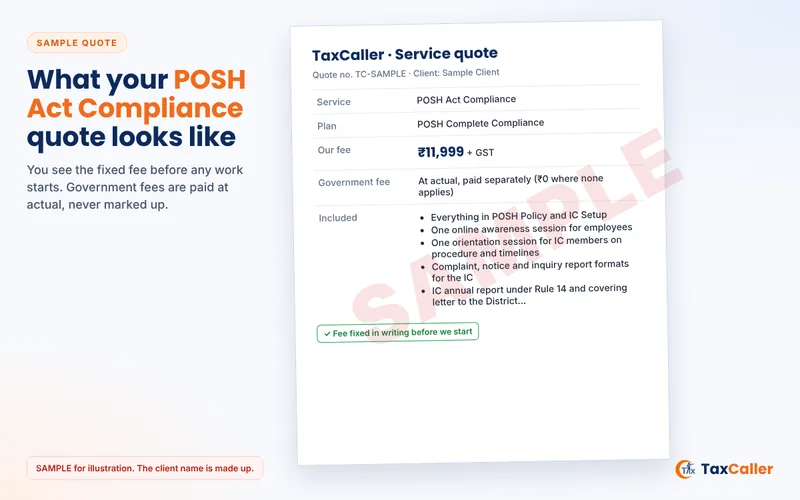
POSH Act Compliance: SAMPLE quote, for illustration only
Every employer with 10 or more employees must constitute an Internal Committee by an order in writing under Section 4(1). The 2013 text called it the Internal Complaints Committee (ICC); the Repealing and Amending Act, 2016 shortened the name to Internal Committee. Both names mean the same POSH committee.
Seat
Who can hold it
Rule
Presiding Officer
A woman employed at a senior level at the workplace
Section 4(2)(a)
Internal members
At least two employees, preferably committed to the cause of women, or with social work experience or legal knowledge
Section 4(2)(b)
External member
One person from an NGO or association committed to the cause of women, or a person familiar with sexual harassment issues
Section 4(2)(c), Rule 4
Gender balance
At least one-half of the members nominated must be women
Section 4(2), proviso
Presiding Officer when no senior woman is available
If no senior woman works at that office, the Presiding Officer can be nominated from other offices or units of the same employer. If the employer has none there either, she can come from another workplace of the same employer or from another department or organisation.
Who can be the external member
Rule 4 explains "a person familiar with the issues relating to sexual harassment". It includes a person with at least five years of experience in social work committed to the cause of women. It also includes a person familiar with labour, service, civil or criminal law. Choose someone independent who has no conflict with the company.
Tenure, fees and removal
Tenure: up to three years from the date of nomination, as the employer specifies (Section 4(3)). Diarise the end date and issue a fresh order in time.
External member fee: Rule 3 provides an allowance of ₹200 per day for holding proceedings, plus travel by AC three-tier train, AC bus, auto or taxi, or actual cost, whichever is less. The employer pays. Many external members also agree a separate professional fee in writing.
Removal: Section 4(5) requires removal of a member who breaches confidentiality under Section 16, is convicted of an offence or faces a pending inquiry into one, is found guilty in (or faces) a disciplinary proceeding, or abuses the position. The vacancy is filled by a fresh nomination.
Practical points for the POSH committee
Keep at least four members, so the Rule 7 quorum of three, including the Presiding Officer, is always possible.
Avoid naming the CEO, owner or a direct reporting chain head where you can; it can raise bias objections.
Take written consent from each member, and an engagement letter from the external member.
Display the names and contact details of members in the office and on the intranet, as Rule 13(e) requires.
Abhinay Rai Legal Expert
Have a question on this topic? Ask Abhinay on a free call.
Local Committee and District Officer for Small Workplaces
The Local Committee is the district-level POSH committee for women who cannot use an Internal Committee. Section 6(1) requires the District Officer to constitute it in every district. It hears complaints from establishments with fewer than ten workers that have no IC, and complaints against the employer.
District Officer (Section 5)
The State Government notifies a District Magistrate, Additional District Magistrate, Collector or Deputy Collector as the District Officer for every district. In Delhi, for example, the Women and Child Development Department names the District Magistrate as the District Officer. The District Officer receives Local Committee reports and IC annual reports.
Composition under Section 7
Seat
Who
Chairperson
An eminent woman in the field of social work committed to the cause of women
Member
A woman working in a block, taluka, tehsil, ward or municipality in the district
Two members
From NGOs or associations committed to the cause of women, or persons familiar with sexual harassment issues; at least one a woman; preferably one with a legal background; and at least one woman from the Scheduled Castes, Scheduled Tribes, Other Backward Classes or a minority community
Ex officio member
The district officer dealing with social welfare or women and child development
Members serve up to three years. Under Rule 5, the Chairperson gets ₹250 per day and the two members nominated from NGOs or as persons familiar with the issues get ₹200 per day for proceedings, plus travel, paid by the District Officer.
Nodal officers
Under Section 6(2), the District Officer designates a nodal officer in every block, taluka and tehsil in rural or tribal areas and in every ward or municipality in urban areas. The nodal officer receives complaints and forwards them to the Local Committee within seven days. This lets a woman in a small shop or village file near home.
For a small business, this means a staff complaint will be heard outside your office. You still owe the duties in Section 19, such as cooperating with the Local Committee and acting on its recommendation.
How to File a POSH Complaint: Time Limit and Who Can File
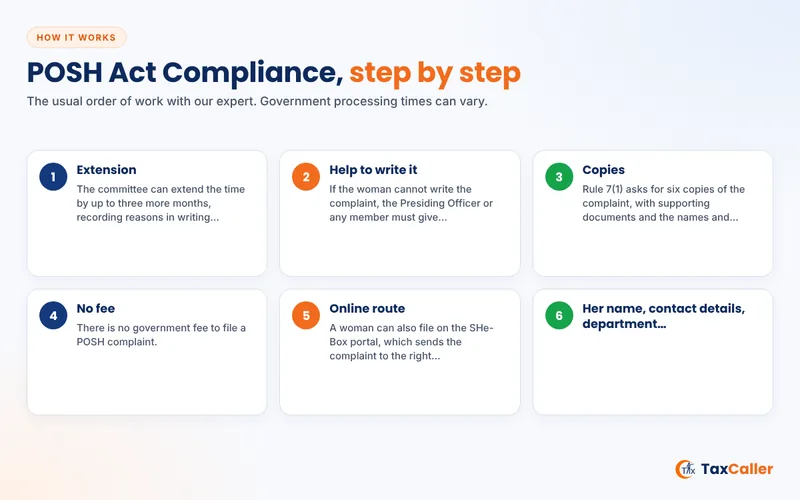
POSH Act Compliance: how the work moves, step by step
A POSH complaint is filed in writing with the Internal Committee, or with the Local Committee where there is no IC. Section 9(1) requires it within three months of the incident. If there was a series of incidents, the three months run from the date of the last one.
Key rules for a complaint
Extension: the committee can extend the time by up to three more months, recording reasons in writing, if circumstances prevented filing on time.
Help to write it: if the woman cannot write the complaint, the Presiding Officer or any member must give reasonable help to put it in writing.
Copies: Rule 7(1) asks for six copies of the complaint, with supporting documents and the names and addresses of witnesses.
No fee: there is no government fee to file a POSH complaint.
Online route: a woman can also file on the SHe-Box portal, which sends the complaint to the right committee.
Who else can file (Section 9(2) and Rule 6)
Situation
Who can file for her
Physical incapacity
A relative or friend, a co-worker, an officer of the National or State Commission for Women, or any person who knows of the incident, with her written consent
Mental incapacity
A relative or friend, a special educator, a qualified psychiatrist or psychologist, or her guardian or the authority caring for her
Cannot file for any other reason
Any person who knows of the incident, with her written consent
Death
Any person who knows of the incident, with the written consent of her legal heir
What a good complaint contains
Her name, contact details, department and the respondent's details.
Dates, times and places of each incident, in order.
What was said or done, in her own words.
Evidence: screenshots, emails, call logs, photos, CCTV requests, medical notes.
Names of witnesses and anyone she told at the time.
The relief she wants, such as transfer or interim leave.
Anonymous complaints are not covered by the Section 9 process, because the respondent must get a copy and a chance to reply. Your policy can still give staff an informal route to raise concerns that HR then looks into.
After a complaint, the committee first offers conciliation if the woman asks for it, and otherwise holds an inquiry. The inquiry must finish within 90 days under Section 11(4).
Conciliation under Section 10
Only at the request of the aggrieved woman, and only before the inquiry starts.
No monetary settlement can be the basis of conciliation.
If a settlement is reached, the committee records it and sends it to the employer or District Officer to act on, with copies to both parties.
No further inquiry is held after a settlement. If the respondent breaks its terms, the woman can inform the committee, which then proceeds to inquiry under Section 11(1).
Inquiry under Section 11 and Rule 7
Where the respondent is an employee, the inquiry follows the service rules that apply to him. Where there are none, it follows Rule 7. For a domestic worker, the Local Committee forwards a prima facie case to the police within seven days. The committee has the powers of a civil court to summon and examine people on oath and to require documents.
The committee sends a copy of the complaint to the respondent within seven working days.
The respondent files a reply, documents and witness names within ten working days of receiving them.
The inquiry follows natural justice. Where both parties are employees, each gets a hearing and a copy of the findings to respond to.
If a party is absent without cause for three hearings in a row, the committee may end the inquiry or decide ex parte, after 15 days' written notice.
No legal practitioner can represent either party at any stage.
At least three members, including the Presiding Officer or Chairperson, must be present.
Full POSH timeline at a glance
Step
Time limit
Provision
File complaint
3 months from incident (or last incident), extendable by 3 months
Section 9(1)
Nodal officer to Local Committee
7 days
Section 6(2)
Copy to respondent
7 working days
Rule 7(2)
Respondent's reply
Within 10 working days
Rule 7(3)
Complete inquiry
90 days
Section 11(4)
Inquiry report to employer or District Officer
10 days from completion
Section 13(1)
Employer acts on recommendation
60 days from receipt
Section 13(4)
Appeal against recommendation
90 days
Section 18(2)
Treat these dates as hard deadlines. Late inquiries are a common ground on which the losing side challenges the outcome in court.
Shadab Legal Expert
Have a question on this topic? Ask Shadab on a free call.
Interim Relief, Inquiry Report and Action Against the Respondent
During the inquiry, the committee can recommend interim relief on the woman's written request. After the inquiry, it reports its findings and recommends action, which the employer must carry out within 60 days.
Interim relief (Section 12 and Rule 8)
Transfer of the aggrieved woman or the respondent to another workplace.
Leave to the aggrieved woman of up to three months. This is in addition to her normal leave.
Stopping the respondent from reporting on her work performance or writing her confidential report, and assigning it to another officer.
In an educational institution, stopping the respondent from supervising her academic work.
The employer must implement the recommendation and report back to the committee.
Inquiry report (Section 13)
The committee gives its report to the employer or District Officer within ten days of finishing the inquiry, with copies to both parties. If the allegation is not proved, it recommends no action. If it is proved, it recommends action as misconduct under the service rules, or under Rule 9 where there are none.
Action options under Rule 9
Written apology, warning, reprimand or censure.
Withholding promotion, pay rise or increments.
Termination from service.
Counselling or community service.
Compensation (Section 13(3)(ii) and Section 15)
The committee can also recommend that a sum be deducted from the respondent's salary and paid to the woman. If he is absent from duty or has left, he can be directed to pay it. If he does not pay, the District Officer recovers it as an arrear of land revenue. Section 15 lists what the committee weighs:
Mental trauma, pain, suffering and emotional distress caused to her.
Loss of career opportunity.
Her medical expenses for physical or psychiatric treatment.
The income and financial status of the respondent.
Whether a lump sum or instalments is feasible.
In payroll terms, a salary deduction ordered under Section 13 needs a clear record and a payroll entry. Our payroll services team can set this up correctly when an order is passed.
The Act protects honest complainants, punishes malicious ones, keeps every case confidential and gives both sides a right of appeal.
False or malicious complaint (Section 14)
If the committee finds that a complaint was malicious, knowingly false or backed by forged or misleading documents, it may recommend action against the complainant. Rule 10 links that action to the Rule 9 options. The key safeguard is in the proviso: a mere failure to prove the complaint, or to give enough proof, is not a ground for action. A malicious intent must be established through an inquiry first. A witness who gives false evidence or produces forged documents can also face action.
Confidentiality (Sections 16 and 17)
The contents of the complaint, the identity and addresses of the woman, the respondent and the witnesses, and the inquiry, recommendations and action taken cannot be published or told to the public, press or media. Section 16 overrides the Right to Information Act, 2005. Information about justice secured can be shared, without names or details that identify anyone.
A person who breaches this duty faces a penalty under the service rules. Where there are none, Rule 12 lets the employer recover ₹5,000 from that person.
Appeal (Section 18 and Rule 11)
Anyone aggrieved by the recommendations under Sections 13(2), 13(3), 14 or 17, or by non-implementation, can appeal.
The appeal goes to the court or tribunal under the service rules. Where there are none, Rule 11 sends it to the appellate authority notified under Section 2(a) of the Industrial Employment (Standing Orders) Act, 1946.
The time limit is 90 days from the date of the recommendations.
Protection from retaliation
The Act does not use the word retaliation, but Section 3(2) treats threats about her job and a hostile environment as harassment. A good POSH policy states clearly that victimising a complainant or witness is misconduct.
Section 19 lists the employer's duties under the POSH Act, and Rule 13 adds the awareness steps. Together they are the core of POSH compliance.
Clause
Duty
How to show it
19(a)
Provide a safe working environment, including safety from people who come into contact at the workplace
Policy, security, transport rules
19(b)
Display the penal consequences of sexual harassment and the order constituting the IC
Notice board, intranet, photo record
19(c)
Hold workshops and awareness programmes at regular intervals; orientation for IC members
Training calendar, attendance
19(d)
Give the IC or Local Committee the facilities needed to deal with complaints and conduct inquiries
Room, records, budget
19(e)
Help secure the attendance of the respondent and witnesses
Letters, leave approvals
19(f)
Make available the information the committee needs
Document requests log
19(g)
Help the woman if she chooses to file a criminal complaint
Support letter, HR contact
19(h)
Start action under criminal law if she wishes, or if the offender is not an employee and the incident took place at the workplace
Police complaint record
19(i)
Treat sexual harassment as misconduct under the service rules and act on it
Updated standing orders or HR rules
19(j)
Monitor timely submission of reports by the IC
Compliance tracker
Rule 13 awareness duties
Formulate and widely circulate an internal policy against sexual harassment.
Hold orientation programmes and seminars for IC members.
Run awareness programmes for employees.
Provide capacity building and skill development for IC members.
Publish the names and contact details of all IC members.
Use the State Government's modules for workshops and programmes.
For a factory or establishment with standing orders, also add sexual harassment as misconduct in those orders. For shops and offices, keep your Shop Act registration current, because Section 26 can lead to cancellation of a licence or registration for repeat breaches.
Shreya Legal Expert
Have a question on this topic? Ask Shreya on a free call.
A POSH policy is the written internal policy that Rule 13(a) requires every employer to adopt and circulate. It tells staff what conduct is banned, how to complain and what happens next. "POSH policy meaning" in a corporate sense is simply this document plus the system behind it.
What a POSH policy should contain
Purpose, scope and the legal basis (the POSH Act and Rules, 2013).
Who is covered: all employees, interns, consultants, contract staff and visitors.
Where it applies: office, branches, client sites, travel, transport, events, remote work and online channels.
Definition of sexual harassment with Section 2(n) and Section 3(2), plus local examples.
Internal Committee members, contact details and how to reach them.
How to file a complaint, time limits, help in writing and the SHe-Box option.
Conciliation, inquiry steps, timelines and interim relief.
Possible penalties, compensation and the false complaint clause with its safeguard.
Confidentiality and the ₹5,000 penalty for breach where service rules are silent.
No retaliation against complainants and witnesses.
Appeal route and time limit.
Training, review date and the person responsible for the policy.
Gender-neutral or women-only?
The POSH Act protects women only. Many companies, especially in IT and services, adopt a gender-neutral anti-harassment policy so men and transgender staff also have a remedy. That is allowed as company policy. Make clear in the document that statutory POSH rights, timelines and the Local Committee route apply to women complainants.
Rolling it out
Board or partner approval, with the date recorded.
Email to all staff, with acknowledgement.
Copy in the employee handbook and onboarding pack.
Hindi or regional language version where staff need it.
POSH training is compulsory in substance: Section 19(c) requires workshops and awareness programmes at regular intervals, and Rule 13 requires orientation and skill building for IC members. The law does not fix the number of hours or a set frequency. Most employers run at least one session a year and train every new joiner.
Three kinds of POSH training
Audience
What it covers
Suggested length
All employees
What counts as harassment, examples, how to complain, confidentiality, no retaliation, bystander role
60 to 90 minutes
Managers and team leads
Spotting early signs, handling a first report, not investigating on their own, protecting the complainant
The lengths above are our suggestion, not a legal rule.
Proof that training happened
Attendance sheet or LMS completion report with names and dates.
Training deck or recording.
Short quiz results, if used.
A line in the IC annual report on workshops held, as Rule 14 requires.
Government staff can take the online course on preventing sexual harassment hosted on the iGOT Karmayogi platform, which some departments have circulated. Private employers can use in-house or external trainers. Training in Hindi or the local language works well for factory and field teams.
The Internal Committee must prepare an annual report for each calendar year and give it to the employer and the District Officer under Section 21. The employer must then show the number of cases and their disposal in its own annual report under Section 22. If it does not prepare an annual report, it must inform the District Officer.
Contents under Rule 14
Number of complaints of sexual harassment received in the year.
Number of complaints disposed of during the year.
Number of cases pending for more than 90 days.
Number of workshops or awareness programmes held.
Nature of action taken by the employer or District Officer.
File a report even when there were no complaints. A "nil" report shows the committee exists and is working. The central Rules do not fix a filing date, so follow the format and date your District Officer or State notice asks for. Keep the dated acknowledgement.
Companies: board's report
Rule 8(5)(x) of the Companies (Accounts) Rules, 2014 requires a statement in the board's report that the company has complied with the provisions on constituting the Internal Committee under the POSH Act. The Companies (Accounts) Second Amendment Rules, 2025, reported to be in force from 14 July 2025, added the number of complaints received, disposed of and pending for more than 90 days. These rules also brought a statement on compliance with the Maternity Benefit Act, 1961.
So a company's POSH numbers must match across three places: the IC annual report, the board's report and any SHe-Box record. We prepare all three together as part of private limited company compliance and wider annual compliance.
Zubair Legal Expert
Have a question on this topic? Ask Zubair on a free call.
Section 26 punishes an employer who fails to constitute an Internal Committee, fails to act under Sections 13, 14 or 22, or breaks any other provision of the Act or Rules. The first offence attracts a fine of up to ₹50,000.
Breach
Consequence
Provision
No IC, no action on report, no annual report data, other breach
Fine up to ₹50,000
Section 26(1)
Same offence repeated after a conviction
Up to twice the punishment for a first conviction; the court also weighs any higher punishment under another law
Section 26(2)(i)
Repeat offence
Cancellation, withdrawal or non-renewal of the licence or registration needed to run the business
Section 26(2)(ii)
Breach of confidentiality by a person
Service rules penalty, or ₹5,000 under Rule 12
Section 17, Rule 12
Company does not include the POSH statement in its board's report
Penalty for the company and officers in default under the Companies Act, 2013
Section 134(8)
Under Section 27, a court acts only on a complaint by the aggrieved woman or a person authorised by the IC or Local Committee. No court below a Metropolitan Magistrate or Judicial Magistrate of the first class can try the offence, and every offence is non-cognizable.
The bigger cost
The fine is small next to the other risks. Courts have set aside inquiries run by badly formed committees. A victim can also seek damages in civil court. Under Supreme Court directions, district officials, helped by Labour Commissioners, are surveying workplaces for committee details. If you receive a notice from a District Officer or a demand from a complainant's lawyer, get it answered properly; our legal notice team can draft or reply to such notices.
SHe-Box (Sexual Harassment electronic Box) is the Ministry of Women and Child Development's online portal for workplace sexual harassment complaints and committee records. The revamped SHe-Box portal was launched on 29 August 2024.
What SHe-Box does
Lets a woman file a complaint online and track its status.
Forwards the complaint automatically to the right Internal Committee or Local Committee.
Acts as a central record of ICs and Local Committees across India.
Has a workplace login where employers upload IC member details. A government note of February 2026 says workplaces also upload annual reports and training records there.
Do employers have to register on SHe-Box?
The Act and the 2013 Rules do not mention SHe-Box. However, Supreme Court directions in the Aureliano Fernandes matter asked States to survey workplaces and upload IC data to SHe-Box. Some state authorities have also told employers to register their IC on SHe-Box; for example, the Delhi Women and Child Development Department issued a public notice on 12 June 2025. Treat registration as expected practice and check your district's notice.
How to register your workplace
Open the SHe-Box portal and choose the workplace or employer registration option.
Enter the organisation's name, address, district, sector and headcount.
Add the IC order and each member's name, role and contact details.
Verify the login and keep the credentials with HR, not one person.
Update the details whenever a member leaves or the IC is reconstituted.
We guide your HR team through each screen. Your own staff log in and submit, so your credentials stay with you.
Court rulings shape how the POSH Act works in practice. Here are the cases every employer and IC member should know. Search terms like "POSH case" usually mean either a complaint under the Act or one of these rulings.
Case
Year
What it held
Vishaka v. State of Rajasthan (Supreme Court)
1997
Workplace sexual harassment breaks fundamental rights; set binding guidelines until a law was made
Apparel Export Promotion Council v. A.K. Chopra (Supreme Court)
1999
Physical contact is not essential; unwelcome sexual conduct is enough
Aureliano Fernandes v. State of Goa (Supreme Court)
12 May 2023
Found serious gaps in committee constitution; directed governments and bodies to verify and publish committee details and to train members
Aureliano Fernandes, follow-up orders
3 December 2024 and 12 August 2025
District Officers to be appointed, district-wise surveys of ICs (with Labour Commissioners' help from August 2025), and the data uploaded to SHe-Box
Political parties case (Supreme Court, reported)
2025
Declined to disturb a Kerala High Court view that political parties are not workplaces with an employer under the Act
Dr. Sohail Malik v. Union of India (Supreme Court, reported)
December 2025
A woman can approach the IC of her own workplace even if the respondent works for another department or workplace
Lessons for employers
A committee formed in breach of Section 4, such as without an external member, puts the whole inquiry at risk.
Courts look at fairness: notice, copies, hearing and a reasoned report.
Committees must cooperate across organisations when the respondent is an outsider.
Courts expect real compliance, not paper orders.
Abhinay Rai Legal Expert
Have a question on this topic? Ask Abhinay on a free call.
The POSH Act and the POSH Rules, 2013 were not amended in 2026. What changed is enforcement: courts, the ministry and the National Commission for Women pushed harder for real compliance.
Date
Development
Status
January to March 2026
The Supreme Court kept monitoring the Aureliano Fernandes matter; on 10 February 2026 it gave States that had not filed compliance affidavits four weeks and asked for District and nodal officer details
Supreme Court order of 10 February 2026, as reported by legal publications
February 2026
A government background note on PIB described SHe-Box as the central platform where workplaces upload IC details, annual reports and training records
Official (PIB)
27 March 2026
Over 1.61 lakh workplaces with more than ten persons onboarded on SHe-Box; details of over 68,460 ICs and 777 Local Committees available
Government figures, as reported from an April 2026 ministry reply in Parliament
19 June 2026
NCW advisory asked States and Union Territories to ensure yearly POSH audits of establishments with 10 or more persons, monitoring cells and correctly formed ICs
Reported advisory; not a change in the Act
Through 2026
Board's reports for FY 2025-26 carry complaint numbers under the Companies (Accounts) Second Amendment Rules, 2025
Reported in force from 14 July 2025
What this means for you in 2026
Expect district or labour officials to ask for your IC order and SHe-Box status.
Keep a yearly internal audit file, even though the Act itself does not require an audit.
Check that your IC tenure has not lapsed; many committees formed in 2022 or 2023 hit the three-year limit in 2025 or 2026.
Match your complaint numbers across the IC report, board's report and SHe-Box.
Our POSH Act Compliance Service: Process, Documents and Fees
TaxCaller sets up and maintains POSH compliance for businesses across India, fully online. We draft your policy, help constitute the Internal Committee, train your people and prepare the annual report.
How we work
Free first call: we note your headcount by location, including contract staff, and what you already have.
Gap check: we review any existing policy, IC order, notices and reports against the Act and Rules.
POSH policy: we draft a policy for your business, in English and, if needed, Hindi.
IC constitution: we draft the IC order, appointment letters, consent forms and the external member's engagement letter.
Notices: we give you the display notice with penal consequences and IC contacts.
Training: we run online awareness sessions for staff and an orientation for IC members.
SHe-Box: we guide your HR to register and update IC details.
Annual report: we draft the Rule 14 report, the covering letter to the District Officer and the board's report statement.
Once we have your details, we usually share the draft policy and IC order within five working days. This is our estimate, not a legal timeline.
Fees
TaxCaller's fee for POSH Act compliance starts at ₹5,999 + GST. There is no government fee to constitute an IC, adopt a policy or file the annual report. Any statutory or third-party cost, such as the external member's Rule 3 allowance of ₹200 per day or a fee agreed with that member, is paid separately at actual. We confirm the full quote on the first call.
Business name, PAN and registration details (company, LLP, firm or proprietor)
List of all offices and branches with address and district
Headcount at each location, including contract staff, trainees and interns
Name and designation of the senior woman employee proposed as Presiding Officer
Names and designations of at least two employee members
External member's details, profile and written consent
Existing HR policy, service rules or certified standing orders
Any earlier IC order, POSH policy and annual reports
Training records of the last year, if any
Letterhead and authorised signatory details for the IC order
SHe-Box login details held by HR, if already registered
Why TaxCaller
Real experts, not a call centre
Your work is handled by experienced professionals who explain every step, check your documents and keep you updated.
Registered company
TaxCaller is run by TaxCaller India LLP (LLPIN AAQ-7388), serving clients since 2018.
Fee told upfront
You know the complete fee, our professional fee and the government fee, before any work starts. No hidden charges.
Support after the work
Notices, renewals, returns and compliance reminders: we stay with your business after the registration is done.
Reviewed By
Expert for this topic POSH Act Compliance
Abhinay Rai
Advocate
Abhinay Rai is a Advocate specialising in POSH Act Compliance. The process, documents, timelines and fees on this page are checked against the current rules and government portals, and updated whenever the law, forms or fees change.
The POSH Act is the Sexual Harassment of Women at Workplace (Prevention, Prohibition and Redressal) Act, 2013. It came into force on 9 December 2013 and protects women from sexual harassment at every workplace. It requires employers to form committees, adopt a policy, train staff and report cases, and it sets a time-bound complaint and inquiry process.
What is the full form of POSH?
POSH stands for Prevention of Sexual Harassment. It is the popular short name for the Sexual Harassment of Women at Workplace (Prevention, Prohibition and Redressal) Act, 2013, and the Rules made under it. The Act itself does not use the word POSH, but HR teams, courts and the government commonly use it in policies and training material.
What are the 11 types of harassment?
The POSH Act does not contain a list of 11 types. Section 2(n) names five acts, such as physical advances and sexually coloured remarks. Section 3(2) adds five circumstances, such as threats about her job or a hostile environment. Lists of 11 types online are informal summaries, so rely on the statutory wording in your policy and training.
What is the difference between POCSO and POSH?
POCSO is the Protection of Children from Sexual Offences Act, 2012, a criminal law for sexual offences against anyone under 18, tried by special courts. POSH is a workplace law that protects women of any age through internal and local committees and civil remedies. One incident can involve both laws, for example harassment of a minor intern.
What is Section 26 of the POSH Act?
Section 26 is the penalty clause for employers. Failing to constitute an Internal Committee, failing to act under Sections 13, 14 or 22, or breaking any other provision can lead to a fine of up to ₹50,000. A repeat offence can attract twice the punishment and cancellation or non-renewal of the business licence or registration.
Does the POSH Act apply if we have fewer than 10 employees?
Yes, the Act applies to every employer, but you do not need your own Internal Committee below 10 employees. Complaints from your staff go to the Local Committee set up by the District Officer. Count contract workers, trainees and part-time staff too. Once you reach 10 employees, constitute the IC by written order without delay.
Does the POSH Act protect men?
No. The POSH Act protects women only, so a man cannot file a complaint under it. A man can be a respondent, and so can a woman in some courts' view. Many companies adopt a gender-neutral anti-harassment policy so men and transgender staff also have an internal remedy, while statutory POSH timelines apply to women complainants.
Is there a government fee or POSH registration certificate?
There is no government fee to file a complaint, constitute an Internal Committee or submit the annual report. The Act does not issue any POSH registration certificate or licence. SHe-Box registration of IC details is free. Be careful with anyone selling a POSH certificate; what matters is a valid IC order, policy, training records and reports.
How often should POSH training be conducted?
The Act requires workshops and awareness programmes at regular intervals under Section 19(c), and orientation for IC members under Rule 13. It does not fix a frequency or duration. Most employers train all staff at least once a year and every new joiner on induction, and give IC members a longer session when appointed.
Can a POSH complaint be settled with money?
No. Section 10 allows conciliation only at the request of the aggrieved woman and before the inquiry begins, and it says no monetary settlement can be the basis of conciliation. If the inquiry proves harassment, the committee can separately recommend compensation under Sections 13 and 15, deducted from the respondent's salary or paid by him.
Can a lawyer be the external member or represent a party?
A person familiar with labour, service, civil or criminal law can be the external member under Rule 4, so a lawyer can sit on the committee. But Rule 7(6) bars legal practitioners from representing either the complainant or the respondent at any stage of the inquiry. Parties may still take legal advice outside the hearings.
Where can I get the POSH Act 2013 PDF and POSH Rules?
Download the official text of the Act from India Code, the government's legal database maintained by the Legislative Department. The POSH Rules, 2013 were notified as G.S.R. 769(E) on 9 December 2013 and are reproduced on many government websites with the Act. Many offices also host Hindi versions; use only official copies, not private summaries.
Does the POSH Act cover work from home and online harassment?
The workplace definition in Section 2(o) includes any place visited during employment and a dwelling place, and courts read it widely. The Act does not name remote work, so write video calls, chat apps, email and work-from-home into your POSH policy. Online sexual messages from a colleague should be treated like office conduct.
When must the annual report be filed and to whom?
Under Section 21, the Internal Committee prepares an annual report for each calendar year and submits it to the employer and the District Officer. Rule 14 lists its contents, including complaints received, disposed of and pending over 90 days. The central Rules set no date, so follow your district's notice, and file a nil report too.