Patent Registration in India: Protect Your Invention
Patent registration for inventors, startups and MSMEs, with your specification drafted and filed by a registered patent agent and every deadline tracked for you.
Starting from · ₹9,999 Patent Registration Provisional Filing plan
STARTING FROM₹9,999
FEE TOLD UPFRONTFree first call
!Brand not protected?Your rights count from the filing date, so file early
Since 2018Trusted Experience
980+Experts Connected
220+Cities Served
1164+Agents Available
12000+Founders Trusted
S
Srishti Magoo
★★★★★
Excellent experience with TaxCaller for filing my &
my family members ITR returns. The entire process was
smooth, quick and hassle-free. They are professional,
knowledgeable and guided me through every step with patience.
O
obeid sait
★★★★★
The team has handled my taxes for the past three years,
and it's been a wonderful, hassle-free experience.
Thank you for your consistently quick and efficient service.
P
Pushkar
★★★★★
They are among the best in their field. Their work culture
is highly professional, and their client service is smooth
and reliable. They can confidently be relied on to get the job done.
P
Prasad Sheth
★★★★★
Excellent experience with TaxCaller! The ITR filing
process was smooth, quick, and completely hassle-free.
The CA was knowledgeable, responsive, and explained everything clearly.
A
Apoorv Bansal
★★★★★
Excellent service for ITR filing. The team was highly
professional, responsive, and guided me through the entire
process smoothly. My return was filed accurately and on time.
A
Abhishek Kumar
★★★★★
I was searching for a good CA firm in Ghaziabad and found
TaxCaller. The experience was excellent from start to finish.
The team is responsive, transparent, and genuinely helpful.
U
uma pandey
★★★★★
Great service! TaxCaller India made the entire ITR filing
process quick, smooth, and hassle-free. They answered all
my queries patiently and ensured maximum accuracy.
T
tanu mittal
★★★★★
Excellent job! We've been connected for many years,
and your success truly makes me happy. You are an
incredibly intelligent person. Keep shining, keep growing.
B
Bhanu Pratap Maurya
★★★★★
I am filing my ITR since past 3 years with Abhinav and
Firm is known as TaxCaller and they are professional
interms of ITR rules. They will explain and tell you all
the information.
A
ashish Sharma
★★★★★
I am providing my honest reviews:
No.1 service ...
A
AARYAN GROUP
★★★★★
Honestly, finding a good CA firm in Ghaziabad was
confusing, but TaxCaller India made it simple.
I contacted them for GST work and the experience was smooth.
N
News Speaks
★★★★★
If you're looking for a reliable CA firm in Ghaziabad,
TaxCaller India is a great choice. They provide complete
taxation and compliance solutions including GST.
A
Anshul Chaprana
★★★★★
Got my GST registration done through TaxCaller CA firm.
Process was quite smooth, they guided properly on documents
and didn't waste time. Overall good experience.
How we work
Online · Call · WhatsApp
Quick answer
Patent registration in India means filing an application with the Indian Patent Office under the Patents Act, 1970 to get a 20-year right over a new invention. You file Form 1 with a provisional or complete specification, request examination within 31 months, answer objections, and pay renewal fees. Official filing starts at ₹1,600 for individuals and startups.
Reviewed by Abhinay Rai · Updated 16 Nov 2026
Pick a plan that fits
Provisional Filing
An inventor or startup that needs a priority date now while the invention is still changing
Eligibility check for expedited examination under Rule 24C
Form 9 early publication and Form 18A filed online
Reply to the first examination report drafted by the patent agent
One hearing attended by the patent agent if needed
Renewal fee schedule set up after grant
Government fees and taxes are extra where applicable. Our expert confirms the final amount on the first call. No hidden charges.
About Patent Registration
Patent registration is the legal process of getting a patent from the Indian Patent Office (the Office of the Controller General of Patents, Designs and Trade Marks). A granted patent gives you the right to stop others from making, using, selling or importing your invention in India for up to 20 years from the filing date. In return, you publish full details of how the invention works.
The law is the Patents Act, 1970 and the Patents Rules, 2003, last changed in a big way by the Patents (Amendment) Rules, 2024. A patent is not automatic. It is granted only after the Patent Office examines your claims for novelty, inventive step and industrial use. The whole journey runs through filing, publication, examination, replies to objections and grant, and then yearly renewal.
TaxCaller has handled registrations and compliance since 2018, from Ghaziabad and online across India. For patents, your specification is drafted and filed by a registered patent agent, as the law requires for anyone acting for you. We plan the filing, prepare your documents and track every deadline with you. This page explains the law, forms, official fees, timelines and 2026 changes in plain words.
Complete guide
Choose a topic to open it. Every answer gives the rule or section it comes from.
01 Topic 1 of 20
What Is a Patent and What Does Patent Registration Give You?
A patent is an exclusive right granted by the government for an invention: a new product or process that involves an inventive step and can be used in industry. Section 2(1)(j) of the Patents Act, 1970 defines an invention in these terms. Registration turns your idea from a secret into a legal right that you can enforce, sell or license.
Rights you get after grant
Product patent: you can stop others from making, using, offering for sale, selling or importing the product in India (Section 48).
Process patent: you can stop others from using the process, and from selling or importing products made directly by it.
Term: 20 years from the filing date, if renewal fees are paid on time (Section 53).
Money value: you can assign (sell) the patent or license it for royalty. Investors often ask about patents during funding.
Benefits and limits of a patent
Benefits: exclusivity in the market, licence or sale income, a stronger position with investors and buyers, and a public record of your priority.
Limits: the process is slow and technical, costs run for up to 20 years, the full invention becomes public, others can oppose or challenge it, and you must enforce it yourself in court.
Rights are territorial. An Indian patent protects you only in India. For other countries you need separate filings, usually through the PCT route explained later.
Patentability Tests: Novelty, Inventive Step and Industrial Application
An invention is patentable only if it passes three tests and is not excluded by Section 3 or Section 4. The Patent Office examiner checks each claim against these tests.
Test
What the Act says
Plain meaning
Novelty
Section 2(1)(l): not anticipated by publication anywhere, or used in India or elsewhere, before the filing date
Nobody in the world has disclosed the same thing before you filed
Inventive step
Section 2(1)(ja): technical advance or economic significance, or both, that is not obvious to a person skilled in the art
An expert in your field would not find it an obvious next step
Industrial application
Section 2(1)(ac): can be made or used in an industry
It works in practice and has a real use
Keep it secret until you file
Your own public disclosure can destroy novelty. A product launch, a pitch deck shared online, a research paper or a crowdfunding video before filing may count as prior art. Section 31 gives only narrow exceptions, such as display at a government-notified exhibition, with filing needed within 12 months. Use a non-disclosure agreement when you must share details before filing.
Patent search before you file
A prior-art search checks patents, published applications and research papers for anything close to your idea. It is not legally required, but it tells you whether filing is worth the cost and helps draft claims that avoid known art. You can start yourself on the IP India public patent search (InPASS) and on global databases such as WIPO Patentscope, Espacenet and Google Patents. A patent agent then runs a deeper search and gives a patentability opinion. If the search finds the same idea, you save the drafting fee and the 20-year renewal costs.
A freedom-to-operate search is different. It checks whether your product would infringe someone else's live patent, and is worth doing before a big launch, whether or not you file yourself.
Shreya Trademark Expert
Have a question on this topic? Ask Shreya on a free call.
What Cannot Be Patented in India: Section 3 and 4 Exclusions
Section 3 lists things that are not inventions under the Act, even if they are new. Section 4 bars patents for inventions relating to atomic energy. Read the full text in Section 3 on the IP India site.
Clause
Not patentable
3(a)
Frivolous inventions or claims contrary to well-established natural laws
3(b)
Inventions whose use is against public order or morality, or seriously harms life, health or the environment
3(c)
Mere discovery of a scientific principle, an abstract theory, or a living thing or substance found in nature
3(d)
New form of a known substance without enhanced efficacy, or new use of a known substance, process or machine
3(e)
A simple mixture that only adds up the properties of its parts
3(f)
Mere arrangement or duplication of known devices working independently
3(h)
Methods of agriculture or horticulture
3(i)
Methods of medical, surgical, diagnostic or therapeutic treatment of humans or animals
3(j)
Plants and animals, seeds, varieties and essentially biological processes (micro-organisms excepted)
3(k)
Mathematical or business methods, computer programmes per se, or algorithms
3(l)
Literary, dramatic, musical or artistic works, films and other aesthetic creations
3(m)
Mental acts, schemes and rules, or methods of playing games
3(n)
Presentation of information
3(o)
Topography of integrated circuits
3(p)
Traditional knowledge, or aggregation of known properties of traditional components
Software and apps
Software is not fully barred. Clause 3(k) excludes computer programmes "per se". An invention that uses software to give a technical effect, such as better hardware control, faster processing or improved security, can still be claimed with the right drafting. Pure business logic or an app idea without a technical effect will usually be refused. App code itself is better protected by copyright.
Medicines and chemicals
Clause 3(d) is strict for pharma. A new salt, ester or polymorph of a known drug is treated as the same substance unless it shows significantly better efficacy. In 2013 the Supreme Court upheld the refusal of Novartis's patent application for a new form of its cancer drug Glivec under this clause. Plan the efficacy data you need before filing.
Section 6 allows three kinds of applicants, alone or jointly with others.
The true and first inventor, an individual who actually made the invention.
The assignee of the inventor: for example, a company, LLP, startup or university to whom the inventor has transferred the right to apply. Proof of that right (an assignment deed or the inventor's endorsement) is needed.
The legal representative of a deceased person who was entitled to apply.
Indians and foreigners can both apply. Students, salaried employees, doctors and engineers often file. A foreign applicant needs an address for service in India, and in practice files through an Indian registered patent agent. If you invented something during a job or a funded project, check your employment contract or the institution's IP policy first: the employer or university may own the right to apply.
Fee category depends on the applicant
Applicant
Fee category
Proof usually needed
Individual (natural person)
Lower fee
None beyond identity
Startup recognised under Startup India (Rule 2(fb))
Lower fee
DPIIT recognition, filed with Form 28
Small entity: an enterprise within the MSMED Act medium-enterprise limits (Rule 2(fa))
Provisional vs Complete Specification and Other Application Types
You can start with a provisional specification to lock an early filing date, then file the complete specification within 12 months. Or you can file a complete specification directly. Both use Form 2.
Point
Provisional specification
Complete specification
Purpose
Secures the priority date while the invention is still being developed
Full disclosure on which the patent is examined and granted
Claims
Not required
Required; claims define the legal scope
Content
Title, field, description of the invention as known so far
Full description, the preferred way of performing it (Section 10(4)), drawings, claims and abstract
Deadline
Complete must follow within 12 months, or the application is deemed abandoned (Section 9(1))
No follow-up specification needed
Examination
Not examined
Examined after a request in Form 18 or 18A
Official filing fee
Form 1 fee
Form 1 fee (no second Form 1 fee if it follows a provisional; extra pages and claims are charged)
The 12-month limit in Section 9(1) cannot be stretched by an extension request. If you miss it, the provisional is lost and any public disclosure in between may block a fresh filing. Section 9(3) also lets you ask, within 12 months, that a complete specification be treated as provisional, and Section 9(2) lets one complete specification cover several cognate provisionals.
Other application types
Ordinary application: first filing in India, with provisional or complete specification.
Convention application: filed in India within 12 months of a first filing in a convention country, claiming that date (Section 135).
PCT national phase application: enters India from an international PCT application within 31 months of priority (Rule 20(4)).
Divisional application: splits out a separate invention from a pending application (Section 16). Since 2024, further divisionals can be filed from a divisional (Rule 13(2A)).
Patent of addition: for an improvement or modification of your own main invention (Section 54).
India has no utility model or petty patent system. Every invention goes through the same examination. The look of a product is protected separately by design registration.
Zubair Trademark Expert
Have a question on this topic? Ask Zubair on a free call.
Patent Forms Explained: Form 1, 2, 3, 5, 9, 18 and 18A
Patent filing uses fixed forms under the Patents Rules, 2003. The current versions are on the IP India forms and official fees page. These are the ones most applicants need.
Form
Purpose
When
Form 1
Application for grant of patent, with applicant and inventor details and declarations
At filing
Form 2
Provisional or complete specification (Rule 13(1))
At filing; complete within 12 months of a provisional
Form 3
Statement and undertaking about corresponding foreign applications (Section 8)
Within 6 months of filing (Rule 12(1A)); updates within 3 months of the first examination report (Rule 12(2))
Form 5
Declaration as to inventorship
With the complete specification, or within 1 month of it (Rule 13(6))
Form 9
Request for early publication (Section 11A(2))
Any time after filing; optional
Form 18
Request for examination (Section 11B)
Within 31 months of the priority or filing date, whichever is earlier (Rule 24B)
Form 18A
Request for expedited examination (Rule 24C)
Only by e-filing, within the Form 18 time limit
Form 26
Authorisation of a patent agent
When an agent files for you; no official fee
Form 28
Startup or small entity declaration with proof
To claim the lower fee
Form 4
Extension of time or condonation of delay
Within the time the relevant rule allows
Form 27
Statement of working of the patent
After grant, once every 3 financial years
Under Rule 13(7), the abstract starts with the title (normally not more than 15 words) and may not exceed 150 words. Many applicants file Form 3 at the start, even before any foreign filing, because it also carries the undertaking to report later foreign filings.
Form 1, Form 2 and the fee are the minimum to get a filing date and an application number. The other forms can follow within their own time limits, but late filing of Form 3 or Form 5 needs a Form 4 request and an extra fee.
Keep these ready before drafting starts. Missing items are the main reason filings slip past deadlines.
About the invention
A written invention disclosure: problem solved, how it works, what is new, the preferred way to make or use it
Drawings, flowcharts, circuit or process diagrams, photos of prototypes
Test results, data or comparisons that show the technical advance
Any known similar products, patents or papers
Dates and details of any disclosure already made (pitch, paper, exhibition)
About the applicant and inventors
Full name, address and nationality of each applicant and inventor
For a company or LLP: certificate of incorporation and authorised signatory details
Startup India recognition certificate or Udyam certificate, for the lower fee (with Form 28)
Proof of right to apply where the applicant is not the inventor, such as an assignment deed
Signed Form 26 authorising the registered patent agent
For inventions using biological material
Source and geographical origin of any biological material used, which the specification must disclose
Approval from, or registration with, the National Biodiversity Authority under the Biological Diversity Act, 2002 where Indian biological resources are used; legal publications report it is needed before the patent is granted
For convention or PCT filings
Priority document (certified copy of the first application) and its English translation if needed
International application number and publication details
Digital signatures are used for e-filing. Your patent agent signs filings with their own digital signature after you approve each document.
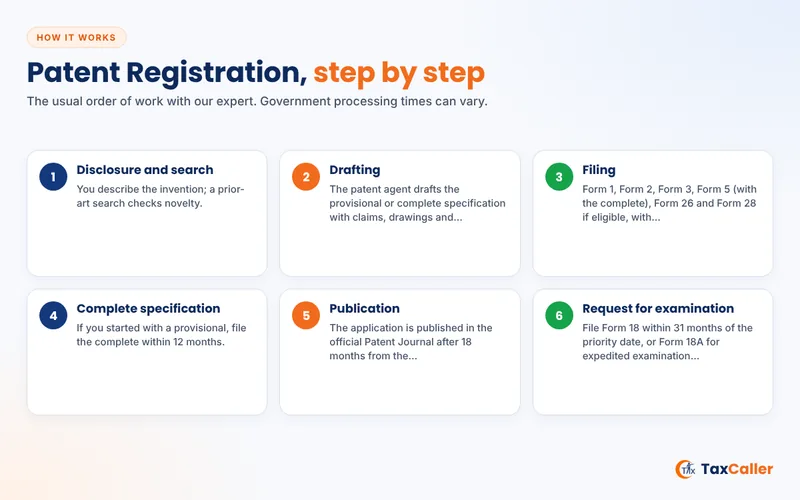
Patent Registration: how the work moves, step by step
The process from filing to grant can be broken into nine stages. Applications are filed online on the IP India e-filing system, and the appropriate patent office is decided by Rule 4: where the applicant lives or does business, or where the invention was made. The Delhi branch covers Delhi, Uttar Pradesh, Haryana, Punjab, Rajasthan, Himachal Pradesh, Uttarakhand, Chandigarh, Jammu and Kashmir and Ladakh.
Disclosure and search: you describe the invention; a prior-art search checks novelty.
Drafting: the patent agent drafts the provisional or complete specification with claims, drawings and abstract (Form 2).
Filing: Form 1, Form 2, Form 3, Form 5 (with the complete), Form 26 and Form 28 if eligible, with the official fee. You get an application number and filing date.
Complete specification: if you started with a provisional, file the complete within 12 months.
Publication: the application is published in the official Patent Journal after 18 months from the priority date, or earlier on a Form 9 request.
Request for examination: file Form 18 within 31 months of the priority date, or Form 18A for expedited examination if eligible.
Examination report: the examiner issues the first statement of objections, often called the FER.
Reply and hearing: you reply and amend claims within 6 months (extendable by 3). You can ask for a hearing before the Controller refuses the application (Section 14).
Grant: once all objections are met and no opposition is pending, the patent is granted and published, and renewals start.
Filing online: what the portal needs
A user account on the IP India e-filing portal, for the applicant or the patent agent
A Class II or III digital signature, or an e-Sign through Aadhaar or PAN, to sign each form
Online payment through the payment gateway; the system generates an e-receipt for each form
Documents in English or Hindi; a verified English translation for anything in another language
Paper filing at the office counter or by post is meant only where a document must be filed offline, and it carries a 10% extra fee (Rule 7(1)). IP India says all office communication is made by email.
How to check patent application status
Use the application number on the IP India public search or the e-register. The status shows publication, examination request, objections issued, replies filed and grant. Hearing dates appear in the Patent Office's cause list, and decisions are posted on the IP India site. Your agent also receives every official letter by email; we pass it on with the deadline marked.
Useful official websites
IP India: Acts, Rules, forms, fees, Patent Journal, register of patent agents
IP India e-filing portal and public search (InPASS) for filing, status and prior art
WIPO (Patentscope and ePCT) for international searches and PCT filing
Startup India and CIPAM (the government's IP promotion cell) for startup IP guidance
Can you file without an agent?
Yes. Section 132 lets the applicant draft the specification and act before the Controller in person. Many first-time inventors still use an agent, because weak claims are hard to fix later.
Abhinay Rai Trademark Expert
Have a question on this topic? Ask Abhinay on a free call.
Who Drafts and Files Your Patent: Our Patent Agent Model
Only a registered patent agent may act for you before the Patent Office as a professional; an advocate may also take part in hearings (Section 132). Section 129 bars anyone else, and any company or other body corporate, from practising as a patent agent. That includes applying for patents for others, preparing specifications, and advising on validity or infringement. Section 127 gives registered agents the right to appear before the Controller and prepare documents. Breaking Section 129 can attract a penalty under Section 123 of up to ₹5 lakh, plus ₹1,000 a day while it continues.
TaxCaller is not a patent agent and does not draft or sign patent specifications. Here is exactly how we handle your patent:
Work
Done by
First call, fee category check, filing plan and deadline calendar
TaxCaller
Collecting documents: disclosure form, Startup India or Udyam proof, assignment deeds, IDs
TaxCaller
Prior-art search and patentability opinion
Registered patent agent
Drafting the provisional or complete specification and claims
Registered patent agent
Filing Form 1, 2, 3, 5, 18 and the other forms, signing as your agent under Form 26
Registered patent agent
Reply to examination report, hearings, amendments
Registered patent agent
Reminders for 12-month, 31-month, reply and renewal deadlines; official fee payment tracking
TaxCaller with the agent
Company, Startup India, MSME, trademark and tax work around the patent
TaxCaller
The agent's name and registration number appear on your Form 26 and engagement letter, so you can verify them on the IP India register of patent agents. The patent is always filed in your name or your company's name, never ours. You can also file yourself under Section 132 and use us only for planning, documents and reminders.
After Filing: Publication, Examination Request and FER Reply
After filing, three clocks matter: publication at 18 months, the examination request at 31 months, and the reply period after objections. Missing the second or third can end the application.
Publication (Section 11A)
Applications stay secret for 18 months from the filing date or priority date, whichever is earlier (Rule 24). Then the Patent Office publishes the title, abstract, applicant and number in the Patent Journal, ordinarily within one month (Rule 24). After a Form 9 request, publication ordinarily follows within one month of the request. From publication you get the same privileges as a patentee, but you can sue for infringement only after grant. Publication also opens the door to pre-grant opposition.
Request for examination (Section 11B, Rule 24B)
The Patent Office does not examine an application unless someone asks. Form 18 must be filed within 31 months from the priority date or filing date, whichever is earlier. The Patents (Amendment) Rules, 2024 cut this from 48 months for applications filed from 15 March 2024. Older applications keep the earlier period. If no request is filed in time, Section 11B(4) treats the application as withdrawn. Since 2024, the Controller may extend this and some other fixed deadlines by up to six months on a Form 4 request made before that extra period ends (Rule 138). The official fee is high (₹10,000 a month for small applicants, ₹50,000 for others), so treat it as an emergency option only.
First examination report (FER) and reply
Under Rule 24B, the examiner's report is ordinarily due within 1 month and at most 3 months of referral, and the Controller then issues the first statement of objections. Common objections are lack of novelty, obviousness, Section 3 exclusions, unclear claims and missing Form 3 details.
Reply time: 6 months from the date the first statement of objections is issued, to put the application in order (Rule 24B(5) and Section 21).
Extension: one extension of 3 months on Form 4, filed before the 6 months end (Rule 24B(6)). The official fee is ₹1,000 per month for small applicants and ₹4,000 per month for others.
Hearing: if objections remain, you can ask for a hearing; the Controller decides after it.
Missed reply: the application is deemed abandoned under Section 21(1).
A good reply argues the technical advance with data and narrows claims only where needed. Amendments cannot add new matter beyond the original disclosure.
Expedited Examination for Startups, Small Entities and Women Inventors
Expedited examination under Rule 24C moves eligible applications to a faster track with tight official timelines. You request it on Form 18A, by e-filing only.
Who can ask for it
Startups recognised under the Startup India initiative
Small entities
Natural persons where at least one applicant is a woman (all applicants must be natural persons)
Government departments, government companies and institutions owned or substantially financed by government
Applicants who chose India as International Searching Authority or International Preliminary Examining Authority in a PCT application
Applicants eligible under an agreement between the Indian Patent Office and a foreign patent office, and notified sectors
Timelines under Rule 24C
Examiner's report ordinarily within 1 month and not more than 2 months of referral
First statement of objections within 15 days after the Controller disposes of the report
Reply within 6 months, with one 3-month extension on Form 4
Final disposal within 3 months of the last reply or the last date to reply, whichever is earlier
The Form 18A request must come with an early publication request (Form 9), unless the application is already published or that request was already filed (Rule 24C(3)). Official fee: ₹8,000 for individuals, startups, small entities and educational institutions; ₹60,000 for others. A startup or small entity does not lose expedited status merely because it later grows out of that category. The Controller may cap the number of expedited requests in a year by notice.
Shadab Trademark Expert
Have a question on this topic? Ask Shadab on a free call.
Patent Registration Fees: Official Fees and Our Fee
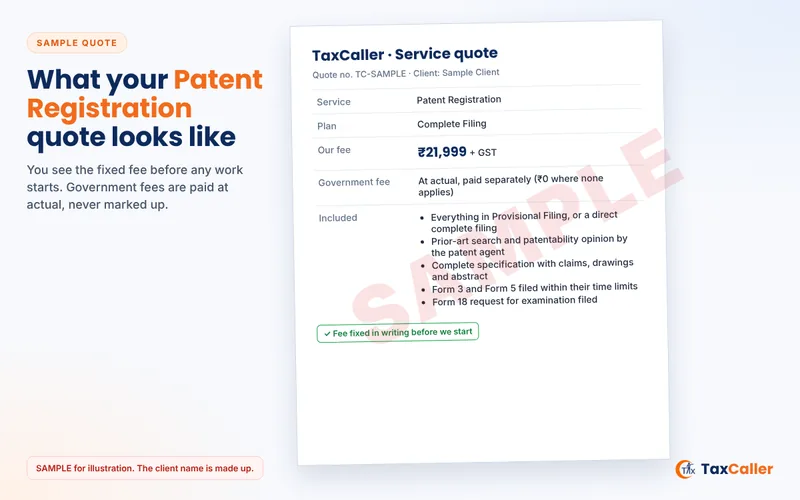
Patent Registration: SAMPLE quote, for illustration only
Patent costs have two parts: the official fees paid to the Patent Office, and the professional fee for drafting, filing and follow-up. Official fees come from the First Schedule to the Patents Rules, 2003, as shown on the IP India forms and official fees page in November 2026.
Item (e-filing)
Individual, startup, small entity, educational institution
Others
Form 1 application (up to 30 pages and 10 claims)
₹1,600
₹8,000
Each extra page beyond 30
₹160
₹800
Each extra claim beyond 10
₹320
₹1,600
Form 9 early publication
₹2,500
₹12,500
Form 18 request for examination
₹4,000
₹20,000
Form 18 express request for a PCT national phase application
₹5,600
₹28,000
Form 18A expedited examination
₹8,000
₹60,000
Form 13 amendment before grant
₹800
₹4,000
Form 7A pre-grant opposition
₹4,000
₹20,000
Form 7 post-grant opposition
₹8,000
₹40,000
Form 15 restoration of a lapsed patent
₹2,400
₹12,000
Form 26 agent authorisation
Nil
Nil
If even one applicant falls in the others category, for example an individual filing jointly with a company, the whole application pays the higher fee for others. The Form 1 fee is multiplied when one application claims several priorities. Physical (paper) filing costs about 10% more, and some forms, such as Form 18A, can only be filed online. If you withdraw an application with Form 29 before the first examination report, Rule 7(4A) allows a partial refund of the examination fee (90% as per the First Schedule).
Typical official cost for an individual or startup
Form 1 (₹1,600) + Form 18 (₹4,000) = ₹5,600 for a normal application within page and claim limits. With early publication and expedited examination instead of Form 18: ₹1,600 + ₹2,500 + ₹8,000 = ₹12,100. A company in the "others" category pays five times or more.
TaxCaller's fee
TaxCaller's fee starts at ₹9,999 + GST for a provisional filing. This covers our coordination and the registered patent agent's work in the chosen plan. Government fees are paid separately at actual, directly to the Patent Office, and we show them line by line before you pay. Replies to objections, hearings, foreign filings and renewals are quoted in writing in advance. See all plans on our pricing page.
How Long Does Patent Registration Take? Timeline and Example
Patent registration usually takes years, not months, because examination runs in a queue. The law fixes the deadlines you must meet; the Patent Office's own speed varies by field and workload. This table shows the fixed points. Practitioner guides commonly report two to four years from filing to grant on the ordinary route; this is not an official figure, and the expedited route is usually much faster.
Stage
Legal time limit
Source
Complete specification after provisional
12 months from provisional filing
Section 9(1)
Form 3 foreign filing statement
6 months from filing
Rule 12(1A)
Publication
After 18 months from priority, or earlier with Form 9
Section 11A
Request for examination
31 months from priority or filing, whichever is earlier
Rule 24B
Reply to first statement of objections
6 months, plus 3 months on Form 4
Rule 24B(5), (6)
Expedited track disposal
3 months after the last reply
Rule 24C(12)
Post-grant opposition window
1 year from publication of grant
Section 25(2)
First renewal fee
Before the end of the 2nd year from the patent date
Rule 80
Worked example: a Ghaziabad startup
A DPIIT-recognised startup builds a low-cost water filter cartridge. The prototype is still changing, and a trade show is due in four months.
Month 0: provisional specification filed with Form 1 and Form 28 at the Delhi office. Official fee ₹1,600. The filing date is now secured, so the trade show can go ahead.
Month 10: complete specification filed with claims, Form 5, and Form 3 (already filed within 6 months). Two extra claims cost ₹640.
Month 10: Form 9 (₹2,500) and Form 18A (₹8,000) filed for expedited examination.
Next stage: the first statement of objections arrives; the agent replies with test data and narrower claims within 6 months.
Grant: after the reply or hearing, the patent is granted for 20 years from Month 0. The first renewal (₹800 a year in this category) falls due as per Rule 80.
Total official fees to grant in this example: ₹12,740. The same filing by a large company in the "others" category would cost far more.
Patent Opposition: Pre-Grant and Post-Grant Under Section 25
Anyone can oppose a published application before grant, and any interested person can oppose within one year after grant. Section 25 lists the only grounds allowed.
Point
Pre-grant, Section 25(1)
Post-grant, Section 25(2)
Who
Any person
Any person interested
When
After publication, before grant
Within 1 year from publication of grant
Form
Form 7A representation
Form 7 notice
Decided by
Controller
Controller after an Opposition Board report
Grounds include: wrongful obtaining of the invention, prior publication or prior claiming, prior public use in India, obviousness, not an invention or not patentable, insufficient description, failure to give Form 3 information, a late convention application, wrong source of biological material, and traditional knowledge.
Under Rule 55, the Controller takes up a pre-grant opposition only after a request for examination is filed, and first checks if a prima facie case exists. If it does, the applicant gets two months to reply with a statement and evidence. If you face an opposition, your patent agent prepares the reply and evidence; we keep the dates.
Shreya Trademark Expert
Have a question on this topic? Ask Shreya on a free call.
A granted patent lasts 20 years from the filing date of the application, or from the international filing date for a PCT application (Section 53). To keep it alive, you pay a renewal fee every year from the third year.
Year of patent
Individual, startup, small entity, educational institution (per year)
Others (per year)
3rd to 6th
₹800
₹4,000
7th to 10th
₹2,400
₹12,000
11th to 15th
₹4,800
₹24,000
16th to 20th
₹8,000
₹40,000
When due: renewal fees fall due at the end of the second year from the patent date and each year after, and must be paid before the year ends (Rule 80). If the patent is granted more than two years after filing, the fees that fell due in the meantime can be paid within three months of the date the patent is recorded in the register (Section 142(4)).
Advance payment: you can pay for two or more years at once. Paying at least four years in advance online gets a 10% reduction (Rule 80(3), added in 2024).
Extension: up to 6 months extra on Form 4, with an extension fee of ₹480 a month (others ₹2,400) (Rule 80(1A)).
Lapse and restoration: if fees stay unpaid, the patent ceases. You can apply to restore it within 18 months from the date it lapsed, explaining why payment was missed (Section 60, Form 15).
After 20 years the patent expires and anyone may use the invention. A patent cannot be renewed beyond 20 years.
Filing Abroad: PCT Route, Convention Priority and Foreign Filing Permission
An Indian patent protects only India. To protect the invention abroad, you either file in each country within 12 months under the Paris Convention, or file one international application under the Patent Cooperation Treaty (PCT) and enter chosen countries later.
Foreign filing permission (Section 39)
A person resident in India must not file a patent application abroad first without written permission from the Controller (Form 25). The exception: if you filed in India at least six weeks before the foreign filing and no secrecy direction applies. Permission for defence or atomic energy inventions needs central government consent. Breaking Section 39 can make the Indian application abandoned (Section 40) and a granted patent revocable.
The PCT route in short
File in India first, with provisional or complete specification.
Within 12 months, file a PCT international application, for example through the Indian Patent Office as receiving office, claiming the Indian date.
Get the international search report and written opinion.
Enter the national phase in each chosen country, generally at 30 or 31 months from priority. For India the limit is 31 months (Rule 20(4)).
The PCT route delays the big country-by-country costs by about 18 months, which gives a startup time to test the market and raise funds. Choosing India as the searching authority also makes the Indian application eligible for expedited examination.
After Grant: Working Statement, Licensing and Infringement
A patent needs care after grant: a working statement every three years, recorded transfers and licences, and action against copying.
Statement of working (Form 27)
Under Section 146(2) and Rule 131, every patentee and licensee files Form 27 once in respect of every period of three financial years, starting from the financial year after grant. It is due within six months of the end of each period, with up to three months' extension on Form 4. There is no official fee. Failing to give it can attract a penalty under Section 122 of up to ₹1 lakh, plus ₹1,000 a day while it continues.
Licensing and assignment
You can sell the patent outright or license it. An assignment or licence must be in writing and should be recorded with the Patent Office (Section 68 and Section 69), otherwise it may not be admitted as evidence of title. Royalty income is taxable; see our income tax filing service.
Infringement and false claims
Infringement suits are filed in a court not lower than a district court (Section 104). Reliefs include injunction and damages or an account of profits (Section 108).
Calling an unpatented product "patented" is penalised under Section 120: up to ₹10 lakh, plus ₹1,000 a day if it continues. Write "patent pending" only while your application is actually pending.
After three years from grant, any person can seek a compulsory licence on grounds such as the public's reasonable needs not being met, the invention not being available at a reasonably affordable price, or it not being worked in India (Section 84). Working the patent and filing Form 27 honestly is your strongest defence.
Zubair Trademark Expert
Have a question on this topic? Ask Zubair on a free call.
The filing process and official fees are the same in 2026 as under the 2024 rules, but the penalty law and startup support changed. Here is what matters now.
Jan Vishwas (Amendment of Provisions) Act, 2026: the Act (8 of 2026) amended the Patents Act. Its patent provisions came into force on 1 June 2026 under S.O. 2846(E) in the Gazette of India, dated 1 June 2026. Legal publications report that it adds a proviso to Section 118, so the punishment under Section 118 for breaching the foreign filing rule in Section 39 does not apply where the central government finds the invention was not relevant to defence or atomic energy. They also report that Section 119 (falsification of register entries) was omitted. Section 39 itself still applies.
Penalty procedure: the Patents (Amendment) Rules, 2025, in force from 25 November 2025 as reported, replaced the chapter on adjudication of penalties. Complaints under Sections 120, 122 and 123 go online on Form 32, appeals on Form 33 within 60 days of receiving the order.
SIPP for startups: the Startup Intellectual Property Protection scheme, which paid empanelled facilitators for startup patent work, was last extended to 31 March 2026. Reports from May 2026 say no further extension was announced. The 80% lower official fee for startups and small entities and the expedited route under Rule 24C continue, as they are part of the Patents Rules.
Forms and fee schedule republished: IP India republished the patent forms in 2026 and the First Schedule of fees in July 2026. The fee amounts on this page are taken from that schedule.
Still in force from 2024: 31 months for the examination request, Form 3 updates within 3 months of the first examination report, working statements once every three financial years, 10% off for four years' renewal paid in advance, and further divisional applications.
Invention disclosure: problem, solution, what is new, preferred way of working it
Drawings, flowcharts, diagrams or prototype photos
Test data or results showing the technical advance
List of known similar products, patents or papers
Details of any public disclosure already made (date, place, medium)
Name, address and nationality of each applicant and inventor
Certificate of incorporation and signatory details (company or LLP applicant)
Startup India recognition or Udyam certificate for the lower fee (with Form 28)
Assignment deed or inventor endorsement where the applicant is not the inventor
Signed Form 26 authorising the registered patent agent
Priority document and translation (convention or PCT filings)
PCT international application number and publication details (national phase)
Why TaxCaller
Real experts, not a call centre
Your work is handled by experienced professionals who explain every step, check your documents and keep you updated.
Registered company
TaxCaller is run by TaxCaller India LLP (LLPIN AAQ-7388), serving clients since 2018.
Fee told upfront
You know the complete fee, our professional fee and the government fee, before any work starts. No hidden charges.
Support after the work
Notices, renewals, returns and compliance reminders: we stay with your business after the registration is done.
Reviewed By
Expert for this topic Patent Registration
Abhinay Rai
Advocate
Abhinay Rai is a Advocate specialising in Patent Registration. The process, documents, timelines and fees on this page are checked against the current rules and government portals, and updated whenever the law, forms or fees change.
Patent registration is the process of applying to the Indian Patent Office for an exclusive right over a new invention under the Patents Act, 1970. You file a specification describing the invention, request examination, answer objections and, if the invention qualifies, get a patent valid for 20 years in India, subject to yearly renewal fees.
How much does patent registration cost in India?
Official fees for an individual, startup, small entity or educational institution start at ₹1,600 for Form 1 and ₹4,000 for the examination request, so about ₹5,600 in total. Other companies pay ₹8,000 and ₹20,000. Expedited examination costs ₹8,000 or ₹60,000. Professional drafting fees are extra and depend on the invention's complexity.
How long does it take to get a patent in India?
There is no fixed total time. You must file the complete specification within 12 months of a provisional and request examination within 31 months of priority. After that, examination runs in a queue and objections must be answered. The expedited route under Rule 24C has tighter official timelines and usually ends much sooner.
Can I file a patent myself without an agent?
Yes. Section 132 of the Patents Act lets the applicant draft the specification and act before the Controller personally. But anyone who acts for you professionally must be a registered patent agent under Section 129. Most first-time inventors use an agent because poorly drafted claims are difficult or impossible to fix later.
Can an idea be patented in India?
No, a bare idea cannot be patented. You must describe a working product or process in enough detail that a skilled person could make or use it. The invention must be new, involve an inventive step and be industrially applicable. A provisional specification can secure your date while the details are still being finalised.
What is a provisional patent application?
A provisional application is a first filing with a provisional specification on Form 2, without claims, made to secure an early priority date. You must file the complete specification within 12 months, or the application is deemed abandoned under Section 9(1). It is useful when the invention is still being developed or tested.
How long is a patent valid in India?
A patent is valid for 20 years from the date of filing the application, or from the international filing date for a PCT application, under Section 53. It stays in force only if renewal fees are paid every year from the third year. After 20 years it expires and cannot be renewed further.
Is software patentable in India?
A computer programme per se, an algorithm or a business method is not patentable under Section 3(k). But an invention where software produces a technical effect, such as improved hardware working, faster processing or better security, can be patented if drafted well. Plain app ideas are usually refused, so protect code through copyright instead.
What is the time limit for filing the request for examination?
Form 18 must be filed within 31 months from the priority date or the filing date, whichever is earlier, under Rule 24B. This applies to applications filed from 15 March 2024, when the Patents (Amendment) Rules, 2024 came into force. If no request is filed in time, the application is treated as withdrawn.
How much time do I get to reply to the FER?
You get six months from the date the first statement of objections is issued to put the application in order for grant. One extension of three months is available on Form 4 if you apply before the six months end. If you do not reply in time, the application is deemed abandoned under Section 21.
Who can get expedited patent examination?
Rule 24C allows Form 18A for recognised startups, small entities, women applicants where all applicants are natural persons, government bodies and companies, PCT applicants who chose India as search or examining authority, and some others. The official fee is ₹8,000 for small applicants and ₹60,000 for others. It is filed online only.
Is an Indian patent valid in other countries?
No. Patents are territorial, so an Indian patent protects you only in India. To protect the invention abroad, file in each country within 12 months under the Paris Convention, or file a PCT application and enter countries later. Indian residents need foreign filing permission under Section 39 unless they filed in India six weeks earlier.
What happens if I do not pay the patent renewal fee?
The patent ceases to have effect if the fee is not paid in time or within the six-month extension available on Form 4. You can apply on Form 15 to restore it within 18 months from the date it lapsed, under Section 60, giving reasons. Restoration is not automatic and third parties may object.
Can I sell my product while the patent is pending?
Yes, once your application is filed you can sell and mark the product "patent pending". Selling before filing can destroy novelty, so file first. You cannot sue for infringement until grant, but from publication you get rights that may be claimed after grant. Never mark a product "patented" before grant: Section 120 penalises it.
Does TaxCaller draft and file the patent itself?
No. Under Section 129, a company cannot practise as a patent agent. Your specification is drafted, signed and filed by a registered patent agent, whose name and number appear on Form 26. TaxCaller handles the first call, fee category check, documents, official fee tracking and deadline reminders, and quotes the full cost in writing.
Share a short note about your invention on a free first call. Our fee starts at ₹9,999 + GST, and official Patent Office fees are paid separately at actual.