Starting from · ₹999 Trademark Journal Journal Check plan
STARTING FROM₹999
FEE TOLD UPFRONTFree first call
!Brand not protected?Your rights count from the filing date, so file early
Since 2018Trusted Experience
980+Experts Connected
220+Cities Served
1164+Agents Available
12000+Founders Trusted
S
Srishti Magoo
★★★★★
Excellent experience with TaxCaller for filing my &
my family members ITR returns. The entire process was
smooth, quick and hassle-free. They are professional,
knowledgeable and guided me through every step with patience.
O
obeid sait
★★★★★
The team has handled my taxes for the past three years,
and it's been a wonderful, hassle-free experience.
Thank you for your consistently quick and efficient service.
P
Pushkar
★★★★★
They are among the best in their field. Their work culture
is highly professional, and their client service is smooth
and reliable. They can confidently be relied on to get the job done.
P
Prasad Sheth
★★★★★
Excellent experience with TaxCaller! The ITR filing
process was smooth, quick, and completely hassle-free.
The CA was knowledgeable, responsive, and explained everything clearly.
A
Apoorv Bansal
★★★★★
Excellent service for ITR filing. The team was highly
professional, responsive, and guided me through the entire
process smoothly. My return was filed accurately and on time.
A
Abhishek Kumar
★★★★★
I was searching for a good CA firm in Ghaziabad and found
TaxCaller. The experience was excellent from start to finish.
The team is responsive, transparent, and genuinely helpful.
U
uma pandey
★★★★★
Great service! TaxCaller India made the entire ITR filing
process quick, smooth, and hassle-free. They answered all
my queries patiently and ensured maximum accuracy.
T
tanu mittal
★★★★★
Excellent job! We've been connected for many years,
and your success truly makes me happy. You are an
incredibly intelligent person. Keep shining, keep growing.
B
Bhanu Pratap Maurya
★★★★★
I am filing my ITR since past 3 years with Abhinav and
Firm is known as TaxCaller and they are professional
interms of ITR rules. They will explain and tell you all
the information.
A
ashish Sharma
★★★★★
I am providing my honest reviews:
No.1 service ...
A
AARYAN GROUP
★★★★★
Honestly, finding a good CA firm in Ghaziabad was
confusing, but TaxCaller India made it simple.
I contacted them for GST work and the experience was smooth.
N
News Speaks
★★★★★
If you're looking for a reliable CA firm in Ghaziabad,
TaxCaller India is a great choice. They provide complete
taxation and compliance solutions including GST.
A
Anshul Chaprana
★★★★★
Got my GST registration done through TaxCaller CA firm.
Process was quite smooth, they guided properly on documents
and didn't waste time. Overall good experience.
How we work
Online · Call · WhatsApp
Quick answer
The Trade Marks Journal is IP India's official weekly publication of trademark applications that are open to public opposition. Section 20 of the Trade Marks Act, 1999 requires advertisement in it. Anyone may oppose a published mark within four months under Section 21. If nobody opposes, the Registrar moves the mark to registration.
Reviewed by Abhinay Rai · Updated 16 Nov 2026
Pick a plan that fits
Journal Check
Applicants and brand owners who need one entry found and explained
Government fees and taxes are extra where applicable. Our expert confirms the final amount on the first call. No hidden charges.
Publication Before Registration: The Basics
The trademark journal, officially the Trade Marks Journal, is where the Trade Marks Registry tells the public which brand names and logos it is about to register. It is published online on the IP India website. A new issue appears each week. Each issue has its own Journal number and date.
For an applicant, publication is good news, but it is not registration. It starts a four-month window in which anyone may oppose the mark. For every other brand owner, the Journal is an early warning system. It is the last cheap chance to stop a copycat mark before it reaches the register.
This guide explains the Journal in plain words: the law behind it, how to search and download it, what each entry and status means, how to count the opposition window and what happens next. It also covers corrections, re-advertisement and how a Journal watch works. TaxCaller's trademark experts handle Journal checks, watch services and opposition filings online across India. Every legal point here is checked against the Trade Marks Act, 1999 on India Code and the Trade Marks Rules, 2017 on IP India.
Complete guide
Choose a topic to open it. Every answer gives the rule or section it comes from.
01 Topic 1 of 20
What Is the Trademark Journal?
The Trademark Journal is the official publication in which the Trade Marks Registry advertises trademark applications before they are registered. It is the public notice board of the Indian trademark system. The Registry publishes it online, and anyone can read it at no cost.
The duty to publish comes from Section 20(1) of the Trade Marks Act, 1999 on India Code. Once the Registrar accepts an application, it must be advertised "as soon as may be", together with any conditions or limitations. Rule 39 of the Trade Marks Rules, 2017 on IP India says every application that Section 20(1) requires to be advertised shall be advertised in the Journal.
How the law defines it
Rule 2: the Journal means the trademarks Journal made available on the official website of the Controller General of Patents, Designs and Trade Marks (CGPDTM).
Rule 2: "publish" means published in that Journal on the official website.
Section 2(1)(p) of the Act: "notify" means to notify in the "Trade Mark Journal" published by the Registrar.
Why the law insists on publication
The examiner checks an application against the register and the law. But the examiner cannot know every unregistered brand in the market, every prior user or every copied logo. Publication fills that gap. It lets the people who know the facts raise them before rights are granted. That is why Section 21 gives "any person" the right to oppose, not only the owners of registered marks.
So the Journal serves two groups. Applicants use it to confirm their mark has cleared examination. Brand owners use it to catch conflicting marks early.
Where Journal Publication Fits in the Registration Process
Publication comes after examination and before registration. It is the fourth of five broad stages a trademark application passes through.
Stage
What happens
Law
1. Filing
Application filed in Form TM-A and an application number issued
Section 18
2. Examination
Registrar searches earlier marks and issues an examination report
Rule 33
3. Objection reply or hearing
Applicant answers any objection; mark accepted or refused
Rule 33, Section 18(4)
4. Journal publication
Accepted mark advertised; four-month opposition window opens
Section 20, Rule 39, Section 21
5. Registration
If no opposition, or opposition decided for the applicant, the mark is entered on the register
Section 23(1), Rule 53(1)
If the examiner raised an objection, the mark reaches the Journal only after a successful reply or hearing. Our trademark objection reply service covers that stage. If you are still at stage 1, start with trademark registration.
Section 23(1) also sets a target. Where a mark is unopposed, or the opposition is decided in the applicant's favour, the Registrar shall register it within eighteen months of filing, unless the Central Government directs otherwise. The date of registration is the date of the application.
Shadab Trademark Expert
Have a question on this topic? Ask Shadab on a free call.
Each issue carries more than new advertisements. The revised draft Trade Marks Manual posted by IP India in August 2026 lists what the Journal contains:
Public notices and notifications issued by the office.
Applications accepted, or ordered to be advertised before acceptance.
Re-advertisements of applications ordered by a competent officer.
Corrigenda or further notifications about applications published earlier.
Lists of marks registered, renewed or removed, and applications withdrawn.
Post-registration changes, including assignments and transmissions recorded.
International non-proprietary names published by the World Health Organization.
Other information the office considers necessary.
How an issue is split into parts
The official Trade Marks Journal page on IP India lists each issue with separate downloadable parts by class range. For example, Journal No. 2286 has parts for Classes 1 to 9, 10 to 18, 19 to 27, 28 to 36, 37 to 45, and a Multiclass part. The ranges are not fixed and can differ from issue to issue. Some issues also carry IR Division notices for international registrations, and a few older issues had supplements.
Notices you may see
Because registrations, renewals and removals are listed too, the Journal also helps you track when a rival's mark is renewed or removed from the register.
The same list shows notices attached to issues. Examples include well-known trademark notices, corrigenda to well-known marks, public notices on abandonment of marks under Section 21(2), and notices on default in filing replies to office objections. If your application is pending, these notices are worth a look too.
Every advertised application has its own entry. Read it closely, because the opposition window and your rights depend on what it shows. The draft Trade Marks Manual says an advertisement should include these details:
Field
What to check
The mark
The word, logo or device exactly as accepted, including colours if claimed
Application number and date
The filing date fixes priority against other marks
Priority claim
Any convention priority from an earlier foreign filing
Applicant
Name, address and legal status of the applicant
Address for service
Where notices, including any opposition, will be served (Rule 17)
Class and specification
The class and the exact goods or services covered
Conditions or limitations
Any disclaimer or limit imposed at acceptance
Statement of use
"Proposed to be used" or a claimed date of first use
Journal number and date
The Journal number is the serial number of the weekly issue, such as 2286. Every issue carries a Date of Publication. The official list also shows a Date of Availability. The two are usually the same day. In a few issues they differ. For example, Journal No. 2278 shows publication on 14 September 2026 and availability on 15 September 2026.
Section 21(1) counts the opposition window from the date of the advertisement. Rule 42(1) counts it from the date of publication of the Journal. Where the two dates on the list differ, we count from the earlier one, so a filing is never at risk.
Things people misread
A Multiclass entry covers several classes in one application. Check every class listed.
The address for service may be an agent's or advocate's address, not the applicant's.
A claimed user date is the applicant's statement. It is not proof of use, and it can be challenged.
Pick the issue: choose the issue by its number or date. If you know your mark's Journal number, go straight to it.
Pick the part: open the class-range part that covers your class, or the Multiclass part if the application covers several classes.
Download the PDF: the part opens as a PDF that you can save and search with your PDF reader.
Search inside: use the find tool to look for your application number, brand name or applicant name. A logo entry may not be searchable as text, so also scroll your class.
Note the details: record the Journal number, date, page and application number. You need these to file or answer an opposition.
Finding your own mark's Journal details
If you filed an application, the online status of your application usually shows when it was advertised and in which Journal. If you cannot find it, Rule 41 lets any person request the Registrar, in Form TM-M, to give the number and date of the Journal in which a mark was advertised. The Registrar must furnish those particulars.
Other official tools you may come across
Trade Marks Public Search: the Registry's search portal on tmrsearch.ipindia.gov.in now asks you to log in with an OTP sent to your email or mobile. It also links to an AI-based trademark search. Use it to search the register, not to read Journal pages.
Older Journal page: a legacy IP India page lets you look up a Journal by Journal Number and Supplementary Number, and links to a "Mega Journal" page.
Application status: the status page shows where your own application stands, including advertisement details once published.
Searching for marks like yours
The class-wise PDFs are large. Reading every page each week is slow. For a single check, search by your brand's key words, close spellings and the main word of your logo. For ongoing protection, a structured Journal watch works better. We explain it further down this page.
Shreya Trademark Expert
Have a question on this topic? Ask Shreya on a free call.
Accepted and Advertised vs Advertised Before Acceptance
Most marks appear in the Journal after acceptance. A smaller number appear before acceptance. Both open the same four-month opposition window, but they mean different things.
Point
Accepted and advertised
Advertised before acceptance
Law
Section 20(1), main part
Proviso to Section 20(1)
When used
Examination or hearing ends in acceptance
Marks raising Section 9(1) or Section 11(1) and (2) issues, or other exceptional circumstances
Usual reason
No objection, or objection answered
The officer is not ready to accept outright but lets the public test the mark
Opposition window
Four months under Section 21(1)
Four months under Section 21(1)
Later re-advertisement
Only for corrections or amendments
Registrar may re-advertise under Section 20(2)(a)
Why an officer orders it
The draft Trade Marks Manual says the power is for exceptional circumstances. It is used where the officer finds strong evidence of bona fide commercial adoption and use of the mark. A hearing officer satisfied of honest concurrent use may also order it.
What it means for you
If it is your mark: you have passed a hurdle, but the mark is more exposed. The objection the examiner had in mind may be raised again by an opponent. Keep your evidence of use ready.
If it is a rival's mark: this label is a signal to read the entry closely. The examiner saw an issue, often a conflict with earlier marks or weak distinctiveness.
The exact wording of status labels on the online status page can differ slightly. Match the label to the nearest stage in this table.
Any person may oppose a published mark within four months from the date of its advertisement or re-advertisement. That is the rule in Section 21(1). Rule 42(1) adds the form: a notice of opposition in Form TM-O, filed within four months from the date of publication of the Journal.
No extension beyond four months
The four months are fixed in the Act itself. Section 131 lets the Registrar extend time only for acts where the Act does not expressly fix the period. So there is no way to buy extra time for an opposition. Plan to file well before the last day.
Worked example
Journal No. 2286 is dated 9 November 2026. A mark advertised in it can be opposed until about 9 March 2027. We treat the date four months on as the outer limit and aim to file weeks earlier. That leaves room for a portal problem, a missing document or an e-KYC issue.
Journal date
Four months end around
Our internal target
9 November 2026
9 March 2027
Mid-February 2027
2 November 2026
2 March 2027
Early February 2027
26 October 2026
26 February 2027
End of January 2027
Re-advertisement starts a fresh window
Section 21(1) counts from the advertisement or the re-advertisement. If a mark is re-advertised after a correction or amendment, a new four-month window runs from the new Journal. Section 21(1) mentions only advertisement and re-advertisement. So check whether a later notice is a full re-advertisement or only a correction notice.
Who can oppose
Section 21(1) says "any person". You do not need a registered mark of your own. A prior user with invoices, the creator of a copied logo or even a member of the public with a valid ground can oppose. The grounds and procedure are covered on our trademark opposition page.
After publication, the application waits out the four months. What happens next depends on whether anyone files Form TM-O.
If nobody opposes
Rule 53(1) says that where no notice of opposition is filed, the Registrar shall enter the mark on the register. This is subject to Section 23(1) or Section 19, as the rule puts it. The draft Trade Marks Manual says such applications are taken up in order of the seniority of their advertisement. Officers check pending amendments, withdrawal orders, opposition status and formalities before approving registration in the system.
Under Section 23(2), the applicant then gets a registration certificate with the seal of the Trade Marks Registry. Rule 56 says the certificate is issued in Form RG-2. Registration runs from the application date and lasts ten years, after which it can be renewed. See our trademark renewal service.
If someone opposes
The opponent files Form TM-O within four months of the Journal.
Under Rule 42(5), the Registrar ordinarily serves a copy on the applicant within three months of receiving it.
The applicant must file a counter-statement in Form TM-O within two months of receipt (Section 21(2), Rule 44(1)). If not, the application is deemed abandoned.
Both sides file evidence, then the Registrar hears the case and decides under Section 21(5).
If the Registrar changes its mind
Section 19 lets the Registrar withdraw acceptance before registration if the application was accepted in error, or should have been accepted only with conditions. The applicant gets a hearing. Rule 38 gives thirty days to respond to the objection, or the acceptance is deemed withdrawn.
Using ™ and ®
During the Journal stage you may use ™ with your brand. The ® symbol is only for registered marks. Using it on an unregistered mark is barred by Section 107.
Zubair Trademark Expert
Have a question on this topic? Ask Zubair on a free call.
Mistakes happen, either in the application or in the printed entry. The law gives three tools to fix them after advertisement.
Tool
When it is used
Law
Correction or amendment of the application
An error in the application, or a change the applicant asks for, allowed on just terms before or after acceptance
Section 22, Rule 37
Notice of correction (corrigendum)
The Registrar notifies the correction in the Journal instead of advertising again
Section 20(2)(b), Rule 40
Re-advertisement
The Registrar advertises the mark again and cancels the earlier advertisement
Section 20(2), proviso to Rule 40
Which one applies
Rule 40 lets the Registrar publish a notice that lists the application, the Journal in which it was advertised and the correction made. Under the proviso to Rule 40, where there is an error in the advertisement of the mark or of the goods or services (the rule's wording also refers to trivial spelling mistakes, class and statement of use), or in any other case the Registrar thinks fit, the Registrar may advertise the mark again, cancelling the earlier advertisement. The draft Trade Marks Manual says clerical errors are fixed by a corrigendum, while major errors in the mark, proprietorship, statement of use, class or specification need re-advertisement.
Limits on changes
Rule 37 bars an amendment that substantially changes the mark or adds goods or services not in the original application. You can narrow the goods. You cannot widen them.
What to do if your entry is wrong
Compare the entry with your filed application, line by line.
If the Registry made the error, ask for correction promptly, with a copy of the filed record.
If you made the error, file a request in Form TM-M with the official fee.
Watch the next Journals for the corrigendum or re-advertisement.
Trademark Journal Watch: Catching Conflicting Marks Early
A trademark journal watch is a regular check of each new issue for marks that may clash with yours. It is how brand owners use the four-month window in practice. Without one, most owners learn about a copycat only after it is registered.
What a good watch looks for
Identical marks: the same word or logo in any class.
Similar spellings: added or dropped letters, phonetic twins and transliterations.
Same idea: a translation of your mark, or a logo with the same central image.
Your key word inside a longer mark: such as your brand plus a common word.
Related classes: goods and services that are sold together or through the same shops.
How we run it
We list your marks, classes, key words and close variants with you.
Each week, we check the new Journal parts for your classes and the related ones.
We screen hits for look, sound and idea, and for overlap of goods and buyers.
You receive a short report with the entry details, our risk view and the last date to oppose.
If you decide to act, we move to a letter, a settlement or a Form TM-O filing.
How to judge a hit
Similarity is judged the way an ordinary buyer with an imperfect memory sees it. Look at the marks as a whole, their dominant part, the goods, the buyers and the strength of your mark. A watch report should rank hits by risk, so you spend time only on the ones that matter.
DIY or professional
A small business with one mark can do a basic weekly search itself using the steps above. A brand with several marks, logos or classes usually needs a structured watch, because a missed week can mean a missed window.
Should You Oppose a Mark You Found? A Decision Table
Finding a similar mark does not always mean you should oppose. Use this table for a first view, then take advice on your facts.
What you found
Usual next step
Identical or very close mark, same or related goods
Strong case to oppose in Form TM-O
Similar mark, you used yours first but never registered it
Oppose on prior use and passing off, with dated proof
Copy of your logo artwork
Oppose, relying on copyright in the artwork
Former distributor or partner filed your brand
Oppose on false proprietorship and bad faith
Similar mark, but goods clearly unrelated and your mark not well known
Usually watch only, or write to the applicant
Only a common or descriptive word is shared
Usually not worth opposing
Window has already closed
Rectification under Section 57 after registration
Cheaper routes before a full opposition
A letter to the applicant asking them to limit the goods or withdraw.
A coexistence or consent arrangement that both sides can live with.
Filing the opposition to protect your position, then negotiating.
For grounds under Sections 9 and 11, evidence and hearings, see our trademark opposition service. If you settle by buying or transferring a mark, our trademark assignment page explains the process.
Abhinay Rai Trademark Expert
Have a question on this topic? Ask Abhinay on a free call.
Publication of your own mark is a milestone. Use the four months well, so nothing derails the last step.
Check the entry: confirm the mark, applicant name, class, goods and user date match your application.
Note the dates: record the Journal number and date, and diarise the end of the four months.
Keep your address for service current: an opposition is served there. A stale email or postal address can make you miss it.
Check your filer's e-KYC: in 2026 the Registry made e-KYC compulsory for IP attorneys on its register, so the agent or advocate acting for you must have completed it.
Watch for notices: check your email, the status page and post regularly.
Act fast if opposed: the counter-statement is due within two months of receiving the notice. Missing it abandons the application under Section 21(2).
Collect use evidence: invoices, adverts and sales figures by year. You may need them if opposed.
Use ™, not ®: until the certificate issues, show ™ only.
Beware of fake notices
Journal entries are public, so your name and address are visible to anyone. If a letter or message asks you for money to "publish" your mark, be careful. The official fee schedule has no fee for advertisement in the Trade Marks Journal. Check any demand against the official status page before you pay anything.
How TaxCaller Handles Journal Checks and Oppositions
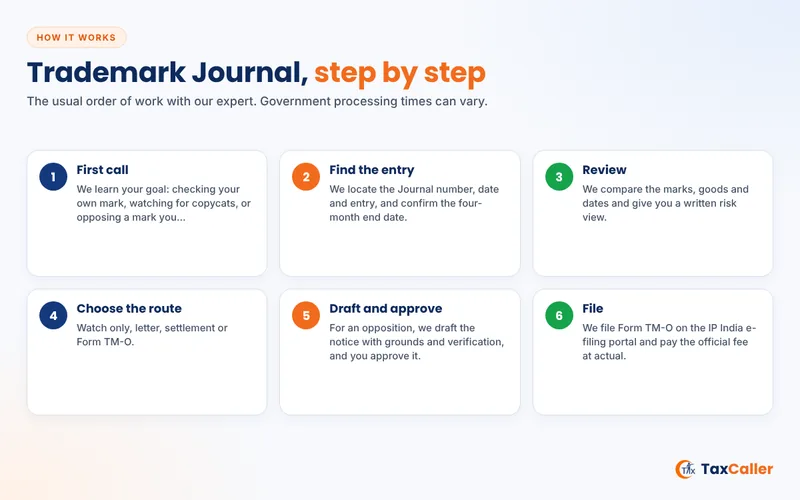
Trademark Journal: how the work moves, step by step
We work fully online. You share details on a call or by email, and we handle the rest.
First call: we learn your goal: checking your own mark, watching for copycats, or opposing a mark you found.
Find the entry: we locate the Journal number, date and entry, and confirm the four-month end date.
Review: we compare the marks, goods and dates and give you a written risk view.
Choose the route: watch only, letter, settlement or Form TM-O.
Draft and approve: for an opposition, we draft the notice with grounds and verification, and you approve it.
File: we file Form TM-O on the IP India e-filing portal and pay the official fee at actual.
Track: we track service of the notice, the counter-statement and later deadlines.
For a watch, we agree the marks, classes and reporting format at the start. You get a report each week that a relevant hit appears, with a clear last date to act.
Shadab Trademark Expert
Have a question on this topic? Ask Shadab on a free call.
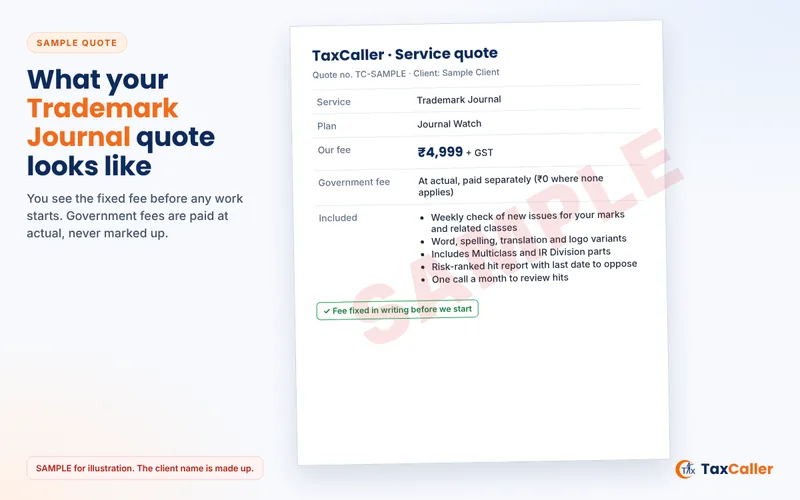
Trademark Journal: SAMPLE quote, for illustration only
Reading or downloading the Journal costs nothing. Official fees apply only when you file a form. Our professional fee is always shown separately.
Official fees (First Schedule, Trade Marks Rules, 2017)
Action
Form
E-filing
Physical filing
Reading or downloading the Journal
None
No government fee
No government fee
New trademark application, per class (for reference)
TM-A
₹4,500 for individuals, startups and small enterprises; ₹9,000 for others
₹5,000; ₹10,000
Notice of opposition, per class
TM-O
₹2,700
₹3,000
Counter-statement, per class
TM-O
₹2,700
₹3,000
Request for Journal particulars (Rule 41), amendment of an application and similar requests
TM-M
₹900
₹1,000
Evidence affidavits in an opposition
No fee form
No official fee
No official fee
Source: the IP India Form and Fees page, checked in November 2026. The TM-O fee is the same for individuals, small enterprises and companies.
TaxCaller's fee
TaxCaller's fee starts at ₹999 + GST. Government fees are paid separately at actual. A Journal watch is priced by the number of marks and classes watched. An opposition is priced by classes and the stage of work. We confirm the full scope in writing before we start.
Other costs
Notary charges for affidavits, if the case reaches evidence.
Translation of documents not in Hindi or English.
Travel, only if a hearing must be attended in person.
These are the legal time limits around the Journal. Registry processing times vary, so we track each case live.
Step
Time limit
Law
Advertisement after acceptance
"As soon as may be"
Section 20(1)
New Journal issue
Each week, dated Mondays in the official list
Official Journal list; draft Trade Marks Manual
Opposition by any person
Four months from advertisement or re-advertisement, no extension
Section 21(1), Rule 42(1), Section 131
Copy of opposition served on applicant
Ordinarily within three months of receipt
Rule 42(5)
Counter-statement
Two months from receipt of the notice
Section 21(2), Rule 44(1)
Response to withdrawal of acceptance
Thirty days
Rule 38(2)
Registration target
Within eighteen months of filing, unless the Central Government directs otherwise
Section 23(1)
From filing to publication, the time depends on examination and any objection. After an unopposed window closes, registration follows the Registry's processing queue. We do not promise fixed dates the law does not fix.
The Trade Marks Act does not charge late fees at the Journal stage. Missing a date costs much more: you can lose the right altogether.
Lapse
Result
Law
Opposition not filed within four months
Opposition is closed; only rectification after registration remains
Section 21(1), Section 57
Applicant files no counter-statement in two months
Application deemed abandoned
Section 21(2)
No response to withdrawal of acceptance in thirty days
Acceptance deemed withdrawn
Rule 38(2)
Copycat mark registered because nobody opposed
Remedies become slower: rectification under Section 57, removal for non-use under Section 47 after five years of non-use from entry on the register, or a suit for passing off or infringement
Sections 47 and 57
Using ® on an unregistered mark
Penalty of half a percent of turnover or ₹5 lakh, whichever is less
Section 107
The Section 107 penalty applies from 1 August 2024, under the Jan Vishwas (Amendment of Provisions) Act, 2023. A mark in the Journal is still unregistered, so ® is not allowed yet.
The Registry also publishes public notices on abandonment of marks under Section 21(2) alongside Journal issues. If your mark appears in such a notice, act at once.
Shreya Trademark Expert
Have a question on this topic? Ask Shreya on a free call.
The Journal itself kept its weekly rhythm through 2026. The official list shows Journal No. 2277 dated 7 September 2026 through Journal No. 2286 dated 9 November 2026, one issue each Monday. These IP India notices from 2026 affect people dealing with Journal entries:
Revised draft Trade Marks Manual (posted 21 August 2026): it describes Journal publication every Monday by the Head Office, the contents of each issue, and the corrigendum and re-advertisement practice. It is a draft for comments, not final.
Mandatory e-KYC: a public notice of 9 July 2026 made e-KYC compulsory for IP attorneys on the CGPDTM register. Notices of 7 August and 31 August 2026 extended the time, with a final extension to 30 September 2026. Whoever files Form TM-O for you must have completed it.
Special drive on old oppositions: a public notice dated 2 November 2026 from the Office of the CGPDTM scheduled all opposition proceedings pending up to 2010 for final hearing. If you have an old opposed mark, check your file.
AI and trademark squatting: a public notice dated 16 October 2026 invited suggestions within three weeks, after a Delhi High Court order of 13 October 2026. No final guidelines have been issued yet.
Refund of duplicate payments: an SOP dated 14 October 2026 sets out how to claim refunds of duplicate fee payments.
Use of IP India content and databases: on 11 November 2026, IP India posted a notice on its home page on the prohibition of unauthorised commercial use of its name, logo, content, databases and digital resources. The Journal remains open to read, but third-party tools built on IP India data may change. We rely on the official Journal pages.
Fees unchanged: as of November 2026, Form TM-O still costs ₹2,700 per class on e-filing.
All of these are on the IP India website. We check the notices each week as part of our Journal watch.
TaxCaller has handled registrations and compliance work since 2018, from our office in Ghaziabad and online across India. For trademark journal work we offer:
Date discipline: every entry we handle gets a written four-month end date and an earlier internal target.
Plain reports: a short note per hit with the entry details, our risk view and a clear next step.
One team for the full path: watch, letter, opposition, counter-statement and renewal, without a handover.
Official sources only: we work from the Act, the Rules and IP India notices.
Fees in writing: our fee + GST, with government fees separate at actual.
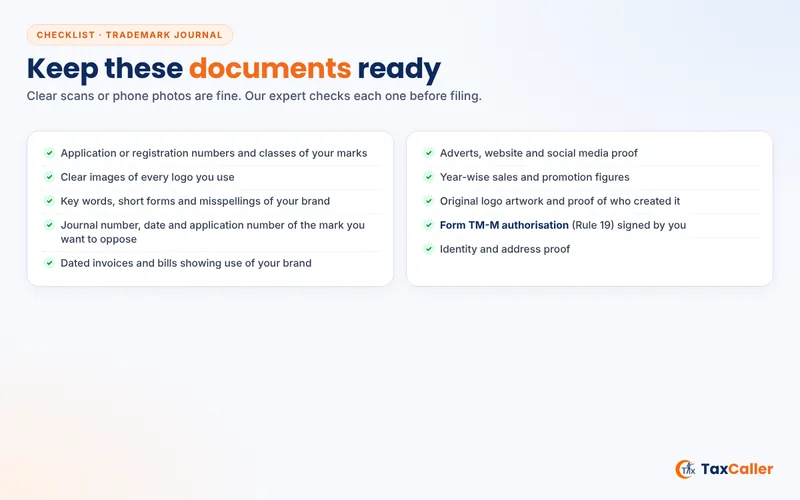
Application or registration numbers and classes of your marks
Clear images of every logo you use
Key words, short forms and misspellings of your brand
Journal number, date and application number of the mark you want to oppose
Dated invoices and bills showing use of your brand
Adverts, website and social media proof
Year-wise sales and promotion figures
Original logo artwork and proof of who created it
Form TM-M authorisation (Rule 19) signed by you
Identity and address proof
Why TaxCaller
Real experts, not a call centre
Your work is handled by experienced professionals who explain every step, check your documents and keep you updated.
Registered company
TaxCaller is run by TaxCaller India LLP (LLPIN AAQ-7388), serving clients since 2018.
Fee told upfront
You know the complete fee, our professional fee and the government fee, before any work starts. No hidden charges.
Support after the work
Notices, renewals, returns and compliance reminders: we stay with your business after the registration is done.
Reviewed By
Expert for this topic Trademark Journal
Abhinay Rai
Advocate
Abhinay Rai is a Advocate specialising in Trademark Journal. The process, documents, timelines and fees on this page are checked against the current rules and government portals, and updated whenever the law, forms or fees change.
The Trade Marks Journal is IP India's official online publication of trademark applications that have cleared examination or were ordered to be advertised. Section 20 of the Trade Marks Act, 1999 and Rule 39 require advertisement in it. Publication invites the public to oppose a mark within four months before the Registrar registers it.
How often is the Trade Marks Journal published?
A new issue is published every week. The official IP India Journal list shows each issue dated on a Monday, for example Journal No. 2285 on 2 November 2026 and No. 2286 on 9 November 2026. The revised draft Trade Marks Manual of 2026 also describes Monday publication by the Registry's Head Office.
How can I check whether my trademark is published in the journal?
Check your application's online status on IP India, which usually shows the advertisement details. You can also open the official Journal list, pick the issue and class part, and search the PDF for your application number. If you still cannot find it, Rule 41 lets you ask the Registrar in Form TM-M.
How long after filing is a trademark published in the journal?
There is no fixed legal period. Section 20(1) only says the Registrar shall advertise an accepted application as soon as may be after acceptance. The time depends on examination, any objection reply or hearing, and Registry workload. A mark with no objection usually reaches the Journal sooner than one that needs a hearing.
Is publication in the trademark journal the same as registration?
No. Publication only means the Registry has cleared the mark for public scrutiny. The mark is registered after the four-month opposition window closes with no opposition, or after an opposition is decided in the applicant's favour, under Section 23(1). Until the certificate issues, use the ™ symbol, not the ® symbol.
What is the opposition period after journal publication?
Any person may oppose within four months from the date the mark was advertised or re-advertised, under Section 21(1) of the Trade Marks Act. The notice is filed in Form TM-O under Rule 42. The period is fixed in the Act, so Section 131 does not allow the Registrar to extend it.
What does advertised before acceptance mean?
It means the Registrar published the mark before formally accepting it, under the proviso to Section 20(1). This is used for marks raising Section 9(1) or Section 11 issues, or in exceptional circumstances. The public then has four months to oppose. The Registrar may re-advertise the application later under Section 20(2)(a).
What happens if no one opposes my trademark?
Under Rule 53(1), where no notice of opposition is filed, the Registrar enters the mark on the register, subject to Section 23(1) or 19. A registration certificate in Form RG-2 then issues. Registration is dated from the application date and lasts ten years, after which you can renew it for further ten-year terms.
What does the trademark journal number mean?
The Journal number is the serial number of the weekly issue, such as Journal No. 2286. Each issue also has a date of publication and a date of availability. You need the number and date to identify the advertisement, count the four-month opposition window, and file or answer Form TM-O.
How long after journal publication is a trademark registered?
No registration can happen until the four-month opposition window closes. After that, unopposed marks are taken up in order of advertisement and checked before the certificate issues. Section 23(1) sets a target of registration within eighteen months of filing. Actual processing time after the window varies, so track the status online.
Can the four-month opposition period be extended?
No. Section 21(1) of the Trade Marks Act fixes four months from advertisement or re-advertisement. Section 131 lets the Registrar extend time only where the Act does not expressly fix the period. If you miss the window, the remaining route is a rectification petition under Section 57 after the mark is registered.
What if there is a mistake in my journal entry?
Compare the entry with your application and ask for correction quickly. Under Rule 40, the Registrar may publish a correction notice in the Journal. For errors in the mark or the goods, the Registrar may re-advertise and cancel the earlier advertisement, which starts a fresh four-month window. Your own errors need Form TM-M.
Are international trademark registrations published in the Indian journal?
The official IP India Journal list shows IR Division items in some issues. These relate to international registrations under the Madrid system that designate India. Section 36E of the Trade Marks Act requires such registrations to be advertised where there is no ground to refuse protection. A thorough Journal watch therefore checks these items and the class-wise parts.
Is there any fee to see or download the Trade Marks Journal?
No. Reading and downloading the Journal from the IP India website carries no government fee and needs no login. Fees arise only when you file something with the Registry. Form TM-O for an opposition or counter-statement costs ₹2,700 per class on e-filing, and most Form TM-M requests, including a Rule 41 request, cost ₹900 on e-filing.
What is a trademark journal watch service?
It is a weekly check of each new Journal issue for marks that look, sound or mean the same as yours in related classes. Each relevant hit is reported with its Journal number, date and last date to oppose. It helps you act within the four months instead of fighting a registered copycat later.