RERA Registration for Projects and Real Estate Agents
RERA registration help for promoters, projects and property agents. Tell us your state, and we prepare the filing with you online and track compliance after approval.
Starting from · ₹4,999 RERA Registration RERA Agent Registration plan
STARTING FROM₹4,999
FEE TOLD UPFRONTFree first call
!GSTR-3B due?Last date 20 Nov 2026 · 3 days left
Since 2018Trusted Experience
980+Experts Connected
220+Cities Served
1164+Agents Available
12000+Founders Trusted
S
Srishti Magoo
★★★★★
Excellent experience with TaxCaller for filing my &
my family members ITR returns. The entire process was
smooth, quick and hassle-free. They are professional,
knowledgeable and guided me through every step with patience.
O
obeid sait
★★★★★
The team has handled my taxes for the past three years,
and it's been a wonderful, hassle-free experience.
Thank you for your consistently quick and efficient service.
P
Pushkar
★★★★★
They are among the best in their field. Their work culture
is highly professional, and their client service is smooth
and reliable. They can confidently be relied on to get the job done.
P
Prasad Sheth
★★★★★
Excellent experience with TaxCaller! The ITR filing
process was smooth, quick, and completely hassle-free.
The CA was knowledgeable, responsive, and explained everything clearly.
A
Apoorv Bansal
★★★★★
Excellent service for ITR filing. The team was highly
professional, responsive, and guided me through the entire
process smoothly. My return was filed accurately and on time.
A
Abhishek Kumar
★★★★★
I was searching for a good CA firm in Ghaziabad and found
TaxCaller. The experience was excellent from start to finish.
The team is responsive, transparent, and genuinely helpful.
U
uma pandey
★★★★★
Great service! TaxCaller India made the entire ITR filing
process quick, smooth, and hassle-free. They answered all
my queries patiently and ensured maximum accuracy.
T
tanu mittal
★★★★★
Excellent job! We've been connected for many years,
and your success truly makes me happy. You are an
incredibly intelligent person. Keep shining, keep growing.
B
Bhanu Pratap Maurya
★★★★★
I am filing my ITR since past 3 years with Abhinav and
Firm is known as TaxCaller and they are professional
interms of ITR rules. They will explain and tell you all
the information.
A
ashish Sharma
★★★★★
I am providing my honest reviews:
No.1 service ...
A
AARYAN GROUP
★★★★★
Honestly, finding a good CA firm in Ghaziabad was
confusing, but TaxCaller India made it simple.
I contacted them for GST work and the experience was smooth.
N
News Speaks
★★★★★
If you're looking for a reliable CA firm in Ghaziabad,
TaxCaller India is a great choice. They provide complete
taxation and compliance solutions including GST.
A
Anshul Chaprana
★★★★★
Got my GST registration done through TaxCaller CA firm.
Process was quite smooth, they guided properly on documents
and didn't waste time. Overall good experience.
How we work
Online · Call · WhatsApp
Quick answer
RERA registration is the approval a promoter needs from the state Real Estate Regulatory Authority before advertising or selling a project, and an agent needs before brokering in registered projects. Sections 3 and 9 of the RERA Act, 2016 require it. The Authority must decide within 30 days. Fees are set by each state's rules.
Reviewed by Abhinay Rai · Updated 16 Nov 2026
Pick a plan that fits
RERA Agent Registration
Individual brokers, proprietors, firms and companies that sell units in registered projects
₹4,999+ GST
+ Govt. fees at actual
Handled by a TaxCaller Expert Licence & Registration Expert
Reminders for the annual audit of the separate account
Extension tracking and application support if needed
Advertisement check for registration number and website
Government fees and taxes are extra where applicable. Our expert confirms the final amount on the first call. No hidden charges.
About RERA Registration
RERA registration is the registration that the Real Estate (Regulation and Development) Act, 2016 (RERA Act) asks for before a real estate project is advertised, booked or sold, and before a property agent helps anyone buy or sell in a registered project. You apply to the Real Estate Regulatory Authority of the state or union territory where the project sits. Each Authority runs its own portal, such as UP RERA, Delhi RERA, HRERA and MahaRERA.
There are two kinds. A promoter registers each project, or each phase, under sections 3 to 5 of the Act and gets a project registration number. A real estate agent registers once for the whole state under section 9 and gets an agent registration number. Both then have ongoing duties: quarterly updates, record keeping and, for promoters, the 70% separate bank account rule.
TaxCaller has handled registrations and compliance since 2018 from Ghaziabad, close to Noida, Delhi and Gurugram, and works online across India. This page explains who must register, exemptions, documents, the steps, state fees, timelines, penalties, extensions, agent renewal, how to check a RERA number and what changed in 2026. The full Act is on India Code.
Complete guide
Choose a topic to open it. Every answer gives the rule or section it comes from.
01 Topic 1 of 20
What Is RERA Registration?
RERA registration is the entry of a real estate project or a real estate agent in the records of the state Real Estate Regulatory Authority under the RERA Act, 2016 (Act No. 16 of 2016). After approval, the Authority gives a registration number and a login for the project or agent web page. That number must then appear in every advertisement and every deal.
RERA stands for Real Estate Regulatory Authority, the body set up under the Act. When people say a project is "RERA approved" or has a "RERA certificate", they mean it is registered and has a registration number. The Act set up one Authority for each state or union territory. The Authority registers projects and agents, publishes their details online, hears complaints and imposes penalties. Parliament made the Act so that buyers get true information, money taken for a project is used for that project, and promises on plans and dates can be enforced.
The two registrations under the Act
Project registration (sections 3, 4 and 5): filed by the promoter for each project or each phase. The registration lasts for the completion period the promoter declares (section 5(3)).
Agent registration (section 9): filed by an individual broker, a firm or a company. One registration covers the whole state or union territory (section 9(3)) for the period set in the state rules.
Who counts as a promoter and an agent
Section 2(zk) defines a promoter widely. It covers anyone who builds a building or apartments for sale, anyone who develops land into plots for sale, and in some cases development authorities and housing co-operatives. Section 2(zm) defines a real estate agent as a person who negotiates or acts for one party in a sale or transfer of a plot, apartment or building for a fee or commission, including someone who introduces buyers and sellers.
The official text of the Act is on India Code, the Government of India's official legislation site.
Every promoter of a real estate project in a planning area must register the project before marketing it, and every agent who facilitates sales in registered projects must register before doing so. Section 3(1) says no promoter shall advertise, market, book, sell or offer for sale, or invite people to buy, any plot, apartment or building without registration.
Who
Section
When to register
Builder or developer of apartments or buildings for sale
3(1), 4
Before any advertisement, booking or sale
Developer of plotted colonies
3(1), 4
Before selling plots (plots are part of a real estate project under section 2(zn))
Promoter of an ongoing project without a completion certificate when section 3 began
3(1), first proviso
Within three months of that commencement (time has passed, so late filers face penalty)
Promoter of a phased project
3, Explanation
Each phase is a separate project and needs its own registration
Real estate agent (individual, proprietor, firm or company)
9(1)
Before facilitating the sale or purchase of any unit in a project registered under section 3
The Authority may also direct a promoter to register a project outside a planning area, if it has local approvals and the Authority thinks it is needed in the interest of buyers (second proviso to section 3(1)).
Builders often form a new company or LLP for each project. If you are setting one up, see our company registration and LLP registration pages first, because RERA asks for the promoter entity's PAN and records.
Shadab Licence & Registration Expert
Have a question on this topic? Ask Shadab on a free call.
Projects Exempt from Registration under Section 3(2)
Section 3(2) exempts three kinds of projects from registration. The exemptions are narrow, and a state can lower the size limits, so check your state's rules before relying on them.
Small projects: land area not more than 500 square metres, or not more than eight apartments, counting all phases together. The appropriate government may reduce these limits for its state.
Completed projects: the promoter received the completion certificate for the project before the Act came into force.
Renovation, repair or redevelopment: work that does not involve marketing, advertising, selling or new allotment of any unit.
Quick decision table
Your situation
Registration needed?
Builder floor project with 4 flats on a 300 sq m plot, nothing else planned
Usually exempt under section 3(2)(a), unless your state set a lower limit
Same promoter adds a second phase so the total crosses 8 apartments
Yes. Limits count all phases together
Plotted colony on 1 acre (about 4,047 sq m) for sale
Yes. Land area is above 500 sq m
Redevelopment of a society building with new flats for sale
Yes, because new units are marketed and allotted
Repair of an old building with no new sale
No, under section 3(2)(c)
Broker selling flats in registered projects
Yes, agent registration under section 9
Exemption from RERA does not exempt you from local building approvals, stamp duty, GST or income tax. It only means the RERA registration duty does not apply.
Project registration is for the promoter of one project, while agent registration is for the broker and covers the whole state. The table shows the main differences under the Act.
Point
Project registration
Agent registration
Who applies
Promoter (builder, developer, colonizer)
Individual, proprietor, partnership, LLP or company acting as broker
Sections
3, 4, 5, 6 and 11
9 and 10
Scope
One project or one phase
The whole state or union territory
Government fee basis
Usually per square metre of land or built area, by project type
Fixed amount, lower for individuals
Validity
The completion period declared by the promoter (section 5(3))
As set by state rules, for example five years in Haryana
Registration lets you sell legally, and it makes your project or agency visible and checkable to buyers on an official portal. These are the practical gains.
Legal right to market and sell: without registration, section 3 bars advertising and booking, and section 59 penalties apply.
Buyer confidence: buyers can verify your approvals, plans and progress on the portal before paying.
Access to registered projects for agents: an agent can lawfully broker units in registered projects only after registering (section 9(1)), and MahaRERA has told developers to work only with certified agents.
Clear rules on money: the separate account and the 10% advance cap reduce disputes with buyers.
A forum for disputes: complaints go to the Authority, with an appeal to the Appellate Tribunal, instead of only civil courts.
Easier funding talks: lenders and buyers can read the registration details and quarterly updates for themselves.
Shreya Licence & Registration Expert
Have a question on this topic? Ask Shreya on a free call.
State RERA Portals: UP RERA, Delhi RERA, HRERA and MahaRERA
Each state or union territory runs its own RERA portal and makes its own rules under section 84, so forms, fees and document lists differ. You apply only to the Authority of the state where the project is located, or where the agent wants to work.
Uttar Pradesh Real Estate (Regulation and Development) Rules, 2016 (Notification No. 1438/Eight-3-16-65Vividh/16, 27 October 2016). The portal requires promoter registration first; a project is registered after that. Offices at Lucknow and Greater Noida. The site has a registration fee calculator, a QPR filing guide and complaint links.
Delhi
Delhi RERA, rera.delhi.gov.in
National Capital Territory of Delhi Real Estate (Regulation and Development) (General) Rules, 2016. Published copies of the rules show the application in Form 'A' with the declaration in Form 'B'.
Haryana Real Estate (Regulation and Development) Rules, 2017 (Notification No. MISC-107(A)/ED(R)/196, 28 July 2017). Fees differ by zone potential. On sign-up you pick Project Developer or Agent, choose RERA Panchkula or RERA Gurugram, and verify email and mobile by OTP.
Maharashtra
MahaRERA, maharera.maharashtra.gov.in
Maharashtra Rules, 2017 plus MahaRERA orders. Filing is now on the MahaCRITI system, as reported (see the 2026 section). Agents need a Certificate of Competency, as reported.
Other states, such as Rajasthan, Madhya Pradesh, Punjab, Bihar, Karnataka, Gujarat and Tamil Nadu, have their own Authorities and rules. Some portals, like Bihar RERA, publish planning area lists and a fee calculator. If your project or agency is in another state, tell us the state and we will check its rules and the portal's current fee calculator with you.
Noida, Greater Noida and Ghaziabad projects
Projects in Noida, Greater Noida and Ghaziabad register with UP RERA, not with Delhi RERA, even though they are in the NCR. Gurugram and Faridabad projects go to HRERA. The location of the land decides the Authority, not the promoter's office address.
For a project, the documents come from section 4(2) of the Act plus your state's rules; for an agent, they come from the state rules made under section 9. The lists below follow section 4(2) and Rule 3 of the Delhi (General) Rules, 2016, which most state rules resemble.
Project registration: promoter and project documents
Promoter details: name, address, type of entity, registration certificate, and names and photographs of directors or partners (section 4(2)(a))
Authenticated PAN of the promoter (Delhi Rule 3(1)(a))
Audited annual reports or audited financial statements for the last three financial years (Delhi Rule 3(1)(b))
Details of projects launched in the last five years, with status, delays, pending cases and payments (section 4(2)(b))
Authenticated copies of approvals and the commencement certificate, phase-wise where relevant (section 4(2)(c))
Sanctioned plan, layout plan and specifications (section 4(2)(d))
Plan of development works and facilities such as fire-fighting, drinking water and renewable energy (section 4(2)(e))
Location details with boundaries and latitude and longitude of end points (section 4(2)(f))
Proforma allotment letter, agreement for sale and conveyance deed (section 4(2)(g))
Number, type and carpet area of apartments, with balconies and terraces, and garages (section 4(2)(h), (i))
Names and addresses of real estate agents, contractors, architect and structural engineer (section 4(2)(j), (k))
Land title deed and chain of title, encumbrance details, and landowner consent with the development agreement if the promoter does not own the land (Delhi Rule 3(1)(d) to (f))
Number of open and covered parking areas (Delhi Rule 3(1)(c))
Authorisation for the person who signs, such as a board resolution or partners' letter, and any land-use conversion order your state law needs
Affidavit or declaration under section 4(2)(l): title, encumbrances, completion date, the 70% separate account, and timely approvals
Agent registration documents
PAN and Aadhaar copies and a photograph of the individual, or of the partners or directors (UP RERA's online form takes these as JPG or PNG files under 100 KB)
Income tax returns, as asked in the UP RERA agent form
Bank account details: account number, bank, branch and IFSC
For a company or firm: details of the chief executive officer, and a declaration whether any earlier registration was refused or revoked
Registration documents of the firm, LLP or company, if not an individual
Business address proof and photographs
Training or competency certificate where the state demands it, such as the MahaRERA Certificate of Competency
Any other form, declaration or document listed in your state's agent rules
Many brokers register as a proprietor or a firm. If you want a firm structure first, see partnership firm registration. Keep your PAN, bank and GST details in the same name everywhere; see GST registration if you have not registered yet.
How TaxCaller Files Your Project Registration Online
RERA Registration: how the work moves, step by step
We prepare and file your application on your state RERA portal with you, in six steps, and keep you in control of the login and payments. Most of the time goes into getting the documents and the professional certificates right before filing.
Eligibility and exemption check: we check land area, number of units, phases and the state's limits under section 3(2), and confirm the right Authority.
Promoter profile: where the portal needs a promoter profile first, as UP RERA does, we create or update it with entity, director or partner, and past project details.
Document pack: we give you a state-specific checklist, review title, approvals and plans, and flag gaps such as missing landowner consent or a mismatch in project name.
Separate account and declaration: you open the project account in a scheduled bank for the 70% rule. We draft the section 4(2)(l) affidavit or declaration for your signature.
Filing and fee: we fill the online form, upload documents and show you the government fee from the portal before you pay it.
Queries and certificate: we reply to deficiency notices, attend to hearings with your team where needed, and share the registration certificate and login once granted.
After approval, we set up a calendar for quarterly updates, the annual audit of the separate account and the extension deadline. Your architect, engineer and chartered accountant issue the certificates that the Act requires; we coordinate with them.
Zubair Licence & Registration Expert
Have a question on this topic? Ask Zubair on a free call.
A real estate agent registers once with the state Authority under section 9, gets a registration number valid across that state, and must renew it before it expires. Section 9(5) requires the agent to quote this number in every sale facilitated.
How agent registration works
Create a login on the state portal and choose individual or other than individual.
Fill the application, upload documents and pay the state fee online.
The Authority grants or rejects the application within the time set in the rules. Haryana Rule 10(1) sets 30 days. If it does not decide in time and has sent no deficiency notice, the agent is deemed registered (section 9(4)).
Download the certificate. In Haryana it is issued in Form REA-II.
Validity and renewal
Haryana: valid for five years. Renewal is filed in Form REA-IV within three months before expiry and is valid for five years (Rules 10(4) and 11).
HRERA portal steps: the portal's instructions say an existing agent logs in, fills the agent extension form, pays the fee and submits a hard copy to HRERA Panchkula.
Uttar Pradesh: renewal application at least three months before expiry (Rule 11(1)); renewal fee ₹5,000 for an individual and ₹50,000 for others (Rule 11(2)).
Maharashtra: as reported, a valid Certificate of Competency, earned by passing the competency exam, is needed for fresh registration and for renewal from 1 January 2024. Check the validity printed on your certificate.
Conditions on the certificate
A 2026 HRERA Gurugram agent certificate we read lists these conditions: do not deal in unregistered projects, keep books under rule 12, avoid unfair trade practices, upload transaction details every quarter within 15 days of quarter end, attend Authority training, and inform the Authority before changing the business address. Section 10 of the Act sets the same core duties for every state. You can see the agent sections in the RERA Act text.
The Authority must grant or reject a project application within 30 days of receipt under section 5(1). If it does neither, the project is treated as registered, and the Authority must give the registration number and login within seven days after the 30 days end (section 5(2)). It cannot reject without first giving the promoter a hearing.
Stage
Typical time
Basis
Collecting documents, certificates and the affidavit
1 to 3 weeks, depending on your records
Our estimate
Drafting and filing on the portal
2 to 5 working days after documents are final
Our estimate
Decision on a project application
Within 30 days of receipt
Section 5(1)
Credentials after deemed registration
Within 7 days
Section 5(2)
Decision on an agent application (Haryana)
Within 30 days, plus up to 30 days to fix defects
Haryana Rule 10(1)
A deficiency notice pauses things in practice, because the Authority waits for your reply. Clean documents are the fastest route. Remember the clock in section 5 runs from a complete application, so a half-filed form does not start a useful countdown.
RERA Registration Fees by State: Government Fee and Our Fee
RERA Registration: SAMPLE quote, for illustration only
The government fee for RERA registration is fixed by each state's rules, usually per square metre for projects and as a flat amount for agents. TaxCaller's professional fee is separate. Our fee starts at ₹4,999 + GST. Government fees, and the fees of your architect, engineer and chartered accountant, are paid separately at actual.
Uttar Pradesh (UP Rules, 2016, as published on up-rera.in)
Item
Government fee
Residential or other project, land up to 1,000 sq m
₹10 per sq m (Rule 3(3))
Residential or other project, land above 1,000 sq m
₹500 per 100 sq m or part (Rule 3(3))
Commercial project, land up to 1,000 sq m
₹20 per sq m (Rule 3(3))
Commercial project, land above 1,000 sq m
₹1,000 per 100 sq m or part (Rule 3(3))
Agent: individual / other than individual
₹25,000 / ₹2,50,000 (Rule 9(2))
Agent renewal: individual / other
₹5,000 / ₹50,000 (Rule 11(2))
Project extension
Twice the registration fee, may be waived for force majeure (Rule 7(2))
Haryana (Haryana Rules, 2017, Schedules I and II)
Item
Hyper or high potential zone
Medium or low potential zone
Residential or industrial, per sq m
₹10
₹5
Commercial or cyber park, per sq m
₹20
₹10
For plotted colonies the rate applies to the gross area. For group housing, commercial and cyber park projects the rates cover up to 100 FAR and rise in proportion for higher FAR. Agents pay ₹25,000 (individual) or ₹2,50,000 (other), with renewal at ₹5,000 or ₹50,000. A project extension costs half the registration fee (Rule 6(2)), which the Authority may waive for force majeure.
Delhi (NCT of Delhi (General) Rules, 2016, Rule 3(3), as reported in published copies)
Project type
Up to 1,000 sq m
Above 1,000 sq m
Cap
Group housing
₹5 per sq m
₹10 per sq m
₹5 lakh
Mixed (residential and commercial)
₹10 per sq m
₹15 per sq m
₹7 lakh
Commercial
₹20 per sq m
₹25 per sq m
₹10 lakh
Plotted development
₹5 per sq m
₹5 per sq m
₹2 lakh
We could not open the Delhi RERA portal to confirm these figures, so they are given as reported in two published copies of the rules. We check the portal's current fee with you before you pay.
Maharashtra
MahaRERA Order No. 44/2023 (20 February 2023), as reproduced in published copies, put a proprietary firm in the individual category, so the agent fee is ₹10,000 for an individual or proprietary firm and ₹1,00,000 for others. The project fee is worked out under the Maharashtra Rules, 2017, and the portal calculates it.
State fees change by notification. Before you pay, we match the amount with the portal's own calculator. Our fee never includes these government amounts, and you pay the Authority directly.
Abhinay Rai Licence & Registration Expert
Have a question on this topic? Ask Abhinay on a free call.
Under section 4(2)(l)(D), the promoter must deposit 70% of the amounts realised from allottees for a project into a separate account in a scheduled bank, and use that money only for the cost of construction and land of that project. The promoter declares this in the affidavit filed with the application, so the account must exist before bookings start.
Rules for using the money
Withdrawals must be in proportion to the percentage of completion of the project.
Each withdrawal needs certificates from an engineer, an architect and a chartered accountant in practice that it matches the stage of completion.
The accounts must be audited by a practising chartered accountant within six months after the end of every financial year. The audit must confirm the money was used for this project and withdrawals matched progress.
Simple illustration
Suppose buyers pay ₹10 crore in a quarter. At least ₹7 crore goes into the separate project account. The balance ₹3 crore can meet other project costs. When the promoter wants to draw from the separate account, the three professionals certify the progress and the cost, and the withdrawal stays within that limit.
States can add their own account rules through their regulations, so read your state's latest version before opening the account. Keep clean books from day one; our accounting and bookkeeping service can maintain project-wise ledgers that match what the auditor will check.
After registration, the promoter must keep the project web page on the Authority's site updated every quarter under section 11(1), and meet the other duties in sections 11 to 17. Missing these is the most common reason for late fees and penalties.
Promoter duties
Quarterly update (section 11(1)): number and types of apartments or plots booked, garages booked, approvals taken and pending, and the status of the project. Haryana Rule 14(1)(d) requires upload within 15 days after each quarter, with construction photographs. Other states set their own deadline in their rules, so we follow your state's calendar.
Advertisements (section 11(2)): every advertisement or prospectus must show the Authority's website address and the project registration number.
At booking (section 11(3)): sanctioned plans, layout and specifications must be available at the site, with a stage-wise completion schedule.
Advance limit (section 13(1)): no more than 10% of the cost as advance or application fee before a registered written agreement for sale.
Allottees' association (section 11(4)(e)): help form it, within three months of most units being booked where no local law applies.
Conveyance (section 17(1)): where no local law applies, within three months of the occupancy certificate.
Structural defects (section 14(3)): defects reported within five years of handing over possession must be fixed within 30 days.
Annual audit of the separate account within six months of the financial year end. Several states collect it through a form on the portal; Punjab RERA, for instance, set 30 September 2025 as the due date to upload Form 5 for 2024-25.
Agent duties
Do not facilitate a sale in a project that should be registered but is not (section 10(a)).
Maintain books of account, records and documents as the rules require (section 10(b)).
Avoid unfair trade practices such as false claims about a project (section 10(c)).
File quarterly transaction details where the state requires it, as in Haryana and, from 2026, Uttar Pradesh (as reported).
Commission and project income also bring tax filings. See our income tax filing page for return support.
A promoter can apply to extend a project's registration under section 6 when force majeure delays the work. Force majeure here means war, flood, drought, fire, cyclone, earthquake or any other calamity caused by nature that affects the regular development of the project. The Authority may also extend registration in reasonable circumstances where the promoter is not at fault, but the total extension under section 6 cannot be more than one year.
The Authority must record reasons and cannot reject an extension without hearing the promoter.
Haryana: apply in Form REP-V within three months before expiry. Fee is half the registration fee (Rule 6(2)).
Uttar Pradesh: apply at least three months before expiry. Fee is twice the registration fee (Rule 7(2)). Both states may waive the fee for force majeure.
Section 7(3) lets the Authority, instead of revoking a registration, allow it to remain in force on terms it sets in the interest of allottees. The 31 July 2026 central advisory also referred to this power, as reported.
An extension of registration is a matter between the promoter and the Authority. It does not by itself rewrite the possession date in each buyer's agreement for sale, so read the extension order and your agreements together before you reply to buyers.
Shadab Licence & Registration Expert
Have a question on this topic? Ask Shadab on a free call.
Selling without RERA registration can cost a promoter up to 10% of the estimated project cost under section 59, and an unregistered agent ₹10,000 for every day of default under section 62. The Act's penalty sections are listed below.
Section
Default
Maximum penalty
59(1)
Promoter fails to register under section 3
Up to 10% of the estimated cost of the project
59(2)
Promoter keeps violating section 3 or ignores orders under 59(1)
Imprisonment up to 3 years, or a further fine up to 10% of the estimated cost, or both
60
False information or breach of section 4
Up to 5% of the estimated cost of the project
61
Breach of any other provision of the Act, rules or regulations by a promoter
Up to 5% of the estimated cost of the project
62
Agent breaks section 9 or 10
₹10,000 per day of default, up to 5% of the cost of the plot, apartment or building sold
63
Promoter ignores the Authority's orders
Daily penalty, up to 5% of the estimated cost
64
Promoter ignores Appellate Tribunal orders
Imprisonment up to 3 years, or a daily fine up to 10% of the estimated cost, or both
65
Agent ignores the Authority's orders
Daily penalty, up to 5% of the cost of the unit sold
Other consequences
The Authority can revoke a registration for default, breach of approval conditions, unfair practices or fraud (section 7(1)).
States also levy late fees through their regulations. UP RERA is reported to charge ₹10,000 for each late agent quarterly report from 2026.
An aggrieved person can appeal to the Appellate Tribunal within 60 days (section 44). A promoter must first deposit at least 30% of the penalty or the amount due to allottees (section 43(5)).
If you have received a show cause notice from an Authority, act within the time given. Our legal notice team can help draft a reply. The penalty text is in sections 59 to 65 of the Act.
Most RERA applications get stuck on incomplete title papers, mismatched details or marketing done before registration. These are common mistakes, mapped to the rule they break.
Pre-launch bookings or "expression of interest" collections before registration. Section 3(1) bans advertising, booking and inviting buyers before registration.
Treating phases as one project, or the reverse. The Explanation to section 3 makes each phase a separate project.
Missing landowner consent or the development agreement in a joint development deal (Delhi Rule 3(1)(f) and similar rules).
Carpet area not as per section 2(k) in the unit list and agreement drafts. Carpet area is the net usable floor area of an apartment. It excludes external walls, service shafts, exclusive balcony or verandah and exclusive open terrace, but includes internal partition walls.
Separate account not opened before the first booking, or money not routed through it.
Different names across documents: the project name, promoter name or survey numbers differ between the plan, title deed and form.
Old or unsigned professional certificates from the architect, engineer or chartered accountant.
Missed quarterly updates, which lead to late fees and can block an extension.
Dead email IDs and phone numbers on the portal, so notices go unseen. MahaRERA notices have been reported as bouncing for this reason.
Agents working without a competency certificate in Maharashtra, or dealing in unregistered projects (section 10(a)).
You can check any project's RERA registration on the state Authority's portal by searching the project name, promoter name or registration number. Every advertisement must print that number and the Authority's website under section 11(2), and every agent must quote their own number under section 9(5).
Steps to verify
Note the registration number from the advertisement, brochure or agreement.
Open the RERA portal of the state where the project is located: UP RERA, Delhi RERA, HRERA or MahaRERA.
Use the registered projects search and enter the number or project name.
Open the project page and compare the promoter name, address, phase and land details with what you were told.
What to look at on the project page
Registration validity and the declared completion date, plus any extension orders
Sanctioned plans and approvals uploaded
Latest quarterly update: bookings and construction status
Complaints and orders against the promoter, where the portal shows them
Agent registration status, if a broker is involved
HRERA's registered projects list, for example, shows the certificate, the date the registration is valid up to, quarterly progress orders and OC or CC links. UP RERA lets you view a project's collection account and report demands to pay into any other account.
A missing number, a number that belongs to another phase, or a lapsed registration with no extension are red flags. Registration does not promise on-time completion; it gives you rights and a regulator to approach. Ask the promoter in writing before paying anything.
If something is wrong: complaints
Under section 31, any aggrieved person can file a complaint with the Authority or the adjudicating officer, against a promoter, allottee or agent. Each portal has an online complaint form and a case status search. UP RERA also accepts information about unregistered projects. Complaint fees are set by state rules and shown on the portal.
Shreya Licence & Registration Expert
Have a question on this topic? Ask Shreya on a free call.
Here is how the numbers come together for a sample project, using the Haryana Rules, 2017 schedule. Treat it as an illustration; the portal shows the final figure.
Item
Working
Result
Project
Residential plotted colony, gross area 20,000 sq m, in a high potential zone
Registration needed (above 500 sq m)
Government registration fee
20,000 sq m × ₹10
₹2,00,000
Extension fee, if ever needed
Half the registration fee (Rule 6(2))
₹1,00,000, unless waived for force majeure
Bookings received in year 1
₹30 crore from allottees
At least ₹21 crore (70%) into the separate account
Quarterly updates
4 quarters, each within 15 days of quarter end
Due by about 15 July, 15 October, 15 January and 15 April
Annual audit of the account
Within six months of 31 March
By 30 September
Pre-filing checklist
Title, licence and approvals in the promoter's name, or landowner consent on file
Separate account opened in a scheduled bank
Architect, engineer and chartered accountant appointed and willing to certify
Draft allotment letter, agreement for sale and conveyance deed ready
No advertisement, hoarding or booking until the registration number is issued
The biggest 2026 change was a four-month extension for delayed projects after the West Asia conflict hit supply chains, followed by state orders. Here is what happened, with sources noted in plain words.
Central advisory, 31 July 2026: the Ministry of Housing and Urban Affairs advised all state RERAs to give a four-month extension to registration and completion timelines for projects whose completion date falls on or after 28 February 2026, treating the situation as force majeure under section 6, as widely reported. States could issue one common order instead of separate applications.
MahaRERA, 7 August 2026: an automatic four-month extension for eligible registered projects, without separate applications. Projects registered on or after 1 August 2026 are excluded, as reported.
HRERA Gurugram, 11 August 2026: an automatic four-month extension for projects with completion dates on or after 28 February 2026 and registered on or before 31 July 2026, as reported.
UP RERA, August 2026: a conditional four-month extension for projects with completion dates between 28 February and 31 October 2026. Reported conditions include filed quarterly reports and valid sanctioned plans, and projects with a completion or occupancy certificate are left out. CREDAI Western UP objected to the conditions, as reported.
MahaRERA Order No. 65A/2026 (8 May 2026): the old MahaRERA portal stopped taking submissions in May 2026, and filings now go only through MahaCRITI (MahaRERA Web Portal 2.0). Incomplete applications left on the old portal were closed as an administrative step, not a rejection, and promoters must file afresh, as reported.
UP RERA agent reporting, June 2026: through an amendment to the UP RERA (General) Regulations, 2019, agents must upload customer transaction details within 15 days after each quarter, keep records for at least five years, and pay ₹10,000 for each late report, as reported. UP RERA also runs agent training batches, with exam results posted on its official site.
Some states also refreshed their own rules. Bihar RERA, for example, lists a new Bihar RERA (General) Regulations, 2026 on its official site.
These changes came through a central advisory, state regulations and Authority orders, so check your state's latest orders before filing.
We keep RERA work simple: one expert, a clear checklist for your state, and a fixed professional fee told before we start. Here is what you can check for yourself.
Since 2018, handling registrations, tax and compliance from our Ghaziabad office and online across India.
Tell us your state: we help with RERA filings and compliance; tell us where your project or agency is, and we check that state's rules and portal before we start.
Reviewed by an advocate: our content and documents are reviewed by Abhinay Rai, Advocate.
Transparent fees: our fee + GST, and government fees at actual, paid by you directly to the Authority.
After approval: quarterly update reminders, extension tracking and agent renewal reminders.
Need a licence beyond RERA, such as a trade or fire approval for a commercial project? See business licences, or contact us for a free first call.
Zubair Licence & Registration Expert
Have a question on this topic? Ask Zubair on a free call.
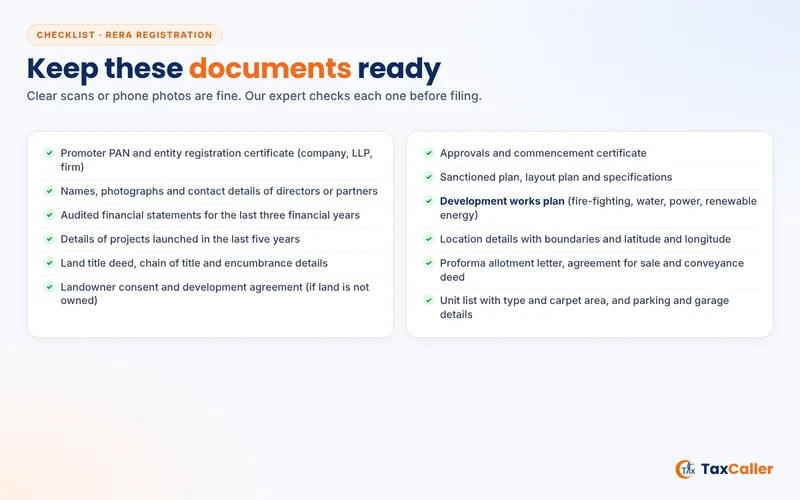
Promoter PAN and entity registration certificate (company, LLP, firm)
Names, photographs and contact details of directors or partners
Audited financial statements for the last three financial years
Details of projects launched in the last five years
Land title deed, chain of title and encumbrance details
Landowner consent and development agreement (if land is not owned)
Approvals and commencement certificate
Sanctioned plan, layout plan and specifications
Development works plan (fire-fighting, water, power, renewable energy)
Location details with boundaries and latitude and longitude
Proforma allotment letter, agreement for sale and conveyance deed
Unit list with type and carpet area, and parking and garage details
Names and addresses of agents, contractors, architect and structural engineer
Separate project bank account details (scheduled bank)
Affidavit or declaration under section 4(2)(l)
For agents: PAN, ID and address proof, business address proof, photographs, firm or company documents, training certificate where required
Why TaxCaller
Real experts, not a call centre
Your work is handled by experienced professionals who explain every step, check your documents and keep you updated.
Registered company
TaxCaller is run by TaxCaller India LLP (LLPIN AAQ-7388), serving clients since 2018.
Fee told upfront
You know the complete fee, our professional fee and the government fee, before any work starts. No hidden charges.
Support after the work
Notices, renewals, returns and compliance reminders: we stay with your business after the registration is done.
Reviewed By
Expert for this topic RERA Registration
Abhinay Rai
Advocate
Abhinay Rai is a Advocate specialising in RERA Registration. The process, documents, timelines and fees on this page are checked against the current rules and government portals, and updated whenever the law, forms or fees change.
RERA registration is the approval from a state Real Estate Regulatory Authority under the RERA Act, 2016. Promoters register each project or phase under section 3 before advertising or selling. Agents register under section 9 before brokering in registered projects. The Authority issues a registration number that must appear in advertisements and deals, plus a login for updates.
Is RERA registration mandatory for all projects?
It is mandatory for projects in a planning area unless section 3(2) exempts them. Exempt cases are land up to 500 sq m or up to eight apartments across all phases, projects with a completion certificate before the Act began, and repair or redevelopment without new sales. States may lower these limits, so check your state's rules.
Who can register in RERA?
Two groups register. Promoters, meaning builders, developers and colonizers, register each project or phase under section 3. Real estate agents, whether an individual, proprietor, firm, LLP or company, register under section 9 if they help sell units in registered projects for a fee. One agent registration covers the whole state, and the number goes on every deal.
How much money is required for RERA registration?
It depends on the state. UP charges ₹10 per sq m for residential projects up to 1,000 sq m and ₹25,000 for an individual agent. Haryana charges ₹5 to ₹20 per sq m by zone and use. MahaRERA charges agents ₹10,000 (individual) or ₹1,00,000 (others). Our professional fee is separate and charged + GST.
How long does RERA registration take?
The Authority must grant or reject a complete project application within 30 days under section 5(1). If it does not decide in time, the project is deemed registered and credentials follow within seven days. Our estimate is one to three weeks to gather documents and certificates before filing, so plan for four to seven weeks overall.
What documents are required for RERA project registration?
You need promoter details and PAN, three years' audited financials, approvals and commencement certificate, sanctioned and layout plans, land title and encumbrance details, landowner consent if any, draft allotment letter, agreement for sale and conveyance deed, unit list with carpet areas, agent and contractor details, and the section 4(2)(l) affidavit.
How can I check if a project is RERA registered?
Open the RERA portal of the state where the project is, such as UP RERA, Delhi RERA, HRERA or MahaRERA. Search registered projects by number, project name or promoter. Check the promoter name, phase, validity date, extensions and latest quarterly update. Every advertisement must show the registration number and the Authority's website under section 11(2).
What is the validity of RERA registration?
A project registration is valid for the completion period the promoter declares in the application, under section 5(3), and can be extended under section 6. Agent registration validity is set by state rules, and Haryana gives five years. Check the validity printed on your certificate. Agents must apply for renewal before expiry, usually three months ahead.
What happens if a builder sells without RERA registration?
Under section 59(1), the Authority can impose a penalty of up to 10% of the estimated project cost. If the builder continues or ignores orders, section 59(2) allows imprisonment up to three years, a further fine up to 10%, or both. Buyers can also complain to the Authority, and agents who sold such units face penalties too.
Can an individual register as a RERA agent?
Yes. Individuals and sole proprietors can register as real estate agents under section 9 and pay the lower individual fee. In UP and Haryana that fee is ₹25,000, and in Maharashtra it is ₹10,000 under Order No. 44/2023. Partnerships, LLPs and companies pay the higher fee for applicants other than individuals.
What is the 70% rule in RERA?
Section 4(2)(l)(D) requires the promoter to deposit 70% of money collected from allottees into a separate scheduled bank account. It can be used only for construction and land cost of that project. Withdrawals must match progress, certified by an engineer, architect and practising chartered accountant, and the account is audited every year.
How do I renew RERA agent registration?
Apply on your state RERA portal before expiry, usually at least three months ahead, with the renewal fee and updated documents. UP charges ₹5,000 for individuals and ₹50,000 for others; Haryana charges the same and uses Form REA-IV. In Maharashtra you also need a valid Certificate of Competency to renew your registration.
How to register in RERA as builder?
Create a promoter account on your state RERA portal, completing the promoter profile first where required, as in UP. Open a separate project bank account. Fill the project form, upload approvals, plans, title papers and the section 4(2)(l) affidavit, and pay the fee online. Reply to deficiency notices; the Authority decides within 30 days.
What are the requirements for UP RERA registration?
For a project, UP RERA needs a registered promoter profile, the project form, approvals, sanctioned plan, title papers, a separate collection account, professional certificates and the fee under Rule 3(3). For an agent, it needs the online form with PAN, Aadhaar, photograph, income tax returns, address proof, bank details and the ₹25,000 or ₹2,50,000 fee.
Do plotted developments need RERA registration?
Yes. The Act's definition of a real estate project in section 2(zn) includes development of land into plots for sale. A plotted colony above 500 sq m, or with more units than the state limit, must register before selling. Haryana charges registration fees on the gross area of a plotted colony under its 2017 Rules.
Register your project or agency with RERA, the right way
Tell us your state, project size or agency type, and our expert will list your documents, state fee and steps on the first call. Our fee starts at ₹4,999 + GST; RERA government fees are paid separately at actual.