Srishti Magoo
Excellent experience with TaxCaller for filing my & my family members ITR returns. The entire process was smooth, quick and hassle-free. They are professional, knowledgeable and guided me through every step with patience.
Business license registration for every kind of business: we find the licences you need and file GST, FSSAI, Udyam, IEC, Shop Act, PF, ESI and DSC online.
Content updated 16 Nov 2026
Get your Business Licences
50+ onlineHow we work
Online · Call · WhatsApp
Quick answer
Business license registration in India means getting each licence your activity, size, staff and state require. There is no single licence. Most businesses need GST and a Shop Act registration, food businesses need FSSAI, importers and exporters need an IEC, and employers add PF and ESI. Licence bundles from TaxCaller start at ₹1,999 + GST; government fees are extra.
A new shop, trader or service business opening in one state
₹1,999 + GST
+ Govt. fees at actual
Fee confirmed in writing before you pay
What you'll get
Most Popular
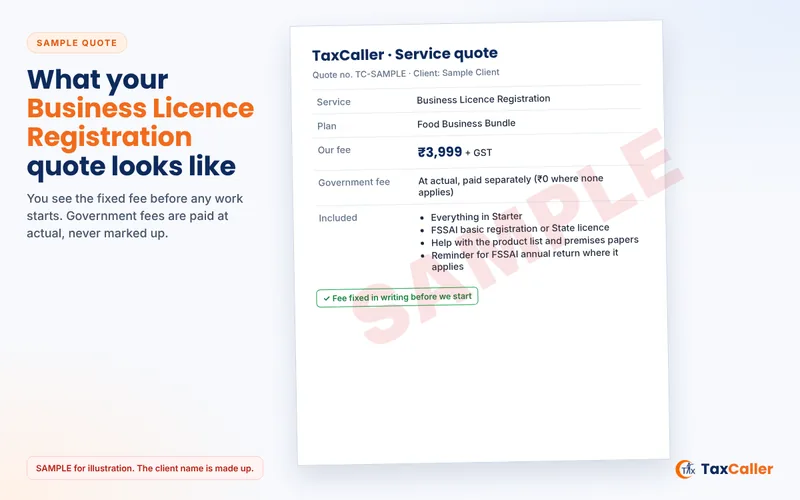
Restaurants, cloud kitchens, food makers and food sellers
₹3,999 + GST
+ Govt. fees at actual
Fee confirmed in writing before you pay
What you'll get
Businesses hiring staff or crossing 10 or 20 employees
₹5,999 + GST
No govt. fee
Fee confirmed in writing before you pay
What you'll get
Government fees and taxes are extra where applicable. Our expert confirms the final amount on the first call. No hidden charges.
All 25 options
Each has its own page with plans, documents, steps and the law it follows. The fee shown is our starting fee; government fees are paid at actual.
From ₹599 + GST
From ₹999 + GST
₹100 a year, paid on FoSCoS
From ₹599 + GST
No government fee
From ₹1,499 + GST
+ DGFT fee ₹500 at actual
From ₹999 + GST
+ Govt. fees at actual
From ₹1,999 + GST
No govt. fee
From ₹1,299 + GST
+ Govt. fees at actual
From ₹499 + GST
+ CA charge and token at actual
From ₹1,999 + GST
No govt. fee
From ₹1,499 + GST
No govt. fee
From ₹2,499 + GST
+ Govt. fees at actual
From ₹3,999 + GST
No govt. fee
From ₹1,999 + GST
No govt. fee
From ₹2,999 + GST
+ Govt. fees at actual
From ₹799 + GST
+ Govt. fees at actual
From ₹6,999 + GST
No govt. fee
From ₹4,999 + GST
+ Govt. fees at actual
From ₹2,999 + GST
+ Govt. fees at actual
From ₹2,999 + GST
+ Govt. fees at actual
From ₹4,999 + GST
+ Govt. fees at actual
From ₹11,999 + GST
+ Govt. fees at actual
From ₹9,999 + GST
+ Govt. fees at actual
From ₹4,999 + GST
+ Govt. fees at actual
From ₹6,999 + GST
+ Govt. fees at actual
From ₹6,999 + GST
+ Govt. fees at actual
Business license registration in India can feel confusing because no single office issues everything. GST comes from the tax department. FSSAI comes from the food regulator. The Shop Act and professional tax come from your state. Your city may add a trade licence. Each has its own trigger, fee and portal.
This page is the map. It explains each registration in a few lines, shows which ones fit your type of business, and lists the government fee for each. Every section links to a full TaxCaller guide. When you are ready, our tax experts file them online in the right order and keep you posted until every certificate is in hand.
Complete guide
Choose a topic to open it. Every answer gives the rule or section it comes from.
01 Topic 1 of 20
Business license registration in India is not one form. It is a set of separate registrations, each run by a different authority. The Centre runs some, like GST, IEC and Udyam. Your state runs others, like the Shop Act and professional tax. Your city may add a trade licence.
Which ones you need depends on four things:
Every licence below has its own TaxCaller page with full detail. This hub gives a short summary of each, so you can see the full picture in one place. If you have not formed your business yet, start with company registration. Most licences ask for the entity's PAN first.
The words overlap. A registration records your business with an authority, as with GST or Udyam. A licence is permission to carry on a regulated activity, such as an FSSAI licence or a drug licence, and can be refused or cancelled. A permit or NOC usually covers one specific thing, such as a fire NOC for a building or a signboard permission. Most businesses need some of each.
| Business structure | Where it is formed |
|---|---|
| Sole proprietorship | No central registration; it runs on the owner's PAN, so GST, Udyam or Shop Act often serve as business proof |
| Partnership firm | Partnership deed, with optional registration at the state Registrar of Firms under the Indian Partnership Act, 1932 |
| LLP | MCA, in Form FiLLiP |
| Private limited, one person or public company | MCA, in the SPICe+ form |
| Section 8 company, trust or society | MCA for Section 8; state registrar for trusts and societies |
| Level | Registrations | Portal or office |
|---|---|---|
| Central | GST, IEC, Udyam, FSSAI (with state officers), Startup India, PF, ESI, DSC (through licensed certifying authorities) | National online portals |
| State | Shop Act, professional tax, FSSAI State licence, pollution consent | State labour, tax and FoSCoS portals |
| Local | Trade licence, health licence, signage permission, fire NOC | Municipal corporation or local body |
02 Topic 2 of 20
Use this table as a first check. Thresholds and state rules decide the final list, so confirm on a call before you apply.
| Business type | Usually needed | Needed only in some cases |
|---|---|---|
| Freelancer or consultant working from home | PAN, bank account, Udyam (optional but useful) | GST above the services threshold; IEC if you export services and claim Foreign Trade Policy benefits; professional tax in some states |
| Retail shop or trader | Shop Act (as per state), GST once over the limit, Udyam | Trade licence from the city; professional tax in states that levy it |
| Restaurant, cloud kitchen or home food seller | FSSAI (basic, State or Central), Shop Act, GST | Trade or health licence, fire NOC, liquor licence, pollution consent |
| Online seller on marketplaces | GST (inter-state sales usually need it from day one), Udyam | FSSAI for food items; IEC for cross-border e-commerce |
| Manufacturer | GST, Udyam, Shop Act or factory licence | Pollution consent, fire NOC, BIS, FSSAI for food, IEC for exports |
| Importer or exporter | IEC, GST, DSC | FSSAI for food imports; LUT for zero-rated exports |
| Tech startup (Pvt Ltd or LLP) | Company or LLP registration, DSC, GST, Startup India recognition | Udyam; IEC if you export and claim Foreign Trade Policy benefits |
| Any business with staff | Shop Act, professional tax (where levied) | ESI from 10 employees; PF from 20 employees |
| Doctor, lawyer or other professional | Professional council registration, professional tax (where levied) | Shop Act for the clinic or office; GST above the threshold |
Rows overlap. A food exporter with 25 staff needs most of the list. That is why we check your case on a free first call before quoting.
Shreya Licence & Registration Expert
Have a question on this topic? Ask Shreya on a free call.
03 Topic 3 of 20
What it is: a 15-character GSTIN that lets you collect GST, claim input tax credit and file returns. You apply online in Form GST REG-01.
Who needs it: a business whose turnover crosses ₹40 lakh for goods or ₹20 lakh for services. Lower limits apply in some states: ₹10 lakh in Manipur, Mizoram, Nagaland and Tripura, and ₹20 lakh for goods in a few others. Section 24 of the CGST Act makes it compulsory, whatever the turnover, for inter-state goods suppliers, casual taxable persons, e-commerce operators and some others.
Government fee: none. The government charges nothing for a GSTIN.
Small businesses can choose the composition scheme under Section 10 of the CGST Act. It is open to most traders and makers up to ₹1.5 crore turnover (₹75 lakh in some special category states) and to service providers up to ₹50 lakh. They pay tax at a fixed low rate but cannot claim input tax credit.
You can also register voluntarily under Section 25(3) to claim input tax credit or to sell to bigger buyers. After registration, regular GST return filing starts.
Full guide: GST registration.
04 Topic 4 of 20
What it is: food safety permission under the Food Safety and Standards Act, 2006. It is issued on the FoSCoS portal in three tiers.
Who needs it: every food business: makers, sellers, restaurants, home kitchens, storage, transport, importers and online food sellers. Since 1 April 2026, basic registration covers turnover up to ₹1.5 crore. A State licence covers above ₹1.5 crore up to ₹50 crore. Above that, or for some activities, the Central licence applies.
Government fee: ₹100 a year for basic registration, a flat ₹5,000 a year for a State licence, and ₹7,500 a year for a Central licence, from 1 April 2026.
New certificates issued from 1 April 2026 no longer carry an end date. They stay valid unless suspended, cancelled or surrendered. Some licence holders must still file an annual return.
Full guide: FSSAI registration.
05 Topic 5 of 20
What it is: a permanent Udyam number and e-certificate for micro, small and medium enterprises, issued on udyamregistration.gov.in using Aadhaar and PAN.
Who needs it: any manufacturer or service business that wants MSME benefits. From 1 April 2025, a micro enterprise has investment up to ₹2.5 crore and turnover up to ₹10 crore. Small goes up to ₹25 crore and ₹100 crore. Medium goes up to ₹125 crore and ₹500 crore. Traders can register too, for priority sector lending.
Government fee: none. Udyam registration is free on the government portal, and it needs no renewal.
The main benefits are protection against late payment under Sections 15 to 18 of the MSMED Act, access to schemes, and preference in public procurement. Details must be updated when your figures change.
Full guide: MSME registration.
Zubair Licence & Registration Expert
Have a question on this topic? Ask Zubair on a free call.
← Previous Next: IEC Registration for Importers and Exporters →
06 Topic 6 of 20
What it is: the 10-character Import Export Code issued by the DGFT. It matches your PAN, but you still apply online in form ANF-2A.
Who needs it: anyone who imports or exports goods. Service exporters need one only to claim benefits under the Foreign Trade Policy. Some categories are exempt under the Handbook of Procedures.
Government fee: ₹500 to DGFT for a new IEC.
The IEC is valid for life if you update it online every year between April and June. If you skip the update, the IEC is deactivated until you update it.
Full guide: IEC registration.
← Previous Next: Shop Act and Professional Tax: Your State Registrations →
07 Topic 7 of 20
These two come from your state, not the Centre. So the rules, fees and forms change from one state to the next.
What it is: the record of your shop, office or other commercial premises under your state's Shops and Establishments Act. Each state writes its own rules.
Who needs it: shops, offices, restaurants, warehouses and most commercial premises, as your state's law decides. Uttar Pradesh now asks for full registration only at 20 or more workers, from 19 November 2025. Maharashtra's limit has changed more than once and is not settled. Smaller units in many states file a simple intimation or are exempt.
Government fee: set by each state's rules and paid at actual.
Validity and renewal also vary, because each state sets its own term. In Maharashtra, the Shop Act certificate is still often called a Gumasta licence. Banks accept this certificate as business proof when a proprietorship opens a current account.
Full guide: Shop Act registration.
What it is: a state registration that lets an employer deduct professional tax from salaries, and lets a business or professional pay its own.
Who needs it: employers and self-employed people in states that levy it, such as Maharashtra, Karnataka, West Bengal and others. Many states, including Uttar Pradesh and Delhi, do not levy it, and Odisha stopped levying it from 1 April 2026. In Maharashtra, employers take PTRC and the business itself takes PTEC.
Government fee: depends on the state. The tax itself is capped at ₹2,500 per person a year by Article 276(2) of the Constitution.
Once registered, you pay and file on the state's schedule, which can be monthly or yearly depending on the state and the amount.
Full guide: professional tax registration.
← Previous Next: Startup India Registration (DPIIT Recognition) →
08 Topic 8 of 20
What it is: recognition as a startup by DPIIT, under notification G.S.R. 108(E) dated 4 February 2026.
Who needs it: a private limited company, LLP, registered partnership firm or cooperative society that is under 10 years old, has never crossed ₹200 crore turnover, and is working on innovation or a scalable model. Deep tech startups get longer limits.
Government fee: none. DPIIT charges no fee for recognition.
Recognition opens the door to the startup tax holiday (section 80-IAC of the 1961 Act, now section 140 of the Income-tax Act, 2025, for eligible companies and LLPs with a separate Inter-Ministerial Board approval), self-certification under some labour and environment laws, expedited patent examination and lower patent and trademark fees.
Full guide: Startup India registration.
Abhinay Rai Licence & Registration Expert
Have a question on this topic? Ask Abhinay on a free call.
09 Topic 9 of 20
What it is: a Class 3 electronic signature on a USB token, issued by a certifying authority licensed by the Controller of Certifying Authorities. Class 2 has not been issued since 1 January 2021.
Who needs it: company directors, LLP partners, companies filing GST and income tax, businesses under tax audit, tender bidders and exporters on DGFT.
Government fee: none. You pay the certifying authority's charge and the token price, which vary by provider and validity of 1 to 3 years.
Apply online with Aadhaar or PAN eKYC and a short video. After 21 September 2026, new certificates go on FIPS 140-3 tokens, as reported.
Full guide: digital signature certificate.
10 Topic 10 of 20
Both are social security registrations triggered by staff numbers. Since 21 November 2025, both sit under the Code on Social Security, 2020.
What it is: the employer's online enrolment with EPFO. You get an establishment code, create UANs for staff and deposit contributions every month.
Who needs it: establishments with 20 or more employees. Smaller employers can join voluntarily. From 17 September 2026, staff earning up to ₹25,000 a month must be enrolled, up from ₹15,000.
Government fee: none for registration. Contributions are 12% from the employee and 12% from the employer, deposited by the 15th of the next month, plus administrative charges.
Full guide: PF registration.
What it is: the employer's registration with ESIC, which gives covered staff medical care and cash benefits.
Who needs it: establishments with 10 or more employees in areas where ESI applies. It covers employees earning up to ₹21,000 a month, and the ministry's March 2026 FAQs, as reported, say that ceiling has not changed.
Government fee: none for registration. The employer pays 3.25% of wages and the employee 0.75%.
Full guide: ESI registration.
11 Topic 11 of 20
A trade licence is permission from your local body to run a particular trade at a particular address. It is issued under your state's municipal law and the city's bye-laws. Its purpose is local: safety, health, zoning and nuisance control.
| Area | Issuing body |
|---|---|
| Large city | Municipal corporation, often through its zonal or health office |
| Smaller town | Municipal council or nagar panchayat |
| Village | Gram panchayat, where the state law gives it this power |
| Cantonment or industrial township | The cantonment board or the township authority |
Each city publishes its own list of trades. Common ones are shops, eateries, salons, gyms, workshops, warehouses, small units and any trade that stores goods that can catch fire or cause harm. Eating places often need a health trade licence from the health department of the same body.
Many cities now take applications online. Others still need a form at the zonal office. An inspector may visit before the licence is issued. The fee is set by each city and depends on the trade, the area of the premises and sometimes the location. There is no single national fee.
Many cities issue the licence for one financial year, and some allow longer terms. Renew before it expires, because late renewal attracts a fine in most cities. If you change the trade name, add a trade or move the premises, apply for an amendment or a fresh licence. When you close or move out, surrender the licence so that dues do not keep building.
A trade licence is usually tied to the holder and the premises. A new owner or a new address normally needs a fresh licence or a transfer under the city's rules. Where the city runs an online system, you can track the application and download the licence from the same portal.
A trade licence is not a condition for GST registration. But a GST officer may still ask for premises proof, and a trade licence can serve as one supporting document.
Shadab Licence & Registration Expert
Have a question on this topic? Ask Shadab on a free call.
12 Topic 12 of 20
Beyond the common registrations, some activities need a sector licence. Some have their own TaxCaller page; for the rest we can tell you on a call whether one applies.
| Licence | Who needs it | Issued by |
|---|---|---|
| Fire NOC | Restaurants, hotels, hospitals, schools, factories and larger buildings | State fire service |
| Pollution consent (to establish and to operate) | Many manufacturing and processing units | State Pollution Control Board, under the Water Act, 1974 and the Air Act, 1981 |
| Factory licence | Manufacturing units above the worker limit set by law | State factories department, now under the Occupational Safety, Health and Working Conditions Code, 2020 |
| Contract labour licence | Contractors where 50 or more contract workers are engaged (see the next section) | Licensing officer of the appropriate government, often the state labour department, under the same Code |
| Drug licence | Chemists, distributors and makers of medicines | State drug controller, under the Drugs and Cosmetics Act, 1940 |
| Liquor licence | Bars, liquor shops and some restaurants | State excise department |
| Legal metrology registration | Packers and importers of pre-packaged goods, and makers or sellers of weights and measures | Legal metrology department of the state, or the central Director for some cases, under the Legal Metrology Act, 2009 |
| BIS certification | Products under compulsory quality control orders, such as many electrical items and toys | Bureau of Indian Standards |
| RERA registration | Real estate projects and agents | State real estate regulatory authority |
| Private security agency licence | Firms that supply security guards | State controlling authority, under the Private Security Agencies (Regulation) Act, 2005 |
| APEDA registration | Exporters of scheduled farm and processed food products | Agricultural and Processed Food Products Export Development Authority |
| Signage permission | Outdoor boards and hoardings, in many cities | Municipal body |
The labour codes took effect on 21 November 2025, so factory and contract labour licences now run under the new Code. States are moving their forms and portals at different speeds, so check your state's current process before you apply.
A trademark is not a licence, but it protects your brand name from copycats. See trademark registration. If a licence on this list applies to you, we tell you which office handles it and what the first step is.
← Previous Next: Contract Labour Licence Under the OSH Code, 2020 →
13 Topic 13 of 20
Where 50 or more contract workers are engaged, the contractor usually needs a contract labour licence. Since 21 November 2025, this licence is issued under the Occupational Safety, Health and Working Conditions Code, 2020 (the OSH Code). Section 143(1)(h) of the Code repealed the Contract Labour (Regulation and Abolition) Act, 1970, so the old Act no longer governs new licences. People often search for it as a contract labour license or labour licence.
Section 45 of the Code applies the contract labour rules to an establishment where 50 or more contract workers worked on any day of the preceding 12 months. It also applies to a manpower supply contractor who employed 50 or more contract workers on any such day. Work that is only intermittent or casual is outside it. Work done for more than 120 days in the preceding 12 months, or seasonal work running more than 60 days a year, does not count as intermittent.
| Point | OSH Code rule |
|---|---|
| Who applies | The contractor (Section 47) |
| What the licence states | The number of contract workers allowed and the security deposit |
| Validity | Five years (Section 48(3)); more workers need an amendment and extra security |
| How it is issued | Electronically or otherwise, under Section 119, either alone or as a common licence with a factory licence |
| Time limit | 45 days; after that the licence is treated as issued and auto-generated (Section 119(4)) |
| Old licences | A licence taken under the 1970 Act stays valid for its original term, then must be taken afresh under the Code (Section 119(5)) |
There is no separate principal employer registration any more. The establishment takes one electronic registration under Section 3 of the Code, and existing registrations under the old laws are treated as registrations under it. The principal employer still carries real duties:
Where the Central Government is the appropriate government, you apply on the Shram Suvidha portal under the OSH (Central) Rules, 2026, notified on 8 May 2026. Those rules, as reported, ask for Form XXI, a security of ₹1,000 per contract worker and a fee from ₹1,000 for 50 to 100 workers, rising with headcount. As reported, they also offer a single licence for work in more than one state or across India. Most private businesses fall under their state instead. In Ghaziabad and the rest of Uttar Pradesh, the state's OSH Rules were reported as notified on 27 August 2026. State fees and forms differ, so check your state's rules before you apply. The Code's text is on India Code.
Unless the Code sets a specific penalty, Section 94 applies: ₹2 lakh to ₹3 lakh, and up to ₹2,000 a day if the breach continues after conviction. A manufacturer that uses contract workers can ask for one common licence covering the factory licence and contract labour. A trade licence from your city does not replace this licence, and contract workers still need PF and ESI cover where those laws apply.
← Previous Next: Documents Required for Business License Registration →
14 Topic 14 of 20

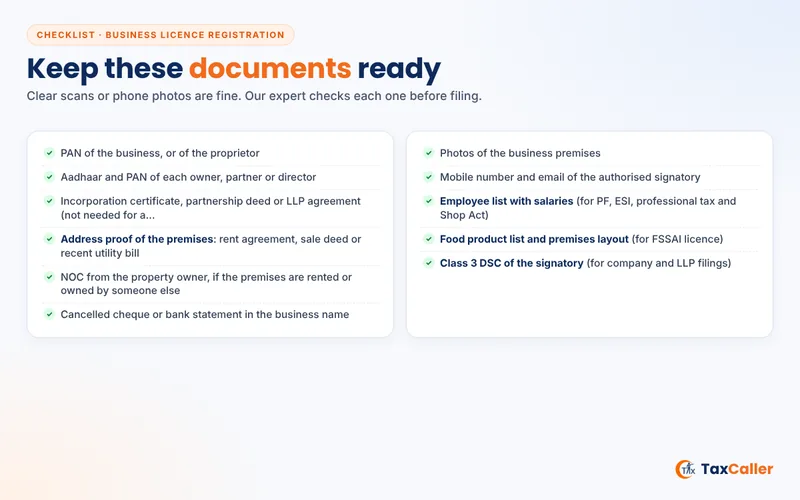
Most applications ask for the same core papers. Keep scanned copies ready in one folder.
| Document | Asked for in |
|---|---|
| PAN of the business or proprietor | Almost all |
| Aadhaar and PAN of owners, partners or directors | GST, Udyam, FSSAI, IEC, DSC, PF, ESI |
| Incorporation certificate, partnership deed or LLP agreement | GST, IEC, Startup India, PF, ESI |
| Address proof of premises (rent agreement, sale deed or utility bill) with owner's NOC | GST, FSSAI, IEC, Shop Act, trade licence |
| Cancelled cheque or bank statement | GST, IEC, PF, ESI |
| Photo of the business premises | GST, Shop Act, FSSAI in some cases |
| List of food products and kitchen or plant layout | FSSAI State and Central licence |
| Employee list with salaries | PF, ESI, professional tax, Shop Act |
| Short write-up on your innovation | Startup India |
| Class 3 DSC of the signatory | Company and LLP filings, GST for companies, some DGFT and EPFO tasks |
Your name must match across PAN, Aadhaar and bank records. A mismatch is the most common reason for queries.
Shreya Licence & Registration Expert
Have a question on this topic? Ask Shreya on a free call.
← Previous Next: Business License Registration Process with TaxCaller →
15 Topic 15 of 20

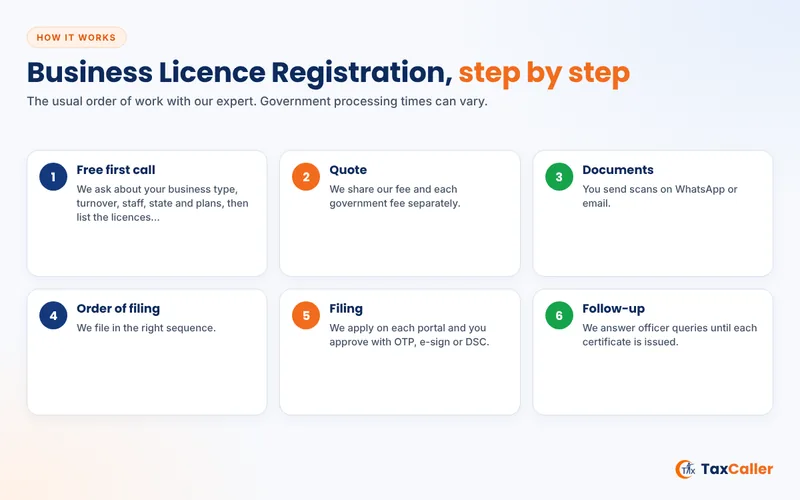
GST, FSSAI, Udyam, IEC, Startup India, PF, ESI and DSC are fully online. Many states now run the Shop Act and professional tax online too. The National Single Window System lets you find the central and state approvals that apply to your project in one place, and its Know Your Approvals tool asks a few questions about your project to list them. Many states run their own single-window portals, such as Nivesh Mitra in Uttar Pradesh. Each approval is still a separate application, and the portal has an applicant dashboard to track the ones made through it. Some trade licences, fire NOCs and inspections still need a visit, and we tell you in advance where one is needed.
| Licence | Usual time with clean documents |
|---|---|
| Udyam | Same day |
| DSC | Same day to 1 working day, plus token courier if needed |
| IEC | 1 to 3 working days |
| GST | About 7 working days, longer if an officer raises a query or asks for verification |
| FSSAI basic registration | About 7 to 15 days |
| FSSAI State or Central licence | About 30 to 60 days, longer with an inspection |
| Shop Act and professional tax | Varies by state, from same day to a few weeks |
| PF and ESI | Usually a few working days |
| Startup India | Often 2 to 4 weeks for DPIIT review |
These are typical ranges, not official deadlines. Officer queries and state systems can add time.
← Previous Next: Business License Registration Fees: Government Fee vs TaxCaller's Fee →
16 Topic 16 of 20

Every licence has two costs. The government fee goes to the department. TaxCaller's professional fee pays for our work. We always show them apart.
| Registration | Starting TaxCaller fee | Government fee, paid separately | Validity or renewal |
|---|---|---|---|
| GST registration | ₹799 + GST | Nil | Valid until cancelled; returns every month or quarter |
| FSSAI registration | ₹999 + GST | ₹100 a year (basic), ₹5,000 a year (State), ₹7,500 a year (Central) | New certificates from 1 April 2026 have no end date; annual return where required |
| MSME registration (Udyam) | ₹599 + GST | Nil | Permanent; update details when they change |
| IEC registration | ₹1,499 + GST | ₹500 | For life, with a yearly update in April to June |
| Shop Act registration | ₹999 + GST | As per state | As per state rules |
| Startup India registration | ₹1,999 + GST | Nil | Until 10 years from incorporation or the turnover limit |
| Professional tax registration | ₹1,299 + GST | As per state | Ongoing; tax capped at ₹2,500 a person a year |
| Digital signature certificate | ₹499 + GST | No government fee; certifying authority charge and token at actual | 1, 2 or 3 years; then a fresh application |
| PF registration | ₹1,999 + GST | Nil | Ongoing; monthly contributions and returns |
| ESI registration | ₹1,499 + GST | Nil | Ongoing; monthly contributions |
The TaxCaller fee shown is the starting price for each service. Each service page lists its plans and what they include. Government fees are paid directly to the department at actual and are never part of our fee.
Ask for a combined quote on a free first call.
← Previous Next: Licence Numbers: How to Read, Verify and Display Them →
17 Topic 17 of 20
Every registration gives you a number. Buyers, banks and marketplaces use these numbers to check that you are genuine. You can also use them to check a supplier before you deal with one.
| Registration | What the number looks like | Where anyone can verify it |
|---|---|---|
| GST | 15 characters: 2-digit state code, the 10-character PAN, an entity number, the letter Z and a check digit | Search Taxpayer on the GST portal |
| FSSAI | 14-digit licence or registration number | Food business operator search on FoSCoS |
| Udyam | UDYAM, then the state code, district code and a 7-digit serial | Verify Udyam option on the Udyam portal |
| IEC | 10 characters, the same as the PAN of the business | IEC view on the DGFT website |
| PF | Establishment code allotted by EPFO | Establishment search on the EPFO website |
| Shop Act and trade licence | Format set by the state or city | The state or city portal, where it offers a search |
Keep one sheet with every number, its issue date and its login. We give you this sheet at handover.
Zubair Licence & Registration Expert
Have a question on this topic? Ask Zubair on a free call.
← Previous Next: Penalties for Running Without the Right Licence →
18 Topic 18 of 20
| Missing registration | Law | What can happen |
|---|---|---|
| GST, when liable | Section 122, CGST Act | Penalty of ₹10,000 or the tax evaded, whichever is higher, plus tax and interest |
| FSSAI licence | Section 63, Food Safety and Standards Act, 2006 | Jail up to six months and a fine up to ₹5 lakh |
| IEC | Section 11, Foreign Trade (Development and Regulation) Act, 1992 | Penalty decided by the adjudicating authority; goods may be held at customs |
| Shop Act | State Shops and Establishments Act | Fines as per state law, higher for repeat defaults |
| Professional tax | State professional tax law | Interest and penalty as per state law |
| PF and ESI | Code on Social Security, 2020 | Interest, damages and prosecution for unpaid contributions |
| DSC obtained with false details | Section 71, IT Act, 2000 | Criminal offence, jail, fine or both |
Penalties grow with time. Interest runs from the date tax or contributions fell due, and late registration often means paying old dues in one go. Registering on time is almost always cheaper than fixing a default later.
Udyam and Startup India have no penalty for not registering. You simply miss the benefits. Beyond penalties, a missing licence can freeze your marketplace account, block a bank loan or delay a shipment.
← Previous Next: What Changed in 2026 for Business Licences →
19 Topic 19 of 20
← Previous Next: Why TaxCaller, and What Comes After Licensing →
20 Topic 20 of 20
State rules change the list. A business in Ghaziabad or Noida falls under Uttar Pradesh law, which does not levy professional tax and now asks for Shop Act registration only at 20 or more workers. Delhi also has no professional tax, but it has its own Shops and Establishments Act. Cross into Haryana or Maharashtra and the rules change again. If you open a branch in a new state, you need fresh GST, Shop Act and professional tax checks for that state. We do these checks state by state and file online wherever the state allows it.
Abhinay Rai Licence & Registration Expert
Have a question on this topic? Ask Abhinay on a free call.
Don't have everything? Send what you have on WhatsApp. Our expert will tell you what's missing.
Send documents on WhatsAppReal experts, not a call centre
Your work is handled by experienced professionals who explain every step, check your documents and keep you updated.
Registered company
TaxCaller is run by TaxCaller India LLP (LLPIN AAQ-7388), serving clients since 2018.
Fee told upfront
You know the complete fee, our professional fee and the government fee, before any work starts. No hidden charges.
Support after the work
Notices, renewals, returns and compliance reminders: we stay with your business after the registration is done.
Expert for this topic Business Licence Registration
Abhinay Rai
Advocate
Abhinay Rai is a Advocate specialising in Business Licence Registration. The process, documents, timelines and fees on this page are checked against the current rules and government portals, and updated whenever the law, forms or fees change.
It is the set of registrations a business needs to operate legally in India. There is no single business licence. Depending on your activity, size, staff and state, you may need GST, FSSAI, Udyam, IEC, Shop Act, professional tax, PF, ESI and a DSC. Central, state and municipal authorities each issue their own.
No single list fits everyone. Most small shops need Shop Act registration under state law and GST once turnover crosses the limit. Food businesses must have FSSAI before they start. Udyam is optional but useful. Importers and exporters need an IEC. Employers add professional tax, ESI and PF as staff numbers grow.
No. India has no single all-purpose business licence. Each law has its own separate registration, such as GST under the CGST Act or FSSAI under the Food Safety and Standards Act. Some states run single-window portals that let you apply for several state approvals together, but each approval is still separate.
Government fees vary widely. GST, Udyam, Startup India, PF and ESI registrations have no government fee. FSSAI costs ₹100 to ₹7,500 a year, and an IEC costs ₹500. Shop Act fees depend on the state. TaxCaller's fee is separate, starting at ₹599 + GST for Udyam and ₹799 + GST for GST registration.
Often, yes. The Shop Act registration comes from the state labour department and covers working conditions. A trade licence comes from the municipal body and permits a trade within city limits. They serve different purposes, so many city businesses need both. Rules vary by state and city, so check locally.
It depends on what you do. A freelancer may need only PAN, a bank account and GST above the threshold. A home kitchen selling food must have FSSAI registration. Some states also expect a Shop Act intimation for a home office. Udyam registration is optional and gives MSME benefits even to a small home business.
Most marketplace sellers need GST registration, because selling goods across states usually needs it from the first sale. Food sellers need FSSAI. Udyam helps with MSME benefits. If you ship abroad, you also need an IEC. Marketplaces usually ask for your GSTIN and bank details before your seller account goes live.
Usually, yes. GST needs a separate registration in each state where you have a place of business. Shop Act and professional tax follow state law, so each state needs its own. FSSAI is issued per premises. IEC and Udyam are national registrations and cover all your branches under one PAN.
No. The GST law does not ask for a trade licence before registration. You need PAN, identity and address proof of the owners, and proof of the business premises. A trade licence can be shown as extra support for the premises. Your city may still require one to run the trade, so get it separately where it applies.
Simple registrations like Udyam come the same day, and an IEC often within 1 to 3 working days. GST usually takes about a week. An FSSAI State or Central licence can take 30 to 60 days. Shop Act timelines depend on the state. Queries from officers add time to any of these.
ESI applies once you have 10 or more employees in an area where it is notified, for staff earning up to ₹21,000 a month. PF becomes compulsory at 20 or more employees, though smaller employers can join voluntarily. Neither registration has a government fee, but monthly contributions start from the first wage month.
Penalties depend on the law. Not registering for GST when liable attracts a penalty under Section 122 of the CGST Act. Running a food business without an FSSAI licence can lead to jail and fine under Section 63. Missing licences can also block bank loans, freeze marketplace accounts and hold shipments at customs.
No. Udyam registration is voluntary. But it is free on the official portal and gives useful benefits, such as protection against delayed payments from buyers, access to government schemes and procurement preferences. It is permanent once issued. Many banks and buyers now ask for the Udyam number before giving credit or orders.
Some do and some do not. GST, Udyam and a new FSSAI certificate from April 2026 stay valid without renewal. The IEC needs a yearly online update. A DSC lasts 1 to 3 years. Shop Act renewal depends on the state. PF, ESI and professional tax bring monthly or yearly filings.
Yes, once it sets up an Indian entity, such as a subsidiary company, or registers a branch or liaison office. The Indian entity then applies for GST, IEC and other licences like any domestic business. Directors without an Indian ID can get a DSC with a passport. Foreign investment rules apply separately.
Book a free first call to find out which licences your business needs. Bundles start at ₹1,999 + GST, and government fees are paid separately at actual.
Mon–Fri 9:00 AM – 6:00 PM, Sat 10:00 AM – 4:00 PM · Your trust is our biggest fee.