Starting from · ₹999 INC-20A Filing INC-20A On-Time Filing plan
STARTING FROM₹999
FEE TOLD UPFRONTFree first call
!GSTR-3B due?Last date 20 Nov 2026 · 3 days left
Since 2018Trusted Experience
980+Experts Connected
220+Cities Served
1164+Agents Available
12000+Founders Trusted
S
Srishti Magoo
★★★★★
Excellent experience with TaxCaller for filing my &
my family members ITR returns. The entire process was
smooth, quick and hassle-free. They are professional,
knowledgeable and guided me through every step with patience.
O
obeid sait
★★★★★
The team has handled my taxes for the past three years,
and it's been a wonderful, hassle-free experience.
Thank you for your consistently quick and efficient service.
P
Pushkar
★★★★★
They are among the best in their field. Their work culture
is highly professional, and their client service is smooth
and reliable. They can confidently be relied on to get the job done.
P
Prasad Sheth
★★★★★
Excellent experience with TaxCaller! The ITR filing
process was smooth, quick, and completely hassle-free.
The CA was knowledgeable, responsive, and explained everything clearly.
A
Apoorv Bansal
★★★★★
Excellent service for ITR filing. The team was highly
professional, responsive, and guided me through the entire
process smoothly. My return was filed accurately and on time.
A
Abhishek Kumar
★★★★★
I was searching for a good CA firm in Ghaziabad and found
TaxCaller. The experience was excellent from start to finish.
The team is responsive, transparent, and genuinely helpful.
U
uma pandey
★★★★★
Great service! TaxCaller India made the entire ITR filing
process quick, smooth, and hassle-free. They answered all
my queries patiently and ensured maximum accuracy.
T
tanu mittal
★★★★★
Excellent job! We've been connected for many years,
and your success truly makes me happy. You are an
incredibly intelligent person. Keep shining, keep growing.
B
Bhanu Pratap Maurya
★★★★★
I am filing my ITR since past 3 years with Abhinav and
Firm is known as TaxCaller and they are professional
interms of ITR rules. They will explain and tell you all
the information.
A
ashish Sharma
★★★★★
I am providing my honest reviews:
No.1 service ...
A
AARYAN GROUP
★★★★★
Honestly, finding a good CA firm in Ghaziabad was
confusing, but TaxCaller India made it simple.
I contacted them for GST work and the experience was smooth.
N
News Speaks
★★★★★
If you're looking for a reliable CA firm in Ghaziabad,
TaxCaller India is a great choice. They provide complete
taxation and compliance solutions including GST.
A
Anshul Chaprana
★★★★★
Got my GST registration done through TaxCaller CA firm.
Process was quite smooth, they guided properly on documents
and didn't waste time. Overall good experience.
How we work
Online · Call · WhatsApp
Quick answer
INC 20A is the form in which a new company with share capital declares, within 180 days of incorporation, that its subscribers have paid for their shares. Until it is filed, Section 10A bars the company from doing business or borrowing. Missing it costs the company ₹50,000, plus ₹1,000 a day for each officer in default, up to ₹1 lakh.
Reviewed by Abhinay Rai · Updated 15 Nov 2026
Pick a plan that fits
INC-20A On-Time Filing
New companies still within 180 days of incorporation
Reply drafted to the ROC show cause or strike-off notice within the 30 days allowed
GNL-1 adjudication application prepared, if chosen
Section 446B small company check for the half-penalty ceiling
Document set showing a working office and real business
Government fees and taxes are extra where applicable. Our expert confirms the final amount on the first call. No hidden charges.
About INC 20A Filing
INC 20A is the declaration for commencement of business that every new company with share capital must file with the Registrar of Companies. It confirms that the people who signed the memorandum have actually paid for their shares, and that the registered office is verified. Until it is filed, the company cannot legally start business or borrow money.
The deadline is short and easy to miss: 180 days from the date of incorporation. Many founders only learn about it when a penalty notice arrives. The penalty is ₹50,000 for the company, plus ₹1,000 a day, up to ₹1 lakh, for each officer in default. The ROC can also start action to strike off the company.
TaxCaller has handled registrations and compliance work since 2018, from our office in Ghaziabad and online across India. This page covers the law, who must file, documents, the MCA V3 process, fees, penalties, strike-off risk, late filing and the 2025 and 2026 changes, in plain words.
Complete guide
Choose a topic to open it. Every answer gives the rule or section it comes from.
01 Topic 1 of 20
What Is INC 20A? The Declaration for Commencement of Business
INC 20A is the e-form in which a new company tells the Registrar of Companies (ROC) that its subscribers have paid for their shares. Its official name is "Declaration for commencement of business". A director files it on the MCA21 V3 portal, and a practising professional certifies it.
The form exists because of Section 10A of the Companies Act, 2013. That section says a company with share capital cannot start business or borrow money until this declaration is filed. So the form is the last legal step between a fresh Certificate of Incorporation and your first invoice or loan.
In plain words, the form answers three questions for the ROC:
Has every subscriber to the memorandum paid the money for the shares they agreed to take?
Has the company verified its registered office address?
If the business needs a regulator's approval, such as from the Reserve Bank of India (RBI), has it been obtained?
It is a one-time filing. You file it once in the life of the company, not every year. Once it is on record, the company is free to trade and borrow, subject to its other licences.
INC-20A rests on Section 10A of the Companies Act, 2013 and Rule 23A of the Companies (Incorporation) Rules, 2014. Here is what each part says.
Provision
What it says
Section 10A(1)(a)
A director must file a declaration within 180 days of incorporation that every subscriber has paid the value of the shares agreed to be taken.
Section 10A(1)(b)
The company must have filed verification of its registered office under Section 12(2).
Section 10A(2)
Default costs the company ₹50,000. Each officer in default pays ₹1,000 a day, up to ₹1 lakh.
Section 10A(3)
If no declaration is filed in 180 days and the ROC believes the company is not doing business, the ROC may start strike-off action under Chapter XVIII.
Rule 23A
The declaration is made in Form INC-20A, with the fee in the Companies (Registration Offices and Fees) Rules, 2014. A Company Secretary, Chartered Accountant or Cost Accountant in practice verifies it. Approval from a sectoral regulator, where needed, is attached.
A short history
The 2013 Act first had a similar rule in Section 11, with Form INC-21. The Companies (Amendment) Act, 2015 omitted Section 11 from 29 May 2015. For about three years, new companies did not need any commencement declaration.
The rule came back through the Companies (Amendment) Ordinance, 2018. The Companies (Amendment) Act, 2019 (Act 22 of 2019) then inserted Section 10A with effect from 2 November 2018. Rule 23A was added by the Companies (Incorporation) Fourth Amendment Rules, 2018 (G.S.R. 1219(E), 18 December 2018). You can read the current text of the Act in the Companies Act, 2013 on India Code.
Zubair Compliance Expert
Have a question on this topic? Ask Zubair on a free call.
Every company that has share capital and was incorporated on or after 2 November 2018 must file INC-20A. The type of company does not matter. Use this table to check your case.
Your entity
INC-20A needed?
Why
Private limited company incorporated on or after 2 November 2018
Yes
Has share capital; Section 10A applies
One Person Company (OPC)
Yes
Has share capital, even with one member
Public limited company
Yes
Has share capital
Section 8 company with share capital
Yes
The section does not exempt non-profits that issue shares
Section 8 company without share capital
No
Section 10A covers only companies having a share capital
Any company incorporated before 2 November 2018
No
Section 10A applies only to companies formed after it came into force
Limited Liability Partnership (LLP)
No
LLPs fall under the LLP Act, 2008, not the Companies Act
Partnership firm or proprietorship
No
Not a company
Small companies and startups get no exemption from filing. They only get a lower penalty ceiling if they default, as explained under penalties below.
If you are still choosing a structure, our company registration guide compares the options. An LLP has no INC-20A, but it has its own yearly forms.
What You Must Show: Subscription Money and Registered Office
You must show two things before filing: the subscribers' money has reached the company's bank account, and the registered office is verified.
1. Subscription money received
The subscribers are the people or companies who signed the memorandum (e-MoA, Form INC-33) at incorporation. Each one agreed to take a number of shares. Before INC-20A, each subscriber must pay the full value of those shares to the company.
Open a current account in the company's name. Banks can open it soon after the Certificate of Incorporation.
Each subscriber pays from their own bank account to the company's account.
Keep the bank statement that shows every credit with the payer's name.
The amount must match the shares in the memorandum. For example, 10,000 shares of ₹10 each means ₹1,00,000.
The V3 form asks for each subscriber's name, the amount paid, the bank and the date of receipt. Cash makes this hard to prove, so pay through the bank. A foreign subscriber pays through normal banking channels, and the company then reports the share issue to the RBI under the foreign exchange rules.
2. Registered office verified
Section 12(1) says a company must have a registered office within 30 days of incorporation. Section 12(2) says it must give the ROC verification of that office within the same 30 days. Most companies give the address in SPICe+ (INC-32) at incorporation, which covers this step. If you did not, Form INC-22 must be filed first.
The INC-20A form also asks for photographs of the registered office. Practice notes on the V3 form describe one photo of the outside of the building and one of the inside, with at least one director or key managerial person present.
3. Regulator approval, if your business needs one
Under the proviso to Rule 23A, a company whose objects need registration or approval from a sectoral regulator must attach it. Examples are RBI registration for a non-banking finance company, or SEBI registration for a regulated market business. Plan this early, because such approvals take time.
INC 20A Due Date: 180 Days From Incorporation, With a Worked Example
The INC 20A due date is 180 days from the date of incorporation shown on your Certificate of Incorporation. It is not linked to the financial year or the AGM.
Worked example: counting the 180 days
Take a sample company, Sunrise Tech Private Limited, incorporated on 12 January 2026. It has authorised capital of ₹10 lakh and two directors.
180 days after 12 January 2026 is 11 July 2026. That is the outer limit.
We would file in May or June 2026, well before the limit, to leave time for bank or portal delays.
If the company files on 5 September 2026, it is 56 days late. Both the extra MCA fee and the penalty apply, as shown in the fee and penalty sections below.
Your first year after incorporation
When
What happens
Law
Day 0
Certificate of Incorporation issued with CIN, PAN and TAN
Section 7
Within 30 days
Registered office in place and verified (INC-22 if not done in SPICe+)
Until INC-20A is filed, a company with share capital cannot commence any business or exercise any borrowing powers. Those are the exact two limits in Section 10A(1).
In practice, this affects you in several ways:
No trading: you should not sell goods or services, sign customer contracts or raise invoices in the company's name.
No borrowing: the company cannot take a bank loan, an overdraft or a loan from a director or anyone else.
Lender checks: banks and investors often check the MCA records for the INC-20A filing before they lend or invest.
Penalty build-up: each day past the 180th day adds to the officers' penalty.
Some steps are part of getting ready to file, not business. These include opening the bank account, receiving the subscription money and getting the office ready. Ask us if you are unsure whether a step counts as business.
Professionals also report that the MCA portal may not accept some later company forms while INC-20A is pending. The safest course is simple: file INC-20A first, then start trading.
Professional Certification: CA, CS or Cost Accountant in Practice
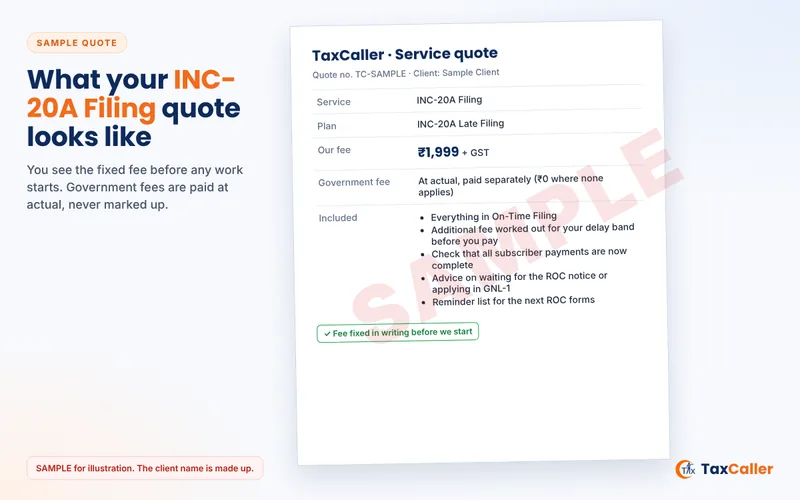
INC-20A Filing: SAMPLE quote, for illustration only
Rule 23A requires a Company Secretary, Chartered Accountant or Cost Accountant in practice to verify the contents of INC-20A. "In practice" means the professional holds a certificate of practice from their institute. An employee of the company cannot certify it.
The certifying professional checks, at the least:
That the subscription money for each subscriber appears in the company's bank statement.
That the amounts match the memorandum.
That the registered office verification has been filed.
That any regulator approval named in the form is attached.
That the attachments are complete and readable.
The professional then signs with their own DSC and gives their membership number and certificate of practice number. A false certificate exposes the professional to action by their institute and under the Act. So a careful certifier will ask for the actual bank statement, not just a summary.
TaxCaller coordinates this step with an independent practising professional. You do not need to find one yourself.
We prepare the form, get it certified and file it on the MCA21 V3 portal. You approve each step and pay the MCA fee directly.
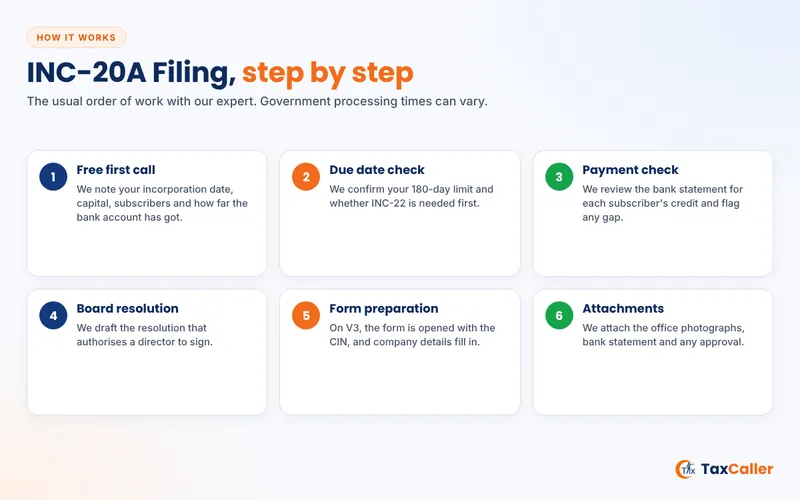
Free first call: we note your incorporation date, capital, subscribers and how far the bank account has got.
Due date check: we confirm your 180-day limit and whether INC-22 is needed first.
Payment check: we review the bank statement for each subscriber's credit and flag any gap.
Board resolution: we draft the resolution that authorises a director to sign.
Form preparation: on V3, the form is opened with the CIN, and company details fill in. We enter subscriber payments, bank details and the regulator question.
Attachments: we attach the office photographs, bank statement and any approval.
Signatures: the director signs with a DSC linked to their V3 login. The practising professional certifies and signs.
Fee payment: the MCA fee is paid online on the portal, and an SRN (service request number) is generated.
Tracking: we track the SRN until the form is taken on record.
Handover: you get the filed form, the payment challan and the approval mail.
You can check your company's filing status on the MCA portal at any time with your CIN. Our TaxCaller tools page has calculators for other due dates.
INC-20A form download: on MCA V3 the form is a web form filled online after logging in, so there is no offline form to download, fill and upload. The instruction kit on the MCA site is only a guide to the fields.
INC-20A is usually quick once the money is in the bank. These are typical ranges, not official deadlines.
Stage
Usual time
Opening the company's current account
Depends on the bank; often a few days to two weeks
Subscribers transferring their money
Same day to a few days
Our preparation, from complete documents to filing
About two working days
Professional certification
Usually within our preparation time
MCA processing after payment
Often a few working days, but the ROC can take longer if it examines the form
The biggest delay is almost always the bank account. Start the account opening as soon as you receive the Certificate of Incorporation. Also check early that each director's DSC works with the V3 login.
Shreya Compliance Expert
Have a question on this topic? Ask Shreya on a free call.
INC 20A Fees: Government Fee and Our Fee, Clarified
INC-20A has two separate costs: the MCA filing fee, set by law, and TaxCaller's professional fee. We keep them apart so you see each one.
The MCA filing fee
The fee comes from the Companies (Registration Offices and Fees) Rules, 2014. It depends on the company's nominal (authorised) share capital.
Nominal share capital
MCA fee
Less than ₹1,00,000
₹200
₹1,00,000 to ₹4,99,999
₹300
₹5,00,000 to ₹24,99,999
₹400
₹25,00,000 to ₹99,99,999
₹500
₹1 crore or more
₹600
Additional fee for late filing
If you file after 180 days, an additional fee is added to the normal fee. The multiples below come from the Companies (Registration Offices and Fees) Amendment Rules, 2022 (G.S.R. 12(E), 11 January 2022), in force from 1 July 2022.
Delay after the due date
Additional fee
Up to 30 days
2 times the normal fee
31 to 60 days
4 times the normal fee
61 to 90 days
6 times the normal fee
91 to 180 days
10 times the normal fee
More than 180 days
12 times the normal fee
In our example, Sunrise Tech has ₹10 lakh capital, so the normal fee is ₹400. Filing 56 days late adds 4 x ₹400 = ₹1,600. The total MCA fee becomes ₹2,000. This fee is separate from the penalty under Section 10A(2).
TaxCaller's fee
TaxCaller's fee for INC-20A filing starts at ₹999 + GST. The final fee depends on the plan and on whether the filing is late. We confirm it in writing on the first call.
Item
Paid to
Amount
Due date check, document review, form preparation, filing and tracking
TaxCaller
From ₹999 + GST
INC-20A filing fee
MCA (government fee)
₹200 to ₹600, at actual
Additional fee, if late
MCA (government fee)
2 to 12 times the normal fee, at actual
Penalty, if the ROC imposes one
Government, through the ROC order
As per the order
DSC renewal, if needed
Certifying authority
As quoted separately
Government fees and penalties are never part of our invoice. You pay them directly on the MCA portal or as the ROC order says.
INC 20A late fee: the late fee is the "additional fee" in the table above. It is a multiple of the normal fee and grows with the delay, so a filing a few days late costs far less than one filed months later.
Penalty for Not Filing INC-20A Under Section 10A(2)
If a company does not file INC-20A in time, Section 10A(2) makes the company pay ₹50,000. Every officer in default pays ₹1,000 for each day the default continues, up to ₹1 lakh each.
Who
Penalty
Section
Company
₹50,000
Section 10A(2)
Each officer in default (usually the directors)
₹1,000 a day, up to ₹1,00,000
Section 10A(2)
Small company, OPC, recognised start-up company or producer company
Not more than half of the above, up to ₹2 lakh for the company and ₹1 lakh for an officer
Section 446B
Worked example: fee and penalty for a late filing
Sunrise Tech files 56 days late. It has two directors.
Company: ₹50,000.
Each director: 56 days x ₹1,000 = ₹56,000. For two directors, ₹1,12,000.
Total exposure: ₹1,62,000, on top of the ₹2,000 MCA fee.
If Sunrise Tech is a small company, Section 446B caps the penalty at half: up to ₹25,000 for the company and ₹28,000 for each director.
How the penalty is imposed
The penalty is not charged automatically on the portal. The ROC, acting as adjudicating officer under Section 454, issues a notice and gives a hearing before passing an order. A company can also apply on its own in Form GNL-1 for adjudication of the default. An appeal against the order lies with the Regional Director within 60 days. Reported orders show that ROCs check small company status before applying Section 446B, so keep your capital and turnover figures ready.
A small company has paid-up capital up to ₹10 crore and turnover up to ₹100 crore, under G.S.R. 880(E) of 1 December 2025. Holding, subsidiary and Section 8 companies cannot be small companies.
Strike-Off Risk: Section 10A(3), Section 248 and Physical Verification
A missing INC-20A can lead to the company's name being removed from the register. Two provisions work together here.
Section 10A(3) and Section 248(1)(d)
If no declaration is filed within 180 days, and the ROC has reasonable cause to believe the company is not carrying on business, the ROC may start strike-off action. This is separate from the money penalty. Section 248(1)(d) lists it as a ground for removal: the subscribers have not paid their subscription, and the declaration under Section 10A(1) was not filed within 180 days.
Section 248(1)(a) adds another ground: the company has not started business within one year of incorporation.
Section 12(9): physical verification of the office
If the ROC believes a company is not doing business, Section 12(9) lets the ROC physically verify the registered office. Rule 25B of the Incorporation Rules, inserted in August 2022, sets the manner. The ROC visits with two independent local witnesses, takes photographs and prepares a report. If the office cannot receive and acknowledge communications, the ROC can start removal action.
The notice and your reply
Before striking off, the ROC sends a notice to the company and all directors. You get 30 days from the date of the notice to reply with documents. A good reply shows the subscription money received, the INC-20A now filed, and proof that the office and business are real.
If the name is struck off, the company is dissolved. Restoring it means an appeal to the National Company Law Tribunal (NCLT) under Section 252, which is slow and costly. A timely INC-20A avoids all of this.
Zubair Compliance Expert
Have a question on this topic? Ask Zubair on a free call.
You can still file INC-20A after 180 days. The form stays open, but the additional fee applies and the penalty exposure grows each day.
Collect the money first: make sure every subscriber has now paid in full through the bank.
Check INC-22: confirm the registered office verification is on record.
Work out the fee: we calculate the normal fee plus the additional fee for your delay band.
File the form: we prepare, certify and file it the same way as an on-time filing.
Deal with the penalty: either wait for the ROC's notice and reply, or apply in GNL-1 for adjudication. We help you weigh the two.
Answer any strike-off notice: if a notice has already come, we draft the reply within the 30 days allowed.
The Companies Compliance Facilitation Scheme, 2026 (General Circular 01/2026) offered reduced additional fees for some annual forms. INC-20A was not in its list of forms, and the scheme closed on 15 September 2026. So there is no fee waiver for a late INC-20A today.
If the subscribers never paid and the company never started, a voluntary strike-off under Section 248(2) may suit you better. Our annual compliance guide explains closure and catch-up options.
INC-20A vs INC-22, INC-22A ACTIVE and Other Early Forms
INC-20A is often confused with other forms that new companies hear about. This table shows how they differ.
Form
Purpose
Who files and when
INC-20A
Declaration that subscribers have paid; needed to start business
Companies with share capital incorporated on or after 2 November 2018, within 180 days
INC-22
Notice of the registered office or a change in it
Within 30 days of incorporation if the office was not given in SPICe+, and later on any change
INC-22A (ACTIVE)
Active Company Tagging Identities and Verification
Under Rule 25A, companies incorporated on or before 31 December 2017; the original due date was 25 April 2019
ADT-1
Intimation of the auditor's appointment
Within 15 days of appointment; the first auditor is appointed within 30 days of incorporation
INC-21 (old)
Commencement declaration under the omitted Section 11
No longer in use since May 2015
Is INC-22A ACTIVE still relevant?
Not for a company that files INC-20A. ACTIVE applied to companies incorporated on or before 31 December 2017, and an INC-20A company was formed after 2 November 2018. Older companies that missed ACTIVE were marked "ACTIVE non-compliant" and paid a ₹10,000 fee to file late. MCA replaced the ACTIVE form with a new version from 14 July 2025, under the Companies (Incorporation) Amendment Rules, 2025.
What Changed for INC-20A and New Companies in 2025 and 2026
The INC-20A rule itself has not changed. Section 10A, Rule 23A, the fee and the penalties are the same today. But several 2025 and 2026 changes affect how it is filed and enforced.
Only MCA21 V3 now. INC-20A has been a V3 web form since the form was replaced by MCA notification of 19 January 2023. The last company e-forms moved to V3 on 14 July 2025, and V2 filing stopped in June 2025. Each signing director needs a V3 login with a linked DSC.
ROCs re-appointed as adjudicating officers. MCA notifications of 10 February 2026, in force from 16 February 2026, re-appointed ROCs as adjudicating officers under Section 454 (S.O. 698(E)). Regional Director offices rose from seven to ten (S.O. 699(E)). Penalty orders for a late INC-20A come from the ROC, and appeals go to the Regional Director.
Wider small company relief. G.S.R. 880(E) of 1 December 2025 raised the small company limits to ₹10 crore paid-up capital and ₹100 crore turnover. More companies now get the half-penalty ceiling under Section 446B.
No amnesty for INC-20A. The Companies Compliance Facilitation Scheme, 2026 (General Circular 01/2026 of 24 February 2026) covered annual returns, financial statements, ADT-1 and a few other forms, but not INC-20A. It closed on 15 September 2026.
New ACTIVE form. INC-22A was replaced by a new version from 14 July 2025. It still applies only to older companies.
Director KYC every three years. From 31 March 2026, DIN holders file KYC once every three financial years under Rule 12A (G.S.R. 943(E)). A director with a deactivated DIN cannot sign INC-20A, so keep KYC current.
Proposals, not yet law. Draft Companies (Incorporation) Amendment Rules, 2026 were released for comments until 9 May 2026. They propose merging INC-22 and three other forms into one form called E-CHNG. They do not mention INC-20A. As of November 2026 we found no final notification. The Corporate Laws (Amendment) Bill, 2026, introduced on 23 March 2026, is also not law yet, and the PRS Legislative Research summary of it does not mention Section 10A.
We follow the rules in force today and update this page when MCA notifies a change. Always check the latest form on the MCA portal before filing.
This service is for a company that already has its Certificate of Incorporation and now needs to file INC-20A, on time or late. If you need something else, these pages fit better:
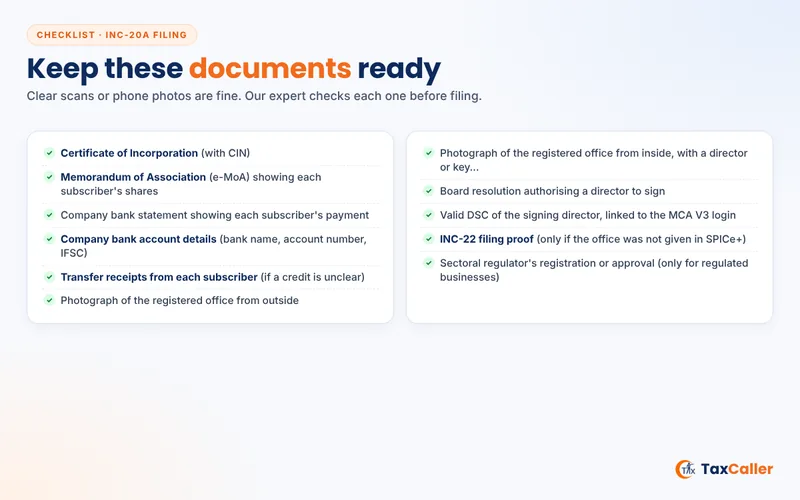
Memorandum of Association (e-MoA) showing each subscriber's shares
Company bank statement showing each subscriber's payment
Company bank account details (bank name, account number, IFSC)
Transfer receipts from each subscriber (if a credit is unclear)
Photograph of the registered office from outside
Photograph of the registered office from inside, with a director or key managerial person
Board resolution authorising a director to sign
Valid DSC of the signing director, linked to the MCA V3 login
INC-22 filing proof (only if the office was not given in SPICe+)
Sectoral regulator's registration or approval (only for regulated businesses)
Why TaxCaller
Real experts, not a call centre
Your work is handled by experienced professionals who explain every step, check your documents and keep you updated.
Registered company
TaxCaller is run by TaxCaller India LLP (LLPIN AAQ-7388), serving clients since 2018.
Fee told upfront
You know the complete fee, our professional fee and the government fee, before any work starts. No hidden charges.
Support after the work
Notices, renewals, returns and compliance reminders: we stay with your business after the registration is done.
Reviewed By
Expert for this topic INC-20A Filing
Abhinay Rai
Advocate
Abhinay Rai is a Advocate specialising in INC-20A Filing. The process, documents, timelines and fees on this page are checked against the current rules and government portals, and updated whenever the law, forms or fees change.
INC 20A is a one-time MCA form in which a new company declares that its subscribers have paid for their shares. A director signs it and a practising CA, CS or Cost Accountant certifies it. Under Section 10A of the Companies Act, 2013, a company with share capital cannot start business or borrow until it is filed.
Is INC-20A mandatory for every company?
It is mandatory for every company with share capital incorporated on or after 2 November 2018. This includes private limited companies, OPCs, public companies and Section 8 companies with share capital. Companies without share capital, companies formed before that date, and LLPs do not file it. Small companies and startups get no exemption from filing.
What is the due date for filing INC-20A?
INC-20A must be filed within 180 days of the date of incorporation shown on the Certificate of Incorporation. For a company incorporated on 12 January 2026, the limit is 11 July 2026. It does not depend on the financial year or the AGM. We suggest filing a month early, so bank or portal delays do not push you late.
What is the penalty for not filing INC-20A?
Under Section 10A(2), the company pays ₹50,000. Each officer in default, usually each director, pays ₹1,000 a day while the default continues, up to ₹1 lakh. A small company, OPC, recognised start-up or producer company pays not more than half under Section 446B. The ROC imposes the penalty through an adjudication order under Section 454.
What is the government fee for INC-20A?
The MCA fee depends on nominal share capital: ₹200 below ₹1 lakh, ₹300 up to ₹4,99,999, ₹400 up to ₹24,99,999, ₹500 up to ₹99,99,999, and ₹600 for ₹1 crore or more. Late filing adds 2 to 12 times this fee, depending on the delay. TaxCaller's professional fee is separate and is charged plus GST.
Can a company start business before filing INC-20A?
No. Section 10A(1) says a company with share capital shall not commence any business or exercise borrowing powers until the declaration is filed. Opening a bank account and collecting subscription money are part of getting ready to file. Selling, invoicing customers or taking a loan before filing is a breach that can attract the Section 10A(2) penalty.
Can INC-20A be filed after 180 days?
Yes. The form can still be filed after 180 days with an additional fee of 2 to 12 times the normal fee, based on the delay. The Section 10A(2) penalty may also follow through an ROC order. The 2026 compliance scheme did not cover INC-20A, so file as soon as the subscription money is in the bank.
Who can certify Form INC-20A?
Rule 23A of the Companies (Incorporation) Rules, 2014 allows a Company Secretary, Chartered Accountant or Cost Accountant in practice to verify the form. The professional must hold a certificate of practice. They check the bank statement, the memorandum, the registered office verification and any regulator approval, then sign with their own DSC and membership number.
What documents are needed for INC-20A?
You need the Certificate of Incorporation, the memorandum showing each subscriber's shares, and the company's bank statement showing each subscriber's payment. Add photos of the registered office, outside and inside with a director, and a board resolution naming the signing director. The director needs a valid DSC. Regulated businesses also attach the regulator's approval.
Can subscription money for INC-20A be paid in cash?
The law asks for proof that every subscriber paid, and the V3 form asks for the bank, account and date of each receipt. Cash deposits make it hard to link a payment to a subscriber. Each subscriber should transfer the money from their own bank account to the company's current account and keep the transfer receipt.
Is INC-20A a yearly filing?
No. INC-20A is filed only once in the life of a company, within 180 days of incorporation. It is different from yearly forms such as AOC-4 for accounts, MGT-7 or MGT-7A for the annual return, and DIR-3 KYC for directors. Once INC-20A is on record, you do not file it again, even if capital increases later.
What is the difference between INC-20A and INC-22A?
INC-20A is the commencement of business declaration for companies formed on or after 2 November 2018. INC-22A, called ACTIVE, was a one-time verification under Rule 25A for companies incorporated on or before 31 December 2017. A company that must file INC-20A was formed later, so ACTIVE does not apply to it. MCA updated the ACTIVE form in July 2025.
Can the ROC strike off my company for not filing INC-20A?
Yes. Section 10A(3) and Section 248(1)(d) let the ROC start removal action if INC-20A is not filed in 180 days and the company appears inactive. The ROC may also verify your office physically under Section 12(9). You get 30 days to reply to the notice. Filing the form and showing real business is your strongest reply.
Share your Certificate of Incorporation and bank statement, and our expert will check the subscriber payments and file INC-20A on MCA V3. Our fee starts at ₹999 + GST, and the MCA fee is paid at actual.