Copyright Registration in India: Protect Your Creative Work Online
Copyright registration online for books, software, logos, music and films, from Form XIV filing to your registration certificate, handled by our expert.
Starting from · ₹1,999 Copyright Registration Basic plan
STARTING FROM₹1,999
FEE TOLD UPFRONTFree first call
!Brand not protected?Your rights count from the filing date, so file early
Since 2018Trusted Experience
980+Experts Connected
220+Cities Served
1164+Agents Available
12000+Founders Trusted
S
Srishti Magoo
★★★★★
Excellent experience with TaxCaller for filing my &
my family members ITR returns. The entire process was
smooth, quick and hassle-free. They are professional,
knowledgeable and guided me through every step with patience.
O
obeid sait
★★★★★
The team has handled my taxes for the past three years,
and it's been a wonderful, hassle-free experience.
Thank you for your consistently quick and efficient service.
P
Pushkar
★★★★★
They are among the best in their field. Their work culture
is highly professional, and their client service is smooth
and reliable. They can confidently be relied on to get the job done.
P
Prasad Sheth
★★★★★
Excellent experience with TaxCaller! The ITR filing
process was smooth, quick, and completely hassle-free.
The CA was knowledgeable, responsive, and explained everything clearly.
A
Apoorv Bansal
★★★★★
Excellent service for ITR filing. The team was highly
professional, responsive, and guided me through the entire
process smoothly. My return was filed accurately and on time.
A
Abhishek Kumar
★★★★★
I was searching for a good CA firm in Ghaziabad and found
TaxCaller. The experience was excellent from start to finish.
The team is responsive, transparent, and genuinely helpful.
U
uma pandey
★★★★★
Great service! TaxCaller India made the entire ITR filing
process quick, smooth, and hassle-free. They answered all
my queries patiently and ensured maximum accuracy.
T
tanu mittal
★★★★★
Excellent job! We've been connected for many years,
and your success truly makes me happy. You are an
incredibly intelligent person. Keep shining, keep growing.
B
Bhanu Pratap Maurya
★★★★★
I am filing my ITR since past 3 years with Abhinav and
Firm is known as TaxCaller and they are professional
interms of ITR rules. They will explain and tell you all
the information.
A
ashish Sharma
★★★★★
I am providing my honest reviews:
No.1 service ...
A
AARYAN GROUP
★★★★★
Honestly, finding a good CA firm in Ghaziabad was
confusing, but TaxCaller India made it simple.
I contacted them for GST work and the experience was smooth.
N
News Speaks
★★★★★
If you're looking for a reliable CA firm in Ghaziabad,
TaxCaller India is a great choice. They provide complete
taxation and compliance solutions including GST.
A
Anshul Chaprana
★★★★★
Got my GST registration done through TaxCaller CA firm.
Process was quite smooth, they guided properly on documents
and didn't waste time. Overall good experience.
How we work
Online · Call · WhatsApp
Quick answer
Copyright registration is the entry of your original work in the Register of Copyrights under Section 45 of the Copyright Act, 1957. You file Form XIV online with ₹500 per literary, dramatic, musical or artistic work, ₹2,000 per sound recording or ₹5,000 per film. After a 30-day objection window and examination, the Registrar issues the certificate.
Reviewed by Abhinay Rai · Updated 15 Nov 2026
Pick a plan that fits
Basic
One book, article, artwork, musical work or simple software filed by its author
Government fees and taxes are extra where applicable. Our expert confirms the final amount on the first call. No hidden charges.
About Copyright Registration
Copyright registration gives your book, software, logo artwork, song or film an official entry in the Register of Copyrights in New Delhi. Copyright itself is automatic, but the register entry is strong evidence of who owns the work. That matters the day someone copies it, or the day a buyer or investor asks for proof.
The rules come from the Copyright Act, 1957 and the Copyright Rules, 2013. You apply on Form XIV, pay a small fee per work and wait through a 30-day objection window. An examiner then checks the file. Once the Registrar signs the entries, you get the registration certificate.
This page explains copyright registration in India step by step: which works qualify, who should apply, the documents, the official fees from the Copyright Office fee schedule, timelines, objections and penalties. TaxCaller files online for creators and businesses across India.
Complete guide
Choose a topic to open it. Every answer gives the rule or section it comes from.
01 Topic 1 of 20
What Is Copyright Registration? Meaning Under the Copyright Act, 1957
Copyright is the exclusive right to copy, publish, perform, adapt and sell an original creative work. In India it comes from the Copyright Act, 1957. The right arises the moment you create the work and fix it in some form. You do not need to file anything to own it.
Registration is a separate step. You ask the Copyright Office to enter the details of your work in the Register of Copyrights. Section 44 of the Act creates this register. Section 45 lets the author, the publisher, the owner or any other interested person apply for an entry. The procedure sits in Chapter XIII of the Copyright Rules, 2013 (Rules 70 to 74), as amended up to 2021.
Why does the entry matter if copyright is automatic? Because of Section 48. It says the register is prima facie evidence of the details entered in it. Certified extracts are accepted by every court without further proof. So in a dispute, the registered owner starts with the paperwork on their side. The other person must prove you wrong.
Point
Copyright without registration
Copyright with registration
Who owns it
The author or first owner, from the day of creation
Same owner, now recorded in the official register
Proof in court
You must prove authorship and date with your own records
Register entry is prima facie evidence under Section 48
Use in deals
Buyers and investors ask for extra proof
Certificate answers most due diligence questions
Cost
Nil
Government fee from ₹500 per work, plus professional fee if you use help
The Copyright Office works under the Department for Promotion of Industry and Internal Trade (DPIIT), Ministry of Commerce and Industry. Its head is the Registrar of Copyrights in New Delhi. Filing is online through the e-filing system on copyright.gov.in, so you can apply from any city.
People often mix up copyright and trademark. Both are intellectual property, but they protect different things and run under different laws and offices.
Copyright protects the creative expression itself: the words of a book, the code of an app, the drawing of a logo, a song, a film.
Trademark protects a sign used in trade: a brand name, logo or slogan that tells customers who sells the goods or services.
Point
Copyright
Trademark
Law
Copyright Act, 1957 and Copyright Rules, 2013
Trade Marks Act, 1999 and Trade Marks Rules, 2017
Office
Copyright Office, New Delhi
Trade Marks Registry
Protects
Original literary, artistic, musical, dramatic works, films and sound recordings
Brand names, logos, labels and slogans used for goods or services
Main form
Form XIV
Form TM-A
Government fee
₹500 to ₹5,000 per work
Per class, based on the type of applicant
Term
Usually the author's life plus 60 years, no renewal
10 years, renewable again and again
Names and slogans
Not protected
Protected if distinctive
For a brand, you usually need both. Copyright covers the logo artwork. The trademark covers the logo and name as a badge of your business. A short brand name cannot get copyright at all, so the trademark is the only route for it. To protect your brand name, see our trademark registration service. This page covers only copyright.
Zubair Trademark Expert
Have a question on this topic? Ask Zubair on a free call.
Works You Can Register, and What Copyright Does Not Protect
Section 13(1) says copyright subsists in six kinds of work. The work must be original, which means you created it yourself and did not copy it. Section 2 of the Act defines each kind.
Category
What the Act includes
Common examples
Literary work, Section 2(o)
Written works, computer programmes, tables and compilations including computer databases
Books, blogs, course material, manuals, software, app code, website text
Logo artwork, labels, packaging art, illustrations, photos, comics
Musical work, Section 2(p)
Music and its graphical notation, not the words sung with it
Compositions, jingles, background scores
Sound recording, Section 2(xx)
A recording of sounds that can be played back, in any medium
Songs, podcasts, audiobooks, ringtones
Cinematograph film, Section 2(f)
Any work of visual recording, including its soundtrack and video films
Feature films, short films, ads, online videos, animation
Dramatic work, Section 2(h)
Recitation, choreography, dumb show, scenic arrangement or acting fixed in writing or otherwise, but not a film
Scripts, screenplays, dance choreography, stage plays
Lyrics are a literary work. The tune is a musical work. The recorded song is a sound recording. A music video is a film. So one song can involve four separate copyrights, often with different owners.
What you cannot register
Ideas and concepts. Copyright protects how an idea is expressed, not the idea. A detailed written concept note can qualify. A one-line idea cannot.
Names, titles, slogans and short phrases. These are too short to count as a work. Protect them as a trademark.
Facts, methods and plots in general. Data and processes are free for all. Your written account of them can be protected.
Blank forms, calendars and simple layouts that show no creative effort.
Registered designs. Section 15(1) says no copyright exists in a design registered under the Designs Act, 2000. Under Section 15(2), copyright in a registrable but unregistered design ends once articles with the design are made more than 50 times by an industrial process.
A website as a whole. You register its parts instead: the text as a literary work, the code as software, the graphics as artistic works.
Is Copyright Registration Mandatory? Benefits of Registering Your Work
No. Copyright registration in India is optional. The official IP India FAQ says acquisition of copyright is automatic and needs no formality. Even so, most businesses and serious creators register their important works. Here is why.
Evidence of ownership. Section 48 makes the register entry prima facie evidence. Courts accept certified extracts without calling the Copyright Office.
A dated public record. The entry fixes your name, the title and the year of publication on an official record that anyone can inspect under Section 47.
Weakens the "I did not know" defence. Under the proviso to Section 55(1), a defendant who proves he had no reason to believe copyright existed may escape damages. A public register entry makes that defence harder to argue.
Police and criminal action. A police complaint under Section 63 is easier to support when you can show an official certificate.
Takedowns and platforms. Marketplaces, app stores and video platforms ask for proof of ownership. A certificate settles most questions.
Licensing, sale and funding. Investors, publishers, OTT platforms and buyers check title before they pay. A registered work is easier to license, assign or value.
Customs action. Section 53 lets an owner ask customs to stop infringing imports. Proof of ownership is part of that request.
Registration costs little compared with a single dispute. The government fee for a book, a song's lyrics, a drawing or a piece of software is ₹500 per work.
Any author, publisher, owner of copyright or other interested person can apply under Section 45. The applicant signs the form. If an agent files, a power of attorney signed by the applicant goes with it.
Who is the first owner?
Section 17 decides this. The author is the first owner, with key exceptions:
Employees. Work made by an employee in the course of a contract of service belongs to the employer, unless they agree otherwise (Section 17(c)).
Commissioned photos, paintings, portraits, engravings and films. The person who pays for them is the first owner (Section 17(b)), unless agreed otherwise.
Freelancers and agencies. For other commissioned work, such as software, logo drawings or written content, the freelancer stays the owner. Your business needs a written assignment.
Films and sound recordings. The producer is the author under Section 2(d).
AI-assisted work. For a computer-generated work, Section 2(d)(vi) treats the person who causes the work to be created as the author.
Assignment must be in writing
Section 19 says an assignment is valid only in writing and signed by the assignor. It should name the work, the rights, the period and the territory. If no period is stated, Section 19(5) treats it as five years. If no territory is stated, Section 19(6) presumes India. Weak freelancer contracts are a common reason companies lose control of their own logo or code.
When the Copyright Office expects an NOC
Rule 70(3) says that when the applicant is not the author, the application must carry an original no objection certificate (NOC) from the author. In practice an NOC or consent is also needed when:
A publisher files for a book, or the author files for a work a publisher has published.
There are joint authors and only one of them applies.
The work uses someone else's work, such as lyrics in a song or a script in a film.
The author has died. The heirs give consent or a succession document.
Any other person has a recorded interest in the work.
Foreign authors and works
Section 13(2) sets the link to India. A published work qualifies if it was first published in India, or if the author was an Indian citizen when it was first published abroad. An unpublished work qualifies if the author was an Indian citizen or domiciled in India when it was made. Works from other Berne Convention countries are also protected in India. Foreign owners can apply here through an authorised agent.
Section 13(3) adds a hard rule. A film gets no copyright if a substantial part of it infringes another work. The same applies to a sound recording made in breach of copyright in the song or music. So clear the underlying rights before you file.
Abhinay Rai Trademark Expert
Have a question on this topic? Ask Abhinay on a free call.
Software and Mobile App Copyright: The Source Code Rules
Software is protected as a literary work. Section 2(o) includes computer programmes in that category. Section 2(ffc) defines a computer programme as a set of instructions, in words, codes or any other form, that makes a computer perform a task. The government fee is ₹500 per work, the same as a book.
Rule 70(5) sets a specific filing rule. With the application you file the source code, at least the first 10 and last 10 pages of it. If the whole code is under 20 pages, you file all of it. The pages filed must not have any blocked out or redacted parts. Since the 30 March 2021 amendment, the rule asks for source code only. Older guides and the IP India FAQ still mention object code, so we keep it ready in case the examiner asks.
Practical points for founders and developers
One version, one application. Each major version that adds new code is a separate work. Plan which versions are worth registering.
Pick clean pages. The first and last pages should not contain passwords, API keys or client secrets. Move them out of the code before you make the extract.
Check open source parts. You can only claim the code you or your team wrote. Licensed libraries stay with their owners.
Get assignments from developers. Code written by freelancers or outside agencies belongs to them until assigned in writing.
Separate the brand. The app's name and icon need a trademark. The code needs copyright.
Copyright protects the code, not the underlying idea or method. If a rival writes different code to do the same job, copyright alone may not stop them. For a startup, a registered code base still helps in funding talks and in disputes with former team members. You may also look at Startup India registration for the wider benefits available to recognised startups.
Logo or Label Artwork Used as a Trademark: TM-C Search Certificate
A logo is an artistic work. If you use it, or could use it, for goods or services, the law adds one more step. The proviso to Section 45(1) and Rule 70(6) say the application must state this. It must also carry a certificate from the Registrar of Trade Marks. The certificate confirms that no one other than you has registered or applied for an identical or deceptively similar trademark.
How the search certificate works
You request it on Form TM-C under Rule 22(1) of the Trade Marks Rules, 2017.
The official fee in the First Schedule is ₹9,000 by e-filing or ₹10,000 on paper, as listed on the IP India forms and fees page.
The Registrar ordinarily issues it within 30 working days. The Registrar may ask for a statement of requirements. If you do not comply within two months, the request is treated as abandoned.
An expedited certificate under Rule 22(3) is ordinarily issued within seven working days. It is available only by e-filing, for ₹30,000.
The copyright fee is also higher. Item 9(b) of the Second Schedule charges ₹2,000 per work for an artistic work used or capable of use for goods or services, against ₹500 for other artistic works.
Design overlap
If the artwork could be registered as a design, Rule 70(7) asks for an affidavit. It states that the work is not registered as a design and has not been applied to an article by an industrial process and reproduced more than 50 times.
A copyright entry for your logo does not give you rights over the brand name. If the TM-C search shows a clash, read our trademark objection reply page and the main trademark registration guide before you invest more in that logo.
Shadab Trademark Expert
Have a question on this topic? Ask Shadab on a free call.
Copyright Registration Process Online: How TaxCaller Files Your Work
Copyright Registration: how the work moves, step by step
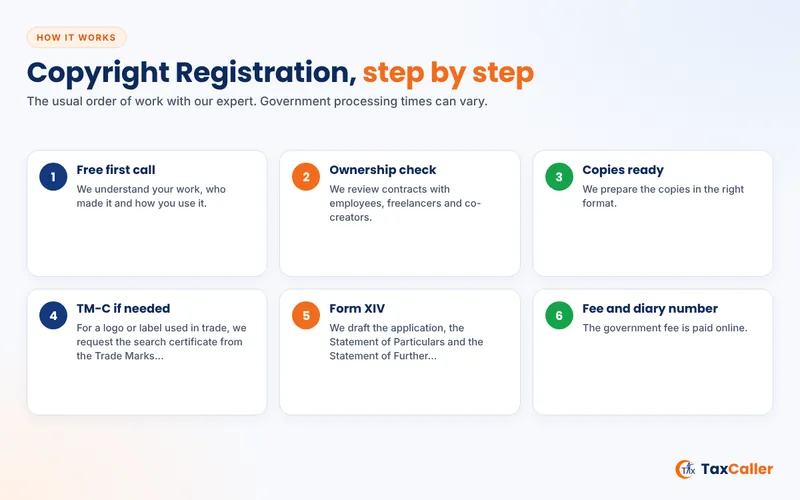
Rule 70(8) allows filing in person, by post or through the online filing facility on the Copyright Office website. We file online for clients across India. These are the steps.
Free first call. We understand your work, who made it and how you use it. We fix the category: literary, artistic, musical, dramatic, sound recording, film or software.
Ownership check. We review contracts with employees, freelancers and co-creators. Where rights are not clear, we draft the assignment deed or NOC.
Copies ready. We prepare the copies in the right format. For software, we help you build the Rule 70(5) source code extract.
TM-C if needed. For a logo or label used in trade, we request the search certificate from the Trade Marks Registry first.
Form XIV. We draft the application, the Statement of Particulars and the Statement of Further Particulars. You review and sign.
Fee and diary number. The government fee is paid online. The application then gets a diary number, which is your reference till the end.
Upload of the work. Since a public notice of 17 January 2019, literary, dramatic and artistic works can be uploaded as soft copies in their original colours. For other works we follow the Office's instructions on copies.
Notice to interested parties. Rule 70(9) needs you to notify anyone who claims an interest in the work. We send these notices where they apply.
Tracking and replies. We watch the status, answer any discrepancy letter and attend hearings.
Certificate. Once the Registrar signs the entries, we share the registration certificate (ROC) with you.
Each application covers one work only (Rule 70(2)). If you have ten designs or five books, that means ten or five applications. We plan the order with you so the most valuable works go first.
After Filing: Diary Number, 30-Day Waiting Period and Examination
Once the fee is paid, the application gets a diary number. Use it to check the status on the Copyright Office website. Then three stages follow.
1. The 30-day objection window
Rule 70(10) builds in a waiting period of 30 days from the date the application is received. Anyone who claims an interest in the work can object in this time. If no objection comes and the Registrar is satisfied with the details, the Registrar enters them in the register.
No objection does not mean automatic approval. Rule 70(10) still needs the Registrar to be satisfied that the particulars are correct.
2. Formality check and examination
An examiner checks the form, the fee, the signatures and the copies. The examiner then checks whether the work is protected and whether the details match the copy. Typical checks are the title, language, author name and year of publication.
3. Entry in the register
If all is in order, the work is entered in the Register of Copyrights. Rule 70(13) says registration is complete only when the Registrar or a Deputy Registrar signs and issues a copy of the entries.
Discrepancy Letters, Third-Party Objections and Hearings
Many applications get a discrepancy letter. It is not a rejection. It is a list of points the examiner wants fixed or explained.
Typical discrepancies
NOC missing or not original
Applicant is not the author and the chain of ownership is not shown
Title, author or year in the form does not match the copy
Wrong category, for example a logo filed without the TM-C certificate
Source code extract incomplete or redacted
Copy unclear or not in original colours
Power of attorney or signatures missing
Reply within the time stated in the letter, with the corrected documents. A late or weak reply can lead to the file being closed. We draft the reply and upload it for you.
Objections from other people
If someone objects within the 30 days, Rule 70(11) lets the Registrar hold an inquiry. Both sides can put forward their case and evidence. The Registrar then decides what to enter in the register. Good records help here: dated drafts, emails, contracts and earlier publications.
Hearing before rejection
Rule 70(12) says the Registrar must give a hearing before rejecting any application. Treat the hearing seriously. We prepare written submissions and attend for you.
If the application is rejected
Section 72 lets a person aggrieved by a final order of the Registrar appeal to the High Court within three months of the order. Older guides still mention the Appellate Board. Since 4 April 2021, appeals go to the High Court. The government fee is not refunded if the application is rejected, according to the official IP India FAQ.
Shreya Trademark Expert
Have a question on this topic? Ask Shreya on a free call.
The Registration Certificate (ROC) and Extracts From the Register
When the Registrar signs the entries, you get a copy of them. This is what people call the registration certificate or ROC. It is your official proof that the work stands in the register in your name.
What the certificate shows
Registration number and date
Name, address and nationality of the applicant and of the author
Title, class and language of the work
Whether the work is published, with year and country of first publication
Owners of the various rights and any licences recorded
How to use it
Attach it to takedown requests and legal notices.
Show it in licensing, publishing and funding deals.
File certified copies in court. Section 48 makes them admissible without further proof.
Changes and certified copies
If details change, such as a new owner after an assignment, you apply on Form XV under Rule 70(1). Rule 74 lets anyone get certified copies of entries. Section 49 lets the Registrar correct clerical errors. Section 50 lets the High Court rectify the register on the application of the Registrar or an aggrieved person. Section 50A asks the Registrar to publish entries, corrections and rectifications.
Timeline: How Long the Copyright Office Takes, Stage by Stage
The official IP India FAQ says registration may take around two to three months in the normal course. Real timelines depend on the examiner's queue and on whether a discrepancy or objection comes up. Here is the stage-by-stage picture.
Stage
Time
Basis
Ownership check, NOCs and copies
Depends on how fast documents and consents are ready
Our process
TM-C search certificate (logo used in trade)
Ordinarily 30 working days; 7 working days if expedited
Rule 22(1) and 22(3), Trade Marks Rules, 2017
Online filing and diary number
On payment of the fee
E-filing system
Objection window
30 days from receipt
Rule 70(10)
Examination
Varies with the Office's workload
Rule 70(10) and (11)
Discrepancy reply
Within the time stated in the letter
Letter from the Office
Hearing, if needed
Date fixed by the Registrar
Rule 70(11) and (12)
Appeal against rejection
Within 3 months of the order
Section 72
Your copyright does not wait for the certificate. It exists from creation. The register entry only adds strong evidence. So you can publish and sell your work while the application is pending.
The quickest files are simple ones: a single author who is also the applicant, a clean copy and no third-party content. Logos used in trade take longer because of the TM-C step. Films and sound recordings take more preparation because of the many underlying rights.
Copyright Registration Fees: Government Fee per Work vs TaxCaller's Fee
Copyright Registration: SAMPLE quote, for illustration only
There are two separate costs. The Copyright Office fee is set by the Second Schedule to the Copyright Rules, 2013 (Rule 70(2) and Rule 83), as amended by G.S.R. 225(E) dated 30 March 2021. It is charged per work and paid at actual.
Item (Second Schedule)
Government fee
9(a) Literary, dramatic, musical or artistic work (includes software)
₹500 per work
9(b) Artistic work used or capable of use for goods or services
₹2,000 per work
11 Cinematograph film
₹5,000 per work
13 Sound recording
₹2,000 per work
10(a) Change in particulars: literary, dramatic, musical or artistic work
₹200 per work
10(b) Change in particulars: artistic work used for goods or services
₹1,000 per work
12 Change in particulars: cinematograph film
₹2,000 per work
14 Change in particulars: sound recording
₹1,000 per work
15 to 17 Extracts and certified copies from the register
₹500 per work or copy
For a logo used in trade, add the Trade Marks Registry fee for Form TM-C: ₹9,000 by e-filing or ₹10,000 on paper, or ₹30,000 for the expedited certificate. The Second Schedule has no lower fee for individuals, startups or small firms. The fee is the same whoever applies.
TaxCaller's professional fee
TaxCaller's fee starts at ₹1,999 + GST for one work. Government fees are paid separately at actual and are not part of our fee. We confirm the full amount in writing before you pay.
Basic: one work, Form XIV drafting, e-filing and tracking till the certificate.
Standard: Basic plus reply to a discrepancy letter or objection, and hearing support.
Premium: software, films, sound recordings, logos used in trade or several works, with NOC and assignment drafting.
Zubair Trademark Expert
Have a question on this topic? Ask Zubair on a free call.
How Long Copyright Lasts: Term Under Sections 22 to 29
Copyright in India does not need renewal. Once the term ends, the work enters the public domain. The term rules in Chapter V of the Act are below. Each term runs from the start of the calendar year after the event named.
Work
Term
Section
Literary, dramatic, musical or artistic work published in the author's lifetime
Author's lifetime plus 60 years after the year of death
22
Joint authorship
60 years after the year the last surviving author dies
22
Anonymous or pseudonymous work
60 years from first publication, or life plus 60 if identity is disclosed
23
Posthumous work
60 years from first publication
24
Cinematograph film
60 years from publication
26
Sound recording
60 years from publication
27
Government work
60 years from first publication
28
Public undertaking work
60 years from first publication
28A
International organisation work
60 years from first publication
29
Photographs used to have a separate term under Section 25. That section was omitted from 21 June 2012, so photographs now follow the general rule for artistic works.
Registration does not change these terms. It only records the work. Compare this with a trademark, which lasts ten years at a time and must be renewed. If you hold both, keep a separate calendar for trademark renewal.
India is a member of the Berne Convention. Your Indian work is protected in other member countries without a separate filing there. Enforcement abroad then follows that country's law.
Infringement, Remedies and Penalties: Sections 51, 55 and 63
Section 51 says copyright is infringed when someone, without a licence, does any act that only the owner may do. It also covers selling or hiring out infringing copies, distributing them, showing them in public by way of trade and importing them. Importing one copy for private use is allowed.
Civil remedies
Section 55: injunction, damages and accounts of profits. If the defendant proves he had no reason to believe copyright existed, you may get only an injunction and a share of his profits.
Section 55(2): the person named as author or publisher on the work is presumed to be the author or publisher, unless shown otherwise.
Section 58: infringing copies are treated as the owner's property.
Section 62: you can sue in the district court where you live or carry on business.
Section 60: a person facing groundless threats can sue for a declaration and an injunction.
Criminal offences
Section
Offence
Punishment
63
Knowing infringement
6 months to 3 years jail and fine of ₹50,000 to ₹2 lakh
63A
Second or later conviction
1 to 3 years jail and fine of ₹1 lakh to ₹2 lakh
63B
Knowing use of an infringing copy of a computer programme
7 days to 3 years jail and fine of ₹50,000 to ₹2 lakh
65A
Getting around technological protection measures
Up to 2 years jail and fine
65B
Removing or altering rights management information
Up to 2 years jail and fine
68
False statement to deceive or influence an authority or officer under the Act, such as the Registrar
Up to 1 year jail, or fine, or both
Section 64 lets police seize infringing copies without a warrant. Section 53 lets you ask customs to stop infringing imports. See the full text in the offences chapter of the Act.
Not every use is infringement. Section 52 allows fair dealing for private use including research, for criticism or review and for reporting current events. Check this before you send a notice.
Common Mistakes That Cause Discrepancies or Rejection
Most problems in copyright filings are avoidable. These are the ones we see most often.
Many works in one form. Rule 70(2) allows one work per application. A logo pack or a song album needs separate filings.
Applicant is not the author, and no NOC. Rule 70(3) needs the author's original NOC.
No written assignment from a freelancer. Without it, the agency or designer still owns the work.
Logo filed at ₹500 without TM-C. An artistic work used for goods or services needs the ₹2,000 fee and the Trade Marks Registry certificate.
Redacted source code. Rule 70(5) does not allow blocked out parts in the pages filed.
Details do not match the copy. A different title, author spelling or year on the copy triggers a discrepancy.
Wrong publication status. Decide carefully whether the work is published, and give the correct year and country.
Filing a title, name or slogan. These are not works. File a trademark instead.
Unlicensed music, lyrics or clips inside a film or recording. Section 13(3) can take away copyright in the whole work.
Design reproduced industrially. More than 50 industrial copies of an unregistered but registrable design end copyright under Section 15(2).
Missing a deadline. An unanswered discrepancy letter or a missed hearing can close the file.
Believing a myth about fees. Some guides say companies pay ₹2,000 for a literary work. The official schedule says ₹500 per work for every applicant. The ₹2,000 rate applies to artistic works used for goods or services. Before 30 March 2021 that entry also named literary works used with goods, which is where the myth comes from.
Abhinay Rai Trademark Expert
Have a question on this topic? Ask Abhinay on a free call.
License in writing. Section 30 says the owner grants a licence in writing, personally or through a duly authorised agent. State the rights, period, territory and royalty.
Assign carefully. Follow Section 19 when you sell rights. Then record the new owner on Form XV.
Respect moral rights. Section 57 lets the author claim authorship and object to distortion that harms his reputation, even after an assignment.
Keep the file. Save the certificate, the copy filed, NOCs, assignment deeds and payment proof in one folder.
Watch the market. Search platforms and marketplaces for copies. Act early with a notice or a takedown.
Register new versions. Major updates to software or a revised edition of a book are new works.
Protect the brand side too. If your logo has become your brand, file a trademark and keep it renewed. If a brand is sold with the business, record the trademark transfer as well; see trademark assignment.
Copyright income is also taxable. Royalty from books, music or software counts in your income. Our income tax filing team can help you report it, and our GST services team can check whether your licence fees attract GST.
Copyright Registration in 2026: Current Rules and E-Filing Status
We checked the official sources on 15 November 2026. This is where things stand.
No new registration fee. The fee schedule on copyright.gov.in still shows the Second Schedule as amended by G.S.R. 225(E) dated 30 March 2021. That amendment reworded the ₹2,000 entry so it covers artistic works used for goods or services, and omitted the old customs fee item. No later fee change for registration is shown.
Same form and rule. Form XIV under Rule 70 remains the registration form. Form XV remains the form to change particulars.
Appeals go to the High Court. Since 4 April 2021, appeals against the Registrar's orders go to the High Court under Section 72. Assignment disputes under Section 19A go to the Commercial Court. Older guides that still mention the Appellate Board are out of date.
E-filing is the normal route. Rule 70(8) allows online filing, and soft copies of literary, dramatic and artistic works can be uploaded. The diary number and status tracking are online.
AI and copyright is under discussion, not law. In December 2025, DPIIT was reported to have released a working paper on generative AI and copyright for public comment. It is a consultation paper. It has not changed the rules for registering a work. For computer-generated work, Section 2(d)(vi) still names the person who causes the work to be created as the author.
If the government notifies a change, we will update this page. Before you pay, we confirm the fee on the official fee schedule so that you pay the correct amount.
TaxCaller has served businesses since 2018 from our office in Ghaziabad. We work online, so clients anywhere in India can file without visiting the Copyright Office in Delhi.
One expert for the whole file. Category choice, ownership papers, Form XIV, replies and hearing, handled by the same person.
Clear fees. Our fee and the government fee are shown separately, in writing, before you pay.
Ownership first. We check who really owns the work before we file, which avoids the most common discrepancies.
Brand and copyright together. Our trademark team can protect the same logo and name under the Trade Marks Act.
Reviewed content. This page is reviewed by Abhinay Rai, Advocate.
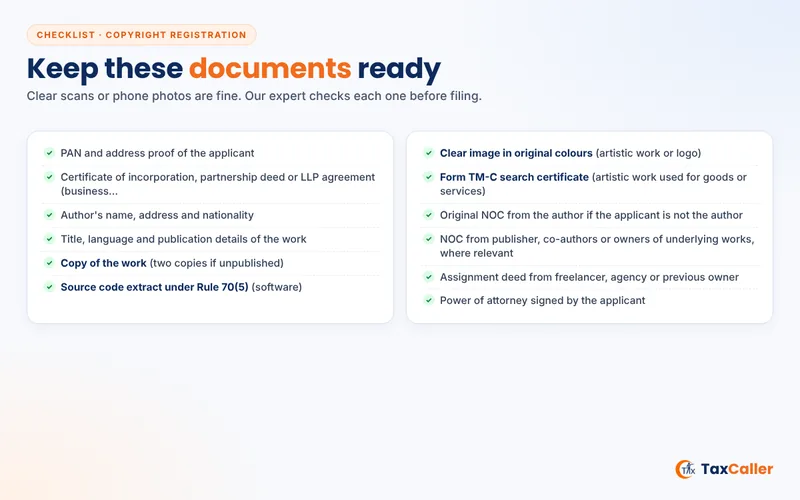
Certificate of incorporation, partnership deed or LLP agreement (business applicants)
Author's name, address and nationality
Title, language and publication details of the work
Copy of the work (two copies if unpublished)
Source code extract under Rule 70(5) (software)
Clear image in original colours (artistic work or logo)
Form TM-C search certificate (artistic work used for goods or services)
Original NOC from the author if the applicant is not the author
NOC from publisher, co-authors or owners of underlying works, where relevant
Assignment deed from freelancer, agency or previous owner
Power of attorney signed by the applicant
Board resolution or authority letter for the signatory
Why TaxCaller
Real experts, not a call centre
Your work is handled by experienced professionals who explain every step, check your documents and keep you updated.
Registered company
TaxCaller is run by TaxCaller India LLP (LLPIN AAQ-7388), serving clients since 2018.
Fee told upfront
You know the complete fee, our professional fee and the government fee, before any work starts. No hidden charges.
Support after the work
Notices, renewals, returns and compliance reminders: we stay with your business after the registration is done.
Reviewed By
Expert for this topic Copyright Registration
Abhinay Rai
Advocate
Abhinay Rai is a Advocate specialising in Copyright Registration. The process, documents, timelines and fees on this page are checked against the current rules and government portals, and updated whenever the law, forms or fees change.
No. Copyright arises automatically when you create an original work, and the law does not require registration. Still, registration is wise for valuable work. Under Section 48 of the Copyright Act, the register entry is prima facie evidence of the details entered in it. That makes disputes, takedowns, licensing and funding talks far easier to handle.
How much does copyright registration cost in India?
The government fee is ₹500 per literary, dramatic, musical or artistic work, including software. It is ₹2,000 for an artistic work used for goods or services, ₹2,000 for a sound recording and ₹5,000 for a film. A logo used in trade also needs a TM-C certificate, costing ₹9,000 by e-filing. TaxCaller's professional fee is separate, plus GST.
How long does copyright registration take?
The official IP India FAQ says it may take around two to three months in the normal course. There is first a 30-day waiting period for objections under Rule 70(10). Examination follows. A discrepancy letter, a third-party objection or a hearing adds time. Your copyright exists from creation, so you can use the work meanwhile.
Can I register software or a mobile app under copyright?
Yes. Software is a literary work under Section 2(o), and the fee is ₹500 per work. Rule 70(5) asks for at least the first 10 and last 10 pages of source code, or the whole code if under 20 pages, with no redacted parts. The rule no longer asks for object code. Each major version is a separate work.
Can I register my logo under copyright as well as trademark?
Yes. Copyright protects the logo as artwork, and a trademark protects it as your brand. If the logo is used for goods or services, the copyright fee is ₹2,000. You must also attach a search certificate from the Trade Marks Registry, requested on Form TM-C. File a trademark too, because copyright does not protect your brand name.
What is Form XIV in copyright registration?
Form XIV is the application for registration of copyright under Rule 70 of the Copyright Rules, 2013. It has a covering application, a Statement of Particulars and a Statement of Further Particulars. It asks for the applicant, author, title, language, publication details and owners of rights. Each Form XIV covers only one work, with its own fee.
What is a diary number in copyright registration?
The diary number is the reference number given to your application once Form XIV is filed and the fee is paid online. You use it to track status on the Copyright Office website and to quote in any letter or reply. Keep the acknowledgement safe. The final registration number is different and appears on the certificate.
Can I copyright a name, title or slogan?
No. Names, titles, slogans and short phrases are too short to count as an original work, so the Copyright Office does not register them. Copyright also does not protect a bare idea. To protect a business name, product name or tagline, file a trademark application instead, because trademark law protects distinctive signs used in trade.
Who owns copyright in work made by an employee or a freelancer?
Under Section 17(c), work made by an employee in the course of employment belongs to the employer, unless agreed otherwise. A freelancer usually remains the owner of software, written content or logo drawings until a written assignment is signed under Section 19. Commissioned photographs, paintings, portraits, engravings and films belong to the person who pays.
What happens if someone objects to my copyright application?
Anyone claiming an interest can object within the 30-day waiting period. Under Rule 70(11), the Registrar may then hold an inquiry, and both sides can present evidence. Rule 70(12) says the Registrar must give a hearing before rejecting an application. If the final order goes against you, Section 72 allows an appeal to the High Court within three months.
How long is copyright valid, and does it need renewal?
For literary, dramatic, musical and artistic works, copyright lasts for the author's lifetime plus 60 years, counted from the start of the year after death. Films, sound recordings and government works get 60 years from publication. There is no renewal. After the term ends, the work enters the public domain and anyone may use it.
Can I register an unpublished work?
Yes. Both published and unpublished works can be registered. For an unpublished work, Rule 70(4) asks for two copies with the application. Registering before you share a manuscript, script or design with publishers or investors gives you a dated official record. You state the work as unpublished in Form XIV, then update details later if needed.
Is my copyright registered in India valid in other countries?
India is a member of the Berne Convention, so works protected in India also get protection in other member countries without a separate filing there. Each country applies its own law to enforcement and remedies. Some countries may need local registration before you can sue there. Take local advice before you act against an infringer abroad.
What is the penalty for copyright infringement in India?
Under Section 63, knowing infringement is punishable with six months to three years in jail and a fine of ₹50,000 to ₹2 lakh. Repeat offenders face one to three years under Section 63A. The owner can also sue for injunction, damages and accounts of profits under Section 55. Police may seize infringing copies under Section 64.
Tell us about your work and our expert will check ownership, draft Form XIV and file it online. TaxCaller's fee starts at ₹1,999 + GST; government fees are paid separately at actual.