Starting from · ₹1,499 ESIC Registration Basic plan
STARTING FROM₹1,499
FEE TOLD UPFRONTFree first call
!GSTR-3B due?Last date 20 Nov 2026 · 4 days left
Since 2018Trusted Experience
980+Experts Connected
220+Cities Served
1164+Agents Available
12000+Founders Trusted
S
Srishti Magoo
★★★★★
Excellent experience with TaxCaller for filing my &
my family members ITR returns. The entire process was
smooth, quick and hassle-free. They are professional,
knowledgeable and guided me through every step with patience.
O
obeid sait
★★★★★
The team has handled my taxes for the past three years,
and it's been a wonderful, hassle-free experience.
Thank you for your consistently quick and efficient service.
P
Pushkar
★★★★★
They are among the best in their field. Their work culture
is highly professional, and their client service is smooth
and reliable. They can confidently be relied on to get the job done.
P
Prasad Sheth
★★★★★
Excellent experience with TaxCaller! The ITR filing
process was smooth, quick, and completely hassle-free.
The CA was knowledgeable, responsive, and explained everything clearly.
A
Apoorv Bansal
★★★★★
Excellent service for ITR filing. The team was highly
professional, responsive, and guided me through the entire
process smoothly. My return was filed accurately and on time.
A
Abhishek Kumar
★★★★★
I was searching for a good CA firm in Ghaziabad and found
TaxCaller. The experience was excellent from start to finish.
The team is responsive, transparent, and genuinely helpful.
U
uma pandey
★★★★★
Great service! TaxCaller India made the entire ITR filing
process quick, smooth, and hassle-free. They answered all
my queries patiently and ensured maximum accuracy.
T
tanu mittal
★★★★★
Excellent job! We've been connected for many years,
and your success truly makes me happy. You are an
incredibly intelligent person. Keep shining, keep growing.
B
Bhanu Pratap Maurya
★★★★★
I am filing my ITR since past 3 years with Abhinav and
Firm is known as TaxCaller and they are professional
interms of ITR rules. They will explain and tell you all
the information.
A
ashish Sharma
★★★★★
I am providing my honest reviews:
No.1 service ...
A
AARYAN GROUP
★★★★★
Honestly, finding a good CA firm in Ghaziabad was
confusing, but TaxCaller India made it simple.
I contacted them for GST work and the experience was smooth.
N
News Speaks
★★★★★
If you're looking for a reliable CA firm in Ghaziabad,
TaxCaller India is a great choice. They provide complete
taxation and compliance solutions including GST.
A
Anshul Chaprana
★★★★★
Got my GST registration done through TaxCaller CA firm.
Process was quite smooth, they guided properly on documents
and didn't waste time. Overall good experience.
How we work
Online · Call · WhatsApp
Quick answer
ESIC registration is an employer's online enrolment with the Employees' State Insurance Corporation, compulsory once 10 or more people work in a covered establishment. Staff earning up to ₹21,000 a month get medical and cash benefits. The employer pays 3.25% and the employee 0.75% of wages, deposited by the 15th of the next month.
Reviewed by Abhinay Rai · Updated 15 Nov 2026
Pick a plan that fits
Basic
Employers that need an ESIC code and will run payroll in-house
₹1,499+ GST
No govt. fee
Pay now (38%)₹570+ GSTAfter the ESIC code₹929+ GST
Handled by a TaxCaller Expert Licence & Registration Expert
Government fees and taxes are extra where applicable. Our expert confirms the final amount on the first call. No hidden charges.
About ESIC Registration
ESIC registration, also called ESI registration, is how an employer brings its business under the Employees' State Insurance scheme. The Employees' State Insurance Corporation (ESIC) gives the business a 17-digit employer code. Each covered worker then gets an insurance number and an e-Pehchan card, which open the door to ESIC dispensaries, hospitals and cash benefits.
For decades the scheme ran under the Employees' State Insurance Act, 1948. Since 21 November 2025, it runs under Chapter IV of the Code on Social Security, 2020, which repealed the 1948 Act. The basic test has not moved: an establishment with 10 or more people must register. ESIC registrations made under the old Act continue under the Code.
TaxCaller has handled tax and compliance work for businesses since 2018, from Ghaziabad and online across India. Our tax experts check whether ESI applies to you, file the application on the ESIC portal, register your staff and set up the first monthly payment. This page covers coverage rules, rates, benefits, documents, process, penalties and the 2026 changes.
Complete guide
Choose a topic to open it. Every answer gives the rule or section it comes from.
01 Topic 1 of 20
ESIC Registration Explained: Health Cover Run by the Employer
The Employees' State Insurance scheme is social insurance for workers on modest wages. It pays for medical care and replaces part of the wage when a worker cannot work. The money comes from a small monthly contribution by the employer and the employee. The ESIC runs its own dispensaries and hospitals and has tie-ups with other hospitals.
ESIC registration has two layers:
Employer registration: the business files an online form and gets a 17-digit employer code. This code is used on every payment, return and letter.
Employee registration: each covered worker gets an insurance number. The person registered is called an Insured Person (IP). Family members are added for medical benefit.
The employer code is shown in a registration letter, often called Form C-11, issued through the portal. The insurance number stays with the worker for life. When a worker changes jobs, the new employer links the same number, so benefits carry on without a fresh start.
ESI or ESIC: same thing
People search for both terms. ESI is the scheme. ESIC is the Corporation that runs it. An ESI code number and an ESIC registration number mean the same employer code. On this page we use both words.
The whole process is online on the ESIC portal. No office visit is needed for registration. An ESIC inspector, now called an Inspector-cum-Facilitator under Section 122 of the Code, may visit later to check records.
When ESIC Registration Is Compulsory: The 10-Employee Test
The First Schedule of the Code on Social Security, 2020 says Chapter IV applies to every establishment in which ten or more persons are employed, other than a seasonal factory. That covers factories, shops, offices, hotels, restaurants, cinemas, private schools and hospitals, transport firms, IT companies and service businesses.
How to count the ten
Count everyone working for the establishment, permanent, temporary, casual or on probation.
Include workers supplied by a contractor. The principal employer stays answerable for their ESI contributions too.
Count staff earning above the wage ceiling. They count towards the ten, even though they are not insured.
Count branches and units of the same establishment together.
Special cases in the First Schedule
Hazardous work: where an establishment carries on a hazardous or life-threatening occupation notified by the Central Government, ESI applies even with a single employee.
Plantations: an employer of a plantation may opt in, where ESI benefits are better than what the employer already gives.
Seasonal factories: they are left out of the ten-person rule.
Once covered, always covered
Section 1(8) of the Code keeps an establishment covered even if its headcount later falls below the threshold. Do not stop payments because staff dropped to eight.
What about the old 20-person rule?
Under the 1948 Act, some states had applied ESI to shops and similar units only at 20 employees. The Code's schedule now states one test of ten for all establishments. If you are in a state that used 20 and you employ 10 to 19 people, talk to us. We check the current position for your area before you file.
Situation
Is ESIC registration needed?
8 employees, office work
Not compulsory
10th person joins on 5 July
Yes, from 5 July
Staff fell from 14 to 9
Yes, coverage continues
3 employees in a notified hazardous process
Yes
Zubair Licence & Registration Expert
Have a question on this topic? Ask Zubair on a free call.
ESI benefits need hospitals and dispensaries on the ground. So the scheme has always grown district by district. Under the old Act, coverage started only in areas notified as implemented areas.
The Code keeps a link to this. The third proviso in the First Schedule says contributions under Section 29 are payable from the date the Central Government notifies that ESI benefits are provided to employees of the establishment. In practice, your duty to pay starts when your district is covered.
Coverage keeps growing
Many districts are fully covered. Others are covered only in part, where only some towns or blocks are notified. For example, notification S.O. 5313(E), dated 28 September 2026, extended ESI to the entire area of 25 districts of Madhya Pradesh from 1 October 2026. Employers there with ten or more staff now have to register.
How we check your area
We check the district and, where needed, the town or block of your premises.
We confirm the date from which ESI applies in that area.
For branches in other districts, we check each one, because coverage can differ.
State-level points
ESI itself is a central scheme. But states run ESI dispensaries in many places, and state rules under the Code are still being finalised in some states. Your shop or trade licence also comes from the state. For that, see our Shop Act registration page.
Ghaziabad, Noida, Delhi and most large cities have been covered for years. Our office in Ghaziabad handles ESIC registration for employers across India online.
Which Employees Are Covered: The ₹21,000 Wage Ceiling
Inside a covered establishment, an employee is insured if his or her monthly wages do not exceed the wage ceiling. The ceiling is ₹21,000 a month. For persons with disabilities, it is ₹25,000. The Labour Ministry's FAQs of 16 March 2026 confirm that the ₹21,000 limit continues under the Code. We found no notification changing it up to mid-November 2026.
Do not mix this up with PF. The EPF wage ceiling was raised to ₹25,000 from 17 September 2026. The ESI ceiling is separate and has not moved with it. A worker earning ₹23,000 is now inside the PF limit but outside the ESI limit.
Crossing the ceiling during the year
A raise above ₹21,000 does not end cover at once. A Labour Ministry notification under the Code, dated 8 May 2026, confirms that the person stays covered until the end of the running contribution period. Contributions continue on the actual wages till then.
Who is covered
Permanent, temporary and casual staff within the ceiling
Workers employed through contractors
Probationers and trainees paid wages, other than apprentices under the Apprentices Act
Part-time staff, if they are employees of the establishment
Who is not covered
Employees earning above the ceiling at the start of the contribution period
Apprentices engaged under the Apprentices Act
Partners and proprietors, who are not employees
The ceiling is set by the Central Government. Proposals to raise it to ₹25,000 or ₹30,000 have been discussed in the news. Until a notification appears, ₹21,000 is the figure we use. We recheck the ceiling on the portal on the day we file.
The contribution is a small share of wages paid every month for each insured employee. The rates have stayed the same since 1 July 2019, when they were cut from 4.75% and 1.75%.
Share
Rate on wages
Who bears it
Employer
3.25%
Paid by the business; cannot be cut from salary
Employee
0.75%
Deducted from the employee's wages
Total
4%
Deposited together by the employer
Rule 19 of the Social Security (Central) Rules, 2026, notified on 8 May 2026, carries the 3.25% employer rate under the Code.
Low-wage workers
An employee whose average daily wage is up to ₹176 does not pay the 0.75% share. The employer still pays its 3.25%.
A worked example
Monthly wages
Employer share (3.25%)
Employee share (0.75%)
Total
₹12,000
₹390
₹90
₹480
₹18,000
₹585
₹135
₹720
₹21,000
₹682.50
₹157.50
₹840
Rules on deduction
Under Section 31 of the Code, the employer pays both shares and recovers the employee's share only by deduction from wages. The employer's own share can never be recovered from the worker. Contributions are worked out for each wage period, so a worker who joins mid-month pays only on wages actually earned.
Abhinay Rai Licence & Registration Expert
Have a question on this topic? Ask Abhinay on a free call.
The contribution is a percentage of wages, so the definition of wages decides the bill. The Code brought one common definition, in Section 2(88), for all its chapters.
The 50% check
Wages include basic pay, dearness allowance and retaining allowance. Some items are left out, such as house rent allowance, overtime, bonus and conveyance. But if the left-out items exceed half of total pay, the excess is treated as wages. ESIC has issued guidance on applying this definition, and the Labour Ministry's FAQs say it applies from 21 November 2025.
Two separate tests
Keep two questions apart:
Is the worker covered? Compare wages with the ₹21,000 ceiling.
How much is due? Apply 3.25% and 0.75% to the wages as defined.
Some legal advisers note that the position on gross wages under the old regime may still matter until a full ESI scheme under the Code is in place. We follow ESIC's current portal practice and circulars when we calculate.
Common items in a pay slip
Pay item
Usual treatment
Basic and DA
Wages
Overtime
Left out under the Code's list, subject to the 50% check
HRA, conveyance
Left out, subject to the 50% check
Annual bonus
Left out, subject to the 50% check
Reimbursement of actual expenses
Not wages
Before your first monthly filing, we review your salary structure so the deduction matches the law and your payroll software agrees with it.
Section 32 of the Code lists six benefits: sickness, maternity, disablement, dependants', medical and funeral expenses. Here is what they mean in practice.
Benefit
What the insured person gets
Medical benefit
Treatment for the insured person and family at ESIC dispensaries and hospitals, from the day the person is insured
Sickness benefit
70% of wages for up to 91 days in a year for certified sickness
Extended sickness benefit
80% of wages for up to two years for listed long-term diseases
Maternity benefit
Full wages for 26 weeks, which can be extended by one month on medical advice
Disablement benefit
90% of wages during temporary disablement after an employment injury; a monthly payment for permanent disablement based on loss of earning capacity
Dependants' benefit
90% of wages, shared among dependants, when death results from an employment injury
Funeral expenses
₹15,000 to the family or the person who performs the last rites
Cash benefits depend on contributions paid for a set number of days in the contribution period. Medical care starts sooner. The worker claims at the branch office or through the ESIC portal and app.
Why this matters to workers
A worker on ₹15,000 a month pays ₹112.50 a month. In return the family gets hospital care and the worker gets income support when ill or injured. Many workers value this more than a small raise. Explaining it at hiring builds trust.
Legal compliance: registering on time avoids interest, damages and prosecution under the Code.
Cover for workplace injury: when an insured worker is hurt at work, ESIC pays the disablement and dependants' benefits. This takes much of the cost off the employer.
Maternity costs shared: ESIC pays maternity benefit to insured women, in place of the employer.
Lower attrition: health cover for the whole family is a real reason to stay.
Clean records for clients: large companies, government buyers and contractors often ask suppliers for ESIC and PF challans.
Payroll discipline: monthly filing keeps wage records, attendance and salary slips in order.
Tax deduction: the employer's contribution is a business expense. The employee's share deducted must be deposited by the due date to be allowed.
For a small business, the cost is modest. On ten workers earning ₹15,000 each, the employer's share is ₹4,875 a month. That buys medical cover for ten families and protection against large injury claims.
Shadab Licence & Registration Expert
Have a question on this topic? Ask Shadab on a free call.
Section 1(7) of the Code lets the Director General of ESIC extend Chapter IV to an establishment with fewer than ten people, where the employer and a majority of employees agree. The employer can later apply to exit under the proviso to that section. This suits small clinics, firms and shops whose workers want medical cover.
Contract workers
The principal employer is responsible for ESI on workers supplied by a contractor. If the contractor has its own ESIC code, collect monthly challans and employee lists from it. If not, the principal employer pays and can recover the amount from the contractor.
New companies
Companies registered through SPICe+ on the MCA portal often get an ESIC registration with incorporation. That gives a code, but the monthly duty depends on headcount and area. If you formed a company recently, check whether a code already exists before applying again. Our company registration team can check this for you.
Several branches
A business with units in different districts or states can register each unit as a sub-code under the main code. Contributions for each unit are then filed under its own sub-code, with the right ESIC branch office.
Gig and platform work
The Code also provides for social security of gig and platform workers through aggregator contributions. That is a separate scheme from ESIC registration of an establishment. We advise on it only where it applies.
Employers often meet ESI and PF together. They are different schemes with different tests. Here is a short comparison. For the full list of business licences, see our business licences page.
Point
ESI
PF
Threshold
10 employees
20 employees
Wage limit for compulsory cover
₹21,000 a month
₹25,000 a month from 17 September 2026
Total contribution
4% of wages
24% of wages plus charges
Main benefit
Medical care and cash benefits
Savings, pension and life cover
Run by
ESIC
EPFO
With 20 or more staff, you usually need both. See PF registration.
How TaxCaller Completes Your ESIC Registration Online
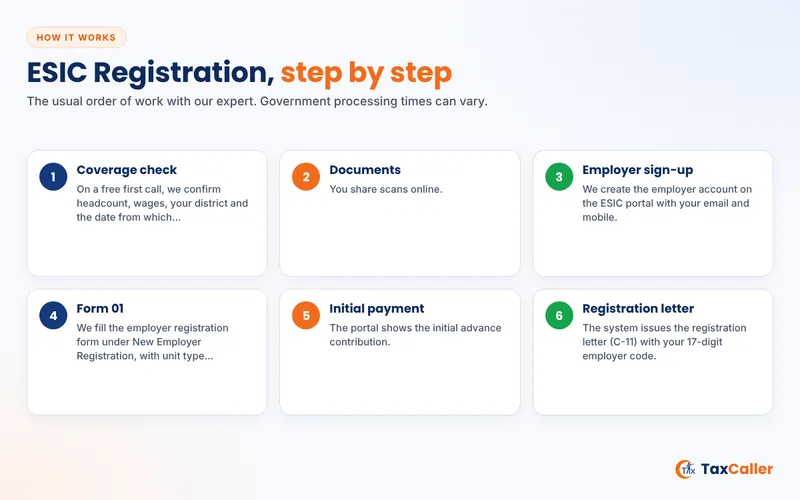
ESIC Registration: how the work moves, step by step
Coverage check: on a free first call, we confirm headcount, wages, your district and the date from which ESI applies.
Documents: you share scans online. We check names, addresses and PAN details for mismatch.
Employer sign-up: we create the employer account on the ESIC portal with your email and mobile.
Form 01: we fill the employer registration form under New Employer Registration, with unit type, address, activity, owners and employee count.
Initial payment: the portal shows the initial advance contribution. You pay it online through the gateway.
Registration letter: the system issues the registration letter (C-11) with your 17-digit employer code.
Employee registration: we register each covered worker, generate insurance numbers and help download e-Pehchan cards.
First monthly filing: we file wages and days for each employee and generate the challan, so you pay by the 15th.
Some employers register through the Shram Suvidha portal, which links ESIC and EPFO. We use whichever route suits your case. For an existing code, we only update details and do not apply again.
Things you do
Share documents and approve the form details
Pay the initial contribution from the business account
Collect family details from staff for their e-Pehchan cards
ESI (General) Regulations, 1950, continued for the transition
Employer code after online filing
Usually on submission and payment, when documents are in order
Portal practice
Register each new employee
Promptly after joining, within the time the regulations allow
ESI (General) Regulations, 1950, continued for the transition
Monthly contribution
By the 15th of the following month
ESI regulations; ESIC portal
The rules and regulations made under the 1948 Act continue under the saving clause in Section 164 of the Code for one year from 21 November 2025, that is, until 20 November 2026, to the extent they fit the Code. New regulations under the Code are expected to take over the same timelines. We follow whichever text is in force on the day we file.
How long our work takes
Once documents are complete, most employer registrations finish within a few working days. Employee registration takes a little longer if many family details are missing. We confirm your timeline on the first call.
When the duty starts
Contributions are due from the date ESI first applies to you, not from the date you apply. A late application can bring a demand for past months. So register as soon as the tenth person joins.
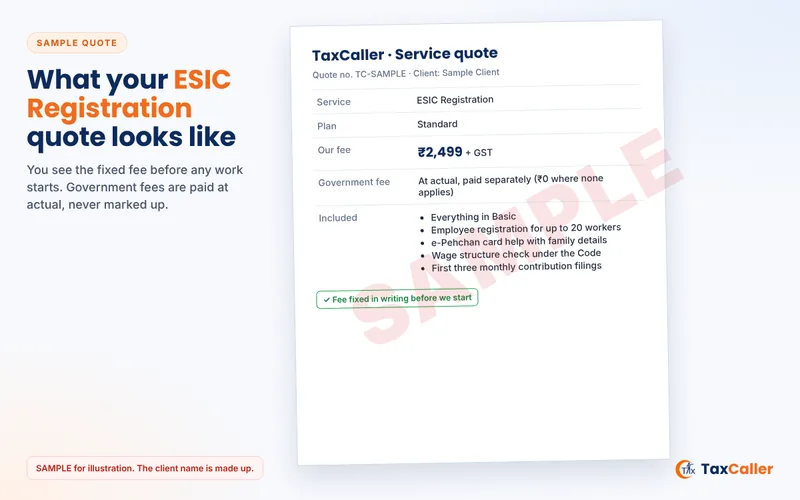
ESIC Registration: SAMPLE quote, for illustration only
ESIC charges no fee to register an employer. There is no stamp duty and no processing charge. Any site that asks for a government fee to issue an ESIC code is not ESIC.
Item
Amount
Paid to
Employer registration on the ESIC portal
Nil
Not applicable
Initial advance contribution shown by the portal
As calculated on your wages; adjusted against dues
ESIC
Monthly employer contribution
3.25% of wages
ESIC
Monthly employee contribution
0.75% of wages, deducted from pay
ESIC
Interest on late payment
12% a year
ESIC
The amounts you pay ESIC are contributions, not fees. They belong to the scheme and fund your workers' benefits. Check the current rates and circulars on the ESIC portal and the Ministry of Labour and Employment website.
Zubair Licence & Registration Expert
Have a question on this topic? Ask Zubair on a free call.
TaxCaller's fee for ESIC registration starts at ₹1,499 + GST. Government payments, such as contributions and any interest, are paid separately at actual. There is no government fee for the registration itself. Our invoice shows our fee and GST only.
What our fee covers
A free first call to confirm coverage and the start date
Document check and employer sign-up
Form 01 filing and the registration letter with your employer code
A short guide to your monthly ESI cycle
What is charged separately
Employee registration beyond the number in your plan
Monthly contribution filing, unless your plan includes it
Past-period dues, interest, damages and replies to ESIC notices
PF, professional tax or Shop Act registration
Each plan is listed with its price + GST in the pricing section. Our expert confirms your fee in writing before work starts.
Late or missing contributions are costly. The Code keeps interest and damages, and adds steep penalties for deducting the worker's share and not depositing it.
Default
Consequence
Law
Late payment of contribution
Simple interest at 12% a year for the period of delay
Section 127 of the Code (earlier the ESI Act and regulations)
Late payment of contribution
Damages that rise with the delay, not more than the arrears
Section 128 of the Code (earlier Section 85B)
Employee share deducted but not paid
Prison term of one to three years and a fine of ₹1 lakh
Section 133 of the Code
Other failure to pay contributions
Prison term of two to six months and a fine of ₹50,000
Section 133 of the Code
Repeat failure to pay after a conviction
Prison term of two to three years and a fine of ₹3 lakh
Section 134 of the Code
Not registering at all
If ESI applied but you never registered, ESIC can assess past contributions on its own estimate of wages. Interest and damages are then added to that figure. A voluntary late registration, with dues paid, is far cheaper than an assessment after inspection.
Settlement schemes
ESIC's SPREE 2025 drive let employers register unregistered units and staff without inspection or past dues for earlier periods. It closed on 31 January 2026. An ESIC amnesty scheme for pending disputes ran until 30 September 2026. If a new scheme opens, we will tell our clients.
Abhinay Rai Licence & Registration Expert
Have a question on this topic? Ask Abhinay on a free call.
The ₹21,000 ceiling, as far as we could find up to mid-November 2026
Payment by the 15th of the next month
No government fee for registration
What to watch
The one-year saving period for the old ESI regulations ends on 20 November 2026. New ESIC regulations under the Code are awaited, and the wage ceiling may be revised. We update this page when they are notified.
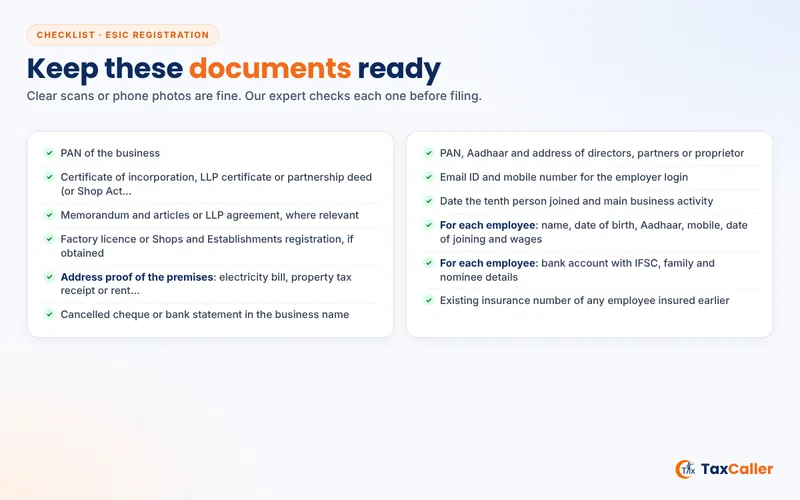
Certificate of incorporation, LLP certificate or partnership deed (or Shop Act, GST or Udyam certificate for a proprietorship)
Memorandum and articles or LLP agreement, where relevant
Factory licence or Shops and Establishments registration, if obtained
Address proof of the premises: electricity bill, property tax receipt or rent agreement
Cancelled cheque or bank statement in the business name
PAN, Aadhaar and address of directors, partners or proprietor
Email ID and mobile number for the employer login
Date the tenth person joined and main business activity
For each employee: name, date of birth, Aadhaar, mobile, date of joining and wages
For each employee: bank account with IFSC, family and nominee details
Existing insurance number of any employee insured earlier
Contractor's ESIC code and challans, for contract labour
Why TaxCaller
Real experts, not a call centre
Your work is handled by experienced professionals who explain every step, check your documents and keep you updated.
Registered company
TaxCaller is run by TaxCaller India LLP (LLPIN AAQ-7388), serving clients since 2018.
Fee told upfront
You know the complete fee, our professional fee and the government fee, before any work starts. No hidden charges.
Support after the work
Notices, renewals, returns and compliance reminders: we stay with your business after the registration is done.
Reviewed By
Expert for this topic ESIC Registration
Abhinay Rai
Advocate
Abhinay Rai is a Advocate specialising in ESIC Registration. The process, documents, timelines and fees on this page are checked against the current rules and government portals, and updated whenever the law, forms or fees change.
Yes. Under the First Schedule of the Code on Social Security, 2020, ESI applies to every establishment employing ten or more persons, other than a seasonal factory, once its area is covered. Count all staff, including contract workers and those above the wage ceiling. Units in notified hazardous work must register even with one employee.
What is the salary limit for ESIC coverage?
An employee is covered if monthly wages do not exceed ₹21,000, or ₹25,000 for a person with a disability. The Labour Ministry's March 2026 FAQs confirm this limit continues under the Code. We found no change notified up to mid-November 2026. This is separate from the new ₹25,000 PF ceiling.
What are the ESIC contribution rates in 2026?
The employer pays 3.25% and the employee 0.75% of wages, making 4% in total. These rates have applied since 1 July 2019. An employee whose average daily wage is up to ₹176 does not pay the 0.75% share, but the employer still pays 3.25%. Both shares are deposited together by the employer.
What is the due date for ESIC payment?
Contributions for a month must be paid by the 15th of the following month. For example, wages for November are covered by a payment made by 15 December. Late payment draws simple interest at 12% a year and damages. Payment is made online through the challan generated on the ESIC employer portal.
Is there any government fee for ESIC registration?
No. ESIC charges nothing to register an employer. The portal does ask for an initial advance contribution, which is adjusted against your dues, and monthly contributions follow. TaxCaller's professional fee is separate and charged + GST. Any website asking for a government fee to issue an ESIC code is not the official ESIC.
How long does ESIC registration take?
The online system usually issues the registration letter with the 17-digit employer code soon after Form 01 is submitted and the initial contribution is paid, if documents are in order. Employee registration follows. With complete documents, most of our files finish within a few working days. We confirm your timeline on the first call.
Is the ESI Act, 1948 still in force?
No. The Code on Social Security, 2020 came into force on 21 November 2025 and repealed the ESI Act under Section 164. ESI now runs under Chapter IV of the Code. Rules and regulations made under the old Act continue for one year from that date where they fit the Code, and existing registrations remain valid.
Can a business with fewer than 10 employees register under ESI?
Yes, by choice. Section 1(7) of the Code lets the ESIC Director General extend coverage where the employer and a majority of employees agree. The employer can later seek to exit. Small clinics, shops and offices sometimes do this so their workers get medical care. Contributions then apply at the normal rates.
What happens if an employee's salary goes above ₹21,000?
Cover does not end at once. A Labour Ministry notification of 8 May 2026 confirms the person stays insured until the end of the running contribution period, which ends on 30 September or 31 March. Contributions continue on actual wages till then. From the next period, the employee drops out of ESI.
What benefits does an employee get under ESIC?
An insured person and family get medical care at ESIC dispensaries and hospitals. Cash benefits include 70% of wages for up to 91 days of sickness, full wages for 26 weeks of maternity, 90% of wages for temporary disablement from work injury, dependants' benefit and ₹15,000 for funeral expenses, subject to contribution conditions.
What is the penalty for not paying ESI contributions?
Interest at 12% a year and damages up to the arrears apply under Sections 127 and 128 of the Code. If the employee's share was deducted but not paid, Section 133 provides one to three years in prison and a ₹1 lakh fine. Repeat offences after conviction attract two to three years and ₹3 lakh.
Do I need ESIC if I already have PF registration?
They are separate. PF applies at 20 employees and ESI at 10, with different wage limits and benefits. If you have 20 or more staff in a covered area with workers earning up to ₹21,000, you usually need both. Your PF code does not give an ESIC code, so apply on the ESIC portal too.
Does a new company get ESIC registration automatically?
Many companies registered through SPICe+ on the MCA portal receive an ESIC registration number with incorporation. That gives a code, but monthly payments start only when ESI applies to you. Check the incorporation email and the ESIC portal before applying again, because a duplicate code causes problems in filing and inspections later.
Book a free first call. Our tax expert checks your headcount, wages and district, then files your ESIC registration online and sets up the monthly payment.