Starting from · ₹2,299 OPC Registration Basic plan
STARTING FROM₹2,299
FEE TOLD UPFRONTFree first call
!New company?File INC-20A within 180 days of incorporation
Since 2018Trusted Experience
980+Experts Connected
220+Cities Served
1164+Agents Available
12000+Founders Trusted
S
Srishti Magoo
★★★★★
Excellent experience with TaxCaller for filing my &
my family members ITR returns. The entire process was
smooth, quick and hassle-free. They are professional,
knowledgeable and guided me through every step with patience.
O
obeid sait
★★★★★
The team has handled my taxes for the past three years,
and it's been a wonderful, hassle-free experience.
Thank you for your consistently quick and efficient service.
P
Pushkar
★★★★★
They are among the best in their field. Their work culture
is highly professional, and their client service is smooth
and reliable. They can confidently be relied on to get the job done.
P
Prasad Sheth
★★★★★
Excellent experience with TaxCaller! The ITR filing
process was smooth, quick, and completely hassle-free.
The CA was knowledgeable, responsive, and explained everything clearly.
A
Apoorv Bansal
★★★★★
Excellent service for ITR filing. The team was highly
professional, responsive, and guided me through the entire
process smoothly. My return was filed accurately and on time.
A
Abhishek Kumar
★★★★★
I was searching for a good CA firm in Ghaziabad and found
TaxCaller. The experience was excellent from start to finish.
The team is responsive, transparent, and genuinely helpful.
U
uma pandey
★★★★★
Great service! TaxCaller India made the entire ITR filing
process quick, smooth, and hassle-free. They answered all
my queries patiently and ensured maximum accuracy.
T
tanu mittal
★★★★★
Excellent job! We've been connected for many years,
and your success truly makes me happy. You are an
incredibly intelligent person. Keep shining, keep growing.
B
Bhanu Pratap Maurya
★★★★★
I am filing my ITR since past 3 years with Abhinav and
Firm is known as TaxCaller and they are professional
interms of ITR rules. They will explain and tell you all
the information.
A
ashish Sharma
★★★★★
I am providing my honest reviews:
No.1 service ...
A
AARYAN GROUP
★★★★★
Honestly, finding a good CA firm in Ghaziabad was
confusing, but TaxCaller India made it simple.
I contacted them for GST work and the experience was smooth.
N
News Speaks
★★★★★
If you're looking for a reliable CA firm in Ghaziabad,
TaxCaller India is a great choice. They provide complete
taxation and compliance solutions including GST.
A
Anshul Chaprana
★★★★★
Got my GST registration done through TaxCaller CA firm.
Process was quite smooth, they guided properly on documents
and didn't waste time. Overall good experience.
How we work
Online · Call · WhatsApp
Quick answer
OPC registration means incorporating a One Person Company, a private company with one member and a nominee, through the MCA's SPICe+ form. The member and nominee must be Indian citizens, residents or NRIs. It usually takes 7 to 15 working days. TaxCaller's fee starts at ₹2,299 + GST; government fees and stamp duty are extra.
Reviewed by Abhinay Rai · Updated 15 Nov 2026
Pick a plan that fits
Basic
A solo founder who needs only the OPC incorporated
₹2,299+ GST
+ Govt. fee and stamp duty at actual
Pay now (38%)₹874+ GSTAfter the CIN₹1,425+ GST
Handled by a TaxCaller Expert Company Registration Expert
Government fees and taxes are extra where applicable. Our expert confirms the final amount on the first call. No hidden charges.
About One Person Company Registration
OPC registration is the legal process of incorporating a One Person Company with the Ministry of Corporate Affairs (MCA) under the Companies Act, 2013. An OPC lets a single founder own 100 percent of a private limited company. You get limited liability and a separate legal identity, without finding a second shareholder. The company is formed online through the SPICe+ form, and no office visit is needed.
One person company registration has rules of its own. Only an Indian citizen can be the member, and a nominee must be named in the memorandum. A person can own only one OPC. This page explains those rules, the 2021 changes for NRIs, the nominee forms, the compliance relief an OPC gets, conversion into a Pvt Ltd company, and what changed in 2026.
TaxCaller has worked with founders since 2018. Our tax experts check your eligibility, prepare the MoA, AoA and nominee consent, file SPICe+ and answer the Registrar's queries until your Certificate of Incorporation is issued. Everything is done online, so you can register from any city in India.
Complete guide
Choose a topic to open it. Every answer gives the rule or section it comes from.
01 Topic 1 of 20
What Is a One Person Company (OPC)?
Section 2(62) of the Companies Act, 2013 defines a One Person Company as a company that has only one person as a member. Section 3(1)(c) lets a single person form such a company, and calls it a private company. So an OPC is a private limited company with one owner instead of two or more.
The law treats the OPC as a separate legal person. It has its own name, CIN, PAN and TAN. It can open a current account, sign contracts and own assets in its own name. Your personal assets are not normally at risk for its business debts. That is the main difference from a sole proprietorship, where you and the business are one and the same.
Three features make an OPC different from a regular Pvt Ltd company:
One member only: all the shares are held by one individual.
A nominee: the memorandum must name another person who will become the member if the owner dies or cannot contract.
A special name tag: the second proviso to Section 12(3) says the words "One Person Company" must appear in brackets below the name wherever it is printed or affixed.
Key terms on this page
Member: the single shareholder who owns the OPC.
Nominee: the person named to take over the shares on the member's death or incapacity.
SPICe+ (Form INC-32): the MCA web form used to reserve the name and incorporate the company.
DSC and DIN: the digital signature used to sign the forms, and the director's identity number.
CRC: the Central Registration Centre of the MCA, which processes new incorporation forms.
An OPC fits a solo founder who wants limited liability and a company name, but does not plan to bring in a partner or investor soon. Freelancers, consultants, traders, small manufacturers and one-person agencies often fit this profile.
Choose an OPC if you work alone, want your personal assets kept apart from business risk and want clients to see a registered company.
Choose a Private Limited Company if you have a co-founder or plan to raise equity or give ESOPs in the next year or two.
Choose an LLP if two or more professionals want limited liability with lighter rules and no investor plans.
Choose a proprietorship if the business is very small and low risk, and you want the lowest cost for now.
A full side-by-side comparison of every structure is on our company registration page. If you are still unsure, our expert will help you decide on the first call before you pay anything.
Shadab Company Registration Expert
Have a question on this topic? Ask Shadab on a free call.
Who Can Register an OPC: Eligibility and Minimum Requirements
The eligibility rules come from Rule 3 of the Companies (Incorporation) Rules, 2014. They are strict, so check them before you start.
Who can be the member and the nominee
Only a natural person: a company, LLP, trust or firm cannot form an OPC.
Indian citizen only: the member and the nominee must be Indian citizens, whether resident in India or not (Rule 3(1)).
One OPC per person: a person can be a member of only one OPC at a time and a nominee in only one OPC (Rule 3(2)).
180-day rule: if a member of one OPC becomes a member of another because they were its nominee, they must meet the one-OPC limit within 180 days (Rule 3(3)).
No minors: a minor cannot be a member or nominee, or hold shares with beneficial interest (Rule 3(4)).
What an OPC cannot do
It cannot be formed as, or converted into, a Section 8 (non-profit) company (Rule 3(5)).
It cannot carry on non-banking financial investment activity, including investing in the securities of other companies (Rule 3(6)).
Minimum requirements
Requirement
Rule for an OPC
Source
Members
Exactly one
Section 2(62)
Directors
Minimum one, maximum 15 (more with a special resolution)
Section 149(1)
First director
The member is deemed the first director until one is appointed
Section 152(1)
Resident director
At least one director must stay in India for 182 days or more in the financial year
Section 149(3)
Share capital
No minimum paid-up capital; most founders start with ₹1 lakh authorised capital
Companies (Amendment) Act, 2015
Registered office
An address in India able to receive post, within 30 days of incorporation
Section 12(1)
Nominee
One adult Indian citizen, named in the memorandum with written consent
Section 3(1), Rule 4
Name rules
The name of an OPC must end with "Private Limited" under Section 4(1)(a). In practice, approved OPC names carry "(OPC) Private Limited" at the end. The name must not be identical or too similar to an existing company, LLP or registered trademark. Words that suggest a link with the government, or words like "Bank" or "Insurance", need extra approval. We usually suggest two names, each with a clear brand word and a word that describes your activity.
Before 1 April 2021, only an Indian citizen living in India could form an OPC. The Companies (Incorporation) Second Amendment Rules, 2021, notified on 1 February 2021 and in force from 1 April 2021, changed this. Rule 3(1) now allows an Indian citizen "whether resident in India or otherwise" to form an OPC and to act as nominee.
What the 2021 amendment changed
NRIs allowed: Indian citizens living abroad can now be the member or the nominee.
Shorter residence test: the meaning of "resident in India" in Rule 3 dropped from 182 days to 120 days of stay in the preceding financial year.
No forced conversion: the old rule that forced an OPC to convert once paid-up capital crossed ₹50 lakh or average turnover crossed ₹2 crore was removed.
No two-year wait: the bar on voluntary conversion within two years of incorporation was removed (Rule 3(7) omitted).
Who still cannot form an OPC
Foreign nationals cannot form an OPC or be its nominee. An OCI cardholder who is not an Indian citizen is also not eligible. A foreign citizen who wants a company in India should look at a Private Limited Company instead.
The resident director point NRIs often miss
Section 149(3) still applies to an OPC. Every company must have at least one director who stays in India for at least 182 days in the financial year. For a new company, this is checked proportionately at the end of its first financial year. So an NRI who lives abroad all year usually appoints a resident Indian as a second director. That person is a director only. They do not own any shares.
Documents and money from abroad
A valid passport is the main identity proof. A PAN is also given if the NRI has one.
Overseas address proof, such as a bank statement or utility bill, is needed.
Documents signed abroad are usually notarised and apostilled, or attested by the Indian embassy.
Share money sent from abroad must follow FEMA rules. We explain the repatriable and non-repatriable routes on the call, and the bank completes its own checks.
The Nominee: Role, Consent (INC-3) and Changes (INC-4)
The nominee is what makes an OPC possible. The first proviso to Section 3(1) says the memorandum must name another person, with that person's prior written consent, who will become the member if the subscriber dies or becomes unable to contract. This keeps the company alive, which is called perpetual succession.
Who can be a nominee
An adult Indian citizen, resident in India or abroad.
A person who is not already a nominee in another OPC.
Often a spouse, parent, sibling or trusted family member. The law does not require a relative.
The nominee has no rights in the company while the member is alive and able. They do not own shares, sign forms or take part in decisions.
How consent is given
For many years, the nominee gave consent in a separate Form INC-3. That is why most people still call it the INC-3 consent. Since the January 2023 amendment to Rule 4(2) (G.S.R. 42(E), in force from 23 January 2023), the nomination and consent are filed as a declaration inside SPICe+ (INC-32), along with the e-MoA and e-AoA. The same amendment omitted Form INC-3, so consent for a later change is given as a declaration in Form INC-4. We draft the consent, get it signed by the nominee and attach it to the filing. You do not file a separate form.
Changing the nominee later
Event
What must happen
Time limit
Nominee withdraws consent
Nominee gives written notice; member names a new nominee
New nominee within 15 days of the notice (Rule 4(3))
Company reports the withdrawal
File Form INC-4 with the new nominee's consent
Within 30 days of the notice (Rule 4(4))
Member changes the nominee by choice
Member informs the company; company files INC-4
Within 30 days of the intimation (Rule 4(5))
Member dies or becomes incapable
Nominee becomes member and names a new nominee; company files INC-4
New nominee within 15 days; INC-4 within 30 days (Rule 4(6))
Under the fifth proviso to Section 3(1), changing the nominee is not treated as changing the memorandum. So no special resolution or MoA amendment is needed.
Shreya Company Registration Expert
Have a question on this topic? Ask Shreya on a free call.
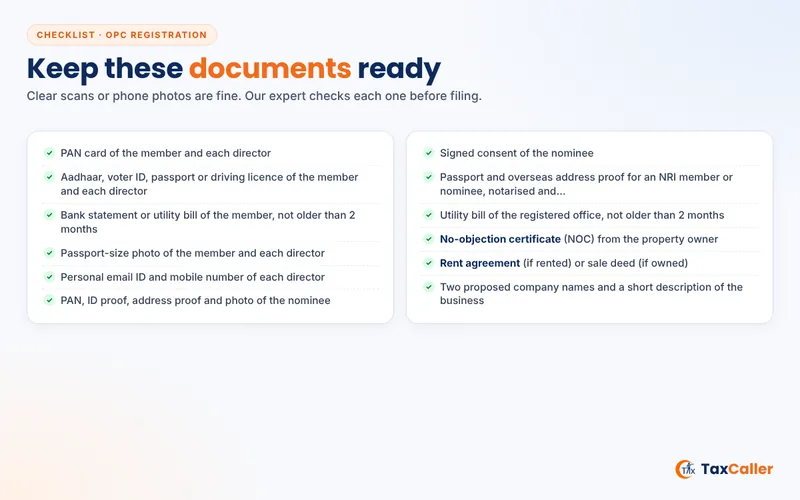
Keep clear scans or phone photos of these papers. Names, dates of birth and addresses must match across all documents.
Person or item
Documents
Member and director (Indian resident)
PAN card; Aadhaar, voter ID, passport or driving licence; bank statement or utility bill not older than 2 months; passport-size photo; personal mobile number and email
Nominee
PAN card; Aadhaar or another ID proof; address proof; photo; signed consent to act as nominee
NRI member or nominee
Passport; PAN if available; overseas address proof; documents notarised and apostilled or attested by the Indian embassy
Second director (if any)
Same KYC as the member, plus consent to act as director (DIR-2)
Registered office (owned)
Sale deed or property tax receipt, plus a utility bill not older than 2 months
Registered office (rented)
Rent agreement, NOC from the owner, and the owner's utility bill not older than 2 months
Business details
Two proposed names, a short description of the business, and the authorised and paid-up capital you want
Forms we prepare for you
SPICe+ Part A (name) and Part B (incorporation), Form INC-32
e-MoA (INC-33) and e-AoA (INC-34)
Declaration and affidavit by the subscriber and first director (INC-9)
Consent of the director (DIR-2) and nominee consent declaration
AGILE-PRO-S (INC-35) for GSTIN, EPFO, ESIC, professional tax and bank account, as applicable
A home address can be the registered office. If the house is not in your name, you also need an NOC from the owner along with the utility bill.
OPC Registration Process: How TaxCaller Files SPICe+ Online
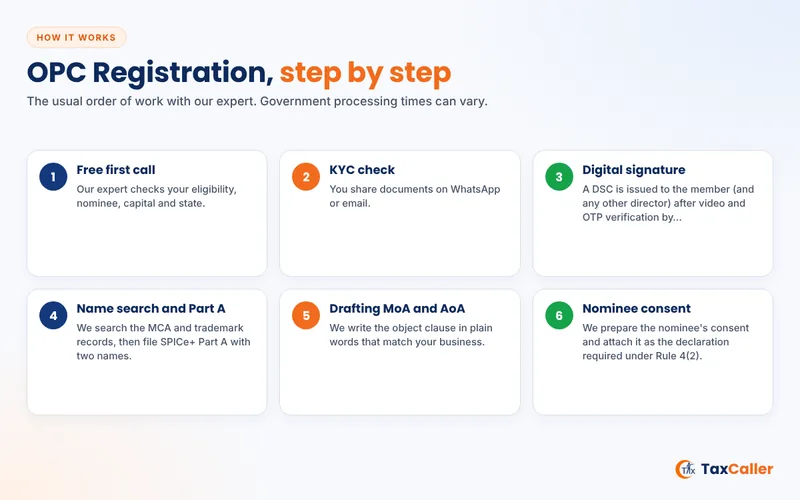
OPC Registration: how the work moves, step by step
The whole process is online. You do not visit any government office. Here is the exact path we follow.
Free first call: our expert checks your eligibility, nominee, capital and state. You get our fee and the expected government fees in writing.
KYC check: you share documents on WhatsApp or email. We check every name, date and address for mismatches before filing.
Digital signature: a DSC is issued to the member (and any other director) after video and OTP verification by a licensed certifying authority.
Name search and Part A: we search the MCA and trademark records, then file SPICe+ Part A with two names. If the name is clearly unique, Part A and Part B can be filed together.
Drafting MoA and AoA: we write the object clause in plain words that match your business. The AoA is adapted for a single member and the nominee.
Nominee consent: we prepare the nominee's consent and attach it as the declaration required under Rule 4(2).
SPICe+ Part B: we enter capital, office, member, director and nominee details. DIN is allotted through the form, so no separate DIN application is needed.
AGILE-PRO-S: we add EPFO and ESIC details, professional tax where your state has it, the bank account request and GSTIN if you want it now.
Signing and payment: forms are signed with DSC. We pay the government fee and stamp duty on the MCA portal and share the challan.
CRC review: if the Registrar marks the form for resubmission, we fix it and refile within the allowed time.
Certificate of Incorporation: the certificate (INC-11) is emailed with the CIN. PAN and TAN are issued with it.
Handover: you get a checklist for the bank account, share certificate, auditor and INC-20A.
The MCA explains SPICe+ Part A, Part B and the linked forms in its own MCA SPICe+ guide (PDF). You can also check your application status with the SRN on the MCA portal.
Zubair Company Registration Expert
Have a question on this topic? Ask Zubair on a free call.
Most OPCs are incorporated in about 7 to 15 working days from the day we get complete documents. The table shows each stage. Government processing time is outside our control, so treat these as usual ranges, not promises.
Stage
Usual time
What can slow it down
Document check
Same day to 1 day
Mismatched names or old bills
DSC issue
1 to 2 days
Video verification not completed
Name approval (Part A)
2 to 4 working days
Name too close to an existing company or trademark
Drafting and signing
1 to 2 days
Delay in nominee consent or signatures
CRC processing (Part B)
3 to 7 working days
Resubmission notes from the Registrar
PAN and TAN
Issued with the certificate
Rare data mismatch with PAN records
An approved name is reserved for 20 days under Rule 9. It can be extended under Rule 9A for a fee if you need more time. Delays at the end usually come from the bank account or GST registration, not the incorporation itself.
OPC Registration: SAMPLE quote, for illustration only
These sums are paid to the government or to third-party providers. They are shown separately because they are not part of TaxCaller's fee. We pay them for you at actual and share every receipt.
Item
Amount
Source
Name reservation (SPICe+ Part A or RUN)
₹1,000 per application
MCA SPICe+ guide
Extension of name validity
₹1,000 up to 40 days; further ₹2,000 up to 60 days
Rule 9A, Companies (Incorporation) Rules, 2014
SPICe+ filing fee, authorised capital up to ₹15 lakh
Nil
MCA (G.S.R. 180(E), 6 March 2019)
SPICe+ filing fee, capital above ₹15 lakh
As per the Table of Fees, based on capital
Companies (Registration Offices and Fees) Rules, 2014
Stamp duty on MoA and AoA
Varies by state and authorised capital
State stamp law, collected on the MCA portal
PAN and TAN of the company
Small fees, collected in the SPICe+ payment
MCA SPICe+ guide
DSC for the member and any other director
Charged by the certifying authority
Market rate
Notary and apostille for NRI papers
At actual
Country where signed
How stamp duty works
Stamp duty is a state levy. It depends on the state of your registered office and on the authorised capital. For states linked with the MCA system, it is paid with the SPICe+ fee in one challan. A share certificate issued later may also need stamp duty under state law. Keeping authorised capital at ₹1 lakh to ₹10 lakh usually keeps the duty low. You can raise it later when you need to.
For a typical OPC with ₹1 lakh authorised capital, the MCA filing fee is nil. The main government cost is the name fee and your state's stamp duty. Your state's exact figure is shared on the first call.
TaxCaller's fee covers our professional work only. TaxCaller's fee for OPC registration starts at ₹2,299 + GST. You pay government fees (name reservation fee, MCA filing fee if any, stamp duty and PAN/TAN fees) separately, at actual. Nothing is added later without your approval.
Plan
Suited to
What is included
Basic
A solo founder who needs only the company
Name approval, 1 DSC, DIN, MoA and AoA, nominee consent, Certificate of Incorporation, PAN and TAN
Standard
A founder who will bill clients from day one
Everything in Basic, plus GST registration, Udyam registration and help opening a current account
Premium
A founder who wants the first-year setup handled
Everything in Standard, plus first auditor (ADT-1) filing and INC-20A commencement filing
When the fee can change
An NRI member or nominee, where papers come from abroad
A second director needing a DSC and DIN
Authorised capital above ₹15 lakh, which brings an MCA fee
Name resubmissions caused by a name you insist on after our advice
The prices for each plan are shown in the plan cards on this page. Yearly compliance such as audit support, ROC returns and bookkeeping is a separate service. See accounting and bookkeeping for that.
Abhinay Rai Company Registration Expert
Have a question on this topic? Ask Abhinay on a free call.
The Companies Act gives an OPC several exemptions that a regular private company does not get. This is a big reason solo founders choose an OPC over a two-member Pvt Ltd company.
Area
Regular Pvt Ltd
One Person Company
Section
Annual General Meeting
Must hold an AGM every year
No AGM needed
Section 96(1)
Member resolutions
Passed at general meetings
Member's resolution entered in the minute book, signed and dated, is enough
Section 122(3)
Board meetings
At least 4 a year (small companies: 2)
One in each half of the calendar year, gap of at least 90 days; none if only one director
Section 173(5)
Board resolutions with one director
Passed at board meetings
Entry in the minute book, signed and dated by the director
Section 122(4)
Cash flow statement
Required, with some exceptions
Not required
Section 2(40)
Signing financial statements
Two directors or more
One director
Section 134(1)
Board's report
Full report with many items
Only comments on the auditor's qualifications or adverse remarks
Section 134
Filing financial statements (AOC-4)
Within 30 days of the AGM
Within 180 days from the end of the financial year
Section 137(1)
Annual return
MGT-7 or MGT-7A
MGT-7A, signed by the director if there is no company secretary
Section 92(1)
Penalties
Full penalty
Up to half, capped at ₹2 lakh for the company and ₹1 lakh for an officer
Section 446B
What is not relaxed
Audit: a statutory audit by a practising auditor is still needed every year.
Books of account: proper books must be kept at the registered office under Section 128.
Contracts with yourself: under Section 193, a contract between the OPC and its sole member who is also a director must be in writing or recorded in the minutes, unless it is made in the ordinary course of business. The Registrar must be informed within 15 days of board approval.
Tax returns: the income tax return, TDS returns and GST returns are the same as for any company.
Compliance After Incorporation: First Year and Every Year
Registration is only the start. These duties keep your OPC in good standing and avoid the penalties in the next section.
One-time tasks after incorporation
Task
Deadline
Law
Open a current account and deposit share money
Soon after incorporation
Needed for INC-20A
Appoint the first auditor (ADT-1 filed by practice)
Within 30 days of registration
Section 139(6)
Issue share certificate to the member
Within 2 months of incorporation
Section 56(4)(a)
Declaration for commencement of business (INC-20A)
Within 180 days of incorporation
Section 10A
Display name with "(One Person Company)" below it
From incorporation
Section 12(3)
Statutory registers, such as the register of members
From incorporation
Section 88
Every year
Task
Deadline
Law or rule
Board meetings (if more than one director)
One in each half of the calendar year
Section 173(5)
Statutory audit
Every year, before filing
Section 139
Financial statements (AOC-4)
Within 180 days of the year end, so by 27 September for a March year end
Section 137(1)
Annual return (MGT-7A)
Within 60 days of the date by which an AGM would have been due; usually treated as late November
Section 92(4)
Director KYC (DIR-3 KYC)
Once every three financial years, by 30 June
Rule 12A, Appointment and Qualification of Directors Rules
Return of deposits (DPT-3)
By 30 June, where applicable
Rule 16, Acceptance of Deposits Rules
MSME-1 (dues to micro and small suppliers over 45 days)
Half-yearly, where applicable
Section 405 order
Nominee change (INC-4)
Within 30 days of the change
Rule 4
Tax filings
An OPC is taxed as a domestic company. It must file an income tax return every year, even with a loss or no business. Returns for financial year 2025-26 follow the Income-tax Act, 1961. From tax year 2026-27, the Income-tax Act, 2025 applies. A company can choose the concessional 22% rate (plus surcharge and cess) if it gives up certain deductions. See our income tax filing service.
If you deduct tax on rent, salary or professional fees, quarterly TDS returns are due. If you take a GSTIN, monthly or quarterly GST returns follow. Official tax rules are on the Income Tax Department website.
An OPC pays lower penalties than a regular company, but the defaults are the same. The table lists the ones new owners meet first.
Default
Penalty in the Act
Section
INC-20A not filed within 180 days
Company ₹50,000; each officer in default ₹1,000 a day, up to ₹1,00,000
Section 10A(2)
Registered office not kept, or name not displayed
₹1,000 a day, up to ₹1,00,000, for the company and each officer
Section 12(8)
AOC-4 or MGT-7A filed late
Additional fee of ₹100 a day for each form
Section 403 with the Fees Rules
Annual return not filed
₹10,000 plus ₹100 a day; up to ₹2 lakh for the company and ₹50,000 for officers
Section 92(5)
Financial statements not filed
₹10,000 plus ₹100 a day; up to ₹2 lakh for the company and ₹50,000 for officers
Section 137(3)
DIR-3 KYC not filed
DIN deactivated; ₹5,000 fee to reactivate
Rule 12A, with the Fees Rules
Annual filings missed for 3 years in a row
Director disqualified for 5 years
Section 164(2)
No business, or INC-20A missed
Name can be struck off the register
Section 248(1)
How Section 446B helps an OPC
Section 446B says an OPC, a small company, a startup company or a producer company pays not more than half of the penalty in the relevant section. The maximum is ₹2 lakh for the company and ₹1 lakh for an officer in default. The additional fee for late forms is a fee, not a penalty, so it is not halved.
A simple yearly calendar avoids most of these. We share one with every client after incorporation.
Shadab Company Registration Expert
Have a question on this topic? Ask Shadab on a free call.
Converting an OPC to a Pvt Ltd, and a Company to an OPC
Section 18 lets a company of one class convert into another class by changing its memorandum and articles. The details for OPCs are in Rules 6 and 7 of the Companies (Incorporation) Rules, 2014, as substituted from 1 April 2021.
OPC into a Private or Public Limited Company (Rule 6)
When: any time. There is no capital or turnover trigger and no two-year wait since 2021.
Members and directors: raise members to at least 2 and directors to at least 2 for a private company (7 members and 3 directors for a public company).
Resolution: the member passes a resolution under Section 122(3) to alter the MoA and AoA.
Form: file Form INC-6 with the altered MoA and AoA, the resolution, consents of new members and directors, a list of creditors and the latest audited accounts.
Result: the Registrar approves the form and issues a fresh certificate. Under Section 18(3), the company's existing debts, liabilities and contracts continue.
Private company into an OPC (Rule 7)
The company passes a special resolution in a general meeting.
Members are reduced to one, and a nominee is named.
Directors give an affidavit that all members and creditors have consented to the conversion.
Form INC-6 is filed with this affidavit and the other documents that Rule 7 lists.
A Section 8 company cannot convert into an OPC.
Proprietorship into an OPC
There is no direct conversion route under the Companies Act. You incorporate a new OPC and transfer the business to it, usually through a business transfer agreement. Assets, GST registration, bank accounts and contracts then move in steps. We plan this on the call if you already run a proprietorship.
A converted Pvt Ltd company may still count as a small company. Since 1 December 2025, a private company with paid-up capital up to ₹10 crore and turnover up to ₹100 crore is a small company (G.S.R. 880(E)). It keeps several reliefs, such as MGT-7A and two board meetings a year.
A few avoidable mistakes cause most of the delays. We check each of these before filing.
Ineligible nominee: a minor, a foreign citizen, or a person already a nominee in another OPC.
Second OPC: the member already owns another OPC. The MCA system catches this.
No resident director: an NRI member with no director who stays 182 days in India.
Weak name: a plain dictionary word, or a name close to an existing company or trademark.
Old address proof: a bill more than two months old is not accepted.
Owner mismatch: the person named on the bill or deed must be the one who signs the NOC.
Name spelling: the name and date of birth must match across PAN, Aadhaar and DSC.
Barred activity: objects that include investment in securities or lending.
Vague objects: the main object should describe your real business in clear words.
Unattested foreign papers: NRI documents without apostille or embassy attestation.
Too much capital: a high authorised capital raises stamp duty with no benefit.
Shared contact details: the director needs a personal mobile number and email.
After incorporation, the two most common slips are forgetting INC-20A and missing the 30-day auditor appointment. Put both in your calendar on day one.
These are the official changes and proposals in 2026 that matter to an OPC owner. We follow the rules in force today and will update this page when new ones are notified.
1. Director KYC moved to once in three years (in force)
The Companies (Appointment and Qualification of Directors) Amendment Rules, 2025 (G.S.R. 943(E), dated 31 December 2025) ended the yearly DIR-3 KYC with effect from 31 March 2026. KYC is now due once every three financial years, by 30 June. A change in mobile number, email or address must be updated within 30 days.
2. New Income-tax Act from 1 April 2026 (in force)
The Income-tax Act, 2025 replaced the 1961 Act from 1 April 2026. It uses the term "tax year" in place of previous year and assessment year. An OPC's return for financial year 2025-26 is still filed under the 1961 Act. Income from 1 April 2026 falls under the new Act.
The MCA issued a draft with a public notice dated 8 April 2026 and took comments until 9 May 2026, as stated in the PIB release of 17 April 2026. The proposals that touch OPCs are:
Removing the directors' affidavit now needed when a company converts into an OPC.
Omitting Rule 7A, the provision on criminal liability that applies only to OPCs.
Merging INC-4 (nominee and member change) into a new combined change form, and INC-6 (conversion) into a combined conversion form.
Allowing DIN for up to five directors in SPICe+, up from three.
As of November 2026, we have not seen a final notification in the Gazette. Until it is notified, the current forms and rules apply.
This Bill was introduced in the Lok Sabha on 23 March 2026 and sent to a Joint Committee of Parliament, which presented its report on 3 August 2026. PRS Legislative Research does not show it as passed, and as of November 2026 it is still pending. It proposes only one board meeting in each calendar year for OPCs, small companies and dormant companies, under an amended Section 173(5). It would also let the government prescribe a penalty below one-half under Section 446B. It is not law yet, so the current two-meeting rule still applies.
5. Higher small company limits (from December 2025)
G.S.R. 880(E) raised the small company limits to ₹10 crore paid-up capital and ₹100 crore turnover from 1 December 2025. This matters when your OPC grows and converts, as the new Pvt Ltd company is likely to keep small company reliefs.
Shreya Company Registration Expert
Have a question on this topic? Ask Shreya on a free call.
OPC registration is a central process. SPICe+ is filed on the MCA portal and processed by the Central Registration Centre, whichever state you are in. After incorporation, your company falls under the Registrar of Companies (ROC) for your state. For example, the ROC Kanpur covers Uttar Pradesh, including Ghaziabad and Noida, and the ROC Delhi covers Delhi and Haryana, including Gurugram.
Two things still change by state:
Stamp duty: each state sets its own duty on the MoA, AoA and share certificates.
Professional tax: some states, such as Maharashtra, Karnataka and West Bengal, levy it. Delhi and Uttar Pradesh do not.
Our office is in Ghaziabad, and we work online with founders across India. If your registered office is in a state with special rules, our expert will tell you the exact stamp duty and any extra registration on the first call.
Most new OPCs need a few more registrations in the first months. Each one has its own page.
GST Registration: needed once turnover crosses the limit, or for interstate supply of goods and most online selling. Official rules are on the GST portal.
MSME (Udyam) Registration: a free registration that supports loans, tenders and protection against delayed payments.
Trademark Registration: protects your brand name and logo. A company name alone does not.
Aadhaar, voter ID, passport or driving licence of the member and each director
Bank statement or utility bill of the member, not older than 2 months
Passport-size photo of the member and each director
Personal email ID and mobile number of each director
PAN, ID proof, address proof and photo of the nominee
Signed consent of the nominee
Passport and overseas address proof for an NRI member or nominee, notarised and apostilled
Utility bill of the registered office, not older than 2 months
No-objection certificate (NOC) from the property owner
Rent agreement (if rented) or sale deed (if owned)
Two proposed company names and a short description of the business
Proposed authorised and paid-up capital
Why TaxCaller
Real experts, not a call centre
Your work is handled by experienced professionals who explain every step, check your documents and keep you updated.
Registered company
TaxCaller is run by TaxCaller India LLP (LLPIN AAQ-7388), serving clients since 2018.
Fee told upfront
You know the complete fee, our professional fee and the government fee, before any work starts. No hidden charges.
Support after the work
Notices, renewals, returns and compliance reminders: we stay with your business after the registration is done.
Reviewed By
Expert for this topic OPC Registration
Abhinay Rai
Advocate
Abhinay Rai is a Advocate specialising in OPC Registration. The process, documents, timelines and fees on this page are checked against the current rules and government portals, and updated whenever the law, forms or fees change.
OPC registration is the process of incorporating a One Person Company with the Ministry of Corporate Affairs through the SPICe+ form. It creates a private company with a single member and a named nominee. After approval, the Registrar issues a Certificate of Incorporation with a CIN, and the company gets its own PAN and TAN.
How much does it cost to register a One Person Company?
The cost has two parts. Government fees include ₹1,000 for name reservation, a nil MCA filing fee up to ₹15 lakh authorised capital, small PAN and TAN fees, and state stamp duty. Our professional fee is separate, plus GST, and is shown in the plans above. We confirm your exact total in writing first.
How many days does OPC registration take?
Most OPCs are incorporated in about 7 to 15 working days after we receive complete documents. The DSC takes a day or two, name approval two to four working days, and CRC processing three to seven working days. Delays usually come from a rejected name, mismatched documents or a resubmission note from the Registrar.
Can an NRI register a One Person Company in India?
Yes. Since 1 April 2021, an Indian citizen living abroad can form an OPC and can also be a nominee. Foreign nationals and non-citizen OCI holders cannot. Remember that Section 149(3) needs at least one director who stays in India for 182 days in the financial year, so an NRI owner usually appoints a resident director.
Who can be a nominee in an OPC?
The nominee must be an adult Indian citizen, resident in India or abroad, and cannot be a nominee in any other OPC. It is often a spouse, parent or sibling, but any trusted person works. The nominee holds no shares and has no role until the member dies or becomes unable to contract.
Is Form INC-3 still needed for the nominee?
Not as a separate form. Since a January 2023 amendment to Rule 4(2), the nominee's consent is filed as a declaration inside SPICe+ along with the e-MoA and e-AoA. Form INC-3 was omitted, though people still say INC-3 consent. Any later change of nominee is reported in Form INC-4 within 30 days, with the new nominee's consent.
What is the minimum capital needed for an OPC?
There is no minimum paid-up capital under the Companies Act. You can start with any amount that suits your business, even a few thousand rupees. Most founders keep authorised capital at ₹1 lakh, because the MCA filing fee is nil up to ₹15 lakh and a lower amount keeps state stamp duty small.
Can an OPC have more than one director?
Yes. An OPC needs at least one director and can have up to 15 under Section 149(1). The single member is often the only director. You can add other directors, such as a resident Indian director for an NRI owner, without giving them shares. Only the number of members is fixed at one.
Is there a turnover limit for an OPC?
No. Before April 2021, an OPC had to convert once paid-up capital crossed ₹50 lakh or average turnover crossed ₹2 crore. The Companies (Incorporation) Second Amendment Rules, 2021 removed those limits. Today an OPC can grow without any cap and convert into a private company only when you choose to add members.
Is an audit compulsory for an OPC with low turnover?
Yes. Every OPC must get its accounts audited each year by a practising auditor under Section 139, even with very low or zero turnover. The first auditor is appointed by the board within 30 days of registration. The audited financial statements are then filed in AOC-4 within 180 days from the end of the year.
Can a salaried employee register an OPC?
Yes, the Companies Act does not stop a salaried person from forming an OPC or being its director. Check your employment contract, since many employers bar side businesses or ask for prior approval. Government employees usually need permission under their service rules. The OPC's income is the company's, while your salary is taxed separately.
Is GST registration mandatory for an OPC?
Not always. An OPC needs GST registration once its turnover crosses the threshold, which is ₹40 lakh for most goods and ₹20 lakh for services in most states. It is needed from the start for interstate supply of goods and for most online marketplace sales. GSTIN can be requested in AGILE-PRO-S at incorporation.
Which is better, an OPC or a sole proprietorship?
An OPC gives limited liability, a separate legal identity and continuity through the nominee. A proprietorship is cheaper and simpler, with no audit under company law and tax at personal slab rates. If your business carries contract risk or needs a company image, an OPC fits better. For very small, low-risk work, a proprietorship can be enough.
Can an OPC be converted into a Private Limited Company?
Yes, at any time since April 2021. The member passes a resolution to alter the MoA and AoA, adds at least one more member and director, and files Form INC-6 with the Registrar. Once approved, a fresh certificate is issued. Under Section 18(3), the company's existing debts, liabilities and contracts continue after conversion.
Register your One Person Company with a tax expert
Book a free call to check your eligibility, nominee and total cost. Our fee starts at ₹2,299 + GST, with government fees and stamp duty shown separately.