!Brand not protected?Your rights count from the filing date, so file early
Since 2018Trusted Experience
980+Experts Connected
220+Cities Served
1164+Agents Available
12000+Founders Trusted
S
Srishti Magoo
★★★★★
Excellent experience with TaxCaller for filing my &
my family members ITR returns. The entire process was
smooth, quick and hassle-free. They are professional,
knowledgeable and guided me through every step with patience.
O
obeid sait
★★★★★
The team has handled my taxes for the past three years,
and it's been a wonderful, hassle-free experience.
Thank you for your consistently quick and efficient service.
P
Pushkar
★★★★★
They are among the best in their field. Their work culture
is highly professional, and their client service is smooth
and reliable. They can confidently be relied on to get the job done.
P
Prasad Sheth
★★★★★
Excellent experience with TaxCaller! The ITR filing
process was smooth, quick, and completely hassle-free.
The CA was knowledgeable, responsive, and explained everything clearly.
A
Apoorv Bansal
★★★★★
Excellent service for ITR filing. The team was highly
professional, responsive, and guided me through the entire
process smoothly. My return was filed accurately and on time.
A
Abhishek Kumar
★★★★★
I was searching for a good CA firm in Ghaziabad and found
TaxCaller. The experience was excellent from start to finish.
The team is responsive, transparent, and genuinely helpful.
U
uma pandey
★★★★★
Great service! TaxCaller India made the entire ITR filing
process quick, smooth, and hassle-free. They answered all
my queries patiently and ensured maximum accuracy.
T
tanu mittal
★★★★★
Excellent job! We've been connected for many years,
and your success truly makes me happy. You are an
incredibly intelligent person. Keep shining, keep growing.
B
Bhanu Pratap Maurya
★★★★★
I am filing my ITR since past 3 years with Abhinav and
Firm is known as TaxCaller and they are professional
interms of ITR rules. They will explain and tell you all
the information.
A
ashish Sharma
★★★★★
I am providing my honest reviews:
No.1 service ...
A
AARYAN GROUP
★★★★★
Honestly, finding a good CA firm in Ghaziabad was
confusing, but TaxCaller India made it simple.
I contacted them for GST work and the experience was smooth.
N
News Speaks
★★★★★
If you're looking for a reliable CA firm in Ghaziabad,
TaxCaller India is a great choice. They provide complete
taxation and compliance solutions including GST.
A
Anshul Chaprana
★★★★★
Got my GST registration done through TaxCaller CA firm.
Process was quite smooth, they guided properly on documents
and didn't waste time. Overall good experience.
How we work
Online · Call · WhatsApp
Quick answer
A trademark objection reply is a written answer to the Registry's examination report, filed online within one month of receiving it. Under Rule 33(4) of the Trade Marks Rules, 2017, an application with no reply may be treated as abandoned. The reply carries no government fee. It must answer each Section 9 or Section 11 ground with law and proof.
Reviewed by Abhinay Rai · Updated 15 Nov 2026
Pick a plan that fits
Reply
Applicants with a fresh examination report who need a strong written reply on time
Status tracking on e-status through acceptance and Journal publication
Journal entry check for errors
Alerts during the four-month opposition window
Request for written grounds (Rule 36) if the mark is refused
Government fees and taxes are extra where applicable. Our expert confirms the final amount on the first call. No hidden charges.
About Trademark Objection Reply
A trademark objection is raised when the examiner at the Trade Marks Registry finds a problem with your application. The objection is written in the examination report. A trademark objection reply is your answer to it. It explains why the mark should be accepted, with legal points and evidence. The process runs under the Trade Marks Act, 1999 and the Trade Marks Rules, 2017.
The reply must reach the Registry within one month of receiving the report. If you stay silent, the application may be treated as abandoned, and you lose your filing date. A clear reply can lead to acceptance and Journal publication. If the examiner still has doubts, you get a show cause hearing, usually by video.
TaxCaller prepares and files objection replies online for applicants across India from our Ghaziabad office. This page explains every type of objection, the documents you need, the fees, the hearing and what to do if a deadline is missed.
Complete guide
Choose a topic to open it. Every answer gives the rule or section it comes from.
01 Topic 1 of 20
What a Trademark Objection Means, and What It Does Not
A trademark objection is a concern raised by the examiner about your application. It is written in the examination report. The examiner may think your mark is too descriptive, too close to an earlier mark, or that a form detail is missing. The Registrar must give you this concern in writing under Rule 33(2) of the Trade Marks Rules, 2017.
An objection is not a rejection. Your application is still alive. The law gives you a chance to answer before any final decision. Section 128 of the Trade Marks Act, 1999 says the Registrar cannot use a discretionary power against you without a hearing if you ask for one in time.
Many owners panic when the status changes to "Objected". There is no need to. Objections are a normal part of examination. Many applications get at least one. What matters is a clear, timely answer.
People often mix up three terms. The table below shows how they differ.
Term
Who raises it
When
How you answer
Objection
The Registry's examiner
During examination, before Journal publication
Written reply to the examination report, then a hearing if needed
Opposition
Any third party
Within four months of Journal publication
Counter-statement in Form TM-O, then evidence and hearing
Refusal
The Registrar, after hearing you
After the reply and hearing fail
Ask for written grounds, seek review or appeal to the High Court
This page covers the first stage: the examiner's objection and your reply. If a third party has opposed your published mark, see our trademark opposition page instead.
The Examination Report: How It Is Issued and How to Read It
After you file Form TM-A, the Registry checks formalities and then examines the mark. Under Rule 33(1), the Registrar also searches the register for earlier marks that are the same or similar. The findings go into one document: the examination report.
The report is issued online. It is uploaded against your application number. Do not wait for an email to reach you. You can download it from the IP India e-status page by entering the application number.
A typical examination report has these parts:
Application details: application number, date, class, mark and applicant name.
Formality requirements: missing items, such as a user affidavit, a translation of a foreign word or a clearer logo.
Objections under Section 9: problems with the mark itself, such as lack of distinctiveness.
Objections under Section 11: conflict with earlier marks.
Search report: a list of earlier marks the examiner found, with their numbers, owners, classes and status.
Read the date of the report first. Your reply clock runs from the day you receive it. Then read each objection on its own. Note which subsection of Section 9 or Section 11 is cited. The cited section tells you what kind of argument the examiner expects.
Next, look at every earlier mark in the search report. Check its current status on e-status. Some cited marks are already abandoned, withdrawn, refused or not renewed. A dead mark should not block yours, and pointing this out is often the shortest answer.
Finally, check the goods. An earlier mark may share a class with you but cover very different products. The Act cares about similar goods or services, not just the same class number.
Shadab Trademark Expert
Have a question on this topic? Ask Shadab on a free call.
Section 9 of the Trade Marks Act, 1999 lists the absolute grounds of refusal. These are about your mark alone. The examiner does not need an earlier mark to raise them.
Provision
What the examiner says
Typical example
Section 9(1)(a)
The mark has no distinctive character
A plain number, a common surname or a simple shape
Section 9(1)(b)
The mark only describes the kind, quality, quantity, purpose, value or origin of the goods
"Pure Ghee" for ghee or "Fast Courier" for delivery
Section 9(1)(c)
The mark is a term customary in the language or in trade practice
"Super", "Deluxe" or "Premium" on their own
Section 9(2)(a)
The mark may deceive the public or cause confusion
"Organic" for goods that are not organic
Section 9(2)(b)
The mark may hurt religious feelings
Names or images of deities on certain goods
Section 9(2)(c)
The mark is scandalous or obscene
Vulgar words or images
Section 9(2)(d)
Use is barred by the Emblems and Names (Prevention of Improper Use) Act, 1950
National emblem, Ashoka Chakra or official names
Section 9(3)
The mark is only a shape that comes from the goods, gives a technical result or adds substantial value
The ordinary shape of a bottle or tool
How we answer a Section 9 objection. The strongest tool is the proviso to Section 9(1). A mark cannot be refused under clauses (a) to (c) if, before the date of application, it had acquired a distinctive character through use, or it is a well-known trade mark. So proof of long and wide use before filing can overcome a descriptiveness objection.
Other common arguments are:
The mark is coined or invented and has no dictionary meaning.
The mark is suggestive, not descriptive. It hints at a quality but needs imagination to connect with the goods.
The mark must be judged as a whole. A descriptive part does not make the whole mark descriptive.
The descriptive word is only one part of a combined mark with a distinctive logo or name.
The applicant does not claim any exclusive right in the common word alone. Section 17(2) already limits rights in non-distinctive parts.
Objections under Section 9(2)(b) to (d) are harder. Here, the usual fix is to remove the offending element through a new application, because Rule 37 does not allow an amendment that substantially changes the mark.
Section 11 deals with conflict with earlier marks. Section 11(1) bars a mark that is identical or similar to an earlier mark, for identical or similar goods or services, if buyers are likely to be confused or to assume a link. Section 11(10) also asks the Registrar to protect well-known marks and to consider bad faith.
The examiner usually lists the conflicting marks in the search report. Your reply must deal with each one. These are the arguments we use, depending on the facts:
Different overall impression: the marks look, sound and mean different things when compared as a whole.
Different goods or trade channels: the earlier mark covers goods that are not similar to yours, or sold to different buyers.
Cited mark is not alive: the earlier application is abandoned, refused, withdrawn or removed for non-renewal.
Earlier use by you: your use began before the cited mark's use or filing date, backed by evidence.
Consent: Section 11(4) allows registration if the earlier owner consents. A signed consent letter can end the objection.
Honest concurrent use: Section 12 lets the Registrar allow similar marks for two owners where there is honest concurrent use or other special circumstances. Conditions may be imposed.
Common element on the register: a shared word is used by many owners in the class, so buyers look at the other parts of the marks.
Narrowing the goods: deleting the overlapping items through an amendment in Form TM-M can remove the clash.
A Section 11 objection is often easier to clear than a Section 9 objection. The examiner has given you the exact marks to deal with. But the reply must be specific. A general statement that "the marks are different" rarely works. We place the marks side by side, explain the visual, sound and idea differences, and back each claim with facts.
If a cited mark is truly identical and covers the same goods, an honest view matters. Fighting a weak case wastes time and money. We may suggest a coexistence talk with the earlier owner, a change in goods, or a fresh brand. Our trademark registration team can run a fresh search before you refile.
Common Trademark Objection Types and the Usual Fix
Examination reports tend to use a set of standard objections. Here are the ones we see most often, with the usual way to deal with each.
Objection type
Legal basis
What usually works
Descriptive mark
Section 9(1)(b)
Suggestive-not-descriptive argument, proof of acquired distinctiveness, focus on the logo or invented part
Lacks distinctiveness
Section 9(1)(a)
Show the mark is coined or has gained recognition through use
Common trade term
Section 9(1)(c)
Show the term is not customary for these goods, or that the mark as a whole is distinctive
Similar earlier marks cited
Section 11(1)
Point by point comparison, status check of cited marks, consent or honest concurrent use
Deceptive mark
Section 9(2)(a)
Explain the true nature of the goods, or narrow the specification so the mark is accurate
Device or logo issues
Rule 26 and Section 9(2)
Clarify the image, explain the logo elements, or refile without a barred symbol
Vague or wrong goods list
Section 7 and Rule 20
Amend the specification in Form TM-M to clear terms in the correct class
User affidavit not filed
Rule 25(2)
File an affidavit of use with supporting documents
Translation or transliteration needed
Registry practice
Give the English meaning of non-English words
Applicant details mismatch
Section 18 and Rule 17
Correct the applicant name, entity type or address through Form TM-M
Device marks. Logos attract their own issues. The image may be blurry or larger than the size allowed under Rule 26(1). The colour claim may not match the image. A logo may include the national flag, a state emblem or a religious symbol. Some image issues can be fixed with a clear copy. A barred symbol usually needs a fresh filing without it.
Wrong class. Goods filed in the wrong class are a common formality issue. You can narrow or correct the wording. But Rule 37 does not allow you to add goods that were not in the original application. If your goods truly belong to a different class, a new application in that class is the safe route.
User affidavit. If you claimed use before the filing date, Rule 25(2) asks for an affidavit testifying to that use, with supporting documents. If it was not filed, the report will ask for it. This is one of the easiest objections to clear when you have good records.
Shreya Trademark Expert
Have a question on this topic? Ask Shreya on a free call.
Every applicant whose examination report raises an objection must reply. This includes individuals, sole proprietors, partnership firms, LLPs, companies, trusts, societies and foreign applicants. The reply can be filed by the applicant or by an authorised representative.
Section 145 of the Act allows a registered trade marks agent or a legal practitioner to act for you. The authorisation is given in Form TM-M under Rule 19. If a different person filed your original application, a fresh authorisation is needed before the new representative files the reply.
The deadline. Rule 33(4) of the Trade Marks Rules, 2017 says that if you do not respond within one month of receiving the examination report, the Registrar may treat the application as abandoned. One month is about 30 days. Count from the date you received the report, and file well before the last day.
The portal can be slow near the deadline. Payment gateways and digital signatures can fail. Leave a buffer of at least a few days for these issues.
Can the time be extended? Section 131 lets the Registrar extend a time limit not fixed by the Act itself if there is sufficient cause. Rule 109 says the request is made in Form TM-M, and the Registrar may extend the time by up to one month if the circumstances justify it. The e-filing fee for this TM-M request is ₹900. An extension is the Registrar's choice, not your right. We plan every reply to meet the original deadline.
If you only learnt about the report late, act at once. A late reply filed before any abandonment order is far better than none. See the section on missed deadlines below for what happens next.
Most objections are worth answering. But a reply is not the only option. The right choice depends on the strength of the objection and on your plans for the brand.
Option
When it fits
Effect
File a reply with arguments
The mark is distinctive, or the cited marks differ in look, sound, meaning or goods
The application moves forward without changes
Reply with an amendment
Only some goods clash, or a detail in the specification is wrong
Narrower protection, but a faster path to acceptance
Reply with evidence of use
The mark is descriptive but has been used widely before filing
Relies on the proviso to Section 9(1)
Withdraw and refile
The mark has a barred element or the logo needs a real change
New filing date and new fee, but a cleaner mark
Rebrand
An identical mark covers the same goods and the owner will not consent
Avoids a refusal and a later infringement fight
Your filing date is valuable. A reply keeps it alive, and that date counts against later applicants. So we try to save the original application wherever the law allows.
If you have not filed yet and want to avoid objections in the first place, start with our trademark registration service. It includes a search and class check before filing.
A good reply does more than meet a deadline. It shapes the rest of the application.
Keeps your filing date: the date of application becomes the date of registration under Section 23(1). Losing the application means losing that date.
Avoids abandonment: a reply on time removes the main risk under Rule 33(4).
Can skip the hearing: if the examiner is satisfied, the mark can be accepted without a show cause hearing.
Builds the record: arguments and evidence filed now stay on the file. They help later if someone opposes the mark.
Protects your use of ™: you can keep using ™ while the application is pending.
Clears the way for brand programmes: marketplaces and investors prefer a mark that is moving toward registration.
Saves money: a reply carries no government fee. A fresh application costs a new TM-A fee per class.
A weak reply has the opposite effect. It invites a hearing, and a poor hearing can end in refusal. The difference is usually in the preparation: the right evidence, the right legal points and a clear layout.
Zubair Trademark Expert
Have a question on this topic? Ask Zubair on a free call.
Documents and Evidence for a Trademark Objection Reply
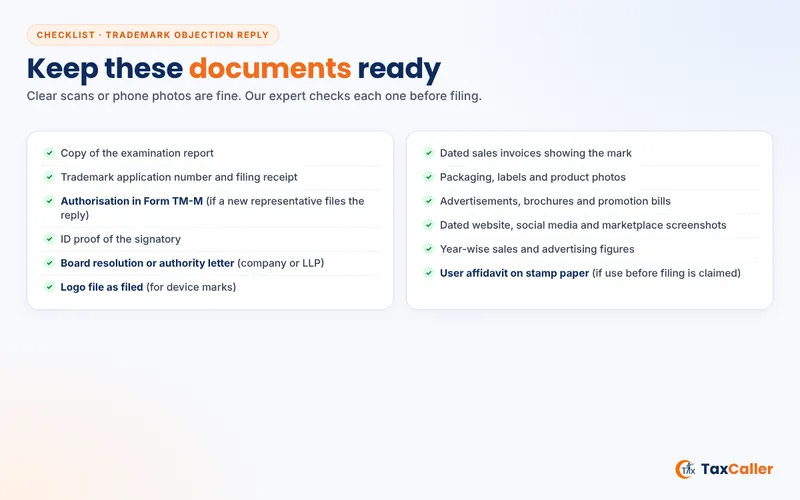
Trademark Objection Reply: documents to keep ready
The documents depend on the objection. A formality objection may need only one paper. A descriptiveness objection may need years of proof. Here is what to gather.
Basic documents (all cases):
Copy of the examination report and the application number.
Authorisation in Form TM-M if a new representative is filing (Rule 19).
ID proof of the signatory, and a board resolution or authority letter for a company or LLP.
Logo file as filed, if the mark is a device mark.
Evidence of use (for Section 9 and many Section 11 objections):
Dated sales invoices showing the mark, from the earliest date of use onward.
Product packaging, labels and photos of goods carrying the mark.
Advertisements, brochures, catalogues and promotion bills.
Website and social media screenshots with dates.
Marketplace listing pages and seller account details.
Year-wise sales figures and advertising spend, ideally certified by an accountant.
Press coverage, awards and customer reviews that mention the brand.
GST registration and returns showing the trade name, if relevant.
The user affidavit. Rule 25(2) asks for an affidavit testifying to use when you claim use before the filing date. It must come with supporting documents. Rule 120 sets the format: a heading naming the matter, first-person wording and numbered paragraphs. Rule 120(6) requires the affidavit to be duly stamped. Stamp duty on the affidavit depends on your state's stamp law and is paid at actual.
The affidavit should state the date of first use, the goods, the places of sale and the yearly sales. Every claim in it must match the attached proof. A use date that the invoices do not support hurts your credibility in the hearing and later in opposition.
Other papers when relevant: a consent letter from the earlier owner under Section 11(4), status printouts of cited marks, and an English translation of non-English words.
How TaxCaller Files Your Reply Online, Step by Step
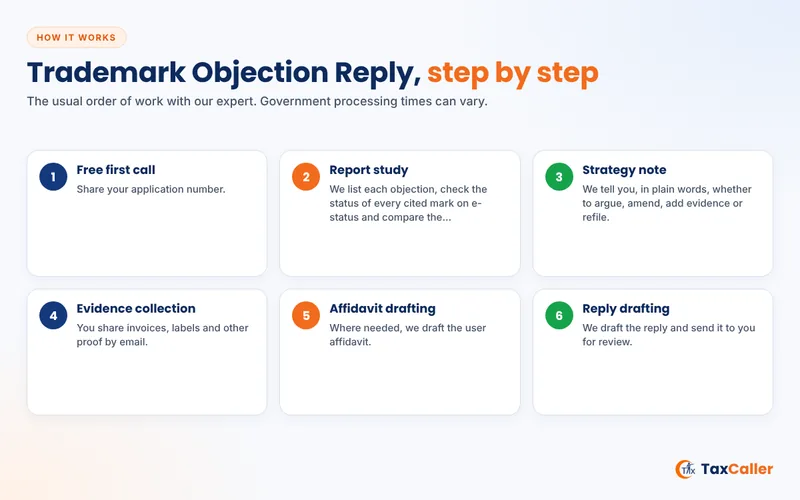
Trademark Objection Reply: how the work moves, step by step
The whole process is online. You do not need to visit the Trade Marks Registry. Here is how a reply moves with us.
Free first call: share your application number. Our expert reads the examination report and tells you the deadline and our fee before any work starts.
Report study: we list each objection, check the status of every cited mark on e-status and compare the goods.
Strategy note: we tell you, in plain words, whether to argue, amend, add evidence or refile. If the odds are poor, we say so.
Evidence collection: you share invoices, labels and other proof by email. We sort them into numbered exhibits.
Affidavit drafting: where needed, we draft the user affidavit. You sign it on stamp paper and send us the scan.
Reply drafting: we draft the reply and send it to you for review. We make changes you need.
Filing: we file the reply against your application on the IP India trademark e-filing portal, attach the evidence, and complete any TM-M request in the same session.
Acknowledgement: the portal generates a receipt. We share it with you the same day.
Tracking: we watch the status for acceptance, a hearing notice or advertisement, and update you at each change.
The portal works through a registered user account. IP India now requires e-KYC for users of its online services, so the filer's account must be verified before filing. If you are filing yourself, complete this well before your deadline.
Keep a copy of the filed reply and all exhibits. You will need them at the hearing and, later, if anyone opposes the mark.
Abhinay Rai Trademark Expert
Have a question on this topic? Ask Abhinay on a free call.
The IP India e-status page shows the stage of your application. The exact wording can differ slightly over time. These are the labels owners see most around the objection stage.
Status you may see
What it means
What you should do
Formalities Chk Pass
Basic checks are complete
Wait for examination
Marked for Exam
The application is with an examiner
Keep your email and evidence ready
Objected
The examination report raises objections
Download the report and reply within one month
Awaiting reply / reply filed
The report is pending your reply, or your reply is on record and under review
File the reply if not done; otherwise wait for the examiner
Ready for Show Cause Hearing
The examiner wants to hear you before deciding
Watch for the hearing notice and prepare
Accepted and Advertised
The objection is cleared and the mark is in the Trade Marks Journal
Watch the four-month opposition window
Advertised before Accepted
The mark is published before final acceptance
Watch for oppositions closely
Abandoned
The Registrar treated the application as abandoned, often for no reply
Act at once: review, or a fresh application
Refused
The Registrar refused the mark after the hearing
Ask for written grounds within 30 days
Registered
The mark is on the register
Download the certificate and use ®
Do not rely only on emails. Check e-status yourself every two weeks while an objection is open. We do this for every file we handle.
If the examiner is not satisfied with your reply, or if you ask to be heard, Rule 33(6) says the Registrar will give you a hearing as per Rule 115. This is often called the show cause hearing. Section 128 of the Act backs this right to be heard before an adverse decision.
How the hearing works. Rule 115(1) says the hearing takes place on the notified date and time. It may be held by video conferencing or other audio-visual means. A video hearing is treated as held at the appropriate office. Video hearings are now common, so you or your representative can often appear from anywhere.
The notice. The hearing notice is sent to the contact details on record for the application. A revised draft Trade Marks Manual posted by IP India in August 2026 proposes that hearing notices go by email about thirty days before the hearing. It is still a draft. Keep your email and phone details on the application current.
How we prepare:
Re-read the examination report and our reply.
Prepare a short written note of arguments with page references to the exhibits.
Collect any fresh evidence of use since the reply was filed.
Check the cited marks' status again, as it may have changed.
Prepare a fallback, such as narrowing the goods, in case the officer is not convinced on the full list.
Possible outcomes. The officer may accept the mark, accept it with conditions or amendments under Section 18(4), or refuse it. Under Section 18(5), any refusal or conditional acceptance must record the grounds and the materials relied on, in writing. The order is usually uploaded later on e-status.
For businesses in Ghaziabad, Noida and Delhi. Rule 4 links your application to the Registry office for your principal place of business. Applications from Delhi, Uttar Pradesh and nearby northern states go to the New Delhi office. With video hearings, location rarely matters now, but the office decides hearing lists and cause lists.
Missing a hearing can lead to an adverse order. If you cannot attend, ask for an adjournment before the date, with a reason. Do not simply stay away.
Some time limits are fixed by law. Others depend on the Registry's workload. The table separates the two.
Stage
Time limit or usual time
Basis
Examination report issued
Depends on the Registry queue; ordinarily within three months of a request for expedited examination
Rule 33; Rule 34(1)
Reply to examination report
Within one month of receiving the report
Rule 33(4)
Extension of reply time, if granted
Up to one month, at the Registrar's discretion
Section 131; Rule 109
Examiner's review of the reply
No fixed time
Registry practice
Show cause hearing
Date fixed by the Registry
Rule 33(6); Rule 115
Advertisement in the Trade Marks Journal
After acceptance
Section 20; Rule 39
Opposition window
Four months from publication
Section 21; Rule 42(1)
Registration certificate
After the opposition window, if not opposed
Section 23; Rule 56
Written grounds after refusal
Request within 30 days in Form TM-M
Rule 36(1)
Review of Registrar's decision
Within one month of the decision
Section 127(c); Rule 119
Appeal to the High Court
Within three months of the order being communicated
Section 91(1)
Section 23(1) sets a target of registration within eighteen months of filing, subject to the Act and Rules. In real life, an objection and a hearing can add months. We cannot control the Registry's pace, and we will not promise a fixed date. What we control is our side: a reply filed well before the deadline and a prepared hearing.
Shadab Trademark Expert
Have a question on this topic? Ask Shadab on a free call.
Government Fees vs TaxCaller's Fee for a Trademark Objection Reply
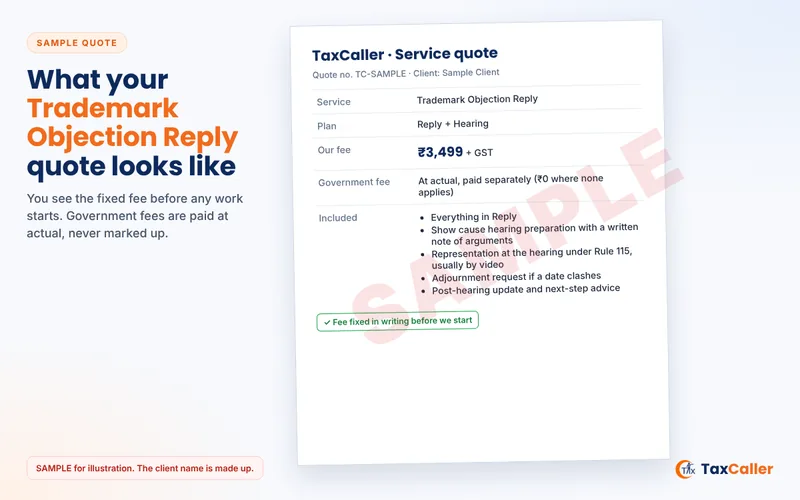
Trademark Objection Reply: SAMPLE quote, for illustration only
There are two separate costs. One goes to the Trade Marks Registry. The other is our professional fee. We show them apart so you can see where each rupee goes.
Government fees. Their source is the First Schedule to the Trade Marks Rules, 2017, as listed on the IP India Form and Fees page. The First Schedule has no fee entry for a reply to an examination report. So filing the reply itself costs no government fee. Fees arise only if you need a related request.
Item
E-filing
Physical filing
Reply to examination report
No fee entry
No fee entry
TM-M: extension of time
₹900
₹1,000
TM-M: amendment in the application (for example, narrowing goods)
₹900
₹1,000
TM-M: seeking grounds of the Registrar's decision (Rule 36)
₹900
₹1,000
Review of the Registrar's decision (Rule 119)
₹2,700
₹3,000
Fresh TM-A, individual, startup or small enterprise (per class)
₹4,500
₹5,000
Fresh TM-A, all others (per class)
₹9,000
₹10,000
Stamp paper for the user affidavit
As per your state's stamp law, at actual
TaxCaller's fee. TaxCaller's fee starts at ₹1,999 + GST for one reply to one examination report for one application. Government fees, such as any TM-M fee or the stamp paper for an affidavit, are paid separately at actual. The plans below show what each level covers.
Reply: report study, strategy note, drafting and filing of the reply, user affidavit drafting if needed.
Reply + Hearing: everything in Reply, plus preparation and representation at the show cause hearing and a written note after it.
Reply + Hearing + Tracking: everything above, plus status tracking through Journal publication and the four-month opposition window.
If we filed your application under the Filing + Objection plan on our trademark registration page, the reply is already part of that plan. For a mark with many classes, many cited marks or heavy evidence, we confirm the fee on the first call before any work starts.
If the Reply Fails or Is Missed: Abandonment, Refusal, Review and Appeal
The Trade Marks Act has no money penalty for a late reply. The real penalty is losing the application. Here is what can happen and what you can still do.
No reply: abandonment. Rule 33(4) lets the Registrar treat the application as abandoned if you do not respond within one month. Section 132 of the Act also covers default in prosecution. The Registrar may send a notice asking you to remedy the default within a set time, and may hear you if you ask. If the default is not remedied, the application can be treated as abandoned.
Options after abandonment:
Review: Section 127(c) lets the Registrar review his own decision. Rule 119 says the request is made in Form TM-M within one month of the decision, with a statement of grounds. The e-filing fee is ₹2,700. The Registrar may allow one more month on request.
Fresh application: if review is not possible, you can file a new TM-A. You lose the old filing date, and anyone who filed a similar mark in between gets ahead of you.
High Court: in some cases, a challenge before the High Court may be possible. This needs separate legal advice.
Refusal after hearing. If the Registrar refuses the mark, first ask for the reasons in writing. Rule 36(1) allows you, within thirty days, to apply in Form TM-M asking the Registrar to state the grounds and the materials used. Under Rule 36(3), the date you receive this statement counts as the date of the decision for appeal purposes.
Appeal. Section 91(1) allows an appeal to the High Court within three months from the date the order is communicated. A late appeal may be admitted only if you show sufficient cause. The Intellectual Property Appellate Board was abolished in 2021, so appeals now go to the High Court.
Court work needs a separate engagement. We help you decide whether an appeal, a review or a fresh filing makes the most sense for your budget and brand.
Most failed replies fail for avoidable reasons. These are the mistakes we see most often:
Missing the one-month window: waiting for a reminder that never comes. Check e-status yourself.
Not reading the report fully: answering the Section 11 point but forgetting the formality requirement.
Using a copied template: generic text that does not mention your mark, your goods or the cited marks.
No status check of cited marks: missing that a cited mark is already abandoned or expired.
Evidence without dates: undated photos and screenshots carry little weight.
Use dates that do not match: the affidavit says 2015, but the first invoice is from 2021.
Unstamped or badly formatted affidavit: Rule 120 sets the format and Rule 120(6) requires stamping.
Trying to change the mark: Rule 37 does not allow an amendment that substantially changes the mark.
Not asking for a hearing: Section 128 protects you only if you ask to be heard in time.
Skipping the hearing: no appearance and no adjournment request can lead to refusal.
Using ® too early: an objected mark is not registered. Section 107 punishes falsely showing a mark as registered, with a penalty of 0.5% of turnover or ₹5 lakh, whichever is less.
Old contact details on the application: notices go to the address and email on record. Update them through Form TM-M.
A careful reply avoids almost all of these. A short call before you file costs far less than losing your filing date.
Shreya Trademark Expert
Have a question on this topic? Ask Shreya on a free call.
After the Objection Is Cleared: Journal, Opposition Window and Brand Use
Clearing the objection is a big step, but not the last one. Here is what follows.
Journal publication. Once accepted, the mark is advertised in the Trade Marks Journal under Section 20 and Rule 39. The status changes to "Accepted and Advertised". Check the Journal entry carefully. Any error in the mark, goods or applicant name should be corrected quickly.
Opposition window. For four months after publication, anyone can oppose the mark under Section 21. If an opposition is filed, you must file a counter-statement in time, or the application is treated as abandoned under Section 21(2). Our trademark opposition service handles this stage.
Withdrawal of acceptance. Section 19 lets the Registrar withdraw an acceptance made in error before registration. You are heard if you ask. Under Rule 38(2), if you do not respond within thirty days, the acceptance is treated as withdrawn. This is rare, but watch for any notice.
Registration. If no one opposes, or the opposition fails, the mark is registered under Section 23. The date of registration is your filing date. The registration lasts ten years and must be renewed. Our trademark renewal page explains the renewal steps.
Ongoing care:
Use the mark as filed, on the goods you claimed. Keep dated proof of use every year.
Use ™ until registration, and ® only after it.
Record any change of address or owner. If you sell or transfer the brand, see our trademark assignment service.
Keep your evidence file. It helps in oppositions, infringement cases and marketplace complaints.
Trademark Objection Rules and IP India Notices in 2026
The core law has not changed. Objections are still raised and answered under the Trade Marks Act, 1999 and the Trade Marks Rules, 2017. But IP India issued several notices in 2026 that affect how replies and hearings work. These come from the IP India news and updates page and its archive.
Fees unchanged: as of November 2026, the First Schedule on the IP India Form and Fees page still shows the 2017 fees. A reply carries no fee, and TM-M requests cost ₹900 on e-filing.
Revised draft Trade Marks Manual: on 21 August 2026, IP India posted a revised draft Manual of Trade Marks Practice and Procedure. Under the proposal, show cause hearing notices would go by email about thirty days before the hearing. It is a draft and cannot override the Act or the Rules.
Mandatory e-KYC: IP India made e-KYC compulsory for users of its online services. A public notice dated 7 August 2026 extended the deadline from 9 August to 31 August 2026. The final extension, to 30 September 2026, was given by a notice dated 31 August 2026. Your filer's account must be verified to file a reply.
Refund of duplicate payments: a procedure dated 14 October 2026, posted on 22 October 2026, explains how to claim a refund if the same trademark fee is paid twice on the e-filing portal. Claims should ideally be made within one year.
AI and trademark squatting: after a Delhi High Court order of 13 October 2026, a public notice dated 16 October 2026 invited suggestions within three weeks for guidelines on the use and misuse of artificial intelligence and on trademark squatting. No final guidelines have been issued yet. Bad faith is already a factor under Section 11(10).
Special drive on old oppositions: a public notice dated 2 November 2026 announced a drive to hear and dispose of long-pending opposition cases from 1996 to 2010. It does not change examination replies, but it shows the Registry's push to clear old files.
We will update this section when IP India notifies a final rule or a new Manual. Drafts do not change how your reply is filed today.
Why Brand Owners Use TaxCaller for Objection Replies
We keep our promises simple and checkable.
Reviewed by an advocate: this page and our objection process are reviewed by Abhinay Rai, Advocate and founder of TaxCaller.
Honest first view: if your objection is hard to win, we tell you before you pay for a reply.
Fee told upfront: you see our fee and any government fee before we start.
Deadline first: we work back from your one-month deadline, not from our queue.
Fully online: share documents by email and attend hearings by video.
Real people: our tax experts and trademark team answer your calls in office hours.
Our office is in Ghaziabad, Uttar Pradesh. We serve clients across India online. TaxCaller is a private professional services firm. We have no link with IP India or with any government department. Government fees go directly to the Trade Marks Registry.
Authorisation in Form TM-M (if a new representative files the reply)
ID proof of the signatory
Board resolution or authority letter (company or LLP)
Logo file as filed (for device marks)
Dated sales invoices showing the mark
Packaging, labels and product photos
Advertisements, brochures and promotion bills
Dated website, social media and marketplace screenshots
Year-wise sales and advertising figures
User affidavit on stamp paper (if use before filing is claimed)
Consent letter from the earlier owner (if available)
English translation of non-English words (if asked)
Why TaxCaller
Real experts, not a call centre
Your work is handled by experienced professionals who explain every step, check your documents and keep you updated.
Registered company
TaxCaller is run by TaxCaller India LLP (LLPIN AAQ-7388), serving clients since 2018.
Fee told upfront
You know the complete fee, our professional fee and the government fee, before any work starts. No hidden charges.
Support after the work
Notices, renewals, returns and compliance reminders: we stay with your business after the registration is done.
Reviewed By
Expert for this topic Trademark Objection Reply
Abhinay Rai
Advocate
Abhinay Rai is a Advocate specialising in Trademark Objection Reply. The process, documents, timelines and fees on this page are checked against the current rules and government portals, and updated whenever the law, forms or fees change.
Trademark Objection Reply: your questions answered
What is a trademark objection?
A trademark objection is a concern the examiner raises in the examination report after checking your application. It may say the mark is descriptive, similar to an earlier mark, or missing a document. It is not a rejection. You can answer it with a written reply, evidence and, if needed, a show cause hearing before the Registrar decides.
What is the objected meaning in trademark status?
"Objected" on IP India e-status means the examiner has issued an examination report raising one or more objections to your application. It is not a refusal. Under Rule 33(4) of the Trade Marks Rules, 2017, you must reply within one month of receiving the report, or the Registrar may treat the application as abandoned.
How many days do I get to reply to a trademark objection?
Rule 33(4) of the Trade Marks Rules, 2017 gives you one month from receiving the examination report, which is about 30 days. If you do not respond, the Registrar may treat the application as abandoned. Extension under Rule 109 is possible only at the Registrar's discretion, so plan to file well before the last day.
Is there a government fee to file a trademark objection reply?
No. The First Schedule to the Trade Marks Rules, 2017 has no fee entry for a reply to an examination report. You pay a government fee only for related requests, such as ₹900 on e-filing for a TM-M extension, amendment or request for grounds. Stamp duty on a user affidavit depends on your state's law.
Can I keep using the ™ symbol while my application is objected?
Yes. You can use ™ from the day you file, and an objection does not change that. Do not use ® until the mark is registered. Section 107 of the Trade Marks Act punishes falsely showing a mark as registered, with a penalty of 0.5% of turnover or ₹5 lakh, whichever is less.
What is the difference between a trademark objection and an opposition?
An objection comes from the Registry's examiner during examination, before the mark is published. An opposition comes from a third party within four months after the mark appears in the Trade Marks Journal. You answer an objection with a reply to the examination report, and an opposition with a counter-statement in Form TM-O, which carries a fee.
What happens after I file the reply?
The examiner reviews your reply. If satisfied, the mark is accepted and advertised in the Trade Marks Journal, and the status changes. If not satisfied, the status shows it is ready for a show cause hearing under Rule 115. There is no fixed time for this review, so check e-status regularly or let us track it for you.
What is a show cause hearing, and do I have to attend in person?
A show cause hearing is your chance to argue the case before a hearing officer when the written reply did not clear the objection. Rule 115(1) allows hearings by video conferencing, so you or your representative can usually appear online. Prepare a short note of arguments, keep your evidence ready, and never skip the date.
Can I file a trademark objection reply myself?
Yes, the applicant can file the reply on the IP India e-filing portal through a verified account. Section 145 also lets a registered trade marks agent or a legal practitioner act for you. The challenge is legal drafting. A weak reply can lead to a hearing or refusal, so many owners take expert help for this stage.
My application was abandoned for no reply. Can it be revived?
Possibly. Section 127(c) lets the Registrar review his own decision, and Rule 119 says the review request goes in Form TM-M within one month of the decision, with grounds. The e-filing fee is ₹2,700. If review is not possible, you can file a fresh application, but you lose your original filing date.
Is a user affidavit mandatory in a reply?
Only in some cases. Rule 25(2) asks for an affidavit with supporting documents when you claim use of the mark before the filing date. It is also useful when you rely on acquired distinctiveness under Section 9(1). The affidavit must follow Rule 120 and be duly stamped, and every use date must match your invoices.
How long does it take to clear a trademark objection?
Your reply is due within one month of the report. After that, timing depends on the Registry. A strong reply can lead to acceptance without a hearing. If a hearing is listed, it adds more time. After acceptance, the mark is advertised and the four-month opposition window must pass before the certificate is issued.
Can a descriptive brand name still be registered?
Sometimes. The proviso to Section 9(1) says a mark cannot be refused as descriptive if it had acquired distinctiveness through use before the filing date. Strong, dated evidence of long and wide use is needed. A descriptive word combined with a distinctive logo or coined word also has a better chance than the plain word alone.
What can I do if the Registrar refuses my trademark after the hearing?
First, apply in Form TM-M within thirty days under Rule 36(1) to get the written grounds of refusal. You can then seek review under Rule 119 or file an appeal before the High Court within three months under Section 91(1). Another option is a fresh application for a changed mark or a narrower list of goods.
Got an examination report? Reply before the deadline
Book a free first call with your application number. Our expert tells you the deadline, the plan and the full cost, our fee + GST and any government fee, before we start.