Starting from · ₹1,874 ITR-2 Filing Capital Gains plan
STARTING FROM₹1,874
FEE TOLD UPFRONTFree first call
!Late ITR?Fee up to ₹5,000 under Sec 234F
Since 2018Trusted Experience
980+Experts Connected
220+Cities Served
1164+Agents Available
12000+Founders Trusted
S
Srishti Magoo
★★★★★
Excellent experience with TaxCaller for filing my &
my family members ITR returns. The entire process was
smooth, quick and hassle-free. They are professional,
knowledgeable and guided me through every step with patience.
O
obeid sait
★★★★★
The team has handled my taxes for the past three years,
and it's been a wonderful, hassle-free experience.
Thank you for your consistently quick and efficient service.
P
Pushkar
★★★★★
They are among the best in their field. Their work culture
is highly professional, and their client service is smooth
and reliable. They can confidently be relied on to get the job done.
P
Prasad Sheth
★★★★★
Excellent experience with TaxCaller! The ITR filing
process was smooth, quick, and completely hassle-free.
The CA was knowledgeable, responsive, and explained everything clearly.
A
Apoorv Bansal
★★★★★
Excellent service for ITR filing. The team was highly
professional, responsive, and guided me through the entire
process smoothly. My return was filed accurately and on time.
A
Abhishek Kumar
★★★★★
I was searching for a good CA firm in Ghaziabad and found
TaxCaller. The experience was excellent from start to finish.
The team is responsive, transparent, and genuinely helpful.
U
uma pandey
★★★★★
Great service! TaxCaller India made the entire ITR filing
process quick, smooth, and hassle-free. They answered all
my queries patiently and ensured maximum accuracy.
T
tanu mittal
★★★★★
Excellent job! We've been connected for many years,
and your success truly makes me happy. You are an
incredibly intelligent person. Keep shining, keep growing.
B
Bhanu Pratap Maurya
★★★★★
I am filing my ITR since past 3 years with Abhinav and
Firm is known as TaxCaller and they are professional
interms of ITR rules. They will explain and tell you all
the information.
A
ashish Sharma
★★★★★
I am providing my honest reviews:
No.1 service ...
A
AARYAN GROUP
★★★★★
Honestly, finding a good CA firm in Ghaziabad was
confusing, but TaxCaller India made it simple.
I contacted them for GST work and the experience was smooth.
N
News Speaks
★★★★★
If you're looking for a reliable CA firm in Ghaziabad,
TaxCaller India is a great choice. They provide complete
taxation and compliance solutions including GST.
A
Anshul Chaprana
★★★★★
Got my GST registration done through TaxCaller CA firm.
Process was quite smooth, they guided properly on documents
and didn't waste time. Overall good experience.
How we work
Online · Call · WhatsApp
Quick answer
ITR-2 is the return for individuals and HUFs with no business income who cannot use ITR-1, such as people with capital gains, foreign assets or NRI status. The due date for FY 2025-26 (AY 2026-27) was 31 July 2026. You can still file a belated ITR-2 until 31 December 2026, with a late fee.
Reviewed by Abhinay Rai · Updated 15 Nov 2026
Pick a plan that fits
Capital Gains
Salary or pension plus gains from shares and mutual funds
Government fees and taxes are extra where applicable. Our expert confirms the final amount on the first call. No hidden charges.
About ITR 2 Filing
ITR 2 filing is how individuals and Hindu Undivided Families (HUFs) report income when ITR-1 is too small for their situation. You need ITR-2 if you sold shares, mutual funds, property or crypto, own foreign assets, are a company director, hold unlisted shares, are an NRI, or earned more than ₹50 lakh. The one firm rule is simple: you must not have income from a business or profession.
For income earned from 1 April 2025 to 31 March 2026, you file ITR-2 for Assessment Year (AY) 2026-27. This return still falls under the Income-tax Act, 1961, even though the new Income-tax Act, 2025 started on 1 April 2026. The form and its utility are on the official e-filing downloads page, and the Income Tax Department explains who can use it in its ITR-2 FAQs.
ITR-2 has many more schedules than ITR-1. Capital gains need scrip-wise or property-wise details. Foreign assets need calendar-year reporting. One wrong entry can lead to a notice or a lost loss carry-forward. At TaxCaller, our tax experts prepare the full working, show it to you before filing, and stay with you until the return is processed. This page covers ITR-2 only. For other forms, see our income tax return filing guide.
Complete guide
Choose a topic to open it. Every answer gives the rule or section it comes from.
01 Topic 1 of 20
What Is ITR-2? Meaning and Scope
ITR-2 is one of the seven income tax return forms notified by the Central Board of Direct Taxes (CBDT). It is built for people whose income is a little more complex than salary and interest, but who do not run a business or practise a profession.
Think of it as the investor's and NRI's return. It has room to report:
Salary or pension, from one or more employers.
Income from any number of house properties.
Capital gains and losses from shares, mutual funds, property, gold, bonds and other assets.
Income from crypto and other virtual digital assets.
Interest, dividends, family pension, gifts, winnings and other income.
Foreign income, foreign tax credit and foreign assets.
Agricultural income above ₹5,000.
Unlike ITR-1, there is no income ceiling. The department's FAQ says ITR-2 can be filed whatever the amount of total income. It can also be used by both residents and non-residents.
ITR-2 cannot be filed on paper by most people. You file it online on the e-filing portal, or prepare it in the offline utility and upload the file. The return is complete only after you verify it.
You should use ITR-2 if you are an individual or HUF with no business or professional income, and any one of these applies to you:
Your situation in FY 2025-26
Why ITR-1 will not work
Sold listed shares or equity mutual funds at a short-term gain
ITR-1 has no place for short-term capital gains
Long-term gains on listed equity above ₹1.25 lakh, or any capital loss to carry forward
ITR-1 allows only small section 112A gains with no loss
Sold a house, plot, gold or debt fund units
These gains need Schedule CG
Income from more than two house properties
ITR-1 now covers up to two houses only
Total income above ₹50 lakh
ITR-1 is capped at ₹50 lakh
Director in any company at any time in the year
Directors must use ITR-2 or ITR-3
Held unlisted equity shares at any time in the year
Holding details must be disclosed
Resident with a foreign bank account, foreign shares, RSUs or foreign income
Needs Schedule FA, FSI or TR
Non-resident (NRI) or resident but not ordinarily resident (RNOR)
ITR-1 is for ordinary residents only
Crypto or other virtual digital asset sales
Needs Schedule VDA
Agricultural income above ₹5,000
ITR-1 limit is ₹5,000
Income of spouse or minor child to be clubbed with yours
Needs Schedule SPI
An HUF without business income also files ITR-2, whatever the size of its income.
If you are a resident with a foreign asset or signing authority in a foreign account, the fourth proviso to section 139(1) requires you to file a return even when your income is below the taxable limit. For most such people, that return is ITR-2.
Zubair Income Tax Expert
Have a question on this topic? Ask Zubair on a free call.
The main bar is business or professional income. If you have any of it, ITR-2 is closed to you. This also covers salary, interest, bonus or commission you receive as a partner from a firm.
If you have
File this instead
Only salary, up to two houses, interest and small 112A gains, total income up to ₹50 lakh, resident
Frequent share trading: delivery-based buying and selling is usually capital gains and fits ITR-2. F&O and intraday are treated as business, so ITR-3 is needed.
Crypto trading: most investors report it as capital gains in ITR-2. If trading is your business, the income moves to ITR-3, though the 30% rate stays.
Still not sure which form is yours? Our income tax return filing page compares all seven forms side by side. On a call, our expert reads your AIS and tells you the right form before you pay anything.
A correct and timely ITR-2 does more than meet a legal duty. It protects money you may need later.
Carry forward capital losses: short-term and long-term capital losses can be carried forward for eight years. This works only if the return is filed by the due date, as required by section 80.
Claim refunds of extra TDS: NRIs often face TDS on the full sale value of property or on interest. The return is the only way to get the excess back.
Pay less tax legally: grandfathering for pre-2018 shares, indexation choice for older property, and exemptions under sections 54, 54EC and 54F can cut your tax sharply. You claim them only in the return.
Avoid heavy foreign asset penalties: correct Schedule FA reporting keeps you clear of the ₹10 lakh penalty under the Black Money Act.
Proof of income: banks, embassies and lenders ask for ITR copies for loans, visas and large purchases.
Fewer notices: big sales, dividends and foreign remittances show up in your AIS. When your return matches them, the chance of a mismatch notice drops.
ITR-2 is long because it has a separate schedule for each type of income. You only fill the ones that apply to you. The main ones are below.
Schedule
What goes in it
Part A: General
Personal details, residential status, regime choice, directorships and unlisted shares held
Schedule S
Salary, allowances, perquisites and standard deduction
Schedule HP
Each house property, rent, municipal tax and home loan interest
Schedule CG
Capital gains and losses of all kinds, with exemptions claimed
Schedule 112A
Scrip-wise long-term gains on listed equity shares and equity funds
Schedule VDA
Each crypto or other virtual digital asset sale
Schedule OS
Interest, dividends, family pension, gifts and winnings
Schedules CYLA, BFLA and CFL
Set-off of losses this year, set-off of old losses, and losses carried forward
Schedule VI-A and 80G
Deductions such as 80C, 80D and donations (mostly old regime)
Schedule SPI
Income of spouse, minor child or others clubbed with yours
Schedule SI
Income taxed at special rates, such as 111A, 112A and 115BBH
Schedule EI
Exempt income, such as PPF interest and agricultural income
Schedule PTI
Pass-through income from REITs, InvITs and alternative investment funds
Schedules FSI and TR
Foreign source income and the tax relief claimed on it
Schedule FA
Foreign assets and accounts held by residents
Schedule AL
Assets and liabilities at year end, when total income is above ₹1 crore
Schedules IT, TDS and TCS
Advance tax, self-assessment tax, TDS and TCS credits
Part B-TI then adds up your total income, and Part B-TTI works out tax, interest and refund. Much of the data comes pre-filled from your AIS, but pre-filled figures are often incomplete for capital gains. Every row needs checking.
Is a balance sheet needed? No. ITR-2 has no balance sheet or profit and loss account. Schedule AL is only a list of assets and liabilities at cost, and only for incomes above ₹1 crore.
Abhinay Rai Income Tax Expert
Have a question on this topic? Ask Abhinay on a free call.
Most people move from ITR-1 to ITR-2 because they sold shares or mutual fund units. Here is how FY 2025-26 gains are taxed and reported.
Holding period: listed shares and equity fund units are long-term after 12 months. Most other assets, including unlisted shares and property, are long-term after 24 months. The department's ITR-2 FAQ sets out these limits.
Debt fund units bought on or after 1 April 2023, and unlisted bonds or debentures
Always short-term, taxed at slab rate under section 50AA
Crypto and other VDAs
30% under section 115BBH, whatever the holding period
These rates came in from 23 July 2024. Last year's form split gains before and after that date. For AY 2026-27 the whole year is under one set of rates, so the split has been removed from the form.
Points our expert checks on every equity return:
Grandfathering: for shares and equity funds bought before 1 February 2018, the cost can be taken as the market value on 31 January 2018, if that is higher. Missing this means paying tax on gains that are exempt.
Scrip-wise 112A details: Schedule 112A asks for ISIN, units, sale value and cost for each holding. We build it from your broker and fund statements.
Share buybacks: for buybacks from 1 October 2024, the amount you receive is taxed as dividend in Schedule OS. The cost of the shares you gave up becomes a capital loss you can use against other gains.
Losses: a short-term loss can be set off against both short-term and long-term gains. A long-term loss can only be set off against long-term gains.
Bonus and split shares: bonus shares have nil cost. Getting this wrong inflates or hides gains.
Rebate trap: in the new regime, the section 87A rebate does not cover tax on special-rate gains such as 111A and 112A. Many people expect zero tax below ₹12 lakh and are surprised.
Selling Property: Capital Gains and Sections 54, 54EC and 54F
Property sales are where ITR-2 errors cost the most. A plot or flat held for more than 24 months gives long-term capital gain.
Rate choice for older property: the general rate is 12.5% without indexation. But a resident individual or HUF who bought land or a building before 23 July 2024 can choose to pay 20% with indexation instead, under the proviso to section 112(1). We work out both and use the lower tax.
Sale value: if the stamp duty value is more than the agreed price, section 50C may treat the stamp duty value as your sale price. A 10% margin is allowed.
Exemptions you can claim:
Section
When it applies
Key condition
Section 54
Sell a residential house, buy or build another house in India
Buy within 1 year before or 2 years after, or build within 3 years. Exemption capped at ₹10 crore.
Section 54EC
Sell land or building, invest the gain in specified bonds
Invest within 6 months, up to ₹50 lakh, locked in for 5 years
Section 54F
Sell any other long-term asset, such as shares or a plot, and buy a house
Invest the net sale amount. You must not own more than one other house on the sale date.
Under section 54, you may buy two houses instead of one, once in your life, if the gain is up to ₹2 crore.
Not bought the new house yet? Deposit the unused amount in the Capital Gains Account Scheme with a bank before the ITR due date. Otherwise the exemption is lost. The deposit receipt then goes into Schedule CG.
Buyer's TDS: the buyer cuts 1% TDS under section 194-IA when a resident sells property worth ₹50 lakh or more. For NRIs, TDS under section 195 is much higher. The credit shows in Form 26AS and must be claimed in your return.
Crypto, NFTs and other virtual digital assets (VDAs) have their own schedule in ITR-2. The rules are strict.
Tax rate: a flat 30% under section 115BBH, plus surcharge and 4% cess. Holding period does not matter.
No expenses: only the cost of acquisition is allowed. Exchange fees, internet and other costs are not deductible.
No loss set-off: a loss on one coin cannot reduce the gain on another, or any other income. It cannot be carried forward either.
TDS: 1% TDS under section 194S is cut on transfers. It appears in your AIS and Form 26AS and must be matched.
Each transaction: Schedule VDA asks for the date of acquisition, date of transfer, cost and sale value for every sale.
Exchange reports are often messy. Trades on more than one exchange, transfers between wallets and swaps from one coin to another all need care. Our expert builds the transaction list, checks it against the 194S TDS in your AIS, and reports it line by line.
If you trade crypto as a regular business, the income may belong in ITR-3 instead. The 30% rate stays the same.
Shadab Income Tax Expert
Have a question on this topic? Ask Shadab on a free call.
Foreign Assets and Foreign Income: Schedules FA, FSI and TR
If you are a resident and ordinarily resident, you are taxed on your worldwide income. You must also list every foreign asset in Schedule FA, even if it earned nothing.
What goes in Schedule FA:
Foreign bank accounts, including ones you only have signing authority over.
Foreign shares, including RSUs and ESOPs from a foreign parent company.
US or other foreign stocks bought through an overseas brokerage or an investing app.
Foreign mutual funds, insurance policies with cash value, and pension accounts.
Property abroad, and interests in foreign trusts or entities.
Calendar year, not financial year: for AY 2026-27, Schedule FA covers assets held at any time from 1 January 2025 to 31 December 2025. Values such as peak balance and closing balance are taken for that calendar year.
Schedule FSI and Schedule TR: foreign salary, dividends, interest and gains are shown in Schedule FSI. If you paid tax abroad, you claim relief in Schedule TR under section 90 or 91. The foreign tax credit also needs Form 67, filed on the portal. Filing it with the return is safest. Rule 128(9) allows it up to the end of the assessment year, if the return is filed on time or as a belated return.
Who does not fill Schedule FA: non-residents and RNORs. They report only Indian income.
Why it matters: under section 43 of the Black Money Act, 2015, failing to report a foreign asset can attract a ₹10 lakh penalty. From 1 October 2024, this penalty does not apply where the foreign assets, other than immovable property, add up to ₹20 lakh or less. Even so, the safe course is to report every asset correctly.
Most NRIs with Indian income file ITR-2. ITR-1 and ITR-4 are not open to non-residents, and ITR-3 is needed only if there is Indian business income.
Step 1: get your residential status right. Under section 6, you are resident if you stay in India 182 days or more in the year. You are also resident if you stay 60 days or more in the year and 365 days or more in the four years before. For Indian citizens and persons of Indian origin who visit India, the 60 days becomes 182 days. It becomes 120 days if their Indian income is above ₹15 lakh. An Indian citizen with Indian income above ₹15 lakh who is not taxed in any other country can be a deemed resident under section 6(1A).
What NRIs usually report:
Rent from Indian property.
Interest on NRO accounts, FDs and bonds. NRE account interest is exempt under section 10(4)(ii).
Capital gains on Indian shares, mutual funds and property.
Dividends from Indian companies.
Rules that differ for NRIs:
The section 87A rebate is not available, in either regime.
The old regime basic exemption is ₹2.5 lakh, whatever the age. Higher limits for senior citizens apply only to residents.
Some deductions, such as section 80TTB for seniors, are for residents only.
TDS under section 195 is cut at higher rates, often on the full sale value of property. A lower TDS certificate under section 197 can help before the sale.
Tax treaty (DTAA) rates can be lower than Indian rates. Claiming them needs a Tax Residency Certificate and the prescribed details.
Many NRIs file only to claim a refund of excess TDS. We check your 26AS, compute the real tax, and file so the refund comes to your Indian bank account. Your account must be pre-validated on the portal first.
Old vs New Tax Regime and Surcharge for ITR-2 Filers
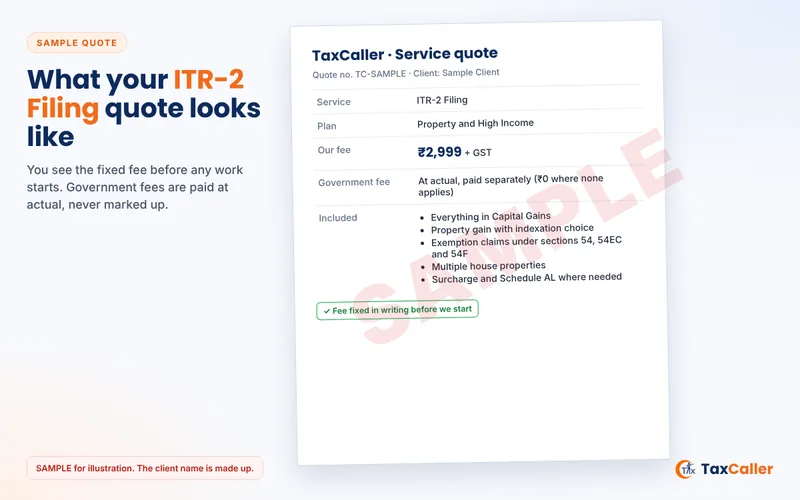
ITR-2 Filing: SAMPLE quote, for illustration only
The new regime under section 115BAC is the default. Since ITR-2 filers have no business income, you can choose either regime each year in your return. The choice must be made in a return filed by the due date under section 139(1). A belated return stays in the new regime.
Income slab (FY 2025-26)
New regime
Old regime (below 60)
Up to ₹2.5 lakh
Nil
Nil
₹2.5 lakh to ₹4 lakh
Nil
5%
₹4 lakh to ₹5 lakh
5%
5%
₹5 lakh to ₹8 lakh
5%
20%
₹8 lakh to ₹10 lakh
10%
20%
₹10 lakh to ₹12 lakh
10%
30%
₹12 lakh to ₹16 lakh
15%
30%
₹16 lakh to ₹20 lakh
20%
30%
₹20 lakh to ₹24 lakh
25%
30%
Above ₹24 lakh
30%
30%
In the new regime, resident individuals get a rebate of up to ₹60,000 under section 87A if total income is up to ₹12 lakh. The old regime rebate is ₹12,500 up to ₹5 lakh. Salaried people get a standard deduction of ₹75,000 in the new regime and ₹50,000 in the old one.
Which is better for ITR-2 filers? The old regime helps mainly if you have large deductions, such as home loan interest on a self-occupied house, 80C, 80D and HRA. Capital gains at special rates are taxed the same way in both. We run both calculations and file the one with lower tax.
Income above ₹50 lakh: surcharge. A surcharge is added to tax: 10% above ₹50 lakh, 15% above ₹1 crore, and 25% above ₹2 crore. A 37% rate above ₹5 crore applies only in the old regime. On gains under sections 111A, 112A and 112, and on dividends, the surcharge is capped at 15%. Marginal relief stops the surcharge from taking more than the income above each threshold. A 4% health and education cess applies on top.
Shreya Income Tax Expert
Have a question on this topic? Ask Shreya on a free call.
How TaxCaller Handles Your ITR 2 Filing, Step by Step
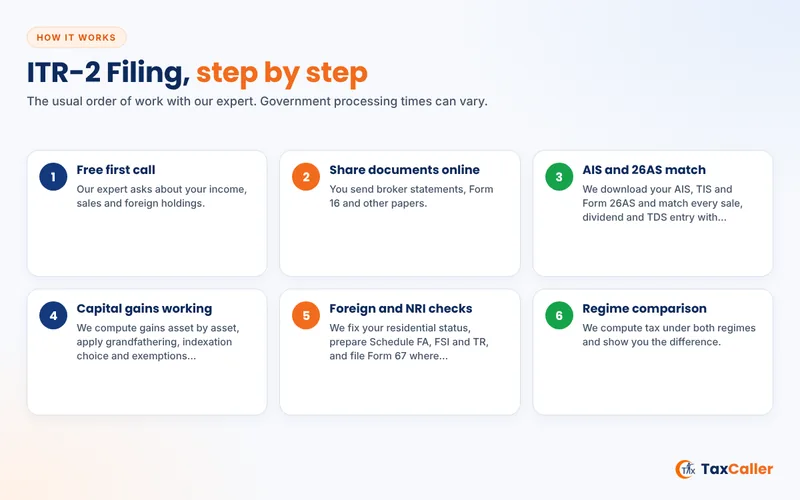
ITR-2 Filing: how the work moves, step by step
Everything is done online, so you can be anywhere in India or abroad.
Free first call. Our expert asks about your income, sales and foreign holdings. We confirm ITR-2 is the right form and tell you our fee before you pay.
Share documents online. You send broker statements, Form 16 and other papers. We give you a checklist made for your case, not a generic one.
AIS and 26AS match. We download your AIS, TIS and Form 26AS and match every sale, dividend and TDS entry with your documents. Wrong AIS entries are flagged so you can give feedback on the portal.
Capital gains working. We compute gains asset by asset, apply grandfathering, indexation choice and exemptions, and plan the set-off of losses.
Foreign and NRI checks. We fix your residential status, prepare Schedule FA, FSI and TR, and file Form 67 where needed.
Regime comparison. We compute tax under both regimes and show you the difference.
Your approval. You get a draft computation to review. We file only after you say yes. If tax is due, we help you pay it through e-Pay Tax first.
Filing and e-verification. We file ITR-2 on the portal and help you e-verify with Aadhaar OTP or net banking on the same day.
Follow-up. We track processing, check the intimation under section 143(1), and follow your refund.
Prefer to file yourself? Log in to the e-filing portal, go to e-File, Income Tax Returns, File Income Tax Return. Choose AY 2026-27, online mode, status Individual or HUF, and ITR-2. Check the pre-filled data, fill each schedule, review the tax computation, pay any balance, then submit and e-verify. The Excel utility can also be used offline. It needs licensed Microsoft Excel 2016 or later with macros enabled.
ITR-2 Due Dates for AY 2026-27 and Options After 31 July
Explanation 2 to section 139(1) holds the due date table, which the Finance Act, 2026 rewrote. ITR-2 filers fall in the general row, so their date did not change. The official ITR help page lists the dates.
Return
Section
Last date for AY 2026-27
Original ITR-2
Section 139(1)
31 July 2026
Belated ITR-2
Section 139(4)
31 December 2026
Revised ITR-2, no fee
Section 139(5)
31 December 2026
Revised ITR-2, with fee under section 234-I
Section 139(5)
31 March 2027
Updated return (ITR-U)
Section 139(8A)
31 March 2031
E-verification
Notification 2/2024
Within 30 days of filing
Missed 31 July 2026? You can still file a belated ITR-2 until 31 December 2026. It costs a late fee and you lose some benefits:
Capital losses of this year cannot be carried forward. House property loss is the exception.
You cannot pick the old regime. The new regime applies.
Interest under section 234A runs on any unpaid tax until you file.
Exemptions that need a deposit in the Capital Gains Account Scheme before the due date may be at risk.
A belated or revised return also closes if your assessment is completed earlier. If no return is filed by 31 December 2026, or a change is needed after 31 March 2027, the only route left is ITR-U, with extra tax. See our updated return filing service for that.
Remember to e-verify. A return not verified within 30 days is treated as filed on the date of verification, as the e-verification FAQ explains. Until verified, it is not valid.
Zubair Income Tax Expert
Have a question on this topic? Ask Zubair on a free call.
Late Fees, Interest and Penalties for ITR-2 Filers
Provision
Trigger
Amount
Section 234F
ITR-2 filed after 31 July 2026
₹5,000, or ₹1,000 if total income is up to ₹5 lakh
Section 234-I
Revised return filed after 31 December 2026
₹5,000, or ₹1,000 if total income is up to ₹5 lakh
Section 234A
Tax unpaid and return filed late
1% simple interest per month or part month
Section 234B
Advance tax paid is below 90% of tax due
1% per month on the shortfall
Section 234C
Advance tax instalments short or late
1% per month on the deferred amount
Section 270A
Income under-reported or misreported
50% of tax on the under-reported income, or 200% for misreporting
Black Money Act, sections 42 and 43
Foreign asset or income not disclosed by a resident
₹10 lakh penalty (relief where non-property foreign assets total up to ₹20 lakh)
Advance tax and capital gains: a large one-time gain often creates a 234C interest charge. The law helps here: if you pay advance tax on the gain in the instalments that fall after the sale, no 234C interest is charged for the earlier ones.
Late fee and interest are not part of any professional fee. They are paid to the government by you, through e-Pay Tax, at actual.
These common errors on self-filed ITR-2 returns often lead to notices or extra tax.
Filing ITR-1 when ITR-2 was needed. Directors, unlisted shareholders and people with capital gains often do this. The return can be declared defective under section 139(9).
Leaving out RSUs or foreign stocks. Schedule FA is skipped because the asset earned nothing. This risks a Black Money Act penalty.
Missing the 31 January 2018 value. Without grandfathering, old shares show a much higher gain.
Trusting pre-filled capital gains blindly. The AIS often lacks the purchase cost or shows the same sale twice.
Ignoring small dividends and interest. They are in your AIS. Missing them triggers a mismatch intimation.
Not reporting a buyback as dividend. For buybacks after 1 October 2024, the amount belongs in Schedule OS, with the cost as a capital loss.
Expecting the 87A rebate on capital gains. In the new regime it does not cover 111A or 112A tax.
Wrong residential status. An NRI who stayed longer in India, or a returning Indian, picks the wrong status and pays the wrong tax.
Setting off crypto losses. VDA losses cannot be set off at all.
Skipping Schedule EI. Exempt income such as PPF interest, NRE interest and exempt gains must still be shown.
Not e-verifying. The return is incomplete until verified within 30 days.
Got a notice already? Our income tax notice reply service handles defective return and mismatch notices.
Here are the changes that matter for your ITR-2, all from official sources.
New Act, old rules for this return. The CBDT press release confirms that the Income-tax Act, 2025 took effect on 1 April 2026. But your FY 2025-26 income is still filed in ITR-2 for AY 2026-27 under the 1961 Act. Section 536 of the new Act keeps the old law alive for past years.
ITR-2 utility released on 26 May 2026. The ITR-2 Excel utility for AY 2026-27 was first released on that date, as the official downloads page shows. The utility has since been updated, with version 1.4 released on 13 August 2026.
No more date-wise split of capital gains. Last year's form split gains before and after 23 July 2024. The AY 2026-27 form drops this split and uses the revised rates for the whole year.
Two self-occupied homes, fewer conditions. The department's FAQ notes that the earlier conditions for treating two houses as self-occupied have been removed from AY 2026-27.
Bigger rebate, new slabs. The new regime rebate under section 87A is up to ₹60,000 for income up to ₹12 lakh, with the basic exemption at ₹4 lakh. AY 2026-27 is the first return with these limits.
New fields in the form. Part A has a secondary address field. Donation claims under section 80G now need a transaction reference and IFSC, and 80GGC claims need the political party's name and PAN.
Longer revised return window, with a fee. A revised ITR-2 can now be filed until 31 March 2027. If filed after 31 December 2026, a fee under the new section 234-I applies.
One-time foreign asset disclosure window. The Foreign Assets of Small Taxpayers Disclosure Scheme (FAST-DS), 2026, under Chapter IV of the Finance Act, 2026, opened on 16 August 2026. Declarations must be made by 31 December 2026. It covers two cases. Undisclosed foreign assets or income worth up to ₹1 crore can be declared by paying 30% tax plus an equal additional amount. Assets up to ₹5 crore bought from taxed income, or while non-resident, but left out of a return, can be regularised for a flat fee of ₹1 lakh. A valid declaration gives immunity under the Black Money Act. See the official FAST-DS FAQs.
Tax Year 2026-27 under the new Act. Income from April 2026 is reported for Tax Year 2026-27. The return will be filed under section 263 of the 2025 Act, in new forms under the Income-tax Rules, 2026, and is due in July 2027 for non-business cases. Verification moves to section 265 and the late fee to section 428, with the same ₹1,000 and ₹5,000 amounts.
We follow these changes for every client, so next year's first return under the new Act starts from a clean base.
Abhinay Rai Income Tax Expert
Have a question on this topic? Ask Abhinay on a free call.
TaxCaller's fee for ITR 2 filing starts at ₹1,874 + GST. The final fee depends on how many sales, properties and foreign assets you have. Our expert tells you the exact fee on the first call, before any work starts.
Government fees are separate. The Income Tax Department charges no fee to file ITR-2 on time. Any government dues are paid by you directly at actual. This includes income tax, interest under sections 234A, 234B and 234C, the late fee under section 234F, the revised return fee under section 234-I, and additional tax on an updated return. None of these are part of TaxCaller's fee.
What the fee covers:
AIS, TIS and Form 26AS matching.
Capital gains computation and the related schedules.
Old vs new regime comparison.
Filing ITR-2 and help with e-verification.
Checking the section 143(1) intimation after processing.
Quoted separately after the call: filing for many past years, replies to scrutiny or reassessment notices, and DTAA or lower TDS certificate work for NRIs.
All TaxCaller fees are + GST. Your invoice shows our fee and GST on it, and nothing else.
After Filing: Refunds, Notices and Related Services
Processing and refund: the Centralised Processing Centre processes your return and sends an intimation under section 143(1). Any refund goes to your pre-validated bank account. If it is delayed, interest under section 244A is added at 0.5% per month.
Notices: a defective return notice under section 139(9) must usually be answered within 15 days. A proposed adjustment under section 143(1)(a) gives you 30 days to respond. We read each notice with you and reply on the portal. Bigger matters are handled by our notice reply team.
Plan for next year: if you expect large gains in FY 2026-27, advance tax may be due. Instalments fall on 15 June, 15 September, 15 December and 15 March. Our tax consultant service can help you plan sales and payments in advance.
Bank account details for all accounts, with one pre-validated for refund
AIS, TIS and Form 26AS for FY 2025-26
Form 16 from each employer
Form 16A, 16B or 16C (other TDS certificates)
Broker tax P&L or capital gains statement
Mutual fund consolidated capital gains statement
Share holding values as on 31 January 2018 (old holdings)
Property sale deed, purchase deed and stamp duty value
Bills for cost of improvement on property
New house deed, 54EC bond certificate or Capital Gains Account Scheme receipt
Crypto exchange transaction reports
Rent details, tenant details and municipal tax receipts
Home loan interest certificate
Interest certificates and dividend statements
Foreign bank and brokerage statements for calendar year 2025
RSU and ESOP grant, vesting and sale records
Proof of foreign tax paid and Tax Residency Certificate
Travel dates or passport stamps (NRIs and returning Indians)
Directorship details: company name, PAN and DIN
Unlisted shares: company name, PAN, number of shares and cost
Previous year ITR (for losses carried forward)
Deduction proofs for 80C, 80D and donations (old regime)
Cost of assets and liabilities as on 31 March 2026 (income above ₹1 crore)
Why TaxCaller
Real experts, not a call centre
Your work is handled by experienced professionals who explain every step, check your documents and keep you updated.
Registered company
TaxCaller is run by TaxCaller India LLP (LLPIN AAQ-7388), serving clients since 2018.
Fee told upfront
You know the complete fee, our professional fee and the government fee, before any work starts. No hidden charges.
Support after the work
Notices, renewals, returns and compliance reminders: we stay with your business after the registration is done.
Reviewed By
Expert for this topic ITR-2 Filing
Abhinay Rai
Advocate
Abhinay Rai is a Advocate specialising in ITR-2 Filing. The process, documents, timelines and fees on this page are checked against the current rules and government portals, and updated whenever the law, forms or fees change.
Individuals and HUFs with no business or professional income should file ITR-2 if ITR-1 does not fit. This covers people with capital gains, more than two house properties, income above ₹50 lakh, foreign assets or income, crypto sales, directorships or unlisted shares. NRIs and RNORs with Indian income also use ITR-2 in most cases.
Can a salaried person file ITR-2?
Yes. Salary is fully covered in ITR-2 through Schedule S. A salaried person must use ITR-2 instead of ITR-1 if they also sold shares or property, hold foreign RSUs, are a company director, hold unlisted shares or earn above ₹50 lakh. The salary part is filled the same way, using Form 16 from each employer.
Which ITR should I file if I sold shares or mutual funds?
If the sales are investments, file ITR-2, since gains go in Schedule CG and Schedule 112A. ITR-1 is allowed only when your only gain is long-term under section 112A up to ₹1.25 lakh, with no losses. If you did F&O or intraday trading, that is business income, and you need ITR-3 instead.
Can I file ITR-2 if I only have capital gains?
Yes. ITR-2 works even if capital gains are your only income, such as for a retired person or a homemaker who sold shares or land. You file it to pay the tax on the gains, claim exemptions, or carry forward a capital loss. Remember that losses carry forward only if the return is filed on time.
What is the last date for ITR 2 filing for FY 2025-26?
The due date for ITR-2 for FY 2025-26 was 31 July 2026. If you missed it, you can file a belated return until 31 December 2026 under section 139(4). A late fee of ₹5,000 applies, or ₹1,000 if income is up to ₹5 lakh. Capital losses of the year then cannot be carried forward.
Can NRIs file ITR-2?
Yes, and most NRIs with Indian income use ITR-2. It covers rent, NRO interest, dividends and capital gains on Indian shares and property. NRIs cannot use ITR-1 or ITR-4. The section 87A rebate is not available to them, and they do not fill Schedule FA. Many file only to claim back excess TDS.
Is Schedule AL mandatory in ITR-2?
Schedule AL is mandatory only when total income for the year is above ₹1 crore. It lists assets such as property, bank balances, shares, jewellery and vehicles at cost, along with related loans, as on 31 March 2026. If your income is ₹1 crore or less, you can leave this schedule blank.
What happens if I file ITR-1 instead of ITR-2?
Filing the wrong form can make your return defective under section 139(9). You will get a notice asking you to correct it, usually within 15 days. If you miss that window, the return can be treated as invalid, as if never filed. You then fix it by filing a revised return in ITR-2.
What is the difference between ITR-2 and ITR-3?
Both are for individuals and HUFs and allow capital gains, foreign assets and any income level. The difference is business income. ITR-2 is for people with no business or professional income. ITR-3 is for those who have it, including F&O traders, freelancers keeping books and partners who receive salary or interest from a firm.
Do I need to report foreign shares or ESOPs in ITR-2?
Yes, if you are a resident and ordinarily resident. Foreign shares, RSUs and ESOPs from a foreign employer must go in Schedule FA, even if you sold nothing. For AY 2026-27, you report holdings for the calendar year 2025. Dividends and sale gains also go in Schedule FSI and the capital gains schedule.
Can I revise my ITR-2 after filing?
Yes. You can file a revised ITR-2 under section 139(5) until 31 March 2027 for AY 2026-27, unless assessment is completed earlier. There is no fee if you revise by 31 December 2026. After that, a fee under section 234-I applies: ₹1,000 if income is up to ₹5 lakh and ₹5,000 otherwise.
How is crypto income shown in ITR-2?
Crypto and other virtual digital asset sales go in Schedule VDA, one row per sale with dates, cost and sale value. Gains are taxed at 30% under section 115BBH. Only the cost is deductible, and losses cannot be set off or carried forward. The 1% TDS under section 194S is claimed from your Form 26AS.
Can I choose the old tax regime in ITR-2?
Yes. Since ITR-2 filers have no business income, you can choose the old or new regime every year. The choice must be made in a return filed by the due date. If you file a belated return after 31 July 2026, the new regime applies by default and the old regime option is lost for that year.
Book a free first call. We confirm that ITR-2 is your form, tell you our fee upfront, then prepare your capital gains working, file the return and help you e-verify.