Srishti Magoo
Excellent experience with TaxCaller for filing my & my family members ITR returns. The entire process was smooth, quick and hassle-free. They are professional, knowledgeable and guided me through every step with patience.
Get your trade license from the right municipal corporation, nagar palika or panchayat, filed online by a tax expert who checks your city's rules first.
Content updated 15 Nov 2026
Get your Trade Licence
50+ onlineHow we work
Online · Call · WhatsApp
Quick answer
A trade license is permission from your municipal body to run a specific trade at a specific address. It is issued under the state's municipal law by a municipal corporation, municipal council or panchayat. Fees, documents and renewal rules differ by city. Most cities renew it every year, and some allow up to five years.
One shop, eatery or unit that needs a new trade licence in one city
₹2,499 + GST
+ Govt. fees at actual
Fee confirmed in writing before you pay
What you'll get
Most Popular
Food, storage and other trades where officers raise queries or inspect
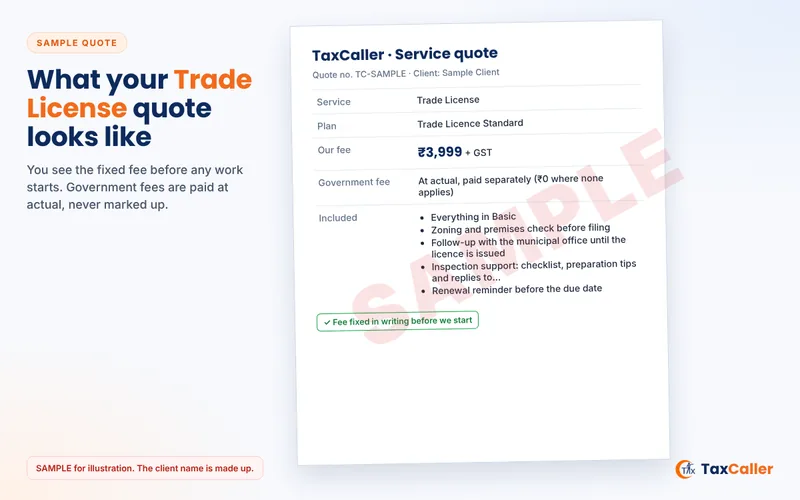
₹3,999 + GST
+ Govt. fees at actual
Fee confirmed in writing before you pay
What you'll get
New businesses that want the main local, state and tax registrations planned together
₹5,999 + GST
+ Govt. fees at actual
Fee confirmed in writing before you pay
What you'll get
Government fees and taxes are extra where applicable. Our expert confirms the final amount on the first call. No hidden charges.
A trade license is the permission your city gives you to carry on a particular trade at a particular address. Restaurants, shops, salons, workshops, godowns and many other businesses need one before they open. It is a local licence. Your municipal corporation, nagar palika or panchayat issues it under the state's municipal law, and not a central department.
That is why the rules change from city to city. Delhi, Mumbai, Bengaluru, Hyderabad, Kolkata and Chennai each have their own Act, portal, fee and renewal calendar. Some of them changed in 2025 and 2026. Delhi moved trade offences to civil penalties, Bengaluru's licences moved to the Greater Bengaluru Authority, and Hyderabad was split into three corporations.
TaxCaller has handled registrations and tax work since 2018, from our office in Ghaziabad and online across India. This page covers who needs the licence, categories, documents, the online process, fees, renewal, penalties, rejection reasons and the latest city changes, in plain words.
Complete guide
Choose a topic to open it. Every answer gives the rule or section it comes from.
01 Topic 1 of 19
A trade license is written permission from your local body to carry on a named trade at a named address. It is not a licence for the business as a whole. It ties one activity to one set of premises. If you run a bakery on the ground floor, the licence says bakery and gives that address.
That is why it is often called a municipal trade license. The power to issue it comes from your state's municipal law. Each municipal corporation Act or municipalities Act lists trades that cannot be carried on without a licence. The city then fills in the detail through bye-laws, fee schedules and circulars. Some examples:
The licence lets the city check that a trade is safe for the people around it. Officers look at health, hygiene, fire risk, noise, waste and zoning. A licence also puts the business on the city's records, which helps it collect fees and act on complaints.
Different cities use different names. You may see trade licence, health trade licence, D and O licence, Certificate of Enlistment, municipal licence or simply licence under section so-and-so. They all mean the same kind of local permission.
02 Topic 2 of 19
People often mix these two up. They are separate licences under separate laws, and many businesses need both.
| Point | Trade licence | Shop Act registration |
|---|---|---|
| Law | State municipal Act and city bye-laws | State Shops and Establishments Act |
| Issued by | Municipal corporation, council or panchayat | State labour department |
| Purpose | Public health, safety, zoning and nuisance control | Working hours, leave, holidays and staff welfare |
| Trigger | The type of trade carried on at the premises | Running a shop or establishment, often linked to staff count |
So a Shop Act certificate does not replace a trade licence, and a trade licence does not replace Shop Act registration. In Maharashtra, the Shop Act certificate is often called a Gumasta licence. That is still a labour law registration, not the municipal trade licence. For the labour side, read our Shop Act registration guide.
Shreya Licence & Registration Expert
Have a question on this topic? Ask Shreya on a free call.
03 Topic 3 of 19
Anyone who carries on a trade that appears in the city's list needs one before starting. The list differs from city to city, but these businesses usually appear on it:
Pure professional offices, such as a doctor's or lawyer's chamber, are often outside the list. A consultant working from a laptop at home usually needs nothing from the city. But check the local list. Some cities include clinics and offices, and some charge an enlistment fee from almost every business.
The test is the activity at the premises, not where you sell. An online seller who stores stock at home, or cooks and packs food at home, may be carrying on a listed trade. A home in a residential zone also raises a zoning question. We check both on the first call.
Apply before you open. Most municipal Acts treat trading without a licence as a breach from the first day. If you are already running, apply now. A late application usually costs less than a penalty or a sealing notice.
04 Topic 4 of 19
Cities group trades by risk. The names change from place to place, but most lists fall into these broad groups.
| Category | Typical trades | Usual extra checks |
|---|---|---|
| Dangerous and offensive trades | Storage of fuel, gas, chemicals, explosives, hides or scrap; tanneries; furnaces; noisy or smelly processes | Fire safety, pollution consent, distance from homes |
| Food and health trades | Eating houses, hotels, bakeries, meat and fish shops, dairies, food processing | Hygiene inspection, FSSAI, water and drainage |
| General trade and storage | Retail shops, wholesale trade, godowns, offices where listed | Premises proof, zoning, property tax |
| Entertainment and public places | Cinemas, gaming zones, swimming pools, amusement parks | Fire NOC, structural safety, public safety |
| Hawking and temporary trade | Vendors, stalls, fairs and exhibitions | Vending zone rules, short validity |
Delhi is a good example of the split. The Municipal Corporation of Delhi issues a General Trade/Storage Licence for listed trades and storage, and a separate health trade licence for eating houses, lodging houses and similar health trades. In Hyderabad it is often called a D and O licence, short for dangerous and offensive trades. Your category decides the fee, the documents and whether an inspector visits.
← Previous Next: Who Issues It: Municipal Corporation, Nagar Palika or Panchayat →
05 Topic 5 of 19
The licence comes from whichever local body governs the area where your premises stand. Your head office address does not matter. Each branch needs a licence from its own local body.
| Area | Issuing body | Common names |
|---|---|---|
| Large city | Municipal corporation, through its zone, ward or health office | Nagar nigam, mahanagar palika |
| Smaller town | Municipal council | Nagar palika, nagar parishad, municipality |
| Town in transition | Nagar panchayat | Town panchayat |
| Village | Gram panchayat, where the state law gives it the power | Panchayat licence or NOC |
| Special areas | Cantonment board, industrial township or development authority | As per its own rules |
Inside the body, the licence may come from the licence department, the public health department or the zonal office. In Mumbai, the ward office licence department handles it. In Delhi, the general licence and the health licence come from different MCD departments. Large cities can also have more than one corporation. Bengaluru now has five, and Hyderabad was split into three in 2026. So the first step is to find the exact body and office for your address.
Zubair Licence & Registration Expert
Have a question on this topic? Ask Zubair on a free call.
06 Topic 6 of 19
Here is how the largest cities handle it. Rules and portals change often, so we check the live position before every filing.
| City | Issuing body and licence | Where to apply |
|---|---|---|
| Delhi | MCD: General Trade/Storage Licence under Section 417, DMC Act, 1957, and health trade licence for eating, lodging and similar trades | MCD online portal |
| Mumbai | MCGM (BMC): licence under Section 394, Mumbai Municipal Corporation Act, 1888, from the ward licence department | MCGM portal |
| Bengaluru | Five city corporations under the Greater Bengaluru Authority (GBA), which replaced BBMP | The online trade licence system of the city corporations under GBA |
| Hyderabad | GHMC (and now Cyberabad and Malkajgiri corporations): trade licence for trades under Section 521, GHMC Act, 1955 | GHMC trade licence page |
| Kolkata | KMC: Certificate of Enlistment under Section 199, KMC Act, 1980 | KMC portal |
| Chennai | Greater Chennai Corporation: trade licence for listed trades | Greater Chennai Corporation website |
MCD runs two tracks. The General Trade/Storage Licence covers listed trades and storage. In 2026 MCD announced that this licence fee would move into the property tax system, as explained in the 2026 section below. The health trade licence is separate and still needs its own application. Areas under the New Delhi Municipal Council and the Delhi Cantonment Board follow their own bodies.
MCGM issues licences for the trades and articles listed in the schedule under Section 394. Its published licence terms cover renewal before expiry, display of the licence and limits on transfer. We follow the current terms when we file. Other cities in Maharashtra have their own corporations and councils. Remember that the Gumasta certificate is a Shop Act registration, not this licence.
The Greater Bengaluru Authority took over from BBMP in September 2025, with five city corporations below it. Trade licences can be taken or renewed for one to five financial years. Under the 2026 renewal rules, commercial trades on residential roads narrower than 40 feet face rejection. Reports say this applies to businesses set up after 2015.
GHMC's official page says you apply online, pay the fee through the payment gateway, and get the certificate with a Trade License Identification Number once payment succeeds. The documents asked for are identity proof and proof of legal occupancy of the premises.
KMC calls its licence a Certificate of Enlistment. Its portal offers new issue, renewal, change, correction and defaulter renewal. A state order caps the application fee that local bodies may charge, as shown in the fees section.
Greater Chennai Corporation issues trade licences through its online services and zonal offices. Its council revised trade licence fees in July 2024, with rates that vary by type of trade. In 2025 it asked traders to renew before 31 March.
Not in one of these cities? Smaller corporations, nagar palikas and panchayats follow the same pattern. Many now take applications online through the state's urban local body portal or single-window system. Tell us your address and we will find the right office.
07 Topic 7 of 19
The licence costs little compared with the cost of a sealing order. It also gives you papers to show when an officer visits.
08 Topic 8 of 19

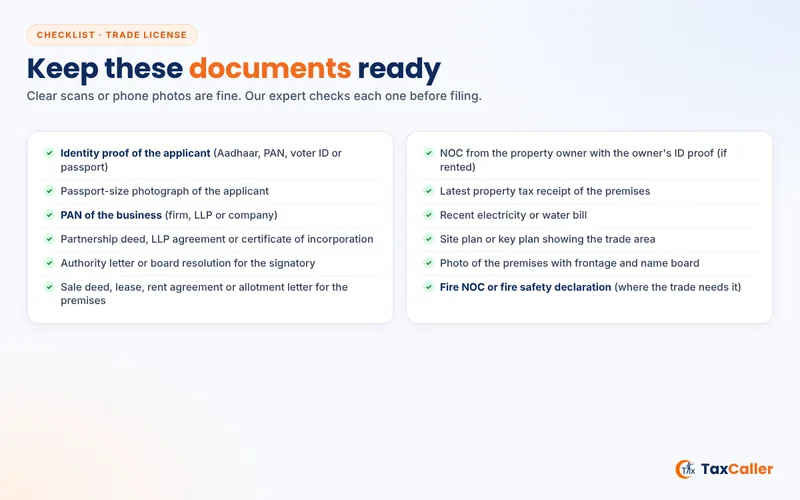
Every city has its own checklist, but these papers cover most applications. We send you a list for your city before you start.
| Document | Why it is needed |
|---|---|
| Identity proof of the applicant (Aadhaar, PAN, voter ID or passport) | To confirm who is applying |
| Passport-size photograph | For the licence and the application |
| PAN of the business | For firms, LLPs and companies |
| Proof of constitution: partnership deed, LLP agreement or certificate of incorporation | To show who owns the business |
| Authority letter or board resolution | When someone signs for the owners |
| Proof of occupancy: sale deed, lease, rent agreement or allotment letter | To show your right to use the premises |
| NOC from the property owner | When the premises are rented or in a relative's name |
| Latest property tax receipt | Many cities check that tax is paid; Delhi has announced linking its general licence fee to it |
| Recent electricity or water bill | Supporting address proof |
| Site plan or key plan of the premises | To check area, layout and zoning |
| Photo of the premises showing the frontage and name board | Asked by many portals |
| Fire NOC or fire safety declaration | For eating houses, hotels, storage of flammable goods and larger premises |
| FSSAI registration or licence | For any food business |
| Pollution consent | For units that need consent from the State Pollution Control Board |
| GST and Udyam certificates | If you already have them |
Abhinay Rai Licence & Registration Expert
Have a question on this topic? Ask Abhinay on a free call.
← Previous Next: How TaxCaller Gets Your Trade Licence Online →
09 Topic 9 of 19

We handle the paperwork and the follow-up. You approve each step and pay the city fee directly.
Some cities still need an offline form or a visit to the zonal office. In those cases we prepare the full file and tell you exactly what to carry. The TaxCaller tools page has calculators that help with your other compliance dates.
10 Topic 10 of 19
Time depends on the city, the category and whether an inspection is needed. These are typical ranges with complete papers, not official deadlines.
| Situation | Usual time |
|---|---|
| Fully online, low-risk trade, auto-approval (for example GHMC, which issues the certificate once payment succeeds) | Same day |
| Online with document check by an officer | About 7 to 15 working days |
| Inspection needed (eating houses, storage, workshops) | About 15 to 30 days |
| Fire NOC or pollution consent needed first | Longer, as those approvals come first |
| Small towns with offline counters | Varies widely |
Our own work, from complete documents to filing, usually takes two working days. Most delays come from a weak premises document, a zoning doubt or an officer query. Several states have public service laws that set time limits for municipal services. We use them where they apply.
← Previous Next: Trade License Fees: Government Fee and Our Fee, Clarified →
11 Topic 11 of 19

A trade licence has two separate costs. We keep them apart so you see each one.
There is no national fee. Your city sets it, and it usually depends on three things: the trade, the area of the premises and the location or road width. Some cities charge a flat fee by category. Some charge per square metre or square foot. A few charge a one-time processing fee on top. Here is what we can confirm from official sources:
| Area | Official ceiling on the yearly application fee | Legal provision |
|---|---|---|
| Kolkata Municipal Corporation | ₹2,500 | Section 199, KMC Act, 1980 |
| Howrah Municipal Corporation | ₹2,500 | Section 102, Howrah Municipal Corporation Act, 1980 |
| Other municipal corporations in West Bengal | ₹2,500 | Section 141, West Bengal Municipal Corporation Act, 2006 |
| Municipalities and notified areas in West Bengal | ₹1,500 | Section 118, West Bengal Municipal Act, 1993 |
These ceilings come from Order No. 372 of 27 May 2025, an order of the West Bengal Urban Development and Municipal Affairs Department. It tells local bodies to follow their Acts strictly and not to levy any other fee beyond the capped application fee. For every other city, the fee is set by your city. We show you the exact amount on the portal before you pay.
TaxCaller's fee for a new trade licence starts at ₹2,499 + GST for one premises in one city. The final fee depends on the plan, the city and whether an inspection or extra approval is involved. We confirm it in writing on the first call.
| Item | Paid to | Amount |
|---|---|---|
| Category check, document review, filing and follow-up | TaxCaller | From ₹2,499 + GST |
| Trade licence fee and any processing fee | Municipal body | Set by your city, at actual |
| Late fee or penalty, if any | Municipal body | As per city rules, at actual |
| Fire NOC, pollution consent or FSSAI fee, if needed | The department concerned | As per that department, at actual |
| Stamp paper for an NOC or affidavit, if needed | State (stamp duty) | As per state stamp law |
Government fees are never part of our invoice. You pay them directly to the municipal body or department.
Shadab Licence & Registration Expert
Have a question on this topic? Ask Shadab on a free call.
12 Topic 12 of 19
Most cities issue a trade licence for one financial year, from April to March. Some let you choose a longer term and pay for all years at once. Bengaluru, for example, allows one to five financial years. Hyderabad's licence year runs from January to December, with renewal due in December for the next year.
Renewal is simpler than a new licence. You usually enter the old licence number, confirm that nothing has changed and pay the fee. If the trade, area, owner or address has changed, it is not a simple renewal. You file an amendment or a fresh application.
Keep the renewal date in your calendar. Most penalties under trade licence rules come from late renewal, not from never applying. Our Standard plan includes a reminder before the due date.
13 Topic 13 of 19
Every municipal Act punishes trading without a licence, but the amounts and the method differ. Here is what the main sources say.
| City | Consequence |
|---|---|
| Delhi | From 15 May 2026, breach of Section 417 of the DMC Act carries a civil penalty of ₹1,000 under the new Twelfth Schedule. An adjudicating officer imposes it under Section 468A. Failing to produce a licence on demand under Section 430(5) draws a warning first, then ₹100. |
| Mumbai | Trading without a valid licence can lead to prosecution and to action against the licence under the MMC Act and MCGM's licence terms. |
| Bengaluru | For 2026-27, renewals filed in March 2026 paid a 25 per cent penalty. From 1 April 2026, the penalty equals the full licence fee. |
| Hyderabad | For the 2026 licence year, renewals after 20 December 2025 and up to 19 February 2026 paid 25 per cent extra. Later renewals paid 50 per cent. |
Older penalty rules still apply in many cities, including fines per day of continuing breach. We check the exact provision for your city before advising you.
14 Topic 14 of 19
Most rejections come from a small set of problems. Each one can be fixed before you file.
Before filing, we check every one of these points. If one is a deal breaker, such as a zoning bar, we tell you honestly instead of taking your fee.
Shreya Licence & Registration Expert
Have a question on this topic? Ask Shreya on a free call.
← Previous Next: Fire NOC, Pollution Consent and Other Approvals →
15 Topic 15 of 19
A trade licence often sits on top of other approvals. Here is a short note on the two most common ones.
The state fire service issues it under the state fire service law and building code. It is usually needed for restaurants above a size limit, hotels, hospitals, schools, cinemas, high-rise buildings and anyone storing flammable goods. Many cities ask for it, or a fire safety declaration, before they issue a trade licence.
Units that discharge effluent or emissions need consent to establish and consent to operate from the State Pollution Control Board. The legal basis is Section 25 of the Water (Prevention and Control of Pollution) Act, 1974 and Section 21 of the Air (Prevention and Control of Pollution) Act, 1981. The board's category list for your activity decides whether consent is needed. Most small shops and offices are outside it.
Getting these in the right order saves weeks. We plan the sequence on the first call. The National Single Window System also helps you find central and state approvals for a project.
← Previous Next: Changes, Display and Surrender After You Get the Licence →
16 Topic 16 of 19
The licence comes with conditions. Keep these in mind for the whole year.
Alongside the licence, keep your other filings current. If you are registered for GST, returns are due every month or quarter. See GST registration for when it applies.
← Previous Next: What Changed for Trade Licences in 2025 and 2026 →
17 Topic 17 of 19
Several cities changed their trade licence rules in the past two years. These are the changes we could confirm. Check your city's portal for anything newer.
The Jan Vishwas (Amendment of Provisions) Act, 2026 (No. 8 of 2026) received Presidential assent on 7 April 2026. It amends the Delhi Municipal Corporation Act, 1957. A Home Ministry notification of 30 April 2026 brought the DMC Act changes into force on 15 May 2026. Key points:
The MCD House approved this in December 2025, and MCD announced the change in May 2026. As reported in the news, the General Trade/Storage Licence fee is set at 15 per cent of the property tax of the premises. It is paid with property tax, and the receipt serves as a deemed licence for that year. Traders reported delays in the rollout, and we could not confirm the change on an MCD page. You still need fire, pollution and other approvals. The reports cover only the General Trade/Storage Licence. The health trade licence is a separate licence. Confirm the current status on the MCD online portal before paying.
The Greater Bengaluru Authority replaced BBMP in September 2025. A GBA circular issued in early February 2026 opened renewals from 1 February 2026. Renewal was penalty-free in February, carried a 25 per cent penalty in March, and a penalty equal to the fee from 1 April. The circular pushed renewals and fee payment online. Trades in buildings that break the approved plan, or that use parking areas or rooftops, may be refused.
In February 2026, Telangana split GHMC into three corporations: Greater Hyderabad, Cyberabad and Malkajgiri. The order, GO Ms No. 55 of 11 February 2026, was challenged in the Telangana High Court that month. If your premises fall in Cyberabad or Malkajgiri areas, the office that renews your licence may change. For the 2026 licence year, GHMC set 20 December 2025 as the penalty-free renewal date.
Order No. 372 of 27 May 2025 told all local bodies not to charge more than ₹2,500 a year in corporations, or ₹1,500 in municipalities, as the application fee for issuing or renewing a trade licence.
In June 2025, the Delhi government ended the police licence for eating houses, hotels, guest houses, swimming pools, amusement venues and similar trades. The municipal licence remains. MCD also launched a web portal for instant health trade licences in June 2025.
Zubair Licence & Registration Expert
Have a question on this topic? Ask Zubair on a free call.
← Previous Next: Is a Trade Licence the Right Licence for You? →
18 Topic 18 of 19
A trade licence answers one question: can you carry on this trade at this address? Your business will likely need other registrations too. Our business licences guide shows the full set. In short:
Not sure where to start? A short call with our expert sorts the order.
Don't have everything? Send what you have on WhatsApp. Our expert will tell you what's missing.
Send documents on WhatsAppReal experts, not a call centre
Your work is handled by experienced professionals who explain every step, check your documents and keep you updated.
Registered company
TaxCaller is run by TaxCaller India LLP (LLPIN AAQ-7388), serving clients since 2018.
Fee told upfront
You know the complete fee, our professional fee and the government fee, before any work starts. No hidden charges.
Support after the work
Notices, renewals, returns and compliance reminders: we stay with your business after the registration is done.
Expert for this topic Trade License
Abhinay Rai
Advocate
Abhinay Rai is a Advocate specialising in Trade License. The process, documents, timelines and fees on this page are checked against the current rules and government portals, and updated whenever the law, forms or fees change.
A trade license is permission from your local body to run a listed trade at a particular address. A municipal corporation issues it in big cities, a municipal council or nagar palika in towns, and a panchayat in some villages. It is granted under the state's municipal law and the city's bye-laws, so the rules differ by city.
No. It is mandatory only for trades on your city's licence list. Eateries, hotels, salons, shops, workshops, godowns and anyone storing risky goods usually need one. Pure professional offices are often outside the list. Since every city publishes its own list, check yours before opening, or ask us to check it on a free first call.
No. The GST law does not list a trade licence among the required documents. GST needs PAN, identity proof, business address proof and bank details. Still, a GST officer may ask for more proof of the premises. A trade licence can support that. You can apply for both together, and we often file them at the same time.
It depends on what happens at your home. A consultant working on a laptop usually needs nothing from the city. But if you cook, pack, store stock or run a workshop at home, that activity may be a listed trade. Zoning rules for residential areas also matter. We check both points for your address.
The city fee is set by your city and depends on the trade, the area of the premises and the location. West Bengal caps the yearly application fee at ₹2,500 for corporations and ₹1,500 for municipalities. TaxCaller's professional fee is separate, charged plus GST, and is confirmed on the first call. City fees are paid at actual.
Low-risk trades on fully online portals, such as GHMC, can get the licence the same day after payment. Applications checked by an officer usually take one to two weeks. Trades that need an inspection, a fire NOC or pollution consent take longer. Clean documents and a clear premises record are what speed things up.
Most cities issue it for one financial year, from April to March, so it needs a yearly renewal. Some cities allow a longer term if you pay for all years together. Bengaluru allows one to five financial years. Hyderabad runs its own licence year. The validity date is printed on your licence, so note it carefully.
You pay a late fee, and the trade may be treated as unlicensed. For 2026-27, Bengaluru charged 25 per cent extra in March and a penalty equal to the fee from April. Hyderabad charged 25 per cent, then 50 per cent. Other cities levy their own late fees. Renew before the due date.
Yes. A tenant can apply in the business's own name. You need a valid rent or lease agreement and a no objection certificate from the property owner, with the owner's ID proof. Many cities also check that the property tax for the premises is paid. Make sure every name matches across these papers to avoid queries.
Often, yes. The trade licence comes from the municipal body and deals with health, safety and zoning. Shop Act registration comes from the state labour department and deals with working hours and staff. One does not replace the other. A restaurant or salon in a city may need both, plus FSSAI for food businesses.
It is a licence from the Municipal Corporation of Delhi for health-related trades, such as eating houses and lodging houses. It is separate from the General Trade/Storage Licence and has its own application. In June 2025, MCD launched a web portal for instant health trade licences. Officers may still inspect the premises, so keep hygiene and fire safety in order.
No. A trade licence is tied to one premises and one trade. Each branch needs its own licence from the local body of the area where it stands. If two branches are in different cities, you deal with two different municipal bodies, each with its own fee, documents and renewal date. We can file for several branches together.
Generally not. The licence is issued to a named person for a named premises. When the business is sold, the new owner applies for a fresh licence, unless the city's rules allow a transfer with written permission. Check your city's licence terms before any sale. The old licence should be surrendered.
Tell us your city, address and trade, and our expert will confirm the licence you need and file it online. Our fee starts at ₹2,499 + GST, and the city fee is paid at actual.
Mon–Fri 9:00 AM – 6:00 PM, Sat 10:00 AM – 4:00 PM · Your trust is our biggest fee.