12A and 80G Registration for NGOs, Trusts and Societies
12A and 80G registration under the Income-tax Act, 2025, filed online with the right form, so your NGO gets tax exemption and your donors get a deduction.
Starting from · ₹2,999 12A and 80G Registration Provisional 12A + 80G plan
STARTING FROM₹2,999
FEE TOLD UPFRONTFree first call
!GSTR-3B due?Last date 20 Nov 2026 · 2 days left
Since 2018Trusted Experience
980+Experts Connected
220+Cities Served
1164+Agents Available
12000+Founders Trusted
S
Srishti Magoo
★★★★★
Excellent experience with TaxCaller for filing my &
my family members ITR returns. The entire process was
smooth, quick and hassle-free. They are professional,
knowledgeable and guided me through every step with patience.
O
obeid sait
★★★★★
The team has handled my taxes for the past three years,
and it's been a wonderful, hassle-free experience.
Thank you for your consistently quick and efficient service.
P
Pushkar
★★★★★
They are among the best in their field. Their work culture
is highly professional, and their client service is smooth
and reliable. They can confidently be relied on to get the job done.
P
Prasad Sheth
★★★★★
Excellent experience with TaxCaller! The ITR filing
process was smooth, quick, and completely hassle-free.
The CA was knowledgeable, responsive, and explained everything clearly.
A
Apoorv Bansal
★★★★★
Excellent service for ITR filing. The team was highly
professional, responsive, and guided me through the entire
process smoothly. My return was filed accurately and on time.
A
Abhishek Kumar
★★★★★
I was searching for a good CA firm in Ghaziabad and found
TaxCaller. The experience was excellent from start to finish.
The team is responsive, transparent, and genuinely helpful.
U
uma pandey
★★★★★
Great service! TaxCaller India made the entire ITR filing
process quick, smooth, and hassle-free. They answered all
my queries patiently and ensured maximum accuracy.
T
tanu mittal
★★★★★
Excellent job! We've been connected for many years,
and your success truly makes me happy. You are an
incredibly intelligent person. Keep shining, keep growing.
B
Bhanu Pratap Maurya
★★★★★
I am filing my ITR since past 3 years with Abhinav and
Firm is known as TaxCaller and they are professional
interms of ITR rules. They will explain and tell you all
the information.
A
ashish Sharma
★★★★★
I am providing my honest reviews:
No.1 service ...
A
AARYAN GROUP
★★★★★
Honestly, finding a good CA firm in Ghaziabad was
confusing, but TaxCaller India made it simple.
I contacted them for GST work and the experience was smooth.
N
News Speaks
★★★★★
If you're looking for a reliable CA firm in Ghaziabad,
TaxCaller India is a great choice. They provide complete
taxation and compliance solutions including GST.
A
Anshul Chaprana
★★★★★
Got my GST registration done through TaxCaller CA firm.
Process was quite smooth, they guided properly on documents
and didn't waste time. Overall good experience.
How we work
Online · Call · WhatsApp
Quick answer
12A and 80G registration is the income tax registration and donor approval a trust, society or Section 8 company needs. From 1 April 2026, 12A is Section 332 and 80G is Section 354 of the Income-tax Act, 2025. A new NGO files Form No. 104 for provisional status, then Form No. 105 for regular status.
Reviewed by Abhinay Rai · Updated 16 Nov 2026
Pick a plan that fits
Provisional 12A + 80G
A new trust, society or Section 8 company whose activities have not started
₹2,999+ GST
No govt. fee
Handled by a TaxCaller Expert Company Registration Expert
Separate service with its own fee, quoted in writing
Choice of section, case and 5 or 10 year period
Form No. 105 with income, asset, office bearer and activity details
Replies to notices on e-Proceedings
Form No. 107 orders and next renewal date shared
Government fees and taxes are extra where applicable. Our expert confirms the final amount on the first call. No hidden charges.
About 12A and 80G Registration
12A and 80G registration are two income tax approvals for a non-profit body. The first lets the NGO keep its income free of tax when it spends it on its objects. The second lets people who donate to it claim a deduction. A trust, a society or a Section 8 company gets neither of these just by being registered under its own law. Each one needs a separate application to the Income Tax Department.
The names 12A and 80G come from the Income-tax Act, 1961. From 1 April 2026, the Income-tax Act, 2025 replaced that Act. Registration now sits in Section 332 and approval for donations sits in Section 354. Donors claim their deduction under Section 133. The forms changed too: Form 10A is now Form No. 104 and Form 10AB is now Form No. 105. People still search for "12A" and "80G", so we use both the old and new names on this page.
TaxCaller has handled registrations and tax work since 2018, from our office in Ghaziabad and online across India. If your NGO is not yet formed, start with our guide to NGO registration. This page covers what comes next: eligibility, documents, the two forms, validity, renewal, the Darpan ID, donor rules, yearly compliance and the reasons applications get rejected.
Complete guide
Choose a topic to open it. Every answer gives the rule or section it comes from.
01 Topic 1 of 20
What Is 12A and 80G Registration?
12A and 80G registration is the pair of approvals that makes an NGO tax-efficient for itself and attractive to donors. 12A covers the NGO's own income. 80G covers the donor's deduction. You can hold the first without the second. 80G approval is open only to a registered non-profit organisation, though a new NGO can apply for both in one form.
12A registration in plain words
A registered non-profit organisation does not pay tax on income it applies to its charitable or religious objects, within the limits of the Act. Without registration, the same income is taxed like any other person's income. Under the 2025 Act, this registration is granted under Section 332. Older certificates under Section 12A, 12AA or 12AB of the 1961 Act still count while they are valid.
80G approval in plain words
80G approval is for donors. When an approved NGO receives a donation, the donor can reduce their taxable income under Section 133(1)(b)(ii). For most NGOs, the donor deducts 50% of the donation, within a qualifying limit. Under the 2025 Act, this approval is granted under Section 354.
Who grants them
Provisional status (Form No. 104): the Commissioner of Income Tax (CPC) on the e-filing portal, as the official Form No. 104 FAQs explain.
Regular status and renewal (Form No. 105): the jurisdictional Principal Commissioner or Commissioner of Income Tax, who can ask for documents and inquire into your work.
Each grant carries a 16-character Unique Registration Number (URN). Keep it safe; it identifies your registration in later filings.
Old 12A, 12AB and 80G vs New Sections 332, 354 and 133
The law is mostly the same; the numbers changed on 1 April 2026. Use this table to match an old certificate, receipt or guide to the new Act.
What it covers
Income-tax Act, 1961
Income-tax Act, 2025
Registration of the NGO for exemption
Sections 12A, 12AA, 12AB
Section 332
Approval so donors can claim a deduction
Section 80G(5)
Section 354
Donor's deduction
Section 80G
Section 133
Definitions and carry-over of old registrations
Spread across sections
Section 355
Provisional registration or approval form
Form 10A
Form No. 104
Regular registration, renewal or approval form
Form 10AB
Form No. 105
Order on the provisional / regular application
Separate order forms under the 1962 Rules
Form No. 106 / Form No. 107
Statement of donations / certificate to donor
Form 10BD / 10BE
Form No. 113 / 114
Audit report of the NGO
Form 10B / 10BB
Form No. 112
What happens to an existing 12A or 80G certificate
Section 355 answers this through its definitions. Clause (g) defines a "registered non-profit organisation" as a person with a valid registration under a "specified provision". Clause (m) lists Sections 12A, 12AA, 12AB and 10(23C) of the 1961 Act and Section 332 of the new Act. Clause (b) defines "approval" to include an approval under the old Section 80G(5). So an NGO with a valid old certificate does not apply again on 1 April 2026. It applies under the new Act when the old certificate is due for renewal.
One more carry-over rule: under Section 332(9), if a registration granted before 1 April 2021 under the 1961 Act has expired, the Commissioner may condone the delay for reasonable cause and grant registration valid for five years from tax year 2021-22.
Tax years up to 2025-26 still follow the 1961 Act. Receipts, returns and assessments for those years keep the old section numbers.
Abhinay Rai Company Registration Expert
Have a question on this topic? Ask Abhinay on a free call.
12A protects the NGO's own income from tax; 80G gives the donor a deduction. The table shows the main differences.
Point
12A (Section 332)
80G (Section 354)
Who benefits
The NGO
The donor
Who can apply
Trust, society, Section 8 company, certain institutions
Only a registered non-profit organisation (or an institution or fund listed in Schedule VII)
Religious objects
Charitable or public religious objects can qualify
Must be for charitable purposes; religious spending capped at 5% of total income
Caste or community
New bodies helping only one religious community or caste face cancellation (Section 351(1)(d)), with exceptions such as Scheduled Castes, Scheduled Tribes, backward classes, women and children
Not available if the NGO is stated to be for a particular religious community or caste (Section 354(1)(a))
Provisional validity
Up to three tax years
Up to three tax years
Regular validity
Five tax years, or ten for smaller NGOs in the cases Section 332(5) covers
Five tax years
Yearly duty linked to it
Audit report, return, 85% application of income
Statement of donations in Form No. 113, certificates in Form No. 114
Can you apply for both at once?
Yes. Form No. 104 and Form No. 105 are common forms. You choose Section 332, Section 354 or both in the same application. The department then passes two separate orders, one for each.
The main benefit is money: the NGO keeps more of what it raises, and donors give more because they save tax. Other benefits follow from that.
Tax-free surplus: income applied to the objects is not taxed. Under Section 336, if 85% or more of regular income is applied or accumulated for the objects, taxable regular income is nil.
Donor deduction: with Section 354 approval, donors deduct 50% of their gift, within the qualifying limit. This makes appeals to salaried people and businesses easier.
CSR funds: Rule 4(1) of the Companies (CSR Policy) Rules, as amended by the CSR Amendment Rules, 2021, asks trusts, societies and Section 8 companies to hold both 12A and 80G registration before they register in Form CSR-1 to receive company CSR money.
Grants and partners: some government schemes and foundations ask for the 12A and 80G orders before they release money.
Credibility: the URN and the orders show that the tax department has examined your objects and, at the regular stage, your activities.
Limits worth knowing
Registration is not a blanket exemption. Income not applied to the objects, or spent against the rules, can be taxed.
Donors get no deduction on cash gifts above ₹2,000.
Both approvals expire and must be renewed on time.
Neither approval allows foreign donations. Money from abroad needs separate FCRA registration or prior permission from the Ministry of Home Affairs.
A trust, society or Section 8 company set up in India for charitable or public religious purposes can apply, if its property is held under an irrevocable trust. Section 332(1) lists the applicants and Section 332(2) sets the core conditions.
Bodies that can apply under Section 332
A public trust
A society registered under the Societies Registration Act, 1860 or a state law
A company under Section 8 of the Companies Act, 2013 (or certain old Section 25 companies)
A university or an affiliated or recognised educational institution
An institution wholly or partly financed by the government or a local authority
Bodies in specified entries of Schedules III and VII, and others the Board notifies
Conditions for registration (Section 332(2))
Constituted, registered or incorporated in India.
Objects are charitable (as defined in Section 2(23)) or public religious.
Property is held for the public under an irrevocable trust. Form No. 104 cannot be filed for a revocable trust.
Extra conditions for 80G approval (Section 354(1))
Not stated to be for the benefit of a particular religious community or caste.
Set up in India for a charitable purpose; religious spending not above 5% of total income in a tax year.
Rules or deed do not allow assets to be moved, at any time, to non-charitable purposes.
Regular accounts of receipts and spending are kept.
Statements of donations are filed and certificates given to donors.
Before you apply: is the NGO set up right?
12A and 80G can only be added to a body that already exists. If you have not chosen a form yet, our NGO registration guide compares all three. A trust deed must be irrevocable, with charitable objects and a dissolution clause that sends assets to a similar body. A society's memorandum and rules must bar profit to members. A Section 8 licence already bars dividends. Apply soon after registration, before any activity starts, so you can use the simple Form No. 104 route.
Running a business or commercial activity does not by itself bar you, but it must stay within the limits of Section 345. A breach is a specified violation under Section 351. An individual cannot file these forms; the portal blocks individual users. A private family trust or a profit-making company is not eligible. If your body is not yet registered, see trust registration, society registration or Section 8 company registration first.
Shadab Company Registration Expert
Have a question on this topic? Ask Shadab on a free call.
File Form No. 104 if your activities have not started; file Form No. 105 in every other case. The time limit depends on your situation, as Section 332(3) and Section 354(2) set out.
Your situation
Form
When to apply
Order due
New NGO, activities not started, never registered
No. 104
Any time in the tax year from which you want it
Within one month from the end of the month of application
Activities started, never registered under a specified provision
No. 105
Any time in the tax year from which you want it
Within six months from the end of the quarter of application
Provisional status held, activities now started
No. 105
Within six months of starting activities
Same six-month rule
Provisional status about to expire, activities still not started
No. 105
At least six months before expiry
Same six-month rule
Regular registration or approval about to expire (renewal)
No. 105
At least six months before expiry
Same six-month rule
Registration made inoperative after a switch under Section 333
No. 105
During the tax year from which it should operate again
Same six-month rule
Objects changed so they no longer fit the registration
No. 105
Within 30 days of the change
Same six-month rule
A common trap
A body whose activities have already started must not file Form No. 104. The Form No. 104 FAQs say such an application is treated as non-est and not processed. The same applies if the body was ever registered under a specified provision. In both cases, Form No. 105 is the right form.
If you miss a time limit, Section 332(4) lets the Principal Commissioner or Commissioner condone the delay for reasonable cause. Explain the delay in the attachment the form asks for. Do not count on it: under Section 332(6), a late application that is not condoned can lead to tax on accreted income.
Provisional vs Regular Registration: Validity of 3, 5 or 10 Tax Years
Provisional status lasts up to three tax years; regular status generally lasts five tax years, and regular registration can last ten tax years for smaller NGOs in some cases.
Status
Form and order
Validity
Provisional registration (Section 332) or approval (Section 354)
Form No. 104; order in Form No. 106
Three tax years from the year of application, or until six months after activities start, whichever is earlier
Regular registration (Section 332)
Form No. 105; order in Form No. 107
Generally five tax years
Regular registration where income stayed within ₹5 crore
Form No. 105; order in Form No. 107
Ten tax years (Section 332(5))
Regular approval (Section 354)
Form No. 105; order in Form No. 107
Five tax years
When the ten-year option applies
Under Section 332(5), the five-year period becomes ten tax years for applications in cases 3 to 7 of the Section 332(3) table. These cover every Form No. 105 case except a first application by a body that is already working: moving from provisional to regular, renewal, restoring an inoperative registration and a change of objects. The condition is that total income, computed without the non-profit exemptions, did not exceed ₹5 crore in each of the two preceding tax years. The Form No. 105 FAQs confirm this, and the portal's Form 105 user manual shows a choice of 5 or 10 years for Section 332. For Section 354 approval, the manual shows five years only.
When the clock starts
In most cases, validity counts from the tax year of application. Where you apply because provisional status or an existing approval is about to expire, the five years run from the tax year after the year of application. This avoids overlap with the old period.
Can donors claim on a provisional approval?
Yes. The Form No. 104 FAQs describe provisional approval under Section 354 as the approval that lets donations qualify under Section 133(1)(b)(ii). So an NGO can issue donation receipts with its URN once the Form No. 106 order for Section 354 is in hand. Do not issue such receipts before that order.
Why provisional status is not the end
Provisional status is granted without a detailed inquiry. Once work starts, you must apply in Form No. 105 within six months. If you forget, the provisional grant still ends six months after the start of activities, and the NGO may lose exemption for later years.
You need the founding document, the registration certificate, PAN and a note on activities; older NGOs also need past accounts. The forms list the attachments, each a self-certified copy.
Form No. 104 (provisional)
A-1: trust deed, if any
A-2: instrument creating the body (memorandum, rules, MoA and AoA)
A-3: other proof of creation, if there is no instrument
A-4: registration with the Registrar of Companies, Firms and Societies or Public Trusts
A-5: FCRA registration, if any
A-6: any earlier rejection or cancellation order
A-7: annual accounts for up to three preceding years, where the body existed earlier (a NIL declaration for a year with no accounts)
A-8: a detailed note on proposed activities
Extra attachments in Form No. 105
Form No. 105 asks for the same core papers plus more. It lists 17 attachments in all. The main additions:
Existing registration or approval orders (old 12A, 12AB, 80G or Form No. 106)
Annual accounts of earlier years
Accounts and audit report of any business undertaking or commercial activity
Papers on any change of objects
Order condoning delay, or a note on the reason for delay
Proof of withdrawal of an appeal, for a re-application
A detailed note on the activities actually carried out
Details the form itself asks for
PAN of the NGO (the form cannot be filed without it)
Details of settlors, trustees, members, directors and office bearers, with PAN or another ID
Beneficial owners holding 5% or more in any non-individual office bearer
Bank accounts, land and buildings, and institutions run by the NGO (Form No. 105)
Income for past years and religious spending as a share of total income (Form No. 105)
Recognition under other laws, such as registration on the NGO Darpan portal
The Darpan ID is not a legal condition for 12A or 80G, but Form No. 104 and Form No. 105 list it as a recognition option, and banks, grant-makers and FCRA need it. So most NGOs get it before or with the tax application.
In the tax forms: both forms ask whether the NGO is recognised under any other law or portal. "Registration on DARPAN portal of Niti Aayog" is one of the listed options, with a field for the unique number.
Bank account: paragraph 46A of the RBI KYC Master Direction asks banks to make sure a non-profit customer is registered on Darpan.
Grants and FCRA: the NGO Darpan portal says the Unique ID is needed for central ministry grants and for FCRA registration or renewal.
Darpan sign-up needs the NGO's PAN, its registration details and details of office bearers. There is no government fee. Keep the names and addresses on Darpan, the PAN record and your tax application exactly the same. A mismatch is a common reason for queries. We cover the full process on our NGO Darpan registration page.
How TaxCaller Files Your Application Online, Step by Step
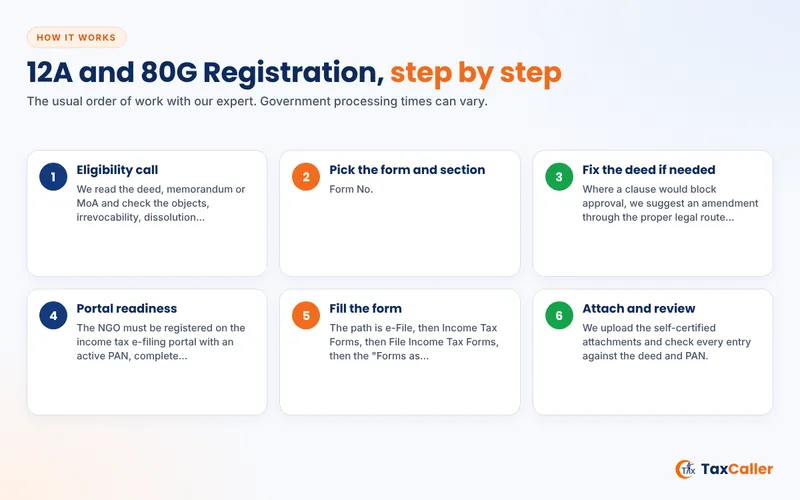
12A and 80G Registration: how the work moves, step by step
We prepare the papers, fill the form with you and file it on the income tax e-filing portal. You verify it with your own DSC or EVC. Here is the path we follow.
Eligibility call: we read the deed, memorandum or MoA and check the objects, irrevocability, dissolution clause and any caste or community wording.
Pick the form and section: Form No. 104 or 105, Section 332, Section 354 or both, and the right section code and nature-of-applicant code.
Fix the deed if needed: where a clause would block approval, we suggest an amendment through the proper legal route before filing.
Portal readiness: the NGO must be registered on the income tax e-filing portal with an active PAN, complete "My Profile" details and a valid DSC if it verifies by DSC.
Fill the form: the path is e-File, then Income Tax Forms, then File Income Tax Forms, then the "Forms as per Income Tax Act 2025" tab. We fill the parts with you: applicant details, other information, office bearers and, for Form No. 105, operations, assets, income and religious spending.
Attach and review: we upload the self-certified attachments and check every entry against the deed and PAN. Lists above 50 rows go as a CSV file.
E-verify: the authorised person verifies with DSC or EVC. The portal shows an acknowledgement number and sends an email and SMS.
Track and reply: for Form No. 105, we track the status under e-Proceedings on the portal. We draft replies and upload documents the officer asks for.
Order and handover: we download Form No. 106 or 107, note the URN and expiry dates, and give you a receipt format with the new section numbers.
How to download the 12A and 80G certificate
There is no separate paper certificate. The order itself is the certificate. On the portal, go to e-File, then Income Tax Forms, then View Filed Forms, open the form under the "Forms as per Income Tax Act 2025" tab. For Form No. 106, the Form 104 user manual shows a "Download Form 106" option under Additional Actions. The status of Form No. 107 shows on the same screen and under e-Proceedings. The whole process is online; the FAQs say offline filing is not allowed, so no office visit is needed unless an officer calls you for a hearing.
Check the form twice before you submit. Form No. 104 cannot be edited after filing. A filed form can be withdrawn only within seven days. For Form No. 105, an incorrect section code or nature of activity can be corrected on request before the order, if the officer allows it.
Provisional orders are due within about a month; regular orders can take up to six months after the quarter ends. The law fixes the outer limits.
Stage
Who acts
Time
Our document check and drafting
TaxCaller
Our estimate: 2 to 3 working days after we get complete papers
Form No. 104 order (Form No. 106)
CIT (CPC)
Within one month from the end of the month of application
Form No. 105 order (Form No. 107)
Jurisdictional PCIT or CIT
Within six months from the end of the quarter of application
Withdrawal window after filing
Applicant
Seven days
A quick worked date
Say a new trust files Form No. 104 on 10 November 2026. The month ends on 30 November, so the order is due by 31 December 2026. The portal's Form 104 user manual says Form No. 106 becomes available for download seven days after filing. If the same trust files Form No. 105 on 10 November 2026, the quarter ends on 31 December 2026. The order is then due by 30 June 2027.
Regular orders take longer because the officer can call for documents and inquire into whether your activities are genuine. Prompt and complete replies help keep to the timeline.
Zubair Company Registration Expert
Have a question on this topic? Ask Zubair on a free call.
12A and 80G Registration Fees: Government Fee and Our Fee
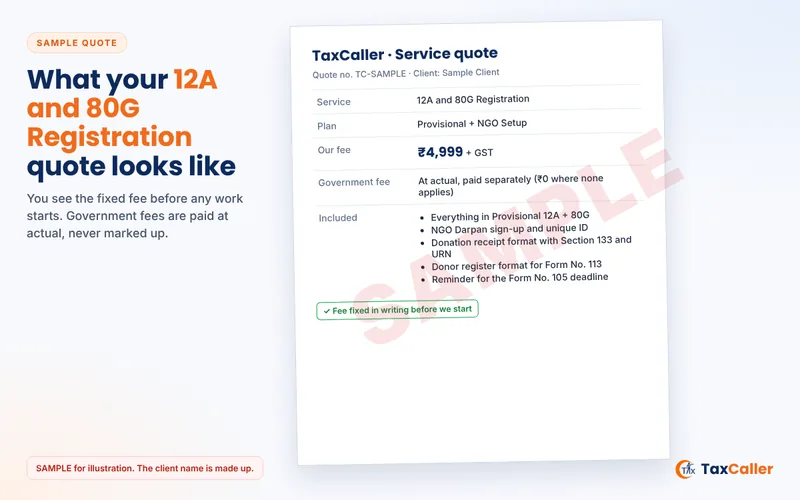
12A and 80G Registration: SAMPLE quote, for illustration only
There is no government fee listed for Form No. 104 or Form No. 105. The official FAQs and portal manuals for both forms mention none. Your cost is our professional fee plus small incidental costs.
Costs you may have outside our fee
Item
Paid to
Amount
Form No. 104 or 105 filing
Income Tax Department
No government fee listed
Digital signature certificate, if you verify by DSC
Stamp duty and registration fee for a deed amendment, if needed
State government
At actual, as per state law
Audit of past accounts, if not done
Your auditor
As agreed with the auditor
TaxCaller's fee
TaxCaller's fee for provisional 12A and 80G (one Form No. 104 for both) starts at ₹2,999 + GST. Government fees, stamp duty and DSC charges, where they apply, are paid separately at actual.
Form No. 105 is a separate service with its own fee. It covers regular registration, renewal and cases where activities have already started. It involves more work: income and asset schedules, office bearer details and replies to the officer. We quote it in writing before we start, so you know the full cost upfront.
Renew 12A and 80G by filing Form No. 105 at least six months before the current registration or approval expires. There is no separate renewal form.
Renewal checklist
Find the expiry tax year on your current order (old 12AB or 80G, or Form No. 107).
Count back six months from the end of that period and mark the last date to file.
Make sure returns, audit reports and Forms 113 for past years are filed.
Collect accounts for the past years and a note on activities.
File Form No. 105, choosing renewal for Section 332, Section 354 or both.
Choose 5 or 10 years for Section 332 if your income qualifies.
Example
Say an NGO's registration is valid up to 31 March 2028. It should file Form No. 105 on or before 30 September 2027. If such a date has already passed for you, file now with a request to condone the delay and a clear reason. A delay that is not condoned can lead to tax on accreted income under Section 352.
What renewal looks at
The officer may check whether your activities are genuine and whether you follow other laws that matter for your objects, as Section 332(7) says. Clean accounts, filed returns and matching office bearer details make renewal smoother.
A donor to an NGO approved under Section 354 deducts 50% of the donation under Section 133(1)(b)(ii), within a qualifying limit. The rules below decide how much the donor actually saves.
Rule
What it says
Provision
Rate for most approved NGOs
50% of the donation, subject to the qualifying limit
Section 133(1)(b)(ii)
Qualifying limit
Such donations above 10% of adjusted gross total income are ignored
Section 133(2)
100% funds
Certain government funds, such as the PM CARES Fund and the National Defence Fund, get 100% with no limit
Section 133(1)(a)
Cash
A donation above ₹2,000 qualifies only if paid other than in cash
Section 133(5)
Money only
Only a sum of money qualifies; goods or services do not
Section 133(4)
Reported donations
The claim is allowed on the basis of the details the NGO reports
Section 133(6)
Indian institutions only
Clause (ii) covers funds and institutions in India; a gift to a foreign charity does not qualify under it
Section 133(1)(b)(ii)
Worked example
Ravi's adjusted gross total income is ₹10 lakh. He gives ₹1,50,000 by bank transfer to an approved NGO. His qualifying limit is 10% of ₹10 lakh, which is ₹1,00,000. Only ₹1,00,000 counts, and he deducts 50% of it: ₹50,000. If he had paid ₹5,000 in cash, that gift would get no deduction at all.
Donors claim the deduction when they file their return; see income tax filing. Check the deduction against the tax regime you choose, because some regimes do not allow such deductions.
Abhinay Rai Company Registration Expert
Have a question on this topic? Ask Abhinay on a free call.
Annual Compliance After Registration: Audit, Return and Donation Statements
After approval, an NGO must keep accounts, get them audited where required, file its return, and report every donation in Form No. 113. The main yearly duties are below.
Duty
Form
Due
Provision
Books of account and audit by an accountant
Form No. 112 (old 10B / 10BB)
One month before the due date of the return
Section 348; Rule 186
Return of income
ITR-7 for tax years up to 2025-26; the notified ITR form after that
By the return due date under Section 263
Section 349
Statement of donations received
Form No. 113 (old 10BD)
Before 31 May following the tax year
Section 354(1)(e); Rule 190
Certificate to each donor
Form No. 114 (old 10BE)
Generated after Form No. 113 is filed
Section 354(1)(g)
Apply 85% of regular income to objects
Shown in audit report and return
Each tax year
Section 336
Audit report in Form No. 112
The Form No. 112 FAQs say the audit is needed where total income, computed without the non-profit exemptions, exceeds the amount not chargeable to tax. A "small" NPO fills fewer schedules: regular income up to ₹5 crore, foreign contribution up to ₹10 lakh and income applied outside India up to ₹10 lakh.
Forms 113 and 114
The Form No. 113 and 114 FAQs say Form No. 113 is filed online with the CIT (CPC) and needs a valid PAN. A correction statement can be filed later, and a revised Form No. 114 may then be issued. Collect each donor's name, address and ID when you receive the gift; the donor's claim depends on your report. Our accounting and bookkeeping team can keep the donor register for you.
If you pay salaries, rent or professional fees above the limits, you also need TAN and quarterly TDS returns; see TDS return filing.
Penalties, Cancellation and Tax on Accreted Income
Late donation statements cost ₹200 a day, serious breaches can cancel registration, and losing registration can trigger tax on the NGO's net assets.
Late Form No. 113 or Form No. 114
Section 429 charges a fee of ₹200 for each day the default continues. The fee cannot exceed the amount of donations for which the failure occurred. It must be paid before the statement is filed or the certificate is given.
Cancellation for specified violations
Under Section 351, the Principal Commissioner or Commissioner can cancel registration for the year of the violation and all later years. Specified violations include:
Income applied for purposes other than the objects
Commercial activity that breaks Section 345
Income applied for private religious purposes that do not benefit the public
For a body set up after the Act began, income applied for one religious community or caste (with exceptions for SC, ST, backward classes, women and children)
Activities that are not genuine or not in line with the registration conditions
Undisputed or final non-compliance with another law that matters for the objects
False or incorrect information in the application
The order must come within six months from the end of the quarter in which the first notice was issued, after a hearing.
Tax on accreted income
Under Section 352, tax at the maximum marginal rate applies to accreted income in certain cases. Accreted income is broadly the fair market value of assets minus liabilities. The cases include cancellation, failure to apply for registration in time, conversion into a non-eligible body, and certain mergers or dissolutions. Interest at 1% a month applies if the tax is paid late. This is why renewal dates matter so much.
Most rejections come from deed clauses, missing papers, unanswered notices or the wrong form. The official FAQs and Sections 332, 351 and 354 point to these risks.
Reason
How to avoid it
Form No. 104 filed after activities started, so treated as non-est
Declare the true start date; use Form No. 105 if work has begun
Trust is revocable, or the deed lets assets go to private hands on dissolution
Amend the deed so it is irrevocable and assets pass to a similar charitable body
Objects limited to one religious community or caste (blocks 80G)
Make objects open to the public; keep religious spending within 5% if you want 80G
Documents or information not given when the officer asks under Section 332(7)
Reply within the time given, with complete papers
Hearing opportunity not used
Attend or reply online on e-Proceedings
Activities not shown as genuine
Keep photos, beneficiary lists, bills, bank entries and an activity report
Non-compliance with another law material to the objects
Keep school, hospital, FCRA or state licences current
False or wrong details, or a form not verified by the right person
Match names, PAN and addresses with the deed and registration certificate
Late renewal or late move from provisional to regular
Diarise dates; file Form No. 105 on time
Following an old guide that still says Form 10A, 10AB or 10G, or "lifetime" validity
Use Forms No. 104 and 105 on the "Forms as per Income Tax Act 2025" tab; validity is limited
Wrong section code or nature of activity
Check codes before filing; request correction before the order if needed
If your application is rejected
The Form No. 105 FAQs allow a re-application only once, after the first rejection or cancellation. It must be filed within one month from the end of the month of the order. It is open only where the rejection was for not giving documents or information, not using the hearing, or terms in the trust deed. You must give an undertaking that no appeal is pending against the order. An appeal is the other route, and we help you weigh the two.
Shadab Company Registration Expert
Have a question on this topic? Ask Shadab on a free call.
Worked Example: A New Education Trust From Form 104 to Renewal
Here is how one Ghaziabad trust might move through the steps. The dates are an example, not a promise of department timelines.
July 2026: the trust deed is registered with the Sub-Registrar. The trust gets its PAN and opens a bank account.
August 2026: the trust signs up on NGO Darpan. It files one Form No. 104 for both Section 332 and Section 354, before any activity starts.
September 2026: Form No. 106 orders arrive with a URN. Provisional status is valid until the earlier of tax year 2028-29 or six months after work starts.
1 January 2027: the first tuition centre opens. The six-month clock to file Form No. 105 starts.
March 2027: we file Form No. 105 well before 30 June 2027, with an activity note, accounts and photos.
By 30 September 2027: the order in Form No. 107 is due (six months from the end of the March quarter). The trust picks the validity period the form allows for its case: five tax years, or ten where the ₹5 crore income test for the two preceding tax years is met.
Every year: audit in Form No. 112 if required, ITR-7, Form No. 113 by 31 May and Form No. 114 to donors.
Renewal: Form No. 105 again at least six months before the regular period ends.
The same path works for a society or a Section 8 company. Only the founding documents differ.
The big change in 2026 is the new Act: the Income-tax Act, 2025 came into force on 1 April 2026, with new section and form numbers for NGOs. Here is what changed in practice.
New sections: 12A/12AB is now Section 332; 80G(5) approval is Section 354; the donor deduction is Section 133; definitions and the status of old registrations are in Section 355.
New forms under the Income-tax Rules, 2026: Forms 10A, 10AB, 10BD, 10BE and 10B/10BB are replaced by Forms No. 104, 105, 113, 114 and 112. Form No. 105 sits under Rule 181 and Forms 113 and 114 under Rule 190.
Simpler Form No. 104: the FAQs say fields thought complicated for new bodies were removed. Provisional status is granted on basic details, with detailed checks at the regular stage.
Ten-year regular registration: Section 332(5) gives ten tax years to smaller NGOs in most Form No. 105 cases, as the Form No. 105 FAQs confirm.
One audit form: Form No. 112 replaces both Form 10B and Form 10BB, with lighter schedules for small NPOs.
Portal tab: the e-filing portal now has a separate "Forms as per Income Tax Act 2025" tab. Filings for tax years up to 2025-26 still use the 1961 Act forms.
Old certificates stay valid until they expire, through the definitions in Section 355. You do not need to re-apply just because the Act changed. Donation receipts for tax year 2026-27 onwards should quote the new sections and your URN.
Deed review first: we read your deed or memorandum before filing and flag clauses that commonly lead to rejection.
New Act ready: we work with the Income-tax Act, 2025 sections and the new form numbers, and we still handle old-Act filings for tax years up to 2025-26.
Clear fees: our fee is shown + GST; government charges are paid at actual and never hidden in our invoice.
Full cycle: Darpan, Form No. 104, Form No. 105, Form No. 113 and renewal reminders can be handled by one team.
Online across India: documents by email or WhatsApp, filing on the official portal, and calls with our expert. The page is reviewed by Abhinay Rai, Advocate.
Have a question first? Contact us and our expert will check your deed and tell you which form you need.
Shreya Company Registration Expert
Have a question on this topic? Ask Shreya on a free call.
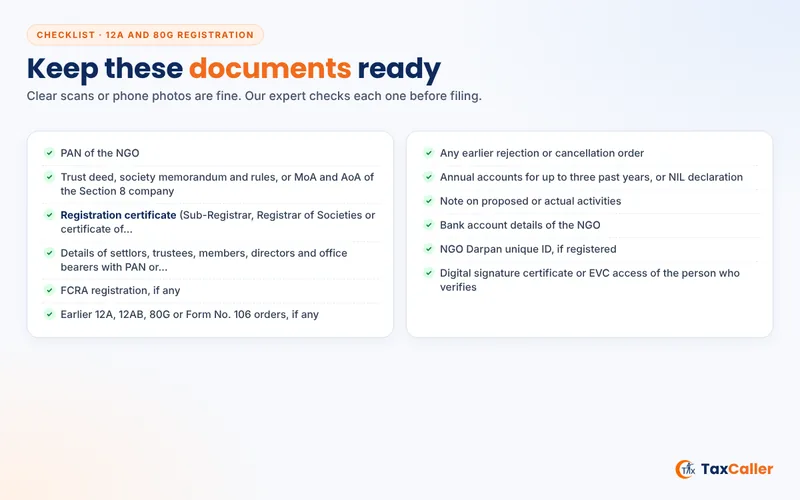
Trust deed, society memorandum and rules, or MoA and AoA of the Section 8 company
Registration certificate (Sub-Registrar, Registrar of Societies or certificate of incorporation with licence)
Details of settlors, trustees, members, directors and office bearers with PAN or other ID
FCRA registration, if any
Earlier 12A, 12AB, 80G or Form No. 106 orders, if any
Any earlier rejection or cancellation order
Annual accounts for up to three past years, or NIL declaration
Note on proposed or actual activities
Bank account details of the NGO
NGO Darpan unique ID, if registered
Digital signature certificate or EVC access of the person who verifies
Why TaxCaller
Real experts, not a call centre
Your work is handled by experienced professionals who explain every step, check your documents and keep you updated.
Registered company
TaxCaller is run by TaxCaller India LLP (LLPIN AAQ-7388), serving clients since 2018.
Fee told upfront
You know the complete fee, our professional fee and the government fee, before any work starts. No hidden charges.
Support after the work
Notices, renewals, returns and compliance reminders: we stay with your business after the registration is done.
Reviewed By
Expert for this topic 12A and 80G Registration
Abhinay Rai
Advocate
Abhinay Rai is a Advocate specialising in 12A and 80G Registration. The process, documents, timelines and fees on this page are checked against the current rules and government portals, and updated whenever the law, forms or fees change.
12A registration lets an NGO keep income spent on its objects free of tax. 80G approval lets donors claim a deduction on their gifts. From 1 April 2026, 12A is Section 332 and 80G is Section 354 of the Income-tax Act, 2025. A trust, society or Section 8 company applies online on the income tax portal.
Is there any government fee for 12A and 80G registration?
No government fee is listed for Form No. 104 or Form No. 105. The official FAQs and portal manuals mention none. You may still pay for a digital signature certificate, a deed amendment or an audit if needed. TaxCaller's professional fee is charged separately, plus GST, and Form No. 105 has its own fee.
Can we apply for 12A and 80G together?
Yes. Form No. 104 and Form No. 105 are common forms. You choose Section 332, Section 354 or both in one application, and the department passes two separate orders. Approval under Section 354 is open only to a registered non-profit organisation, so applying for both together is the usual route for a new NGO.
How long is 12A and 80G registration valid?
Provisional status lasts three tax years, or until six months after activities start, whichever is earlier. Regular registration under Section 332 is generally valid for five tax years, or ten in most Form No. 105 cases where income stayed within ₹5 crore in each of the two preceding years. Regular approval under Section 354 lasts five tax years.
What is the difference between Form 104 and Form 105?
Form No. 104 is for provisional registration or approval when activities have not started. The CIT (CPC) passes the order in Form No. 106. Form No. 105 is for regular status, renewal, and bodies already working. The jurisdictional Commissioner can inquire before passing the order in Form No. 107. They replace Forms 10A and 10AB.
How long does it take to get 12A and 80G?
For Form No. 104, the order is due within one month from the end of the month in which you apply. For Form No. 105, it is due within six months from the end of the quarter of application. We estimate our own drafting at two to three working days once we have complete documents.
When should we renew 12A and 80G?
File Form No. 105 at least six months before your current registration or approval expires. If your provisional status is ending and activities have not started, the same six-month rule applies. Once activities start under provisional status, apply within six months of the start. Late filing needs a condonation request with a reason.
Is a Darpan ID required for 12A and 80G?
It is not a legal condition in Sections 332 or 354. But Forms 104 and 105 ask about recognition under other laws, with Darpan registration as one option. Banks must check Darpan for non-profit customers, and ministries ask for it before grants. Most NGOs therefore get the Darpan ID first. There is no government fee for Darpan.
Can a religious trust get 80G approval?
A public religious trust can get registration under Section 332. For 80G approval under Section 354, the body must be set up for a charitable purpose, and religious spending cannot exceed 5% of total income in a tax year. It also must not be stated to be for one religious community or caste.
How much tax does a donor save under the new Act?
For most approved NGOs, the donor deducts 50% of the donation under Section 133(1)(b)(ii). Such donations above 10% of adjusted gross total income are ignored. A cash gift above ₹2,000 gets no deduction. The saving then depends on the donor's tax slab and on whether their chosen tax regime allows this deduction.
Is our old 12AB or 80G certificate still valid after April 2026?
Yes, until it expires. Section 355 defines a registered non-profit organisation to include a body with a valid registration under the old Sections 12A, 12AA, 12AB or 10(23C), and approval to include an old 80G(5) approval. Renew under the new Act by filing Form No. 105 at least six months before expiry.
What happens if we do not file Form 113 on time?
Form No. 113 must be filed before 31 May following the tax year. Under Section 429, a late statement or certificate costs ₹200 for each day of default, capped at the donation amount involved, and must be paid before filing. Donors may also lose their deduction because their claim relies on what the NGO reports.
Why do 12A and 80G applications get rejected?
Common reasons are a revocable trust deed, objects limited to one community or caste, filing Form No. 104 after work has started, missing documents, unanswered notices, and doubts about whether activities are genuine. Wrong or mismatched details also cause trouble. A deed review and complete, prompt replies to the officer avoid most of these problems.
Is 12A and 80G needed for CSR funds?
Yes. Rule 4(1) of the Companies (CSR Policy) Rules, as amended in 2021, asks a trust, society or Section 8 company to hold both 12A and 80G registration before registering in Form CSR-1. Under the new Act, these are Section 332 registration and Section 354 approval. CSR-1 is filed on the MCA portal.
Is 12A registration compulsory for an NGO?
No law forces an NGO to apply, but without registration under Section 332 its surplus is taxed like any other income. Donors also cannot get 80G approval benefits, because Section 354 approval is open only to registered non-profit organisations. CSR-1 needs both. So in practice, almost every trust, society or Section 8 company applies.
Send us your deed or registration certificate, and our expert will tell you whether to file Form No. 104 or 105. Our fee starts at ₹2,999 + GST, and any government charges are paid at actual.