TAN Registration Online: Get Your TAN Number Before You Deduct
TAN registration online in Form 135 or Form 134, with documents checked, the application tracked and your TAN set up on the e-filing portal by a tax expert.
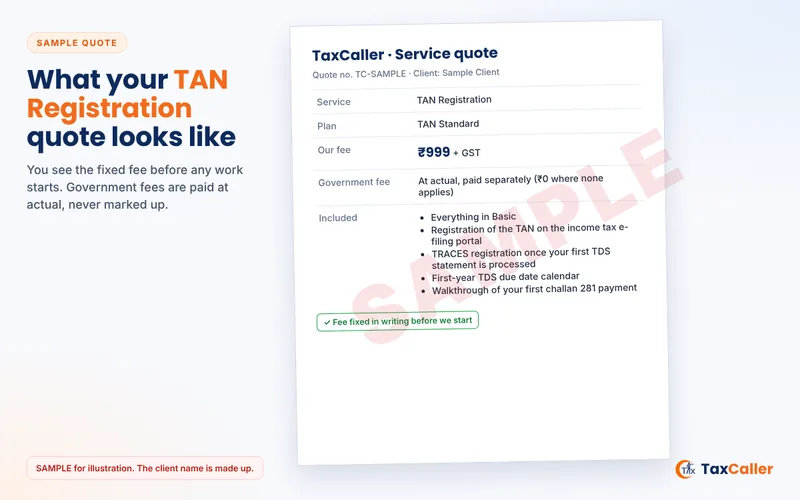
Starting from · ₹499 TAN Registration TAN Basic plan
STARTING FROM₹499
FEE TOLD UPFRONTFree first call
!Late ITR?Fee up to ₹5,000 under Sec 234F
Since 2018Trusted Experience
980+Experts Connected
220+Cities Served
1164+Agents Available
12000+Founders Trusted
S
Srishti Magoo
★★★★★
Excellent experience with TaxCaller for filing my &
my family members ITR returns. The entire process was
smooth, quick and hassle-free. They are professional,
knowledgeable and guided me through every step with patience.
O
obeid sait
★★★★★
The team has handled my taxes for the past three years,
and it's been a wonderful, hassle-free experience.
Thank you for your consistently quick and efficient service.
P
Pushkar
★★★★★
They are among the best in their field. Their work culture
is highly professional, and their client service is smooth
and reliable. They can confidently be relied on to get the job done.
P
Prasad Sheth
★★★★★
Excellent experience with TaxCaller! The ITR filing
process was smooth, quick, and completely hassle-free.
The CA was knowledgeable, responsive, and explained everything clearly.
A
Apoorv Bansal
★★★★★
Excellent service for ITR filing. The team was highly
professional, responsive, and guided me through the entire
process smoothly. My return was filed accurately and on time.
A
Abhishek Kumar
★★★★★
I was searching for a good CA firm in Ghaziabad and found
TaxCaller. The experience was excellent from start to finish.
The team is responsive, transparent, and genuinely helpful.
U
uma pandey
★★★★★
Great service! TaxCaller India made the entire ITR filing
process quick, smooth, and hassle-free. They answered all
my queries patiently and ensured maximum accuracy.
T
tanu mittal
★★★★★
Excellent job! We've been connected for many years,
and your success truly makes me happy. You are an
incredibly intelligent person. Keep shining, keep growing.
B
Bhanu Pratap Maurya
★★★★★
I am filing my ITR since past 3 years with Abhinav and
Firm is known as TaxCaller and they are professional
interms of ITR rules. They will explain and tell you all
the information.
A
ashish Sharma
★★★★★
I am providing my honest reviews:
No.1 service ...
A
AARYAN GROUP
★★★★★
Honestly, finding a good CA firm in Ghaziabad was
confusing, but TaxCaller India made it simple.
I contacted them for GST work and the experience was smooth.
N
News Speaks
★★★★★
If you're looking for a reliable CA firm in Ghaziabad,
TaxCaller India is a great choice. They provide complete
taxation and compliance solutions including GST.
A
Anshul Chaprana
★★★★★
Got my GST registration done through TaxCaller CA firm.
Process was quite smooth, they guided properly on documents
and didn't waste time. Overall good experience.
How we work
Online · Call · WhatsApp
Quick answer
TAN registration means getting a Tax Deduction and Collection Account Number, which every person who deducts or collects tax at source must hold. From 1 April 2026, section 397(1) of the Income-tax Act, 2025 requires it (old section 203A). You apply in Form 135, or Form 134 for government offices, through Protean for ₹77 including GST.
Reviewed by Abhinay Rai · Updated 15 Nov 2026
Pick a plan that fits
TAN Basic
A business or person who needs a new TAN, filed correctly the first time
One TAN change or correction request within the first year
Surrender of a duplicate TAN, if found
Check that e-filing and TRACES show the updated details
Government fees and taxes are extra where applicable. Our expert confirms the final amount on the first call. No hidden charges.
About TAN Registration
TAN registration is the first step before you deduct tax from salary, rent, contractor bills or professional fees. TAN stands for Tax Deduction and Collection Account Number. It is a 10-character number issued by the Income Tax Department. You must quote it on every TDS or TCS challan, statement and certificate.
The law changed on 1 April 2026. The Income-tax Act, 2025 and the Income-tax Rules, 2026 replaced the old Act and Rules. The duty to get a TAN now sits in section 397(1), and the application forms are Form 134 and Form 135 under Rule 216. Form 49B is no longer used for new applications. Some small payers, such as an individual buying a flat, do not need a TAN at all.
TaxCaller has handled tax registrations and filings since 2018, from our office in Ghaziabad and online across India. This page explains who needs a TAN, who does not, the forms, documents, fee, timeline, penalty, corrections, duplicate TAN surrender and every 2026 change, in plain words.
Complete guide
Choose a topic to open it. Every answer gives the rule or section it comes from.
01 Topic 1 of 20
What Is a TAN Number?
A TAN is a 10-character alphanumeric number that identifies a person who deducts or collects tax at source. The Income Tax Department allots it once. You then use it for all TDS and TCS work for that entity or branch.
How a TAN is built
Position
What it is
Example
Characters 1 to 3
Letters showing the jurisdiction code
ABC
Character 4
First letter of the deductor's name
D
Characters 5 to 9
Five digits
12345
Character 10
A check letter
E
So a TAN looks like ABCD12345E. This is a made-up example, not a real number. The structure comes from the Income Tax Department's TAN page.
Where the law requires it
From 1 April 2026:section 397 of the Income-tax Act, 2025 says every person deducting or collecting tax must apply for a TAN. Clause (b) says the TAN must be quoted in all challans, statements and certificates.
Up to 31 March 2026: the same duty sat in section 203A of the Income-tax Act, 1961.
Procedure: Rule 216 of the Income-tax Rules, 2026 sets the forms and time limit. It replaced Rule 114A of the Income-tax Rules, 1962.
Where you quote it
You enter your TAN on challan 281 when you pay TDS or TCS. You quote it in every quarterly statement, such as Form 138 for salary or Form 140 for other payments. It also appears on the certificates you give payees. The official FAQs say PAN cannot be quoted in place of TAN where TAN is required.
Every person who deducts tax at source or collects tax at source must get a TAN, unless a specific exemption applies. The test is the payment you make, not your size or business type.
Common cases that need a TAN
Employers who deduct tax from salary under section 392 of the 2025 Act (old section 192).
Companies and LLPs paying rent, contractors, professionals, commission or interest above the TDS limits in section 393.
Partnership firms, including TDS on salary, interest or commission paid to partners.
Proprietors and HUFs whose turnover in the previous tax year was above ₹1 crore (business) or ₹50 lakh (profession), when they make TDS payments to vendors.
Trusts, societies, AOPs and co-operative societies making payments covered by TDS rules.
Sellers who collect TCS under section 394, such as on scrap or motor vehicles above the limit.
Anyone paying a non-resident a sum taxable in India, with one 2026 exception for property buyers explained below.
Central and State Government offices and local authorities, which apply in Form 134.
Categories listed in the official FAQs
The official FAQs on Forms 134 and 135 list who uses Form 135: individuals, sole proprietorships, LLPs, firms, associations of persons, trusts, bodies of individuals, artificial juridical persons, HUFs, companies, statutory or autonomous bodies, and branches or divisions of these.
When the duty starts
The duty starts with your first deduction or collection. Even a single deduction in a year needs a TAN, unless you fall in an exempt category. A business that has staff but pays salary below the taxable limit may not deduct yet. It still needs a TAN once any TDS payment arises.
Shreya Income Tax Expert
Have a question on this topic? Ask Shreya on a free call.
Some individuals and HUFs who deduct tax on one-off personal payments do not need a TAN. Section 397(1)(c) of the 2025 Act lists them. They deposit the tax with their PAN using Form 141, a challan-cum-statement.
Payment
2025 Act reference
Old 1961 Act section
TAN needed?
Buying immovable property (not agricultural land) for ₹50 lakh or more, TDS 1%
Section 393(1), Table Sl. No. 3(i)
194-IA
No
Rent above ₹50,000 a month paid by an individual or HUF below the turnover limits for regular rent TDS, TDS 2%
Section 393(1), Table Sl. No. 2(i)
194-IB
No
Contract work, professional fees or commission paid by an individual or HUF not otherwise required to deduct, above ₹50 lakh, TDS 2%
Section 393(1), Table Sl. No. 6(ii)
194M
No
Payment for a virtual digital asset by an individual or HUF covered by the ₹50,000 limit
Section 393(4), Table Sl. No. 12.C(a), with Sl. No. 8(vi)
194S
No
Resident individual or HUF buying immovable property from a non-resident
Section 393(2), Table Sl. No. 17
195
No, from 1 October 2026
Persons notified by the Central Government
Section 397(1)(c)
Not applicable
As notified
Points to note
The exemption covers only that transaction. If the same person also pays salary or contractors under other entries, a TAN is needed for those.
Form 141 replaced the old Forms 26QB, 26QC, 26QD and 26QE. It is due within 30 days from the end of the month in which tax was deducted.
Property bought from a non-resident before 1 October 2026 still needed a TAN. The relief came through the Finance Act, 2026 and the Income-tax (Fifth Amendment) Rules, 2026.
If you only need Form 141 for a property or rent payment, you do not need this service. Our TDS return filing team can file the Form 141 instead.
PAN identifies a taxpayer. TAN identifies a person who deducts or collects tax for the government. Most businesses need both, and they are not interchangeable.
Point
TAN
PAN
Full form
Tax Deduction and Collection Account Number
Permanent Account Number
Section, 2025 Act
Section 397(1)
Section 262
Old section, 1961 Act
Section 203A
Section 139A
Who needs it
Persons who deduct or collect tax at source
Taxpayers, return filers and people doing listed transactions
Format
4 letters, 5 digits, 1 letter
5 letters, 4 digits, 1 letter
Used on
TDS and TCS challans, statements and certificates
Returns, tax payments, bank and property deals
How many
One per deductor, with separate TANs allowed for branches
Only one per person
Application form (2026)
Form 134 or Form 135
Separate PAN forms
Do not type your PAN where a challan asks for TAN. A challan paid under the wrong number does not link to your TDS statement, and the payee loses credit.
Zubair Income Tax Expert
Have a question on this topic? Ask Zubair on a free call.
Government deductors use Form 134. Everyone else uses Form 135. Both replaced Form 49B from 1 April 2026. The official FAQs on Forms 134 and 135 list them as the forms earlier known as Form 49B.
Point
Form 134
Form 135
Who files
Central Government, State Government and local authorities
Companies, LLPs, firms, individuals, HUFs, trusts, AOPs, BOIs, statutory bodies and their branches
Key identifier
Accounts Office Identification Number (AIN), 7 digits
PAN of the applicant, and CIN or LLPIN where applicable
Supporting paper
Certificate from the PAO, ZAO, DTO or CDDO
Proof of identity, address and date of birth or incorporation
Rule
Rule 216(1), Income-tax Rules, 2026
Rule 216(1), Income-tax Rules, 2026
Categories inside Form 135
Form 135 asks you to tick one category. Protean's instructions warn that ticking more than one leads to rejection. A company recorded as a firm, for example, then needs a correction later.
Details asked in both forms
Name and address of the deductor or branch, in full
TDS Assessing Officer code: area code, AO type, range code and AO number
Details of the person responsible for deduction: full name, PAN, designation and contact number
Email and phone for the allotment letter
For a company branch, the CIN is mandatory. For an HUF, the person responsible is the Karta.
Ways to Apply: Protean Online, PAN Centre or SPICe+
For TAN registration you can apply online on the Protean (formerly NSDL) portal, offline at an authorised centre, or through the MCA portal when a company is incorporated. The official FAQs list all three routes.
Fill in the form, fix any errors the system shows and confirm.
Pay the fee by net banking, card, cheque or demand draft.
Save the acknowledgement with its 14-digit number and sign it in the box.
Send the signed acknowledgement and document copies to Protean's office in Pune within 15 days.
Protean processes the application only after it receives the papers and the payment is realised.
2. Offline at a TIN Facilitation Centre or PAN centre
You fill in the form at an authorised centre, hand over the documents and pay the fee there. The centre uploads the data and gives you an acknowledgement. This suits people who cannot sign or send papers easily.
3. Through SPICe+ for a new company
A company being incorporated applies for PAN and TAN inside SPICe+ Part B (INC-32) on the MCA portal. The small PAN and TAN fees are part of the SPICe+ payment, and the TAN arrives with the Certificate of Incorporation. Rule 216(2) allows this kind of common application form when the Central Government notifies it. If you are still forming the company, see our private limited company registration service.
Which route we use
For most clients we file online with Protean. It is faster to track and keeps a clean record of what was submitted.
Non-government applicants must now attach proof of identity, proof of address and proof of date of birth or incorporation. Rule 216(5) ties these to the document list used for PAN in the Table under Rule 158(8). Before 2026, the online route needed almost no papers beyond the signed acknowledgement.
The table shows what we usually ask for, by type of applicant.
Applicant
Documents we usually ask for
Company
Certificate of Incorporation with CIN, company PAN, registered office proof, authorised signatory's ID
LLP
LLP incorporation certificate with LLPIN, LLP PAN, office address proof, designated partner's ID
Partnership firm
Partnership deed or registration certificate, firm PAN, office address proof, partner's ID
Proprietor or individual
Own PAN, Aadhaar or other ID, proof of business or residential address, date of birth proof
HUF
HUF PAN, Karta's ID and address proof, HUF declaration
Trust or society
Trust deed or registration certificate, PAN, address proof, trustee's or secretary's ID
Government office (Form 134)
AIN and certificate from the PAO, ZAO, DTO or CDDO
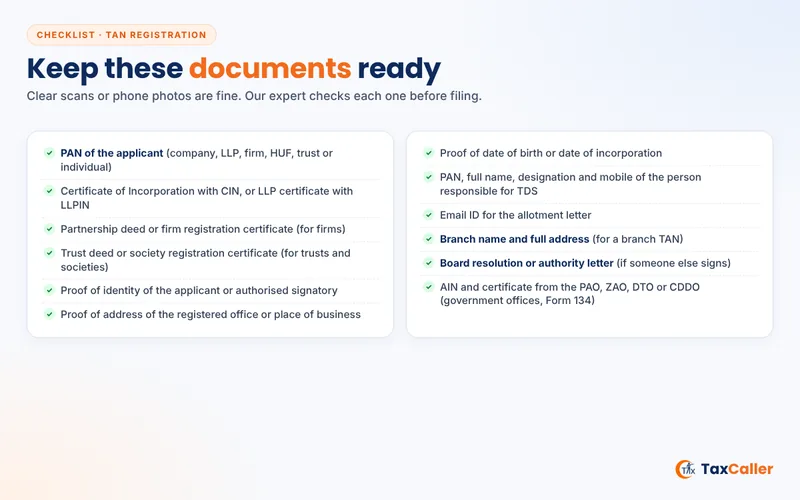
Also keep ready
PAN, name, designation and mobile of the person responsible for TDS
Email ID that will receive the allotment letter
Branch name and full address, if the TAN is for a branch
Board resolution or authority letter if someone else signs
Tips that avoid a rejection
The name must match the PAN record exactly, including "Private Limited" or "LLP".
Write the responsible person's full name. Protean's instructions do not allow abbreviations.
A thumb impression must be attested by a Magistrate, Notary Public or Gazetted Officer.
Abhinay Rai Income Tax Expert
Have a question on this topic? Ask Abhinay on a free call.
TAN Registration: how the work moves, step by step
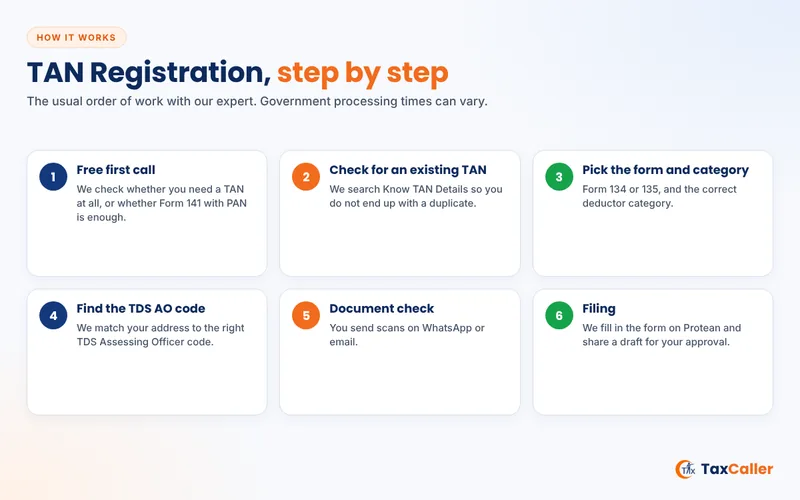
We prepare and file your TAN registration application, track it with Protean and hand over your TAN with the portal set up. You approve each step.
Free first call: we check whether you need a TAN at all, or whether Form 141 with PAN is enough.
Check for an existing TAN: we search Know TAN Details so you do not end up with a duplicate.
Pick the form and category: Form 134 or 135, and the correct deductor category.
Find the TDS AO code: we match your address to the right TDS Assessing Officer code.
Document check: you send scans on WhatsApp or email. We match names with PAN and CIN records.
Filing: we fill in the form on Protean and share a draft for your approval.
Fee: the ₹77 government fee is paid on the portal at actual.
Acknowledgement: we prepare the 14-digit acknowledgement for signature and guide the dispatch to Pune within 15 days.
Tracking: we follow the status until the TAN is allotted, and reply to any query.
Handover: you get the allotment letter, your TAN and a short note on your first TDS due dates.
On our Standard plan we also register the TAN on the e-filing portal and TRACES. Need a DSC for the person responsible? Our digital signature certificate service can issue one.
Timelines and the 30-Day Deadline, with a Worked Example
Rule 216(4) says you must apply before you deduct or collect tax. If you did not, you must apply within 30 days after the end of the month in which you deducted or collected it.
How long each step takes
Step
Usual time
Our document check and filing
1 to 2 working days after full documents
Signed papers reaching Protean
Must be within 15 days of applying
Status visible online
From about 3 days after applying
TAN allotment
No fixed official time. Processing starts once Protean has the papers and the payment
TAN through SPICe+
With the Certificate of Incorporation
TRACES and e-filing registration
After your first TDS statement is processed
These are typical times for TAN registration, not official deadlines. Delays come from wrong categories, name mismatches and late dispatch of papers.
Worked example: the legal deadline vs the practical one
A proprietor in Ghaziabad with last year's turnover above ₹1 crore pays a contractor ₹40,000 on 10 June 2026 and deducts TDS.
Legal deadline for TAN: 30 days after the end of June, so by 30 July 2026, under Rule 216(4).
TDS deposit due: by 7 July 2026, through challan 281. The challan needs a TAN.
Result: without a TAN by early July, the deposit is late. Interest under section 398 then runs at 1.5% a month or part of a month.
So the real deadline is your first deposit date, not the Rule 216 date. Apply as soon as you know a TDS payment is coming.
Failing to apply for a TAN, or not quoting it, can draw a penalty of ₹10,000. From 1 April 2026 this falls under section 468 of the Income-tax Act, 2025, which replaced section 272BB of the 1961 Act.
Default
2025 Act
1961 Act
Penalty
Failing to comply with section 397, such as not applying for TAN or not quoting it
Section 468(1)
Section 272BB(1)
₹10,000
Quoting a TAN you know or believe to be false
Section 468(2)
Section 272BB(1A)
₹10,000
Who levies it, and the reasonable cause defence
The Assessing Officer may impose the penalty. Section 470 of the 2025 Act lists section 468 among the provisions where no penalty is imposed if you prove reasonable cause for the failure. Keep a note of why a delay happened and what you did to fix it.
Old periods
Defaults for periods up to 31 March 2026 are handled under the 1961 Act framework, so section 272BB applies to them.
Knock-on costs
Late deposit interest under section 398 if you cannot pay TDS for lack of a TAN.
Late statement fee of ₹200 a day under section 427 if the quarterly return is delayed.
Penalty of ₹10,000 to ₹1,00,000 under section 461 for not filing statements.
Our TDS return filing page explains these return-level charges in detail.
TAN Correction, Change Requests and Duplicate TAN Surrender
To change or correct TAN details, you file the TAN Change Request Form, officially the "Form for Changes or Correction in TAN data for TAN allotted", online on Protean. The same form is used to surrender a duplicate TAN.
What you can change
Name of the deductor, for example after a company changes its name
Address, phone and email
Details of the person responsible for TDS
Category, but only if it was wrongly recorded, such as a company shown as a firm
How a TAN correction works
Open the change request form and enter your existing TAN.
Tick the box beside each field you want to correct, and fill in the new details.
Pay the processing fee and save the acknowledgement.
Send the signed acknowledgement with supporting documents to Protean in Pune.
Track the status with the acknowledgement number until the update is done.
The official FAQs add that a submitted application cannot be edited. Errors are fixed through a correction request after the TAN is allotted. The steps above follow the Income Tax Department's Change Your TAN Data page.
Duplicate TAN surrender
Holding or using more than one TAN for the same deductor is illegal. If you have two, keep the one you use regularly and surrender the rest. In the change request form, the TAN you keep goes at the top. The TAN to be cancelled goes in the cancellation item, and it must differ from the one at the top.
Separate TANs for separate branches or divisions are allowed. Those are not duplicates.
After a correction
Check that the e-filing portal and TRACES show the updated details. Use the new name and address in your next TDS statement.
Shreya Income Tax Expert
Have a question on this topic? Ask Shreya on a free call.
You can find any deductor's TAN, including your own, through Know TAN Details on the e-filing portal, without logging in. You need a mobile number for an OTP.
Know TAN Details, step by step
Open the income tax e-filing portal home page and click Know TAN Details.
Choose to search by name or by TAN.
Select the deductor's category and state.
Enter the name or TAN and your mobile number, then click Continue.
Enter the 6-digit OTP. It is valid for 15 minutes, with three attempts.
Click the deductor's name to see its TAN and Assessing Officer details.
Once your TAN is allotted, register it on the income tax e-filing portal and on TRACES. You need both to file statements, see defaults and download TDS certificates.
e-filing portal registration
The official deductor registration guide lists two prerequisites: a valid and active TAN, and the PAN of the principal contact registered on the e-filing portal. You choose the deductor category, validate the TAN and enter the responsible person's details. Two OTPs go to the mobile and email. The registration completes after approval by the competent authority.
TRACES registration
If the TAN is not yet linked to TRACES, the portal asks you to register on TRACES first. TRACES asks for the token number of a TDS statement already filed and processed, with challan details from it. So many new deductors file their first statement through a TIN Facilitation Centre, then register on TRACES and the e-filing portal.
Your first-year TDS calendar
Deposit TDS by the 7th of the next month. For March, the date is 30 April.
File quarterly statements by 31 July, 31 October, 31 January and 31 May.
Issue salary certificates in Form 130 by 15 June after the tax year.
Our TDS return filing service handles these quarterly statements once your TAN is active.
2026 brought the biggest changes to TAN registration rules in years. Here is what is new, with the official reference for each.
New law from 1 April 2026. The Income-tax Act, 2025 replaced the 1961 Act. The TAN duty moved from section 203A to section 397(1).
New Rules. Rule 216 of the Income-tax Rules, 2026 replaced Rule 114A. It sets the forms, the authority and the time limit.
Two new forms. Form 134 (government) and Form 135 (others) replaced Form 49B. Protean reports that the new forms took effect on 1 April 2026.
Documents now required. Form 135 needs proof of identity, address and date of birth or incorporation, as per Rule 216(5).
More details of the person responsible. The forms ask for the full name, PAN, designation and contact number of the person responsible for TDS.
New penalty section. Section 468 replaced section 272BB. The penalty stays at ₹10,000 for not complying and for a false TAN.
One form for TAN-exempt payers. Form 141 replaced Forms 26QB, 26QC, 26QD and 26QE for property, rent, contract and VDA payments by exempt individuals and HUFs.
No TAN for property bought from an NRI. From 1 October 2026, a resident individual or HUF buying property from a non-resident deducts TDS with PAN in Form 141, Schedule E. The Finance Act, 2026 amended section 397(1)(c). The rules came through Notification No. 121/2026 (G.S.R. 830(E), 22 September 2026), the Income-tax (Fifth Amendment) Rules, 2026.
Fee unchanged. The online fee remains ₹77 including GST.
Old-period work stays under the old law. A default from before 1 April 2026 is judged under the 1961 Act and its rules.
GST: TAN is an income-tax number. GST needs its own registration. See GST registration.
If you only need the TAN today, this page covers it in full. If you are setting up a business, ask us on the first call which of these you need, and in what order.
PAN of the applicant (company, LLP, firm, HUF, trust or individual)
Certificate of Incorporation with CIN, or LLP certificate with LLPIN
Partnership deed or firm registration certificate (for firms)
Trust deed or society registration certificate (for trusts and societies)
Proof of identity of the applicant or authorised signatory
Proof of address of the registered office or place of business
Proof of date of birth or date of incorporation
PAN, full name, designation and mobile of the person responsible for TDS
Email ID for the allotment letter
Branch name and full address (for a branch TAN)
Board resolution or authority letter (if someone else signs)
AIN and certificate from the PAO, ZAO, DTO or CDDO (government offices, Form 134)
Why TaxCaller
Real experts, not a call centre
Your work is handled by experienced professionals who explain every step, check your documents and keep you updated.
Registered company
TaxCaller is run by TaxCaller India LLP (LLPIN AAQ-7388), serving clients since 2018.
Fee told upfront
You know the complete fee, our professional fee and the government fee, before any work starts. No hidden charges.
Support after the work
Notices, renewals, returns and compliance reminders: we stay with your business after the registration is done.
Reviewed By
Expert for this topic TAN Registration
Abhinay Rai
Advocate
Abhinay Rai is a Advocate specialising in TAN Registration. The process, documents, timelines and fees on this page are checked against the current rules and government portals, and updated whenever the law, forms or fees change.
TAN registration is getting a 10-character Tax Deduction and Collection Account Number from the Income Tax Department. Every person who deducts or collects tax at source needs one under section 397(1) of the Income-tax Act, 2025. This covers employers, companies, firms, LLPs, trusts, proprietors above the turnover limits and TCS collectors. Some individuals making one-off payments are exempt.
What is the difference between TAN and PAN?
PAN identifies a taxpayer and is used in returns and financial deals. TAN identifies a person who deducts or collects tax and is used on TDS and TCS challans, statements and certificates. PAN falls under section 262 and TAN under section 397 of the 2025 Act. Most businesses need both, and PAN cannot replace TAN.
Which form is used to apply for TAN in 2026?
From 1 April 2026, government deductors apply in Form 134 and all other applicants in Form 135, under Rule 216 of the Income-tax Rules, 2026. These replaced Form 49B under old Rule 114A. Companies being incorporated can get a TAN through SPICe+ on the MCA portal. Old Form 49B guides are now out of date.
What is the fee for a TAN application?
The government fee for a new TAN application is ₹77, which is ₹65 plus 18% GST, paid to Protean. The official FAQs on Forms 134 and 135 confirm it includes GST. For companies, the TAN fee is part of the SPICe+ payment. TaxCaller's professional fee is separate and charged plus GST, while government fees stay at actual.
How long does it take to get a TAN?
Protean processes the application only after it receives the signed acknowledgement and documents, which must reach it within 15 days, and the payment is realised. The Rules set no fixed time for allotment. You can track the status about three days after applying, and the allotment letter comes by email. Companies formed through SPICe+ get the TAN with incorporation.
Do I need a TAN to deduct TDS on rent or a property purchase?
Usually not, if you are an individual or HUF making a personal payment. Buyers of property worth ₹50 lakh or more and tenants paying rent above ₹50,000 a month are exempt under section 397(1)(c). They deposit TDS with PAN through Form 141 within 30 days from the end of the month of deduction.
Do I need a TAN if I buy property from an NRI?
Not from 1 October 2026, if you are a resident individual or HUF. The Finance Act, 2026 amended section 397(1)(c), and Notification No. 121/2026 added Schedule E to Form 141 for these deals. You deduct TDS and report it with your PAN. Purchases with deductions before that date still needed a TAN.
What is the penalty for not obtaining a TAN?
The Assessing Officer may impose a penalty of ₹10,000 under section 468(1) of the Income-tax Act, 2025 for failing to comply with section 397. Quoting a false TAN draws another ₹10,000 under section 468(2). For periods before 1 April 2026, old section 272BB applies. Section 470 gives relief if you prove reasonable cause.
How can I find my TAN number?
Use Know TAN Details on the income tax e-filing portal. You can search by deductor name or TAN, after choosing the category and state. A 6-digit OTP goes to your mobile, and the result shows the TAN with Assessing Officer details. No login is needed, and employees can use it to check an employer's TAN.
How do I correct or change my TAN details?
File the TAN Change Request Form online on Protean. Enter your TAN, tick each field to change, fill in new details and pay the processing fee. Then send the signed acknowledgement with supporting documents to Protean in Pune. A category can be changed only if it was recorded wrongly. Check e-filing and TRACES afterwards.
What should I do if I have two TANs?
Keep the TAN you use regularly and surrender the others, because holding more than one TAN for the same deductor is illegal. Use the TAN Change Request Form: put the TAN you keep at the top and the one to cancel in the cancellation item. Separate TANs for separate branches or divisions are allowed, so those are not duplicates.
Does a new company get a TAN automatically?
Yes, when it is incorporated through SPICe+ on the MCA portal. The PAN and TAN applications are part of SPICe+ Part B, their small fees are in the SPICe+ payment, and the TAN arrives with the Certificate of Incorporation. Check your certificate before applying separately, or you may end up with a duplicate TAN.
Can one TAN be used for both TDS and TCS?
Yes. The official FAQs on Forms 134 and 135 say a single TAN covers both TDS and TCS, so you do not need a separate one for collection. A business may also take separate TANs for its branches or divisions if each handles its own payments. Every branch must then file its own quarterly statements under that TAN.
Does a TAN expire or need renewal?
No. A TAN has no expiry date and no renewal fee. It stays valid until you surrender it or the department cancels it. If your business details change, file a correction request instead of a new application. If your business closes, clear pending TDS statements and dues first, then speak to us about surrendering the TAN.
Is TAN required for GST registration?
No. GST registration is based on PAN, along with identity, address and bank details. TAN is an income-tax number used only for TDS and TCS under the Income-tax Act. A business may need both, but they are separate applications on separate portals. We can file your GST registration and TAN application together if you need both.
Tell us what payments you make and our expert will confirm whether you need a TAN and file it online. Our fee starts at ₹499 + GST, and the ₹77 government fee is paid at actual.