Halal Certification in India for Exporters and Manufacturers
Halal certification support for food, meat, cosmetic and pharma businesses: we match your certifier to your export market, prepare your file and coordinate each audit.
Starting from · ₹6,999 Halal Certification Halal Basic plan
STARTING FROM₹6,999
FEE TOLD UPFRONTFree first call
!GSTR-3B due?Last date 20 Nov 2026 · 4 days left
Since 2018Trusted Experience
980+Experts Connected
220+Cities Served
1164+Agents Available
12000+Founders Trusted
S
Srishti Magoo
★★★★★
Excellent experience with TaxCaller for filing my &
my family members ITR returns. The entire process was
smooth, quick and hassle-free. They are professional,
knowledgeable and guided me through every step with patience.
O
obeid sait
★★★★★
The team has handled my taxes for the past three years,
and it's been a wonderful, hassle-free experience.
Thank you for your consistently quick and efficient service.
P
Pushkar
★★★★★
They are among the best in their field. Their work culture
is highly professional, and their client service is smooth
and reliable. They can confidently be relied on to get the job done.
P
Prasad Sheth
★★★★★
Excellent experience with TaxCaller! The ITR filing
process was smooth, quick, and completely hassle-free.
The CA was knowledgeable, responsive, and explained everything clearly.
A
Apoorv Bansal
★★★★★
Excellent service for ITR filing. The team was highly
professional, responsive, and guided me through the entire
process smoothly. My return was filed accurately and on time.
A
Abhishek Kumar
★★★★★
I was searching for a good CA firm in Ghaziabad and found
TaxCaller. The experience was excellent from start to finish.
The team is responsive, transparent, and genuinely helpful.
U
uma pandey
★★★★★
Great service! TaxCaller India made the entire ITR filing
process quick, smooth, and hassle-free. They answered all
my queries patiently and ensured maximum accuracy.
T
tanu mittal
★★★★★
Excellent job! We've been connected for many years,
and your success truly makes me happy. You are an
incredibly intelligent person. Keep shining, keep growing.
B
Bhanu Pratap Maurya
★★★★★
I am filing my ITR since past 3 years with Abhinav and
Firm is known as TaxCaller and they are professional
interms of ITR rules. They will explain and tell you all
the information.
A
ashish Sharma
★★★★★
I am providing my honest reviews:
No.1 service ...
A
AARYAN GROUP
★★★★★
Honestly, finding a good CA firm in Ghaziabad was
confusing, but TaxCaller India made it simple.
I contacted them for GST work and the experience was smooth.
N
News Speaks
★★★★★
If you're looking for a reliable CA firm in Ghaziabad,
TaxCaller India is a great choice. They provide complete
taxation and compliance solutions including GST.
A
Anshul Chaprana
★★★★★
Got my GST registration done through TaxCaller CA firm.
Process was quite smooth, they guided properly on documents
and didn't waste time. Overall good experience.
How we work
Online · Call · WhatsApp
Quick answer
Halal certification is a third-party audit confirming that a product or facility meets a published halal standard. In India it is issued by private certification bodies. No central law requires it for domestic sale, but halal meat exports to listed countries need i-CAS Halal certification from an NABCB-accredited body. Uttar Pradesh restricts halal-certified food sold within the state.
Reviewed by Abhinay Rai · Updated 15 Nov 2026
Pick a plan that fits
Halal Basic
One site making a few products for domestic buyers or a single export market
₹6,999+ GST
No govt. fee
Handled by a TaxCaller Expert Licence & Registration Expert
DGFT country list and transition check for each order
Guidance on APEDA registration and the i-CAS Halal portal
Facility certification support with an NABCB-accredited body
Consignment certificate workflow for each shipment
Support through the first surveillance audit
Government fees and taxes are extra where applicable. Our expert confirms the final amount on the first call. No hidden charges.
About Halal Certification
Halal certification is an independent check that your product, ingredients and process meet a halal standard. A certification body audits your site, reviews every ingredient and then issues a certificate and the right to use its mark. Buyers in the Gulf, Malaysia, Indonesia and many other markets ask for it before they place an order.
In India the picture has several layers. Most halal certificates are voluntary and come from private bodies. Exports of halal meat are different: under DGFT rules, they need certification under the i-CAS Halal scheme of the Quality Council of India, from a body accredited by NABCB. Each importing country also keeps its own list of accepted certifiers. And Uttar Pradesh has restricted halal-certified food products for sale inside the state since November 2023, while exempting goods made for export.
TaxCaller has handled registrations and compliance work since 2018, from our office in Ghaziabad and online across India. This page explains the rules as they stand in November 2026, in plain and neutral words: who needs a certificate, the export rules, documents, the audit, validity, costs, mistakes to avoid and the 2026 changes. We do not issue certificates. We help you choose a suitable accredited body and get your file ready.
Complete guide
Choose a topic to open it. Every answer gives the rule or section it comes from.
01 Topic 1 of 20
What Is Halal Certification (Halal License)?
Halal certification is a written confirmation, issued after an audit, that a product or facility meets a named halal standard. The word halal is Arabic and is usually translated as "permissible". In trade, it refers to goods and processes that meet the requirements written into a standard used by a certification body or a government.
The certificate is not a single national document. It is issued by a certification body (CB) under its own scheme or under a scheme set by a government. The CB's standard decides which ingredients are accepted, how raw materials are sourced, how lines are cleaned and how products are kept apart from material the standard does not permit.
What a certificate usually states
Name and address of the certified company and site
Products, brands or categories covered
Standard or scheme used for the audit
Certificate number, issue date and expiry date
Name of the certification body and, where relevant, its accreditation or recognition
Who sets the standards
There is no single worldwide halal standard. Common reference points include the Gulf standard GSO 2055-1:2015 for halal food, the GSO 2055-2 standard for halal certification bodies, Malaysia's MS 1500:2019 and Indonesia's Halal Product Assurance law. In India, the i-CAS Halal scheme of the Quality Council of India (QCI) applies to meat exports. Because standards differ, a certificate accepted in one country may not be accepted in another.
Halal certified meaning: a "halal certified" label means a certification body has checked that product's ingredients, process and facility against a halal standard and issued a certificate that is still valid. It does not by itself mean a product is non-vegetarian: vegetarian food, cosmetics and medicines can also be certified.
Who Needs It: Food, Meat, Cosmetics, Pharma and Exporters
Businesses usually need a halal certificate when a buyer, a marketplace or an importing country asks for one. For meat exports to listed countries, Indian export policy itself requires it. The table shows the common cases.
Brand owners need halal status for every input before their own audit
Cosmetics and personal care
Indonesia's halal law covers cosmetics; UAE and other buyers often ask for it
Pharmaceuticals, nutraceuticals and supplements
Capsule shells, excipients and actives may need halal status for some export tenders and markets
Restaurants, caterers, hotels and cloud kitchens
Voluntary; used to answer customer and aggregator questions
Warehouses, cold stores and logistics firms
Some exporters need a certified storage chain to keep products segregated
Who usually does not
A business that sells only in India and has no buyer request has no legal need for halal certification. The certificate is also never a substitute for a licence. A food business still needs FSSAI registration or a licence, and a cosmetic or drug maker still needs its licence under the Drugs and Cosmetics Act, 1940.
The owner's religion does not matter to the certifier. Any business that meets the standard and passes the audit can apply.
Shadab Licence & Registration Expert
Have a question on this topic? Ask Shadab on a free call.
No central law in India makes halal certification compulsory for goods sold within the country. The one central rule is for exports: halal meat and meat products sent to listed countries must be certified under i-CAS Halal. Here is the legal position as of November 2026.
Area
Position
Source
Domestic sale (most states)
Voluntary. Private certification bodies issue certificates on request. FSSAI does not issue halal certificates
No central statute on halal certification
Halal meat exports
Mandatory i-CAS Halal certification by an NABCB-accredited body for exports to listed countries
DGFT Notification No. 34/2024-25 of 1 October 2024, as amended
Non-halal meat exports
Procedure unchanged
Same notification
Uttar Pradesh
Manufacture, storage, distribution and sale of halal-certified food products restricted in the state; goods made for export excluded
UP Food Safety and Drug Administration order of 18 November 2023
Proposed changes
A Food Safety and Standards (Amendment) Bill, 2025 was listed in the Rajya Sabha in December 2025. As reported, it proposes bringing religious dietary certifications, including halal, under government agencies. We found no report of it being passed. Until a law changes, certification for the domestic market stays voluntary outside Uttar Pradesh.
Remember that your importing country's rules can make certification mandatory for you even where Indian law does not. That is the main reason Indian exporters apply.
Halal meat exports from India are governed by DGFT export policy conditions, which require i-CAS Halal certification for listed countries. The rules were built in four steps.
Date
Notification
What it did
6 April 2023
Notification No. 03/2023
Halal-certified meat exports only from facilities certified under i-CAS Halal by an NABCB-accredited body. Existing certification bodies got six months to seek accreditation, and existing units six months to register on APEDA's meat export portal
2023 to 2024
Extensions
The accreditation and registration window was extended to 5 April 2024 and then, as reported, to 4 July 2024
1 October 2024
Notification No. 34/2024-25
New Policy Condition 8 under Chapter 2 and Policy Condition 2 under Chapter 16 of Schedule 2 (Export Policy), ITC(HS) 2022. Applied from 16 October 2024 to 15 listed countries
9 February 2026
Notification No. 59/2025-26
Added 20 more countries. Two-week transition for all except Egypt
The 2023 notification covers ITC(HS) headings 0201, 0202, 0204, 0206, 0207, 0210, 1601 and 1602: bovine, sheep, goat and poultry meat, offal, salted or smoked meat, sausages and other prepared meat. The 2023 notification was issued under Section 3 read with Section 5 of the Foreign Trade (Development and Regulation) Act, 1992. You can read the original DGFT Notification No. 03/2023 on the APEDA website and the later ones on the DGFT notifications page.
The five policy conditions in Notification No. 34/2024-25
Specified meat products may be exported as halal certified only if produced, processed or packed in a facility certified under i-CAS Halal.
After shipment, the exporter gives the buyer a valid halal certificate issued under i-CAS by an NABCB-accredited body.
Where the importing country has notified halal import rules, the exporter must also meet them and hold certificates from bodies approved under that country's system.
Export of non-halal certified meat follows the existing procedure.
The conditions apply to the listed countries.
Countries covered
List
Countries
Original 15 (from 16 October 2024)
Bahrain, Bangladesh, Indonesia, Iran, Iraq, Jordan, Kuwait, Malaysia, Oman, Philippines, Qatar, Saudi Arabia, Singapore, Turkey, United Arab Emirates
Transition extended to twelve months from 9 February 2026, so about 9 February 2027
The i-CAS Halal portal of QCI links APEDA-registered meat units and accredited certification bodies. The CB certifies the facility and then the exporter's consignments through the portal.
Accreditation in India: NABCB and Recognised Certification Bodies
In India, the National Accreditation Board for Certification Bodies (NABCB) under QCI accredits halal certification bodies for the i-CAS Halal scheme. For meat exports, only an NABCB-accredited body can issue the certificate DGFT asks for. For other products, accreditation is not legally required in India, but it is the simplest objective check you have.
Three questions to ask any certification body
Is it accredited? For meat, check the list of NABCB-accredited halal certification bodies linked from the i-CAS Halal portal. The NABCB website lists i-CAS Halal among its product certification schemes.
Is it recognised by your buyer's country? Each importing country keeps its own list. A body that is NABCB-accredited may still not be on the Malaysian, UAE, Saudi or Indonesian list.
Does its scope cover your product? Recognition is often limited to categories such as slaughter, processed food, cosmetics or flavours.
What the i-CAS Halal scheme document sets
The scheme document published by QCI in March 2023 refers to ISO/IEC 17065 and ISO/IEC 17021-1 for certification bodies, and ISO/IEC 17011 for the accreditation body. It sets audits in two stages, a decision by a committee of at least three members, one of whom must have expertise in Sharia law or halal certification, and a three-year certification cycle with surveillance. QCI can revise the scheme documents, so the CB will audit you against the version in force.
We do not recommend or name any private certification body on this page. On the first call, we check the accreditation and recognition of the bodies you are considering against your target markets.
Shreya Licence & Registration Expert
Have a question on this topic? Ask Shreya on a free call.
Halal Certification for Exports: What Importing Countries Require
Importing countries accept halal certificates only from bodies they have approved, so the buyer's country decides which certifier you need. Indian rules are only the first layer. Here is a summary of major markets, based on official and reported sources.
Market
Authority and rule
What it means for an Indian exporter
Malaysia
JAKIM recognises foreign halal certification bodies, listed in the Second Schedule of the Trade Descriptions (Certification and Halal Marking) Order 2011. Standard: MS 1500:2019 for food
Your certifier must be on JAKIM's recognised list for your product category. Check the Halal Malaysia portal
United Arab Emirates
Ministry of Industry and Advanced Technology (MoIAT), which took over the former ESMA's work. Cabinet Resolution No. 10 of 2014 on the UAE system for control of halal products
Certificates must come from a body registered with MoIAT. An optional Halal National Mark is also available. See MoIAT's halal page
Saudi Arabia
Saudi Food and Drug Authority (SFDA) and its Saudi Halal Center
Meat, poultry, animal-derived ingredients and products carrying a halal claim need certificates from bodies recognised by the Saudi Halal Center, and consignments in these categories also need a halal shipment certificate, as reported
Other GCC states
Gulf standards GSO 2055-1:2015 (halal food) and GSO 2055-2 (certification bodies), adopted with national rules
Check each state's approved list; Gulf buyers often ask for GSO-based certification
Indonesia
BPJPH under Law No. 33 of 2014 on Halal Product Assurance, with Government Regulation No. 42 of 2024, as amended by Government Regulation No. 40 of 2026
Foreign certificates are accepted from bodies with a mutual recognition agreement with BPJPH, and the importer registers them on the SIHALAL system
Indonesia's phased deadlines
Indonesia is phasing in mandatory halal certification. Government Regulation No. 40 of 2026, issued in October 2026, amended the schedule in Government Regulation No. 42 of 2024. Imported food, beverages and slaughter products must now be halal certified from 18 October 2028, and the deadline for cosmetics, health supplements, chemical products and several consumer goods moved to 17 October 2028. Over-the-counter drugs stay at 17 October 2029 and prescription drugs at 17 October 2034. BPJPH Regulation No. 2 of 2026, in force from 5 June 2026, sets written warnings, fines, revocation of halal certificates or registration numbers and withdrawal of products for breaches.
Other markets
Singapore, Brunei, Bangladesh, Turkey, Egypt and the Central Asian states each have their own approval routes. Ask your buyer for their written halal requirement before you choose a certifier. It saves a second audit later.
The Uttar Pradesh Order on Halal-Certified Products
Uttar Pradesh restricts halal-certified food products for sale within the state, but goods made for export are excluded. The facts, as recorded in court reports and news reports, are these.
Order: on 18 November 2023, the Food Safety and Drug Administration of Uttar Pradesh banned the manufacture, storage, distribution and sale of halal-certified food products in the state with immediate effect.
Legal basis cited: Sections 30(2)(a) and 30(2)(d) of the Food Safety and Standards Act, 2006. Reports say the order also covered halal-certified medicines.
Export exception: food products made for export are outside the ban.
Court challenge: petitions were filed in the Supreme Court, including Writ Petition (Criminal) No. 690 of 2023. The Court issued notice on 5 January 2024 and later protected the petitioners from coercive action. It heard the matter again on 20 January 2025 and listed it for March 2025.
Status: we found no report of a final judgment as of November 2026, and no report that the order has been withdrawn or set aside.
What this means in practice
A UP-based exporter can still obtain and use halal certification for export goods.
A brand selling within UP should check whether its domestic packs carry a halal mark or claim.
Brands selling across India often keep separate export and domestic packaging, so that each pack meets the rules where it is sold.
This is a legal compliance point only. We give no view on the policy. If your business is affected, we explain the current order and court status on the first call.
Types of Halal Certificates: Product, Facility, Consignment and Services
Halal certificates come in four main types: product, facility or system, consignment, and service. Which ones you need depends on what you sell and to whom.
Type
What it covers
Typical users
Product certificate
Named products or SKUs made at a named site
Food, cosmetics, supplements, ingredients
Facility or system certificate
A whole plant, abattoir or kitchen and its halal control system
One export lot, linked to the facility certificate
Meat and poultry exporters; some processed food exporters
Service certificate
Restaurants, catering, storage, warehousing and logistics
Hotels, caterers, cold chains
For meat exports under i-CAS Halal, you need both: the facility certificate first, then a certificate for each consignment. Many processed food exporters need only a product certificate, unless the buyer asks for shipment-wise certificates. Ask the CB which certificates it will issue and whether it charges separately for each.
Zubair Licence & Registration Expert
Have a question on this topic? Ask Zubair on a free call.
The quickest way to know what you need is to match your product with your market. This table sums up the rules above.
Your situation
Indian rule
What to arrange
Halal meat export to a listed country
Mandatory i-CAS Halal
APEDA registration, i-CAS Halal facility certificate, consignment certificates, plus the importing country's approved body
Halal meat export to Egypt
i-CAS Halal from about 9 February 2027
Start the i-CAS process now; confirm Egypt's own approval route
Processed food export to the UAE
Voluntary in India
Certificate from a body registered with MoIAT
Food or cosmetics export to Indonesia
Voluntary in India
Body with a BPJPH recognition agreement, and registration by your importer
Food export to Malaysia with a halal claim
Voluntary in India
Body on JAKIM's recognised list for your category
Domestic sale outside Uttar Pradesh
Voluntary
Only if buyers ask; any credible body
Domestic sale in Uttar Pradesh
Halal-certified food restricted by the state order
Check labels and packs before supplying the state
Worked example: a spice blend maker in Ghaziabad
A small company makes spice blends in Ghaziabad. It sells in Delhi and Uttar Pradesh, and now has orders from a Dubai distributor and a Jakarta importer. No meat is involved, so the DGFT i-CAS rule does not apply.
Market check: the Dubai order needs a certificate from a MoIAT-registered body. The Jakarta importer asks for a certificate from a body with a BPJPH recognition agreement, which the importer then registers in Indonesia.
Choose one certifier: the company picks a body that appears on both lists, so one audit can serve both markets.
Ingredient review: 18 raw materials are listed. Two flavour carriers and an anti-caking agent lack supplier halal certificates, so the company gets them or switches suppliers.
Packaging: export packs carry the CB's mark. Domestic packs for Uttar Pradesh carry no halal mark, in line with the state order.
Licences: the company already has an FSSAI licence and an IEC. It registers its brand as a trademark before printing new export packs.
The result is one audit, two accepted export routes and no conflict with the state order at home.
A halal certificate mainly opens export markets and answers buyer questions; it does not replace food safety or quality licences. Here is a balanced view.
Benefits
Market access: required or preferred in many Gulf, Southeast Asian, Central Asian and African markets.
Fewer buyer queries: one certificate answers ingredient questions that would otherwise come product by product.
Better supplier control: the ingredient review often finds suppliers with missing specifications or old certificates.
Traceability: batch and segregation records help with recalls and other audits too.
Tender eligibility: some export tenders and large retailers list it as a condition.
Limits
It is not a food safety licence. FSSAI rules still apply in full.
It is not universal. A certificate accepted in one country may be refused in another.
It adds yearly cost and audit work, which must be weighed against the order value.
In Uttar Pradesh, a halal mark on domestic food packs conflicts with the state order.
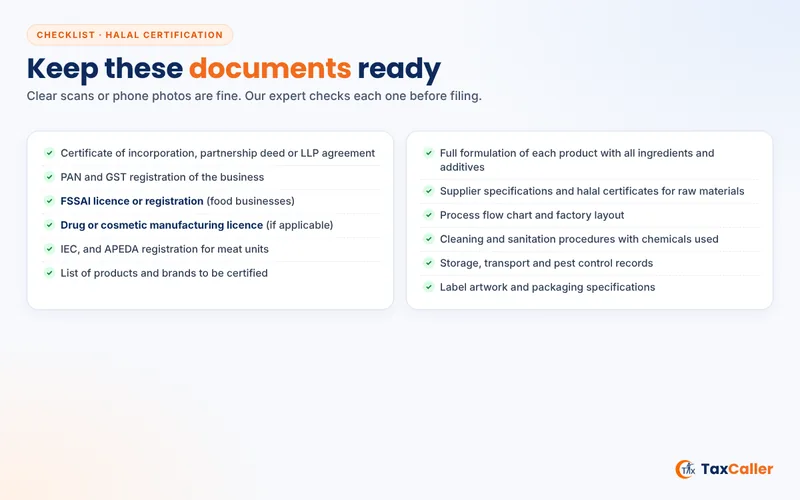
Most certification bodies ask for the same core documents, plus extra records for meat, cosmetics or pharma. We send you a list matched to your CB and market before you start.
Document
Why it is needed
Proof of business: certificate of incorporation, partnership deed or LLP agreement, PAN and GST registration
To confirm the legal entity
FSSAI licence or registration (food), or manufacturing licence (drugs and cosmetics)
The CB checks that the site is legally licensed
IEC, and APEDA registration for meat units
Needed for exports and for the i-CAS Halal portal
List of products and brands to be certified
Defines the scope of the certificate
Full formulation of each product, with every ingredient and additive
The core of the ingredient review
Supplier specifications and halal certificates for raw materials
Especially for animal-derived, flavour, enzyme and emulsifier inputs
Process flow chart and factory layout
To check segregation and cross-contact risks
Cleaning and sanitation procedures, with chemicals used
Cleaning agents and lubricants are also reviewed
Storage, transport and pest control records
To check the chain after production
Label artwork and packaging specifications
To check claims and planned use of the mark
Halal policy and name of the internal halal coordinator or committee
Most schemes ask for a named responsible person
Training records and lab test reports (where asked)
Evidence that the system works
For slaughter units: animal sourcing, slaughter and veterinary records
Required under i-CAS Halal and most export schemes
Keep every supplier certificate valid. An expired input certificate is the most common reason for a delayed decision.
Abhinay Rai Licence & Registration Expert
Have a question on this topic? Ask Abhinay on a free call.
How TaxCaller Handles Your Halal Certificate Application
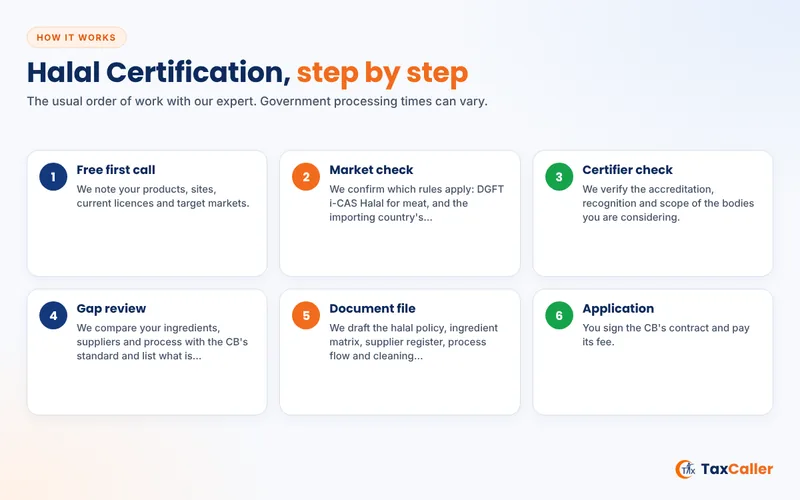
Halal Certification: how the work moves, step by step
We prepare your file and coordinate the audit; the certification body audits you and issues the certificate. You approve each step and pay the CB directly.
Free first call: we note your products, sites, current licences and target markets.
Market check: we confirm which rules apply: DGFT i-CAS Halal for meat, and the importing country's approved list.
Certifier check: we verify the accreditation, recognition and scope of the bodies you are considering. You choose the CB.
Gap review: we compare your ingredients, suppliers and process with the CB's standard and list what is missing.
Document file: we draft the halal policy, ingredient matrix, supplier register, process flow and cleaning records in the CB's format.
Application: you sign the CB's contract and pay its fee. We submit the file and answer the CB's questions.
Audit support: we brief your team on what the auditor checks and stay available on audit day.
Closing findings: we help you reply to any non-conformities with evidence.
Certificate and mark: you receive the certificate. We check the scope, dates and logo rules before you print packs.
After certification: we track expiry, surveillance and consignment certificates, and remind you before each due date.
Most of this work is online through email, WhatsApp and video calls. Many audits need a site visit, and that is decided by the CB.
The Audit and Ingredient Review: What Auditors Check
The audit checks that your products, inputs and process match the CB's halal standard and your own documents. It usually has a document review and a site audit.
Ingredient review
Every ingredient, additive, processing aid and carrier is listed with its source.
Animal-derived inputs, such as gelatin, enzymes, some emulsifiers and some flavours, need supplier halal certificates.
Ingredients the standard does not permit, and alcohol-based carriers above the CB's limit, must be removed or replaced.
Any change of supplier or recipe after certification must be approved by the CB first.
Site audit
Receiving and storage: certified and non-certified material kept apart and labelled.
Production lines: cleaning between runs, and checks on shared equipment.
Cleaning chemicals, lubricants and packaging materials.
Traceability: can you trace a finished batch back to its raw material lots?
Staff awareness and the named halal coordinator.
For slaughter units: the slaughter process, supervision and records required by the scheme.
Testing
Some CBs take samples for laboratory testing. Under the i-CAS Halal scheme document, samples go to labs accredited to ISO/IEC 17025.
After the audit
Findings are graded. Minor findings are closed with evidence; major ones may need a follow-up visit. The certification decision is then taken by the CB's committee, not by the auditor alone.
Timelines and validity are set by the certification body and its scheme, not by a government rule. These are typical ranges, not official deadlines.
Situation
Usual time
Small processed food unit, few products, documents ready
About 4 to 8 weeks
Many products or many raw materials without supplier certificates
About 2 to 3 months
Meat unit under i-CAS Halal
Longer, as APEDA registration and facility certification come first
Registration of a foreign certificate in Indonesia (by the importer)
Up to 20 working days from a complete application, as reported
Validity
i-CAS Halal: the March 2023 scheme document sets a three-year certificate with surveillance audits in the first and second years and recertification in the third. It asks clients to apply for recertification six months before expiry.
Other schemes: many private CBs issue certificates for one year, renewed after a fresh audit.
Consignment certificates: valid for the named shipment only.
Renewal
Apply for renewal well before expiry. A lapsed certificate means products made after the expiry date cannot carry the mark, and an importer may reject a shipment. Our Standard and Premium plans include reminders.
Shadab Licence & Registration Expert
Have a question on this topic? Ask Shadab on a free call.
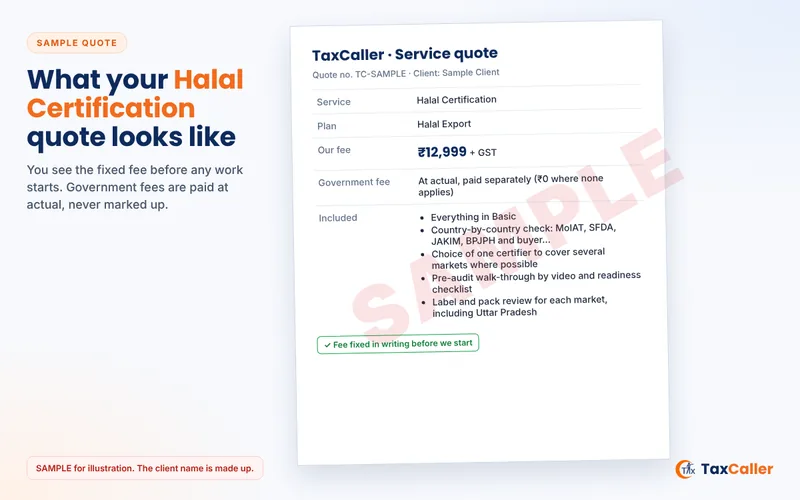
Halal Certification: SAMPLE quote, for illustration only
A halal certificate has two kinds of cost: the certification body's fee and our professional fee. We keep them separate.
TaxCaller's fee starts at ₹6,999 + GST. It covers the market and certifier check, document preparation and audit coordination as per the plan you choose. The certification body's fees are set by the certification body and paid to it directly at actual. There is no Indian government fee for halal certification itself.
Item
Who you pay
Amount
Consulting, documents and audit coordination
TaxCaller
As per plan, + GST
Application, audit, certificate, mark and surveillance
Certification body
Set by the certification body, at actual
Consignment certificates (if needed)
Certification body
Set by the certification body, at actual
Auditor travel (if charged)
Certification body
At actual
IEC, APEDA, FSSAI or other licences
The government department
Official fee, at actual
Foreign certificate registration (Indonesia)
Paid by the importer to BPJPH
Set by BPJPH
CB fees usually depend on the number of sites, products and audit days, and on the scheme. Ask each CB for a written quote that shows the full cycle, including surveillance. We confirm our own fee in writing before you pay.
The main risks come from false or unsupported claims, from exporting outside DGFT conditions and from breaking an importing country's rules. No Indian law penalises a business simply for not holding a halal certificate.
Risk
Law or rule
Halal claim on a food label without valid certification
Can be treated as misbranding or a misleading claim under Sections 52 and 53 of the Food Safety and Standards Act, 2006
Misleading halal claim in an advertisement
Action by the Central Consumer Protection Authority under Section 21, and punishment under Section 89, of the Consumer Protection Act, 2019
Halal meat export without i-CAS Halal to a listed country
Breach of export policy; penalty under Section 11 of the Foreign Trade (Development and Regulation) Act, 1992
Halal-certified food sold within Uttar Pradesh
Action under the state order of 18 November 2023
Certificate from a body not recognised by the importing country
Shipment refused, detained or relabelled at the border
Halal mark from an unauthorised body in Malaysia
Offence under Malaysia's trade description rules
Breach of Indonesia's halal rules
Written warnings, fines, revocation of the halal certificate or registration number and withdrawal of products under BPJPH Regulation No. 2 of 2026
The CB can also suspend or withdraw your certificate if you use the mark outside its scope or change ingredients without approval. Keep every pack, label and claim within what the certificate covers.
Most problems come from choosing the wrong certifier or from gaps in supplier records. Each mistake below can be avoided before you apply.
Certifier not recognised by the buyer's country: the certificate is valid in India but useless for that market.
Treating any certificate as enough for meat: for listed countries, DGFT requires i-CAS Halal from an NABCB-accredited body.
Missing the country list update: 20 countries were added on 9 February 2026, and for all but Egypt exporters had only two weeks to comply.
Expired supplier certificates: one expired input can hold up the whole decision.
Changing a recipe or supplier silently: the new input is outside the certificate.
Using the mark on uncertified products: the scope lists named products and sites only.
Shared lines without cleaning records: auditors ask for proof, not promises.
Letting surveillance lapse: the certificate is suspended and shipments stop.
Not registering the certificate in Indonesia: the importer must register a foreign halal certificate with BPJPH before the goods are sold there as halal.
Same packs for every market: a halal mark on domestic food packs supplied in Uttar Pradesh conflicts with the state order.
Thinking it replaces licences: FSSAI, drug and cosmetic licences and IEC are still required.
Shreya Licence & Registration Expert
Have a question on this topic? Ask Shreya on a free call.
2026 brought a wider country list for meat exports, an extended deadline for Egypt and a new schedule for Indonesia's halal rules. Here are the changes, with sources.
Date
Change
Source
9 February 2026
20 more countries added to the i-CAS Halal list for meat exports, taking it to 35. Two-week transition for all except Egypt, which got six months
DGFT Notification No. 59/2025-26 (S.O. 1759(E))
5 June 2026
Indonesia's rules on administrative sanctions for halal breaches came into force
BPJPH Regulation No. 2 of 2026
5 August 2026
Egypt transition extended from six to nine months
DGFT Notification No. 28/2026-27
October 2026
Indonesia moved its 17 October 2026 deadlines: imported food, beverages and slaughter products need halal certification from 18 October 2028, and cosmetics, supplements and several consumer goods by 17 October 2028. Drug deadlines (2029 and 2034) are unchanged
Government Regulation No. 40 of 2026 (Indonesia), amending Government Regulation No. 42 of 2024
9 November 2026
Egypt transition extended again, to twelve months from 9 February 2026 (about 9 February 2027)
DGFT Notification No. 48/2026-27
The Uttar Pradesh order of November 2023 remains in place, and we found no final Supreme Court ruling on it. DGFT keeps amending the halal meat rules, so we check the latest DGFT notifications before every export file.
Is This the Right Certificate for You? FSSAI, IEC, ISO and Trademark
Halal certification is right for you when a buyer or an importing country asks for it, or when you export halal meat. It works alongside other registrations, not in place of them.
FSSAI registration: the food safety licence every food business needs, certified or not.
IEC registration: the DGFT code you need before you export anything.
ISO certification: quality or food safety systems such as ISO 9001 or ISO 22000, which some buyers ask for alongside halal.
TaxCaller has served businesses since 2018 from our office in Ghaziabad, and we work online across India. For halal certification, that means:
Independent advice: we are not a certification body and we do not issue certificates. You choose the CB and pay it directly.
Market first: we check DGFT rules and the importing country's approved list before you sign with any certifier.
Neutral and factual: we explain the legal position, including state orders, without taking sides.
Fee told upfront: our fee + GST in writing; the CB's fees shown separately.
One team for related work: the same experts handle FSSAI, IEC, GST and trademark filings your export file needs.
Clients in Ghaziabad, Noida and Delhi can meet us at our Ghaziabad office by appointment. Everyone else can work with us fully online. Contact us to book a call.
Zubair Licence & Registration Expert
Have a question on this topic? Ask Zubair on a free call.
Certificate of incorporation, partnership deed or LLP agreement
PAN and GST registration of the business
FSSAI licence or registration (food businesses)
Drug or cosmetic manufacturing licence (if applicable)
IEC, and APEDA registration for meat units
List of products and brands to be certified
Full formulation of each product with all ingredients and additives
Supplier specifications and halal certificates for raw materials
Process flow chart and factory layout
Cleaning and sanitation procedures with chemicals used
Storage, transport and pest control records
Label artwork and packaging specifications
Halal policy and name of the internal halal coordinator
Training records and lab test reports (where asked)
Animal sourcing, slaughter and veterinary records (slaughter units)
Why TaxCaller
Real experts, not a call centre
Your work is handled by experienced professionals who explain every step, check your documents and keep you updated.
Registered company
TaxCaller is run by TaxCaller India LLP (LLPIN AAQ-7388), serving clients since 2018.
Fee told upfront
You know the complete fee, our professional fee and the government fee, before any work starts. No hidden charges.
Support after the work
Notices, renewals, returns and compliance reminders: we stay with your business after the registration is done.
Reviewed By
Expert for this topic Halal Certification
Abhinay Rai
Advocate
Abhinay Rai is a Advocate specialising in Halal Certification. The process, documents, timelines and fees on this page are checked against the current rules and government portals, and updated whenever the law, forms or fees change.
No central law makes halal certification compulsory for products sold in India. It is voluntary and issued by private certification bodies. The exception is halal meat exports: DGFT requires i-CAS Halal certification for listed countries. Separately, Uttar Pradesh restricts the sale of halal-certified food products within the state, while exempting goods made for export.
What does 100% halal certified mean?
It is a marketing phrase, not a separate grade. A product is either covered by a valid halal certificate for its ingredients, process and facility, or it is not. Check the certificate number, the product list, the validity dates and whether the certifier is accredited under i-CAS or recognised by the importing country, rather than the label claim.
Is a halal certificate legal in India?
Yes. A halal certificate, often called a halal license, is a private certificate issued by a certification body, and no central law bans it. For meat exports to the listed countries, DGFT makes i-CAS Halal certification compulsory. Uttar Pradesh banned the making, storage and sale of halal-certified food for domestic sale in November 2023, with exports excluded.
Who issues halal certificates in India?
Private certification bodies issue halal certificates in India. The government does not issue them, and FSSAI does not either. For meat exports, the certifier must be accredited by NABCB under QCI's i-CAS Halal scheme. For other exports, the certifier should be on the importing country's recognised list, such as JAKIM's list for Malaysia.
What is i-CAS Halal?
i-CAS Halal is the India Conformity Assessment Scheme for halal, set up by the Quality Council of India and notified by DGFT. Under it, certification bodies accredited by NABCB certify meat facilities and their export consignments through an online portal. It is mandatory for halal meat and meat product exports to the countries DGFT lists.
Which countries need i-CAS Halal for Indian meat exports?
DGFT's list began with 15 countries from 16 October 2024, including the UAE, Saudi Arabia, Malaysia, Indonesia, Qatar and Kuwait. On 9 February 2026, 20 more were added, such as Kazakhstan, Uzbekistan, Morocco, Algeria and Kenya. Egypt's requirement applies after twelve months from that date, which works out to about 9 February 2027.
Is halal certification banned in Uttar Pradesh?
Uttar Pradesh's Food Safety and Drug Administration ordered on 18 November 2023 that halal-certified food products cannot be made, stored, distributed or sold within the state. Products made for export are excluded. The order has been challenged in the Supreme Court, and we found no final judgment as of November 2026. Exporters in the state can still certify export goods.
How much does halal certification cost?
The certification body sets its own fees for application, audit, certificate, mark use and surveillance, and you pay it directly. Fees usually depend on sites, products and audit days. There is no Indian government fee for the certificate itself. TaxCaller's professional fee starts at ₹6,999 + GST, shown separately from the certification body's charges.
How long is a halal certificate valid?
Validity depends on the scheme and the certification body. The i-CAS Halal scheme document sets a three-year cycle with surveillance audits in the first and second years. Many private bodies issue one-year certificates that are renewed after a fresh audit. Consignment certificates cover only the named shipment, so check the expiry date before every export.
How long does it take to get halal certified?
A small food unit with few products and ready supplier certificates can often finish in about four to eight weeks. Many products, missing supplier records or a meat facility under i-CAS Halal take longer. These are typical ranges, not legal deadlines. Most delays come from incomplete ingredient files and slow supplier responses, not from the audit itself.
Can a non-Muslim owned business get halal certification?
Yes. Certification bodies assess the product, ingredients, process and controls, not the owner's religion. Any business that meets the standard and passes the audit can be certified. Some schemes ask for a named internal halal coordinator or committee with specific knowledge, and slaughter units must meet the scheme's own rules on how slaughter is carried out and supervised.
Can vegetarian products, cosmetics and medicines be halal certified?
Yes. Certification bodies certify vegetarian foods, spices, beverages, cosmetics, supplements and pharmaceuticals. The audit focuses on inputs such as flavours, enzymes, capsule shells, colours and alcohol-based carriers, along with cleaning and segregation. Indonesia now requires halal certification for cosmetics and supplements by 17 October 2028, over-the-counter drugs by 2029 and prescription drugs by 2034.
Is a halal certificate a substitute for an FSSAI licence?
No. FSSAI registration or a licence is a legal requirement for every food business under the Food Safety and Standards Act, 2006. A halal certificate is a separate, private certification. Certification bodies usually ask for your FSSAI licence before they audit you. Cosmetic and drug makers likewise need their licences under the Drugs and Cosmetics Act, 1940.
How do I check whether a halal certificate is genuine?
Check the certificate number on the certification body's own register, and match the company name, site, products and expiry date. For meat exports, confirm the body's NABCB accreditation under i-CAS Halal. For a foreign market, check that country's list, such as JAKIM in Malaysia, MoIAT in the UAE, SFDA in Saudi Arabia or BPJPH in Indonesia.
Do I need a separate halal certificate for each export country?
Not always. One certificate can serve several markets if the certification body is recognised by each of them for your product category. That is why choosing the certifier matters. Some countries also need extra steps, such as Indonesia, where the importer registers the foreign certificate with BPJPH, or Saudi Arabia, which needs halal shipment certificates for meat.
Get your halal certification file ready for the right market
Tell us your products and target countries, and we will check the rules and certifier options on the first call. Our fee starts at ₹6,999 + GST; certification body fees are paid separately at actual.