!ITR, transfer pricing cases due?Last date 30 Nov 2026 · 2 days left
Since 2018Trusted Experience
980+Experts Connected
220+Cities Served
1164+Agents Available
12,650+Founders Trusted
S
Srishti Magoo
★★★★★
Excellent experience with TaxCaller for filing my &
my family members ITR returns. The entire process was
smooth, quick and hassle-free. They are professional,
knowledgeable and guided me through every step with patience.
O
obeid sait
★★★★★
The team has handled my taxes for the past three years,
and it's been a wonderful, hassle-free experience.
Thank you for your consistently quick and efficient service.
P
Pushkar
★★★★★
They are among the best in their field. Their work culture
is highly professional, and their client service is smooth
and reliable. They can confidently be relied on to get the job done.
P
Prasad Sheth
★★★★★
Excellent experience with TaxCaller! The ITR filing
process was smooth, quick, and completely hassle-free.
The CA was knowledgeable, responsive, and explained everything clearly.
A
Apoorv Bansal
★★★★★
Excellent service for ITR filing. The team was highly
professional, responsive, and guided me through the entire
process smoothly. My return was filed accurately and on time.
A
Abhishek Kumar
★★★★★
I was searching for a good CA firm in Ghaziabad and found
TaxCaller. The experience was excellent from start to finish.
The team is responsive, transparent, and genuinely helpful.
U
uma pandey
★★★★★
Great service! TaxCaller India made the entire ITR filing
process quick, smooth, and hassle-free. They answered all
my queries patiently and ensured maximum accuracy.
T
tanu mittal
★★★★★
Excellent job! We've been connected for many years,
and your success truly makes me happy. You are an
incredibly intelligent person. Keep shining, keep growing.
B
Bhanu Pratap Maurya
★★★★★
I am filing my ITR since past 3 years with Abhinav and
Firm is known as TaxCaller and they are professional
interms of ITR rules. They will explain and tell you all
the information.
A
ashish Sharma
★★★★★
I am providing my honest reviews:
No.1 service ...
A
AARYAN GROUP
★★★★★
Honestly, finding a good CA firm in Ghaziabad was
confusing, but TaxCaller India made it simple.
I contacted them for GST work and the experience was smooth.
N
News Speaks
★★★★★
If you're looking for a reliable CA firm in Ghaziabad,
TaxCaller India is a great choice. They provide complete
taxation and compliance solutions including GST.
A
Anshul Chaprana
★★★★★
Got my GST registration done through TaxCaller CA firm.
Process was quite smooth, they guided properly on documents
and didn't waste time. Overall good experience.
How we work
Online · Call · WhatsApp
Quick answer
A cheque bounce notice is the written demand that Section 138 of the NI Act requires before a criminal case. Send it within 30 days of receiving the bank's return memo, and demand the exact cheque amount. The drawer then has 15 days to pay. If the drawer does not pay, file the complaint within one month.
Reviewed by Abhinay Rai · Updated 27 Nov 2026
Dishonoured Cheque? Start With the Dates
A bounced cheque is stressful, whether you are owed the money or you signed the cheque. The law gives both sides short, fixed windows, and most cases are won or lost on those dates.
This page explains how a cheque bounce notice works under Sections 138 to 148 of the Negotiable Instruments Act, 1881, what it must say, how to send it, how to reply, and what happens in court. It also covers the BNSS changes and the latest Supreme Court rulings up to 2026.
TaxCaller's advocates draft, sign and send notices and replies online for clients across India. Our legal notice page covers other kinds of notices.
Complete guide
Choose a topic to open it. Every answer gives the rule or section it comes from.
01 Topic 1 of 20
What Is a Cheque Bounce Notice?
A cheque bounce notice is the written demand for payment that the payee sends to the person who signed a dishonoured cheque. Section 138 of the Negotiable Instruments Act, 1881 makes this demand a condition for any criminal case. No notice, or a notice sent late, means no prosecution.
People call it by many names: legal notice for cheque bounce, Section 138 notice, demand notice, or cheque dishonour notice. They all mean the same letter. It gives the drawer one last chance to pay the cheque amount within 15 days of receiving it.
Why the notice matters so much
It starts the clock. The offence under Section 138 is complete only when the drawer fails to pay within 15 days of receiving the notice.
It fixes the amount. The demand must match the cheque amount exactly. Courts have thrown out cases where it did not.
It becomes evidence. The notice, the postal receipt and the tracking report are filed with the complaint.
It invites the drawer's defence. What the drawer says, or does not say, in reply can be used at trial.
A cheque bounce becomes an offence only when all six conditions below are met. We check each one before drafting, because a missing condition usually cannot be fixed later.
Condition
What it means in practice
Law
1. Cheque drawn on the drawer's own account
The person who signed it maintains the account with the bank
Section 138
2. Given for a debt or other liability
The debt must be legally enforceable. A gift or donation cheque does not qualify.
Section 138, Explanation
3. Presented within validity
Within three months of the date on the cheque for cheques dated on or after 1 April 2012
Proviso (a); RBI circular of 4 November 2011
4. Returned unpaid for a covered reason
Insufficient funds, or the amount exceeds the arrangement with the bank
Section 138
5. Written notice within 30 days
Counted from the day the payee receives the bank's information about the return
Proviso (b)
6. No payment within 15 days
Counted from the day the drawer receives the notice
Proviso (c)
The Act itself says six months or the validity period, whichever is earlier. The Reserve Bank's circular RBI/2011-12/251 cut the validity of cheques to three months from 1 April 2012, so three months is the limit that applies today.
Two presumptions that help the payee
Section 118 presumes that every negotiable instrument was made for consideration and on the date it bears. Section 139 presumes that the cheque was received for a debt or liability, unless the drawer proves otherwise. Section 146 asks the court to presume the dishonour once the bank's return memo is produced. These presumptions are why a clean notice and a clean memo are usually enough to start the case.
Section 6 of the Act treats a cheque in electronic form and a truncated cheque as cheques too, so cheques cleared by image under the bank's clearing system are covered in the same way.
Shadab Legal Expert
Have a question on this topic? Ask Shadab on a free call.
Cheque Bounce Notice Period and Case Time Limit: Full Timeline
The cheque bounce notice time limit is 30 days from the day you receive the bank's return memo. Every later step depends on that first date, so we note it on day one and count from there.
Step
Time limit
Law
Present the cheque
Within three months of its date
Section 138 proviso (a), read with the RBI circular
Send the demand notice
Within 30 days of receiving the return memo or other bank information
Section 138 proviso (b)
Drawer pays
Within 15 days of receiving the notice
Section 138 proviso (c)
Cause of action arises
The day after the 15 days end without payment
Section 142(1)(b)
File the complaint
Within one month of the cause of action; later only if the court condones the delay
Section 142(1)(b) and its proviso
Interim compensation paid
Within 60 days of the order, plus up to 30 more days
Section 143A(3)
Deposit pending appeal
Within 60 days of the appellate order, plus up to 30 more days
Section 148(2)
The cheque bounce validity period matters before all of this: a cheque presented after three months is stale, and its return cannot found a case.
Worked example with real dates
Example: a cheque dated 2 June 2026 is deposited on 20 June 2026 and returns marked "funds insufficient". The payee's bank hands over the memo on 24 June 2026.
Last day to send the notice: 24 July 2026 (30 days from 24 June).
The notice is delivered on 30 June 2026. The drawer's 15 days end on 15 July 2026.
No payment comes. The cause of action arises on 16 July 2026.
The complaint should be filed within one month, so by 15 August 2026.
Count from the dates of receipt, not from the dates printed on the documents. Keep the memo's delivery date and the postal delivery report safe, as both are needed to prove these dates.
Missed the 30 days?
A late notice cannot support a complaint. If the cheque is still within its three months, it can be presented again. In MSR Leathers v. S. Palaniappan (2012), the Supreme Court allowed prosecution on a later dishonour followed by a fresh, timely notice. After validity ends, the remaining route is a civil recovery suit.
Reasons for Return: Which Bank Memos Lead to a Case
Section 138 names only two reasons: the money in the account is not enough, or the cheque exceeds the amount arranged with the bank. Courts have read the section in a practical way, so other memo reasons can also lead to a case.
Reason on the return memo
Can Section 138 apply?
Funds insufficient
Yes, the main ground named in the section
Exceeds arrangement
Yes, also named in the section
Account closed
Usually yes, as the drawer closed the account the cheque was drawn on
Payment stopped by drawer
Usually yes, unless the drawer proves there was enough money and a valid reason to stop it
Signature differs or incomplete
It can, where the drawer caused the mismatch on purpose
Cheque stale, post-dated or damaged
No. Present a valid cheque again on or after its date.
Payee's own error, such as a wrong name
No. This is a technical return, not a dishonour by the drawer.
In Laxmi Dyechem v. State of Gujarat (2012), the Supreme Court held that a return for reasons such as a signature mismatch can still attract Section 138 where the drawer's conduct caused it. The facts decide each case, so we read the memo before drafting.
The bank's cheque bounce message
Most banks send an SMS or email alert when a cheque is returned, and hand over or post the return memo with the reason code. The alert is useful, but keep the memo itself. It is the document Section 146 relies on, and its date of receipt starts your 30 days.
Banks also charge a fee for each returned cheque. That charge is a bank matter and is separate from any notice or case. If the cheque was for a loan instalment, the lender may also report the missed payment to credit bureaus.
If you are the drawer: avoiding a bounce
Keep the full amount in the account until the cheque is cleared, including for post-dated cheques.
Do not stop payment to delay a genuine debt; a stop-payment return can still lead to a case.
Write the amount in words and figures the same way, and sign as per the bank's records.
If you cannot pay, talk to the payee before the cheque is deposited and agree a new date in writing.
No form is prescribed for a Section 138 notice. What matters is that it clearly demands the cheque amount and gives the drawer 15 days to pay. Our checklist covers every detail courts look for.
Full name and address of the payee and of each drawer or person being made liable
Cheque number, date, amount in figures and words, bank and branch
The debt or liability the cheque was meant to clear, in two or three lines
Date of presentation, date of return and the reason written on the memo
A clear demand for the exact cheque amount
Payment within 15 days of receipt, with the account or address to pay to
A statement that a complaint under Section 138 will follow if payment is not made
Signature of the payee or the advocate, with the date
The exact-amount rule
In Kaveri Plastics v. Mahdoom Bawa Bahrudeen Noorul, 2025 INSC 1133, decided on 19 September 2025, the Supreme Court held that the notice must demand the same amount as the cheque. A notice that named a different figure was invalid, even though the payee said it was a typing slip.
So we write the cheque amount alone in the demand. If you also want interest, costs or other dues, we put them in a separate paragraph that clearly sits outside the 15-day demand. That keeps the statutory demand clean.
Who should sign it
The law does not insist on an advocate. Still, a notice drafted and signed by an enrolled advocate reads as serious, uses the right sections and avoids slips that the defence would use later. All our cheque bounce notices are drafted and signed by advocates.
Shreya Legal Expert
Have a question on this topic? Ask Shreya on a free call.
Cheque Bounce Notice Format: The Outline We Follow
A good cheque bounce notice format is short and orderly. The drawer, the magistrate and the defence lawyer should all be able to find each fact in seconds. This is the order we use.
Part
What goes in it
Heading
"Legal notice under Section 138 of the Negotiable Instruments Act, 1881", the date and the mode of sending
Addressees
The drawer, and for a company or firm, the persons in charge of its business
Background
The transaction, invoice or loan behind the cheque
Cheque details
Number, date, amount, bank, branch and account holder
Dishonour
Presentation date, return date and the memo reason
Demand
The exact cheque amount within 15 days of receipt
Consequence
That a complaint will be filed if payment is not made
Other claims
Interest or costs, stated separately and without changing the demand
Signature
Advocate's name, enrolment number, address and contact details
Avoid copying a free cheque bounce notice sample from the internet without checking it. Many old samples still cite repealed criminal laws, give 30 days to pay or mix the cheque amount with interest. Each of these can hand the drawer a defence.
Signed PDF and print copy
You receive the signed notice as a PDF, plus the postal receipts. The same PDF goes by email and WhatsApp, so every copy the drawer gets is identical.
Language
English is fine across India. If the drawer is more comfortable in Hindi or another language, a translation can go with the notice. The demand amount and the dates must be identical in both versions.
Sending the Notice: Speed Post, Email and WhatsApp
The section only says the notice must be given in writing. It does not fix a mode. What matters is proof that it reached, or was sent to, the drawer's correct address.
Post to the correct address
In Sainaba v. State of Kerala, 2026 INSC 1069, decided on 30 September 2026, the Supreme Court restored a conviction where the drawer's mother had received the notice at his correct address. Sending it by registered post to the right address raises a presumption of service. The drawer then has to show that the address was wrong or that he never learnt of the notice. The Court held an earlier two-judge ruling, M.D. Thomas v. P.S. Jaleel (2009), to be per incuriam.
Email and WhatsApp
The Allahabad High Court, in Rajendra v. State of U.P. (2024), held that a demand notice sent by email or WhatsApp is valid if it meets Section 13 of the Information Technology Act, 2000. Such a notice is treated as dispatched and received on the date shown by the electronic record. Other High Courts have not all ruled on this point, so we treat electronic service as an extra layer, never the only one.
Our usual combination
Speed Post with proof of delivery to every known address
Email to the address the drawer actually uses, such as the one on invoices or loan papers
WhatsApp to the drawer's own number, with the PDF notice
If the post comes back "refused" or "unclaimed", keep the sealed envelope. A refusal at the correct address generally counts as service. For electronic proof in court, a certificate under Section 63 of the Bharatiya Sakshya Adhiniyam, 2023 is needed.
Cheque Bounce Notice to a Company: Section 141 and Directors
When a company, LLP or partnership firm issues the cheque, Section 141 makes the firm and the persons in charge of its business liable. The notice must reach the company, and it is safer to address those persons as well.
Who can be named
The company or firm itself, which must be made an accused
Persons who were in charge of, and responsible for, its business when the offence took place, such as a managing director or a working partner
Any director, manager or officer with whose consent or connivance the offence happened, or whose neglect led to it
Who is protected
A director nominated by virtue of holding an office or job in the Central or State government, or a government financial corporation, cannot be prosecuted under this Chapter. A person also escapes liability by proving that the offence happened without their knowledge or despite due diligence.
Recent guidance
In Saroj Pandey v. Govt of NCT of Delhi, 2026 INSC 324, the Supreme Court said that being a director is not enough by itself. The complaint must state that the person was in charge of the company's day-to-day business. So we ask you who actually ran the business and who signed the cheque, and we draft the notice and complaint with those facts.
A cheque signed by an authorised signatory under a company's mandate can also bind that signatory. In K. Ranganayakulu v. State of Telangana, 2026 INSC 555, the Court treated a treasurer who signed and controlled payments as liable.
Zubair Legal Expert
Have a question on this topic? Ask Zubair on a free call.
If you receive a cheque bounce notice, you have 15 days from receipt to pay the cheque amount. Paying in full within that period means no offence is made out. If you dispute the claim, send a written reply within the same 15 days.
Pay, settle or dispute
Your position
What to do
You owe the money and can pay
Pay the exact cheque amount within 15 days, by bank transfer or demand draft, and keep written proof
You owe part of it
Reply with your figures and pay the admitted part, or offer a written settlement
The cheque was a security cheque and the debt was cleared
Reply with proof of the payments and of what the cheque was given for
The payee lacked money to lend you
Say so in the reply, with reasons
The cheque was misused or stolen
Reply with your police complaint or stop-payment record
Why the reply matters at trial
In Kuntegowda v. Thurubaiah, 2026 INSC 790, decided on 4 August 2026, the Supreme Court said a defence that the payee lacked the means to lend should be raised in the reply to the demand notice. If it is missing there, the court may infer that the payee's version has merit. A vague or late reply weakens your later defence.
Remember Section 139. The law presumes the cheque was given for a debt. In Renuka v. State of Maharashtra, 2026 INSC 327, the Court held that a complaint cannot be thrown out before trial merely because the drawer says the debt was not legally enforceable. That question is decided on evidence. So your reply should give facts and documents, not just a denial.
What not to do
Do not ignore the notice. Silence helps the payee.
Do not send a fresh cheque instead of paying unless the payee agrees to it in writing.
Do not admit facts you dispute just to sound polite.
Our reply service covers a point-wise reply drafted and signed by an advocate, sent within your 15 days.
Filing the Complaint: Limitation, Jurisdiction and Papers
Cheque Bounce Notice: documents to keep ready
If the drawer does not pay within 15 days, the payee can file a written complaint before a Metropolitan Magistrate or a Judicial Magistrate of the first class. Section 142(1)(b) gives one month from the cause of action.
Delay must be condoned first
The proviso to Section 142(1)(b) lets the court accept a late complaint if the payee shows sufficient cause. In S. Nagesh v. Shobha S. Aradhya, 2026 INSC 27, the Supreme Court held that the court must condone the delay before it takes cognizance. Taking cognizance first and condoning later is not allowed. File an application for condonation with the complaint if you are even a day late.
Which court: Section 142(2)
If you deposited the cheque in your bank account, the complaint goes to the court where your branch is located.
If you deposited it at any other branch of your bank, the law treats it as delivered to your home branch.
If you presented the cheque over the counter at the drawer's bank, the court where the drawer's branch is located has jurisdiction.
Section 142A, added in 2015, keeps later cases between the same parties in the same court where one is already pending.
Several cheques
Each dishonoured cheque gives its own cause of action. In Sumit Bansal v. MGI Developers and Promoters, 2026 INSC 40, the Court held that separate complaints for separate cheques from one deal are not a parallel prosecution.
Papers filed with the complaint
Original cheque and the bank's return memo
Copy of the notice, postal receipts, tracking report and any returned envelope
Email or WhatsApp proof with a Section 63 BSA certificate
Any reply from the drawer
Papers showing the debt, such as invoices, ledger or loan agreement
Your evidence on affidavit, which Section 145 allows
Trial, Interim Compensation and Appeal: Sections 143, 143A and 148
Cheque cases are meant to move fast. The Act gives the court tools to keep the drawer from dragging the case on without paying anything.
Summary trial under Section 143
Section 143 makes a summary trial the normal route. In a summary trial, the magistrate can pass a sentence of up to one year and a fine above ₹5,000. If a longer sentence may be needed, the magistrate switches to the regular procedure after hearing both sides. Section 143(3) asks courts to try to finish the trial within six months of the complaint.
Interim compensation under Section 143A
The court may order the drawer to pay up to 20% of the cheque amount while the case is pending.
In a summary or summons trial, this can be ordered once the drawer pleads not guilty. In other cases, on framing of charge.
It must be paid within 60 days, which the court can extend by up to 30 days.
If the drawer is acquitted, the payee must repay it with interest at the RBI bank rate.
It can be recovered like a fine, and any final fine or compensation is reduced by it.
Deposit in appeal under Section 148
When a convicted drawer appeals, the appellate court may order a deposit of at least 20% of the fine or compensation.
This is in addition to any interim compensation already paid.
The deposit is due within 60 days, extendable by 30 days, and can be released to the payee during the appeal.
Evidence made simple
Section 145 lets the complainant give evidence on affidavit. Section 146 makes the bank memo proof of the dishonour unless disproved. Section 144 allows summons by speed post or approved courier. These rules mean a well-prepared complainant may need few court visits.
Abhinay Rai Legal Expert
Have a question on this topic? Ask Abhinay on a free call.
The punishment for cheque bounce under Section 138 is imprisonment of up to two years, a fine of up to twice the cheque amount, or both. Most cases end long before that, because the law encourages settlement.
Compounding under Section 147
Every offence under the Act is compoundable. The payee and drawer can settle at any stage, and the court then closes the case. In Sanjabij Tari v. Kishore S. Borcar, 2025 INSC 1158, decided on 25 September 2025, the Supreme Court revised the costs for late settlement.
Stage of settlement
Extra cost on the drawer
Before the defence evidence is recorded
None
After defence evidence, before the trial court's judgment
5% of the cheque amount
In appeal or revision before the Sessions Court or High Court
7.5% of the cheque amount
Before the Supreme Court
10% of the cheque amount
The cost goes to the legal services authority or another body the court names. It is not a payment to the payee.
Mediation and Lok Adalat
Many cheque cases settle in court-annexed mediation or at a Lok Adalat. A settlement should be in writing, with the amount, the dates of each instalment and what happens if an instalment bounces.
Compensation to the payee
On conviction, the court can award compensation from the fine. Under the BNSS this power sits in Section 395, which replaced Section 357 of the old Code. Any interim compensation already paid under Section 143A is set off against it.
The Bharatiya Nagarik Suraksha Sanhita, 2023 (BNSS) replaced the Code of Criminal Procedure from 1 July 2024. Sections 138 to 148 of the NI Act did not change. Some of the procedure around them did.
Point
Old Code
BNSS
Hearing the accused before cognizance of a complaint
Not required
Section 223, but not needed for cheque complaints after Sanjabij Tari
Explaining the accusation in a summons case
Section 251
Section 274
Compensation out of fine
Section 357
Section 395
Plea of guilty in summons cases
Section 255
Section 278
Directions in Sanjabij Tari
Summons can be served by email and WhatsApp as well as by the usual modes, with the details given on affidavit.
District courts should offer online payment by QR code or UPI link, so the drawer can pay at the first stage.
Each complaint should carry a short synopsis in a set format.
The magistrate should ask the accused direct questions at the start, including whether they want to settle.
Courts have put these directions into practice. For example, the Delhi High Court Practice Direction No. 157 sets out electronic service and payment links for Delhi courts. Your complaint is drafted to fit the practice of the court where it is filed.
The Supreme Court decides many cheque cases every year. These recent rulings change how a notice is drafted, served or answered.
Case
Date
What it means for you
Sainaba v. State of Kerala, 2026 INSC 1069
30 September 2026
Notice to the correct address is presumed served, even if a family member receives it
Kuntegowda v. Thurubaiah, 2026 INSC 790
4 August 2026
Raise a "no money to lend" defence in the reply to the notice
Dineshchand Surana v. UCO Bank, 2026 INSC 579
2026
An insolvency moratorium does not stop the criminal case against a director; a larger bench will settle related questions
K. Ranganayakulu v. State of Telangana, 2026 INSC 555
2026
An authorised signatory who controls payments can be liable as drawer
Renuka v. State of Maharashtra, 2026 INSC 327
2026
"Debt not enforceable" is a trial question, not a reason to dismiss early
Saroj Pandey v. Govt of NCT of Delhi, 2026 INSC 324
2026
Directors are liable only with specific facts on their role
Sumit Bansal v. MGI Developers, 2026 INSC 40
2026
Each bounced cheque can found its own complaint
S. Nagesh v. Shobha S. Aradhya, 2026 INSC 27
January 2026
Delay in filing must be condoned before cognizance
Sanjabij Tari v. Kishore S. Borcar, 2025 INSC 1158
25 September 2025
New compounding costs, electronic summons, online payment, no pre-cognizance hearing
Kaveri Plastics v. Mahdoom Bawa Bahrudeen Noorul, 2025 INSC 1133
19 September 2025
The notice must demand the exact cheque amount
We review new rulings as they come and update this table. If a ruling affects a notice you already sent, we tell you what, if anything, needs to change.
Shadab Legal Expert
Have a question on this topic? Ask Shadab on a free call.
We can draft your notice the same day once we have the papers below. Phone photos are fine for the first review, but keep the originals safe for court.
The dishonoured cheque, front and back
The bank's return memo, and the date you received it
Your bank statement page showing the return entry
Drawer's full name, every known address, email and mobile number
For a company or firm: its registered office and the names of the persons who run it
Invoice, loan agreement, ledger, chat or email showing the debt
Your own ID and address, or the company's authority letter
Any earlier notice, reply or settlement talk
If you received a notice and want to reply, send the notice, its envelope or email with the date of receipt, and your papers on the transaction.
How TaxCaller Handles Your Cheque Bounce Notice, Step by Step
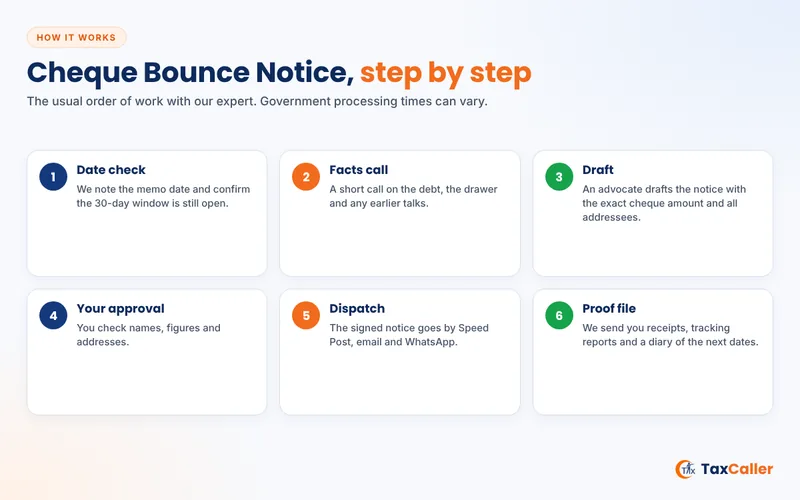
Cheque Bounce Notice: how the work moves, step by step
Here is how the work moves once you share the cheque and memo. Most notices are drafted and sent within one or two working days.
Date check: we note the memo date and confirm the 30-day window is still open.
Facts call: a short call on the debt, the drawer and any earlier talks.
Draft: an advocate drafts the notice with the exact cheque amount and all addressees.
Your approval: you check names, figures and addresses. We revise if needed.
Dispatch: the signed notice goes by Speed Post, email and WhatsApp.
Proof file: we send you receipts, tracking reports and a diary of the next dates.
After the 15 days
If payment comes, we help you record it and close the matter. If it does not, and you ask us to prepare the complaint, we draft the complaint, the affidavit of evidence and the list of documents for filing within the one-month window.
You stay in control throughout. Nothing is sent without your approval of the final draft.
Cheque Bounce Notice Fees: Our Charge and Other Costs, Clarified
Our fee for a cheque bounce notice depends on the case, so an expert tells you the exact amount on a free call back before any work starts. That is our professional fee only. Postage, court fees and any later court appearance are separate and shown to you before you pay.
Cost
Who it goes to
Amount
Our professional fee
TaxCaller
Told on a free call back, + GST
Speed Post charges
India Post
At actual, for each addressee and address
Court fee on the complaint
The state, through the court
As per the state's court fees law; small in most states
Advocate's court appearances
The advocate who appears
Quoted separately, as it depends on the court and the number of hearings
Bank's cheque return charge
Your bank
As per the bank's schedule
There is no government fee for sending a notice. No stamp paper is needed either. The notice is printed on the advocate's letterhead.
Choosing between the three services
Basic: you want the notice sent correctly and will decide later about the case.
Reply: you received a notice and want a reply on record within 15 days.
Complaint Ready: you expect the drawer not to pay and want the complaint ready on time.
Shreya Legal Expert
Have a question on this topic? Ask Shreya on a free call.
Civil Recovery and Other Remedies Alongside Section 138
A Section 138 case punishes the drawer and pushes payment, but it is not the only route to your money. Some remedies can run side by side.
Remedy
When it helps
Summary suit under Order XXXVII of the Code of Civil Procedure, 1908
Recovery of the cheque amount with interest through a faster civil procedure
Regular money recovery suit
Where the debt is larger than the cheque or the 30-day window was missed
MSME delayed payment claim
Where a registered micro or small enterprise supplied goods or services
Insolvency route
Where a company owes a large undisputed operational or financial debt
A police complaint for cheating, now under Section 318 of the Bharatiya Nyaya Sanhita, needs proof of a dishonest intention from the start. In V. Ganesan v. State, 2026 INSC 265, the Supreme Court held that the bounce of a post-dated cheque does not by itself show such intention.
The criminal case and a civil suit serve different ends, so filing one does not bar the other. We tell you which route puts more pressure on the drawer in your facts, and our legal notice service covers other money recovery notices too.
If you are a small supplier, an MSME registration can open the delayed payment route for future dues.
TaxCaller is India's online tax and business compliance platform, with its head office in New Delhi and clients across India. Our legal desk handles notices for traders, lenders, landlords and businesses every week.
Advocate-drafted: every cheque bounce notice and reply is drafted and signed by an enrolled advocate.
Date-first approach: we confirm the 30-day and one-month windows before anything else.
Proof you can use: receipts, tracking and electronic proof are kept in one file for the court.
Fee told upfront: our fee is told on a call before work starts, and postage and court costs are listed separately.
Advocate review: Abhinay Rai, Advocate, has reviewed this cheque bounce guide.
If a customer paid by a cheque that bounced, our bookkeeping team can also help you record the return and the recovery correctly. A business owner may also want a tax consultant to check how an unrecovered debt is treated. You can contact us for a free first call.
Zubair Legal Expert
Have a question on this topic? Ask Zubair on a free call.
Drawer's full name, every known address, email and mobile
Company details and names of persons in charge, for a company cheque
Invoice, loan agreement or ledger showing the debt
Your ID and address, or the company's authority letter
Any earlier notice, reply or settlement talk
Why TaxCaller
Real experts, not a call centre
Your work is handled by experienced professionals who explain every step, check your documents and keep you updated.
Registered company
TaxCaller is run by TaxCaller India LLP (LLPIN AAQ-7388), serving clients since 2018.
Fee told upfront
You know the complete fee, our professional fee and the government fee, before any work starts. No hidden charges.
Support after the work
Notices, renewals, returns and compliance reminders: we stay with your business after the registration is done.
Reviewed By
Expert for this topic Cheque Bounce Notice
Abhinay Rai
Advocate
Abhinay Rai is a Advocate specialising in Cheque Bounce Notice. The process, documents, timelines and fees on this page are checked against the current rules and government portals, and updated whenever the law, forms or fees change.
After booking, the case is opened in the TaxCaller Client Portal under a named expert, where you upload papers, follow each stage and download the invoice. The reference number from your confirmation also works on Track my request.
Within how many days must a cheque bounce notice be sent?
The notice must be sent within 30 days of receiving the bank's information that the cheque was returned, usually the return memo. This comes from proviso (b) to Section 138 of the NI Act. If the deadline is missed and the cheque is still valid, present it again and send a fresh notice after the next return.
How many days does the drawer get to pay after a cheque bounce notice?
The drawer gets 15 days from the day the notice is received. Paying the full cheque amount within this period means no offence is made out under Section 138. If the drawer does not pay, the cause of action arises on the next day, and the payee has one month to file the complaint.
Can a cheque bounce notice be sent by WhatsApp or email?
Yes, as an added mode. The Allahabad High Court held in 2024 that a notice sent by email or WhatsApp is valid if it meets Section 13 of the IT Act. Not every High Court has ruled on this, so we also send the notice by Speed Post to the correct address and keep proof of each mode.
What happens if the drawer does not reply to the notice?
Silence does not stop the case. Once 15 days pass without payment, the payee can file a complaint under Section 138. A drawer who stays silent also loses the chance to put a defence on record early. Courts may later doubt defences, such as the payee's lack of means, that were never raised in a reply.
Can I file a cheque bounce case without sending a notice?
No. A written demand within 30 days and non-payment within 15 days of receipt are conditions of the offence under Section 138. Without them, the magistrate cannot proceed on the complaint. You may still sue for the money in a civil court, but the criminal route under the NI Act will be closed.
Is it necessary to send the notice through a lawyer?
The Act only asks for a written notice from the payee or holder in due course, so a lawyer is not compulsory. Still, the drafting rules are strict, such as the exact amount and correct addressees. A notice drafted and signed by an advocate avoids technical slips that the defence often uses to get cases dismissed.
Where do I file a cheque bounce complaint?
Under Section 142(2), file it before the magistrate where your bank branch is, if you deposited the cheque in your account. If you presented it at the drawer’s bank over the counter, file where the drawer’s branch is. A deposit at any branch of your bank is treated as made at your home branch.
What is interim compensation under Section 143A?
It is an amount of up to 20% of the cheque value that the court may order the drawer to pay during the trial. It is ordered once the drawer pleads not guilty in a summary or summons trial, or when charges are framed. The drawer pays within 60 days, and it is refunded with interest on acquittal.
What is the punishment for cheque bounce in India?
Section 138 allows imprisonment of up to two years, a fine of up to twice the cheque amount, or both. In a summary trial, the sentence is capped at one year. Courts also order compensation to the payee from the fine. A settlement at an early stage avoids conviction, as the offence is compoundable under Section 147.
Can a cheque bounce case be settled after filing?
Yes. Section 147 makes the offence compoundable at any stage. Under Sanjabij Tari v. Kishore S. Borcar (2025), there is no extra cost if the parties settle before defence evidence. Later settlements cost 5% of the cheque amount before the trial judgment, 7.5% in appeal or revision, and 10% before the Supreme Court, paid to the court’s chosen body.
Does a security cheque bounce fall under Section 138?
It can. If a debt was due on the date the security cheque was presented and it bounced, Section 138 can apply. If the debt had already been paid or never arose, the drawer can raise that defence. The point should be stated with proof in the reply to the notice and then proved at trial.
Can a notice be sent to company directors for a company cheque?
Yes. Under Section 141, the company and the persons in charge of its business at the time are liable. The notice should go to the company and to those persons. Naming a director without facts on their role risks the case against them being quashed, as the Supreme Court stressed in Saroj Pandey (2026).
What are the charges for a cheque bounce notice?
Our fee for drafting and sending the notice depends on the case and is told on a free call back. Postage is charged at actual. No government fee or stamp paper is needed for a notice. If a complaint follows, the court fee as per state law and the advocate's appearance fees are separate and quoted before you decide.
Send your cheque bounce notice before the 30 days run out
Share the cheque and the return memo. Our advocate checks the dates and drafts the notice for your approval. Get a free call back for the fee; postage and court costs are separate.