
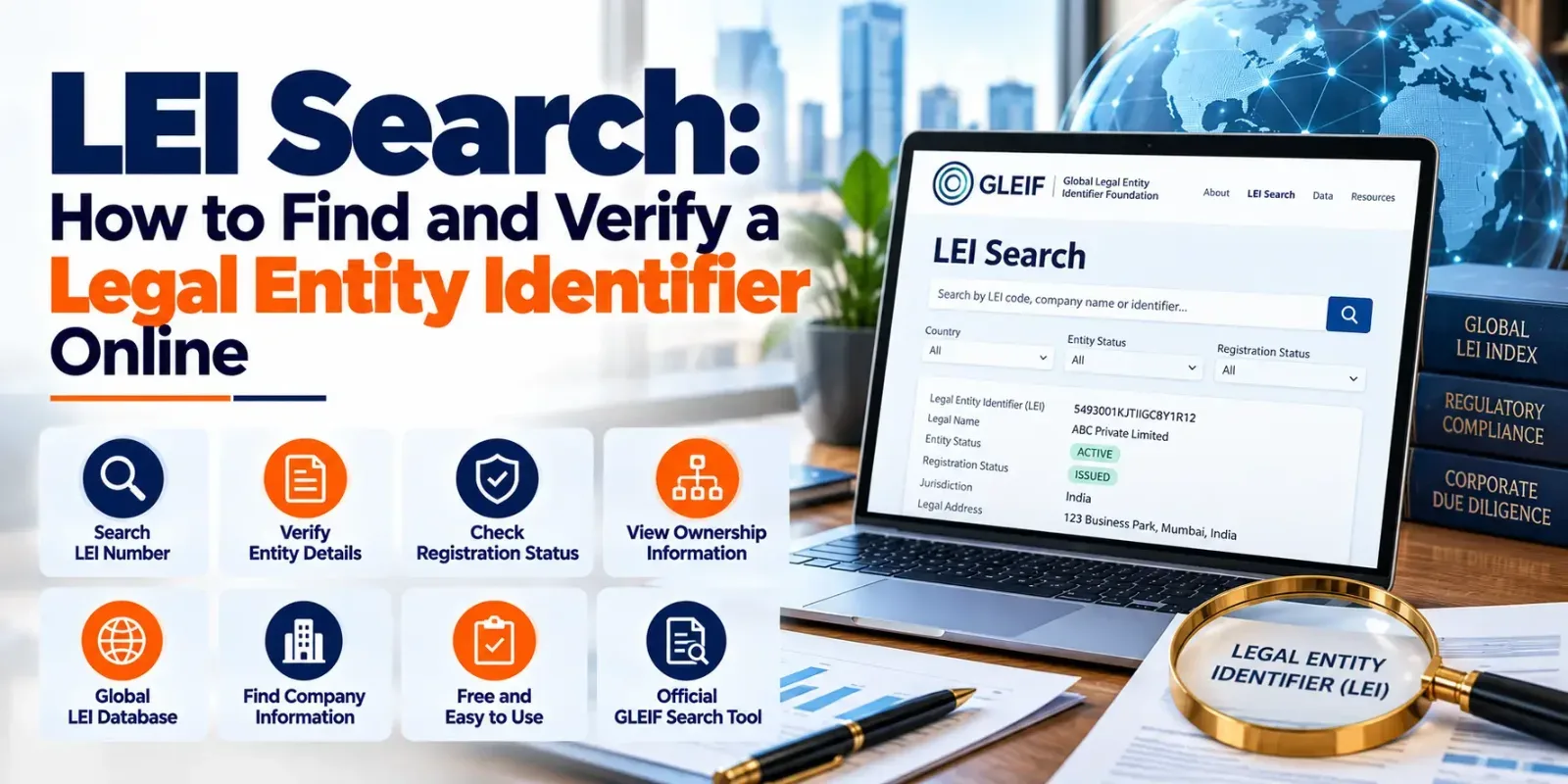
Direct Answer: What Is LEI Search?
LEI Search is a web-based application that enables users to search and validate a Legal Entity Identifier (LEI) - a unique 20-character alphanumeric code assigned to legal entities that engage in financial transactions. The Global Legal Entity Identifier Foundation (GLEIF) offers a free public search tool that can be used to search for LEI records, legal names, registration status, addresses, and ownership relationships.
Quick Summary
- LEI full form: Legal Entity Identifier.
- LEI format: A unique 20-character alphanumeric code.
- Primary purpose: To identify legal entities participating in financial transactions.
- Official search platform: GLEIF LEI Search.
- Search cost: GLEIF's public LEI Search tool is free to use and does not require registration.
- Information available: Legal name, LEI code, entity status, registration status, addresses, and other reference data.
- LEI validity: LEI records require periodic renewal and verification.
- Indian LEI issuer: Legal Entity Identifier India Limited (LEIL) is recognised by the Reserve Bank of India as an LEI issuer.
- Who may need an LEI: Companies, financial institutions, and other eligible entities covered by applicable regulatory or transaction requirements.
- Important distinction: Finding an LEI record is not the same as applying for a new LEI or renewing an existing one.
You can search the global LEI database through the official GLEIF LEI Search tool.
What Is a Legal Entity Identifier (LEI)?
The Legal Entity Identifier is a global identifier used to identify legal entities in financial transactions.
The LEI system was developed to support the identification of organizations and to improve the consistency of financial data across institutions and jurisdictions.
An LEI is particularly useful when financial institutions, regulators, counterparties and other organizations want to differentiate between entities with similar names or operating in different countries.
For example, two companies might have similar names but their LEI records can help to identify their registered identities and associated reference data.
The Global Legal Entity Identifier Foundation supports the LEI system by maintaining the Global LEI Index and providing access to publicly available LEI reference data.
What Does an LEI Code Look Like?
An LEI consists of 20 alphanumeric characters.
For example, a code may follow this general format:
549300XXXXXXXXXXXXXX
This is only an illustrative format, not a real LEI assigned to a specific company.
An LEI is linked to an entity's reference information, including its legal name, jurisdiction, registration details, and other available data.
Users should copy the complete code from an official record rather than attempt to construct or guess an LEI.
Why Is LEI Search Important?
LEI Search helps businesses and financial institutions identify legal entities using standardized reference data.
Verify a Company's Identity
A company name alone may not be sufficient to identify the correct legal entity, especially when several organizations have similar names.
Searching for an LEI allows users to compare the entity's recorded legal name, jurisdiction, registration information, and other available details.
Check LEI Registration Status
The search results contain information about the registration status, which helps users understand if an LEI record is issued or has another status.
This is particularly important when a bank, financial institution or counterparty requires a current LEI.
Review Ownership Relationships
The GLEIF provides functionality to explore certain corporate ownership relationships through its Level 2 data.
Users can search for direct and ultimate parent entities as well as organizations owned by a specific entity based on the information available. These relations are based on the reported and available data in the LEI system.
Support Financial Transactions
Certain financial-market activities, banking relationships, or transactions may be subject to applicable regulatory requirements that require an LEI.
In India, the Reserve Bank of India has issued directions relating to LEI for specified financial activities and transactions. Whether a particular business is required to have an LEI depends on the rules that apply to it and the type of business it does.
LEI Search Options: GLEIF, LEIL and Other Sources
Different resources serve different purposes. Understanding the distinction helps users choose the appropriate option.
| Feature | GLEIF LEI Search | LEI Issuer in India | Company Registry Search |
|---|---|---|---|
| Main purpose | Search global LEI records | Apply for, manage, or renew an LEI | Check local corporate registration details |
| Search existing LEIs | Yes | Depends on the issuer's services | Usually not the primary purpose |
| Global coverage | Yes | Depends on the issuer's accredited jurisdictions | Generally jurisdiction-specific |
| Apply for a new LEI | No, the search tool itself does not issue LEIs | Yes, through an authorized issuer | No |
| Verify LEI reference data | Yes | May provide related services | Does not replace LEI verification |
| Cost to search | Free on GLEIF | Service fees may apply for issuance or renewal | Depends on the registry and service |
| Best use | Find and verify an existing LEI | Obtain or renew an LEI | Verify local corporate registration |
The GLEIF tool is intended for searching existing LEI records, while LEI issuers provide registration and renewal services. In India, Legal Entity Identifier India Limited is recognized by the RBI as an LEI issuer.
How to Perform an LEI Search Online
The following process explains how to find and verify an LEI using the official GLEIF search tool.
Step: Open the Official GLEIF LEI Search Tool
Visit the GLEIF LEI Search website.
The platform allows users to search the global LEI data pool without creating an account.
Always check that you are using the official search platform when verifying an entity's LEI.
Step: Enter the Company Name or LEI Code
Enter one of the following in the search field:
- Legal company name.
- Existing LEI code.
- Relevant business name or available identifier.
If you already have the LEI code, searching by the complete code can help identify the corresponding record.
If you do not know the code, search using the company's legal name.
Step: Review the Search Results
The result list can display fields such as:
- Country or jurisdiction.
- Entity status.
- Legal name.
- LEI code.
- Registration status.
Compare the results carefully if multiple entities have similar names.
GLEIF also offers search suggestions and alternative matches that can help users address spelling variations or typing mistakes.
Step: Open the Correct Entity Record
Click on the result that best matches the organization you want to check.
Check out the record details such as the legal name, registered address, jurisdiction, entity status, and registration status.
Don't trust just a matching company name. Verify all possible details with the company’s official documents or other authoritative records.
Step: Check the LEI Registration Status
Review the record's registration status.
An ISSUED record indicates that the LEI has been issued and its registration is current according to the LEI system's status information.
A LAPSED status generally means the LEI is due for renewal and has not been revalidated within the planned interval. It does not, by itself, mean that the legal entity has become inactive.
If a financial institution requires a current LEI, confirm its acceptance criteria before proceeding with a transaction.
Step: Verify the Entity Status
Entity status and LEI registration status are different fields.
The entity status is the status of the legal entity as indicated in the LEI record and the registration status is the status of the LEI record within the LEI system.
For example, a record might show an entity as active when its LEI registration has expired.
So check both fields and do not assume that an issued LEI is proof that the entity is currently active.
Step: Review Additional Information
Depending on the record, you may be able to examine:
- Registered legal name.
- Alternative names.
- Registered address.
- Headquarters address.
- Jurisdiction of formation.
- Legal form.
- Registration authority.
- Date of last update.
- Next renewal date.
- Parent and ownership relationship information.
GLEIF also provides a change-history view for available LEI reference data, enabling users to examine changes recorded since 9 February 2018.
Step: Save or Share the LEI Record
GLEIF supplies permanent record URLs that can be bookmarked or shared.
You can keep the record link for internal validation, due diligence or compliance documentation.
The platform also offers export options for larger searches including CSV, JSON, XML and Excel for eligible result sets.
How to Verify an LEI Number in India
Businesses in India may need to verify an LEI for banking, regulatory, financial-market, or cross-border transaction purposes.
Use the Global LEI Database
Start with the official GLEIF search tool to check whether the LEI exists and to inspect its reference data.
Verify the legal name and jurisdiction against the entity's official documents.
Check the LEI Issuer Information
An LEI is issued and managed through an authorised LEI issuer, also known as a Local Operating Unit (LOU).
GLEIF maintains information about accredited LEI issuers and their authorised jurisdictions.
Use the official GLEIF LEI Issuer Directory if you need to identify an issuer or obtain an LEI.
Review Applicable RBI Requirements
RBI has introduced LEI requirements for certain categories of financial transactions and entities.
For instance, directions for certain cross-border transactions require authorized dealer banks to obtain LEI information for resident non-individual entities undertaking capital or current account transactions of ₹50 crore or more per transaction, subject to the directions.
The RBI circular also states that once an entity is assigned an LEI, it should be reported in all applicable transactions irrespective of size of transaction as prescribed in the circular. Always check the current regulatory directions and any subsequent amendments before relying on a particular threshold.
Use the Indian LEI Issuer for Registration or Renewal
If your business needs to obtain or renew an LEI, consult Legal Entity Identifier India Limited (LEIL) for its current procedures, documentation requirements, and service charges.
Searching for an existing LEI is different from applying for a new one.
What Information Can You Find Through LEI Search?
The GLEIF platform provides access to structured reference information about registered legal entities.
| Information field | What it tells you |
|---|---|
| LEI code | The entity's unique 20-character identifier |
| Legal name | The recorded legal name of the entity |
| Entity status | The entity status shown in the LEI record |
| Registration status | Whether the LEI record is issued, lapsed, or otherwise classified |
| Jurisdiction | The jurisdiction associated with the entity |
| Legal address | The registered address information available in the record |
| Headquarters address | The recorded headquarters address, where available |
| Entity legal form | The recorded legal form or category |
| Last update | When the record was last updated |
| Next renewal date | The recorded renewal date |
| Ownership relationships | Available information about parent and subsidiary relationships |
Not all fields will necessarily contain information for every entity. GLEIF's search tool allows users to reveal available fields and review ownership information where relationship records exist.
Common Mistakes to Avoid During LEI Search
Relying Only on the Company Name
Two organizations can have similar or identical names.
Always compare the legal name with the jurisdiction, address, registration details, and other available information.
Confusing Entity Status With LEI Registration Status
An entity may be active while its LEI registration is lapsed.
Check both fields because they answer different questions.
Assuming a Lapsed LEI Means the Company Is Closed
A lapsed LEI generally indicates that the registration has not been renewed or revalidated within the planned interval.
It does not automatically mean that the entity has ceased to exist. Verify the legal entity separately.
Using Unofficial or Outdated Information
Third-party websites may contain incomplete or outdated information.
Use GLEIF to verify LEI reference data and consult relevant official corporate registries or regulators for other legal details.
Assuming Every Business Must Have an LEI
LEI requirements depend on applicable laws, regulations, transaction types, and financial institutions' requirements.
Do not assume that every company, LLP, or small business is automatically required to obtain an LEI.
Confusing LEI Search With LEI Registration
Searching the global database does not issue a new LEI.
If no record exists, consult an authorised LEI issuer to determine the appropriate application process.
Expert Advice from TaxCaller
At TaxCaller, we suggest companies to verify the LEI before using it for banking and financial transactions, counterparty checks or regulatory filings.
When verifying an LEI record, ensure the legal name, jurisdiction, entity status, registration status and renewal date are correct. Where the record is lapsed, determine if renewal is needed for the intended transaction.
It is also recommended to separate LEI verification from other compliance checks. An LEI is not a substitute for company incorporation documents, GST registration, PAN verification or other due diligence requirements.
TaxCaller offers business compliance and financial services that can help organizations with their related statutory and administrative needs:
- Company Registration Services: Support for business incorporation and related documentation.
- GST Registration Services: Assistance with GST registration and compliance.
- Income Tax Filing Services: Support with applicable income-tax return filing.
- Accounting and Bookkeeping Services: Assistance with financial records and accounting processes.
For LEI issuance, renewal, or specialist regulatory questions, businesses should consult an authorised LEI issuer, their bank, or a qualified professional familiar with the relevant transaction requirements.
Official External References
Use these authoritative resources within the published article:
- GLEIF LEI Search — Search and verify global LEI records.
- GLEIF: About LEI Search — Search functionality, data fields and ownership information.
- GLEIF: How to Use LEI Search — Search instructions, filters, record status and exports.
- GLEIF: Find an LEI Issuer — Find an authorised issuer for new registration or renewal.
- Reserve Bank of India: LEI for Cross-Border Transactions — Regulatory information on LEI requirements for specified transactions.
- Legal Entity Identifier India Limited — Indian LEI issuer information and application resources.
Conclusion
LEI Search is a helpful tool for searching and validating Legal Entity Identifier records for companies and other legal entities across the globe. The official GLEIF platform allows users to access information such as legal names, LEI codes, registration status, addresses and ownership information (where available) without the need to register for an account.
For Indian businesses, looking up an LEI can help with due diligence and some banking or financial transaction requirements. However, LEI is not a substitute for company incorporation records, GST registration, PAN verification and other compliance checks.
Before you rely on an LEI, you should verify the identity of the entity, check its registration status, look at the renewal information and, where appropriate, consult the relevant bank or regulator. If an LEI is required but not available, contact an authorized issuer for instructions on how to apply and renew.