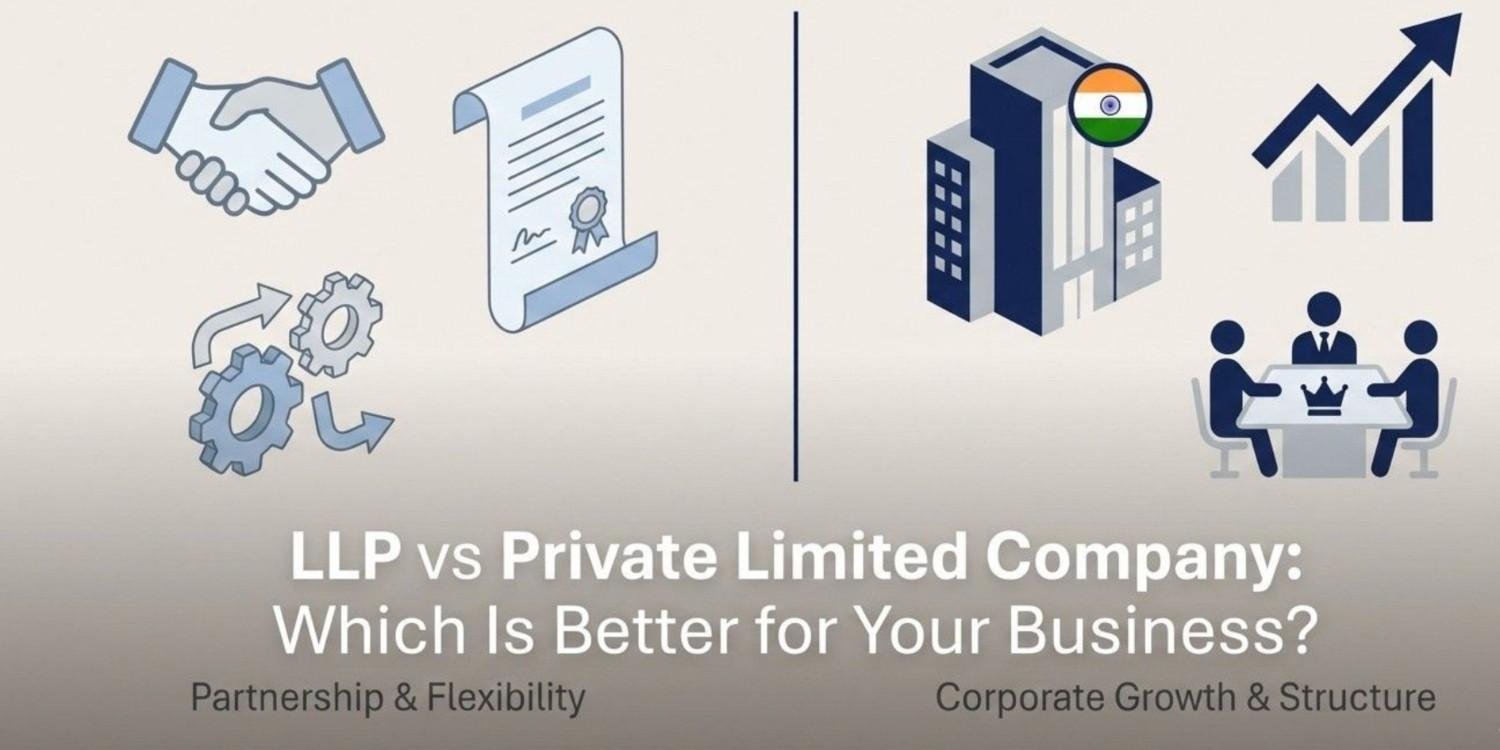
LLP vs Private Limited Company: Which Is Better for Your Business?
Choosing the right business structure is one of the most important decisions you’ll make as an entrepreneur. It affects how much tax you pay, how much compliance you deal with, how easily you can raise funds, and even how seriously others take your business.
In India, two of the most popular options are Limited Liability Partnership (LLP) and Private Limited Company. Both offer limited liability protection, but they are designed for very different kinds of businesses.
So how do you decide which one is better for your business?
What Is an LLP (Limited Liability Partnership)?
An LLP is a business structure that combines the flexibility of a partnership with the benefit of limited liability. It is governed by the Limited Liability Partnership Act, 2008.
In an LLP:
- The business has a separate legal identity.
- Partners are not personally responsible for the firm’s debts beyond their agreed contribution.
- Management is flexible and decided through an LLP agreement.
LLPs are often preferred by professionals, consultants, and small businesses that want limited liability but lower compliance compared to a company.
What Is a Private Limited Company?
A Private Limited Company is a separate legal entity registered under the Companies Act, 2013. It is one of the most widely used structures for startups and growing businesses in India.
In a Private Limited Company:
- The company is legally separate from its owners.
- Ownership is divided into shares held by shareholders.
- Management is handled by directors.
- The company continues to exist even if ownership changes.
This structure is generally chosen by businesses that plan to scale, raise funds, or build long-term brand credibility.
LLP vs Private Limited Company: Key Differences at a Glance
| Aspect |
LLP |
Private Limited Company |
| Legal Identity |
Separate legal entity |
Separate legal entity |
| Liability |
Limited to partner contribution |
Limited to shareholding |
| Ownership |
Partners |
Shareholders |
| Management |
Partners manage directly |
Managed by directors |
| Compliance |
Lower |
Higher |
| Fundraising |
Difficult |
Easier |
| Transfer of Ownership |
Complex |
Simple through shares |
| Investor Preference |
Low |
High |
This table gives a quick snapshot, but the real decision depends on how you plan to run and grow your business.
Pros and Cons of an LLP
Advantages of an LLP
Lower compliance burden
LLPs have fewer annual filings and compliance requirements compared to companies, which makes them easier and cheaper to maintain.
Flexible management
Partners can decide how the business is run through an LLP agreement, without rigid rules around meetings or resolutions.
Limited liability protection
Partners are not personally liable for business losses or debts beyond their contribution.
Ideal for service-based businesses
Professionals like consultants, designers, architects, and small agencies often find LLPs practical and sufficient.
Disadvantages of an LLP
Limited fundraising options
LLPs cannot issue shares, making it difficult to raise funds from investors or venture capitalists.
Lower credibility for large deals
Some banks, clients, and investors still prefer companies over LLPs for bigger contracts or funding.
Pros and Cons of a Private Limited Company
Advantages of a Private Limited Company
Easier access to funding
Private Limited Companies can issue shares, making them attractive to angel investors, venture capital firms, and private equity.
Higher credibility
This structure is often seen as more professional and trustworthy by clients, lenders, and investors.
Scalability
It is easier to expand, add shareholders, or bring in strategic investors as the business grows.
Clear ownership transfer
Shares can be transferred, making exits and ownership changes relatively simple.
Disadvantages of a Private Limited Company
Higher compliance requirements
Annual filings, board meetings, audits, and regulatory compliance are mandatory.
Higher costs
Compliance, audits, and professional fees make this structure more expensive to maintain than an LLP.
Tax and Compliance Differences
From a tax perspective:
- LLPs and Private Limited Companies are taxed at different rates depending on applicable provisions.
- LLPs are not subject to dividend distribution tax, as profits are taxed directly in the hands of the LLP.
- Companies have more complex tax planning options but also stricter reporting requirements.
Compliance-wise:
- LLPs have fewer filings and relaxed meeting requirements.
- Companies must comply with regular ROC filings, audits (in most cases), and statutory meetings.
If you want simplicity and lower ongoing effort, LLPs are easier. If you want structure and scalability, companies are better.
Funding and Growth: Which One Helps You Scale?
This is where the difference becomes very clear.
If you plan to:
- Raise external funding
- Bring in investors
- Offer equity
- Build a scalable startup
A Private Limited Company is usually the better choice.
LLPs work well for stable businesses with predictable income, but they are not designed for aggressive growth or fundraising.
Who Should Choose an LLP?
An LLP may be the right choice if:
- You are running a professional or service-based business
- You do not plan to raise external funding
- You want low compliance and flexibility
- You are partnering with a small, trusted group
Examples include consulting firms, design studios, small agencies, and family-run service businesses.
Who Should Choose a Private Limited Company?
A Private Limited Company may be better if:
- You plan to scale or raise funds
- You want strong business credibility
- You may bring in investors later
- You want structured ownership and governance
Startups, tech companies, product-based businesses, and growth-focused ventures usually benefit more from this structure.
A Simple Checklist to Decide
Ask yourself these questions:
- Do I plan to raise funding in the next 1–3 years?
- Is lower compliance more important than scalability?
- Do I need strong credibility with banks or investors?
- Am I building a lifestyle business or a growth business?
- How many owners will the business have?
Your answers will usually point clearly toward either LLP or Private Limited.
Conclusion
There is no “one-size-fits-all” answer to the LLP vs Private Limited Company debate. The right choice depends on your business goals, growth plans, and compliance comfort.
If you want simplicity and flexibility, an LLP can work well. If you want scale, funding, and long-term growth, a Private Limited Company is often the better option.
Before registering, take a moment to think not just about where your business is today, but where you want it to be in the next few years.
If you need guidance on choosing the right structure or completing the registration process smoothly, TaxCaller can help you make an informed decision and handle the legal and compliance steps with ease.
Frequently Asked Questions
1. What is the main difference between an LLP and a Private Limited Company?
The main difference lies in structure and scalability. An LLP offers flexible management with lower compliance, while a Private Limited Company provides better credibility and easier access to funding.
2. Which is better for startups, LLP or Private Limited Company?
Most startups prefer a Private Limited Company because it allows shareholding, attracts investors, and supports long-term growth. LLPs are better suited for small or service-based businesses.
3. Is an LLP a separate legal entity?
Yes, an LLP is a separate legal entity, meaning it exists independently from its partners and can own assets, enter contracts, and be sued in its own name.
4. Can an LLP raise funds from investors?
Raising funds is difficult for LLPs because they cannot issue shares. Investors usually prefer Private Limited Companies due to clear ownership and exit options.
5. Is compliance higher in a Private Limited Company?
Yes, Private Limited Companies have higher compliance requirements, including annual filings, audits, and board meetings, compared to LLPs.
6. Which structure is more tax-efficient?
Tax efficiency depends on income levels and business nature. LLPs often have simpler tax structures, while companies offer more tax planning options but with stricter compliance.
7. Can ownership be transferred easily in an LLP?
Ownership transfer in an LLP is more complex and usually requires changes to the LLP agreement. In a Private Limited Company, ownership can be transferred easily through shares.
8. Is audit mandatory for both LLP and Private Limited Company?
Audit is mandatory for all Private Limited Companies. For LLPs, audit is required only if turnover or contribution crosses specified limits.
9. Which is better for long-term business growth?
For businesses aiming for expansion, funding, or scaling operations, a Private Limited Company is generally better suited than an LLP.
10. Can I convert an LLP into a Private Limited Company later?
Yes, it is possible to convert an LLP into a Private Limited Company, but the process involves legal and regulatory steps, approvals, and compliance requirements.
 4.9 Google Rating
 4.4 Rated Excellent Trustpilot