Table of Contents
Direct Answer
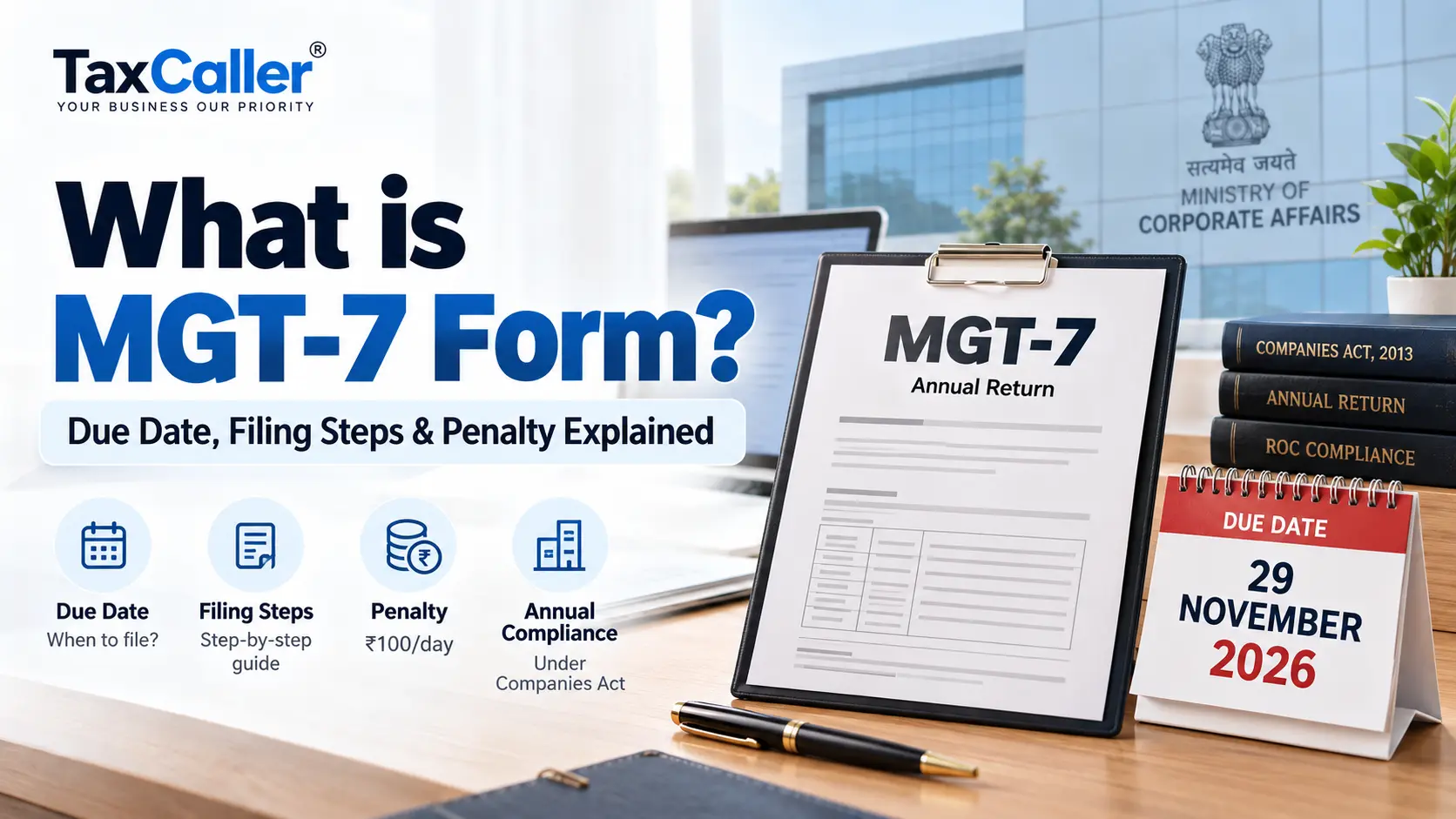
MGT-7 is the form of annual return which is filed by the concerned companies with the Registrar of Companies under section 92 of the Companies Act, 2013. These include prescribed corporate information such as shareholding, directors, meetings and particulars of the company. The return is to be made generally within 60 days of the AGM. If the AGM is held on 30 September 2026 then the due date is 29 November 2026.
Quick Summary
- MGT-7 is an annual return filed under Section 92 of the Companies Act, 2013.
- It provides important information about the company's corporate structure and activities.
- The filing is made with the Registrar of Companies through the MCA system.
- The annual return is generally due within 60 days from the date of the AGM.
- If the AGM is held on 30 September 2026, the due date is 29 November 2026.
- OPCs and qualifying small companies generally use the abridged MGT-7A framework.
- MGT-7 is different from AOC-4, which relates to financial statements.
- Late filing can result in statutory penalties and applicable additional filing fees.
- Section 92(5) provides a ₹10,000 penalty and ₹100 per day for continuing failure, subject to prescribed maximum amounts.
- Companies should prepare their annual return information before the filing deadline.
What Is MGT-7 Form?
MGT-7 is the form in which the applicable companies have to file their annual return as per Section 92 of the Companies Act, 2013.
An annual return is not the same as a company’s income tax return or financial statements. It is a corporate snapshot and provides prescribed information about the company.
The annual return may contain information on: depending on the applicable requirements
- Registered office
- Principal business activities
- Share capital
- Shareholding pattern
- Members
- Directors
- Key managerial personnel
- Meetings held during the year
- Changes in shareholding
- Indebtedness
- Other prescribed corporate particulars
The purpose is to provide the Registrar with updated information about the company's corporate position.
The MCA rules prescribe MGT-7 as the annual return form, while OPCs and small companies have an abridged annual return framework through MGT-7A.
Who Needs to File MGT-7?
The exact annual return form depends on the company's legal status and whether it qualifies for the abridged form.
Generally, companies that do not fall within the applicable MGT-7A category file MGT-7.
The company should determine the correct form based on:
- Type of company
- Whether it is an OPC
- Whether it qualifies as a small company
- Applicable Companies Act provisions
- Applicable rules for the relevant financial year
This distinction is important because businesses should not automatically assume that every company uses exactly the same annual return form.
The MCA rules specifically provide for MGT-7 and MGT-7A, with MGT-7A applicable to OPCs and qualifying small companies.
MGT-7 Due Date for 2026
Under Section 92(4), the annual return must generally be filed with the Registrar within 60 days from the date on which the AGM is held.
If an AGM is not held, the law provides for filing within 60 days from the date on which the AGM should have been held, along with the prescribed statement regarding why the AGM was not held.
MGT-7 Example for FY 2025-26
If a company holds its AGM on:
30 September 2026
then the annual return deadline is:
29 November 2026
Therefore, 29 November 2026 is the MGT-7 due date for a company whose AGM is held on 30 September 2026.
It is important to understand that 29 November is not automatically the due date for every company. The deadline is calculated from the actual AGM date.
Example
| AGM Date |
MGT-7 Due Date |
| 15 September 2026 |
14 November 2026 |
| 25 September 2026 |
24 November 2026 |
| 30 September 2026 |
29 November 2026 |
The statutory rule is AGM date + 60 days.
MGT-7 vs MGT-7A
MGT-7 and MGT-7A should not be treated as interchangeable forms.
| Particular |
MGT-7 |
MGT-7A |
| Nature |
Annual Return |
Abridged Annual Return |
| Main use |
Applicable companies |
OPCs and qualifying small companies |
| Information |
More detailed |
Abridged |
| Filing authority |
ROC/MCA |
ROC/MCA |
| Relevant provision |
Section 92 |
Section 92 and applicable rules |
The applicable form should be determined based on the company's status and the rules applicable for the relevant financial year.
Companies should verify the current MCA requirements before filing because corporate compliance rules and forms can change.
What Information Is Included in MGT-7?
MGT-7 is designed to provide the Registrar with prescribed information about the company.
Depending on the applicable form and requirements, the information can cover areas such as:
1. Company Details
This can include:
- CIN
- Company name
- Registered office
- Principal business activities
- Corporate status
2. Share Capital
Information may include:
- Authorised share capital
- Paid-up share capital
- Equity shares
- Preference shares
- Changes during the year
3. Shareholders and Members
The annual return can contain information regarding members and their shareholding.
4. Directors and KMP
Prescribed information relating to directors and key managerial personnel may also be reported.
5. Meetings
The return may include details of applicable meetings held during the year.
6. Changes During the Year
Relevant changes in shareholding, directors, capital or other prescribed corporate information may need to be reflected.
Therefore, MGT-7 should be prepared from the company's actual statutory records rather than copied from an earlier year's return.
Documents Required for MGT-7 Filing
The exact documents and information depend on the company's circumstances.
A company should generally keep the following records ready:
- Certificate of Incorporation and CIN details
- Registered office information
- Share capital records
- Shareholder/member details
- Register of members
- Director and KMP information
- Details of board meetings
- AGM details
- Share transfer information, where applicable
- Changes in shareholding
- Financial and corporate records
- Previous annual return
- Previous MCA filing records
- DSC of the authorised person
- MGT-8 certification, where applicable
Companies should reconcile the information in MGT-7 with their statutory registers and other corporate records.
Step-by-Step MGT-7 Filing Process
Step 1: Determine the Correct Annual Return Form
First determine whether the company should file MGT-7 or the applicable abridged annual return form.
Do not select the form solely based on what was filed in an earlier year.
Step 2: Complete the AGM
The company should complete its AGM in accordance with the applicable provisions of the Companies Act.
The MGT-7 deadline is generally calculated from the AGM date.
Step 3: Collect Corporate Information
Collect information relating to:
- Company details
- Shareholders
- Share capital
- Directors
- KMP
- Meetings
- Changes during the year
- Other prescribed particulars
Step 4: Reconcile the Information
Compare the information with the company's:
- Statutory registers
- Share records
- Board records
- AGM records
- Previous MCA filings
- Accounting records
This step can help identify inconsistencies before submission.
Step 5: Prepare MGT-7
Enter the required information into the applicable MCA form.
The information should accurately reflect the company's position for the relevant period.
Step 6: Review Certification Requirements
Certain companies may have additional annual-return certification requirements under Section 92 and the applicable rules.
Where MGT-8 certification is applicable, the required certification should be completed by a practising Company Secretary.
Step 7: Sign the Form
The applicable authorised signatory/director should complete the required digital signing process.
Step 8: File on the MCA Portal
Submit the completed annual return electronically through the MCA system.
Step 9: Pay Applicable Filing Fees
Applicable MCA filing fees and additional fees should be paid according to the current MCA fee structure.
Step 10: Save the Filing Records
After successful submission, retain:
- Filed form
- SRN
- Challan
- Acknowledgement
- Certification
- Supporting records
These documents should be preserved for future compliance and reference.
MGT-7 Filing Fees and Penalty
MGT-7 involves applicable MCA filing fees, which depend on the prescribed fee structure and company particulars.
Late filing can create an additional financial burden.
There are also statutory consequences under Section 92(5) for failure to file the annual return within the prescribed period.
The Companies Act currently provides for a ₹10,000 penalty and, in case of continuing failure, a further ₹100 per day after the first day, subject to a maximum of:
- ₹2 lakh for the company
- ₹50,000 for an officer in default
This statutory penalty should be distinguished from any applicable additional filing fee under the MCA filing framework.
MGT-7 ₹100 Per Day Penalty Explained
The commonly discussed ₹100/day penalty comes from Section 92(5) of the Companies Act.
It applies in the context of continuing failure to file the annual return within the prescribed period.
For example, if the applicable filing deadline has passed and the annual return remains unfiled, the statutory provision provides for an additional ₹100 per day after the first day of continuing failure, subject to the statutory maximums.
This is why companies should avoid treating annual ROC filing as an administrative formality.
Important distinction
There can be more than one financial consequence associated with delayed filing.
| Component |
Meaning |
| Normal filing fee |
Fee applicable when filing within the prescribed framework |
| Additional filing fee |
Additional amount applicable for delayed filing under the MCA fee framework |
| Section 92(5) penalty |
Statutory penalty for failure to file annual return |
| Professional fee |
Fee charged by a consultant or professional, if engaged |
Therefore, the actual cost of delayed filing should be evaluated based on the company's specific circumstances and the current MCA fee structure.
MGT-7 vs AOC-4
MGT-7 and AOC-4 are both important annual ROC filings, but they serve different purposes.
| Particular |
MGT-7 |
AOC-4 |
| Main purpose |
Annual Return |
Financial Statements |
| Primary provision |
Section 92 |
Section 137 |
| Information |
Corporate and membership information |
Financial statements and related documents |
| Filing period |
Generally within 60 days of AGM |
Generally within 30 days of AGM |
| Filed with |
ROC/MCA |
ROC/MCA |
AOC-4 deals with financial statements, whereas MGT-7 deals with the company's annual return.
A company should therefore maintain a compliance calendar covering both filings where applicable.
Common Mistakes While Filing MGT-7
1. Missing the AGM-Based Deadline
Companies sometimes assume that every annual return has the same calendar date.
The actual deadline is generally calculated from the AGM date.
2. Filing the Wrong Form
A company should determine whether MGT-7 or the applicable abridged form is required.
3. Incorrect Shareholding Information
Shareholding information should be reconciled with the company's statutory records.
4. Incorrect Director Details
Director and KMP information should be checked carefully.
5. Copying Previous Year's Information
A previous year's return can be used as a reference, but current-year changes must be incorporated.
6. Ignoring Changes During the Year
Changes in directors, shareholders, capital or other corporate particulars should be reviewed before filing.
7. Ignoring Certification Requirements
Companies should check whether any additional certification requirements apply.
8. Filing at the Last Minute
Waiting until the final days can increase the risk of errors, portal issues and missed deadlines.
9. Not Saving the SRN and Challan
The company should preserve its filing acknowledgement and payment records.
10. Confusing MGT-7 With AOC-4
These are separate annual ROC compliance forms and should not be treated as the same filing.
Expert Advice from TaxCaller
TaxCaller recommends that companies treat annual ROC compliance as a planned process rather than a deadline-driven activity.
A useful annual compliance workflow is:
Financial Year Closing → Accounts Finalisation → Audit → AGM Preparation → AGM → AOC-4 → MGT-7/MGT-7A → Record Keeping
Companies should prepare the relevant corporate information well before the AGM.
The following records should be reviewed:
- Shareholder records
- Share capital
- Directors and KMP
- Registered office
- Board meetings
- AGM records
- Share transfers
- Corporate changes
- Previous MCA filings
Businesses completing Company Registration Online should also remember that incorporation is only the beginning of their compliance journey. After incorporation, companies need to monitor annual ROC filings, tax registrations, accounting and other applicable statutory requirements.
TaxCaller provides company registration, GST, accounting and tax compliance support for businesses.
Frequently Asked Questions About MGT-7
1. What is MGT-7 Form?
MGT-7 is the annual return form used by applicable companies to provide prescribed corporate information to the Registrar of Companies under Section 92 of the Companies Act, 2013. It can contain information relating to the registered office, share capital, shareholders, directors, meetings and other prescribed particulars. The form is filed electronically through the MCA system.
2. What is the MGT-7 due date for 2026?
MGT-7 is generally due within 60 days from the date of the AGM. Therefore, if a company holds its AGM on 30 September 2026, its annual return deadline falls on 29 November 2026. Companies should calculate the deadline based on their actual AGM date rather than automatically assuming 29 November is applicable to every company.
3. Is MGT-7 mandatory for every company?
The applicable annual return requirement depends on the company's status and the relevant Companies Act rules. Companies generally file MGT-7 unless they fall within the applicable MGT-7A category. OPCs and qualifying small companies may use the abridged annual return framework. The correct form should be verified before filing.
4. What is the penalty for late filing of MGT-7?
Section 92(5) provides a penalty of ₹10,000 for failure to file the annual return within the prescribed period. In continuing failure, a further ₹100 per day after the first day can apply, subject to a maximum of ₹2 lakh for the company and ₹50,000 for an officer in default.
5. Is the ₹100 per day amount the only cost for late MGT-7 filing?
Not necessarily. The ₹100-per-day amount arises from the statutory penalty provision under Section 92(5). Delayed filing can also involve applicable additional filing fees under the MCA filing framework. Professional charges may also apply if a company engages a professional to prepare and submit the annual return. The actual amount depends on the circumstances.
6. What is the difference between MGT-7 and AOC-4?
MGT-7 is the annual return and primarily reports prescribed corporate information, including relevant shareholder, share capital, director and meeting details. AOC-4 is used for filing financial statements and related documents with the Registrar. They are separate compliance filings with different statutory purposes and generally different filing timelines.
7. What documents are required for MGT-7?
The required information depends on the company. Common records include shareholder and member details, share capital records, director and KMP information, AGM and meeting records, registered-office information, changes during the year, previous filings and applicable certifications. Companies should reconcile the information against statutory registers before submitting the annual return.
8. Can MGT-7 be filed online?
Yes. The annual return is filed electronically through the MCA system. The company needs to prepare the applicable form, enter the prescribed information, complete applicable digital signatures and certification requirements, submit the form and pay the applicable filing fee. The company should save the SRN, challan and acknowledgement after submission.
9. What is MGT-7A?
MGT-7A is the abridged annual return framework applicable to OPCs and qualifying small companies under the applicable Companies Act rules. It contains a simplified set of annual-return disclosures compared with the full MGT-7. Companies should determine their status and applicable rules for the relevant financial year before selecting the annual return form.
10. Is Company Registration Online enough to complete company compliance?
No. Company Registration Online relates primarily to incorporation. Once a company is incorporated, it may have continuing obligations such as annual ROC filings, financial statement filing, tax compliance, accounting and other applicable statutory requirements. Entrepreneurs should prepare a post-incorporation compliance calendar instead of assuming that incorporation completes all future obligations.
Related TaxCaller Services
TaxCaller provides business registration, tax and compliance services that can support companies at different stages of their business lifecycle.
Relevant services include:
- Company Registration
- GST Registration
- Income Tax Return Filing
- Accounting & Bookkeeping Services
- Tax Compliance Services
- Trademark Registration
For businesses planning Company Registration Online, TaxCaller also provides assistance with company incorporation and related registration requirements.
Official Government References
For authoritative and current compliance information, companies should verify requirements through the official government sources.
Section 92 of the Companies Act establishes the annual-return filing requirement and the 60-day filing period, while Section 92(5) sets out the statutory consequences for failure to file within the prescribed period.
Conclusion
MGT-7 is an important annual ROC compliance form for the applicable companies under Section 92 of Companies Act, 2013.
The form supplies the Registrar with prescribed information on the corporate structure of the company, its shareholders, share capital, directors, meetings and other relevant particulars.
The annual return is to be filed generally within 60 days from the date of AGM. For a company holding its AGM on 30 September 2026, the relevant deadline is 29 November 2026.
Companies also have to consider the financial implications of filing late. Section 92(5) provides for a penalty of ₹10,000 plus ₹100 per day for continuing default, subject to statutory maximums applicable to the company and officer in default.
The best way is to prepare the company's annual return information well in advance of the deadline, reconcile it with statutory records and complete the MCA filing on time.
For entrepreneurs who have already registered a company online or are planning to do so, maintaining a good post-incorporation and annual compliance calendar can help the company stay compliant with its ongoing MCA obligations.
 4.9 Google Rating
 4.4 Rated Excellent Trustpilot