

Table of Contents
- Quick Answer: Common ITR Filing Errors
- What Is an Income Tax Notice?
- Why Do ITR Filing Errors Trigger Notices?
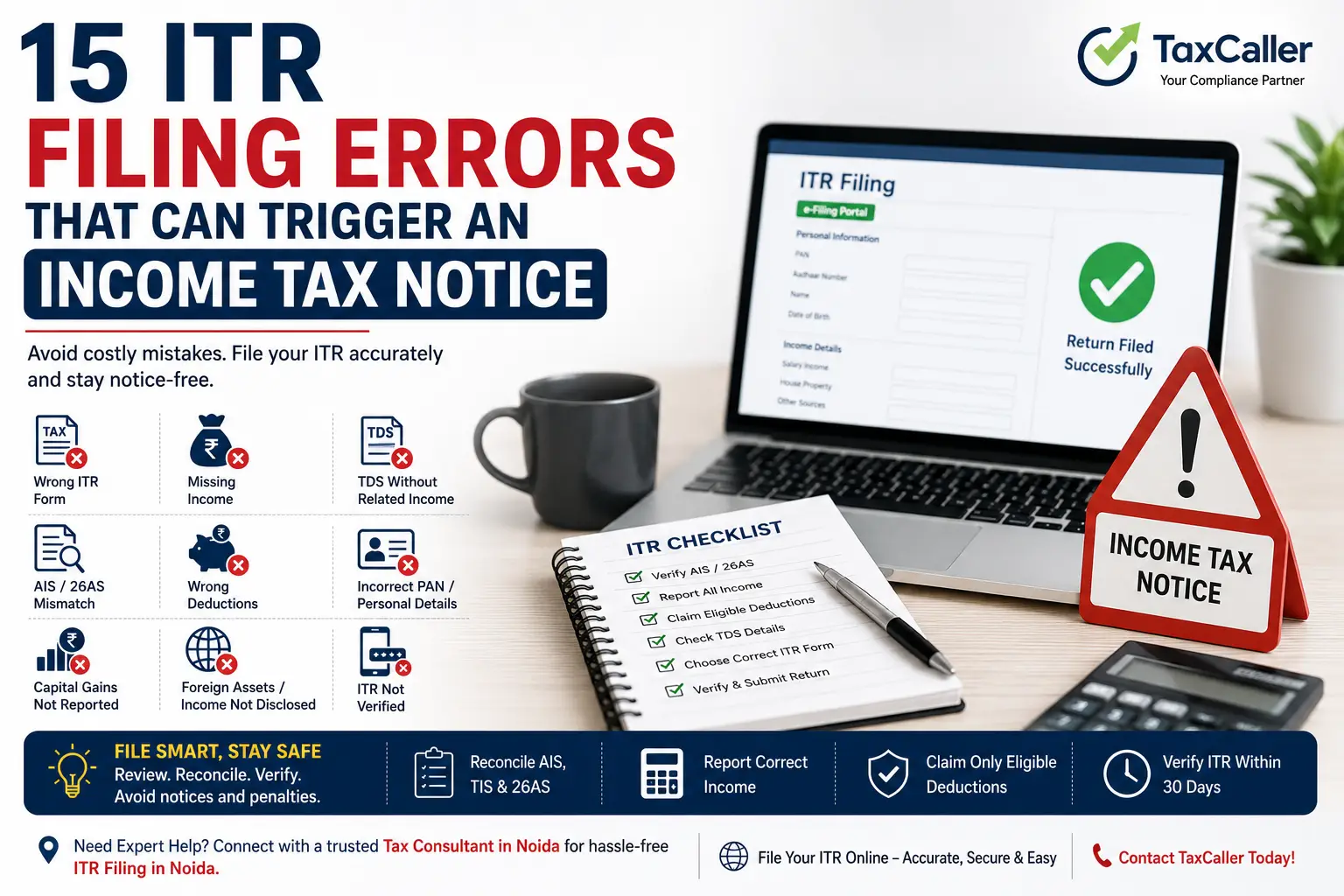
- 15 ITR Filing Errors That Can Trigger an Income Tax Notice
- 1. Choosing the Wrong ITR Form
- 2. Not Reporting All Sources of Income
- 3. Claiming TDS Without Reporting Related Income
- 4. Ignoring AIS, TIS and Form 26AS Mismatches
- 5. Reporting Incorrect Salary Income
- 6. Forgetting Bank Interest Income
- 7. Not Reporting Capital Gains
- 8. Incorrectly Claiming Deductions
- 9. Entering Incorrect PAN or Personal Details
- 10. Selecting the Wrong Tax Regime
- 11. Failing to Report Foreign Assets or Income
- 12. Incorrect Business or Professional Income Reporting
- 13. Forgetting Previous Employer Income
- 14. Incorrect Bank Account or Refund Details
- 15. Failing to Verify the ITR
- ITR Filing Checklist: What to Check Before Submission
- ITR Filing Online: How to Avoid Common Errors
- When Should You Hire a Tax Consultant?
- ITR Filing in Noida: DIY or Professional Assistance
- What Should You Do If You Receive an Income Tax Notice?
- Frequently Asked Questions
- 1. What are the most common ITR filing mistakes?
- 2. Can a small ITR mistake trigger an income tax notice?
- 3. Can AIS mismatch cause an income tax notice?
- 4. What happens if TDS is shown in Form 26AS but income is not reported?
- 5. How can I avoid an income tax notice while filing ITR?
- 6. Is ITR Filing Online safe?
- 7. Should I hire a Tax Consultant in Noida for ITR filing?
- 8. What should I check before ITR Filing in Noida?
- 9. What is a defective income tax return?
- 10. How long do I have to verify my ITR?
- Final Takeaway
Quick Answer: Common ITR Filing Errors
The common ITR filing errors that can lead to an income tax notice include reporting incorrect or incomplete income, claiming TDS without declaring the related income, choosing the incorrect ITR form, ignoring AIS or Form 26AS mismatches, claiming deductions incorrectly, omitting capital gains, and failing to verify the return.Other problems can include incorrect salary details, missing bank interest, incorrect PAN or personal information, incomplete business income reporting, missing previous-employer income, undisclosed foreign information where applicable, and incorrect bank details.
Before completing ITR Filing Online, review your income, Form 16, AIS, TIS, Form 26AS, TDS, investments, deductions and bank details. A careful review can help reduce avoidable errors
What Is an Income Tax Notice
An income tax notice is an official communication from the Income Tax Department about your tax return, tax information, compliance, assessment, refund, or another tax-related matter.Receiving a notice does not automatically mean that you committed tax fraud or intentionally made a mistake. A notice may be issued for several reasons, including information mismatches, missing income, TDS discrepancies, defective returns, refund-related issues, or requests for additional information.
The important point is not to panic or ignore the communication. Read the notice carefully, identify the issue and check the applicable response requirements and deadline.
Why Do ITR Filing Errors Trigger Notices?
Employers, banks, financial institutions, mutual funds, stockbrokers, property-related reporting entities, TDS deductors and other reporting entities provide tax-related information to the Income Tax Department.Your ITR should therefore accurately reflect your financial activity. When the information in your return differs from information available to the tax department, the difference may require clarification or further review.
For example, if you claim TDS but do not report the corresponding income, the figures may not reconcile. Similarly, differences between AIS, TIS, Form 26AS, Form 16 and your ITR may require you to review the underlying transaction.
This does not mean every mismatch results in a notice. It means that taxpayers should reconcile their records before filing rather than relying entirely on auto-populated information.
15 ITR Filing Errors That Can Trigger an Income Tax Notice
| No. | ITR Filing Error | Why It Can Cause Problems |
|---|---|---|
| 1 | Choosing the Wrong ITR Form | The return may not be appropriate for the taxpayer's income profile. |
| 2 | Not Reporting All Sources of Income | Information reported by third parties may not match the ITR. |
| 3 | Claiming TDS Without Reporting Related Income | Creates a TDS-income mismatch. |
| 4 | Ignoring AIS, TIS and Form 26AS Mismatches | Reported tax information may differ from the return. |
| 5 | Reporting Incorrect Salary Income | Salary and TDS information may not reconcile. |
| 6 | Forgetting Bank Interest Income | Interest income may be omitted from the return. |
| 7 | Not Reporting Capital Gains | Investment transaction information may not match. |
| 8 | Incorrectly Claiming Deductions | Unsupported or incorrect claims may require explanation. |
| 9 | Entering Incorrect PAN or Personal Details | Identity-related information can become inconsistent. |
| 10 | Selecting the Wrong Tax Regime | The tax calculation may not reflect the intended position. |
| 11 | Failing to Report Foreign Assets or Income | Applicable disclosure requirements may not be satisfied. |
| 12 | Incorrect Business or Professional Income Reporting | Receipts and financial information may be incomplete or inconsistent. |
| 13 | Forgetting Previous Employer Income | Total salary and TDS may be understated. |
| 14 | Incorrect Bank Account or Refund Details | Refund processing and communication can be affected. |
| 15 | Failing to Verify the ITR | An unverified return may not be treated as valid. |
1. Choosing the Wrong ITR Form
Different taxpayers may need different ITR forms depending on their income sources and financial circumstances. Selecting a form simply because it appears easy can result in an inappropriate return.Before filing, consider whether you have salary income, business or professional income, capital gains, foreign assets or income, rental income, or other reporting requirements.
If you are unsure which form applies to you, professional tax guidance can help you make a more informed choice.
2. Not Reporting All Sources of Income
Salary is not necessarily your only source of income. Taxpayers can overlook bank interest, dividends, rental income, freelance income, business income, professional receipts and capital gains.Not reporting an income source simply because no TDS was deducted does not automatically make the income non-taxable or non-reportable.
Before filing, create a complete income checklist and reconcile it with your financial records and applicable tax information.
3. Claiming TDS Without Reporting Related Income
Claiming TDS credit without reporting the corresponding income can create a significant mismatch.For example, if a deductor reports income and TDS but the taxpayer claims the TDS while leaving out the related income, the return may not reconcile with available tax information.
Always identify the income related to each TDS entry before claiming the corresponding credit in your ITR.
4. Ignoring AIS, TIS and Form 26AS Mismatches
AIS, TIS and Form 26AS can contain important tax-related information. Taxpayers should review these records instead of automatically copying every figure into the return.Compare the available information with bank statements, Form 16, investment statements, property-related records and your own financial documents.
If you identify an apparent discrepancy, investigate the underlying transaction and take the appropriate corrective action where necessary.
5. Reporting Incorrect Salary Income
Salaried taxpayers may overlook components of salary or fail to reconcile their income with the information reported by employers.Review gross salary, taxable salary, eligible exemptions, deductions and TDS. If you changed jobs during the year, make sure the income and tax information from all applicable employers is considered.
6. Forgetting Bank Interest Income
Savings-account interest, fixed-deposit interest and other interest income are commonly overlooked.Even when the amount appears small, review bank statements and interest certificates to determine the appropriate tax treatment before filing.
Maintaining a list of all active bank accounts and deposits can make this review easier
7. Not Reporting Capital Gains
Capital gains can arise from transactions involving shares, mutual funds, property and other capital assets.Common problems include missing transactions, using incorrect purchase or sale values, incorrect classification, or failing to reconcile broker statements and other transaction records.
Taxpayers with numerous investment transactions should carefully review their statements before completing the return.
8. Incorrectly Claiming Deductions
Tax deductions should only be claimed when you satisfy the applicable conditions.Common problems include claiming an amount that is not eligible, entering an incorrect amount, claiming the same benefit twice, or failing to retain relevant supporting documents.
Tax rules and deduction availability can vary depending on the applicable tax regime and tax year, so review the rules relevant to your filing year.
9. Entering Incorrect PAN or Personal Details
Carefully review your name, PAN, date of birth, address, contact information and other personal details before submitting your ITR.Small data-entry errors can create identity or information mismatches. Compare the information against your official records before final submission.
10. Selecting the Wrong Tax Regime
The selected tax regime can affect the applicable tax calculation and the availability or treatment of certain deductions and exemptions.Do not automatically choose the same option you used in a previous year. Instead, compare the options based on your current income, eligible deductions and the rules applicable to the relevant tax year.
11. Failing to Report Foreign Assets or Income
Taxpayers with relevant foreign assets, investments or income should carefully review applicable disclosure requirements before filing.This can be particularly important for people with overseas investments, foreign bank accounts, foreign securities, foreign employment income, or other cross-border financial interests.
Because foreign reporting can be complex, professional advice may be appropriate when the circumstances are complicated.
12. Incorrect Business or Professional Income Reporting
Business owners, freelancers and professionals should ensure that their receipts, expenses, profits and other required financial information are correctly reflected in the return.Problems can arise when taxpayers omit receipts, incorrectly calculate expenses, report the wrong profit, or fail to provide required financial information.
Maintain invoices, bank statements, accounting records, expense records and other supporting documents throughout the year rather than trying to reconstruct everything at filing time
13. Forgetting Previous Employer Income
If you changed employers during the financial year, reporting income from only your current employer can result in incomplete salary information.Collect the relevant salary and TDS information from all applicable employers and reconcile the figures before filing.
14. Incorrect Bank Account or Refund Details
Incorrect bank details can create problems when processing a tax refund or managing other tax-related transactions.Before submitting your return, review the account number, IFSC, selected refund account and other applicable details.
Avoid simply copying bank information from an old return without checking whether it is still accurate and active.
15. Failing to Verify the ITR
Submitting the ITR is not necessarily the final step. You also need to complete the applicable verification process.Taxpayers should check the current verification requirements and complete e-verification or the applicable alternative within the prescribed time.
Do not assume that the return is complete simply because you received an acknowledgement after submission.
ITR Filing Checklist: What to Check Before Submission
Before clicking the final submit button, use the following checklist. A structured review can help identify inconsistencies before the return is submitted.Personal Information
- Name matches PAN records
- PAN is correct
- Date of birth is correct
- Contact details are correct
- Bank details are correct
Income
- Salary included
- Previous employer income included where applicable
- Bank interest included
- Dividend income reviewed
- Rental income reviewed
- Capital gains checked
- Freelance/business income included where applicable
- Foreign income/assets reviewed where applicable
Tax Information
- Form 16 reviewed
- Form 26AS checked
- AIS checked
- TIS reviewed
- TDS reconciled
- TCS reviewed where applicable
- Advance tax/self-assessment tax checked where applicable
Deductions
- Eligible deductions reviewed
- Supporting documents retained
- No duplicate claims
- Tax-regime implications checked
Final Submission
- Correct ITR form selected
- Tax calculation reviewed
- Bank details checked
- Return submitted
- ITR verified within the applicable time
ITR Filing Online: How to Avoid Common Errors
ITR Filing Online makes the return-filing process convenient, but convenience should not mean submitting information without checking it.
A good online filing process should follow a structured sequence.
Step 1: Collect Documents
Keep the relevant documents ready, including:
- Form 16
- Form 16A, where applicable
- Bank statements
- Interest certificates
- Investment statements
- Capital-gain statements
- Rent-related records, where applicable
- Business records, where applicable
- Previous ITR
- Tax-payment details
Step 2: Review AIS and Form 26AS
Check tax-related information before entering figures into the return. Investigate important differences instead of assuming every auto-populated figure is automatically correct.
Step 3: Identify All Income
Create a complete income checklist rather than relying only on information that appears automatically in the filing system.
Step 4: Select the Appropriate ITR Form
Choose the return form based on your actual income sources and applicable circumstances.
Step 5: Reconcile TDS
Make sure the TDS claimed corresponds with the relevant income and the available tax records.
Step 6: Review Deductions
Claim only those deductions for which you are eligible and retain relevant supporting documents.
Step 7: Check the Tax Calculation
Review the final tax payable or refund and verify that the figures appear reasonable based on your income and tax payments.
Step 8: Submit and Verify
Complete the applicable verification process after submission. Keep the acknowledgement and related records for your files.
This approach makes ITR Filing Online more reliable and helps reduce avoidable filing errors.
When Should You Hire a Tax Consultant?
Not every taxpayer needs professional assistance. A person with a simple salary income profile may be comfortable preparing and filing the return independently.
However, hiring a Tax Consultant in Noida may be useful when your tax situation is more complicated than a straightforward salary return.
Consider Professional Assistance If You Have:
- Multiple income sources
- Business income
- Professional income
- Capital gains
- Rental income
- Foreign assets
- Foreign income
- Multiple employers
- Significant investments
- Complex deductions
- Previous tax notices
- Tax disputes or outstanding issues
A Tax Professional Can Help With:
- ITR form selection
- Income classification
- Tax calculations
- TDS reconciliation
- AIS and Form 26AS review
- Capital-gain reporting
- Deduction review
- Tax notice assistance
- Return verification guidance
- Tax compliance planning
The goal is not simply to have someone “fill the form.” The objective is to ensure that the return accurately represents your financial information and applicable tax position.
ITR Filing in Noida: DIY or Professional Assistance?
```If you are looking for ITR Filing in Noida, you generally have two approaches: filing the return yourself or obtaining professional assistance.
Option 1: File Yourself
DIY filing may be suitable if:
- You have simple salary income.
- You have limited income sources.
- Your documents are complete.
- You understand the ITR process.
- You are comfortable checking AIS and Form 26AS.
Option 2: Hire a Tax Professional
A Tax Consultant in Noida may be more suitable when you have:
- Business income
- Capital gains
- Multiple sources of income
- Foreign assets
- Complex deductions
- Multiple employers
- Previous tax notices
- Tax calculation difficulties
Quick Comparison
| Factor | DIY ITR Filing | Professional Assistance |
|---|---|---|
| Cost | Usually lower | Professional fee applies |
| Convenience | Requires your time | Professional handles much of the process |
| Simple salary return | Often suitable | Optional |
| Complex income | Can be difficult | More suitable |
| Notice assistance | Limited | May be available |
| TDS reconciliation | Self-managed | Professional assistance may be available |
| Capital gains | Requires careful review | Professional assistance can help |
| Business income | More complex | Often preferable |
The right choice depends on your financial situation, the complexity of your return, the time you have available and your confidence with tax information.
What Should You Do If You Receive an Income Tax Notice?
Don't ignore the notice.
- Read the notice carefully.
- Check the relevant assessment year.
- Identify the reason for the notice.
- Review your filed ITR.
- Compare the relevant information with AIS and Form 26AS.
- Collect supporting documents.
- Check the applicable response deadline.
- Submit the appropriate response through the prescribed process.
- Seek professional assistance if the issue is complicated.
A notice should be addressed based on its actual contents. Avoid sending a generic response without first understanding the issue and reviewing the underlying records.
Frequently Asked Questions
```1. What are the most common ITR filing mistakes?
Common ITR filing mistakes include choosing the wrong ITR form, omitting income, claiming TDS without reporting the related income, ignoring AIS or Form 26AS differences, incorrectly claiming deductions, missing capital gains, entering incorrect PAN or personal information, selecting an inappropriate tax regime, and failing to verify the return.
Taxpayers can also overlook interest income, previous-employer income, business receipts, foreign information where applicable, or important bank and investment details. The risk of errors increases when a taxpayer relies entirely on auto-populated information without reconciling it with their own records.
A practical way to reduce these errors is to complete a document review before filing, including Form 16, AIS, TIS, Form 26AS, bank records, investment statements and other relevant financial information.
2. Can a small ITR mistake trigger an income tax notice?
A small mistake does not automatically mean that an income tax notice will be issued. However, an inconsistency between information reported in the return and information available to the Income Tax Department can result in a question, communication, adjustment, defective-return issue or other tax-related correspondence, depending on the circumstances.
The significance of a mistake depends on what information is affected. For example, an unexplained TDS mismatch, omitted income, incorrect bank or investment information, or an inconsistency involving a major transaction may require more attention than a minor typographical issue.
This is why taxpayers should review and reconcile their return carefully rather than assuming that a small-looking discrepancy will always be ignored.
3. Can AIS mismatch cause an income tax notice?
An AIS mismatch can require clarification when information reported by a third party does not appear to match the taxpayer's ITR or financial records.
However, an AIS entry should not automatically be treated as correct. Taxpayers should compare the information with bank statements, investment records, transaction statements, Form 16 and other supporting documents.
If the information reported in AIS appears inaccurate, the taxpayer should use the appropriate feedback or correction mechanism available through the tax system and retain supporting records.
4. What happens if TDS is shown in Form 26AS but income is not reported?
This can create a significant mismatch because the tax information shows that TDS was deducted against an underlying transaction or income, while the ITR does not show the related income.
The taxpayer should identify the transaction related to the TDS entry, determine how it should be reported, and ensure that the return accurately reflects the underlying income.
Simply claiming the TDS credit without checking the related income can create an inconsistency. Before filing, reconcile TDS entries with the corresponding income and supporting records.
5. How can I avoid an income tax notice while filing ITR?
There is no way to guarantee that you will never receive an income tax notice. However, you can reduce avoidable filing errors by carefully reviewing your return before submission.
Important steps include:
- Report all relevant income.
- Check AIS and TIS.
- Review Form 26AS.
- Reconcile TDS and TCS.
- Use the appropriate ITR form.
- Report capital gains correctly.
- Review bank interest.
- Claim only eligible deductions.
- Check personal and bank information.
- Complete ITR verification after filing.
The goal is not to try to “avoid notices” through shortcuts. The better approach is to submit a complete and accurate return supported by your records.
6. Is ITR Filing Online safe?
ITR Filing Online through the official Income Tax e-Filing system is the standard electronic method for filing income tax returns.
Taxpayers should use the official government portal, protect their login credentials, avoid sharing passwords and OTPs, and carefully review information before submitting the return.
Keep copies of your submitted return, acknowledgement, supporting documents and important communications for your records. Also ensure that you complete the applicable verification step after filing.
7. Should I hire a Tax Consultant in Noida for ITR filing?
It depends on your tax situation. A taxpayer with straightforward salary income and a simple return may be comfortable handling the filing independently.
A Tax Consultant in Noida may be useful when you have business income, professional income, capital gains, rental income, foreign assets, multiple employers, complex deductions or previous income tax notices.
Professional assistance can also help with ITR form selection, tax calculations, TDS reconciliation, AIS review, capital-gain reporting, deduction review and tax-notice assistance.
8. What should I check before ITR Filing in Noida?
Before ITR Filing in Noida, review your PAN details, Form 16, Form 26AS, AIS, TIS, bank interest, capital gains, other income, deductions, TDS, tax-regime selection, bank account details and ITR verification.
The location does not change the core review process. A taxpayer filing in Noida should apply the same careful reconciliation approach used elsewhere in India.
If your income is complex, a professional can help identify inconsistencies before submission.
9. What is a defective income tax return?
A return may be treated as defective when the information required in the return or its schedules is incomplete or inconsistent.
Examples of potential issues can include certain TDS-income mismatches, inconsistencies in personal details, missing required information, or incomplete financial reporting where applicable.
If a defective-return communication is received, the taxpayer should read the reason carefully, identify the relevant information and take the required corrective action within the applicable period.
10. How long do I have to verify my ITR?
The verification requirement and applicable timeline should be checked against the current Income Tax Department rules for the relevant filing year.
Taxpayers should not assume that submission alone completes the filing process. After filing, check the verification status and complete the applicable e-verification or alternative verification procedure within the prescribed period.
Keep the filing acknowledgement and verification confirmation for your records.
Final Takeaway
Filing a correct ITR is not just a matter of entering numbers into an online form. Before completing ITR Filing Online, make sure you reconcile your income, TDS, AIS, TIS, Form 26AS, investments, deductions, bank details and other relevant information.
The 15 common errors discussed in this article include choosing the wrong ITR form, missing income, claiming TDS without related income, ignoring AIS/Form 26AS mismatches, incorrect deductions, missing capital gains, personal-detail errors, foreign disclosure issues, business-income errors, previous-employer income omissions, incorrect bank details and failure to verify the return.
If your tax situation is complicated, professional assistance from a Tax Consultant in Noida can help you review potential discrepancies and manage ITR Filing in Noida more confidently.
The main idea is simple:
Do not consider the ITR filing process complete until you have checked, reconciled and verified your return.
Need Help With ITR Filing?
Looking for professional assistance with ITR Filing in Noida or tax-related queries? TaxCaller can help you understand your filing requirements and review your tax information.