
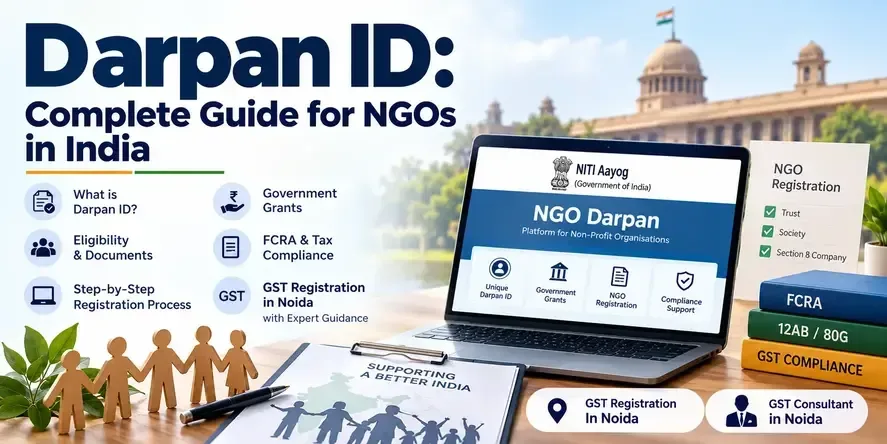
Darpan ID is a unique identification number, provided on the NGO Darpan portal maintained by NITI Aayog for eligible non-profits. It is especially important for NGOs seeking grants from the Government of India, and also relevant to some FCRA, tax-exemption and banking compliance requirements.
Direct Answer
Darpan ID is a unique identification number issued by NITI Aayog through NGO Darpan platform for eligible NGOs and other non-profit organizations. An organization generally needs to have ready its basic registration, PAN and authorized office-bearer information before creating Darpan profile for an NGO. Darpan ID is important when an NGO applies for government grants or regulatory services.
Quick Summary
NGO Darpan is associated with NITI Aayog's Voluntary Action Cell.
Darpan ID provides a system-generated Unique ID to eligible NPOs.
It is particularly important for NGOs seeking grants from Government of India ministries and departments.
Darpan registration does not replace the underlying registration of an NGO as a trust, society or Section 8 company.
NGOs should keep their registration certificate and PAN information ready.
Information relating to trustees, office bearers or authorised persons may also be required.
Darpan ID should not be confused with PAN, TAN, GSTIN, 12AB registration, 80G approval or FCRA registration.
An NGO may need several registrations and approvals depending on its activities.
FCRA is separately regulated by the Ministry of Home Affairs.
Darpan ID can be particularly relevant when an NGO applies for government grants and certain FCRA-related services.
NGOs should keep their Darpan profile and organisation information updated.
If an NGO provides taxable supplies or otherwise becomes liable under GST law, GST Registration in Noida or another applicable location may need to be evaluated separately.
A GST Consultant in Noida can help an NGO understand GST registration, invoicing and compliance where GST applies.
What Is Darpan ID?
Darpan ID is a unique ID number generated for eligible non-profit organizations through the NGO Darpan portal of NITI Aayog.
The NPO Darpan portal is maintained by the Voluntary Action Cell of NITI Aayog where non-profit organizations can register and get a Unique Identity number called Darpan ID, it says. The same government manual also specifies Darpan ID as mandatory for NPOs applying for grants from Ministries/Departments of the Government of India.
Therefore, Darpan system is more than an online directory. It gives participating non-profit organizations a government-facing identity to interact with government departments.
Getting a Darpan ID, however, does not mean that the organization has been incorporated or registered as a legal entity. First of all, an NGO must have its underlying legal constitution such as Trust, Society or Section 8 Company as the case may be.
Why Is Darpan ID Important for NGOs?
Darpan ID is important because government departments are increasingly using structured information about NGOs and voluntary organizations when processing grants and related services.
NITI Aayog documentation clearly states that the Unique ID is mandatory for NPOs seeking grants from Ministries/Departments of Government of India.
It can also apply to other compliance situations. The existing NITI Aayog manual mentions its relevance to some of the FCRA and income-tax exemption processes and the banking requirement introduced under the Prevention of Money Laundering framework.
Therefore, an NGO seeking to apply for government funding should generally view Darpan registration as a significant part of its compliance preparation.
Darpan ID vs Other NGO Registrations
Darpan ID should not be confused with other registrations and approvals.
Registration / ID | Main Purpose | Authority / Platform |
Darpan ID | Unique identity for eligible NPOs and government-facing NGO registration | NITI Aayog |
Trust Registration | Legal constitution of a charitable/religious trust | Applicable state authority |
Society Registration | Legal registration of a society | Applicable Registrar |
Section 8 Company | Incorporation of a non-profit company | MCA |
PAN | Income-tax identification | Income Tax Department |
12AB / applicable charitable tax registration | Tax-exemption framework for eligible organisations | Income Tax Department |
80G / applicable donation approval | Enables eligible donors to claim prescribed donation deductions | Income Tax Department |
FCRA Registration / Permission | Regulation of foreign contributions | Ministry of Home Affairs |
GST Registration | Indirect tax registration where applicable | GST authorities |
The key point is that Darpan ID does not replace these registrations.
An NGO may need several of them depending on its legal structure, activities, funding sources and tax position.
Who Should Obtain a Darpan ID?
Darpan is designed for non-profit organisations and voluntary organisations that need to interact with government systems.
These may include organisations established as:
Public charitable trusts
Societies
Section 8 companies
Other eligible non-profit organisations
Voluntary organisations covered by the applicable Darpan framework
The exact eligibility and information requirements should be checked against the current NGO Darpan portal and applicable government instructions.
NITI Aayog documentation confirms that the portal facilitates registration of NGOs, civil society organisations and voluntary organisations and provides a system-generated Unique ID.
Documents and Information Required for Darpan ID
Before starting the Darpan registration process, an NGO should organise its basic records.
Commonly relevant information can include:
1. NGO Registration Certificate
The organisation should have evidence of its underlying legal registration, such as its trust, society or company registration.
2. PAN of the Organisation
The NGO's PAN is an important identity document for tax and compliance purposes.
3. Constitutional Documents
Depending on the entity type, this may include:
Trust deed
Memorandum of Association
Articles of Association
Rules and regulations
Certificate of incorporation
Society registration documents
4. Office-Bearer Information
Trustees, governing body members, directors or other authorized office bearers may be required to provide information.
Earlier annual report of NITI Aayog has mentioned about organization registration details, PAN and PAN/Aadhaar information of office bearers/trustees in relation to Darpan registration.
5. Contact Details
Keep the organisation's:
Registered email
Mobile number
Office address
District
State
PIN code
readily available.
6. Banking Information
Where required by the portal or relevant government service, the NGO may need appropriate bank information.
How to Register for Darpan ID Online?
The exact interface and fields can change as the government updates the portal. However, the practical registration process can be understood through the following steps.
Step 1: Confirm the NGO's Legal Status
Before applying for Darpan ID, identify how the NGO is legally constituted.
For example, determine whether it is:
A trust
A society
A Section 8 company
Another eligible non-profit organisation
Darpan registration should not be treated as a substitute for establishing the NGO's underlying legal identity.
Step 2: Keep the Registration Certificate Ready
Keep a clear copy of the organisation's registration certificate and constitutional documents.
Check that the organisation's:
Name
Registration number
Registration date
Address
Legal status
are consistent across documents.
Step 3: Keep PAN and Authorised-Person Information Ready
The organization PAN should be available.
Also, prepare the necessary information relating to trustees, directors, governing body members or authorized representatives.
Do not enter inconsistent names and registration details.
Step 4: Access the NGO Darpan Platform
Please use the official NGO Darpan website and not some unofficial third party website.
The NITI Aayog has developed Darpan portal to allow online registration of NGOs and Voluntary Organizations.
The interface of government portals can be altered, so applicants should follow the instructions as they appear on the official portal.
Step 5: Create the Organisation Profile
Enter the requested organisation details.
These may include information about:
Organisation name
Legal constitution
Registration details
Address
Contact details
Areas of work
Office bearers
PAN
Other organisational information
The information should match the NGO's official documents.
Step 6: Enter Office-Bearer Details
Provide the information requested for Trustees, Directors, Governing Body Members or other authorized persons.
This step should be done carefully, as discrepancies between the NGO’s documents and the online profile can generate verification or compliance issues.
Step 7: Provide the Organisation's Activity Details
The NGO may need to provide information about its areas of operation or social activities.
Examples can include:
Education
Healthcare
Women empowerment
Child welfare
Rural development
Skill development
Environment
Disability support
Poverty alleviation
Community development
The description should accurately represent the organisation's actual activities.
Step 8: Verify the Information
Before submitting the profile, check:
Legal name
Registration number
PAN
Address
Email
Mobile number
Office-bearer information
Areas of work
Uploaded documents
A small mismatch can create unnecessary follow-up.
Step 9: Submit the Registration
After reviewing the information, submit the organisation's Darpan profile through the applicable online process.
Keep the acknowledgement or reference information generated by the portal.
Step 10: Obtain and Preserve the Darpan ID
After successful registration and generation of the Unique ID, keep Darpan ID safe.
It may be needed when the NGO works with government departments or applies for relevant grants and regulatory services.
NITI Aayog particularly stresses on the importance of Unique ID for applying for government grants.
Darpan ID and Government Grants
One of the key reasons NGOs register on Darpan is government funding.
According to NITI Aayog documentation, NPOs applying for grants from Ministries/Departments of the Government of India are required to have Darpan’s Unique ID.
Hence, an NGO willing to take part in government grant schemes needs to verify the eligibility criteria of the specific scheme and make sure that its Darpan profile is appropriately filled.
A Darpan ID does not guaranty a government grant.
The NGO has to meet the eligibility, documentation, project and financial conditions of respective government scheme separately.
Darpan ID and FCRA
Darpan registration is not the same as FCRA compliance.
The Ministry of Home Affairs governs foreign contribution under the Foreign Contribution Regulation Act.
Government records have also explicitly linked NGO Darpan Unique ID requirements with FCRA related services. As per the NITI Aayog manual, Darpan ID is mandatory for FCRA registration/renewal and other processes.
Hence, an NGO that intends to accept foreign contributions should not think that registering with Darpan is an FCRA permission.
Darpan ID != FCRA Registration Number
Darpan ID and Income Tax Compliance
Income-tax Registrations and Approvals of NGOs should be handled separately.
Depending on the organization and the law in force, an eligible charitable organization may need to secure appropriate registration/approval under the income-tax regime to enjoy tax benefits and to allow eligible donors to get deductions.
The existing guidelines by the Income Tax Department have already covered the processes of registration and approval of non-profit organizations and compliance for deductions for donors.
Therefore, NGOs should maintain a separate compliance checklist covering:
PAN
Applicable charitable registration
Donation-related approval
Income-tax return filing
Audit requirements
Donor reporting
Darpan ID
Darpan ID and GST Registration
Another common misconception is that an NGO is automatically exempt from GST because it is a non-profit.
That is not a safe assumption to make.
GST applicability depends on nature of activities, supplies, exemptions, turnover and other provisions of GST law.
GST registration could be separately assessed for an NGO supplying taxable goods or services.
Registration on the GST portal requires details such as legal name, PAN, state/district, authorized signatory and constitution documents. In the official GST documentation, the constitution documents mentioned are trust deed and registration certificate.
For example, an NGO running in Uttar Pradesh may have to check if GST Registration in Noida is required or any other registration based on the place of business and taxable activities.
A GST Consultant in Noida can help an eligible NGO in assessing the registration requirements, preparing the documents and handling GST compliance.
GST Registration in Noida for NGOs: What Should Be Checked?
If an NGO operates from Noida, GST should be evaluated separately from Darpan registration.
An NGO should consider:
What goods or services does it provide?
Are the activities taxable or exempt?
Is there consideration for the supply?
What is the applicable turnover?
Does a specific compulsory-registration provision apply?
Where is the NGO's relevant place of business?
Are there multiple locations?
Does the organisation receive grants, donations, fees or other receipts?
Are the receipts actually consideration for a taxable supply?
This is where professional guidance can be valuable.
TaxCaller can help organisations assess their GST position and, where applicable, assist with GST Registration in Noida and subsequent compliance.
Common Mistakes NGOs Make With Darpan ID
1. Treating Darpan ID as NGO Registration
Darpan ID does not replace the legal registration of a trust, society or Section 8 company.
2. Entering Different Names
The NGO name should be consistent across its registration certificate, PAN and other records.
3. Using Incorrect Office-Bearer Details
Trustees, directors or governing-body information should be entered carefully.
4. Ignoring PAN Details
PAN information should be checked before submission.
5. Assuming Darpan Gives FCRA Permission
Darpan ID and FCRA approval are different regulatory matters.
6. Assuming Darpan Gives Tax Exemption
Darpan ID is not the same as charitable income-tax registration or donation approval.
7. Assuming Every NGO Is Automatically Exempt From GST
GST applicability must be evaluated based on the organisation's actual activities and applicable GST provisions.
8. Using Unofficial Websites
NGOs should rely on official government portals for registration and regulatory requirements.
9. Not Updating Organisational Information
Changes in trustees, directors, address or other important information should be appropriately reflected wherever required.
Expert Advice from TaxCaller
TaxCaller recommends that NGOs maintain a central compliance file rather than treating Darpan ID as an isolated registration.
A practical NGO compliance checklist should include:
Legal registration certificate
Trust deed/MOA/AOA, as applicable
PAN
TAN, where applicable
Darpan ID
Applicable income-tax registration/approval
80G or applicable donor-related approval
FCRA registration/prior permission, where applicable
GST registration, where applicable
Bank account records
Annual financial statements
Income-tax returns
Audit reports
Government grant records
Donor records
Board/trustee records
For NGOs operating in Noida, GST compliance should be considered independently of Darpan registration. If the organisation's activities create GST liability, professional assistance from a GST Consultant in Noida can help reduce errors in registration, invoicing and return compliance.
The most important principle is simple:
Darpan ID is one component of NGO compliance—not a substitute for all other registrations and approvals.
Frequently Asked Questions
1. What is a Darpan ID for an NGO?
Darpan ID is a unique identification number generated through Darpan NGO platform which is maintained by NITI Aayog. It provides identity to the eligible non-profit organizations in the Darpan system. This is especially relevant for NGOs applying for grants from the ministries and departments of the Government of India, and may also be applicable for some other regulatory processes.
2. Is Darpan ID mandatory for NGOs?
As per NITI Aayog’s current manual, Darpan ID is specifically mandatory for NPOs applying for grants from Ministries/Departments of the Government of India. Requirements may vary depending on the government service or scheme. NGOs should therefore check the requirements applicable to their intended activity and not assume that Darpan registration has the same consequences for every organization.
3. How can an NGO get a Darpan ID?
Usually, an NGO has to create its profile on the NGO Darpan platform and provide its organizational, registration, PAN and authorized person details as required by the portal. The organization should have its registration certificate and constitutional documents on hand and also ensure that the information entered online is the same as recorded with the official records.
4. Is Darpan ID the same as 12AB registration?
No. Darpan ID and Income Tax Charitable registration are different things. Darpan provides a unique NGO Identity under the NITI Aayog system while income-tax registration or approval is related to the organization's eligibility for income-tax benefits under the income-tax framework. An NGO might need both, depending on its activities and tax position.
5. Is Darpan ID the same as FCRA registration?
No. Darpan ID is not the same as FCRA registration. FCRA regulates receipt and utilization of foreign contributions and is administered by the Ministry of Home Affairs. Some FCRA processes may be relevant to Darpan ID but having a Darpan ID itself does not give an NGO the right to get foreign contributions.
6. Can a trust obtain a Darpan ID?
Eligible charitable trusts can generally register on the NGO Darpan platform subject to compliance with applicable requirements. The organization should have its basic legal registration and supporting records in place. Before beginning the registration process, trusts should also be ready with their PAN, constitutional documents, details of the authorized person and such other information as required by the portal.
7. Does an NGO need GST registration?
Not all the NGOs need to be automatically registered for GST. The applicability of GST depends on the activities of the organization, taxable supplies, exemptions, turnover and other applicable provisions. An NGO should check its actual receipts and activities before determining if registration is necessary. The registration process for the eligible applicants is separately provided in the GST portal.
8. Can an NGO get GST Registration in Noida?
Yes, the NGO can file through the GST portal where it has a relevant place of business in Noida and GST registration is applicable under the law. The organisation’s legal constitution, PAN, address and details of the authorized signatory are required for the GST application. Before you file, a professional can help you determine if you really need to be registered.
9. How can a GST Consultant in Noida help an NGO?
GST Consultant in Noida A GST Consultant in Noida can help an NGO decide if its activities are taxable or exempt, if GST registration is needed, prepare the registration application, review supporting documents and assist with ongoing GST compliance. This is the case particularly when the NGO receives different types of income or carries out activities involving taxable supplies.
10. Does Darpan ID guarantee government funding?
No, Darpan ID helps in identification and is important for NGOs looking for government grants, but it is not a guaranty of funding. The NGO has to separately fulfilll the eligibility conditions, documentation requirements, project criteria and financial or administrative requirements of the particular government grant or scheme.
TaxCaller Services for NGOs
TaxCaller can assist NGOs and non-profit organisations with various business and tax compliance requirements, depending on the organisation's structure and activities.
Company Registration
For Section 8 company incorporation and related requirements:
TaxCaller Company Registration Services
GST Registration
For applicable GST registration and compliance:
TaxCaller GST Registration Services
Income Tax Filing
For income-tax return and related compliance:
TaxCaller Income Tax Filing Services
Accounting & Bookkeeping
For NGO accounting and bookkeeping requirements:
TaxCaller Accounting & Bookkeeping Services
Official Government References
For Darpan registration and NGO compliance, applicants should rely primarily on official government sources.
NITI Aayog – Voluntary Action Cell: NITI Aayog's official manual explains the role of the NPO Darpan portal and the Unique Identity number.
NITI Aayog – NGO Darpan: NITI Aayog documentation describes the portal as the mechanism for NGOs/CSOs/VOs to obtain a system-generated Unique ID.
Ministry of Home Affairs – FCRA: The MHA regulates foreign contribution under FCRA.
GST Portal: The official GST registration process is available through the GST portal and requires entity and authorised-signatory information.
Income Tax Department: The Income Tax Department provides current guidance for non-profit organisation registration/approval and donor-related compliance.
Conclusion
Darpan ID is an important identification and compliance tool for NGOs in India. It provides uniqueness to eligible non-profit organizations on the NGO Darpan portal of NITI Aayog and is particularly important for organizations applying for grants from the Government of India.
But, Darpan ID is not to be mistaken with NGO registration, PAN, income-tax registration, 80G approval, FCRA registration or GST registration. They all serve different purposes.
An NGO in Noida should also independently assess its GST position. In case GST registration is applicable, then GST Registration in Noida needs to be done from the official GST system including proper documentation and verification. An experienced GST Consultant in Noida can help the organization understand its GST obligations and stay compliant on an ongoing basis.
The safest route is to have an entire NGO compliance framework in place for legal registration, Darpan ID, tax registrations, relevant FCRA obligations, GST, accounting, audit and yearly filings.
Government rules, portal procedures and NGO compliance requirements can change. Always verify the latest requirements on the relevant official government portal before filing.