

Table of Contents
- Quick Answer: Does Your Business Need a Tax Consultant?
- Why Do Businesses Need Professional Tax Support?
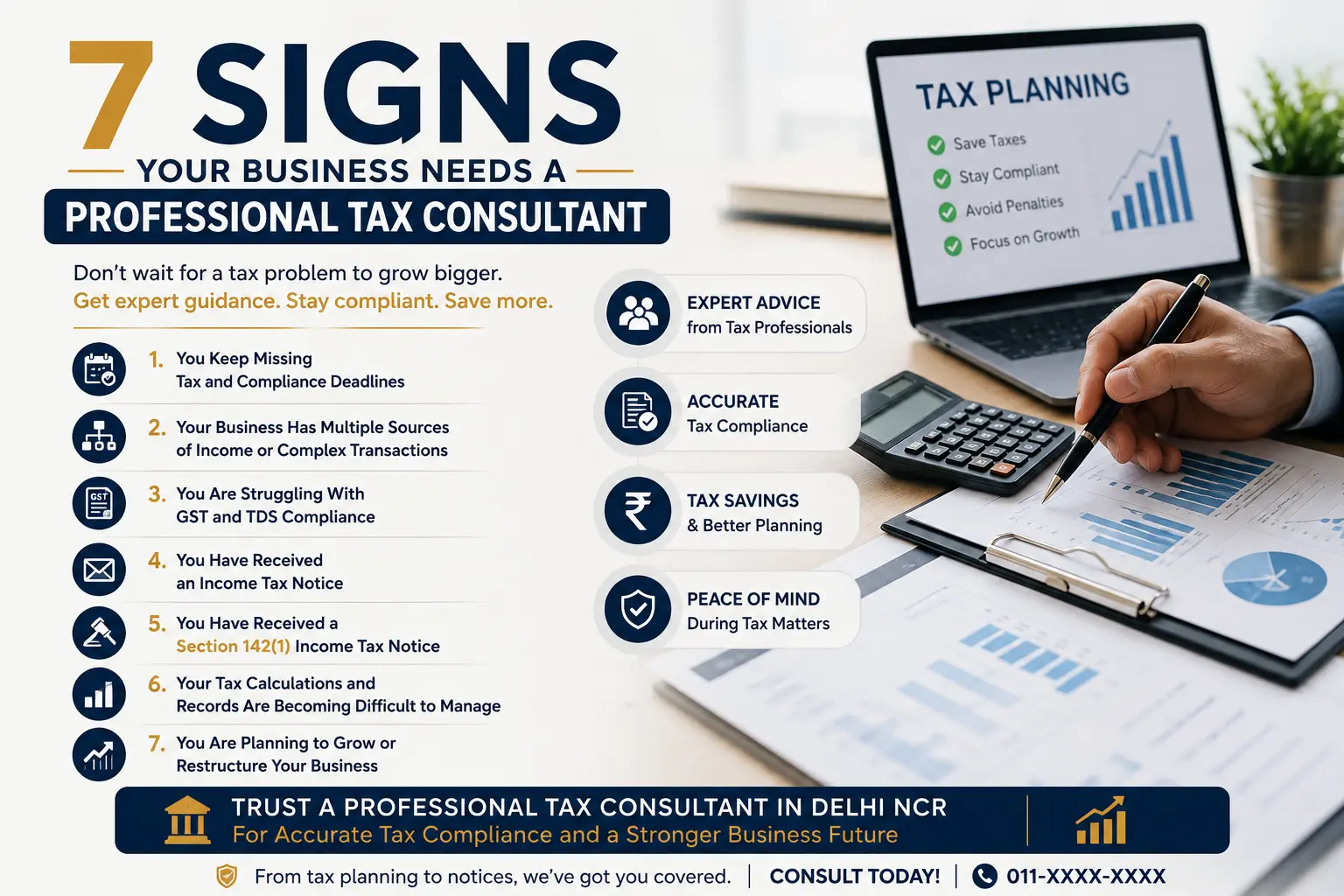
- 7 Signs Your Business Needs a Professional Tax Consultant
- 1. You Keep Missing Tax and Compliance Deadlines
- 2. Your Business Has Multiple Sources of Income or Complex Transactions
- 3. You Are Struggling With GST and TDS Compliance
- 4. You Have Received an Income Tax Notice
- 5. You Have Received a Section 142(1) Income Tax Notice
- 6. Your Tax Calculations and Records Are Becoming Difficult to Manage
- 7. You Are Planning to Grow or Restructure Your Business
- What Does a Professional Tax Consultant Do for a Business?
- Tax Consultant vs Accountant: What Is the Difference?
- When Is the Right Time to Hire a Tax Consultant?
- Benefits of Hiring a Tax Consultant in Delhi NCR
- How to Choose the Right Tax Consultant
- What Documents Should Your Business Maintain?
- What to Do After Receiving a Section 142(1) Income Tax Notice
- Frequently Asked Questions
- 1. Does every business need a professional tax consultant?
- 2. What is a Section 142(1) income tax notice?
- 3. Does a Section 142(1) notice mean there is a tax problem?
- 4. When should I hire a Tax Consultant in Delhi NCR?
- 5. Can a tax consultant help with GST and income tax together?
- 6. Is a tax consultant only useful when I receive a notice?
- 7. How much does a tax consultant charge?
- 8. Can a tax consultant guarantee that my business will never receive a tax notice?
- 9. What records should my business maintain for tax purposes?
- 10. Can I handle tax compliance myself?
- Final Takeaway
Quick Answer: Does Your Business Need a Tax Consultant?
Your business may need a professional tax consultant when tax compliance becomes difficult to manage, deadlines are frequently missed, financial transactions become complicated, or you receive income tax, GST, or TDS-related notices.
Other warning signs include difficulty reconciling tax records, uncertainty about tax calculations, poor financial documentation, multiple income sources, business expansion, and major financial transactions.
One particularly important warning sign is receiving a section 142 1 income tax notice. Such a notice under the Income-tax Act, 1961 could require a taxpayer to furnish information, documents, accounts, or other details relevant to income-tax proceedings.
For businesses operating in the NCR region, a qualified Tax Consultant in Delhi NCR can provide professional assistance with income tax compliance, tax calculations, reconciliations, notices and other tax-related requirements, depending on the professional's qualifications and the agreed scope of services.
7 Warning Signs at a Glance
- You regularly miss tax or compliance deadlines.
- Your business has multiple or complicated income sources.
- GST, TDS or tax reconciliation is becoming difficult.
- You have received an income tax notice.
- You have received a Section 142(1) income tax notice.
- Your tax calculations and financial records are difficult to manage.
- Your business is expanding, restructuring or making major financial decisions.
Why Do Businesses Need Professional Tax Support?
Tax compliance is more than filing an income tax return once a year. Depending on the business structure and activities, a business may have to manage income tax, GST, TDS, tax payments, accounting records, invoices, reconciliations, financial statements and responses to tax communications.
As a business grows, these requirements can become increasingly difficult to manage. A small business may initially have only a few customers and limited transactions, but later it may have multiple bank accounts, employees, vendors, GST obligations, investments, loans and different business activities.
Without an organized system, a business owner can easily lose track of deadlines or submit inaccurate information.
A professional tax consultant can help organize tax-related work, identify potential inconsistencies, prepare or review returns and assist with tax-related communications.
7 Signs Your Business Needs a Professional Tax Consultant
Not every business needs a full-time tax professional. However, the following signs indicate that professional tax support may be worth considering.
1. You Keep Missing Tax and Compliance Deadlines
Repeatedly missing tax deadlines is one of the clearest signs that your business needs a better compliance system.
Business owners already manage customers, sales, employees, vendors, operations and cash flow. Tax deadlines can easily become a secondary priority.
The problem is not only the possibility of late compliance. Last-minute filing can also increase the likelihood of errors.
Common Warning Signs Include:
- You regularly prepare returns just before the deadline.
- You forget important compliance dates.
- Your books are not updated regularly.
- You discover tax requirements only after receiving reminders.
- You do not have a formal compliance calendar.
- Tax calculations are completed at the last minute.
A professional can help establish a more organized process for collecting records, reviewing information, preparing returns and monitoring deadlines.
The objective is to move from reactive tax management to planned tax compliance.
2. Your Business Has Multiple Sources of Income or Complex Transactions
A business may start with one simple revenue stream but become financially complicated as it expands.
You may eventually have:
- Multiple products or services
- Different customer categories
- Several bank accounts
- Business investments
- Interest income
- Capital transactions
- Loans and financing
- Foreign transactions
- Multiple branches
- Related-party transactions
With more transactions comes a greater need for accurate classification and documentation.
For example, incorrectly classifying a transaction can affect accounting, GST, TDS or income-tax reporting.
A professional tax consultant can review the overall tax position instead of examining individual transactions in isolation.
3. You Are Struggling With GST and TDS Compliance
GST and TDS can create significant administrative work for growing businesses.
Your business may require assistance with:
- GST registration
- Applicable GST return filing
- GST reconciliation
- TDS calculations
- TDS reporting
- Tax-payment reconciliation
- Invoice review
- Supporting-document management
- Tax-related communications
One of the biggest challenges is keeping tax records consistent with the underlying accounting records.
If you repeatedly find differences between accounting records and tax records, professional assistance may be useful.
4. You Have Received an Income Tax Notice
Receiving an income tax notice is a strong reason to consider professional advice, especially when you do not understand why the notice was issued or what information needs to be provided.
An income tax notice does not automatically mean that your business has committed fraud or intentionally made a mistake.
Tax communications may relate to:
- Requests for information
- Verification
- Income or TDS discrepancies
- Tax demands
- Assessments
- Defective returns
- Refund matters
- Other compliance requirements
The appropriate response depends on the exact contents of the notice.
Consider Professional Help If:
- You do not understand the notice.
- The notice requests multiple documents.
- Multiple assessment years are involved.
- The issue concerns business transactions.
- A significant tax demand may be involved.
- You believe the information is incorrect.
- You are unsure how to prepare the response.
5. You Have Received a Section 142(1) Income Tax Notice
A Section 142(1) income tax notice under the Income-tax Act, 1961 could require a taxpayer to provide information, documents, accounts or other details relevant to income-tax proceedings.
The Indian tax-law framework has since transitioned to the Income-tax Act, 2025, so businesses should check the law and official communication that applies to the relevant tax year and proceeding.
Why Should You Take a Section 142(1) Notice Seriously?
Such a communication may ask for specific documents, explanations or information. The appropriate response depends on exactly what the notice requests and the facts of the case.
For a business, requested information may involve:
- Books of account
- Bank statements
- Invoices
- Income details
- Expense records
- Tax-payment information
- Other supporting documents
Do not respond with generic information. Read the notice carefully, identify every requirement and organize supporting documents before submitting the response.
This is one situation where a qualified Tax Consultant in Delhi NCR can potentially provide significant value.
6. Your Tax Calculations and Records Are Becoming Difficult to Manage
A simple test can help determine whether your business has outgrown its current tax-management process.
Can you quickly determine:
- Your current taxable income?
- How much tax has already been paid?
- How much TDS has been deducted?
- Your current GST position?
- Your major business expenses?
- Your current business profit?
- Which records support the figures in your tax return?
If answering these questions requires searching through spreadsheets, invoices, emails, bank statements or old files, your tax process may need improvement.
Good tax compliance begins with good record-keeping. A professional tax consultant can work with your accountant or accounts team to improve the organization of tax-related information.
7. You Are Planning to Grow or Restructure Your Business
Tax considerations can become especially important when you are making major business decisions.
You may need professional advice when planning to:
- Open a new branch.
- Expand into another state.
- Change your business structure.
- Add a new business activity.
- Buy or sell substantial assets.
- Take significant business financing.
- Add investors or partners.
- Acquire another business.
- Restructure existing operations.
Tax consequences can depend on the structure of a transaction and the applicable provisions. Seeking professional advice before completing a significant transaction can therefore be more useful than trying to correct a tax problem afterward.
What Does a Professional Tax Consultant Do for a Business?
The exact role of a tax consultant depends on the professional's qualifications and the agreed scope of services.
| Area | Possible Professional Support |
|---|---|
| Income Tax | Return preparation, tax computation and compliance support |
| GST | Registration, applicable return filing, reconciliation and related support |
| TDS | Calculation, reconciliation and applicable compliance support |
| Tax Notices | Reviewing notices and assisting with appropriate responses |
| Tax Planning | Identifying legitimate tax-planning opportunities based on applicable law |
| Financial Records | Reviewing accounting information relevant to tax compliance |
| Business Decisions | Explaining potential tax implications of certain transactions |
The exact scope of work should always be confirmed with the professional before engagement.
Tax Consultant vs Accountant: What Is the Difference?
An accountant and a tax consultant can perform different but complementary functions.
| Requirement | Accountant | Tax Consultant |
|---|---|---|
| Bookkeeping | Usually a core function | May support or review |
| Recording transactions | Usually | May depend on engagement |
| Financial records | Usually | May review |
| Income tax filing | May assist | Usually a key service |
| GST support | Depends on expertise | May provide |
| TDS support | Depends on expertise | May provide |
| Tax planning | May be limited | Depending on qualification |
| Tax notice support | Depends on expertise | Often a relevant service area |
| Complex tax matters | May require additional expertise | May be more suitable |
The two roles are not necessarily alternatives. A business may have an accountant maintaining daily books while a tax professional handles tax planning, returns, reconciliation and notices.
When Is the Right Time to Hire a Tax Consultant?
You do not necessarily need to wait until you receive a notice before seeking professional help.
Consider professional assistance when:
- Your business has outgrown basic bookkeeping.
- Your tax compliance takes too much of your time.
- You are unsure whether your records are complete.
- You have multiple tax registrations or obligations.
- You have started receiving tax communications.
- You are expanding or restructuring.
- You want more proactive tax planning.
Early professional involvement can be useful because it allows compliance processes to be improved before a serious problem develops.
Benefits of Hiring a Tax Consultant in Delhi NCR
Businesses operating across Delhi, Noida, Gurugram, Ghaziabad and nearby NCR areas may have different accounting, tax and compliance requirements.
A professional Tax Consultant in Delhi NCR can potentially help with:
- Organizing tax information.
- Reviewing applicable compliance requirements.
- Preparing or reviewing tax returns.
- Reconciling tax records.
- Handling selected tax-related communications.
- Explaining tax implications of business transactions.
- Supporting businesses during tax-related reviews or notices.
The objective should be to create a systematic tax process rather than simply solving individual problems after they occur.
How to Choose the Right Tax Consultant
Choosing a tax professional based only on price can be a mistake. Consider the following factors before hiring one.
1. Relevant Experience
Ask whether the professional has experience with businesses similar to yours in terms of industry, size and transaction complexity.
2. Qualifications
Verify the professional's qualifications and the services they are permitted to provide.
3. Service Scope
Understand whether the engagement covers filing, reconciliation, notices, GST, TDS, tax planning and other services you require.
4. Communication
The professional should be able to explain tax matters clearly rather than simply providing figures for approval.
5. Transparency
Ask for a clear fee structure and identify services that may attract additional charges.
6. Technology and Record Management
Good digital record management can make tax compliance more efficient and easier to review.
7. Notice Handling
If tax notices are a concern, ask whether the professional provides assistance with reviewing and responding to tax communications.
What Documents Should Your Business Maintain?
Maintaining organized records makes tax compliance much easier.
Depending on your business, relevant records can include:
- Sales invoices
- Purchase invoices
- Bank statements
- Expense records
- GST records
- TDS records
- Tax-payment challans
- Financial statements
- Accounting records
- Investment documents
- Loan documents
- Contracts
- Tax returns
- Tax notices and correspondence
If you receive a tax notice, focus particularly on preserving the documents relevant to the specific information requested.
What to Do After Receiving a Section 142(1) Income Tax Notice
If your business receives a Section 142(1) income tax notice, follow a structured approach rather than responding immediately without reviewing the underlying records.
Step 1: Read the Notice Carefully
Identify the relevant tax or assessment year, issuing authority, information requested and response deadline.
Step 2: Verify the Communication
Use the official Income Tax e-Filing portal and applicable notice-verification facilities where required.
Step 3: Identify Every Requirement
Create a checklist of every document, explanation or piece of information requested.
Step 4: Review Your Filed Return
Compare the notice with your ITR, schedules, books of account and supporting records.
Step 5: Gather the Documents
Collect the relevant bank statements, invoices, accounting records, financial statements, tax-payment records and other requested documents.
Step 6: Identify Any Discrepancy
Determine whether the issue is caused by missing information, a mismatch, incorrect reporting, incomplete documentation or another matter.
Step 7: Prepare an Appropriate Response
Respond to the specific points raised in the notice and provide relevant supporting information.
Step 8: Meet the Applicable Deadline
Do not wait until the last day to prepare and submit the response.
Step 9: Obtain Professional Assistance if Needed
If the notice concerns complex transactions, substantial amounts, multiple years or issues you do not understand, consider consulting a qualified tax professional.
Frequently Asked Questions
1. Does every business need a professional tax consultant?
No. A small business with straightforward transactions and simple tax requirements may be able to manage routine compliance internally or obtain professional assistance only when needed.
However, professional support can become valuable when the business has multiple income sources, GST and TDS obligations, complex transactions, tax notices, financial discrepancies or major expansion plans.
The decision should be based on the complexity of the business's tax situation rather than simply its size or turnover.
2. What is a Section 142(1) income tax notice?
A Section 142(1) income tax notice, under the Income-tax Act, 1961, could require a taxpayer to provide information, documents, accounts or other details relevant to income-tax proceedings.
The notice may ask for financial records, explanations or supporting documentation. The exact requirements depend on the communication issued by the tax authority and the facts of the case.
Because India's tax-law framework has transitioned to the Income-tax Act, 2025, taxpayers should check the law and official communication applicable to their specific proceeding and year.
3. Does a Section 142(1) notice mean there is a tax problem?
Not necessarily. Receiving a Section 142(1) notice does not by itself establish that the taxpayer has committed fraud, intentionally concealed income or made an unlawful claim.
Such a communication can be used to seek information or documents relevant to an income-tax proceeding. The taxpayer should therefore focus on understanding exactly what has been requested.
If the requested information is straightforward, the business may be able to prepare it internally. If the notice involves complex financial transactions, multiple years or substantial amounts, professional assistance may be appropriate.
4. When should I hire a Tax Consultant in Delhi NCR?
A Tax Consultant in Delhi NCR may be useful when your business has multiple tax obligations, complicated transactions, GST or TDS reconciliation issues, income tax notices, tax demands or major financial decisions.
Professional support can also be useful when an internal accountant manages daily bookkeeping but the business needs specialist assistance with tax planning, returns, reconciliations or tax communications.
Ideally, the professional should first understand your business and tax position before recommending a specific service.
5. Can a tax consultant help with GST and income tax together?
Many professionals and professional firms provide support across multiple tax areas, although the exact services depend on qualifications and the engagement.
For a business, reviewing GST, TDS, accounting and income-tax information together can help identify inconsistencies and improve overall compliance.
Before engaging a professional, confirm which GST, income-tax, TDS and advisory services are included in the agreed scope.
6. Is a tax consultant only useful when I receive a notice?
No. A tax consultant can also provide preventive and ongoing support.
Professional assistance may include tax-return preparation, tax calculations, GST and TDS support, reconciliations, compliance planning, tax documentation and advice regarding the tax implications of business transactions.
For many businesses, proactive support can be more useful than waiting until a notice or tax issue becomes urgent.
7. How much does a tax consultant charge?
There is no universal professional fee. Charges can vary according to business size, transaction volume, complexity, services required and whether the engagement is one-time or ongoing.
A straightforward filing may require less professional work than a business requiring GST, TDS, tax planning, notice assistance, reconciliations and regular advisory services.
Ask for a clear service scope and fee structure before engaging a professional.
8. Can a tax consultant guarantee that my business will never receive a tax notice?
No professional can responsibly guarantee that a business will never receive a tax notice.
Tax authorities may issue communications for a range of legitimate reasons, including requests for information, verification, assessment or discrepancies in reported information.
The role of a tax consultant is to help improve compliance, maintain accurate records, reduce avoidable errors and assist with appropriate responses when communications are received.
9. What records should my business maintain for tax purposes?
The records required depend on the nature and structure of your business. Generally, businesses should maintain relevant sales and purchase invoices, bank statements, expense records, tax-payment records, GST/TDS information, accounting records, financial statements and other supporting documents.
Maintaining organized records throughout the year makes it easier to prepare accurate returns and respond to requests for information.
10. Can I handle tax compliance myself?
Yes. Some businesses can manage straightforward tax matters internally, particularly when their transactions are simple and the business owner or accounts team has sufficient knowledge and time.
However, DIY tax management becomes more difficult when the business has multiple income sources, complicated transactions, several compliance requirements or tax notices.
If you find yourself spending excessive time understanding tax rules or correcting recurring errors, professional assistance may become more practical.
Final Takeaway
A business does not have to wait for a major tax problem before considering professional assistance.
The seven strongest signs that your business may need a professional tax consultant are:
- You regularly miss tax and compliance deadlines.
- Your income and transactions are becoming more complicated.
- GST and TDS compliance is becoming difficult.
- You have received an income tax notice.
- You have received a Section 142(1) income tax notice.
- Your tax calculations and records are becoming difficult to manage.
- You are planning to grow, expand or restructure your business.
For businesses in the NCR region, a qualified Tax Consultant in Delhi NCR can provide professional support based on the complexity of the business and the services required.
The most important principle is simple:
Don't wait until tax compliance becomes a crisis. Build an accurate, organized and proactive tax process while your business is still growing.
Need Professional Tax Assistance?
Looking for a reliable Tax Consultant in Delhi NCR for business tax compliance, tax notices or planning?