
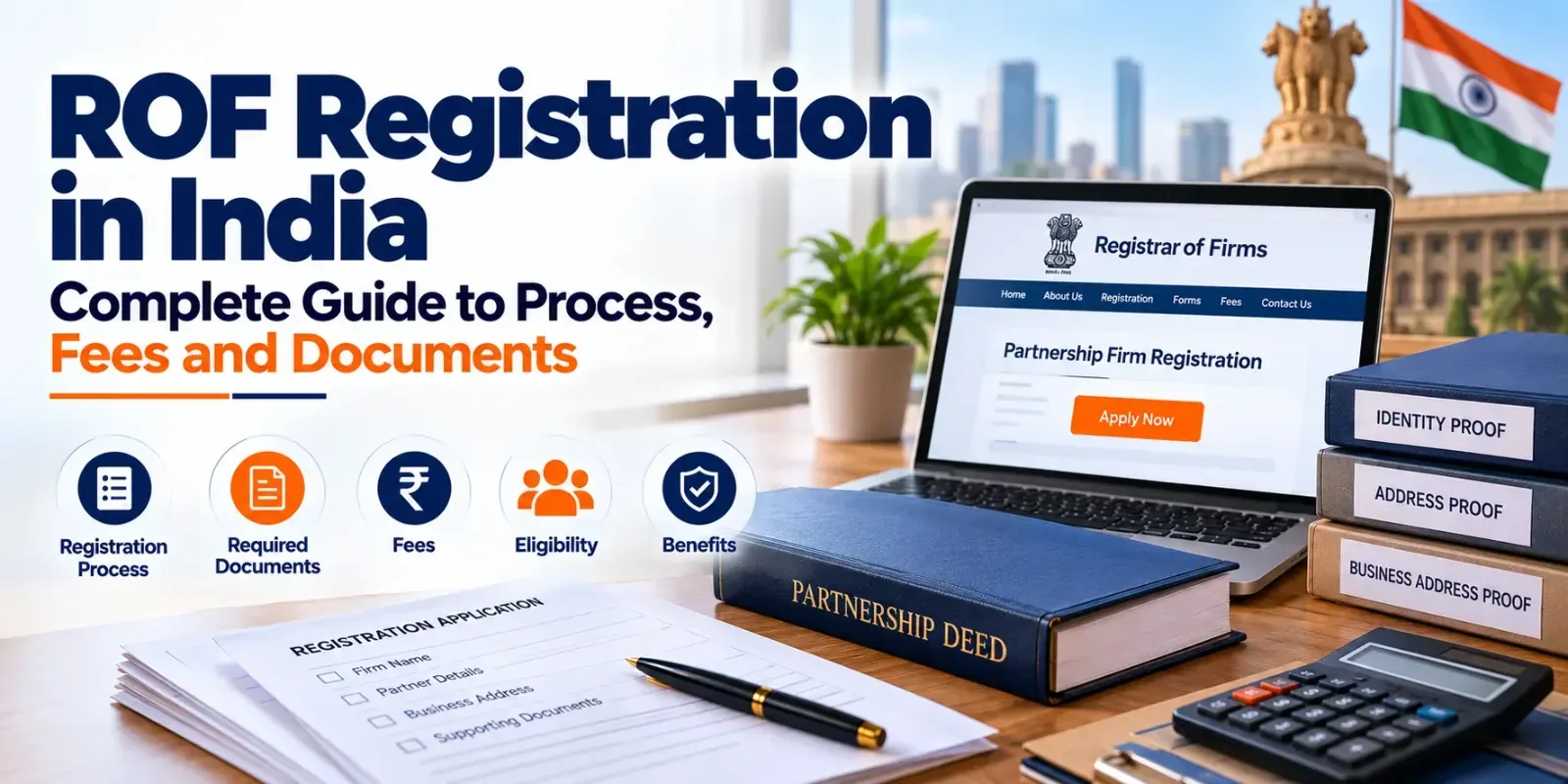
Direct Answer: What Is ROF Registration?
ROF Registration or Registrar of Firms Registration is registration of partnership firm (traditional form) under the Indian Partnership Act 1932 in the state with the concerned authority. It documents the firm name, business address and details of partners. Application procedure, paperwork, online submission and government fees vary from state to state.
Quick Summary of ROF Registration
- Full form: Registrar of Firms Registration.
- Governing legislation: Indian Partnership Act, 1932, and applicable state rules.
- Applicable business structure: Traditional partnership firms.
- Registration authority: The relevant state Registrar of Firms or designated authority.
- Common documents: Partnership deed, prescribed application, partner identity proofs and business address evidence.
- Registration fees: Vary according to the applicable state fee schedule.
- Online registration: Available in some states through designated government portals.
- Main benefits: Official registration records, better documentation and fewer restrictions when enforcing certain contractual rights.
- Important legal provision: Section 69 of the Indian Partnership Act, 1932, restricts certain suits involving unregistered firms, subject to statutory exceptions.
- Other registrations: PAN, GST registration and applicable business licences may need to be obtained separately.
Important: ROF registration is different from LLP registration, company incorporation, GST registration and MSME/Udyam registration. Each serves a different legal purpose.
What Is the Registrar of Firms?
(A) Registration with the registrar: According to the relevant law, the registrar is obligated to keep registration papers of a firm.
The firm may apply for the registration by filing a statement, and a prescribed fee with the Registrar of areas, as per the requirements set out under section 58 of the Partnership Act, 1932. The statement usually contains the name of the firm, the principal place of business, the other places where business is to be carried on, the date when each partner was admitted, the names and addresses of the partners, and the duration of the firm.
The application must be signed and verified according to the law and the state procedure.
For example, the Government of Odisha prescribeshow to register partnership firms as per this list of application, documents, etc. Requirements and processes differ by state.
Typically, registration is at the state level, so contact the state where the firm is or intends to be.
Benefits of ROF Registration
Registering a partnership firm can provide several legal and administrative advantages.
Official Record of the Firm
Registration records the firm's particulars with the relevant authority. This can help partners maintain consistent records across their partnership deed, bank documents and business correspondence.
Better Documentation of Partners
The registration process records specified information about the partners and the firm. These records may be useful when dealing with banks, suppliers, customers and other institutions.
Support for Enforcing Contractual Rights
According to s 69 of the Indian Partnership Act 1932, subject to a few statutory exceptions, when a partnership firm (or its partners) is not registered or not properly recorded, then it shall be barred from filing certain suits brought to enforce contractual rights.
Thus, registration may be important in suits by the partnership firm to enforce contractual rights. However, it does not ensure success in litigation or dispense with all procedural requirements.
Support for Business Transactions
Banks and counterparties may request a partnership deed, registration particulars, PAN or other supporting records during their verification processes. The precise requirements depend on the institution and transaction.
Better Compliance Management
A registered firm can maintain its registration record alongside its partnership deed, PAN, GST records, financial statements and applicable licences.
Easier Updating of Firm Particulars
Changes to a firm's name, principal business address or partner details may require prescribed notifications or filings. Maintaining accurate records helps ensure that the firm's official particulars remain current.
Remember: ROF registration does not automatically provide a PAN, GSTIN or every licence required to operate a business.
ROF vs LLP vs Private Limited Company
Choosing the right legal structure is an important decision before registration.
| Feature | Partnership Firm (ROF) | Limited Liability Partnership (LLP) | Private Limited Company |
|---|---|---|---|
| Governing law | Indian Partnership Act, 1932 | LLP Act, 2008 | Companies Act, 2013 |
| Registration authority | State Registrar of Firms | Ministry of Corporate Affairs | Ministry of Corporate Affairs |
| Separate legal personality | Not separate from partners in the same manner as an LLP or company | Yes | Yes |
| Liability | Partners generally have personal liability under partnership law | Generally limited, subject to statutory exceptions | Generally limited, subject to statutory exceptions |
| Ownership | Partners | Partners | Shareholders |
| Main registration documents | Partnership deed and applicable registration record | Certificate of incorporation and LLP agreement | Certificate of incorporation and constitutional documents |
| Compliance | Partnership law and other applicable requirements | Statutory filings and applicable compliance | Statutory filings and applicable compliance |
| Typical suitability | Traditional partnership businesses | Businesses seeking partnership-style management with limited liability | Businesses seeking a corporate ownership structure |
Where the business is seeking a simple partnership structure, then a traditional partnership may be appropriate. If separate legal personality, limited liability or a company ownership structure is preferred, a private limited company or an LLP is likely to be more appropriate.
When choosing a structure, consider the proposed ownership, risk profile of the business, funding, and future goals of the business.
For assistance with business incorporation, explore TaxCaller's Company Registration Services.
Eligibility for ROF Registration
ROF registration generally applies to traditional partnership firms formed under the Indian Partnership Act, 1932.
A Partnership Must Exist
The partners should have a genuine partnership arrangement.
Under Section 4 of the Act, partnership involves persons who agree to share the profits of a business carried on by all, or any of them acting for all.
Partner Details Must Be Available
Applicants must provide the particulars required by the prescribed application form. These commonly include partners' names, addresses and dates of joining the firm.
The Firm Must Have a Business Address
The application generally requires the principal place of business and, where applicable, details of additional business locations.
Supporting address documents depend on the state procedure.
State Requirements Must Be Followed
Applicants must comply with the relevant authority's prescribed forms, fees, signatures and supporting document requirements.
Some states support online filing, while others may require physical submission or additional verification.
ROF Registration Is Not LLP Incorporation
A traditional partnership firm follows the relevant partnership registration procedure. An LLP is incorporated under the Limited Liability Partnership Act, 2008, through the Ministry of Corporate Affairs framework.
Applicants should decide which legal structure they want before starting the registration process.
Documents Required for ROF Registration
The exact checklist depends on the state. The following documents are commonly relevant to partnership firm registration.
Partnership Deed
The partnership deed records the terms agreed between the partners. It commonly includes:
- Name of the firm.
- Nature of the business.
- Principal business address.
- Names and addresses of partners.
- Capital contributions.
- Profit-and-loss sharing ratio.
- Roles and responsibilities of partners.
- Admission and retirement provisions.
- Dispute-resolution arrangements.
- Dissolution provisions.
The deed should be properly executed and stamped according to the applicable state requirements.
Identity Proof of Partners
The authority may require identity documents for each partner. Accepted documents depend on the state's current checklist.
Address Proof of Partners
Residential address proofs may be required for the partners named in the application.
Business Address Proof
Depending on the circumstances, this may include ownership documents, a rent or lease agreement, a utility bill or a landlord's no-objection certificate.
Prescribed Application Form
Applicants must complete the form specified by the relevant Registrar of Firms.
The form number and filing procedure may differ by state.
Photographs and Declarations
Some state procedures require partner photographs, declarations, affidavits or other supporting documents.
Payment Receipt and Authorization
Keep the government fee receipt and application acknowledgement. If an authorized representative files the application, an authorization letter or other prescribed document may be required.
Practical advice: Do not rely exclusively on a generic document checklist. Check the latest official requirements for the state in which you intend to register the firm.
ROF Registration Fees in India
There is no single nationwide registration fee applicable to every ROF application. Government charges and document requirements vary by state.
The total cost may include:
- Government registration fee.
- Application fee, where applicable.
- Stamp duty on the partnership deed.
- Notarisation or document-attestation expenses, where required.
- Professional fees for preparing documents and handling the application.
- Additional fees for amendments or related services.
State-Wise ROF Registration Fees
The following examples illustrate why applicants should check the relevant state procedure.
| State | Published government guidance | Important consideration |
|---|---|---|
| Odisha | The published procedure lists a ₹2 application fee and ₹3 registration fee, along with a partnership deed and specified supporting documents. | Confirm the current schedule and deed stamp-duty requirements before filing. |
| Assam | The state portal publishes a registration procedure and lists a nominal registration fee in its guidance. | Verify the current fee and whether additional documents or charges apply. |
| Other states | Fees and prescribed procedures depend on the applicable state legislation, rules and notifications. | Consult the relevant Registrar of Firms for the current fee schedule. |
The Government of Odisha's published checklist also specifies a partnership deed with stamp duty and other supporting documents. These figures are examples from particular state procedures, not a nationwide fee schedule.
How to Calculate the Total Cost
A practical estimate should include all applicable expenses:
Total cost = Government fees + applicable stamp duty + document or attestation charges + professional fees, if any.
For example, a firm may pay the prescribed registration fee and separately incur stamp duty on its partnership deed.
Request a clear breakdown of charges before paying a service provider, and confirm the official government fee through the relevant state portal.
Step-by-Step ROF Registration Process
The following steps describe the general process. The exact procedure depends on the state.
Prepare the Partnership Deed
Draft the deed with the firm's name, business activities, partner details, capital contributions and profit-sharing arrangement.
Review the terms before signing and ensure that the deed meets applicable stamping and execution requirements.
Identify the Relevant Registrar of Firms
Determine the authority responsible for the firm's registration based on the applicable jurisdiction.
Visit the official state portal to find the current application form, checklist and payment instructions.
Collect the Required Documents
Prepare the partnership deed, identity proofs, address proofs and other documents specified by the authority.
Check whether documents must be self-attested, notarised, certified or uploaded in a prescribed format.
Complete the Application Form
Enter the firm's name, principal place of business, partner details, joining dates and other required information.
Ensure that the information matches the partnership deed and supporting documents.
Submit the Application
Follow the state's prescribed procedure. Depending on the jurisdiction, this may involve online submission, physical filing or a combination of both.
Ensure that the application is signed and verified as required by law.
Pay the Applicable Government Fees
Use the payment method specified by the authority. Save the payment receipt and application acknowledgement.
Respond to Objections
The Registrar may identify missing documents, inconsistent information or other deficiencies.
Monitor the application status and respond within the applicable period by submitting the requested information or corrections.
Receive the Registration Record
If the application is approved, the authority records the firm's registration and provides the applicable certificate or acknowledgement.
The document format and delivery method depend on the state's procedure.
Verify the Registration Details
Check that the firm's name, address and partner particulars are correct. Keep the registration record with the partnership deed and other business documents.
Complete Other Applicable Registrations
ROF registration does not complete every business compliance requirement.
Depending on the firm's activities, it may also need PAN, GST registration, tax filings or local licences.
Businesses that need GST-related assistance can explore TaxCaller's GST Registration Services.
Common Mistakes to Avoid During ROF Registration
Using an Incorrect Firm Name
The name in the application should match the partnership deed and supporting records. Review spelling and formatting before submission.
Providing Inconsistent Partner Details
Differences in names, addresses or identity information can lead to objections. Check all documents before filing.
Submitting an Incomplete Partnership Deed
A deed that omits important terms or fails to satisfy applicable execution requirements can create legal and administrative problems.
Applying Through the Wrong Authority
ROF procedures are state-specific. Confirm the correct authority and jurisdiction before submitting the application.
Assuming Fees Are Identical Across India
Government charges and deed-stamping requirements differ. Always use the current official fee schedule for the relevant state.
Ignoring Application Objections
Applicants should monitor the application and respond promptly to requests for clarification or additional documents.
Treating Registration as Complete Business Compliance
A registered partnership may still need tax registrations, financial records, licences and other approvals. Review these obligations separately.
Expert Advice from TaxCaller
TaxCaller recommends that partners decide on their legal structure and have underlying documentations in place to be prepared for ROF registration.
An ideal partnership deed should specify the rights and responsibilities of the partners, capital contribution details, profit-sharing ratio, and dispute-resolution mechanism.
Potential clients should confirm their state's current filing requirements and government fees. Incomplete and inconsistent documents attract objections and delay.
After registration, maintain the registration document, the partnership deed, and the PAN, along with the financial statements and other tax registrations. In case of any change in the activities or ownership of the firm, review the compliance requirements of the firm.
TaxCaller offers business services that may support partnership firms with related compliance needs:
- Company Registration Services: Support with business structure and incorporation-related formalities.
- GST Registration Services: Assistance with GST registration and compliance.
- Income Tax Filing Services: Support with applicable income-tax return filing.
- Accounting and Bookkeeping Services: Assistance with maintaining financial records.
The appropriate registration route depends on whether the business is intended to operate as a traditional partnership, LLP or company. Partners should make this decision before filing.
Conclusion: ROF Registration in India
ROF Registration is an important process for business entities functioning as traditional partnership firms in India. It involves filing particulars of the firm with an authority and standardizing the business records of partners.
Generally, it involves preparation of the partnership deed, collection of relevant documents, filing of prescribed form along with relevant filing fees and disposition of objection if raised by the Registrar of Firms.
Because the forms, the fees, and procedure change from state to state, the applicant should check the concerned government portal for the latest requirements before applying.
Partners should be also familiar with the consequences of running an unregistered firm, especially the restrictions imposed under Section 69, Indian Partnership Act, 1932. ROF registration does not substitute PAN or the GST registration and compliance with the rules of income tax or any other license relevant to the business.
Registration can be streamlined with good documentation and understanding of the rules so that the documents are properly maintained for future operations.
Official Government References
- Indian Partnership Act, 1932 — India Code — Official legislation repository. Search for the Indian Partnership Act, 1932, particularly Sections 4, 58 and 69.
- Maharashtra Registrar of Firms — State-specific forms, instructions and registration requirements.
- Government of Odisha — Partnership Firm Registration — Published procedure, documents and applicable registration requirements.
- Madhya Pradesh Registration of Firms and Societies — Application process and fee information.
- Ministry of Corporate Affairs — Official resources for LLP and company incorporation.
- TaxCaller Company Registration Services — Internal service link for business registration support.
Always verify current state-specific requirements and fee schedules before filing an application.